At the end of the first year of life, there are several developmental changes that facilitate language acquisition. Two key changes are: the attunement of speech perception categories to selective discrimination of native language sound categories (e.g. Werker & Tees, Reference Werker and Tees1984; Kuhl, Reference Kuhl and Harnad1987); and the first signs of a burgeoning proficiency in word learning (e.g. Feldman, Dollaghan, Campbell, Kurs-Lasky, Janosky & Paradise, Reference Feldman, Dollaghan, Campbell, Kurs-Lasky, Janosky and Paradise2000). Prior to learning the mappings between words and their meanings, infants must parse the continuous speech stream into units that correspond to words in the ambient language.
Infants' experience with their native language's sound structure provides a foundation for segmenting the speech stream. In particular, knowledge of legal sound combinations of their native language (Mattys & Jusczyk, Reference Mattys and Jusczyk2001), context-dependent alternations of sound patterns (Jusczyk, Hohne & Bauman, Reference Jusczyk, Hohne and Bauman1999) and language-specific rhythmic patterns (Curtin, Mintz & Christiansen, Reference Curtin, Mintz and Christiansen2005; Jusczyk, Houston & Newsome, Reference Jusczyk, Houston and Newsome1999; Polka, Sundara & Blue, Reference Polka, Sundara and Blue2002; Thiessen & Saffran, Reference Thiessen and Saffran2007) guide segmentation. The predominant rhythm pattern of language is not merely used as a tool for segmentation. Indeed, stress is encoded in the word form representation of the segmented sequence (Curtin et al., Reference Curtin, Mintz and Christiansen2005). Infants at 0 ; 7 and 0 ; 9 demonstrate a listening preference for sequences that conform to the stress pattern (‘TIpegu’) of a segmented sequence over sequences that are segmentally identical but have stress on a different syllable (‘tiPEgu’). This suggests that infants' representations encode information about a syllable's status with respect to stress. In the current study, we ask whether this sensitivity to lexical stress carries over to early word learning.
In their seminal paper, Stager & Werker (Reference Stager and Werker1997) hypothesized that learning about one's native language's sound categories would facilitate forming associations between new words and objects. Instead, they found that infants younger than 1 ; 5 fail to notice a switch in object–label mappings when the labels differ in minimally different consonant contrasts that are discriminable in perception. Specifically, when infants at 1 ; 2 are taught two minimally different words such as ‘bih’ and ‘dih’ in a word–object associative learning task, they fail to notice a mismatch in the pairing between a novel object and its label (Stager & Werker, Reference Stager and Werker1997; Werker, Fennell, Corcoran & Stager, Reference Werker, Fennell, Corcoran and Stager2002). Indeed, in a basic word–object associative learning task, even if the items are dissimilar (‘lif’ vs. ‘neem’), infants younger than 1 ; 2 fail at learning the two object mappings (Werker, Cohen, Lloyd, Stager & Cassosola, Reference Werker, Cohen, Lloyd, Stager and Cassasola1998).
Over the past ten years, several contrasts have been tested, and this inability to detect mismatches in the pairings holds for minimal consonants (Pater, Stager & Werker, Reference Pater, Stager and Werker2004) and for some, but not all, minimal vowel contrasts (Curtin, Fennell & Escudero, in press). Interestingly, the inability to detect minimal differences does not arise when infants are presented with familiar or known words. Studies examining infants' ability to recognize mispronunciations of labels when the objects are known, have found that infants as young as 1 ; 2 can detect these subtle phonetic differences (Bailey & Plunkett, Reference Bailey and Plunkett2002; Fennell & Werker, Reference Fennell and Werker2003; Swingley & Aslin, Reference Swingley and Aslin2002). If the differences are broad enough (i.e. a change in three features: height, backness and rounding), infants at 1 ; 2 will notice a mispronunciation in a recently learned novel word (e.g. ‘mot’ mispronounced as ‘mit’) (Mani & Plunkett, Reference Mani and Plunkett2008).
The picture with respect to consonants and vowels suggests that infants at 1 ; 2 have difficultly detecting contrasts when learning novel word–object pairings. At the early stages of word learning, when infants are just forming associative links, computational demands may easily overwhelm the beginning word learner's ability to use speech detail in new words (Stager & Werker, Reference Stager and Werker1997). However, this may not be the case for all types of information. Specifically, it may be the case that salient speech information, even when presented in a minimal pair situation, may be detected by young word learners. To date, all studies examining infants' ability to learn minimal pairs have focused on segmental differences. The current study is the first exploration of infants' ability to learn minimal pairs differing only in their stress pattern.
Research has demonstrated that infants can detect changes in the rhythmic patterns of alternating Sw (strong–weak) syllables as young as 0 ; 1 (Jusczyk & Thompson, Reference Jusczyk and Thompson1978) and use stress information to segment the speech stream (Curtin et al., Reference Curtin, Mintz and Christiansen2005; Johnson & Jusczyk, Reference Johnson and Jusczyk2001; Jusczyk, Houston & Newsome, Reference Jusczyk, Houston and Newsome1999; Polka et al., Reference Polka, Sundara and Blue2002; Thiessen & Saffran, Reference Thiessen and Saffran2007). The goal of this study is to examine whether or not infants younger than 1 ; 2 can learn two new word–object associations that differ only in stress pattern. Thus we ask: will novice word learners notice stress differences in new words with greater ease than consonant or vowel differences? If this is the case, we expect to see that even younger infants will be able to link novel words that differ solely in their stress pattern to novel objects. That is, our question of interest is whether young infants pay attention to lexical stress and encode this information in their representations during a word–object associative learning task. We tested whether infants at 1 ; 0 will succeed in a word–object associative learning task when the novel forms differ only in their stress patterns.
METHOD
Participants
Sixteen infants aged 1 ; 0 (Mean: 1 ; 0·20, SD: 7 days) from monolingual English homes successfully participated in this study. An additional three were tested but removed from the analysis due to one of the following reasons: not habituating (n=1), looking times shorter than 1 second (n=1) and not recovering to post-test (n=1).
Materials
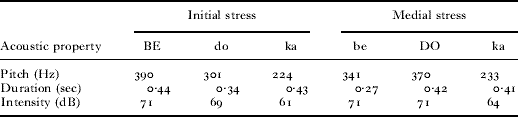
Two three-syllable word forms with differing trochaic stress patterns were recorded by a female native speaker of English. The stimuli consisted of ‘BEdoka’ and ‘beDOka’ (capital letters indicate stress). We chose to use Sww and wSw forms rather than Sw and wS because few nouns in English conform to the wS pattern. Moreover, three-syllable words with main stress on either the first or second syllable are similar in their mean frequency. Three-syllable words with primary stress on the final syllable are much less frequent than other three-syllable words (Clopper, Reference Clopper2002). All syllables contained full vowels (i.e. no reduced vowels occurred in unstressed syllables). Stress was assessed by pitch, duration and intensity differences. The average acoustic measurements for the stressed and unstressed syllables are presented in Table 1.
Average acoustic measurements of audio stimuli across all tokens

As can be seen from Table 1, pitch is mainly marking the difference between stressed and unstressed syllables. Amplitude does not appear to play a role. Final syllables are often lengthened and this is also case with the stimuli used here.
Each habituation and test trial consisted of eight exemplars with a 1·5 s silent interval between exemplars, resulting in audio files of 20 s in duration, one for each word. Each novel word was associated with a novel object (see Figure 1).
Objects used in experiment.

Apparatus
Participants were tested in a dimly lit, sound attenuated, small room. The infant sat on the parent's lap facing a 122 cm high by 91·5 cm wide video monitor. The audio stimuli were delivered at 65 dB, +/−5 dB. Infants were recorded using a digital video camera. The video record was used for subsequent frame-by-frame off-line coding. As a masking control, the parent wore tight-fitting headphones over which female vocal music played. Habit X 1·0 (Cohen, Atkinson & Chaput, Reference Cohen, Atkinson and Chaput2004) was used to order stimuli presentation and to collect looking time data. The experimenter, blind to the audio stimuli and to trial type (habituation or test), monitored the infant's looking times via a closed-circuit television system from an adjacent testing room.
Design
We used the version of the Switch procedure modified by Werker et al. (Reference Werker, Cohen, Lloyd, Stager and Cassasola1998). In the word-learning variant of this procedure, infants are habituated to two word–object pairings and tested on their ability to detect a switch in the pairing. Each trial began when the infant fixated on a flashing red light. On the first trial, infants were presented with a pretest stimulus, the label ‘munepo’ paired with a waterwheel (Figure 1) displayed on the monitor. Each syllable in the pretest item was equally emphasized (i.e. no stress contour). Each subsequent trial began with the flashing light and once the infant fixated a trial – first habituation, then test trials – an object (Figure 1) was presented with an accompanying novel label. Each object was of equal interest and counterbalanced across words. During the habituation phase the infant was shown two word–object pairs (e.g. Pair A: word ‘BEdoka’ and object X; Pair B: word ‘beDOka’ and object Y). Every block of four trials contained two instances of each word–object pairing presented in a random order (ABAB, ABBA, etc.).
Looking time was calculated on-line, and when the average looking time across a four-trial block decreased to the preset criterion (65%), the habituation phase ended. The infants participated in a minimum of 8 and a maximum of 24 habituation trials.
Following the habituation phase of the experiment, infants were tested in the Switch design. This part of the experiment determines whether the infants have learned not only about the words and objects individually, but have linked object A to word A and object B to word B. This involved two test trials. Both trials had a familiar object accompanied by a familiar word. In the control trial (the Same trial) the familiar word and object were presented in a familiar combination, e.g. Object A with Word A. In the test trial (the Switch trial) a familiar word and object were presented, but in a new combination, e.g. Object A with Word B.
The order of presentation of the trials was counterbalanced across participants. In the final post-test trial, the infant was again presented with ‘munepo’ and the waterwheel. If infants were still engaged in the experiment their looking time would recover to near pretest level during this final trial. If infants have learned about the words and the objects but have not learned the associative link, the Same and Switch trials will be equally familiar, and equal looking times should result. On the other hand, if the infant has learned the link between the specific words and objects, then longer looking times should result during the Switch trial than the Same trial, since the word–object link has been violated. The design of this experiment allowed us to determine whether or not infants at 1 ; 0 can indeed form new word–object associations. If infants notice a mismatch in the pairing of word form and object, then this suggests that the appropriate linkage has been formed.
RESULTS
To determine whether infants maintained interest throughout the experiment and recovered from habituation, a series of planned comparisons were run to first compare pretest to post-test and, if looking time on these two trials were similar, to then compare the post-test trial to the last habituation block. There was no significant difference between the pretest and post-test (t(15)=−0·012, n.s.). The post-test was significantly different from the last habituation block (t(15)=11·79, p<0·001; MeanPRETEST=16·59, MeanLASTBLOCK=6·23, MeanPOSTTEST=16·6). These findings demonstrated that infants maintained interest and recovered from habituation.
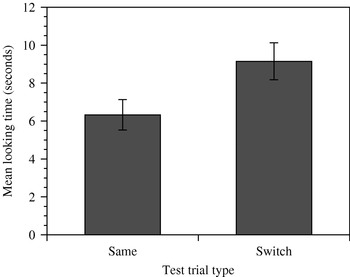
The main analysis of interest examined infants' performance on the test trials. An ANOVA with trial type (Same vs. Switch) as the within subjects factor and gender (male vs. female) as the between subjects factor revealed a significant difference in mean looking time for trial type (F(1, 14)=5·03, p=0·04, ηp2=0·264; Meansame=6·33, Meanswitch=9·16). Infants looked longer when there was a mismatch between the object and the label (see Figure 2). This was the case regardless of whether the Switch trial was ‘BEdoka’ or ‘beDOka.’ There was no effect of gender (F(1, 14)=0·199, n.s). Twelve of sixteen infants demonstrated a preference for the Switch trial.
Mean looking times for Same and Switch trials.

DISCUSSION
These results demonstrate that infants aged 1 ; 0 succeed at learning two new word–object pairings and that they notice a mismatch in the pairing even when the only difference between the words is the stress pattern. Learning novel word–object pairings with minimal segmental contrasts (i.e. ‘bih’ and ‘dih’) is quite difficult for infants under 1 ; 5 (Stager & Werker, Reference Stager and Werker1997). However, our findings demonstrate that salient information, such as lexical stress, is accessed by infants as young as 1 ; 0 and they look longer at a mismatch in a newly learned pairing when the word with the incorrect stress pattern is accompanied by the incorrect object. This finding suggests that salient information helps to disambiguate between similar items.
When it comes to learning new word–object associations, infants at 1 ; 2 are less likely to detect subtle differences if the novel words only differ by one consonant (Pater et al., Reference Pater, Stager and Werker2004; Stager & Werker, Reference Stager and Werker1997; Werker et al., Reference Werker, Fennell, Corcoran and Stager2002). If differences are broad enough, infants at 1 ; 2 can notice a vowel mispronunciation in a recently learned novel word (Mani & Plunkett, Reference Mani and Plunkett2008). It has been argued that the representations of words that differ minimally in one of their segments are fully specified, but access is limited depending on the task (Werker & Curtin, Reference Werker and Curtin2005; Werker et al., Reference Werker, Fennell, Corcoran and Stager2002). If the task requires minimal resources, such as in discrimination (e.g. Stager & Werker, Reference Stager and Werker1997) or recognition tasks (e.g. Swingley & Aslin, Reference Swingley and Aslin2002), then infants can detect subtle phonetic differences. The findings of the current study demonstrate that infants as young as 1 ; 0 can learn words that minimally differ only in their stress pattern. Thus, when forms are overlapping the more distinctive acoustic properties facilitate recognition of newly learned word–object pairings. In our study this means lexical stress differences. Stressed syllables are longer, louder and higher in pitch then unstressed syllables. This may maximize the distinctiveness of the forms, minimizing the use of resources.
Prior studies with younger infants have demonstrated some abilities to learn mappings between words and objects, but social information is needed (Hollich, Hirsh-Pasek & Golinkoff, Reference Hollich, Hirsh-Pasek and Golinkoff2000). However, it is not sufficient. Rather, infants at 0 ; 10 and 1 ; 0 also require the object to be of interest to them, otherwise no learning occurs or infants inappropriately map the words to the interesting object (Pruden, Hirsh-Pasek, Golinkoff & Hennon, Reference Pruden, Hirsh-Pasek, Golinkoff and Hennon2006). These results suggest that word learning is tenuous at these younger ages. However, we demonstrate that infants at 1 ; 0 also succeed at learning two novel word–object pairings, and importantly, can do so even if the words only differ in their stress pattern. Moreover, each object was of equal interest and counterbalanced across words. Thus, this is one of the first studies to demonstrate word–object pairings with infants at 1 ; 0 without any social or contextual support.
While few words in English differ mainly in their stress pattern (i.e. ‘REcord’ (noun) and ‘reCORD’ (verb)), these pairs do exist. Differences in stress pattern arise in polysyllabic words according to grammatical class: nouns have initial (or trochaic) stress and verbs have final (or iambic) stress. Being able to distinguish items based on their stress pattern may facilitate learning of grammatical classes. The next step to is to examine whether or not infants are better at mapping a word with final stress to an action and a word with initial stress to an object.
The results of this study and previous studies exploring infant sensitivity to language-specific rhythmic patterns and its use in segmentation, suggest that it may be one of the earliest phonological cues used for language-related tasks. Previous findings examining lexical stress and word segmentation have demonstrated that infants store these candidate word forms with the stress pattern encoded (Curtin et al., Reference Curtin, Mintz and Christiansen2005). Infants' representations of newly learned word–object pairing also encode this information. If this were not the case, then the infants would not have noticed a violation in the pairing. Thus, infants are not only attending to stress, but storing it as well, suggesting that infants' representations are not impoverished (Werker & Curtin, Reference Werker and Curtin2005). The current experiment has advanced the discussion of minimal pair word learning in young infants by demonstrating that not all minimal differences are equal. Indeed, this is the first finding using a word–object associative learning task with infants under 1 ; 2 that shows infants are sensitive to minimal word differences.