





Introduction
Palmer amaranth (Amaranthus palmeri S. Watson) is one of the most problematic weed species in the ecological niche of U.S. row-crop production systems (Van Wychen Reference Van Wychen2025). Its obligate outcrossing promotes rapid accumulation and pollen-mediated spread of herbicide resistance, particularly under repeated herbicide selection. As a summer annual, A. palmeri emerges throughout the growing season and is widespread in major agronomic crops such as soybean [Glycine max (L.) Merr.], cotton (Gossypium hirsutum L.), and corn (Zea mays L.); its rapid growth and competitiveness make control challenging and contribute to substantial yield losses (Jha and Norsworthy Reference Jha and Norsworthy2009; Ward et al. Reference Ward, Webster and Steckel2013; Webster and Nichols Reference Webster and Nichols2012). Although not historically a major problem in rice (Oryza sativa L.) production systems, A. palmeri may become increasingly problematic with the expansion of furrow-irrigated rice (FIR) (Butts et al. Reference Butts, Kouame, Norsworthy and Barber2022), particularly in soybean-dominated systems where seedbanks are already established. The absence of continuous flooding in FIR allows emergence throughout the growing season (Bagavathiannan et al. Reference Bagavathiannan, Norsworthy and Scott2011). Furrow-irrigated rice production has expanded in Arkansas in recent years as an alternative to traditional continuously flooded systems, rising from approximately 0.9% of total rice acreage in 2015 to 18% in 2022 (Hardke Reference Hardke, Hardke, Sha and Bateman2025). A recent crop–weed interference study showed that early-emerging A. palmeri plants can cause yield losses of up to 50% depending on spatial proximity, while later-emerging cohorts can also reduce rice grain yield and contribute to weed soil seedbank replenishment (King et al. Reference King, Norsworthy, Butts, Fernandes, Drescher and Avent2025).
FIR is commonly grown in row-crop production systems where herbicide-resistant A. palmeri is already established, and soil seedbanks are present. Chemical control options for A. palmeri in FIR systems are limited and often inconsistent. Several preemergence herbicides, including pendimethalin and saflufenacil, can provide early-season control; however, resistance to dinitroanilines and protoporphyrinogen oxidase–inhibiting herbicides has been reported, reducing their long-term effectiveness (Barber et al. Reference Barber, Scott, Jones, Norsworthy, Burgos, Bertucci and Blazier2026; Gonzalez-Torralva and Norsworthy Reference Gonzalez-Torralva and Norsworthy2021; Varanasi et al. Reference Varanasi, Brabham, Norsworthy, Nie, Young, Houston, Barber and Scott2018). Imazethapyr-based programs, even when combined with clomazone or applied at increased rates, have not consistently improved A. palmeri control in FIR systems and may vary depending on soil texture (Norsworthy et al. Reference Norsworthy, Griffith and Scott2008, Reference Norsworthy, Scott, Bangarwa, Griffith, Wilson and McClelland2011). Fluridone can reduce A. palmeri density; however, its effectiveness diminishes over time, it often requires sequential applications with postemergence herbicides to maintain control, and crop injury has been observed at higher rates (Souza et al. Reference Souza, Norsworthy, Carvalho-Moore, Godar, Fernandes, Roberts and Butts2025a). Additionally, ineffectiveness of fluridone and diflufenican, two herbicides in these cropping systems, has been reported in multiple A. palmeri accessions (Souza et al. Reference Souza, Woolard, Norsworthy, Avent, Barber and Botelho2025b). Effective postemergence options are even more limited: florpyrauxifen-benzyl can provide up to 92% control when applied to small (<10 cm) plants, but its efficacy declines substantially on larger plants (20–40 cm), limiting its reliability under field conditions (Beesinger et al. Reference Beesinger, Norsworthy, Butts and Roberts2022). Collectively, these limitations highlight the need for additional postemergence herbicide options that provide consistent and effective control of A. palmeri across growth stages in FIR systems.
Mesotrione, a triketone 4-hydroxyphenylpyruvate dioxygenase (HPPD)-inhibitor (WSSA Group 27), is among the most widely used herbicides in this group for broadleaf weed control in corn (Grossmann and Ehrhardt Reference Grossmann and Ehrhardt2007; Mitchell et al. Reference Mitchell, Bartlett, Fraser, Hawkes, Holt, Townson and Wichert2001; USDA-NASS 2022). However, despite limited direct use in the soybean- and cotton-dominated cropping systems in Arkansas, reduced sensitivity to triketone herbicides in A. palmeri accessions has been reported in several accessions and is suspected to be widespread across the state (Gonzalez-Torralva et al. Reference Gonzalez-Torralva, Norsworthy, Piveta, Varanasi, Barber and Brabham2020). Resistance to mesotrione is often associated with enhanced metabolic detoxification via cytochrome P450 (P450) monooxygenases, frequently followed by Phase II conjugation via glutathione S-transferases or glycosyltransferases (Gaines et al. Reference Gaines, Duke, Morran, Rigon, Tranel, Küpper and Dayan2020; Ma et al. Reference Ma, Kaundun, Tranel, Riggins, McGinness, Hager, Hawkes and Riechers2013; Nakka et al. Reference Nakka, Godar, Wani, Thompson, Peterson, Roelofs and Jugulam2017; Yu and Powles Reference Yu and Powles2014). The broad substrate recognition of P450 enzymes allows them to metabolize structurally diverse compounds through hydroxylation, O-demethylation, or ring oxidation reactions, conferring cross-resistance not only across chemical families sharing the site of action but also to herbicides with entirely different target sites (Délye Reference Délye2013; Han et al. Reference Han, Yu, Beffa, González, Maiwald, Wang and Powles2021). This explains how mesotrione resistance can arise without direct HPPD-inhibitor selection: in Kansas, A. palmeri evolved resistance to mesotrione in fields with no history of HPPD-inhibitor use but prolonged selection with acetolactate synthase (ALS)- and photosystem II (PSII)-inhibiting herbicides (Nakka et al. Reference Nakka, Godar, Wani, Thompson, Peterson, Roelofs and Jugulam2017). Similarly, in rigid ryegrass (Lolium rigidum Gaudin), a single overexpressed P450 gene (CYP81A10v7) confers metabolic resistance spanning at least five sites of action and seven chemical classes (Han et al. Reference Han, Yu, Beffa, González, Maiwald, Wang and Powles2021), and in waterhemp [Amaranthus tuberculatus (Moq.) Sauer] non–target site resistance to ALS-inhibitors encompassing all five commercialized chemical families has been documented in accessions lacking any known target-site mutation (Guo et al. Reference Guo, Riggins, Hausman, Hager, Riechers, Davis and Tranel2015). However, metabolic susceptibility is not dictated solely by shared mode of action but is influenced by the specific structural feature of each herbicide, the presence of accessible functional groups amenable to enzymatic modification, and variation in steric or electronic properties among compounds (Nandula et al. Reference Nandula, Riechers, Ferhatoglu, Barrett, Duke, Dayan, Goldberg-Cavalleri, Tétard-Jones, Wortley, Onkokesung, Brazier-Hicks, Edwards, Gaines, Iwakami, Jugulam and Ma2019; Riechers et al. Reference Riechers, Soltani, Chauhan, Concepcion, Geddes, Jugulam, Kaundun, Preston, Wuerrfel and Sikkema2024). Consequently, herbicides sharing the same biochemical target can display differential persistence in plant tissues, and chemical family-specific metabolic properties may limit the protective value of rotational strategies predicated solely on target-site diversity (Riechers et al. Reference Riechers, Soltani, Chauhan, Concepcion, Geddes, Jugulam, Kaundun, Preston, Wuerrfel and Sikkema2024; Yu and Powles Reference Yu and Powles2014).
Iptriazopyrid is a novel azole carboxamide HPPD-inhibitor being developed for use in rice. Unlike mesotrione, its selectivity in rice is primarily driven by differential metabolism, with rapid degradation in rice and limited metabolism in susceptible barnyardgrass [Echinochloa crus-galli (L.) P. Beauv.], despite comparable target-site inhibitory activity (Nishio et al. Reference Nishio, Nishijima, Kubota, Furuhata, Nanao, Permana, Furuhashi and Kato2025). This metabolic profile raises the possibility that structural differences between iptriazopyrid and mesotrione could translate into differential susceptibility to the enhanced detoxification pathways present in resistant A. palmeri accessions. However, the metabolism of iptriazopyrid in A. palmeri has not been characterized, and whether P450-mediated mechanisms that reduce mesotrione efficacy similarly compromise structurally distinct HPPD-inhibitors in this species remains unknown. Therefore, the objectives of this study were to (1) evaluate the postemergence efficacy of iptriazopyrid against select A. palmeri accessions and (2) compare iptriazopyrid metabolism with mesotrione.
Materials and Methods
Plant Materials and Growth Conditions
The A. palmeri accessions 1986, 21–115, and MSR2 were used in this study. The 1986 accession, collected from South Carolina, has been previously characterized as herbicide susceptible. The 21–115 accession, collected from Crittenden County, AR, was confirmed susceptible to mesotrione and was included as a second susceptible comparator for parent compound profiling. The MSR2 accession was collected from a continuous cotton field in Mississippi County, AR, in 2020 and has been reported to exhibit resistance to mesotrione and glufosinate (Carvalho-Moore et al. Reference Carvalho-Moore, Norsworthy, Souza, Barber, Piveta, Meiners and Porri2025). Prior dose–response assays further indicated resistance to multiple herbicides, including mesotrione, 2,4-D, atrazine, dicamba, diuron, fomesafen, glyphosate, and imazethapyr. Accordingly, MSR2 was used as a mesotrione-resistant accession in this study.
Seeds were sown in a greenhouse at the Milo J. Shult Agricultural Research and Extension Center, Fayetteville, AR, USA. Plants were grown in a commercial potting mix (Pro-Mix® LP15, Premier Horticulture, PA, USA) under a 16-h photoperiod provided by light-emitting diode (LED) lighting, with day/night temperatures of 35/25 C. Seedlings were transplanted at the 1-leaf stage into 50-cell plastic trays for further growth.
Dose–Response Assay
Plants were treated with mesotrione (Callisto®, 480 g ai L⁻1, Syngenta Crop Protection, Greensboro, NC, USA) or iptriazopyrid (100 g ai L−1) at the 5- to 6-leaf stage. Mesotrione was applied at 0, 6.56, 13.1, 26.2, 52.5, and 105 (1X) g ai ha⁻1, whereas iptriazopyrid was applied at 0, 9.38, 18.8, 37.5, 75.0, and 150 (1X) g ai ha−1. Herbicide treatments included 1% (v/v) crop oil concentrate (COC) for mesotrione and 1% (v/v) methylated seed oil (MSO) for iptriazopyrid. Herbicide applications were performed in a spray chamber equipped with a two-nozzle boom fit with 1100067 flat-fan nozzles (TeeJet® Technologies, Springfield, IL, USA), calibrated to deliver 187 L ha⁻1 at 1.6 km h⁻1. The experiment was arranged in a completely randomized design with 5 to 10 replicates per treatment, each replicate consisting of five plants. The dose–response assay was repeated twice. Following treatment, plants were maintained under greenhouse conditions for further evaluation. At 21 d after treatment (DAT), visible injury was assessed on a scale of 0% to 100% (0% = no injury, 100% = plant death) based on bleaching and growth inhibition. Plant survival was recorded at the time of evaluation. Aboveground biomass was harvested at 21 DAT, dried at 66 C for 5 d to constant mass, and weighed. Biomass was expressed relative to the nontreated control for each accession.
Metabolism Studies
Plants were grown as previously described. Mesotrione (PESTANAL®, analytical standard, Sigma-Aldrich, St. Louis, MO, USA) and iptriazopyrid (analytical grade, Nissan Chemical Corporation, Tokyo, Japan) were used for metabolism studies. At the 6-leaf stage, fully expanded leaves of similar size were selected for treatment. Herbicide solutions were applied using a calibrated 100-µl micropipette as approximately 1-µl droplets deposited on the adaxial leaf surface on both sides of the midrib while avoiding major veins, similar to the droplet application procedure described by Nishio et al. (Reference Nishio, Nishijima, Kubota, Furuhata, Nanao, Permana, Furuhashi and Kato2025). Leaves were left undisturbed until droplets were fully absorbed or dried. About 10 µl of a 33.3 ng µl⁻1 iptriazopyrid solution and 10 µl of a 23.3 ng µl⁻1 mesotrione solution were applied to three individual leaves. Treated leaves were harvested at 0, 4, 8, 12, and 24 h after treatment (HAT) and stored at −20 C until analysis. Unabsorbed iptriazopyrid was removed by rinsing leaves in 5 ml of acetonitrile for 30 s, whereas mesotrione-treated leaves were rinsed with 20% methanol in water (Ma et al. Reference Ma, Kaundun, Tranel, Riggins, McGinness, Hager, Hawkes and Riechers2013). Three leaves were pooled to constitute one sample, homogenized in 3 ml of acetonitrile, and centrifuged at 10,000 rpm for 10 min, and the supernatant was filtered through a 0.2-µm PTFE membrane filter (VWR International, Radnor, PA, USA) before analysis. Extracts were analyzed using high-performance liquid chromatography with a photodiode array detector (HPLC-PDA; Prominence™ UFLC, Shimadzu, Kyoto, Japan), with detection at 254 nm and a 10-µl aliquot was injected onto a reverse-phase C18 column (Columbus™ 5 µm, 110 Å, 250 × 4.6 mm; Phenomenex, Torrance, CA, USA). Separation of iptriazopyrid was achieved using an isocratic mobile phase of 30% solvent A (water with 0.1% formic acid) and 70% solvent B (acetonitrile), whereas mesotrione was separated using 40% solvent A and 60% solvent B under identical flow rate (1 ml min⁻1) and temperature (40 C) conditions. The experiment was conducted with five biological replicates per treatment and repeated twice. Time-dependent parent-compound persistence was assessed by measuring chromatographic peak area of the parent compound at each sampling time and comparing relative peak-area depletion patterns among accessions.
Statistical Analysis
Data were analyzed in R (R Core Team 2026). Dose–response data were analyzed separately for each herbicide and accession. Before dose–response analysis, experimental run and its interactions with herbicide rate and accession were evaluated. Because no run interactions were detected, data were pooled across runs for subsequent modeling. Dose–response curves were fit using a four-parameter log-logistic model (LL.4) implemented in the drc package, which estimates the slope (b), lower asymptote (c), upper asymptote (d), and the effective dose producing a specified level of response (e) (Knezevic et al. Reference Knezevic, Streibig and Ritz2007; Ritz et al. Reference Ritz, Baty, Streibig and Gerhard2015). The model is defined as:
 $Y = c + {{d - c} \over {1 + {\rm{exp}}\left[ {b\left( {{\rm{log}}\left( x \right) - {\rm{log}}\left( e \right)} \right)} \right]}}$
The upper asymptote was fixed at 100% and the lower asymptote was fixed at 0%. These constraints were used to facilitate calculating absolute response estimates while maintaining biologically meaningful response limits and to avoid implausible asymptote estimates when unconstrained models lacked parameter identifiability. Effective doses (ED) and their 95% confidence intervals were estimated using the delta method as implemented in the ED function in drc with ED50 values calculated as absolute response levels. The herbicide rates causing 50% mortality, 50% biomass reduction, and 50% visible injury were reported as LD50, GR50, and ID50, respectively.
For the metabolism study, percent parent compound was analyzed using a beta generalized linear mixed model (GLMM) with a logit link implemented in the glmmTMB package. Herbicide, accession, and time were included as fixed effects, with replication treated as a random intercept. Type III Wald χ2 tests were used to evaluate fixed effects. Estimated marginal means were calculated, and pairwise comparisons of accession by time within each herbicide were conducted, with statistical significance determined at α = 0.05.
Results and Discussion
Amaranthus palmeri Response to Mesotrione and Iptriazopyrid
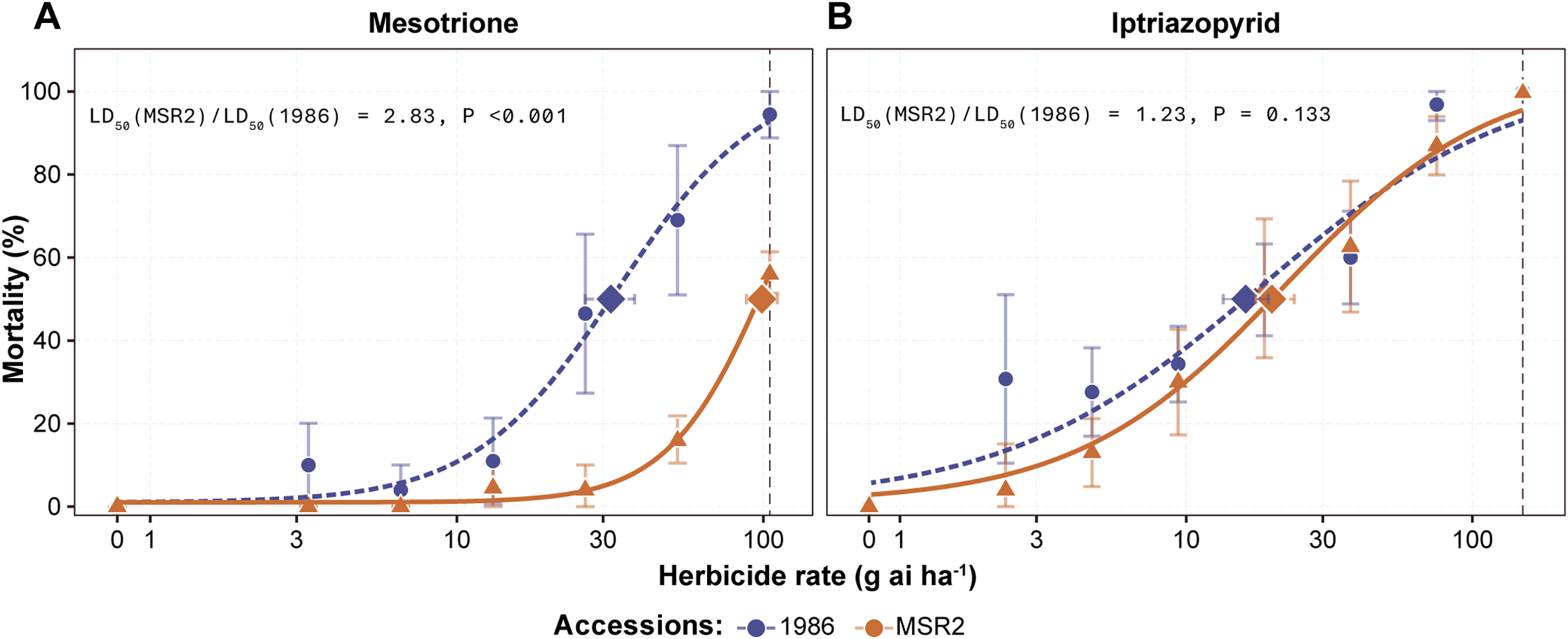
In response to mesotrione, differences in sensitivity were observed between the susceptible accession (1986) and the MSR2 accession. Previous studies have reported reduced sensitivity to mesotrione in MSR2, with LD50-based resistance levels ranging from approximately 2.4- to 3.4-fold and LD90-based resistance levels ranging from approximately 4.8- to 5.6-fold relative to susceptible standards (Carvalho-Moore et al. Reference Carvalho-Moore, Norsworthy, Souza, Barber, Piveta, Meiners and Porri2025). In the present study, the dose required to cause 50% mortality (LD50) was 31.2 g ha⁻1 for 1986 compared with 88.2 g ha⁻1 for MSR2, indicating that MSR2 required 2.8-fold higher mesotrione dose to achieve equivalent mortality (P < 0.0001) (Table 1; Figure 1). Similarly, the dose required to reduce aboveground biomass by 50% (GR50) was 2.33 g ha⁻1 for 1986 compared with 21.5 g ha⁻1 for MSR2, corresponding to a 9.21-fold increase in resistance (P < 0.0001) (Table 2). The dose required to cause 50% visible injury (ID50) followed a comparable trend, with MSR2 requiring 11.3 g ha⁻1 compared with 2.33 g ha⁻1 for 1986, representing a 4.83-fold increase (P < 0.0001) (Table 3). Collectively, these results generally corresponded to those reported by Carvalho-Moore et al. (Reference Carvalho-Moore, Norsworthy, Souza, Barber, Piveta, Meiners and Porri2025) and showed that MSR2 exhibits a consistent level of resistance to mesotrione across multiple response parameters.
Dose–response estimates for plant mortality at 4 wk after treatment with mesotrione and iptriazopyrid in Amaranthus palmeri accessions 1986 and MSR2 a

Table 1. Long description
A table comparing the sensitivity of Amaranthus palmeri accessions to different herbicides. The table has 4 rows and 5 columns. The columns are labeled Herbicide, Accession, Slope (b), LD50 (95% CI) g ai ha^-1, RI (95% CI), and RI > 1 P-value. The row labels are Mesotrione 1986, MSR2, Iptriazopyrid 1986, and MSR2. Row 1: Mesotrione, 1986, -1.93 (0.27), 31.2 (2.47), --. Row 2: Mesotrione, MSR2, -2.69 (0.14), 88.2 (1.53), 2.83 (2.41-3.31), <0.0001. Row 3: Iptriazopyrid, 1986, -1.01 (0.10), 15.7 (1.51), --. Row 4: Iptriazopyrid, MSR2, -1.27 (0.15), 19.3 (1.89), 1.23 (0.94-1.61), 0.133. The table shows the dose required to cause 50% mortality (LD50) and the resistance index (RI) for each accession and herbicide combination.
a Dose–response parameters were estimated using a four-parameter log–logistic model (Eq. 1); b represents the slope at the inflection point, e. CI, confidence interval.
b Accession 1986 is the susceptible standard; MSR2 is a confirmed mesotrione-resistant accession.
c LD50 is the herbicide dose (g ai ha⁻1) causing 50% absolute plant mortality.
d Resistance index (RI) was calculated as the ratio of the MSR2 LD50 to the LD50 of accession 1986.
Dose–response curves for percent control of Amaranthus palmeri accessions in response to mesotrione (A) and iptriazopyrid (B). Points represent treatment means with 95% confidence intervals. Curves were fit using a four-parameter log-logistic model with the lower and upper asymptotes fixed at 0% and 100%, respectively. Diamonds indicate absolute LD50 estimates with 95% confidence intervals. The dashed vertical line denotes normal current use or anticipated use rate.

Dose–response estimates for growth reduction at 4 wk after treatment with mesotrione and iptriazopyrid in Amaranthus palmeri accessions 1986 and MSR2 a

Table 2. Long description
A table comparing herbicide sensitivity in Amaranthus palmeri accessions. The table has 4 rows and 6 columns. Column headers are Herbicide, Accession, b (SE), GR50 (SE) g ai ha^-1, RI (95% CI), and RI > 1 P-value. Row labels are Mesotrione 1986, Mesotrione MSR2, Iptriazopyrid 1986, and Iptriazopyrid MSR2. Row 1: Mesotrione, 1986, -0.78 (0.03), 2.33 (0.16), --, --. Row 2: Mesotrione, MSR2, -0.72 (0.06), 21.5 (1.98), 9.21 (7.37-11.5), <0.0001. Row 3: Iptriazopyrid, 1986, -2.48 (0.14), 1.04 (0.16), --, --. Row 4: Iptriazopyrid, MSR2, -1.20 (0.12), 1.38 (0.22), 1.32 (0.86-2.03), 0.201.
a Dose–response parameters were estimated using a four-parameter log–logistic model (Eq. 1); b represents the slope at the inflection point, e. CI, confidence interval.
b Accession 1986 is the susceptible standard; MSR2 is a confirmed mesotrione-resistant accession.
c GR50 is the herbicide dose (g ai ha⁻1) causing 50% absolute growth reduction relative to untreated check.
d Resistance index (RI) was calculated as the ratio of the MSR2 GR50 to the GR50 of accession 1986.
Dose–response estimates for visible injury at 4 wk after treatment with mesotrione and iptriazopyrid in Amaranthus palmeri accessions 1986 and MSR2 a

Table 3. Long description
A table comparing the sensitivity of Amaranthus palmeri accessions to herbicides mesotrione and iptriazopyrid. The table has 4 rows and 5 columns. The columns are labeled Herbicide, Accession, b (SE), ID50 (SE) g ai ha^-1, RI (95% CI), and RI > 1 P-value. The rows are labeled with the herbicide names and accession numbers. Row 1: Herbicide, Mesotrione; Accession, 1986; b (SE), -0.78 (0.03); ID50 (SE) g ai ha^-1, 2.33 (0.16); RI (95% CI), --; RI > 1 P-value, --. Row 2: Herbicide, Mesotrione; Accession, MSR2; b (SE), -0.89 (0.06); ID50 (SE) g ai ha^-1, 11.3 (0.67); RI (95% CI), 4.83 (4.05-5.75); RI > 1 P-value, <0.0001. Row 3: Herbicide, Iptriazopyrid; Accession, 1986; b (SE), -1.31 (0.15); ID50 (SE) g ai ha^-1, 3.63 (0.33); RI (95% CI), --; RI > 1 P-value, --. Row 4: Herbicide, Iptriazopyrid; Accession, MSR2; b (SE), -1.00 (0.08); ID50 (SE) g ai ha^-1, 4.05 (0.34); RI (95% CI), 1.12 (0.87-1.42); RI > 1 P-value, 0.375.
a Dose–response parameters were estimated using a four-parameter log–logistic model (Eq. 1); b represents the slope at the inflection point, e. CI, confidence interval.
b Accession 1986 is the susceptible standard; MSR2 is a confirmed mesotrione-resistant accession.
c ID50 is the herbicide dose (g ai ha⁻1) causing 50% absolute visible injury relative to the untreated check.
d Resistance index (RI) was calculated as the ratio of the MSR2 ID50 to the ID50 of accession 1986.
In contrast, the response to iptriazopyrid was similar between the 1986 accession and MSR2. The LD50 values were 15.7 and 19.3 g ha⁻1 for 1986 and MSR2, respectively, with a resistance index (RI) of 1.23-fold (P = 0.133) (Table 1; Figure 1). Likewise, GR50 values were 1.04 and 1.38 g ha⁻1 (RI = 1.32-fold; P = 0.201), and ID50 values were 3.63 and 4.05 g ha⁻1 (RI = 1.12-fold; P = 0.375) (Tables 2 and 3). The lack of significant differences indicates that iptriazopyrid maintained similar efficacy in both mesotrione-resistant and mesotrione-susceptible accessions. Iptriazopyrid has been reported to exhibit strong phytotoxic activity in other species, with greater potency than mesotrione under controlled conditions. In E. crus-galli, iptriazopyrid induced chlorosis at concentrations approximately 10-fold lower than mesotrione and exhibited a substantially lower IC50 in greenhouse evaluations (Nishio et al. Reference Nishio, Nishijima, Kubota, Furuhata, Nanao, Permana, Furuhashi and Kato2025). In this study, iptriazopyrid demonstrated greater herbicidal activity compared with mesotrione. Direct comparisons of herbicidal activity between mesotrione and iptriazopyrid should be interpreted with caution, because mesotrione was applied with COC, whereas iptriazopyrid was applied with MSO; these adjuvant systems can differentially influence herbicide uptake and overall efficacy.
The limited availability of effective postemergence options in rice production systems makes this difference in response particularly relevant for the management of A. palmeri. The similar response observed across A. palmeri accessions, despite varying sensitivity to mesotrione, suggests that iptriazopyrid activity may be less influenced by metabolic detoxification.
Metabolism of Mesotrione and Iptriazopyrid in Amaranthus palmeri Accessions
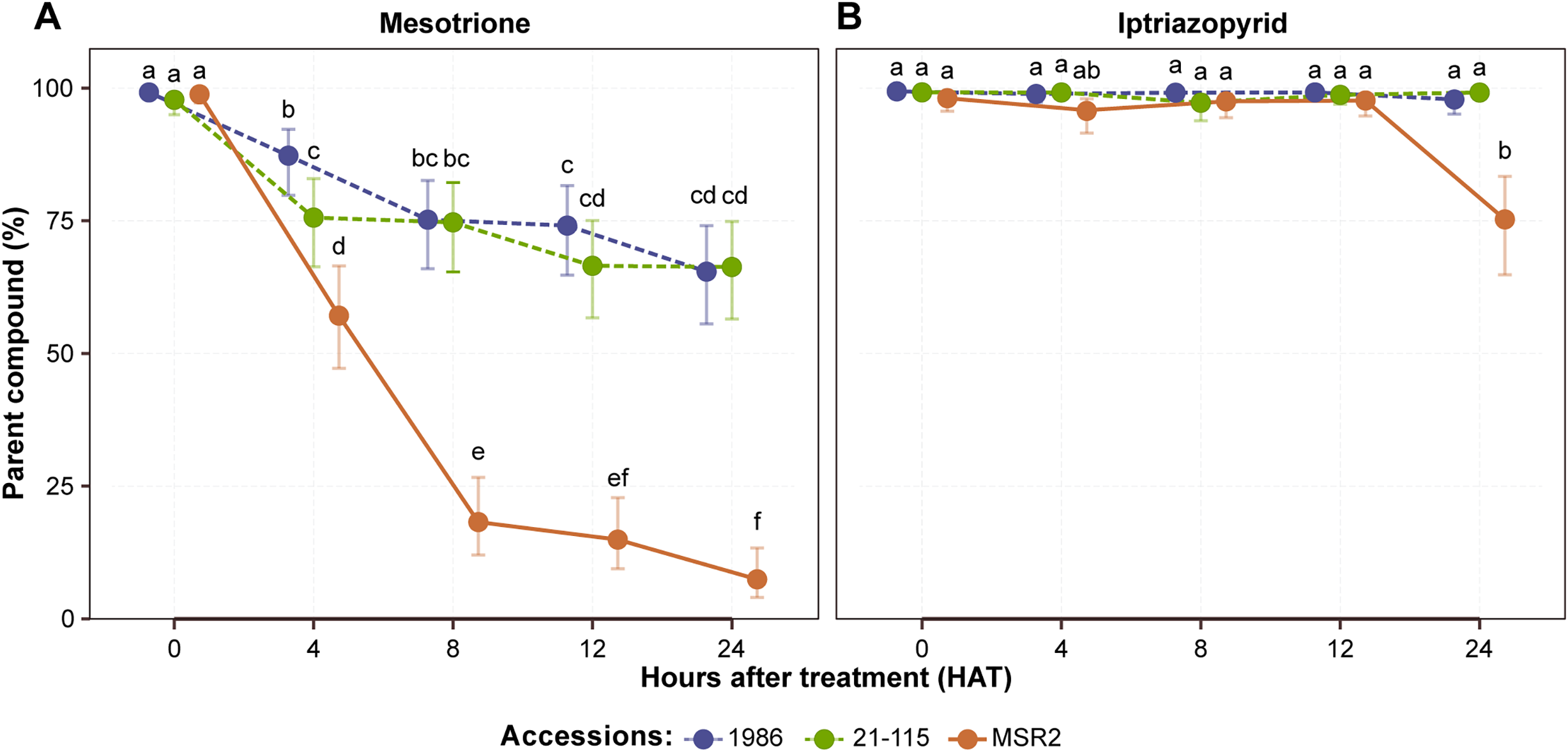
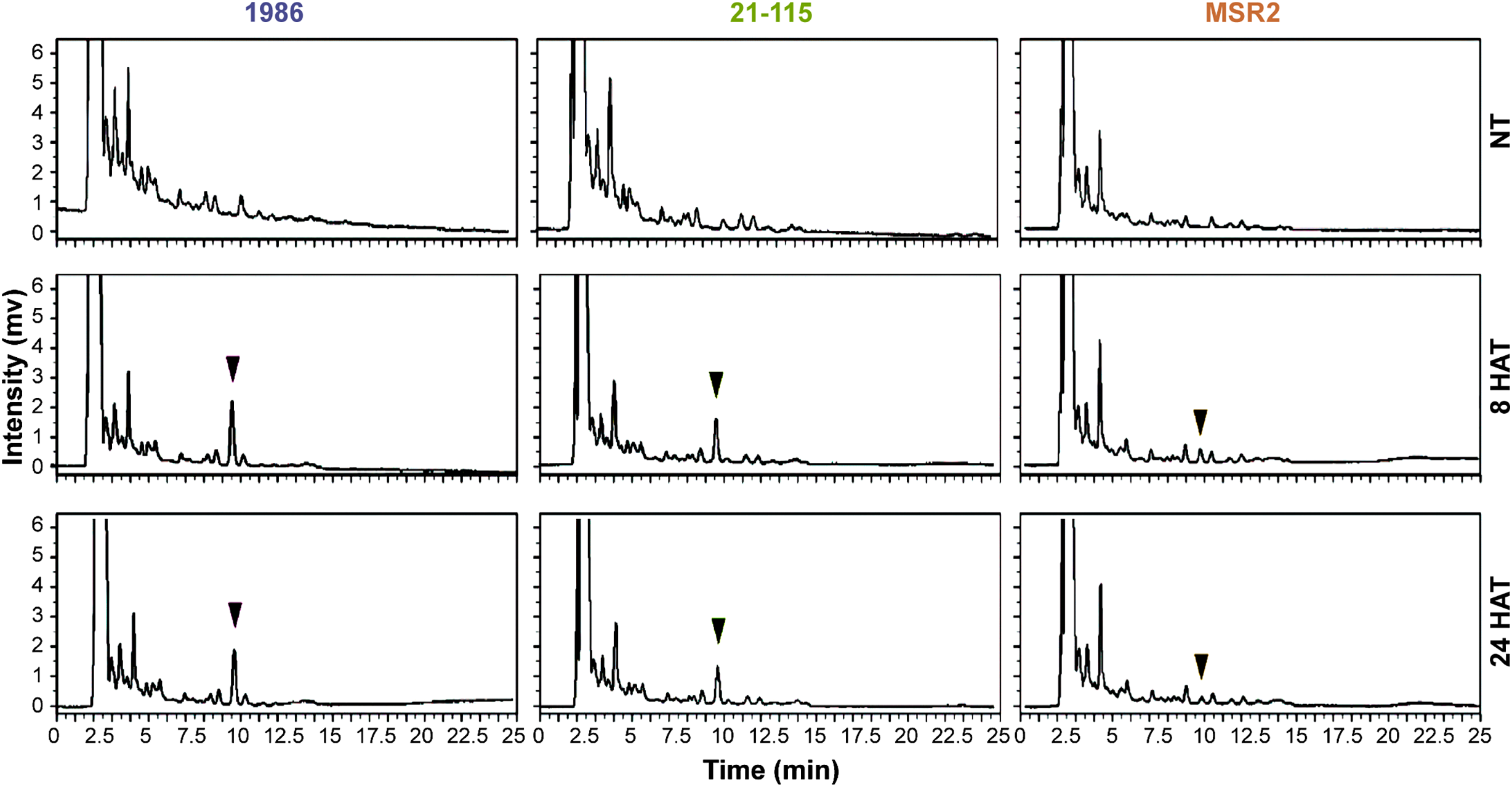
For mesotrione, the GLMM identified significant effects of accession, time, and their interaction (P < 0.001), and mean separation patterns showed clear divergence in degradation profiles as time progressed. Separation among accessions emerged rapidly (Figure 2A). By 4 HAT, MSR2 exhibited noticeably lower retention (≈57%) relative to 1986 (≈88%) and 21–115 (≈76%). These differences expanded through 12 and 24 HAT, during which MSR2 declined sharply to 14% and 6% of the parent compound, respectively. Meanwhile, accessions 1986 and 21–115 retained substantially more mesotrione parent compound at all time points (66% to 76%). The steep decline from 4 to 24 HAT in MSR2 indicates substantially greater metabolic activity toward mesotrione in this accession. Accessions 1986 and 21–115 demonstrated slower and more moderate degradation, consistently retaining the highest proportion of parent herbicide. These patterns were supported by chromatographic profiles, in which the parent mesotrione peak at 9.75 min declined rapidly in MSR2 while remaining more prominent in the susceptible accessions (Figure 3).
Time course of parent compound (% remaining) for mesotrione (A) and iptriazopyrid (B) in Amaranthus palmeri accessions. Accessions 1986 and 21–115 are known mesotrione susceptible, and MSR2 is resistant to mesotrione. Data represent mean ± 1 SE. Similar letters above SE bar indicate no difference at α = 0.05.

Representative high-performance liquid chromatography chromatographs showing mesotrione detection and metabolism in Amaranthus palmeri accessions 1986 (susceptible), 21–115 (susceptible), and MSR2 (resistant), under nontreated (NT) conditions, 8 h after treatment (8 HAT), and 24 HAT. The retention time of mesotrione is approximately 9.75 min (indicated by wedge). The MSR2 accession showed reduced mesotrione peak intensity over time compared with the two susceptible accessions, suggesting enhanced metabolism, whereas 1986 and 21–115 retained a more pronounced mesotrione peak at corresponding time points.

Figure 3. Long description
Nine chromatographs depict mesotrione detection and metabolism in Amaranthus palmeri accessions 1986, 21-115, and MSR2 under nontreated (NT) conditions, 8 hours after treatment (8 HAT), and 24 HAT. Panel A: The chromatograph for accession 1986 under NT conditions shows a high peak at the beginning, which quickly declines and stabilizes. Panel B: The chromatograph for accession 21-115 under NT conditions shows a similar pattern with a high initial peak that declines and stabilizes. Panel C: The chromatograph for accession MSR2 under NT conditions also shows a high initial peak that declines and stabilizes. Panel D: The chromatograph for accession 1986 at 8 HAT shows a high initial peak, a smaller peak around 9.75 minutes, and then stabilizes. Panel E: The chromatograph for accession 21-115 at 8 HAT shows a similar pattern with a high initial peak, a smaller peak around 9.75 minutes, and then stabilizes. Panel F: The chromatograph for accession MSR2 at 8 HAT shows a high initial peak, a reduced peak around 9.75 minutes, and then stabilizes. Panel G: The chromatograph for accession 1986 at 24 HAT shows a high initial peak, a smaller peak around 9.75 minutes, and then stabilizes. Panel H: The chromatograph for accession 21-115 at 24 HAT shows a similar pattern with a high initial peak, a smaller peak around 9.75 minutes, and then stabilizes. Panel I: The chromatograph for accession MSR2 at 24 HAT shows a high initial peak, a further reduced peak around 9.75 minutes, and then stabilizes. The retention time of mesotrione is approximately 9.75 minutes, indicated by a wedge. The MSR2 accession showed reduced mesotrione peak intensity over time compared with the two susceptible accessions, suggesting enhanced metabolism, whereas 1986 and 21-115 retained a more pronounced mesotrione peak at corresponding time points.
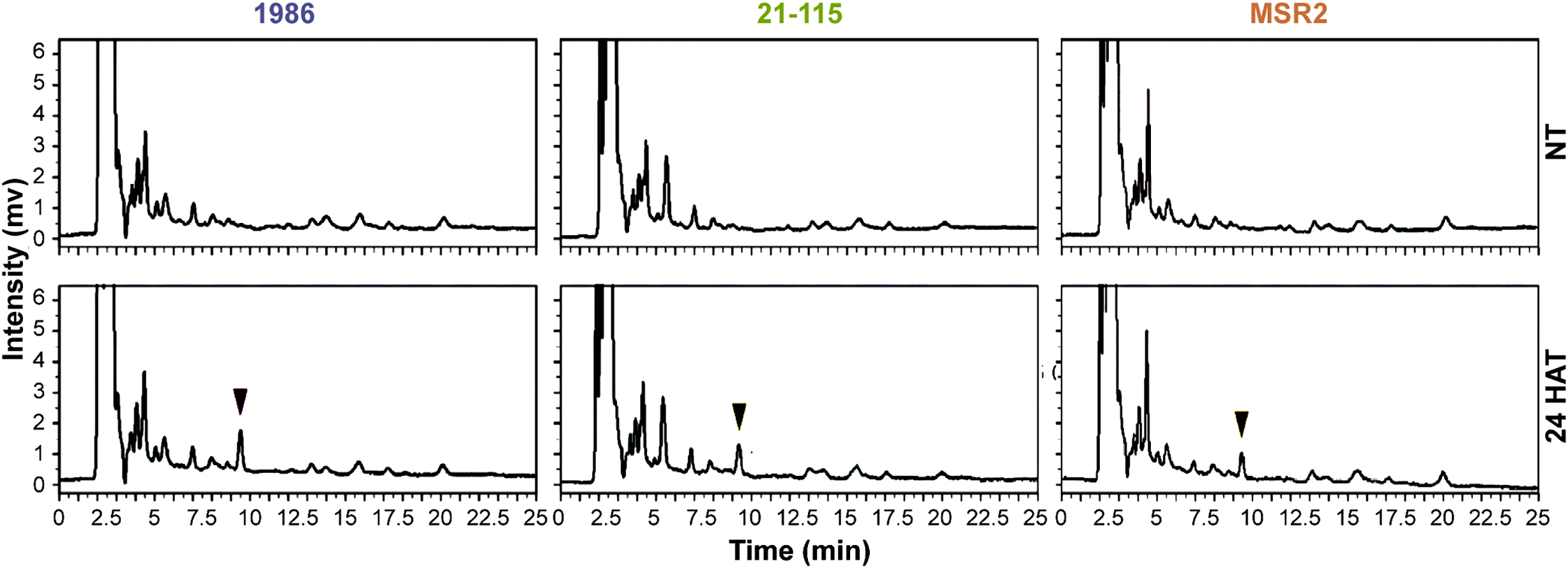
For iptriazopyrid, accession (P < 0.05), time (P < 0.05), and their interaction were significant; however, differences were small and not biologically meaningful, as all accessions retained high parent compound across time (Figure 2B). Across all time points, parent compound remained high and comparatively stable in all three accessions (1986, 21–115, and MSR2). Parent compound remained above 94% for 1986 and 21–115 through 24 h. MSR2 showed only a modest decline at 24 HAT (~75%), but the overall magnitude of degradation across the experiment was relatively small compared with the initial concentration. Chromatographic analysis confirmed minimal decline in the parent iptriazopyrid peak (identified at a retention time of 9.51 min) across accessions at 24 HAT (Figure 4).
Representative high-performance liquid chromatography chromatographs showing iptriazopyrid detection in Amaranthus palmeri accessions 1986 (mesotrione-susceptible), 21–115 (mesotrione-susceptible), and MSR2 (mesotrione-resistant), under nontreated (NT) conditions and 24 h after treatment (HAT). The retention time of iptriazopyrid is approximately 9.51 min (indicated by wedge). Comparable peak intensities across accessions at 24 HAT suggest limited or no differential metabolism of iptriazopyrid among mesotrione-resistant and mesotrione-susceptible accessions examined.

Enhanced metabolism of mesotrione is a well-established non–target site resistance mechanism in weeds. Mesotrione degradation involves both Phase I and Phase II reactions, including oxidative hydroxylation, reduction, and conjugation mediated by enzymes such as P450 monooxygenases, glutathione S-transferases, and glycosyltransferases (Chen et al. Reference Chen, Lv, Zhai and Yang2021, Reference Chen, Zhai, Liu, Zhang and Yang2023). Phase I metabolism, particularly ring hydroxylation, produces metabolites such as 4-OH- and 5-OH-mesotrione and represents a critical initial step in herbicide detoxification (Concepcion et al. Reference Concepcion, Kaundun, Morris, Brandenburg and Riechers2024; Ma et al. Reference Ma, Kaundun, Tranel, Riggins, McGinness, Hager, Hawkes and Riechers2013). Collectively, this rapid and sequential metabolism reduces the effective concentration of mesotrione at the target site and is considered a major factor contributing to reduced herbicide sensitivity in resistant accessions.
In contrast to the well-characterized Phase I and Phase II metabolic pathways of mesotrione, information on the metabolic fate of iptriazopyrid remains limited. In rice, metabolic studies have shown rapid degradation of iptriazopyrid within plant tissues, accompanied by the formation of downstream transformation products, resulting in reduced accumulation of the parent compound. In E. crus-galli, by contrast, higher intercellular levels of the parent compound are retained with no detectable metabolites (Nishio et al. Reference Nishio, Nishijima, Kubota, Furuhata, Nanao, Permana, Furuhashi and Kato2025). These differences in metabolic processing suggest that variation in detoxification capacity influences the persistence and activity of iptriazopyrid within plant tissues.
The differences in A. palmeri response to mesotrione and iptriazopyrid observed in this study may be associated, in part, with differences in susceptibility to metabolic detoxification, potentially influenced by their chemical structures. Mesotrione, a triketoneHPPD-inhibitor, contains a β-diketone moiety and associated electron-rich functional groups that provide multiple accessible sites amenable to P450-mediated oxidative metabolism, particularly hydroxylation and cleavage reactions (Concepcion et al. Reference Concepcion, Kaundun, Morris, Brandenburg and Riechers2024; Küpper et al., Reference Küpper, Peter, Zöllner, Lorentz, Tranel, Beffa and Gaines2018; Ma et al. Reference Ma, Kaundun, Tranel, Riggins, McGinness, Hager, Hawkes and Riechers2013). These structural features promote rapid Phase I metabolism and lead to reduced intracellular accumulation of the bioactive parent compound as observed in MSR2 in the present study. Iptriazopyrid belongs to the azole carboxamide class and possesses a distinct heterocyclic structure compared with triketone herbicides such as mesotrione (Nishio et al. Reference Nishio, Nishijima, Kubota, Furuhata, Nanao, Permana, Furuhashi and Kato2025). The absence of a β-diketone moiety and the presence of a distinct heterocyclic scaffold may potentially influence susceptibility to metabolic detoxification. Iptriazopyrid remained predominantly as the intact parent molecule across accessions, indicating limited metabolism relative to mesotrione. These structural distinctions can modulate herbicide persistence within plant tissues and may help explain the sustained inhibitory activity of iptriazopyrid under conditions where mesotrione undergoes rapid inactivation and at an enhanced rate in MSR2.
Similar variability in herbicide response within a single mode of action has been reported in other herbicide groups. For example, populations of blackgrass (Alopecurus myosuroides Huds.) have shown differential resistance among dinitroaniline herbicides, where resistance to compounds such as pendimethalin was observed, while sensitivity to others, including trifluralin, ethalfluralin, and isopropalin was retained (James et al. Reference James, Kemp and Moss1995; Moss Reference Moss1990). These differences were associated with substitutions on the aromatic ring that influenced susceptibility to metabolic detoxification, with herbicides containing ring-methyl groups being more readily metabolized than those containing trifluoromethyl groups (Riechers et al. Reference Riechers, Soltani, Chauhan, Concepcion, Geddes, Jugulam, Kaundun, Preston, Wuerrfel and Sikkema2024). Differences in response have also been reported for acetyl-CoA carboxylase inhibitors in E. crus-galli where biotypes exhibited strong resistance to cyhalofop-butyl and fenoxaprop-ethyl but only low-level resistance to quizalofop-ethyl, despite all belonging to the same chemical family (Hwang et al. Reference Hwang, Norsworthy, González-Torralva, Piveta, Barber and Butts2022). These differences may be influenced by subtle variations in chemical structure that affect how readily the herbicides are converted to or degraded from their active forms, although the specific structural features responsible were not determined.
The availability of effective postemergence herbicide options for managing A. palmeri in rice production systems remains limited, particularly in areas where resistance to commonly used herbicides has been reported. A. palmeri accessions are often exposed to HPPD-inhibiting herbicides in rotational cropping systems such as corn, which may contribute to the selection of accessions with reduced sensitivity. The results of this study demonstrate that iptriazopyrid maintained consistent, high-level herbicidal activity across accessions where mesotrione efficacy was reduced, suggesting a potential advantage under conditions where metabolism-based resistance limits the performance of triketone herbicides. While further evaluation under field conditions, coupled with assessments across a broader repertoire of mesotrione-resistant accessions, remains essential, these findings indicate that iptriazopyrid may constitute a promising supplementary postemergence option for managing A. palmeri in rice systems.
Acknowledgments
The authors acknowledge Nissan Chemical Corporation and Gowan Company for supplying iptriazopyrid, and the Milo J. Shult Agricultural Research and Extension Center for support in conducting this research. Grammarly and GPT-5.5 were used to assist with language refinement, including improving grammar, readability, and sentence structure only.
Funding statement
This research is funded by the Arkansas Rice Checkoff Program administered by the Arkansas Rice Research and Promotion Board.
Competing interests
The authors declare no conflicts of interest.




 Open access

