Introduction
Emerald ash borer, Agrilus planipennis Fairmaire (Coleoptera: Buprestidae), has killed hundreds of millions of ash trees, Fraxinus spp. (Oleaceae), in North America since it was discovered in 2002 (Haack et al. Reference Haack, Jendek, Liu, Marchant, Petrice, Poland and Ye2002; Herms and McCullough Reference Herms and McCullough2014). Emerald ash borer has spread throughout much of eastern North America, with isolated populations established as far west as Oregon in the United States of America, and British Columbia in Canada. With the aim of reducing the impacts of emerald ash borer on North America’s ash resources, a classical biological control programme was initiated in 2007 as part of a long-term emerald ash borer management strategy (Liu et al. Reference Liu, Bauer, Gao, Zhao, Petrice and Haack2003; Bauer et al. Reference Bauer, Duan, Gould and Van Driesche2015a; Duan et al. Reference Duan, Gould, Slager, Quinn, Petrice, Poland, Van Driesche, Winston, Perring and Lopez2022, Reference Duan, Gould, Quinn, Petrice, Slager and Poland2023a).
To date, the Asian larval parasitoids, Spathius agrili Yang (Hymenoptera: Braconidae), Spathius galinae Belokobylskij and Strazanac (Hymenoptera: Braconidae), and Tetrastichus planipennisi Yang (Hymenoptera: Eulophidae), and the egg parasitoid, Oobius agrili Huang and Zhang (Hymenoptera: Encyrtidae), from emerald ash borer’s native range have been approved for release against emerald ash borer in the United States of America (Bauer et al. Reference Bauer, Duan, Gould and Van Driesche2015a; Duan et al. Reference Duan, Bauer, van Driesche and Gould2018) and Canada (Canadian Food Inspection Agency 2024). Post-release studies have confirmed that O. agrili, S. galinae, and T. planipennisi have established and persist in many areas of the upper midwestern and northeastern United States of America (Duan et al. Reference Duan, Gould, Quinn, Petrice, Slager and Poland2023a, Reference Duan, Schmude, Petrice, Bauer, Poland and Chandler2023b) and in some areas of Ontario and Québec, Canada (Butler et al. Reference Butler, Dedes, Jones, Hughes, Ladd and Martel2022; MapBioControl 2024). Spathius agrili has failed to establish in northern climates of North America, and releases of this species are now restricted to areas with warmer climates below 40° latitude (Bauer et al. Reference Bauer, Duan, Gould and Van Driesche2015a; Duan et al. Reference Duan, Gould, Slager, Quinn, Petrice, Poland, Van Driesche, Winston, Perring and Lopez2022).
Studies over the last two decades also document several native North American hymenopteran species parasitising emerald ash borer larvae (Liu et al. Reference Liu, Bauer, Gao, Zhao, Petrice and Haack2003; Cappaert and McCullough Reference Cappaert and McCullough2009; Taylor et al. Reference Taylor, Duan, Fuester, Hoddle and Van Driesche2012; Duan et al. Reference Duan, Taylor, Fuester, Kula and Marsh2013; Hooie et al. Reference Hooie, Wiggins, Lambdin, Grant, Powell and Lelito2015; Roscoe et al. Reference Roscoe, Lyons and Smith2016). Many of these species are known parasitoids of North American Agrilus species and include members of the braconid genera Atanycolus, Leluthia, and Spathius (Hymenoptera: Braconidae); the chalcidid genus Phasgonophora (Hymenoptera: Chalcididae); the eupelmid genus Eupelmus (Hymenoptera: Eupelmidae); and the ichneumonid genera Cunocephalus (not confirmed) and Dolichomitus (Hymenoptera: Ichneumonidae). In addition, the adventive species, Balcha indica Mani and Kaul (Hymenoptera: Eupelmidae), also attacks emerald ash borer larvae (Liu et al. Reference Liu, Bauer, Gao, Zhao, Petrice and Haack2003; Duan et al. Reference Duan, Taylor, Fuester, Kula and Marsh2013; Bauer et al. Reference Bauer, Duan, Lelito, Liu, Gould, Bauer, van Driesche and Reardon2015b). The native species most frequently documented to parasitise emerald ash borer include Atanycolus cappaerti Marsh and Strazanac (Hymenoptera: Braconidae), Phasgonophora sulcata Westwood (Hymenoptera: Chalcididae), and multiple Spathius species. Both Atanycolus and Spathius species primarily attack third- and fourth-instar emerald ash borer larvae (emerald ash borer has four larval instars), and P. sulcata attacks early-instar larvae (Duan et al. Reference Duan, Taylor, Fuester, Kula and Marsh2013; Duan and Schmude Reference Duan and Schmude2016; Roscoe et al. Reference Roscoe, Lyons and Smith2016).
Emerald ash borer parasitism by native larval parasitoids has been highly variable but generally low, e.g., less than 1–5% (Liu et al. Reference Liu, Bauer, Gao, Zhao, Petrice and Haack2003; Duan et al. Reference Duan, Fuester, Wildonger, Taylor, Barth and Spichiger2009, Reference Duan, Ulyshen, Bauer, Gould and Van Driesche2010, Reference Duan, Taylor, Fuester, Kula and Marsh2013). However, some studies have documented similar emerald ash borer parasitism rates to those of introduced emerald ash borer–larval parasitoids. For example, Cappaert and McCullough (Reference Cappaert and McCullough2009) reported emerald ash borer parasitism by A. cappaerti as high as 71% at one site in Michigan, United States of America, and Duan et al. (Reference Duan, Bauer, Abell, Ulyshen and Van Driesche2015) reported average parasitism by Atanycolus spp. as high as 62% across six sites in Michigan. Also, Roscoe et al. (Reference Roscoe, Lyons and Smith2016) observed emerald ash borer–larval parasitism by P. sulcata as high as 34% at a site in Ontario, Canada. Factors affecting the variability in emerald ash borer parasitism rates by native parasitoids species are unclear.
Long-term management of emerald ash borer using biological control requires a better understanding of the variability in emerald ash borer–larval parasitism contributed by native hymenopteran species. Although the studies cited above reported emerald ash borer parasitism rates from native parasitoids, few have examined adult parasitoid seasonal abundance, which would affect their synchrony with susceptible emerald ash borer–larval stages. It is also unclear if interspecific competition between introduced Asian and native larval parasitoids occurs at sites where they coexist. Therefore, we conducted studies with the objective of determining the seasonal abundance of several native hymenopteran parasitoid species that attack emerald ash borer larvae. We also examined relationships in abundance between native emerald ash borer parasitoids and the Asian larval parasitoids, S. galinae and T. planipennisi. To accomplish this, we collected parasitoid adults throughout the growing season over a four-year period (2016–2019) using yellow pan traps placed on ash trees at sites where emerald ash borer and Asian parasitoids were established. We also debarked infested ash trees to estimate densities of emerald ash borer larvae parasitised by each species. Information gathered as part of this study will be useful for further investigation of the potential impacts of native hymenopteran parasitoids on emerald ash borer population dynamics and their interactions with introduced Asian emerald ash borer parasitoids.
Methods
During 2016–2019, we monitored emerald ash borer–larval parasitoid activity and abundance using yellow pan traps and tree dissections at three sites in south-central Michigan, United States of America (Gratiot-Saginaw State Game Area in Gratiot County, and Harris Nature Center and Legg Park in Ingham County), where T. planipennisi was first released in 2008 and where S. galinae was released in 2015. These stands were composed of mixed hardwoods with Fraxinus as a major component. Detailed information on parasitoid release and establishment histories for these three sites can be found in Petrice et al. (Reference Petrice, Poland, Bauer, Strazanac, Duan, Schmude and Ravlin2023) and MapBioControl (2024).
Yellow pan traps were constructed following instructions provided in the Emerald Ash Borer Biocontrol Guidelines (United States Department of Agriculture, Animal and Plant Health Inspection Service – Agricultural Research Service – Forest Service 2021). Traps were placed on the south side of ash trees, 1.75 m above the ground. A solution of 50% food-grade propylene glycol (ChemWorld.com, Taylor, Michigan, United States of America) and 50% water was added to the nested bowl to kill and preserve trapped insects. We added approximately 5 mL/L of unscented dish soap to the solution to reduce surface tension. Samples were collected once every two weeks in 2016 and once every week in 2017–2019. In 2016, we placed yellow pan traps on live ash trees that showed evidence of recent emerald ash borer attack (e.g., fresh woodpecker feeding holes, epicormic sprouts, and/or canopy dieback) within a 0.25-ha plot at each study site. The number of traps per site varied between 12 and 28, depending on the number of ash trees with recent emerald ash borer attack that were present. In 2017–2019, we placed 10 yellow pan traps on live ash trees within the same plots on trees with evidence of recent emerald ash borer attack. Sample trees ranged from 5.0 to 30.3 cm in diameter at breast height (DBH, 1.37 m above ground). Adult parasitoids were identified using species keys, illustrations, and descriptions from the following resources: Yang et al. (Reference Yang, Strazanac, Marsh, Van Achterberg and Choi2006), Marsh and Strazanac (Reference Marsh and Strazanac2009), Marsh et al. (Reference Marsh, Strazanac and Laurusonis2009), and Belokobylskij et al. (Reference Belokobylskij, Yurchenko, Strazanac, Zaldívar-Riverón and Mastro2012).
In fall 2016 and 2017 and in early spring 2019, we felled and dissected 4–5 small ash trees per site that ranged between 8.0 and 15.6 cm DBH to recover emerald ash borer larvae parasitised during the 2016, 2017, and 2018 growing seasons, respectively. In addition, we felled and dissected 10 sapling-sized ash trees (range: 2.6–5.8 cm DBH) at each site in early spring 2019. Emerald ash borer larvae from the 2019 growing season were not sampled in spring 2020 due to COVID-19 restrictions. Trees and saplings selected for dissection had evidence of recent emerald ash borer attack (i.e., woodpecker feeding holes, bark splits, and/or epicormic sprouts) and were within 50 m of the 0.25-ha plots used for yellow pan trap sampling.
Trees were dissected with a draw knife by removing the bark from the entire stem and all branches that were larger than 2.5 cm in diameter. The number of emerald ash borer larvae attacked by each parasitoid genus was recorded. Immature parasitoids were identified based on larval morphology and parasitoid biology. For example, Tetrastichus are gregarious endoparasitoids that exit their host when mature and form exarate pupae (Bauer et al. Reference Bauer, Duan, Lelito, Liu, Gould, Bauer, van Driesche and Reardon2015b). Spathius are gregarious ectoparasitoids that spin silken cocoons where they will later pupate (Bauer et al. Reference Bauer, Duan, Lelito, Liu, Gould, Bauer, van Driesche and Reardon2015b). Atanycolus are solitary ectoparasitoids that also spin silken cocoons when mature (Cappaert and McCullough Reference Cappaert and McCullough2009; Duan and Schmude Reference Duan and Schmude2016). Phasgonophora sulcata is a solitary endoparasitoid that attacks early-instar larvae and lives in the host’s haemolymph until the host completes diapause (Roscoe et al. Reference Roscoe, Lyons and Smith2016).
To determine if emerald ash borer larvae were parasitised by P. sulcata, all larvae without external signs of immature parasitoids were dissected in the laboratory. We reared all undamaged immature parasitoids in the laboratory, and adults that successfully emerged were used to confirm parasitoid species identifications. We calculated immature parasitoid brood densities by dividing the number of emerald ash borer larvae parasitised by each genus or species by the total ash phloem surface area dissected for each site and year to standardise parasitised emerald ash borer–larval densities. Phloem area for each tree or sapling was calculated using models described in McCullough and Siegert (Reference McCullough and Siegert2007).
Data analysis
Seasonal abundance of adults
Data for growing degree-days (base 10 °C; GDD10; Baskerville–Emin method, start date = 1 January) were downloaded from the nearest weather station for each study site (Michigan State University Enviroweather 2024). Weather stations selected were within 10 km of each study site. To improve visual interpretation of seasonal abundance of parasitoid species, we averaged the GDD10 accumulation across sites each year because study sites were within 60 km of one another, the difference in daily GDD10 accumulation ranged from only 19 to 28 GDD10 among sites each year, and weekly trap collections occurred on the same day or no more than two days apart. We then plotted the summed adult captures of each parasitoid species across all three sites against the average accumulated GDD10 for each sample week and year.
Comparison of adult and larval parasitoid abundance
Abundance of adult and immature parasitoids were compared among all parasitoid species using a generalised linear mixed model (GLMM, PROC GLIMMIX; SAS Institute 2012) with a gamma distribution. The gamma distribution provided the best model fits based on visual inspections of residuals and Shapiro–Wilk tests. Levene’s tests were used to confirm homogeneity of variances. Models included parasitoid species, year, and the interaction between them as fixed effects and site as random effect. When interactions were significant between parasitoid species and year, models were run separately for each year. Degrees of freedom were calculated using the Kenward–Rodger method. Estimated marginal means that were significantly different (P < 0.05) were separated using the Tukey–Kramer means comparison procedure. In addition, we examined the data for correlations in abundance among native and Asian parasitoid species for both adult and immature life stages using Pearson’s correlation analysis (PROC CORR; SAS Institute 2012).
Results
Adult parasitoid abundance
We identified five native parasitoid species from yellow pan trap captures that were previously reported as attacking emerald ash borer larvae. For each of these species, the total adult captures and GDD10 range for all sites and years were as follows: A. cappaerti – 75 individuals; 264–1595 GDD10; Atanycolus simplex (Cresson) – 58; 264–1376; P. sulcata – 21; 653–1209; Spathius laflammei Provancher – 322; 184–1485; and Spathius floridanus Ashmead –2; 477–1294 (Fig. 1). We did not include S. floridanus in seasonal abundance or species abundance analyses due to the low number captured. For the two Asian larval parasitoids, total adult captures and GDD10 range were as follows: T. planipennisi – 161 individuals; 119–1549 GDD10; and S. galinae – 59; 264–1535 (data not shown).
Adult parasitoid abundance of native emerald ash borer parasitoid species captured in yellow pan traps as a function of growing degree-days (base 10 °C; start date = 1 January) by sample year. Yearly data were pooled for three sites (12–28 traps per site in 2016, and 10 traps per site in 2017–2019) in Michigan, United States of America.

Adult parasitoid abundance varied significantly among species (df = 5,46; F = 10.73; P < 0.0001) and year (df = 3, 46; F = 18.20; P < 0.0001), with annual variation in the abundance of given parasitoid species (species × year interaction: df = 15,46; F = 3.12; P = 0.002). Because of the significant interaction between species and year, we compared abundance among parasitoids separately for each year. In 2016, S. laflammei had the highest adult abundance (df = 5,10; F = 10.29; P = 0.001), S. galinae the lowest, and the remaining species had intermediate abundance. Adult parasitoid abundance in 2017 was significantly higher for T. planipennisi than for P. sulcata (df = 5,10; F = 4.60; P = 0.019; Fig. 2). In 2018, abundance was significantly higher (df = 5,12; F = 2.84; P = 0.069) for S. laflammei than for P. sulcata, and abundances of the other species were intermediate (Fig. 2). Adult abundance in 2019 was significantly higher (df= 5,12; F = 5.58; P = 0.007) for S. laflammei than for A. cappaerti, and abundances of the other species were intermediate (Fig. 2).
Comparison of mean (± standard error) adult abundance among native (white bars) and Asian (black bars) emerald ash borer parasitoid species captured in yellow pan traps. Bars with different letters differ significantly. Data were analysed using a generalised linear mixed model with a gamma distribution followed by Tukey–Kramer multiple comparison of estimated marginal means, P < 0.05, N = 3 sites. Estimated marginal means shown.

Significant positive correlations in adult captures were revealed between A. cappaerti and P. sulcata (P = 0.019, R = 0.664), A. cappaerti and T. planipennisi (P = 0.004, R = 0.768), P. sulcata and T. planipennisi (P = 0.001, R = 0.818), and S. laflammei and S. galinae (P = 0.001, R = 0.812; Table 1). No significant negative correlations were found between adult captures of any parasitoid species (Table 1).
Correlation matrix showing the P-value (P) and correlation coefficient (R) comparing abundance of adult parasitoid species (Asian species highlighted grey) captured in yellow pan traps. Correlations that were significant are displayed in bold; Pearson’s correlation analysis, N = 3 sites

Immature parasitoid abundance
For immature parasitoids that were reared to adult from tree dissections, all immature Spathius that successfully eclosed were S. galinae adults, all Atanycolus were A. cappaerti, and all Tetrastichus were T. planipennisi. Immature P. sulcata (the only species in this genus in North America) dissected from emerald ash borer larvae were confirmed using characters described in Roscoe (Reference Roscoe2014). Therefore, we assumed that all immature parasitoids in these four genera represented these four respective species.
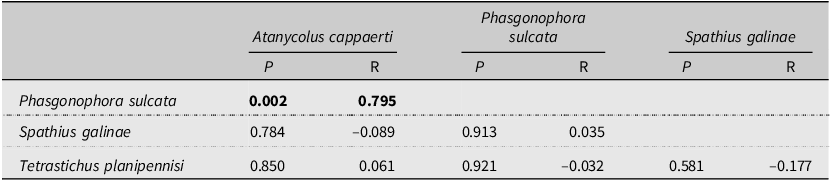
The density of parasitoid broods did not vary significantly among species (df = 3,22; F = 1.51; P = 0.240) or year (df = 2,22; F = 1.02; P = 0.377), but their abundances differed annually (species × year interaction: df = 6,22; F = 3.91; P = 0.008). Because significant interaction occurred between year and species, we compared immature parasitoid densities separately for each year. In 2016, density of immature parasitoids was significantly lower (df = 3, 6; F = 7.11; P = 0.021) for S. galinae than for A. cappaerti, P. sulcata, and T. planipennisi. Density of immature parasitoids did not vary significantly among species in 2017 (df = 3,6; F = 1.12; P = 0.411) or 2018 (df = 3,6; F = 0.84; P = 0.518; Fig. 3). Atanycolus cappaerti and P. sulcata parasitoid brood densities had a significant positive correlation (P = 0.002, R = 0.795; Table 2). Correlations of parasitoid brood densities between other species were not significant (Table 2).
Comparison of mean (± standard error) immature parasitoid brood densities in ash trees among native (white bars) and Asian (black bars) emerald ash borer parasitoid species. Bars with different letters are significantly different. Data were analysed using a generalised linear mixed model with a gamma distribution followed by Tukey–Kramer multiple comparison of estimated marginal means, P < 0.05, N = 3 sites. Estimated marginal means shown.

Correlation matrix showing the P-value (P) and correlation coefficient (R) comparing densities of immature parasitoid brood densities between species (Asian species highlighted in grey). Correlations that were significant are displayed in bold; Pearson’s correlation analysis, N = 3 sites

Discussion
Several native North American hymenopteran parasitoid species have been documented as attacking emerald ash borer. We monitored the seasonal abundance of four of these native species and the correlation of their abundance with introduced emerald ash borer parasitoids. The seasonal abundance among native species varied, but generally the seasonal activity period was broader for species of Spathius and Atanycolus than for Phasgonophora sulcata. No negative correlations were found between adult or immature parasitoid abundance of any native or introduced Asian larval parasitoid species. In fact, some species were positively correlated, suggesting that they were attracted to the same host resource, but impacts of exploitative competition were minimal.
Of the species collected during our study, S. laflammei was frequently the most abundant parasitoid species captured in yellow pan traps. Interestingly, adult abundance of S. laflammei was positively correlated with its congener, S. galinae. To date, S. laflammei parasitism of emerald ash borer has been reported only by Duan et al. (Reference Duan, Taylor, Fuester, Kula and Marsh2013). During their study, S. laflammei field parasitism of emerald ash borer larvae was low; however, this species frequently attacked emerald ash borer larvae in laboratory exposures (Duan et al. Reference Duan, Taylor, Fuester, Kula and Marsh2013). It is unclear why S. laflammei adult abundance was among the highest of all parasitoids in the present study, even though we never recovered it from emerald ash borer larvae. Given this, it is likely that S. laflammei prefers its native host(s) and attacks emerald ash borer larvae rarely and incidentally when S. laflammei females are searching for native host species in dying or dead ash trees. Native hosts of S. laflammei include several species in the coleopteran families Cerambycidae and Curculionidae (Marsh and Strazanac Reference Marsh and Strazanac2009). During the present study, S. laflammei was captured mostly at or before mid-summer, and it is unclear whether S. laflammei is univoltine or multivoltine. Nevertheless, we suspect that the seasonal abundance of S. laflammei was influenced by the phenology of its native host(s), given that it was less abundant later in the growing season when late-instar emerald ash borer larvae are most abundant.
Atanycolus cappaerti was intermediately abundant among the native parasitoids that were recovered. Adult captures occurred throughout the growing season without consistent trends in seasonal abundance. This was similar to the S. galinae and T. planipennisi adult seasonal abundances reported by Petrice et al. (Reference Petrice, Poland, Bauer, Strazanac, Duan, Schmude and Ravlin2023). Similarly to those two Asian parasitoids, Atanycolus cappaerti is a multivoltine species, but a proportion of each generation enters obligatory diapause (Cappaert and McCullough Reference Cappaert and McCullough2009; Duan and Schmude Reference Duan and Schmude2016). In the present study, the density of emerald ash borer larvae parasitised by A. cappaerti was highly variable among sites and years but did not significantly differ from the density of the Asian larval parasitoid species, except for being higher than S. galinae in 2016. This difference in 2016 was likely due to the more recent release of S. galinae at our study sites, beginning in 2015, compared to the T. planipennisi releases, which occurred between 2008 and 2009 (Duan et al. Reference Duan, Taylor, Fuester, Kula and Marsh2013; Petrice et al. Reference Petrice, Poland, Bauer, Strazanac, Duan, Schmude and Ravlin2023). There is a strong potential for exploitative competition between A. cappaerti and S. galinae because both are ectoparasitoids that attack similar-sized hosts in similar-sized trees (Abell et al. Reference Abell, Duan, Bauer, Lelito and Van Driesche2012; Duan et al. Reference Duan, Van Driesche, Schmude, Quinn, Petrice and Rutledge2021). However, as S. galinae abundance increased over time at our study sites, we did not see any significant negative correlations in adult or immature parasitoid abundance between these two species.
Atanycolus simplex adults were also intermediately abundant during our study, with most adult captures more restricted to the first half of the growing season than was observed for A. cappaerti. However, we did not confirm A. simplex parasitising any emerald ash borer larvae during the present study. Although the literature has reported A. simplex attacking emerald ash borer, it is not clear from published studies if this parasitoid–host relationship was confirmed or if A. simplex was reared from ash logs that contained emerald ash borer larvae but possibly other wood borers as well. According to Krombein et al. (Reference Krombein, Hurd, Smith and Burks1979), hosts of A. simplex include the buprestids Agrilus bilineatus (Weber) and Chrysobothris spp. (both Coleoptera: Buprestidae) and the cerambycids: Phymatodes aereus (Newman), Rhagium inquisitor (Linnaeus), Saperda discoidea Fitch, Olivier, and Xylotrechus nauticus (Mannerheim) (all Coleoptera: Cerambycidae). Given this relatively broad host range, it seems plausible that A. simplex would parasitise emerald ash borer larvae, but the failure to confirm this during the present study suggests that if these attacks occur, they are infrequent.
Although P. sulcata was often the least frequently recovered adult native emerald ash borer parasitoid in yellow pan traps in the present study, densities of emerald ash borer larvae parasitised by P. sulcata were similar to those of emerald ash borer larvae parasitised by the other species that were confirmed to be attacking emerald ash borer larvae. Gaudon et al. (Reference Gaudon, Lyons, Jones, Allison and Smith2020) also reported low trap recoveries of adult P. sulcata with yellow pan traps. Phasgonophora sulcata also had the shortest period of seasonal abundance of all the parasitoids we monitored. Unlike the other emerald ash borer larval parasitoids, P. sulcata has a univoltine or semivoltine life cycle and attacks early-instar Agrilus larvae. This requires P. sulcata adult emergence to occur just after Agrilus egg hatch (Haack et al. Reference Haack, Benjamin and Schuh1981). Phasgonophora sulcata are solitary endoparasitoids, and their larvae persist in the haemolymph of the host, with incremental development until the host reaches the J-larval stage, which could require two years for some emerald ash borer larvae. In the spring, after overwintering within the emerald ash borer J-larvae, parasitoids rapidly consume the host larvae and mature (Roscoe et al. Reference Roscoe, Lyons and Smith2016). Considering that P. sulcata attacks early-instar emerald ash borer larvae that continue to develop after they are parasitised, multiparasitism may occur when these larvae reach the susceptible stages (i.e., third and fourth instars) for other emerald ash borer parasitoids. However, we did not find any significant negative correlations between P. sulcata abundance and any emerald ash borer parasitoid species we monitored, suggesting that if multiparasitism is occurring, it is not having a significant effect on P. sulcata populations.
The present study confirmed that four native hymenopteran larval parasitoids that were reported to attack emerald ash borer remain in forest habitats where Asian emerald ash borer parasitoids have been established for multiple years. The seasonal abundance varied considerably among these species, depending on their voltinism, host stage attacked, and preferred host species. Densities of emerald ash borer larvae parasitised by two of these species, A. cappaerti and P. sulcata, did not significantly differ from the densities of emerald ash borer larvae attacked by two Asian larval parasitoid species. However, emerald ash borer parasitism by S. laflammei and A. simplex was not documented despite adults being abundant. It is likely that these two species prefer their native hosts and that attacks on emerald ash borer larvae therefore are rare. Moreover, no evidence of exploitative competition effects among any of these species was observed. Our results suggest that interspecific competition among EAB larval parasitoids is not negatively affecting the biological control services provided by both native and Asian parasitoid species that attack emerald ash borer.
Acknowledgements
The authors thank the following Michigan State University undergraduate employees for field and laboratory assistance: Minali Bhatt, Emma Charney, Josie Griffith, Craig Malone, Mike Martinson, Kyler Moran, Paige Payter, Jonathan Wenrick, and Tanner Yurk; John Stanovick (United States Department of Agriculture, Forest Service) for statistical advice; and Robert Haack, Marianna Szucs, and two anonymous reviewers for comments on earlier drafts of this manuscript. This research was supported in part by the United States Department of Agriculture, Forest Service and Michigan State University, AgBioResearch.