The fangtooth moray Enchelycore anatina (Lowe, 1839), belonging to the family Muraenidae, is a subtropical species widely distributed in eastern Atlantic waters (from 40°N to 17°S latitude, i.e. approximately from Portugal to southern Angola), including the main insular systems (Azores, Madeira, Canary, Cape Verde, Ascension and St Helena Islands; see Lipej et al., Reference Lipej, Furlan, Antolovic, Golani and Dulcic2011 and references therein).
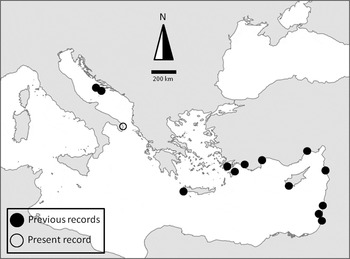
The first record of E. anatina in the Mediterranean basin dates back to 1980, when this moray species was reported from the Israeli waters by Ben-Tuvia & Golani (Reference Ben-Tuvia and Golani1984). Since then, this fish has been recorded from Rhodes and Elafonissos Islands (Greece), the southern coast of Turkey, the Syrian coast, Cyprus and, very recently (in 2010), along the eastern Adriatic coast (Croatia; see Lipej et al., Reference Lipej, Furlan, Antolovic, Golani and Dulcic2011 and references therein) (Figure 1).
Map reporting the previous records of fangtooth moray in the Mediterranean basin, and the one reported from the Ionian Sea (Apulia, south-eastern Italy).

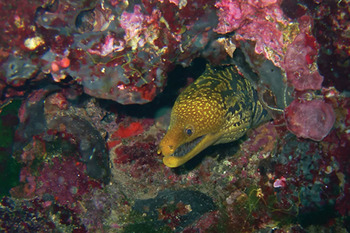
The main characteristics of this fish are the body very elongated (typical of muraenid fish), the dorsal fin very long and originating above branchial opening, together with anal fin confluent with caudal fin. Pectoral and pelvic fins are absent. The head is pointed and shows an elevated occipital region. The anterior nostril is tubular, while the posterior one can be round- to oval-shaped and opens in front of eyes. The mouth is large, its cleft extending back well behind eye. Jaws are arched, with many fang-like teeth that remain visible even when the mouth is in a closed position. This species has no scales on the body, this latter being dark to brown coloured with yellow blotches and dots arranged along longitudinal rows. Snout and cheeks are light brown with yellow dots. The size (i.e. total length) of E. anatina is commonly around 50–100 cm total length (maximum 120 cm: Golani et al., Reference Golani, Orsi-Relini, Massutí and Quignard2002; Froese & Pauly, Reference Froese and Pauly2011).
The fangtooth moray is reported to live from a few metres to about 60 m depth, occurring occasionally among rocks and rubble. As many other muraenids, it is a cryptic and sedentary predatory fish, which commontly stays concealed, waiting for prey mostly represented by other fish, molluscs and crustaceans (Maigret & Ly, Reference Maigret and Ly1986).
The aim of this note is to report the first record of fangtooth moray in the Ionian Sea (Mediterranean basin).
The specimen of fangtooth moray, the object of this record in the Ionian Sea (Figure 2) was found while diving nearby of the entrance of a marine cave located at Marina di Corsano (39°53′12.41″N and 18°23′52.06″E; Otranto Channel, south-eastern Apulia, Italy; Figure 1).
Photograph of the specimen of fangtooth moray recorded at Marina di Corsano (south-eastern Apulia, Italy) clearly showing the distinctive arched jaws, typical of the species.

The rocky bottom where the sightings took place was mostly rocky, rich in crevices and holes, with rocks covered by a sciaphilous assemblage of benthic macroalgae and sessile animals. The first sighting occurred on 4 August 2011 in a crevice of the east wall at the entrance of a submerged cavity, at a depth of ~6 m in a day of calm sea. The second sighting (likely of the same specimen) took place in the same locality, on 30 August 2011. On the occasion of both sightings water temperature was around 26°C. As usual for moray species, only the head was visible, while the rest of the body remained hidden within the rocks. However, due to the peculiar characteristic of the arched jaws, the nostrils and the livery of the head, the identification of the morey at species level was possible and quite easy in the occasion of both sightings. Different features characterize, in fact, the other two morey species living in the Mediterranean Sea, with which the fangtooth moray could be potentially confused: Gymnothorax unicolor has no arched jaws and the body is uniformly coloured; Muraena helena has no arched jaws, and both posterior and anterior nostrils have tubes. In addition to E. anatina another 14 moray species are reported as belonging to the genus Enchelycore (Froese & Pauly, Reference Froese and Pauly2011). These species, however, generally display completely different livery and/or body shape from E. anatina and, in addition, their distribution areas are very far from the Mediterranean borders (e.g. western Atlantic or tropical waters).
The present note about the presence of the fangtooth moray in the Ionian Sea, therefore, is interesting as this record represents a further step westwards for the spread of this species in the Mediterranean basin. The previous record in temporal terms, from this point of view, was the one from Croatia (Lipej et al., Reference Lipej, Furlan, Antolovic, Golani and Dulcic2011), i.e. from the eastern side of the Adriatic Sea, which involves that the species could have ‘jumped' the east Adriatic in a south-west direction. An alternative view, nevertheless, which may be as plausible is that the fangtooth moray arrived in the Ionian Sea directly from the Atlantic waters, just considering that its original distribution area is the eastern Atlantic.
On the one hand, this fast expansion is something expected considering some biological traits of the species (e.g. the long pelagic larval stage) enabling this moray to cross long distances. On the other hand, it remains unknown why this species, entered via Gibraltar (i.e. from the Atlantic Ocean); it was firstly reported from the eastern Mediterranean and it is expanding westwards, with no records until now from the western sector of the basin. The species, even though the records are becoming more and more frequent, still remains quite rare. The record of this moray, in any case, contributes to the change of the Mediterranean fish fauna that occurred in these decades (Golani et al., Reference Golani, Orsi-Relini, Massutí and Quignard2002).
The fangtooth moray, in conclusion, is not only a species in progressive expansion westwards that is continuously added to the local lists of fish species from the various sectors of the Mediterranean, but it is also an active predator, such as other spreading non-native predatory fish like the cornet fish Fistularia commersioni and the African hind Cephalopholis taeniops (Dulcic et al., Reference Dulcic, Scordella and Guidetti2008; Guidetti et al., Reference Guidetti, Giardina and Azzurro2010). Non-native predatory fish, along with non-native herbivorous fish, have the potential to heavily affect native communities directly (via predator–prey interactions) and indirectly (via food web or habitat alterations) (Stergiou & Karpouzi, Reference Stergiou and Karpouzi2002; Sala et al., Reference Sala, Kizilkaya, Yildirim and Ballesteros2011). All the above issues suggest how important it is to keep monitoring the presence and expansion of the geographical ranges of non-native species in the Mediterranean Sea, especially in those areas that are known to be crucial crossroads across the basin, such as the Sicily Channel (see Andaloro & Azzurro, Reference Andaloro and Azzurro2004; Guidetti et al., Reference Guidetti, Giardina and Azzurro2010; but see Zenetos et al., Reference Zenetos, Gofas, Verlaque, Cinar, Garcia Raso, Bianchi, Morri, Azzurro, Bilecenoglu, Froglia, Siokou, Violanti, Sfriso, San Martin, Giangrande, Katagan, Ballesteros, Ramos-Espla’, Mastrototaro, Ocana, Zingone, Gambi and Streftaris2010 and references therein for a general view) or, like in this study, the Otranto Channel.