1. Introduction
How interpreting experience may help strengthen domain-general cognitive control is part of the research on the plasticity of the human cognitive system. This issue of interpreter advantage is generally investigated by comparing interpreting experience with general bilingual experience, based on the fact that interpreters are all bilinguals and on the assumption that the additional language experience of interpreting will produce an impact on cognitive control. Interpreting is a cognitively highly demanding language task, taxing heavily on cognitive control, and it is thus assumed that cognitive control may get strengthened because of the intense exercise during interpreting. Previous research mainly focused on the basic cognitive control (executive) functions of working memory, inhibitory control and cognitive flexibility (or mental set shifting, switching ability) (see Dong & Zhong, Reference Dong, Zhong, Schwieter and Paradis2019; García, Muñoz & Kogan, Reference García, Muñoz and Kogan2020 for reviews). Most research shows that interpreting experience gradually enhances one's working memory (from updating to spans, see Wen & Dong, Reference Wen and Dong2019 for a meta-analysis), and cognitive flexibility (from local control to global control in switching tasks, see Zhao & Dong, Reference Zhao and Dong2020). As for inhibitory control, almost all behavioral studies failed to find evidence supporting an interpreter advantage (e.g., Babcock & Vallesi, Reference Babcock and Vallesi2017; Dong & Liu, Reference Dong and Liu2016), but the ERP study by Dong and Zhong (Reference Dong and Zhong2017) did find evidence showing that interpreting experience enhances one's performance in the Flanker task that is supposed to test inhibitory or interference control. All such research indicates that the task of interpreting helps strengthen the three basic executive functions of cognitive control.
An executive function that is less explored but also essential to the successful accomplishment of interpreting tasks is coordination or dual-tasking (Dong & Li, Reference Dong and Li2020; Reference GileGile, 1995/2009; Strobach, Salminen, Karbach & Schubert, Reference Strobach, Salminen, Karbach and Schubert2014). Although there are different types of interpreting (e.g., consecutive interpreting, simultaneous interpreting, sight translation, etc.), all of them involve multiple processes or subtasks (e.g., listening and comprehending, memorizing, note-taking, speaking) that have to be dealt with within a very limited time period. Completing an interpreting task requires interpreters to appropriately manage these processes or subtasks, and the management involves coordination (Reference GileGile, 1995/2009). Interpreting training or experience may therefore exercise the ability of coordinating multiple processes, which may then result in an interpreter advantage in coordination.
As an executive function, coordination (or dual-tasking, cf. Strobach et al., Reference Strobach, Salminen, Karbach and Schubert2014) is complex, and as a skill, coordination seems hard to acquire, which is probably one of the reasons why the few studies exploring how interpreting experience may affect one's coordination ability (Becker, Schubert, Strobach, Gallinat & Kühn, Reference Becker, Schubert, Strobach, Gallinat and Kühn2016; Morales, Padilla, Gómez-Ariza & Bajo, Reference Morales, Padilla, Gómez-Ariza and Bajo2015; Padilla, Bajo & Macizo, Reference Padilla, Bajo and Macizo2005; Strobach, Becker, Schubert & Kühn, Reference Strobach, Becker, Schubert and Kühn2015) all employed professional interpreters. However, the demand to coordinate multiple processes under extreme time pressure must be more demanding for interpreting students than for professional interpreters, and research on how this skill may get strengthened at early training stages may enrich our understanding not only of interpreting-related issues but also of coordination itself.
1.1 Effects of interpreting training/experience on coordination
Up till now, only a few empirical studies (Becker et al., Reference Becker, Schubert, Strobach, Gallinat and Kühn2016; Morales et al., Reference Morales, Padilla, Gómez-Ariza and Bajo2015; Padilla et al., Reference Padilla, Bajo and Macizo2005; Strobach et al., Reference Strobach, Becker, Schubert and Kühn2015) have explored the potential effect of interpreting training or experience on coordination. Among these studies, Strobach et al. (Reference Strobach, Becker, Schubert and Kühn2015) and Becker et al. (Reference Becker, Schubert, Strobach, Gallinat and Kühn2016) reported an interpreter advantage in coordination. Specifically, in Strobach et al. (Reference Strobach, Becker, Schubert and Kühn2015), control participants with only consecutive interpreting (CI) and translation experience and professional interpreters with the additional experience of simultaneous interpreting were asked to perform a dual-task, which consisted of an auditory task requiring participants to determine the pitch of a tone (high, medium and low), and a visual task requiring them to determine the size of a triangle (large, medium, and small). In the single-task condition, only one of the tasks was presented, while in the dual-task condition, the auditory task (Task 1) was presented first, followed by the visual one (Task 2) with different SOAs (stimulus onset asynchrony). For Task 1, SIs made faster responses than controls in both the single- and dual-task conditions, and the differences between the two participant groups were larger in the dual-task condition. For Task 2, SIs made faster responses than controls only in the dual-task condition, but not in the single-task one. Thus, in both tasks, SIs revealed better performance than the controls in the dual-task condition in relation to the single-task one (i.e., better performance in the former condition remained when the contribution of the latter was excluded), suggesting an interpreter advantage in coordination. Becker et al. (Reference Becker, Schubert, Strobach, Gallinat and Kühn2016), with almost the same sample of participants tested with the fMRI technique, also reported an interpreter advantage in Task 2 performance.
However, Morales et al. (Reference Morales, Padilla, Gómez-Ariza and Bajo2015) and Padilla et al. (Reference Padilla, Bajo and Macizo2005) failed to obtain an interpreter advantage in coordination. Padilla et al. (Reference Padilla, Bajo and Macizo2005) asked professional interpreters, professional non-interpreters and psychology students of high working memory (WM) span to perform a dual-task consisting of a free recall task and a visual tracking task, and no group difference concerning coordination was obtained between the interpreter group and the other two groups. Morales et al. (Reference Morales, Padilla, Gómez-Ariza and Bajo2015) asked SIs and general bilingual controls to perform a dual-task composed of a visual and an auditory N-back tasks, and the results revealed no evidence supporting an interpreter advantage in coordination.
Whether or not an interpreter advantage was observed is probably related to specific methods adopted. Morales et al. (Reference Morales, Padilla, Gómez-Ariza and Bajo2015) reported performance accuracy, and Padilla et al. (Reference Padilla, Bajo and Macizo2005) adopted tasks with non-speeded responses, which is probably not sensitive enough for group differences (Strobach et al., Reference Strobach, Becker, Schubert and Kühn2015). However, the studies that have found such an interpreter advantage (Becker et al., Reference Becker, Schubert, Strobach, Gallinat and Kühn2016; Strobach et al., Reference Strobach, Becker, Schubert and Kühn2015) employed the Psychological Refractory Period (PRP) dual-task which involves two tasks with speeded responses and with RT as the major index.
1.2 Dual-task: Psychological Refractory Period (PRP)
“PRP” is used to describe a dual-task situation where the delay of the response for the second task tends to become shorter when the SOA between the two tasks becomes larger (Pashler, Reference Pashler1994). In a typical PRP dual-task, as illustrated in Figure 1, participants are instructed to give response priority to Task 1, i.e., the task presented first. The response-selection bottleneck (RSB) model is an influential theory expounding the mechanism of processing the PRP task (Fischer & Plessow, Reference Fischer and Plessow2015). The model proposes a structural bottleneck where the central stage of processing for each task, i.e., response selection (“RSelect” in Figure 1) can only proceed serially so that the response selection of Task 2 (“RSelect2”) has to be suspended until that of Task 1 (“RSelect1”) has passed the bottleneck. In such a dual-task situation, participants need to appropriately coordinate the two tasks to accomplish the dual-task.
Illustration of a Psychological Refractory Period dual-task with two SOA conditions for Task 2. (adapted from Fischer & Plessow, Reference Fischer and Plessow2015 and Strobach et al., Reference Strobach, Becker, Schubert and Kühn2015). The processing of each task proceeds from stimulus perception (Percp1/2) to response selection (RSelect1/2) and then to motor response (MotorR1/2). Response selection can only be processed serially, and RSelect2 can be processed only after the completion of RSelect1. TC1/TC2/TC3: task coordination at different stages.

Better coordination, as tested in a PRP dual-task, is usually indexed by smaller dual-task cost, i.e., the performance difference between the dual- and the single-task conditions (e.g., Becker et al., Reference Becker, Schubert, Strobach, Gallinat and Kühn2016; Liepelt, Strobach, Frensch & Schubert, Reference Liepelt, Strobach, Frensch and Schubert2011). Strobach et al. (Reference Strobach, Becker, Schubert and Kühn2015) further specified three components of the coordination skill, i.e., task instantiation at the start of dual-task processing (TC1 in Figure 1; “task instantiation” hereafter), bottleneck access (TC2 in Figure 1) and bottleneck switching (TC3 in Figure 1), and associated them with advantages in coordination. If Group A exhibits better performance than Group B in both Task 1 and Task 2, Group A enjoys an advantage in either or both of the first two components, but if the better performance is restricted to Task 2, the advantage is associated with the third component (Strobach et al., Reference Strobach, Becker, Schubert and Kühn2015).
1.3 The present study
As mentioned earlier, probably due to the complexity of the coordination skill which renders it hard to acquire, the empirical studies investigating the interpreter advantage in coordination (Becker et al., Reference Becker, Schubert, Strobach, Gallinat and Kühn2016; Morales et al., Reference Morales, Padilla, Gómez-Ariza and Bajo2015; Padilla et al., Reference Padilla, Bajo and Macizo2005; Strobach et al., Reference Strobach, Becker, Schubert and Kühn2015) all focused on professional simultaneous interpreters. However, the advantage may not appear at one stroke, and there might be different manifestations at earlier stages of interpreting experience when students of interpreting training try to adapt to the needs of this highly demanding activity of interpreting. The investigation of the interpreter advantage in coordination at earlier interpreting training stages would thus boost our understanding of how this advantage appears and changes across different developmental stages.
The present study was thus intended to investigate the interpreter advantage in coordination at early interpreting training stages. As coordination is a complex skill hard to acquire, we would start the investigation with interpreting students at the intermediate training stage (i.e., graduate students majoring in interpreting, with nearly 2 years of interpreting training), and if an interpreter advantage was obtained, we would move forward to an earlier stage, i.e., undergraduate students having received interpreting training for less than a year. Moreover, interpreting students may undergo rapid changes at the beginning of interpreting training; we would therefore recruit two groups of interpreting students with more or less interpreting training (with each group compared with a control group) to see whether the amount of training would produce different impacts.
The interpreter advantage in the present study, if there is any, may differ from that found in the extant literature (e.g., Strobach et al., Reference Strobach, Becker, Schubert and Kühn2015), as participants in the present study were consecutive interpreting students while those in Strobach et al. (Reference Strobach, Becker, Schubert and Kühn2015) are simultaneous interpreting professionals. Simultaneous interpreting professionals, with their considerable expertise, can manage both comprehension and production phases, including all their subtasks like listening, speaking, memorizing, etc., in a parallel way. Consecutive interpreting students, however, may be unable to deal with the subtasks in a fully parallel way, and they may intermittently switch their primary focus between different processes or subtasks. For instance, they may sometimes pay more attention to the listening process and sometimes to the note-taking one. This is indeed a possible way of coping with two continuous tasks that proceed simultaneously (Pashler, Reference Pashler1994). Additionally, they may also need to efficiently switch from the listening phase to the speaking one when the speaker stops talking. These switching processes resemble bottleneck switching as both of them involve rapid shift between two sequentially scheduled components, with one task being halted until the completion of the preceding one. Therefore, the potential interpreter advantage in coordination in the present study, which is closely related to CI training, may be associated with the bottleneck switching component of coordination (see Figure 1). If an advantage in coordination was to be found in the present study, the advantageous group of interpreting students would outperform in dual-task costs (suggesting better coordination), and the better performance would be restricted to Task 2 (suggesting bottleneck switching).
2. Experiment 1
Experiment 1 aimed to explore the interpreter advantage in the coordination skill at the intermediate stage of interpreting training.
2.1 Methods
Participants
Altogether 76 Chinese–English bilingual graduate students between the ages of 21 and 26 from a university in China participated in Experiment 1 for monetary compensation. The participants signed a written consent before the experiments. All of them were right-handed (tested by Coren, Reference Coren1992) and had normal or corrected-to-normal vision.
The background information of these Chinese–English bilingual participants such as age, L2 age of acquisition and frequency of L2 use were collected by an adapted version of the Language History Questionnaire 2.0 (LHQ 2.0; Li, Zhang, Tsai & Puls, Reference Li, Zhang, Tsai and Puls2014). The amount of interpreting training was reported by participants themselves. Their intelligence was tested by the Combined Raven's Test (Department of Psychology, East China Normal University, 1991), and their L2 proficiency was gauged by the Oxford Quick Placement Test (version 2, Syndicate, Reference Syndicate2001). Participants’ working memory was tested by an operation span (testing WM span), adapted from Unsworth, Heitz, Schrock and Engle (Reference Unsworth, Heitz, Schrock and Engle2005) and a visual-spatial N-back task (testing WM updating). In addition, parents’ education was measured by a seven-point scale (1: elementary school and below; 2: middle school; 3: high school; 4: junior college; 5: bachelor's degree; 6: master's degree; 7: doctoral degree).
Data of five participants were excluded for two reasons. First, three participants had an accuracy rate (ACC) lower than 60% in the N-back task. Second, two participants had an ACC lower than 44% in a certain condition in the dual-task. We chose a relatively low criterion of 44% for two reasons. First, 44% is acceptable, as with three choices for each response, the ACC for guessing is around 33%, much lower than 44%. Second, more participants and more data would be preserved when choosing this particular percentage.
Among the 71 participants that remained, 35 (4 male, 31 female) were first-year graduate students majoring in interpreting, and the other 36 (3 male, 33 female) were first-year graduate students majoring in other branches of English, i.e., linguistics or literature. The interpreting group had received an average of 1.97 years of the training, and during the semester when they participated in the experiment, they had been receiving an average of 11.77 hours of interpreting training per week (4 hours of in-class training and on average 7.77 hours of after-class practice). The control group did not take any interpreting courses and seldom practiced interpreting (on average less than 0.25 hour per week) during the semester when they took part in the experiment, although they had received some interpreting training mostly when they were at the 3rd or 4th year of their undergraduate studies as an English major. The background information of these participants is summarized in Table 1.
Summary of participants’ background information in Exp 1 (means with SDs in brackets)

Notes: aIE (hours per week): the hours of interpreting experience per week during the semester of the experiment; bAoA: age of acquisition; cApart from interpreting experience, the participant groups differed in both Father's and Mother's education levels, but stepwise regression analyses showed that only the latter (ps < .05) but not the former (ps > .1) could predict some of the dependent variables and was thus used as a covariate in the data analysis. dWM updating accuracy was indexed by the accuracy of the N-back task, while efficiency was indexed by RT. **: p < .01; ***: p < .001.
As Table 1 reveals, the two groups of participants differed in interpreting training experience (t = 14.951, p < .001, Cohen's d = 3.549). Besides, other background information including personal traits (intelligence, age and working memory), and L2 status (L2 proficiency, L2 AoA, L2 learning history, and frequency of L2 use) were well matched. Although the two groups also differed in factors of Father's and Mother's education levels, stepwise regression showed that only the latter (ps < .05) but not the former (ps > .1) could predict some of the dependent variables (i.e., Task 2 cost RT). Therefore, Mother's education level was used as a covariate in the data analysis.
Experiment task
The dual-task in the present study is similar to that in Strobach et al. (Reference Strobach, Becker, Schubert and Kühn2015). It consisted of an auditory (Task 1) and a visual (Task 2) tasks. In Task 1, participants would hear a tone whose pitch was high (3250 Hz), middle (880Hz) or low (350 Hz), and they were asked to respond to the tones respectively with the fourth finger, the middle one, and the index one of their right hand. With the same three fingers (i.e., fourth, middle and index) of their left hand, they were required to make a response to triangles of small, medium or large size in Task 2. The background of the screen was black throughout the experiment.
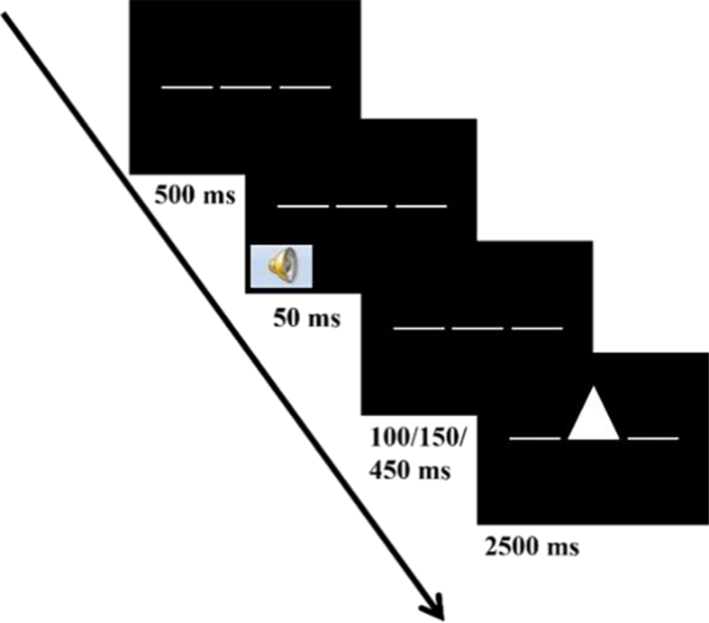
The experiment started with a single-task block of the auditory task (i.e., only the tones were presented), and then that of the visual task (i.e., only the triangles were presented), followed by three dual-task blocks (i.e., both types of stimuli were presented). In single-task blocks, each trial began with three horizontally arranged white dashes, with the central one placed at the center of the screen. After 500 ms, a tone was presented for 50 ms, or a triangle was presented above the central dash until the end of the trial (i.e., when a response was made or when it exceeded 2500 ms after stimulus onset). In dual-task blocks, three dashes were presented first in the same way as that in the single-task blocks. Then a tone was presented for 50 ms, followed by a triangle with a pseudo-randomly presented SOA of 100 ms, 150 ms or 450 ms (with the same SOA not appearing in more than three consecutive trials, and each block containing an equal number of the three SOAs). The triangle disappeared at the end of the trial (i.e., when a response for the triangle was made or when it exceeded 2500 ms after the onset of the triangle). In both single-task and dual-task blocks, the next trial would begin when the previous one ended. The dashes remained on the screen throughout the experiment. Participants were instructed to give response priority to Task 1, and were required to make responses as accurately and quickly as they could. Figure 2 is a schematic illustration of the trial procedure in the dual-task blocks.
Schematic illustration of the trial procedure in the dual-task blocks.

Each single-task block consisted of 54 trials, with 18 trials for each type of stimuli (i.e., low, middle, and high tones, or small, medium, and large triangles). Each of the three dual-task blocks consisted of 54 trials (stimuli pairs), with two trials for each of the 9 types of stimulus pair (low/medium/high tone ~ small/ medium/ large triangle) at each of the three SOA conditions. In addition, there was one practice block of nine trials before each of the single-task block, and two practice blocks of nine trials each before the dual-task blocks. Within each block, the trials were pseudo-randomly presented on the condition that the same stimulus did not appear in more than three consecutive trials. The whole experiment lasted for around 20 minutes.
Data analysis
As for data trimming, trials with incorrect responses (including incorrect order of responses in dual-task conditions) or no responses were deleted first. Then, trials with response time exceeding mean (individual mean) ±3SD were deleted. A total of 0.67% of the original data were lost in the data trimming procedure.
Statistical analysis was conducted for data obtained from the dual-task experiment, including accuracy (ACC) and response time (RT) for Task 1 and Task 2. The four types of data were analyzed separately following the same procedure. As mentioned in Introduction, better coordination skill would be reflected in smaller dual-task costs. Therefore, the dual-task costs were subjected to an ANCOVA analysis with a between-group variable of Group (Interpreting, Control), a within-group variable of Condition (dual-task_100, dual-task_150, dual-task_450, with 100, 150, 450 referring to the three SOA conditions), and a covariate of Mother's education level.
In addition, the appendix (in supplementary materials online) presents the results of raw data analysis, which were subjected to the same ANCOVA, except that there were four levels in the variable Condition (single-task, dual-task_100, dual-task_150, dual-task_450, with 100, 150, 450 referring to the three SOA conditions). The results of the raw data analysis reached the same conclusion as those of the dual-task costs analysis below. Please see the appendix for more details.
2.2 Results
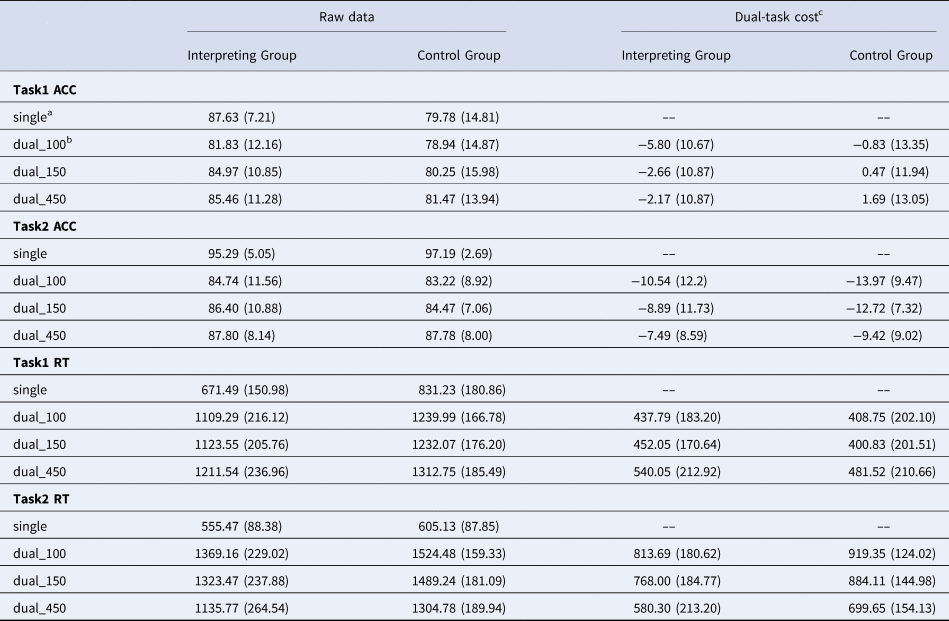
The results of the ANCOVA analysis for dual-task costs in ACC and RT are summarized in Table 2 and reported as follows.
Group means (with SD) of raw data and dual-task costs in ACC (%) and in RT (ms) in each task and in each condition in Exp 1

Note: asingle: single−task condition; bdual: dual−task, with 100, 150 and 450 referring to the three SOA conditions); cdual−task cost: differences between dual- and single-task conditions.
ACC results: Task 1
The ANCOVA (Group × Condition, with a covariate of Mother's education level) revealed a main effect of Condition (F(2, 136) = 3.78, p = .030, η p2 = .053). Pairwise comparison with Bonferroni correction showed that the only difference among the three conditions was that the ACC cost was smaller in the dual-task_100 condition than in the dual-task_450 condition (p < .001). No other main effects or interactions were significant (Fs < 2, ps > .1).
ACC results: Task 2
The ANCOVA (Group × Condition, with a covariate of Mother's education level) revealed a main effect of Condition (F(2, 136) = 8.02, p = .001, η p2 = .106). Pairwise comparison with Bonferroni correction showed that the ACC cost was larger in the dual-task_450 condition than those in the other two SOA conditions (ps < .01), and the latter two did not differ from each other (p = .166). No other main effects or interactions were significant (Fs < 2.1, ps > .1).
RT results: Task 1
The ANCOVA (Group × Condition, with a covariate of Mother's education level) revealed a main effect of Condition (F(2, 136) = 9.08, p < .001, η p2 = .118). Pairwise comparison with Bonferroni correction showed that the cost in the dual-task_450 condition was smaller than those in the other two conditions (ps < .001), and the latter two did not differ from each other (p = 1.000). No other main effects or interactions were significant (Fs < 1.2, ps > .1).
RT results: Task 2
The ANCOVA (Group × Condition, with a covariate of Mother's education level) revealed a main effect of Group (F(1, 68) = 4.80, p = .032, η p2 = .066), with smaller RT costs for the Interpreting group than those for the Control, suggesting an interpreter advantage in the coordination skill. The main effect of Condition was also significant (F(2, 136) = 42.318, p < .001, η p2 = .384). Pairwise comparison with Bonferroni correction showed that all the three SOA conditions differed significantly from each other (dual-task_450 < dual-task_150 < dual-task_100, ps < .001). No others including the effect of the covariate or its interaction with other factors reached significance (Fs < 2.6, p > .1), suggesting no effects of Mother's education on the cost RT of Task 2.
To summarize, the key results are that the Interpreting group exhibited smaller dual-task costs in Task 2 than the Control group. However, no such results were obtained in Task 1. The results thus suggest an interpreter advantage in the coordination skill, especially in the bottleneck switching component.
2.3 Discussion
Experiment 1 was intended to investigate the interpreter advantage in the coordination skill at the intermediate stage of interpreting training. Two groups of graduate students (Interpreting vs Control) were asked to perform a PRP dual-task. The results showed that, the Interpreting group exhibited smaller dual-task costs than the Control group in Task 2, which were absent in Task 1. These results suggest an interpreter advantage in the coordination skill at the intermediate stage, and specifically, in the bottleneck switching component of the skill.
A direct reason for the advantage is probably that the interpreting students at the intermediate stage of (consecutive) interpreting training had received sufficient training, and their skill of switching between different processes under time pressure had been significantly improved. When performing a consecutive interpreting task, interpreters have to intermittently switch their primary focus between different processes or subtasks as a result of an inability to deal with all the processes or subtasks fully in parallel. For instance, they may sometimes pay more attention to the listening process and sometimes to note-taking. This is indeed a possible way of coping with two continuous tasks that proceed simultaneously (Pashler, Reference Pashler1994). Additionally, they may also need to rapidly switch from the comprehension phase to the production one. In other words, when a speaker stops talking, interpreters have to quickly disengage from the processes of listening, note-taking, etc., and swiftly get engaged in those of note-reading, production, etc. These switching processes resemble bottleneck switching as both of them involve rapid shift between two sequentially scheduled components, with one task being suspended until the completion of the preceding one. Constant practice of these switching processes may be beneficial to the bottleneck switching component of the coordination skill, leading to an advantage in the bottleneck switching component of coordination.
In addition, the analysis of the raw data (see Appendix for details) showed the Interpreting group were overall faster than the Control group in Task 1 RT, indicating that the Interpreting group processed auditory information more efficiently, which is probably due to interpreters’ need to quickly process the auditory input during interpreting.
3. Experiment 2
Experiment 2 aimed to explore the interpreter advantage in the coordination skill at the beginning stage of interpreting training, to examine whether the interpreter advantage obtained in Experiment 1 could be observed, or whether there were transitional features of the advantage at an earlier stage. Two groups of interpreting students with more or less interpreting training were recruited (with each interpreting group matched with a group of general bilinguals), which was respectively reported in Experiment 2a and 2b.
The methods in Experiment 2 were the same as those in Experiment 1, except for the participants recruited. All the participants signed a written consent before the experiments, and all of them had normal or corrected-to-normal vision and were right-handed (tested by Coren, Reference Coren1992). Background information was collected in the same way as that in Experiment 1. For brevity, only the details of participants are presented below and other parts about methods are omitted.
3.1 Experiment 2a
Methods
Altogether 72 Chinese–English bilingual undergraduate students between the ages of 19 and 22 participated in Experiment 2a for monetary compensation. Based on the same data trimming criteria as in Experiment 1, the data of eight participants were invalid and were thus excluded. Among the 64 participants that remained, 29 (5 male, 24 female) were third-year undergraduates majoring in English who had received about eight months of interpreting training, with 3.10 hours of training per week (1.33 hours of in-class training and on average 1.77 hours of after-class practice). The other 35 participants (7 male, 28 female) were third-year undergraduates with little interpreting training experience. The two participant groups were labelled respectively as the Interpreting-less group (relative to the Interpreting-more group in Experiment 2b) and the Control group.
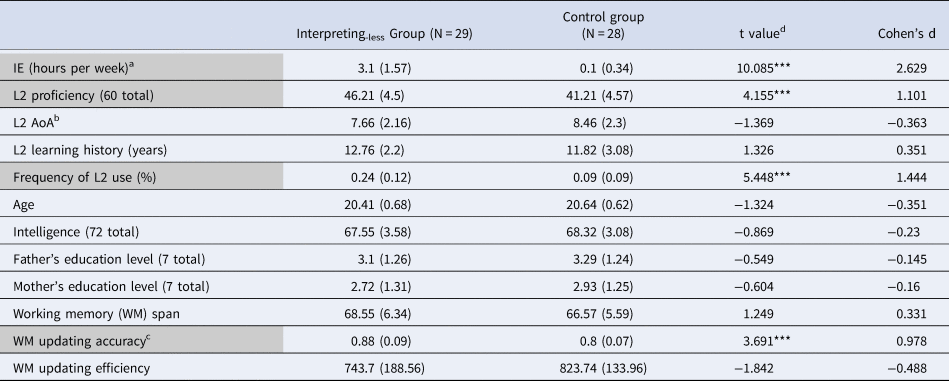
The two participant groups differed in WM updating efficiency (indexed by RT), but since it interacted with one of the independent variables (i.e., Condition), we could not take it as a covariant, and thus had to match the two participant groups on this factor, leading to a loss of seven participants from the Control group (with 28 participants left, 7 of them being male). Background information of the remaining participants is summarized in Table 3.
Summary of participants’ background information in Exp 2a (means with SDs in brackets)

Notes: aIE (hours per week): the hours of interpreting experience per week during the semester of the experiment; bAoA: age of acquisition; cWM updating accuracy was indexed by the accuracy of the N-back task, while efficiency was indexed by RT. dApart from interpreting experience, the participant groups differed in three factors, among which only L2 proficiency and frequency of L2 use predicted some dependent variables (ps < .05), as shown by stepwise regression analyses, and would thus enter data analysis as covariates. ***: p < .001.
As Table 3 shows, the two participant groups differed in interpreting training experience (t = 10.085, p < .001, Cohen's d = 2.629), with all other factors but L2 proficiency (t = 4.155, p < .001, Cohen's d = 1.101), frequency of L2 use (t = 5.448, p < .001, Cohen's d = 1.444) and WM updating accuracy (t = 3.691, p < .001, Cohen's d = 0.978), being matched, including L2 status (L2 AoA, L2 learning history), personal traits (age, intelligence and working memory span), and parents’ education level. As stepwise regression analyses showed that L2 proficiency and frequency of L2 use could predict some dependent variables, i.e., respectively RT for Task 2 cost in the SOA = 100 ms condition (p = .009), and ACC for Task 2 cost in the SOA = 450 ms condition (p = .003), they would enter data analysis as covariates.
Results
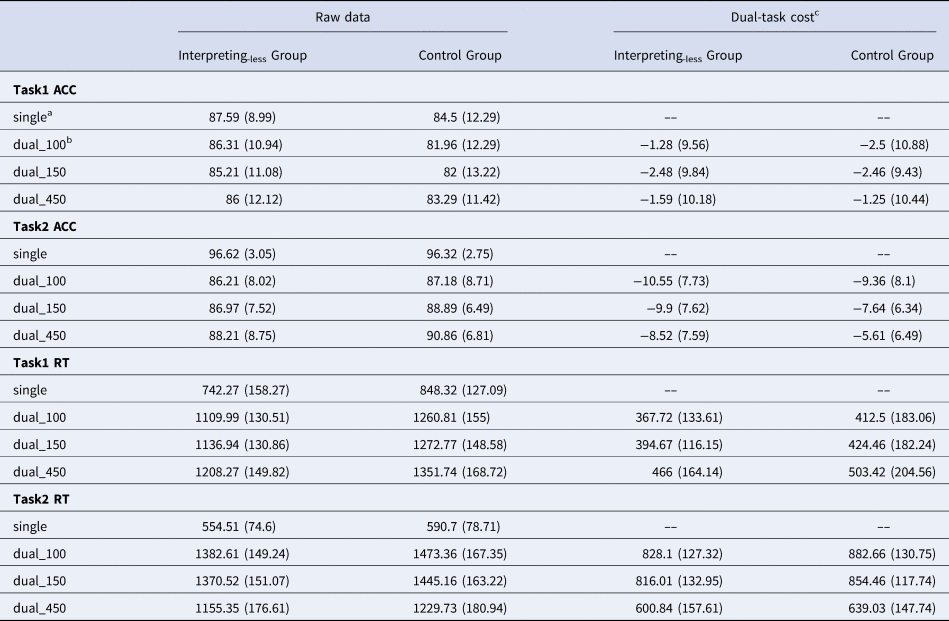
The same data trimming procedure (as in Experiment 1) resulted in a loss of 0.25% of the original data. The results of the dual-task costs in ACC and RT are reported below. Briefly, no significant group differences were obtained and the results are summarized in Table 4.
Group means (with SD) of raw data and dual-task costs in ACC (%) and in RT (ms) in each task and in each condition in Exp 2a

Note: asingle: single-task condition; bdual: dual-task, with 100, 150 and 450 referring to the three SOA conditions); cdual-task cost: differences between dual- and single-task conditions.
ACC results: Task 1
The ANCOVA (Group × Condition, with covariates of L2 proficiency and frequency of L2 use) did not reveal any significant results, i.e., none of the main effects or interactions reached significance (Fs < 3.2, ps > .08).
ACC results: Task 2
Similarly, the ANCOVA (Group × Condition, with covariates of L2 proficiency and frequency of L2 use) did not reveal any significant results (Fs < 3.7, ps > .06).
RT results: Task 1
The ANCOVA (Group × Condition, with covariates of L2 proficiency and frequency of L2 use) did not reveal any significant results, i.e., none of the main effects or interactions reached significance (Fs < 1.5, ps > .1).
RT results: Task 2
The ANCOVA (Group × Condition, with covariates of L2 proficiency, and frequency of L2 use) revealed a main effect of Condition (F(2,106) = 4.95, p = .011, η p2 = .085), with the dual-task cost for Task 2 RT being smaller in the dual-task_450 condition than that in the other two SOA conditions (ps < .001), but no significant difference between the latter two (p = .140). None of the other main effects or interactions reached significance (Fs < 3, ps > .06).
To summarize, no significant group differences were obtained in the dual-task costs of Task 1 ACC, Task 2 ACC, Task 1 RT or Task 2 RT, suggesting no evidence for an interpreter advantage in coordination at the beginning stage of interpreting training. For detailed discussion, see section 3.3.
3.2 Experiment 2b
Methods
Altogether 83 Chinese–English bilingual undergraduate students between the ages of 19 and 22 participated in Experiment 2b for monetary compensation. Based on the same data trimming criteria as in Experiment 1, the data of six participants were invalid and were thus deleted. Among the 77 participants that remained, 42 (4 male, 38 female) were third-year undergraduates majoring in translation and interpreting. They had received 8 months of interpreting training, with 5.48 hours of interpreting training per week (2.67 hours of in-class training and on average 2.81 hours of after-class practice). The other 35 participants (7 male, 28 female) were third-year undergraduates with no interpreting training experience. The two participant groups were labelled respectively as the Interpreting-more group (relative to the Interpreting-less group in Experiment 2a) and the Control group.
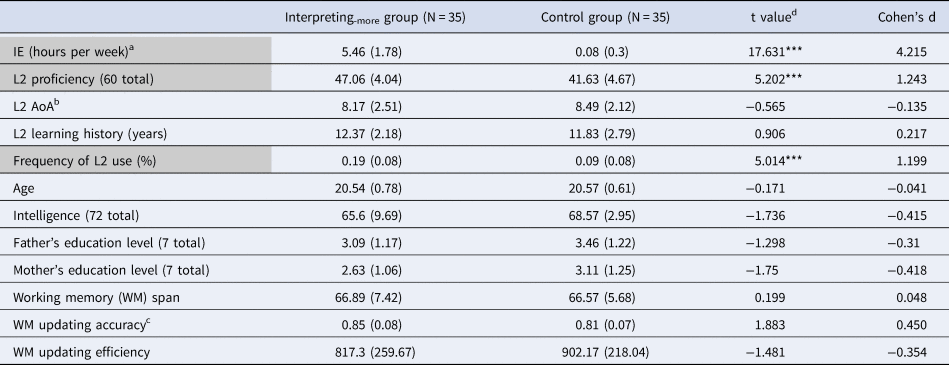
Similar to Experiment 2a, the participant groups differed in WM updating accuracy, but since this factor interacted with Condition, it could not enter data analysis as a covariant, and we had to match the participant groups on this factor, leading to a loss of seven participants from the Interpreting-more group (with 35 participants (4 male) left). Background information of the participants is summarized in Table 5.
Summary of participants’ background information in Exp 2b (means with SDs in brackets)

Notes: aIE (hours per week): the hours of interpreting experience per week during the semester of the experiment; bAoA: age of acquisition; cWM updating accuracy was indexed by the accuracy of the N-back task, while efficiency was indexed by RT. dApart from interpreting experience, the two participant groups differed in two factors, but neither of them could predict the dependent variables, as shown by stepwise regression analyses. ***: p < .001.
As Table 5 reveals, the two participant groups differed in interpreting training experience (t = 17.631, p < .001, Cohen's d = 4.215), with all other factors but L2 proficiency (t = 5.202, p < .001, Cohen's d = 1.243) and frequency of L2 use (t = 5.014, p < .001, Cohen's d = 1.199), being matched, including L2 status (L2 AoA, L2 learning history), personal traits (age, intelligence and working memory), and parents’ education level. As stepwise regression analyses showed that neither L2 proficiency nor frequency of L2 use could predict the dependent variables (ps > .05), they were not used as covariates in data analysis.
Results
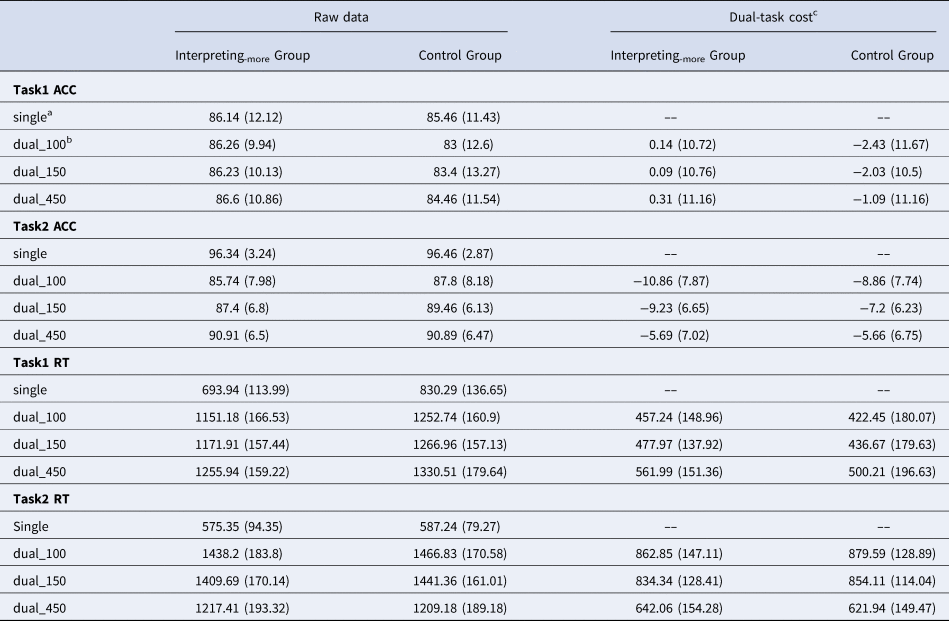
The same data trimming procedure as in Experiment 1 resulted in a loss of 0.29% of the original data. The results of the dual-task costs in ACC and RT are reported below. Similar to Experiment 2a, no significant group differences were obtained, and the results are summarized in Table 6.
Group means (with SD) of raw data and dual-task costs in ACC (%) and in RT (ms) in each task and in each condition in Exp 2b

Note: asingle: single-task condition; bdual: dual-task, with 100, 150 and 450 referring to the three SOA conditions); cdual-task cost: differences between dual- and single-task conditions.
ACC results: Task 1
The ANOVA (Group × Condition) revealed no significant results, i.e., none of the main effect of Group or Condition, or their interaction reached significance (Fs < 1, ps > .1).
ACC results: Task 2
The ANOVA (Group × Condition) revealed a significant main effect of Condition (F(2,136) = 15.42, p < .001, η p2 = .185), with the dual-task cost for Task 1 RT being smaller in the dual-task_450 condition than those in the other two SOA conditions (ps < .01), but no significant difference between these two conditions (p = .203). The main effect of Group and its interaction with Condition were not significant (Fs < 1.5, ps > .1).
RT results: Task 1
The ANOVA (Group × Condition) revealed a significant main effect of Condition (F(2,136) = 48.36, p < .001, η p2 = .416), with the dual-task cost for Task 1 RT being smaller in the dual-task_450 condition than those in the other two SOA conditions (ps < .001), but no significant difference between the latter two (p = .130). The main effect of Group and its interaction with Condition were not significant (Fs < 1.5, ps > .1).
RT results: Task 2
The ANOVA (Group × Condition) revealed a main effect of Condition (F(2, 136) = 303.62, p < .001, η p2 = .817), with the dual-task cost for Task 2 RT in all the three conditions differing significantly from each other (dual-task_450 < dual-task_150 < dual-task_100, ps < .05). The main effect of Group and its interaction with Condition were not significant (Fs < 2.2, ps > .1).
To summarize, no significant group differences were obtained in the dual-task costs of Task 1 ACC, Task 2 ACC, Task 1 RT or Task 2 RT, suggesting no evidence for an interpreter advantage in coordination at the beginning stage of interpreting training.
3.3 Discussion
Experiment 2 was intended to investigate the interpreter advantage in coordination at the beginning stage of interpreting training. Since interpreting students at this stage may undergo rapid changes, we recruited two groups of interpreting students having received less or more amount of interpreting training, i.e., around 3.1 hours (SD:1.57) or 5.46 hours (SD:1.78) a week for about eight months. When compared with bilingual control participants, the two groups of interpreting students did not show any advantage indexed in dual-task costs either in accuracy or RT, suggesting no evidence for an interpreter advantage in coordination at the beginning stage of interpreting training.
This null finding is reasonable since the coordination skill is complex and hard to acquire, and interpreting students at the beginning stage of interpreting training may have not received sufficient training conducive to an interpreter advantage in coordination. It is also possible that interpreting students at this stage are busy coping with other aspects of interpreting, e.g., the accuracy of the transmitted messages, the swift switching between languages.
Similar to Experiment 1, the analysis of the raw data (see Appendix for details) showed that the students of interpreting training were overall faster than their corresponding bilingual control participants in Task 1 RT, which again indicates that the interpreting students processed auditory information more efficiently.
4. General discussion
The present study aimed at investigating the interpreter advantage in the coordination skill at early stages of interpreting training. To achieve this goal, we recruited three groups of interpreting students, with one at the intermediate interpreting training stage (nearly two years), and two at the beginning stage (having received about 3.1 hours or 5.46 hours of interpreting training per week for about eight months). Each interpreting group was compared with a control group of bilingual students. The coordination skill was measured by a PRP dual-task, and was indexed by dual-task costs between the dual- and single-task conditions in Task 1 and Task 2.
Two crucial results were obtained. First, at the intermediate stage, the Interpreting group exhibited smaller dual-task costs only in Task 2 than the Control group, indicating an interpreter advantage in the coordination skill, or specifically, in the bottleneck switching component of coordination. Second, at the beginning stage, no group differences in any of the dual-task costs were obtained, suggesting no evidence for such an interpreter advantage at the beginning stage. These results suggest that the interpreter advantage in coordination may not appear until the intermediate stage of interpreting training. This is probably because coordination in interpreting (especially bottleneck switching in this context) requires interpreters to efficiently switch between different processes, which takes time for students to adapt to. Another reason might be that interpreting students at this stage may lay more emphasis on improving the accuracy of transmitted messages, on swift switching between languages and on keeping up with the fast pace of interpreting, and the improvement of the coordination skill may lag behind.
The advantage found in the present study for the intermediate stage is different from that in Strobach et al. (Reference Strobach, Becker, Schubert and Kühn2015), in which interpreters outperformed controls in both Task 1 and Task 2, suggesting an interpreter advantage in the task instantiation and/or bottleneck access components of coordination. As discussed in the introduction, the different results are pertinent to the differences in the mode of interpreting experience, i.e., simultaneous interpreting (SI) in Strobach et al. (Reference Strobach, Becker, Schubert and Kühn2015) and consecutive interpreting (CI) in the present study. The need in SI to coordinate simultaneously ongoing processes under great time pressure requires interpreters to efficiently activate relevant information at the start of interpreting, and get them into the “processor” in parallel, which is closely related to the task instantiation and bottleneck access components of the coordination skill. CI, however, is characterized by quick and intermittent switches between different processes or subtasks, which resembles the bottleneck switching process. Another source of the differences may be the duration of interpreting (training) experience. With over ten years of interpreting experience (Strobach et al., Reference Strobach, Becker, Schubert and Kühn2015), professional interpreters may have obtained enough expertise to coordinate the multiple processes in interpreting tasks in parallel, but with only around two years of interpreting training, the students may have to switch their primary focus among different processes of interpreting. It is hard to separately analyze the contributions of the above two factors to the differences between Strobach et al. (Reference Strobach, Becker, Schubert and Kühn2015) and the present study, as students generally start receiving CI training and turn to SI after having acquired enough expertise, but it merits further research.
Taking into consideration both the present study and Strobach et al. (Reference Strobach, Becker, Schubert and Kühn2015), we could delineate a more comprehensive picture of the development of the interpreter advantage in coordination. It would probably not appear until the intermediate stage of interpreting training, and bottleneck switching is the prominent feature for the coordination advantage at this stage. Then, at the professional stage, the advantage in other aspects of the skill, i.e., task instantiation and bottleneck access or either of them appears, indicating mastery of a multitasking skill required for professional performance in interpreting. This developmental trajectory reflects interpreters’ early progress in efficiently switching between different processes in consecutive interpreting tasks and later virtuosity in simultaneously dealing with multiple processes in simultaneous interpreting tasks.
The changes in the development of an interpreter advantage in coordination is more or less consistent with that in the development of interpreter advantages in working memory (WM) and cognitive flexibility (switching ability). As regards WM, at the very beginning of interpreting training (32 hours of classroom training), an advantage in WM updating showed up while that of WM span did not (Dong, Liu & Cai, Reference Dong, Liu and Cai2018). Then, at a later stage (tested at an intermediate stage), an advantage in WM span was obtained (see review in Wen & Dong, Reference Wen and Dong2019). Finally, at the professional stage, advantages in both WM updating (Henrard & Van Daele, Reference Henrard and Van Daele2017; Morales et al., Reference Morales, Padilla, Gómez-Ariza and Bajo2015) and WM span (see review in Wen & Dong, Reference Wen and Dong2019) were observed. As regards the switching ability measured by color-shape switching tasks, at the very beginning (e.g., as few as 32 hours of classroom training), interpreting students exhibited better performance than controls in switch cost as measured by a univalent color-shape switching task (Dong & Liu, Reference Dong and Liu2016; Zhao & Dong, Reference Zhao and Dong2020), an index for local switching ability. Then, at a later stage (intermediate stage), this advantage disappeared (measured by a bivalent color-shape switching task with interpreting students with 19.4 months of training, Babcock, Capizzi, Arbula & Vallesi, Reference Babcock, Capizzi, Arbula and Vallesi2017; and those with 24.4 months of training, Zhao & Dong, Reference Zhao and Dong2020). Finally, at the professional stage, the (simultaneous) interpreters outperformed the controls in mixing cost (again measured by the bivalent task, Babcock & Vallesi, Reference Babcock and Vallesi2017; Becker et al., Reference Becker, Schubert, Strobach, Gallinat and Kühn2016), an index for monitoring a switching task.
The complexity in the development of interpreter advantages in certain executive functions (e.g., coordination, WM and cognitive flexibility) may reflect interpreting students’ different foci at different training stages. For instance, at the very beginning, to meet the basic requirements of rapid switching between two languages and to keep pace with the continuous delivery of information (e.g., in note-taking), interpreting students may primarily focus on the speed and rhythm of switching and updating, leading to a boost in local switching and WM updating abilities. Along the same line of thinking, coordination at the beginning of interpreting training may fail to be optimized, due to its multitasking nature. Then, at a later stage, interpreting students may lay more emphasis on dealing with concurrent tasks (e.g., listening and note-taking) and efficiently switching between them, resulting in an enhancement of the coordination skill, especially the bottleneck switching component. Then, at the professional stage, interpreters are able to take a global control, as shown in interpreters’ monitoring advantage (Babcock & Vallesi, Reference Babcock and Vallesi2017; Becker et al., Reference Becker, Schubert, Strobach, Gallinat and Kühn2016) and in coordinating multiple tasks (Strobach et al., Reference Strobach, Becker, Schubert and Kühn2015). In short, the question of when and how the interpreter advantage of a certain ability or skill appears and develops may be contingent on the specific needs or features of interpreting at different training stages.
The present study shows that to explore the effects of training and life experiences on cognitive control, it is beneficial to investigate early stages. For interpreting training, students at early stages are undergoing rapid changes, and may show data patterns indicating how they gradually adapt to the demands of the interpreting task. For other experiences such as bilingualism or cognitive training, it is also worthwhile to investigate the early exhibition and the developmental trajectory of the possible effects. The step-by-step influence of the training or life experiences on cognitive abilities or skills may help elucidate the features and nature of the training or life experiences.
A weakness of the present study is that the tasks were not counterbalanced, i.e., Task 1 was always an auditory task while Task 2 was always a visual one. We adopted this design because it was the one adopted by Strobach et al. (Reference Strobach, Becker, Schubert and Kühn2015), so that a direct comparison can be made between the two studies, and a relatively comprehensive picture concerning the developmental trajectory of interpreter advantage in coordination can be drawn. Nevertheless, a counterbalance of the tasks can better exclude task-specific factors and shed light on the extension of the interpreter advantage in coordination.
To conclude, the present study offered evidence for the interpreter advantage in coordination and its development at early stages of interpreting training. The advantage associated with the bottleneck switching component of the skill did not appear until the intermediate stage of training, indicating interpreting students’ early progress in finding an efficient way to coordinate multiple tasks.
Acknowledgments
This work was supported by the National Social Science Fund of China (Grant number: 22BYY077). We thank Xiaochong Chen, Yaqiong Liu, Hongming Zhao and Fei Li for their help with the research.
Data availability
The data that support the findings of this study are openly available in Mendeley Data at http://doi.org/10.17632/s3smmnb5gy.1
Competing interests
The authors declare none.
Supplementary material
For supplementary material accompanying this paper, visit https://doi.org/10.1017/S1366728922000918