INTRODUCTION
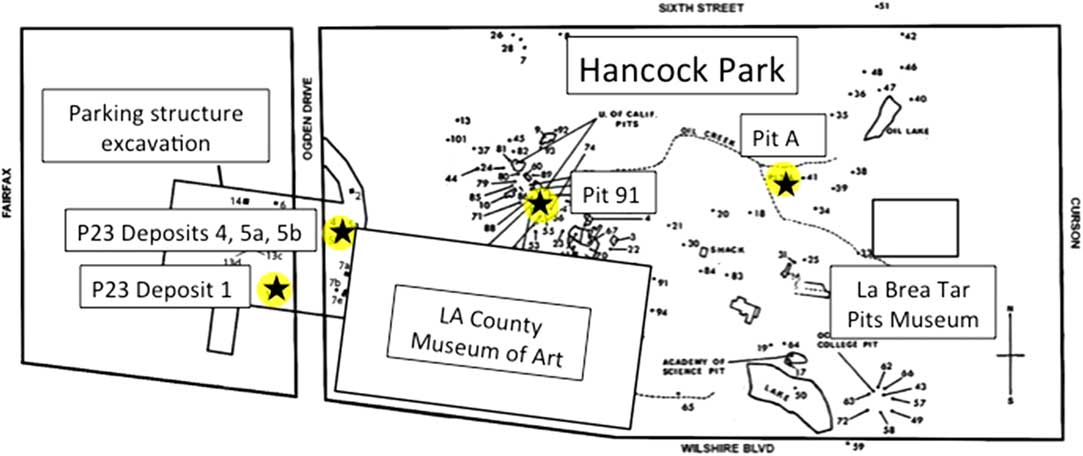
The Rancho La Brea Tar Pits of Hancock Park, a mid-city region within Los Angeles, California, constitute one of the richest Ice Age fossil localities in the world, and provide a record of shifting biotic communities during the Late Pleistocene in southern California (Figure 1). The Los Angeles Basin was a shallow and highly productive ocean basin in Miocene time, and like much of coastal southern California, it is now underlain by significant shallow petroleum reservoirs formed from the resultant marine sedimentary biomass. At the La Brea site, crude oil from the porous sedimentary rock of the underlying Salt Lake Oil Field has migrated to the surface via faulted zones, thereby forming numerous surface oil seeps. As crude oil pools at the surface, lighter fractions evaporate and leave behind a sticky asphalt residue that can trap and immobilize even large mammals. Age distributions of previous radiocarbon dates on bone and wood (Ward et al. Reference Ward, Harris, Cerling, Wiedenhoeft, Lott, Dearing, Coltrain and Ehleringer2005; Friscia et al. Reference Friscia, Van Valkenburgh, Spencer and Harris2008; O’Keefe et al. Reference O’Keefe, Fet and Harris2009; Fuller et al. Reference Fuller, Fahrni, Harris, Farrell, Coltrain, Gerhart, Ward, Taylor and Southon2014) suggest that some seeps are characterized by sharp peaks in entrapment events while others appear to have operated quasi-continuously for many millennia. Deposits that are starved of new oil eventually become inactive as the surface asphalt oxidizes and hardens into a solid cap, and some Pleistocene seeps are now covered by fluvial sediments.
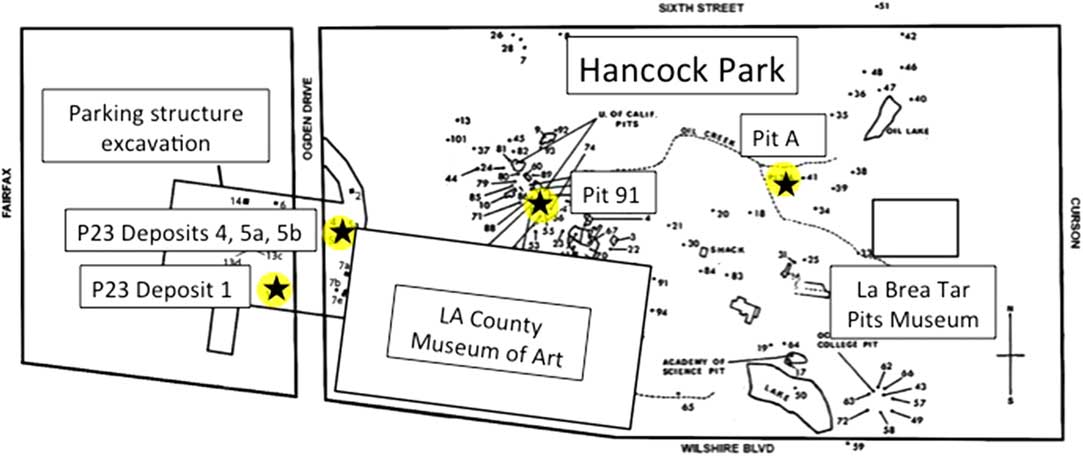
Map of Hancock Park and Rancho La Brea Tar Pits. A merged image of Project 23 by Jim Quinn, 2006 and other asphaltic deposits by Bonnie Templeton (Templeton Reference Templeton1964). Image by Carrie Howard. Pit Bliss not pictured because it is combined material researched by Dr Wesley Bliss from multiple, unconfirmed deposits.
Starting in the late 19th century, many of the larger deposits, commonly referred to as pits, were excavated to depths of 5 m or more to recover fossils. Despite the wide breadth of fossil organisms excavated from this site, these collections are mostly famous for their large holdings of mammalian megafauna and birds. While understandably charismatic, these specimens have overshadowed other equally vast collections, particularly insects. The opportunity to use insects as paleoenvironmental indicators (when confidently identified and provenance established) exists because most Quaternary, and even many Tertiary, insect species are still extant and can reasonably be assumed to have flourished under the same climatic conditions that they do today (Elias Reference Elias1994, Reference Elias2010; Coope Reference Coope2009). All Pleistocene beetles found at Rancho La Brea represent extant species, except for two scarab beetles that may have specialized on the dung of large and now-extinct mammals (Miller Reference Miller1983). Fossils of extant insect species whose temperature ranges are well documented can provide quantitative constraints on both summer and winter paleotemperatures (Elias Reference Elias1994, Reference Elias2010; Coope Reference Coope2009), The use of insects as a paleoclimate proxy is a well-established technique (Coope Reference Coope2009; Elias Reference Elias2010; Brooks and Langdon Reference Brooks and Langdon2014), which has distinct advantages in certain contexts over pollen analysis and other paleobotanical techniques. For example, it is possible to document rapid climate change using fossils of winged predaceous or scavenging insects, since many species are able to migrate rapidly to more suitable territory in response to abrupt variations in environmental conditions (Elias Reference Elias1994, Reference Elias2010; Coope Reference Coope2009).
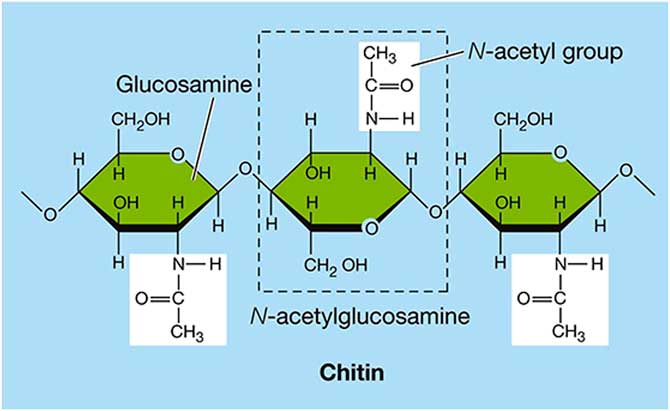
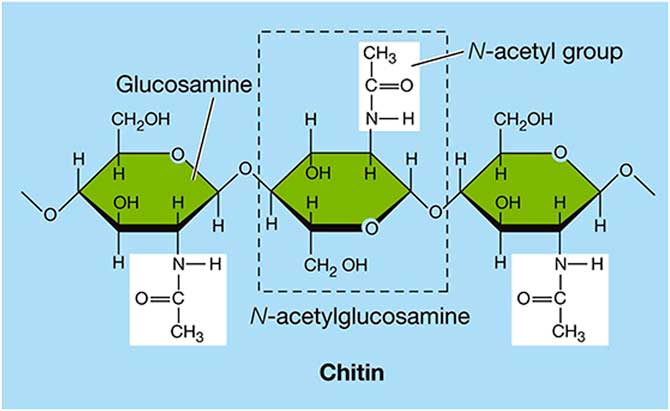
The vehicle for the 14C and isotopic studies presented here is insect chitin (Figure 2), a composite material constructed primarily from the biopolymer chitin plus structural proteins, often with a hardened and pigmented outer layer that is modified or sclerotized when cuticle proteins are cross-linked via reactions with phenolic compounds (Anderson Reference Andersen2010; Muzzarelli Reference Muzzarelli2011). Chitin shares structural and chemical properties with cellulose, and like cellulose is polymerized through condensation reactions involving the loss of a water molecule from hydroxyl groups on adjacent hexose sugar monomers. However, whereas cellulose is formed from glucose, the building block for chitin is the amino-sugar N-acetyl-glucosamine, in which one of the hydroxyl groups on the glucose ring is replaced by an acetylated amino group.
Chemical structure of chitin (Sadava et al. Reference Sadava, Hillis, Heller and Berenbaum2009)
Previous studies have attempted to date insect chitin but used unnecessarily complex protocols that resulted in insufficient material for measurement, and/or were unsuccessful in the removal of contaminants. As reviewed by Tripp and Higham (Reference Tripp and Higham2011), early 14C dating work on insect chitin yielded mixed results: some dates agreed with those on other noninsect materials, but others appeared highly discrepant for reasons that were variously attributed to old wood and hardwater effects, and the influence of old detrital carbon in insect diet. More recently, extensive studies of the deglacial St Bees peat section in northwest England by Walker et al. (Reference Walker, Bryant, Coope, Harkness, Lowe and Scott2001) and Hodgins et al. (Reference Hodgins, Thorpe, Coope and Hedges2001) showed systematic offsets between dates on different insect species, and all of the insect dates were significantly younger than dates on cellulose prepared from Carex (sedge) seeds. Subsequent efforts by the Oxford group initially focused on the development of single-compound dating of glucosamine monomer (Hodgins et al. Reference Hodgins, Thorpe, Coope and Hedges2001) and chitosan hydrochloride (Tripp et al. Reference Tripp, Higham and Hedges2004), but both methods gave poor yields and their more recent work on samples from archaeological contexts (Tripp et al. Reference Tripp, Higham and Hedges2004; Panagiotakopulu et al. Reference Panagiotakopulu, Higham, Buckland and Tripp2015) reverted to use of simple solvent and acid treatments. These yielded dates that were mostly consistent with expectations, though some problems were experienced with samples that had been stored for long periods in organic solvents or had otherwise been in prolonged contact with resins or hydrocarbons. Interestingly, the anomalously young St Bees samples did not receive base treatment to remove humics, which was applied as part of the Carex cellulose preparation and would normally be considered essential for materials recovered from peat; nor has it always been applied in subsequent studies, primarily due to concerns over low yields (Panagiotakopulu et al. Reference Panagiotakopulu, Higham, Buckland and Tripp2015).
The technique of using 18O/16O ratios in chitin from chironomid (midge) larvae in lake sediments as a paleotemperature monitor is now more than 10 years old (Walker et al. Reference Walker, Bryant, Coope, Harkness, Lowe and Scott2001; Wooler et al. Reference Wooler, Francis, Fogel, Miller, Walker and Wolfe2004; Verbruggen et al. Reference Verbruggen, Heiri, Reichart and Lotter2011; Hein et al. Reference Hein, Schilder and van Hardenbroek2012), but other stable isotopes in chitin have received less attention and little work has been done on the dietary proxies 13C/12C and 15N/14N in insects. As dietary compounds are recycled in the body or broken down and reassembled into other molecules, carbon and nitrogen isotopes undergo fractionation, with the result that there is often a strong relationship between isotope ratios in diet and those of consumers. When 13C/12C and 15N/14N ratios are expressed in the common δ notation as parts per thousand (per mil or ‰) deviation of isotope ratios in a sample from those of a standard: δ=(Rsample/Rstandard – 1) ×1000, where R is an isotope ratio.
These trophic level shifts are typically 1‰ for δ13C and 3‰ in δ15N (“you are what you eat plus a few per mil”), though significant variations about these mean values exist.
Early work by Schimmelmann and DeNiro (Reference Schimmelmann and DeNiro1986a) showed large differences in δ13C and δ15N between glucosamine and muscle biomass in two marine arthropods (∆δ15N=12‰ and ∆δ13C=2‰) and between the chitin acetyl group and the hexose ring (∆δ13C=6‰). Since these results suggested that compositional variations (chitin versus proteins) in bulk cuticle or varying degrees of deacetylation of chitin could wash out any useful isotopic dietary signatures, further work including controlled diet experiments (Schimmelmann and DeNiro Reference Schimmelmann and DeNiro1986b) was carried out using the single compound glucosamine hydrochloride, a chitin derivative. However, while those studies showed good correlations between δ13C of diet and glucosamine in several insect species, no such relationship was observed for δ15N. This result was highly surprising, as DeNiro and Epstein (Reference DeNiro and Epstein1981) had previously observed a good correlation between dietary and whole-chitin δ15N in the same species, and it calls into question the entire rationale for using single compounds rather than bulk chitin. Furthermore, Goedkoop et al. (Reference Goedkoop, Akerblom and Demandt2006) and Hein et al. (Reference Hein, Schilder and van Hardenbroek2012) subsequently found strong correlations for both δ13C and δ15N between diet and the chitinous head capsules of chironomid larvae, and Hodgins et al. (Reference Hodgins, Thorpe, Coope and Hedges2001) observed what appeared to be reasonable trophic level shifts in δ15N in solvent- and acid-treated chitin from the St Bees insect assemblages. Hence, while strong arguments have been made for using single compounds for insect stable isotope studies, there is empirical evidence that less rigorously purified chitin fractions may be useful and perhaps even preferable.
Our intention in this study was to establish methods for 14C dating and isotopic analysis of insect fragments from La Brea, to facilitate the use of insect assemblages as proxies for Late Pleistocene climate fluctuation in southern California and to gain a clearer understanding of tar pit taphonomy for individual deposits. We developed sample preparation techniques for removing residual asphalt and cleaning solvents from insect cuticle and used them to date insects from five La Brea deposits and to compare the results to known dates from bone collagen. We tested these methods by comparing 14C ages for insects, plant material, and collagen from an unusually rapid entrapment event in order to discern consistency or discrepancies in dates. We also tested whether 14C and isotopic results were impacted by variations in the preparation chemistry or the use of chitin from different layers of cuticle.
METHODS
A total of 28 insect samples were chosen from five asphalt deposits from Hancock Park (Figure 1). Specimens from Pits Bliss and A were excavated between 1913 and 1929 and cleaned with kerosene and xylol to remove as much asphalt and substrate as possible. Specimens from Pit 91 have been excavated at intervals since 1913 and prepared with a variety of chemicals including kerosene, xylol, and tetrachloroethylene. Other material studied was excavated from Boxes 1 and 5B, which represent different asphaltic deposits from Project 23, an ongoing excavation of 16 asphaltic fossiliferous deposits along the western edge of the La Brea Tar Pits. The deposits were exposed, crated into 23 wooden boxes (hence the project name), and transported to a nearby compound for examination. These fossils were soaked in Gentech (N-propyl bromide) to dissolve asphalt, and then rinsed with water. Using chemical solvents to prepare specimens from each of the aforementioned excavations resulted in recovery of numerous insect fragments with clearly visible detail. All specimens are stored dry and are housed at the George C. Page Museum, a branch of the Natural History Museum of Los Angeles County.
Specimens of insect chitin were prepared and dated at the W. M. Keck AMS Laboratory in the Department of Earth System Science at the University of California, along with associated samples of seeds, twigs, and bone plus blanks and standards. Stable isotopes (δ13C and δ15N) were measured where sample sizes permitted, or if insufficient material for 14C dating remained after the pretreatment chemistry.
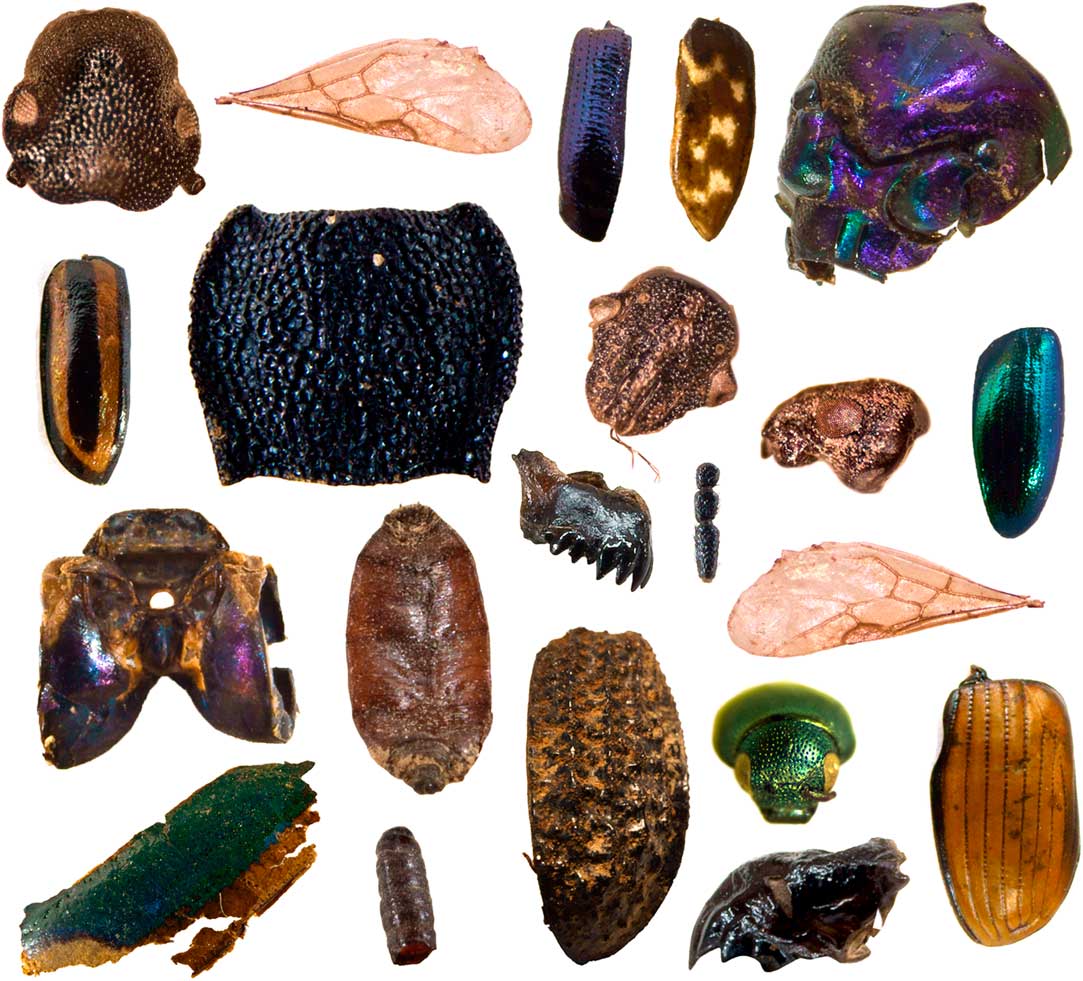
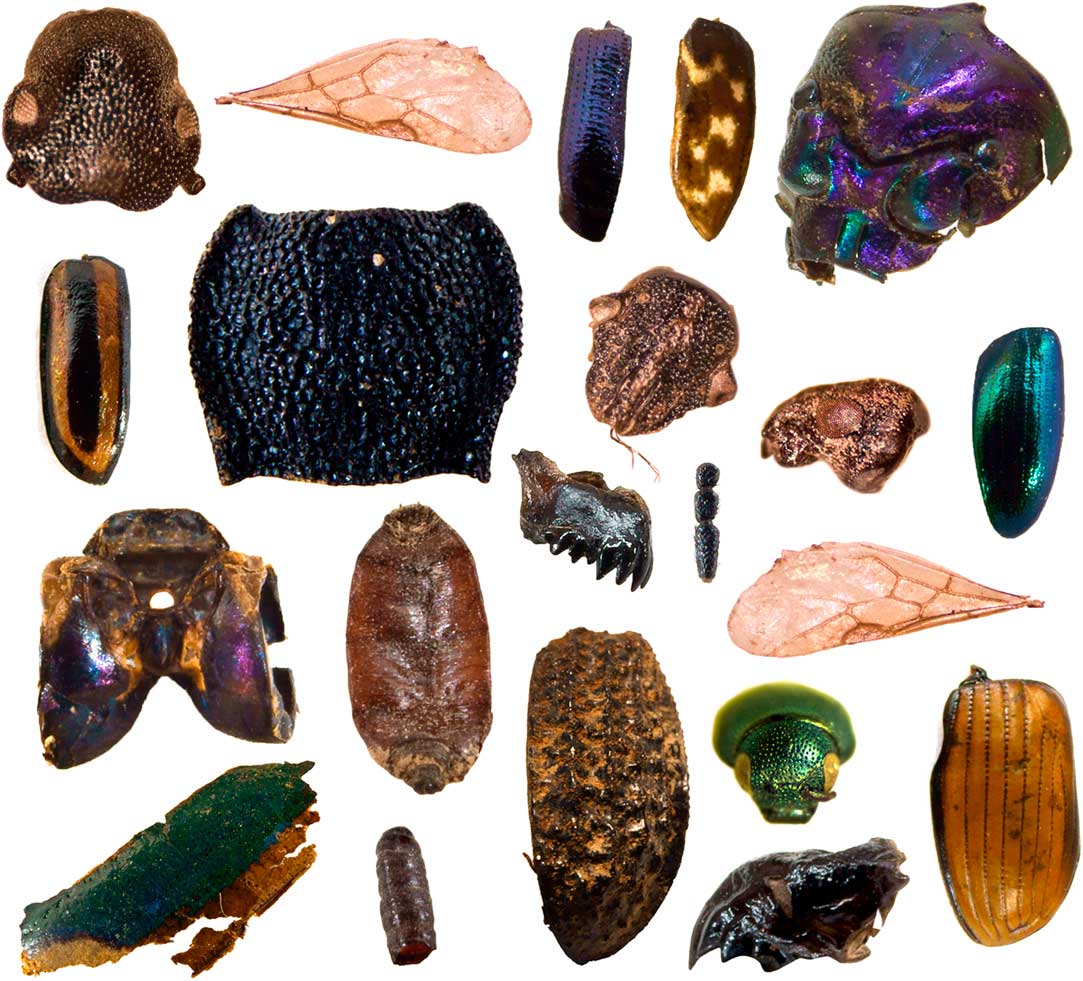
For testing consistency or discrepancies in dates on chitin and other materials, as well as before holding confidence in 14C dates material from less understood or lengthier entrapment events, we examined and dated specimens compacted in a C. hesternus skull from Project 23 Box 5B. This skull contained an unusually large quantity of insect and plant material, and for Rancho La Brea, this material is unique in the quality of its preservation. The camel skull and ribs were entrapped within a tabular single asphalt flow that was never subsequently rejuvenated by additional asphalt seepage, often caused fossils from different entrapment periods to mix. Insect and plant specimens from the skull show varying degrees of asphalt impregnation after fossil and before precombustion preparation treatment. Some appear completely pristine and some are clearly contaminated (Figure 3). This provides additional evidence that the camel and insect material was entrapped within a short interval. Furthermore, the exquisitely preserved insect specimens, which include ant wings and soft-bodied damselflies, often semi-articulated and virtually indiscernible from modern material, would have degraded if immersed in water or exposed to liquid asphalt for extended periods. It is probable that insect and plant material collected along stream or river margins was moved into the skull during a flood or overbank event.
Unusually well-preserved insect specimens compacted inside a Camelops skull from Project 23, Box 5B
As few rapid entrapment events have been clearly identified at Rancho La Brea, we also tested whether insects from another skull yielded 14C ages that agreed with collagen dates. The P. atrox skull from the central vent of Project 23 Box 1 also contains compacted material, but in this case the contents may have been much more vulnerable to mixing of specimens of different ages as fluid asphalt moved through the skull over time. It was of interest to test whether this did in fact happen, or whether the skull and its contents moved as a unit after the initial asphalt fill.
All samples received a preliminary treatment with a sequence of solvents of increasing polarity to remove residual asphalt and any traces of previously used cleaning solvents. Samples were sonicated for periods of 20–30 min at room temperature in 2:1 toluene/methanol, repeated as necessary until the solutions remained clear, then in methanol and in Milli-Q™ water. Samples were then subjected to a standard acid-base-acid (ABA) treatment: 1N HCl, 1N NaOH repeated as necessary every 30 min until the solutions remained clear, 1N HCl, all at 75°C; washed in Milli-Q water; and vacuum-dried at room temperature to minimize the problem of small dried samples sticking to the inside of glass containers. Plant material (juniper seeds and small twigs) was treated with ABA treatment: 1N HCl, 1N NaOH repeated as necessary, 1N HCl, 75°C; bleached to holocellulose in a 1:1 mixture of 1N HCl and 1M NaCl02 at 75°C; washed in Milli-Q water; and air-dried. Bone samples were decalcified, gelatinized, and double-ultrafiltered to isolate an intermediate molecular weight fraction (3–30 kDa) as described in detail in Fuller et al. (Reference Fuller, Fahrni, Harris, Farrell, Coltrain, Gerhart, Ward, Taylor and Southon2014). Samples were combusted, converted to graphite, and measured using standard AMS techniques (Southon et al. Reference Southon, Santos, Druffel-Rodriguez, Druffel, Trumbore, Xu, Griffin, Ali and Mazon2004). For measurements of δ13C and δ15N and elemental analyses, aliquots of ~0.7 mg of prepared chitin were placed in tin capsules and combusted to CO2 and N2 in a Fisons NA1500NC elemental analyzer coupled to a Finnigan Delta Plus isotope ratio mass spectrometer.
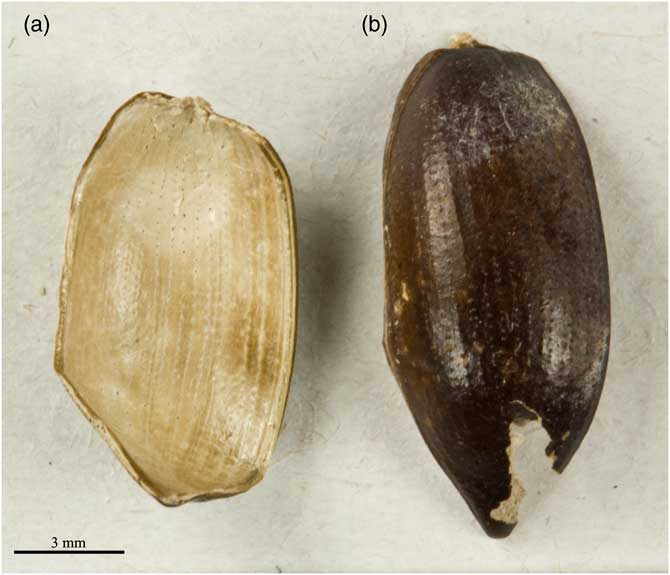
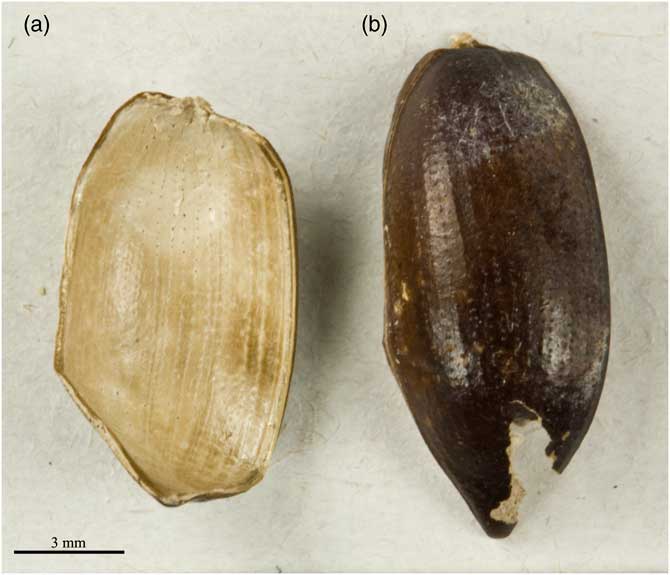
Insect cuticle chemically treated as above was in many cases bleached or blanched to an off-white color, suggesting that any residual hydrocarbon content was extremely small, but some heavily sclerotized elements remained black, and in some cases the cuticle separated into a thin outer black layer and a thicker blanched underlayer (Figure 4). Since we could not distinguish whether the dark layer was strictly pigmented cuticle or whether it contained residual asphalt (which would bias 14C dates older) or young humics, we attempted to separate pretreated and dried insect material from individual specimens into “pigmented” and “blanched” aliquots to test whether they yielded different 14C dates and isotopic results.
Chemically treated beetle elytra resulting in both blanched and pigmented chitin.
We also addressed the concerns raised by Schimmelmann and DeNiro (Reference Schimmelmann and DeNiro1986a) that base treatment would lead to deactylation of the chitin and consequent blurring of isotopic information, by splitting individual specimens into 2 aliquots, processed separately with base treatments of different durations. Samples processed normally were treated with 1N NaOH at 75°C until the replenished base solution remained clear (typically for 30 min), but test aliquots received an extended treatment lasting 10 hr.
RESULTS AND DISCUSSION
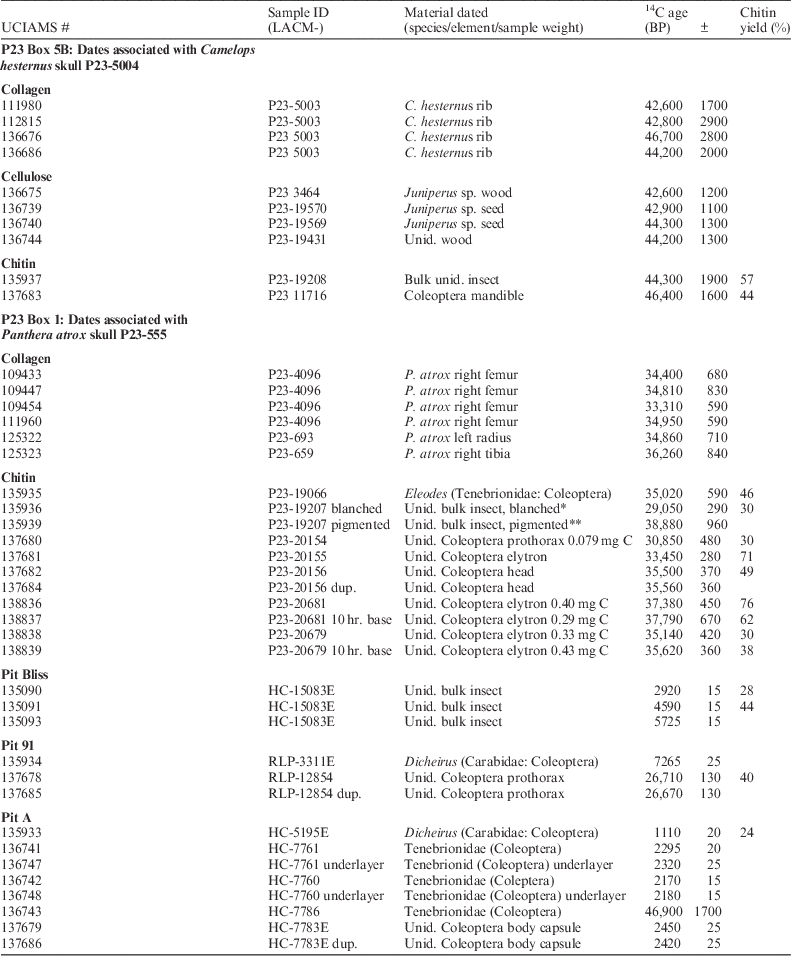
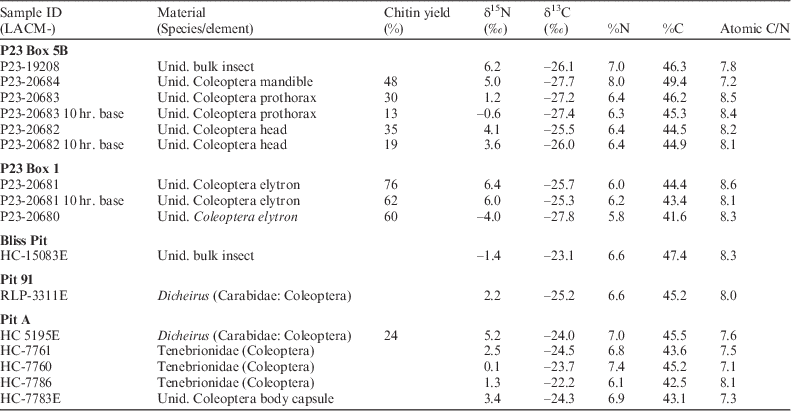
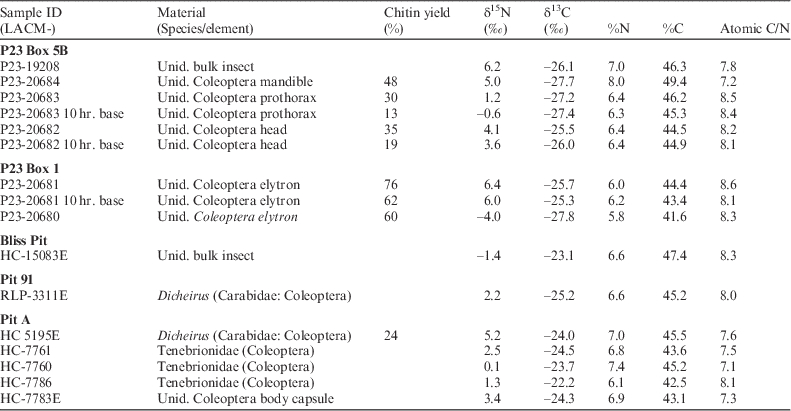
14C results are presented in Table 1 as conventional 14C ages corrected for isotopic fractionation (Stuiver and Polach Reference Stuiver and Polach1977). Size-dependent sample preparation backgrounds have been subtracted (Santos et al. Reference Santos, Southon, Griffin, Beaupre and Druffel2007). For chitin, these were based on measurements of 14C-free wood, since no samples of suitably old insect material were available. 14C uncertainties shown in the table include contributions from scatter in repeated measurements and from background subtractions as well as counting statistics. Stable isotope results are shown in Table 2 in δ notation, as parts per thousand deviations of sample isotopic ratios from those of standards: atmospheric nitrogen and Pee Dee Belemnite (PDB) for nitrogen and carbon, respectively. Uncertainties for δ13C and δ15N based on long-term reproducibility of standards are 0.1‰ and 0.2‰, respectively.
Radiocarbon dating results.

Notes:
Sample IDs include LACM- prefix, e.g. LACMHC-7783E.
Unless otherwise noted, samples were 0.6–0.8 mg of carbon.
Duplicate samples/aliquots (dup.) are splits of pretreated material.
Samples labeled 10 hr. base were treated for 10 hr in 1N NaOH at 75°C.
* Blanched elements picked from pretreated bulk insect assemblage.
** Pigmented elements selected from pretreated insect assemblage, not the same as 135936.
Stable isotope results.
Sample IDs include LACM- prefix, e.g. LACMHC-7783E.
Samples labeled 10 hr. base were treated for 10 hr in 1N NaOH at 75°C.
Despite prior use of solvents on excavated material at Rancho La Brea, significant quantities of residual asphalt were removed from the insect samples by the pretreatment methods described previously. Initially, the renewed repeated solvent treatments extracted varying amounts of color, with waste solutions ranging from golden to almost black. Solutions usually remained clear even after one or two 20-min sonications in solvent, but treatment with hot 1N NaOH in the subsequent ABA procedure released significant quantities of black color into the base solution, and a similar reaction was observed in the preparation of twigs and juniper seeds. This second release was again relatively rapid, and the replenished base solutions typically remained clear after 30 min. The original motivation for including this step was to remove soil humics: asphalt is normally thought of as hydrophobic, but groundwater readily combines with asphalt leachate to produce a black liquid that quickly fills quarried and excavated pits; hence, the absence of humics in tar pit material cannot be simply assumed. However, although some of the leached material may indeed have been soil carbon, it smelled strongly of hydrocarbons and was probably mostly composed of asphaltenes. These are medium molecular weight crude oil constituents (~1000 Da) that are known for their strong tendency to combine into macroscopic solvent-resistant aggregates (Mullins et al. Reference Mullins, Sheu, Hammami and Marshall2007; Goual Reference Goual2012). Either the asphaltenes were solubilized by the NaOH treatment or they were simply removed by the physical opening up of the cuticle structure as the base dissolved the protein component. The entire chitin pretreatment chemistry was typically completed within a single working day and produced yields ranging from 30 to 77% for samples that received ~30 min of NaOH treatment (Tables 1 and 2). These are surprisingly high relative to published data (e.g. Hodgins et al. Reference Hodgins, Thorpe, Coope and Hedges2001), perhaps because prolonged exposure to the tar pits biogeochemical environment had already removed some of the cuticle protein, leaving a chitin-rich residue.
Box 5B (Project 23), Camelops hesternus Skull and Associated Insect and Plant Material
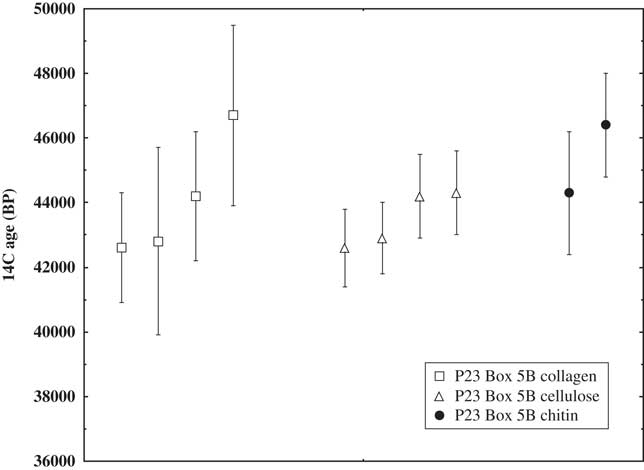
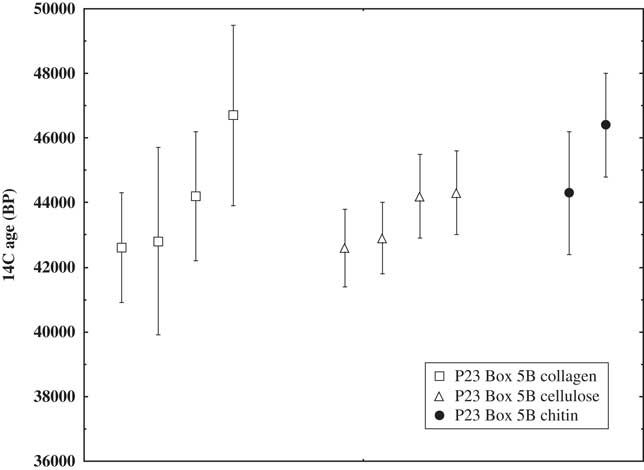
Results for samples of unidentified beetle material (LACMP23-19208, -11716, -20682–20684) and cellulosic material from unidentified wood (LACMP23-19431) and Juniperus seeds (LACMP23-19569, -19570) recovered from the camel skull are consistent with bone collagen results on a rib (LACMP23-5003) from the same individual (Table 1, Figure 5). The uncertainties on these measurements are large because the ages are close to the 14C dating limit, at which point such error margins are unavoidable even for accurate dates. However, the consistency of the results, including the aliquots of standard and extended base treatment, is very encouraging and suggests that La Brean insects can be located in time on a millennial scale.
Radiocarbon dating results for insect and plant material compacted in a Camelops hesternus skull, as well as bone collagen dates for the same C. hesternus ribs.
Box 1 (Project 23), Panthera atrox (Giant Jaguar) and Associated Insect Material
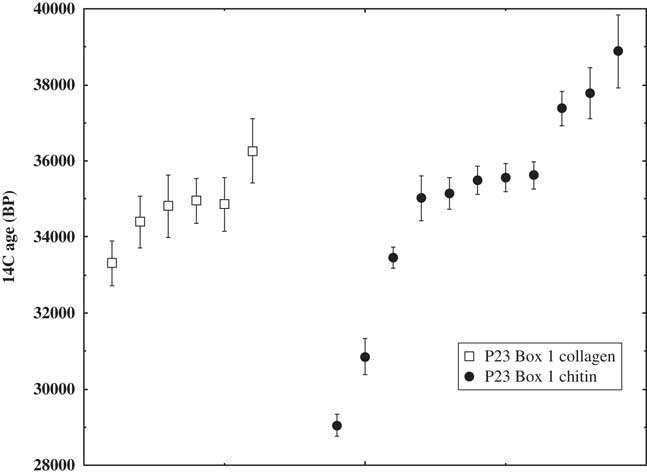
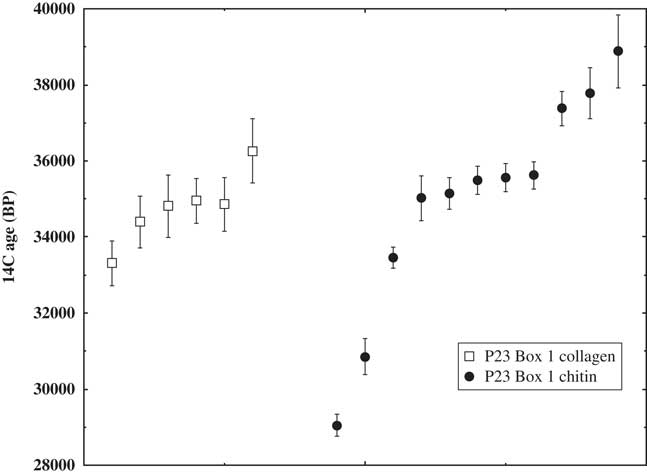
Multiple collagen dates on a right femur (LACMP23-4096) and left radius (LACMP23 693) from the same individual as the Project 23 Box 1 P. atrox skull LACMP23-555) averaged 34.7 kyr BP (Fuller et al. Reference Fuller, Fahrni, Harris, Farrell, Coltrain, Gerhart, Ward, Taylor and Southon2014a). Results from insect material recovered from inside the skull scatter about this value but show an exceedingly large age spread, ranging from 29 kyr BP (LACMP23-19207) to 39 kyr BP (LACMP23-19207) (Table 1, Figure 6). Unlike the Box 5B Camelops skull, which does not appear to have suffered any displacement since initial entrapment, the P. atrox skull was excavated from the central “pipe” of the Box 1 deposit, and a right canine unquestionably from the jaw was found 3 ft below it. Therefore, initial deposition was followed by substantial vertical displacement over time. We infer that, after the skull initially filled with low-viscosity tar, its contents did not move as a unit; there was continuing or episodic movement of asphalt within and though the skull, permitting subsequent accumulation of insect material from quite different periods.
Radiocarbon dating results for insect material compacted in a P. atrox skull, as well as bone collagen dates for the same P. atrox femur, radius, and tibia.
Pit Bliss
Three unidentified beetle samples (LACMHC-15083E bulk insect #1-3) recovered from this previously undated deposit returned Holocene dates of 2.6, 4.6, and 5.7 kyr BP (Table 1). These are the first 14C dates for Pit Bliss.
Pit 91
The prothorax of an unidentified beetle (LACMRLP-12854) was divided into 2 aliquots from Pit 91; both dated to 26.7 kyr BP (Table 1), consistent with multiple bone dates, indicating a major cluster of carnivore entrapments at 25–28.5 kyr BP (Friscia et al. Reference Friscia, Van Valkenburgh, Spencer and Harris2008; Fuller et al. Reference Fuller, Fahrni, Harris, Farrell, Coltrain, Gerhart, Ward, Taylor and Southon2014). However, a specimen (LACMRLP-5195E) from the genus Dicheirus (Carabidae: Coleoptera) yielded a surprisingly young, Holocene date of 7.3 kyr BP (Table 1). Attributing this to in situ or laboratory contamination if the true age was ~25 kyr BP would require that more than 30% of the sample was recent (21st century) carbon, and the most likely explanation is that this sample represents the first reported Holocene entrapment in Pit 91.
Pit A
The only previous 14C dates for Pit A are 46.8 kyr BP for XAD-purified amino acids from a coyote (Canis latrans) (O’Keefe et al. Reference O’Keefe, Fet and Harris2009) and 16.6 kyr BP for cellulose from juniper wood (Ward et al. Reference Ward, Harris, Cerling, Wiedenhoeft, Lott, Dearing, Coltrain and Ehleringer2005). Ages of Tenebrionidae (Coleptera) chitin showed an even larger range, from 1 kyr BP (LACMHC-5195E) to approximately 47 kyr BP (LACMHC-7786), again providing an unexpected Holocene aged specimen for a deposit assumed to be completely Late Pleistocene (Table 1). Thus, deposits at Rancho La Brea cannot be assumed to be completely Late Pleistocene without sufficient dating of material.
INTERSPECIES DIFFERENCES
A lesson from the Pit A and Pit 91 results is that age distributions for different species within a given deposit may not be the same. Dates from some deposits at La Brea such as Pit 91 show major clustering of entrapment events (Friscia et al. Reference Friscia, Van Valkenburgh, Spencer and Harris2008), but the age distributions for large mammals are characterized by an extended tail of younger ages. This suggests that as deposits age, entrapment becomes increasingly less likely, perhaps due to progressive surface oxidation and hardening of deposits that are increasingly starved of new tar. We speculate that at least in some cases, occasional opportunities for entrapment of small species may occur long after a deposit has ceased to be a hazard for large mammals. Hence, the derivation of climate proxies from undated insect samples from “Pleistocene” La Brea deposits may give erroneous results. The wide range of dates from the Project 23 Box 1 P. atrox and associated material gives further reason to be cautious in terms of using insects dating proxies for other specimens.
COMPARISON OF PIGMENTED AND BLANCHED INSECT CHITIN
The pretreated LACMHC-7761 (tenebrionid beetle) and LACMHC-7760 (tenebrionid beetle) samples showed a thin, black layer of chitin overlying a thicker, blanched underlayer. The pigmented material was too thin to date separately, but the outer layer was scraped off and aliquots of this and the blanched layer were dated independently. Ages for the underlayer and the full cuticle were similar, indicating that no significant component of residual contaminating young humics was present in the black material. Samples LACMP23-20156 (unidentified beetle), LACMRLP-12854 (unidentified beetle), and LACMHC-7783E (unidentified beetle) were split after pretreatment. Originally, it was hoped to dissect the material into aliquots of blanched and pigmented chitin, but the resulting samples were too small. However, the duplicates, combusted and graphitized separately, gave very similar results as expected.
C:N RATIOS AND STABLE ISOTOPE RESULTS
Atomic C:N ratios for the treated cuticle samples (Table 2) roughly cluster around the value of 8 expected for intact fully acetylated chitin, and the elemental abundance data showed minimal differences between the normal and extended base treatments. While not definitive, these results strongly suggest that the normal pretreatment removes most if not all of the protein component (C:N~4; Karlson et al. Reference Karlson, Sekeri and Marmaras1969a, Reference Karlson, Sekeri, Richards and Richards1969b) from the cuticle, and that even the extended base treatment of 10 hr is insufficient to deacetylate the chitin, which would reduce the C:N ratio to 6. A 1.8‰ decrease in δ15N in LACMP23-20683 (unidentified beetle) between aliquots undergoing normal and extended base treatment is significant and equivalent to about half a trophic level shift, but other isotopic shifts were relatively small. These results are clearly highly preliminary, but they do suggest that some of the perceived difficulties in using δ15N and δ13C in chitin for dietary and paleoenvironmental studies may have been overstated and that these techniques deserve further study.
CONCLUSIONS AND FUTURE WORK
Our methods successfully removed asphalt, diverse preparation solvents, and humics from insect chitin and produced sufficient material to date La Brea samples accurately and precisely. Measurement of aliquots subject to different base treatment durations, aliquots of different components of insect chitin, and comparison of dates on bone collagen with ages for well-associated insect and plant material, all yielded compatible results confirming the effectiveness of our methods. Furthermore, extended periods of base treatment for the most part had little effect on 14C ages, stable isotope ratios, or C:N values. These results offer encouragement that well-dated insects will be able to serve as proxies for trophic interactions and climate change at La Brea and potentially elsewhere.
Successful methods for carbon dating insects from the tar pits have been long in coming, and now offer the prospect using insects in novel ways to evaluate changes in ecosystems, climate, and taphonomy at the tar pits. The highly specific lifecycles, narrow climatic ranges, and geographic restriction of insects to the environs of Rancho La Brea provide a basis for utilizing them as high-resolution paleoenvironmental indicators across 14C time. Potentially, they can provide more accurate paleoenvironmental data regarding this site than pollen data from distant offshore sediment cores used previously (Heusser 1998).
Significant numbers of dates from insects can also potentially help to reconstruct entrapment periods that, thus far, seem to be unique for each deposit and may cluster or spread. An advantage of using insects, versus other tar pit material, in destructive sampling is that thousands (or even millions) of “junk” specimens in the form of disarticulated elements can be used without compromising systematic collections of identifiable (and therefore inherently more valuable) specimens.
Our present dating results suggest that insect remains from La Brea can certainly be located in time on a millennial scale, but the true test of the extraction techniques reported here will require further measurements on younger “Rosetta Stone” material such as plants that can be assuredly associated with insect remains, where smaller 14C uncertainties associated with younger ages will allow more precise comparisons. Possible examples are wood containing bark beetles (Curculionidae: Coleptera), or cynipine wasps (Cynipidae: Hymenoptera) in woody galls.
ACKNOWLEDGMENTS
We thank the following individuals: from the American Museum of Natural History, R MacPhee provided extensive review; from the George C. Page Museum, L Chiappe offered financial support while A Farrell and G Takeuchi expedited the preparation and documentation of specimens for the study and provided information on specimen excavation and provenance; and from the University of California, Irvine, B Fuller provided technical training and guidance. We also thank S Elias, M McClure, and an anonymous reviewer for their constructive criticism.