Singapore's educational system is one of the most accredited in Asia; in fact, in 2015, it was ranked first in the Organisation for Economic Cooperation and Development's (OECD) global school rankings (Coughlan, Reference Coughlan2015). However, counselling has only been in existence for less than 50 years in Singapore (Yeo, Tan, & Neihart, Reference Yeo, Tan and Neihart2012). The development of school counselling grew out of the welfare services of the 1960s (Tan, Reference Tan2002) and was led by the Ministry of Education (MOE) and the National Institute of Education (NIE; Yeo et al., Reference Yeo, Tan and Neihart2012). In the year 2000, the Psychological and Guidance Services Branch replaced the Pastoral Care and Career Guidance Branch at the MOE and included educational psychologists, counselling psychologists, and career guidance specialists in its team of staff (Tan, Reference Tan2002).
According to the MOE (2015), a school counsellor:
works closely with the school management in planning and implementing a school-wide counselling system, providing direct counselling intervention to at-risk students and case consultations to school personnel and parents and training teachers and parents on counselling-related issues. . . . The School Counsellor will also identify, devise and deliver specialised group guidance programs for at-risk students who need additional help in the area of social and emotional development, as evidenced by social, emotional and behavioural concerns presented by these students. (Job Description section, para. 1)
Hence, school counsellors are important because they develop strategies and interventions that can help students who face academic, behavioural, or family problems to function and develop as well as their peers (Martin, Reference Martin2002). They are also instrumental in helping students establish healthy relationships with others (Wong, Reference Wong, Lui and Wong2006). As much of a child's or adolescent's day is spent in school, school counsellors become important sources of support for them (Wong, Reference Wong, Lui and Wong2006).
Currently, in terms of professional development, school counsellors are recommended to undergo continuous upgrading of their skills and knowledge through courses arranged by the MOE's Guidance Branch (GB; MOE, 2015). Additionally, the GB conducts cluster group supervision sessions for them.
Purpose of Study
With growing recognition of the importance of school counsellors comes a heightened awareness of the need for more supervisory services for counsellors, especially newly trained counsellors and psychologists who are required to start work with limited supervision (Yeo et al., Reference Yeo, Tan and Neihart2012). Consequently, due to a lack of support and proper supervision, they are likely to become stressed and be less effective (Cashwell & Dooley, Reference Cashwell and Dooley2001; Crutchfield & Borders, Reference Crutchfield and Borders1997), and experience role stress (Culbreth, Scarborough, Banks-Johnson, & Solomon, Reference Culbreth, Scarborough, Banks-Johnson and Solomon2005). As the work of counsellors can be complex and emotionally demanding, it is vital that they continue to improve themselves and receive constant support (McMahon & Patton, Reference McMahon and Patton2000). However, a review of the literature reveals that there is little research conducted on supervision for school counsellors in the Asian context. Hence, this research seeks to examine on-the-job structured group counselling supervision as an option to address counselling supervision in Singapore.
Literature Review
Supervision
Supervision refers to ‘an intervention provided by a more senior member of a profession to a more junior member or members of that same profession’ (Bernard & Goodyear, Reference Bernard and Goodyear2009, p. 7). Specifically, it ‘enhances the professional functioning of the more junior person(s); monitoring the quality of professional services offered to the clients that she, he, or they see; and serving as a gatekeeper for those who are to enter the particular profession’ (Bernard & Goodyear, Reference Bernard and Goodyear2009, p. 7). In short, supervisors help fill in gaps in knowledge and improve proficiency (Carroll, Reference Carroll2001).
The most common form of supervision is group supervision (Borders, Reference Borders1991; Carroll, Reference Carroll2001; Linton & Deuschle, Reference Linton and Deuschle2006).
Group supervision is defined as
the regular meeting of a group of supervisees with a designated supervisor for the purpose of furthering their understanding of themselves as clinicians, or their clients, or of the service delivery in general and who are aided in this endeavour by their interactions with each other and with their supervisor in the context of group process. (Bernard & Goodyear, Reference Bernard and Goodyear2009, p. 72)
Linton and Deuschle (Reference Linton and Deuschle2006) outlined four models of group supervision: (a) structured group supervision (Wilbur, Roberts-Wilbur, Morris, Betz, & Hart, Reference Wilbur, Roberts-Wilbur, Morris, Betz and Hart1991); (b) systemic peer group supervision (Borders, Reference Borders1991); (c) a case presentation model (McAuliffe, Reference McAuliffe1992); and (d) structured peer consultation model (Benshoff & Paisley, Reference Benshoff and Paisley1996). These models follow a structure and are time efficient, providing steps and guidelines to be followed (Linton & Deuschle, Reference Linton and Deuschle2006). Indeed, group supervision on the whole is said to be a more efficient means of using counsellors’ and supervisors’ time (Bernard & Goodyear, Reference Bernard and Goodyear2009) as counsellors receive feedback not only from their supervisors, but also from each other (Linton & Deuschle, Reference Linton and Deuschle2006).
Here, we have selected the structured group supervision (SGS) model for discussion and use in the supervision sessions. Wilbur et al. (Reference Wilbur, Roberts-Wilbur, Morris, Betz and Hart1991) developed the SGS model from the existing concepts of group supervision. It focuses on how group supervision can be used in counsellor training programs, and on using foci and goals as a means to guide the supervision process (Wilbur et al., Reference Wilbur, Roberts-Wilbur, Morris, Betz and Hart1991). It therefore provides a more organised framework for case presentations and guides the interactions between supervisor and supervisee, and feedback during supervision meetings (Linton & Deuschle, Reference Linton and Deuschle2006). In addition, issues that may occur in group supervision are addressed: group member interactions that may be disruptive are minimised, group productivity is enhanced, and conflict and resistance among and in members are reduced (Wilbur et al., Reference Wilbur, Roberts-Wilbur, Morris, Betz and Hart1991). The other models were not selected as they focus on sharing of experiences through case studies and presentations, which was not in the scope of our study. They also rely more heavily on peer feedback, rather than supervisor and peer feedback.
There are three distinct categories in SGS: the task process group, the psycho-process, and the socio-process modalities for skill development and personal development. These will form the basis of the SGS sessions. Results from the 7-year pilot study conducted by Wilbur and Roberts-Wilbur in 1994 suggested that the SGS model was more effective than supervision in the control group. In other words, there was evidence supporting the effectiveness of the SGS model in increasing the levels of personal growth and development in beginning counsellors.
Although the SGS model was much discussed, there was a lack of research done by other researchers on SGS effectiveness. For example, although Linton and Deuschle (Reference Linton and Deuschle2006) outlined four models of group supervision, they did not mention any case studies or research done on the effectiveness of the models. On the other hand, there has been evidence that counsellors want and require supervision, but more often than not were unable to have access to supervision (Agnew, Vaught, Getz, & Fortune, Reference Agnew, Vaught, Getz and Fortune2000; Linton & Deuschle, Reference Linton and Deuschle2006; McMahon & Patton, Reference McMahon and Patton2000; Page, Pietrzak, & Sutton, Reference Page, Pietrzak and Sutton2001).
Counsellor Self-Efficacy
Several studies have shown that more supervision leads to higher reported self-efficacy (e.g. Cashwell & Dooley, Reference Cashwell and Dooley2001; Larson et al., Reference Larson, Suzuki, Gillespie, Potenza, Bechtel and Toulouse1992; Larson & Daniels, Reference Larson and Daniels1998; Tang et al., Reference Tang, Addison, LaSure-Bryant, Norman, O'Connell and Stewart-Sicking2004; Urbani et al., Reference Urbani, Smith, Maddux, Smaby, Torres-Rivera and Crews2002).
Bandura (Reference Bandura1982) suggested that perceived self-efficacy is ‘concerned with judgments of how well one can execute courses of action required to deal with prospective situations’ (p. 122). He added that a lack of self-efficacy can bring about ineffective behaviour, despite their skills and knowledge; and that similarly, a stronger perceived self-efficacy can make people persist in their efforts until they achieve success (Bandura, Reference Bandura1982). Larson and Daniels (Reference Larson and Daniels1998) further described counsellor self-efficacy (CSE) as ‘one's beliefs or judgments about her or his capabilities to effectively counsel a client in the near future’ (p. 180). Barnes (Reference Barnes2004) added that these beliefs are self-assessments of counselling competence, and counsellors with strong CSE consider themselves highly capable of counselling while those with weak CSE believe they lack the necessary skills for effective counselling.
Urbani et al. (Reference Urbani, Smith, Maddux, Smaby, Torres-Rivera and Crews2002) found that on top of clinician performance, CSE also had a positive impact on client outcome for counsellors. They concluded that increasing CSE decreased clinician anxiety, which in turn increased the level of clinical judgment and performance (Urbani et al., Reference Urbani, Smith, Maddux, Smaby, Torres-Rivera and Crews2002). Cashwell and Dooley (Reference Cashwell and Dooley2001) proposed that supervision allows counsellors an opportunity to put the theories and skills they learnt in their training program to use in real-life situations. In fact, results from their study showed that supervision is related to higher levels of CSE.
In this article, we will examine the impact of group supervision on CSE.
Counselling Competency
According to Lee (Reference Lee2005), the work of a school counsellor is based on the ideas of access, equity and social justice, and this is reflected in their commitment to ensure that all children have the opportunity to reach their fullest potential. He then listed counsellor competencies as ‘cultural competence, skills for promoting empowerment, systemic perspective, advocacy, collaboration and leadership’ (pp. 186–187).
Ridley, Mollen, and Kelly (Reference Ridley, Mollen and Kelly2011) proposed a more inclusive definition of counsellor competence; they defined it as ‘the determination, facilitation, evaluation, and sustaining of positive therapeutic outcomes’ by managing and incorporating competencies and micro skills learnt into their sessions (p. 835). Their view on competence focused on how clinicians think and feel and their views on their performance (Ridley et al., Reference Ridley, Mollen and Kelly2011). In short, competence encompasses both counsellors’ psychological attributes and their mastery of counselling behaviours.
Eriksen and McAuliffe (Reference Eriksen and McAuliffe2003) developed the Counsellor Skills Scale, which assesses the skills of beginning counselling students. The scale comprises a 22-item measure of the effectiveness of counselling skills performance, divided into six subscales: (a) shows interest and appreciation, (b) encourages exploration, (c) deepens the session, (d) encourages change, (e) develops therapeutic relationship, and (f) manages the session. They believe that it is important that the counselling profession are able to produce effective and ethical counsellors, so as to gain the confidence of the public (Eriksen & McAuliffe, Reference Eriksen and McAuliffe2003). Simply put, like any other profession, counsellors must be able to demonstrate a level of expertise in order to provide the best possible services for clients (Ridley et al., Reference Ridley, Mollen and Kelly2011).
Job Involvement
Job involvement has been defined as ‘the degree to which a person is identified psychologically with his work or the importance of work in his total self-image’ (Lodahl & Kejner, Reference Lodahl and Kejner1965, p. 24). There are two main areas of research: (1) organisation conditions, such as meaningfulness of work and adequacy of supervision; and (2) socialisation process, such as work-relevant norms and values (Lodahl & Kejner, Reference Lodahl and Kejner1965). Various aspects of job involvement have been studied, such as the relationship between job involvement and work performance (Rotenberry & Moberg, Reference Rotenberry and Moberg2007; Tayo & Adedapo, Reference Tayo and Adedapo2012) and between job involvement and employee commitment (Cohen, Reference Cohen1999; Khan, Jam, Akbar, Khan, & Hijazi, Reference Khan, Jam, Akbar, Khan and Hijazi2011). Hafer and Martin (Reference Hafer and Martin2006) also found that employees with high levels of job involvement identify with and care about their jobs. Word and Park (Reference Word and Park2009) suggested that demographic factors (e.g., gender, age), managerial factors (e.g., intrinsic and extrinsic motivations) and institutional factors (red tape and hierarchical culture) can all affect the level of job involvement in workers. Other factors such as emotional labour and psychological capital have also been studied (Fu, Reference Fu2015). However, most articles have focused on corporate organisations instead of schools.
Hypotheses
This study seeks to investigate the impact of structured group supervision in enhancing school counsellors’ self-efficacy, counselling competency and job involvement.
Four hypotheses have been formulated:
1. There will be a significant increase in self-efficacy among the SCs after completing the SGS.
2. There will be a significant increase in counselling competency among the SCs after completing the SGS.
3. There will be a significant increase in job involvement among the SCs after completing the SGS.
4. There will be significant relationships among self-efficacy, counselling competency, and job involvement.
Method
Participants
As the focus of the research was on school counselling, the criteria for recruiting participants included at least 6 months’ working as a counsellor in schools or educational settings. Participation was by invitation and on a voluntary basis.
Twenty-one SCs successfully completed the program: 19 females (90.5%) and two males (9.5%). Their age range was from 25 to 55 years and above, with an equal distribution among the age groups: four aged 25–35, six aged 36–45, five aged 46–55 and six were over 56. All the participants were at least a degree holder: ten had a master's degree and nine had a diploma in counselling. Fourteen participants had less than 5 years of counselling experience while seven had at least five.
Research Design
We utilised the single-group, before-after design (Table 1) to examine the impact of SGS. We ran two SGS groups concurrently, one group with 12 members and the other with 9. This is because the ideal size for group supervision is between 8 to 12 (Harvey & Struzziero, Reference Harvey and Struzziero2008). The primary reason the single-group, before-after design was adopted was because the researchers faced difficulty in recruiting participants. There was little support from schools to participate in the studies, and participation was on a voluntary basis. As a result, there were not enough participants to form a control group. Hence, comparisons were made between the pre- and posttest instead of between two separate groups of participants (i.e., control and SGS groups).
Single-Group Before-After Design

Supervisor and SGS
Twenty-one counsellors participated in six, 3-hour structured group supervision sessions. Participants met six times over the course of 12 weeks. Three cases were presented in each session. These sessions were supervised by one certified supervisor using a structured group supervision approach to minimise the confounding supervisor's variables in terms of personality, supervision style, and approaches. However, counsellors continued to attend cluster group supervision sessions conducted by GB so as not to disrupt their overall supervision schedules with MOE. Although these sessions did not follow the SGS format, we believe that the influence on the participants will be minimal as they were only held at most twice in the entire course of the study. In addition, they focused on different aspects of the supervision process that will not affect our study. No other form of supervision or support was offered to the participants.
The supervisor engaged in this study possesses a master's degree in counselling psychology and is a registered supervisor with the Singapore Association for Counselling (SAC). Any study bias or conflict of interest was avoided as he would not be involved in the authorship of the study. In addition, to maintain consistency in the administering of the supervision, the supervisor was briefed and given a prepared manual to refer to. The briefing and manual highlight the responsibilities and procedures of the SGS. A video recording of every session was carried out for monitoring.
The sessions were based on Wilbur and Roberts-Wilbur's pilot study conducted in 1994, which consists of five steps to be followed through:
1. Step 1: Plea for help. Supervisee presents information about a case in which assistance is required.
2. Step 2: Question time. Group members ask questions about the case presented in step 1 and identify focus.
3. Step 3: Feedback time. Group members provide comments and feedback on how they would handle the case while supervisee takes notes and remains silent.
4. Pause period: Supervisee in question takes time out to reflect on what has been said so far.
5. Step 4: Response statement. Group members remain silent while supervisee responds to feedback, both the helpful and unhelpful suggestions.
6. Step 5: Discussion time. The whole group enters into a discussion about the session.
Hence, the group session followed a structure for the orderly input and processing of the information shared among the members (Wilbur & Roberts-Wilbur, Reference Wilbur and Roberts-Wilbur1994).
Instruments
Participants completed pre- and posttest questionnaires both of which include scales to measure counselling self-efficacy, counselling competency, and job involvement. Pilot tests were conducted and reliability was found to be 0.91, 0.91, and 0.82 for the respective scales.
Counselling Self-Efficacy
The Counselling Self-Estimate Inventory (COSE) is a 37-item scale developed by Larson et al. (Reference Larson, Suzuki, Gillespie, Potenza, Bechtel and Toulouse1992) as a reliable and valid self-efficacy instrument for use in the counselling process. It comprises positive and negative statements about self-efficacy that were developed after preliminary testing to improve its usefulness and generalisability (Larson et al., Reference Larson, Suzuki, Gillespie, Potenza, Bechtel and Toulouse1992). Sample items include ‘I am confident that the wording of my responses will be clear and easy to understand’ and ‘I will be an effective counsellor with clients from a different ethnic background’. Participants rated them in accordance with the degree to which they agreed that the statements showed how they would perform in a situation, on a scale of 1 to 5 (Larson et al., Reference Larson, Suzuki, Gillespie, Potenza, Bechtel and Toulouse1992). Higher scores correspond to stronger counselling self-efficacy. The Counselling Self-Efficacy Scale (CSES) was adapted from the COSE for measuring self-efficacy in the following categories: helping skills, counselling challenges, cultural competence, and session management. The last category was our own addition, as we wanted to measure how confident the counsellors were in managing the sessions. It includes items such as ‘I am worried that I am unable to keep the sessions on track and focused’ and ‘I am positive that I will be able to help the client decide what actions to take regarding his/her problems’. The scoring followed that of the COSE.
Counselling Competence
The Counsellor's Competence Self-Evaluation Scale (CCSS) consists of 47 items based on counselling skills: (1) clinical skills used during counselling sessions, such as intake interview skills and process skills; (2) non-clinical skills, such as ethical practice and report writing; and (3) personal skills, such as professionalism and exhibiting self-assurance. These items were derived from Dimick and Krause's (Reference Dimick and Krause1975) manual and a survey from Kress, Eriksen, Rayle, and Ford's (Reference Kress, Eriksen, Rayle and Ford2005) research paper. The scoring was on a scale of 1 to 5, with 1 indicating that the respondents strongly disagreed with the statement and 5 as strongly agreed. Sample items for (1) are ‘Establishes rapport with clients’ and ‘Demonstrates a variety of responses and techniques’; (2) ‘Respects and maintains confidentiality’ and Synthesises intake and background information’; and (3) ‘Presents as a professional counsellor and dresses appropriately’ and ‘Exhibits appropriate self-assurance, confidence, and trust in own ability’.
Job Involvement
Counsellor job involvement was measured by using the Job Involvement Scale (JIS) developed by Lodahl and Kejner (Reference Lodahl and Kejner1965). A panel of ‘expert’ judges, psychologists, sociologists, and graduate students in human relations picked out 22 items from the original 110 items collected from interview protocols, questionnaires, and other researchers. Its reliability coefficient was reported to be 0.76. For our paper, 12 items were selected based on the local SC's nature of counselling. Sample items include ‘My line of work/career field is an important part of who I am’ and ‘I strongly identify with my chosen line of work/career field’, where ‘line of work/career field’ refers to the respondents’ profession as a counsellor in the school setting. Sample items that were removed included ‘I'll stay overtime to finish a job, even if I'm not paid for it’ and ‘You can measure a person pretty well by how good a job he does’, as they were not related to counselling. The scoring was on a scale of 1 to 5, with 1 indicating that the respondents strongly disagreed with the statement and 5 as strongly agreed. A post-hoc reliability test was later conducted using the results from our scale and the Cronbach's alpha was found to be 0.711.
A section of the questionnaire solicited participants’ demographic information: age, gender, ethnic group, years of experience, and highest academic degree attained. Additionally, information describing their school and types of services provided (counselling and teacher/parent consultation) were collected.
Procedure for Analysis
We assessed the impact of counselling supervision on counsellors by comparing the counsellors’ pre- and posttest scores on self-efficacy, counselling competency, and job involvement. As there was a difficulty in recruitment, and due to the attrition rate of 16% (4 members dropped out after attending between one to three sessions), there were only 21 participants. The scores for both groups were compiled and used for analysis on the impact of the SGS. Paired sample t tests were then used to analyse the differences and a correlation matrix of the variables under study was obtained. The paired sample t tests were used to compare the means of the test scores before (pretest) and after (posttest) the participants completed the SGS. In addition, the Pearson analysis were conducted to analyse the correlations among the three variables.
Results
Paired Sample t Tests
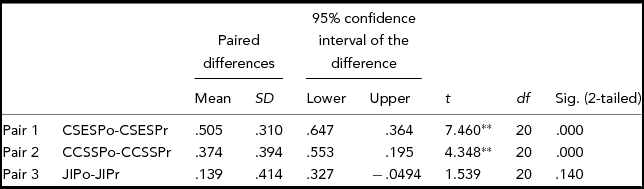
Paired sample t tests were conducted and the summary of the results is outlined in Table 2.
Paired-Samples t Test for Pre- and Post-Test Counselling Self-Efficacy, Counselling Competence, and Job Involvement

Note: CSESPo = Counselling Self-efficacy Post; CSESPr = Counselling Self-efficacy Pre; CCSSPo = Counselling Competence Post, CCSSPr = Counselling Competence Pre; and JIPo = Job Involvement Post, JIPr = Job Involvement Pre.
*p < .05 (two-tailed), **p < .01 (two-tailed).
Counselling Self-Efficacy
Results indicated that the mean counselling self-efficacy posttest (M = 3.97, SD = .42) was significantly greater than the mean counselling self-efficacy pretest (M = 3.46, SD = .33), t(20) = 7.46, p < .00. The standardised effect size index, d, was 1.63. The 95% confidence interval for the mean difference between the two ratings was −.65 to −.36. This showed that there was a significant increase in self-efficacy among the SCs after completing the SGS sessions. The first hypothesis is hence supported.
Counselling Competence
Results indicated that the mean counselling competence posttest (M = 4.21, SD = .32) was significantly greater than the mean counselling competence pretest (M = 3.84, SD = .25), t(20) = 4.35, p < .00. The standardised effect size index, d, was 0.95. The 95% confidence interval for the mean difference between the two ratings was −.55 to −.19. There was hence a significant increase in counselling competence among the SCs after the SGS sessions. The second hypothesis is also supported.
Job Involvement
Results indicated that the mean job involvement posttest (M = 3.88, SD = .36) was not significantly greater than the mean job involvement pretest (M = 3.74, SD = .44), t(20) = 1.54, p < .14. The standardised effect size index, d, was 0.34. The 95% confidence interval for the mean difference between the two ratings was −.33 to .05. There is hence no significant increase observed in the SCs’ job involvement after the sessions, and the third hypothesis is not supported.
Correlational Analyses
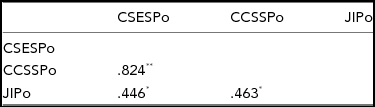
Subsequently, Pearson correlations among the three measures were obtained. Results would fall between −1 and 1, where positive values indicate positive correlation and negative values indicate negative correlation, and zero indicates no correlation. The results obtained are presented in Table 3.
Pearson Correlations Between Posttest Results of Counselling Self-Efficacy, Counselling Competence, and Job Involvement

Note: CCSSPo = Counselling Competence Post, JIPo = Job Involvement Post, CSESPo = Counselling Self-Efficacy Post, *p < .05 (two-tailed), **p < .01 (two-tailed).
It was observed that there was a significant positive correlation between counselling self-efficacy and counselling competence at the p < .01 level. There were also significant positive correlations between job involvement and counselling self-efficacy, and between job involvement and counselling competence at the p < .05 level. Therefore, the fourth hypothesis, that there will be a significant relationship between the three variables, is supported as well.
Discussion
Major Findings
The main purpose of the study was to investigate the impact of SGS on the self-efficacy, counselling competency, and job involvement of SCs. Comparisons between pre- and posttest scores were made and the findings were as hypothesised in the aspects of self-efficacy and counselling competency.
Counselling Self-Efficacy
Using the CSES, it was observed that there was a statistically significant mean increase in the SCs’ self-efficacy after the completion of the SGS sessions. Since the CSES measured the level of confidence the participants had in conducting specific counselling services at the time of the study, it can be interpreted that they felt more confident in their counselling skills after going through the structured group supervisory sessions. This may be due to positive and/or constructive feedback received during the session, leading to counsellors having a higher perceived level of capability (Somody, Henderson, Cook, & Zambrano, Reference Somody, Henderson, Cook and Zambrano2008). They had the opportunity to share and receive ideas and opinions on difficult cases, and were also likely able to obtain learning experiences, support and encouragement through such case discussions (Carroll, Reference Carroll2001). As self-efficacy is concerned with how people judge themselves to be capable of action required in a situation, honest assessment can help them improve and strengthen their self-confidence (Cashwell & Dooley, Reference Cashwell and Dooley2001). In fact, Bandura (Reference Bandura1982) suggested that their perceived sense of efficacy will have an impact on the level of effort put in and work performance. On a similar note, several researchers have found evidence showing that it is an important factor for counsellor performance (Jaafar, Mohamed, Bakar, & Tarmizi, Reference Jaafar, Mohamed, Bakar and Tarmizi2009; Larson & Daniels, Reference Larson and Daniels1998; Urbani et al., Reference Urbani, Smith, Maddux, Smaby, Torres-Rivera and Crews2002). Hence, counsellors with higher self-efficacy are more likely to put in more effort in their counselling sessions.
Counselling Competency
Similarly, there was a statistically significant mean increase in counselling competency observed from the CCSS before and after the sessions. During SGS sessions, the supervisor can help promote skill and professional development of the participating counsellors through observation and evaluation of supervisees’ competencies (Wilbur et al., Reference Wilbur, Roberts-Wilbur, Morris, Betz and Hart1991). Using feedback received from the supervisor and members of the supervision group, participants are able to identify areas that they are competent in, as well as areas to improve in (McMahon & Patton, Reference McMahon and Patton2000). Indeed, supervision provides the school counsellor with someone to consult with about difficult situations, new strategies, and insight into personal issues in crisis situations (Cashwell & Dooley, Reference Cashwell and Dooley2001). Crutchfield and Borders (Reference Crutchfield and Borders1997) also found evidence that a lack of supervision leads to a decline in skills.
Job Involvement
No statistically significant difference was observed between the pre- and posttest results of the JIS. There may not have been an impact on job involvement as this may be influenced by other factors such as personal motivations, worker demographics, work environment, and work habits (Tayo & Adedapo, Reference Tayo and Adedapo2012; Word & Park, Reference Word and Park2009). Fu (Reference Fu2015) also noted that for preschool teachers, there was a relationship among preschool teachers’ emotional labour, psychological capital, and job involvement. This may be due to the high levels of emotional, technical, and cognitive engagement in their daily interaction with children, parents, and other school administrators (Fu, Reference Fu2015), which may also apply to school counselling as it is also emotionally taxing (McMahon & Patton, Reference McMahon and Patton2000). In addition, as public schools are non-profit organisations, SCs’ job involvement may be influenced by public service motivation (Word & Park, Reference Word and Park2009).
Relationship Between the Three Variables
There was evidence that there is a significant relationship between the three variables.
First, it was observed that post-CSES results were highly correlated to post-CCSS results, which showed that self-efficacy is strongly related to a sense of competency. Competency affects the amount of effort put into actions and determines how long one will persevere to succeed (Bandura, Reference Bandura1997), while self-efficacy reflects one's confidence in how well one can perform in a given role; hence, as counsellors pick up more skills and become more competent, they also become more confident in themselves (Larson & Daniels, Reference Larson and Daniels1998; Urbani et al., Reference Urbani, Smith, Maddux, Smaby, Torres-Rivera and Crews2002). Competent counsellors are aware of the social, cultural, psychological, and circumstantial aspects in their work environment (Vanzandt, Reference Vanzandt1990). This awareness can be built up in supervision sessions, as supervisees increase their knowledge, improve their skills, and bridge the gap between theory and practice (Carroll, Reference Carroll2001).
Hence, through feedback sessions and sharing of experiences and lessons, there is a positive impact on counsellors’ self-efficacy and sense of competency. Supervision is also a source of support and encouragement (Lambie & Sias, Reference Lambie and Sias2009). With a higher level of self-efficacy and competence, counsellors will have a stronger sense of job involvement as job involvement is significantly affected by a high degree of self-worth (Fu, Reference Fu2015), and self-worth can be attributed to self-efficacy (Bandura, Reference Bandura1982; Reference Bandura1997) and competence (Ridley et al., Reference Ridley, Mollen and Kelly2011).
Limitations
There were three major limitations of this study that need to be addressed: (a) a bigger sample size with a greater diversity of participants (such as different levels of work experience and gender) would provide for a more representative distribution of the school counsellor population; (b) as the study depends on self-reported efficacy, counselling competence and job involvement, the data obtained may not be completely reflective of the participants’ true state of mind or indicative of an actual improvement in their self-efficacy or competency; and (c) due to the difficulty in recruiting participants, all participants were placed in the SGS groups and there were insufficient members to form a control group. Finally, efficacy, competency and job involvement were not analysed based on age. Hence, it may be difficult to draw conclusions about how the SGS sessions affected them.
Implications and Further Study
The SGS model can be proposed to the MOE as a model of supervision to support school counsellors in providing effective services to better support the students in schools. It provides supervisors with a structure with which to conduct their sessions to maintain focus and achieve a higher level of effectiveness (Linton & Deuschle, Reference Linton and Deuschle2006). These findings will also be useful to NIE in two main ways. First, they can be taken as valuable and important feedback to further improve the quality of the counselling training programs that NIE offers. Supervisory sessions can be conducted using the SGS model, which is useful for counselling students in learning group counselling skills (Wilbur et al., Reference Wilbur, Roberts-Wilbur, Morris, Betz and Hart1991). Second, existing counsellors can also benefit from this study. Past research in counselling supervision revealed robust evidence of benefits for counsellors, such as ensuring the continual professional development of counsellors, enhancing their self-efficacy and professionalism, and training them to deal with complicated cases. The SGS model saves valuable time as members are able to meet foci and goals effectively (Wilbur et al., Reference Wilbur, Roberts-Wilbur, Morris, Betz and Hart1991). All in all, it will contribute to the development of culturally relevant and clinical supervision practices in the counselling and education sector in Singapore. Students from all levels will also benefit with more competent and confident school counsellors who are able to help them cope with their academic and personal problems.
There are many other more complex variables that can be explored to investigate how SGS can benefit SCs, such as reflection on past cases and constant updating of skills and knowledge. The subscales of CSES and CCSS could be further analysed to determine which aspects of self-efficacy and competence have a stronger relationship with SGS.
Contributions for the Findings of the Study to Counselling Literature
This study offers an evidence-based research into the relationship between SGS and SCs’ self-efficacy, counselling competency, and job involvement. A review of the counselling supervision literature revealed that there were few studies that examine the effects of SGS on all three aspects of school counselling. It also provides an insight into how SGS can be carried out in the local context, and the benefits for school counsellors here.
Conclusion
Overall, there was a positive impact of SGS sessions on counsellor self-efficacy and competence. It was observed that there was a significant increase in mean scores for pre- and posttest for counsellor self-efficacy and competency. There was also a significant relationship among the three variables. In the SGS sessions, participants discussed counselling skills, learnt new skills and gained new knowledge, all of which helped to improve their self-efficacy and develop their skills and competence. This is important as counsellors can better meet the needs of their clients as they become more confident and competent. MOE and NIE need to maintain and enhance their school counsellors’ job involvement, as this will affect their wellbeing at work and effectiveness, and reduce their departure from the field (Cooper-Hakim & Chockalingam, Reference Cooper-Hakim and Chockalingam2005). This in turn will have an impact on their counselling services and ultimately, their clients.