Background
Fontan circulation is the final stage of surgical palliation for many patients with univentricular hearts, but it carries a high rate of complications during follow-up that often lead to heart failure and premature death.
Malnutrition is gaining relevance in patients with acquired heart disease, as its presence constitutes a prognostic factor, which can also be modifiable through specific interventions. Reference Habaybeh, de Moraes, Slee and Avgerinou1 Specifically, malnutrition has been shown to be associated with worse outcomes in patients with heart failure, Reference Driggin, Cohen and Gallagher2, Reference Ni, Fang, Zhang and Chen3,Reference Sze, Pellicori and Kazmi4 and malnourished patients undergoing cardiac surgery are at higher risk of morbidity and mortality. Reference Lomivorotov, Efremov and Boboshko5,Reference Yu, Cassiere, Dellis, Manetta, Kohn and Hartman6 In fact, nutritional intervention protocols have demonstrated to improve functional capacity and outcomes in hospitalised patients with heart failure. Reference Driggin, Cohen and Gallagher2,Reference Hersberger, Dietz and Bürgler7 Nevertheless, the prevalence and prognostic impact of malnutrition in patients with CHD and Fontan circulation have barely been studied. The limited data and recommendations published focus on paediatric populations Reference Baldini, Librandi, D’Eusebio and Lezo8,Reference Sekhon, Foshaug and Kantor9 and not on adults with years of evolution of their heart disease.
On the other hand, obesity represents a pandemic in both developed and developing countries and is a significant risk factor due to its association with other diseases. The relationship between body mass index and malnutrition is complex, as malnutrition may also be present in patients with normal weight and overweight or obesity, with malnutrition being a more powerful independent risk factor. Reference Raposeiras-Roubín, Abu-Assi and Lizancos Castro10 The prevalence of obesity in Fontan patients is not adequately described, but a deleterious effect has been observed in these patients, who exhibit worse functional class, Reference Goldberg, Zak and McCrindle11 higher pulmonary vascular resistance, Reference Lubert, Alsaied, Trout, Dillman and Goldstein12 and increased risk of heart failure. Reference Martinez, Byku and Novak13 Weight is also associated with an increase in ventricular end-diastolic pressure in Fontan patients, which could predispose to a higher risk of Fontan failure. Reference Byrne, Weingarten and Clark14
Malnutrition assessment has particular interest in the setting of Fontan circulation, as these patients have impaired liver function and intestinal absorption, with chronic low cardiac output and venous congestion that make them prone to heart failure and arrhythmias, with a reduced life expectancy. Many of them will eventually be candidates for transplantation, with nutritional status being a known risk factor for complications after transplant. Reference Baldini, Librandi, D’Eusebio and Lezo8
Therefore, we aimed to assess the prevalence of malnutrition in patients with Fontan circulation and its usefulness as a prognostic marker.
Methods
Design
Retrospective cohort study at a single referral centre for CHD. Eligible population was obtained from a prospectively collected database, where all patients are included at the time of their first visit.
Study population
All consecutive adult patients with diagnosis of Fontan circulation assessed between 2000 and 2022 were included (N = 93). Five additional patients were excluded due to lack of data in key variables, defined as those essential to calculate nutritional scores and body mass index (weight, height, albumin, cholesterol, and lymphocytes). The study protocol conforms to the ethical guidelines of the 1975 Declaration of Helsinki and was approved by the hospital’s Ethics committee, with an informed consent exemption due to the retrospective and observational nature of the study.
Objectives and variables
The main goal was to analyze the prognostic impact of nutritional status, assessing the relationship between malnutrition and the combined event of death or heart transplant. Secondary objectives were 1. To evaluate the prevalence of malnutrition in adult Fontan patients, as defined according to Controlling Nutritional Status, Geriatric Nutritional Risk Index,l and Prognostic Nutritional Index scores [Supplementary material, table S1]; 2. To analyse body mass index in adult Fontan patients and its relationship with nutritional status; and 3. To assess the relationship between body mass index with functional class and with prognosis (death or heart transplant).
Definition of variables: for the purposes of the main analysis, malnutrition was defined according to Controlling Nutritional Status score (that includes albumin, lymphocytes, and cholesterol and has been validated in previous studies for patients with acquired heart disease), considering as moderate or severe malnutrition a score of ≥ 5 points. In order to calculate prevalence, in addition to Controlling Nutritional Status scale, we also used Geriatric Nutritional Risk Index and Prognostic Nutritional Index scales. Scores were calculated at first available visit. Calculation of each score is summarised in table S1 (Supplementary material).
Cyanosis was defined as oxygen saturation equal to or less than 90%. Atrial arrhythmias were defined as any previous episode of sustained atrial flutter, atrial fibrillation, or focal atrial tachycardia lasting more than 30 s (either paroxysmal or persistent), registered by conventional electrocardiogram or Holter monitoring. Advanced portal hypertension was defined as a score ≥ 2 on the VAST scale (acronym which includes oesophageal varices, ascites, splenomegaly, and thrombocytopenia, giving 1 point for each variable). Functional class includes NYHA grades I to IV, but was dichotomised for some analysis as “advanced functional class”, that grouped NYHA III and IV categories (versus NYHA I and II together). Ventricular dysfunction was defined as any degree of systolic impairment on echocardiogram (left ventricular ejection fraction < 50% or right ventricular fractional area change < 35%) or on cardiac magnetic resonance imaging (left ventricular ejection fraction < 50% or RVEF < 46%). Systemic atrioventricular valve regurgitation was considered significant when it was described as moderate or severe. Protein-losing enteropathy required the presence of low albumin in plasma and elevated faecal a1-antitripsin. Body mass index was categorised as low weight (body mass index < 18.5), normal weight (body mass index 18.5–24.9), overweight (body mass index 25–29.9), and obesity (body mass index ≥ 30). Fontan circulatory failure was not included as a variable as it is a broad, nonspecific term describing disfunction of the Fontan circulation, Reference Alsaied, Rathod and Aboulhosn15 instead we used related parameters such as use of diuretics, cyanosis, or portal hypertension.
Data were obtained from patients’ medical records.
Statistical analysis
Categorical variables were analysed using the Chi-square test, and continuous variables were analysed using Student’s t-test provided they followed a normal distribution, as confirmed by the Kolmogorov–Smirnov test. In cases of variables with more than two categories, one-way analysis of variance or trend analysis was conducted as appropriate.
To assess the relationship with prognosis, we performed a Cox regression analyses using the hazard ratio as association measure and graphically represented it by means of Kaplan–Meier curves. All analysis were performed using STATA (Stata Corp, United States ) version 15.0.
Missing values: 5 patients were excluded due to lack of follow-up data or other key variables necessary to calculate Controlling Nutritional Status score and BMI. Considering included patients, complete data from cardiopulmonary exercise test were only available in 66.7%, NT-proBNP levels in 72% and VAST scale in 83.9%. In the remaining variables, the proportion of missing data was minimal.
Results
Prevalence of malnutrition
Moderate or severe malnutrition (Controlling Nutritional Status score ≥ 5) was present in 18.3% (95% confidence interval 11 – 27.6%) of our cohort. Baseline characteristics are summarised in table 1. When applying different scales, prevalence of malnutrition was lower: 8.6% when using Geriatric Nutritional Risk Index and 5.4% with PNI. Controlling Nutritional Status score identified all patients with diagnosis of malnutrition according to Prognostic Nutritional Index scale, and 63% of those diagnosed according to Geriatric Nutritional Risk Index scale.
Characteristics of global cohort and stratified by malnutrition status

Continuous variables are expressed as mean (±SD) and categorical variables as percentages. *The VAST scale reflects the presence of portal hypertension and includes the presence of varices, ascites, splenomegaly, and thrombocytopenia (1 point for each variable). Diuretic use was considered when the patient was chronically receiving oral diuretic medication at any dose. AV = atrioventricular; BMI = body mass index; FC = functional class; (according to NYHA scale); MRA = mineralocorticoid receptor antagonist; O2 sat = oxygen saturation.
Analysing the individual components of Controlling Nutritional Status scale, only 4.3% had low albumin levels, whereas lymphocyte count and cholesterol levels were at least mildly decreased in 81.7% and 89.2% of our patients, respectively.
Prevalence of low weight and overweight and relation to malnutrition
8.6% of patients had low weight, whereas 21.5% were overweight and 4.3% were obese. We observed a higher prevalence of malnutrition among patients with low weight, although not statistically significant (p = 0.14). Indeed, up to 15% of overweight patients met criteria for malnutrition (Figure 1).
Prevalence of malnutrition according to CONUT scale, for each BMI category. P = 0.39 (Chi-squared test) and P = 0.14 for trend analyses. BMI = body mass index.

Association of malnutrition with prognosis
In univariate analysis, moderate or severe malnutrition was associated with the risk of death or heart transplantation with a hazard ratio of 3.7 (95% confidence interval 1.3 – 10.7, p = 0.01). Survival curves are shown in Figure 2. During follow-up, 5 patients underwent heart transplantation and 10 patients died. Among patients with malnutrition, 41% (7 out of 17) met the combined outcome of death or transplant, whereas only 9% (7/76) of patients without malnutrition did. Median age of death was 40 years (interquartile range 34.4 – 44 years). Causes of death were as follows: there were 2 surgery-related deaths (one Fontan conversion, one heart transplant), 2 due to heart failure, 2 thrombosis, one following thyrotoxicosis (amiodarone-related), one hepatocellular carcinoma, and 2 cases in which the cause of death was not clarified in clinical history.
Survival free of death or heart transplant according to malnutrition status. HR 3.7 (p = 0.01). HR = hazard ratio.

Association of body mass index with prognosis
In our cohort, body mass index was not associated with prognosis. Considering patients with normal weight as the reference group, hazard ratio for mortality or transplant in patients with low weight was 3.3 (p = 0.13) and for patients with overweight or obesity was 0.6 (p = 0.47) (Figure S3, supplementary material).
Association of malnutrition and body mass index with functional class
Patients with malnutrition had worse functional class, with 58.8% of patients in NYHA class III or IV (vs. 32.9% of patients without malnutrition, p = 0.046). Mean value of NYHA class was 2.6 in patients with malnutrition versus 2.1 in the remainder (p = 0.02).
However, when analysing objective capacity during cardiopulmonary exercise test, peak oxygen uptake (VO2) was only slightly reduced in patients with malnutrition (mean 50% of predicted, versus 54% of predicted in patients without malnutrition, p = 0.49). Interpretation of VO2 results is limited by the fact that many patients did not have VO2 data.
On the other hand, body mass index did not correlate with a worse subjective NYHA functional class, with a similar proportion of patients with advanced functional class in all body mass index categories (Figure S4, supplementary material). However, peak VO2 was slightly reduced at the two ends of the spectrum, both in patients with low weight and in those with obesity (Figure S4, supplementary material).
Analysis of additional prognostic variables and confounding factors
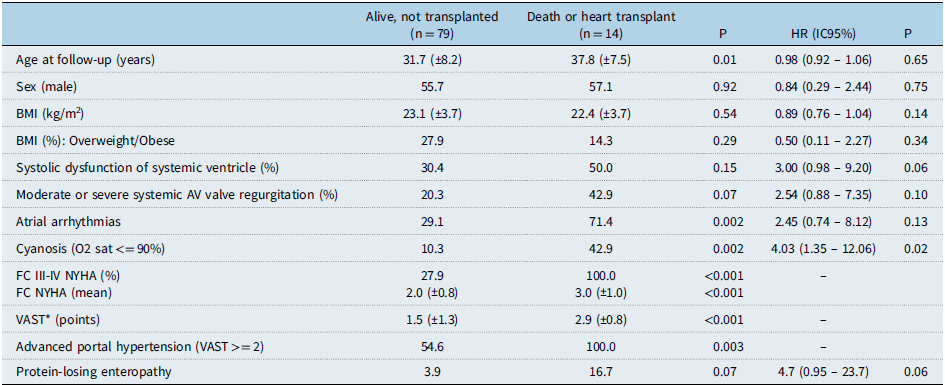
We analysed several variables that were potentially related with malnutrition and with prognosis and therefore could act as confounding factors. To do so, we performed two analysis that are summarised in Table 1 (association of selected variables with the existence of malnutrition) and Table 2 (association of selected variables with prognosis).
Relationship between selected factors and outcome (death or transplant)

Analysis was performed both considering the primary endpoint as a dichotomic variable and also by means of a survival model using HR. *p calculated by means of Chi-squared for proportions and t-Student for means. P-value for HR calculated by Cox regression. *The VAST scale reflects the presence of portal hypertension and includes the presence of varices, ascites, splenomegaly, and thrombocytopenia (1 point for each variable). AV = atrioventricular; BMI = body mass index; FC = functional class; (according to NYHA scale); O2 sat = oxygen saturation; VAST = scale for portal hypertension, acronym reflecting oesophageal varices, ascites, splenomegaly, and thrombocytopenia.
A number of demographic and clinical variables were evaluated. We identified cyanosis, functional class, and protein-losing enteropathy as potential confounding factors. In the adjusted model using these variables, malnutrition did not reach statistical significance (p = 0.81). However, given the relatively small number of patients in the cohort and the low absolute number of events, multivariate and subgroup analyses must be interpreted with caution.
Discusion
To the best of our knowledge, this is the first study to systematically analyse the prevalence of malnutrition in adult patients with Fontan physiology and its relationship with prognosis. It represents a relatively large cohort, given the rarity of this condition. Nutritional assessment may be specially useful in this population due to its unique pathophysiology, which includes altered intestinal absorption due to lymphatic dysfunction, liver disease, or sarcopenia. An exceptional review on nutritional considerations for Fontan patients has been recently published Reference Clode, Tran, Majumdar, Ayer, Ferrie and Cordina16 and may be very helpful for guiding assessment and management of this group of patients.
As main findings, we observed a high prevalence of moderate or severe malnutrition and worse outcomes in those who fulfilled malnutrition criteria. Malnutrition was more frequent in patients with low weight, but it was also diagnosed in patients with normal weight or overweight. On the other hand, in our study, overweight was not associated per se with a worse functional class or a worse prognosis, as suggested by previous studies. Reference Goldberg, Zak and McCrindle11,Reference Martinez, Byku and Novak13
Limitations
This was a single-centre, observational and retrospective study, with limitations inherent to this design. Causality cannot be established given the retrospective nature of our study.
Malnutrition is a complex condition that ideally requires multiple tools to be assessed. In fact, there is no standard definition for the diagnosis of malnutrition. The most accepted criteria comes from the Global Leadership Initiative on Malnutrition and requires at least one phenotypic and one etiologic criterion to make diagnosis. Reference Cederholm, Jensen and Correia17 Other usual methods, such as the Mini nutritional assessment, Reference Alsaied, Possner and Brown18 combine anthropometric parameters (with various measurements such as weight, height, waist and arm circumference, and body composition) with questionnaires to the patient (assessing diet, temporal changes in weight, or body habitus, etc.) and laboratory parameters. This kind of evaluation is the most comprehensive but is hardly applicable in the cardiology outpatient clinic context. In addition, it is impractical for a retrospective study where such data may not be available. For this reason, a number of simple scales have been developed that aim to assess malnutrition based on a few simple laboratory and/or anthropometric parameters. This is the case for the Controlling Nutritional Status, Prognostic Nutritional Index, and Geriatric Nutritional Risk Index scales, Reference Ni, Fang, Zhang and Chen3 which have been previously used and validated in patients with different types of heart disease. These scales include parameters that are routinely obtained in the follow-up of our patients and therefore are ideal for their use in daily practice. Their main limitation is that, although easy and quick to calculate, they may reflect the severity of the patient’s heart disease rather than nutritional status, Reference Driggin, Cohen and Gallagher2 and the scores can be affected by factors unrelated to nutrition itself. According to this, we would not consider them as prognostic factors, but rather prognostic markers that reflect a higher likelihood of clinical events in patients with more advanced disease. Moreover, they should be used only as screening tools for malnutrition to be later completed by extended examinations in order to decide, for example, whether a patient needs nutritional support.
Detecting malnutrition in patients with normal weight or overweight is likely reflecting sarcopenia. However, the mentioned scores used in our study do not assess sarcopenia or body composition and this is one of the main limitations of our study.
Individual components of Controlling Nutritional Status scale can be affected by factors other than malnutrition itself. However, this fact does not seem to have an impact on the results of the study. Albumin levels can be reduced in the context of protein-losing enteropathy (only 5.6% of our patients), but this would actually reflect one of the pathophysiological mechanisms that can contribute to malnutrition in patients with Fontan. Cholesterol levels could be artificially low by the use of different drugs, but this was not the case as none of the patients in our cohort were receiving lipid-lowering therapy. Finally, lymphocyte count could be low as a consequence of hypersplenism in patients with liver disease and portal hypertension. Reference Alsaied, Possner and Brown18 In our cohort, lymphocyte count was lower in patients with advanced portal hypertension (1.1x10³/L versus 1.4x10³/L, p = 0.004).
The Controlling Nutritional Status scale identifies three degrees of malnutrition (mild, moderate, or severe). In our cohort, a high proportion of patients met criteria for mild malnutrition, due to the high frequency of lymphopenia and low cholesterol levels in our population, as previously explained. We decided to use a cut-off of moderate or severe malnutrition to increase specificity and identify patients at a higher risk. This decision was also based in previous studies using same cut-offs. Reference Sze, Pellicori and Kazmi4
Patients with malnutrition had worse functional class as compared to those without malnutrition. However, when analysing objective measurements of maximum oxygen uptake, the difference was small and not significant. Caution must be taken when analysing VO2 measures as cardiopulmonary exercise test was available only in a relatively small proportion of patients.
Our study also analysed the prevalence of overweight and obesity. According to a recent review, Reference Willinger, Brudy, Meyer, Oberhoffer-fritz, Ewert and Müller19 prevalence of obesity in CHD patients is similar to the general population, although some studies have described a higher prevalence. Reference Steele, Preminger and Erenberg20 Patients with CHD are often sedentary, sometimes for “medical prescription”, with the risk of weight gain, deconditioning, and sarcopenia, which can have a negative impact on Fontan circulation as peripheral muscles are known to play a role in keeping cardiac output in Fontan physiology. Relationship between weight and malnutrition is not linear. Although, as expected, most patients meeting criteria for malnutrition had low weight, there were also patients in the normal weight or overweight categories, and in these cases, it would be specially interesting to test for sarcopenia. Obesity alone does not seem to significantly impact prognosis. A recent study of patients with atrial fibrillation found that obese patients had better prognosis than those with normal or low weight (the so called “obesity paradox”). Reference Raposeiras-Roubín, Abu-Assi and Lizancos Castro10 However, these differences disappeared when body mass index was adjusted by nutritional status by means of Controlling Nutritional Status scale, showing that patients with malnutrition had worse prognosis irrespective of body mass index.
Finally, we would suggest using Controlling Nutritional Status scale as a screening tool for malnutrition and to help identify high-risk patients, and referring those with high scores (≥ 5 points) for a dedicated assessment by a Nutrition specialist. After comprehensive evaluation, a nutritional support program should be established for those patients in whom malnutrition is confirmed.
In conclusion, nutritional assessment may hold particular relevance in patients with Fontan circulation, as a way of establishing individual prognosis, and with the potential to aid as a therapeutic goal for specific interventions. Nearly one out of five adult Fontan patients show parameters of moderate or severe malnutrition as defined by Controlling Nutritional Status score, representing a prognostic marker. Controlling Nutritional Status scale could be used in Fontan patients as a simple tool to identify a high-risk group of patients.
Supplementary material
The supplementary material for this article can be found at https://doi.org/10.1017/S1047951125001337.
Acknowledgements
None.
Financial support
This research received no specific grant from any funding agency, commercial, or not-for-profit sectors.
Competing interests
None.
Declaration of generative AI and AI-assisted technologies in the writing process
AI was not used during the preparation of this work.