Regretfully, we were not prepared for Sandy.… In the future, I will be proactive in being prepared for all hurricanes and storms by following the advice and recommendations to avoid another horrific experience. Hurricane Sandy survivorReference Hodgett 1
Household Emergency Preparedness
Hurricane Sandy made landfall along the northeastern US coastline on October 29, 2012, and caused billions of dollars in damage and numerous fatalities.Reference Gilbert 2 The results of Sandy included widespread and prolonged power outages and disrupted services for more than 1 million people. 3 Hurricane Sandy was the largest disaster event in the United States in 2012, accounting for 23 of the 112 federally declared disasters that year, and became an example of the need for emergency preparedness. 4 Disasters may vary in size and severity, but they invariably affect the communities where they occur. Households and individuals need to be prepared for such emergencies. The US Federal Emergency Management Agency (FEMA), whose mission is to support citizens and first responders in emergency preparedness, response, and recovery, recommends a whole community approach to disaster preparedness. This approach entails a shared responsibility for preparedness among individuals, businesses, community organizations, nongovernmental organizations, schools and academia, media, and all levels of government. 5
In 2003, FEMA began its “ready” campaign to increase the level of basic preparedness of citizens in the United States. 6 Along with the ready campaign, the American Red Cross and the Centers for Disease Control and Prevention (CDC) encourage individuals to be informed, make a plan, build a kit, and get involved. 7 , 8 In the event of a disaster, individuals are encouraged to have pre-established plans and enough provisions to be able to last on their own for at least 72 hours. 7 , 8
The US National Preparedness guidelines and target capabilities list were established in 2003 as part of the all-hazards national preparedness system. The guidelines’ community preparedness and participation capability outlines performance measure targets for community-level citizen preparedness, such as increasing the percentage of citizens with basic first-aid training to 80% of the population. 9 In spite of the promotion of household preparedness, regional and national surveys of individuals and households since these campaigns have found variable, but overall below target, rates of preparedness.Reference Silva, Yannacci and Paulsen 10 - 13 FEMA's 2009 national household survey on personal preparedness in the United States found that 57% of respondents reported having supplies set aside in their home in case of a disaster, and 44% reported having a household emergency plan.Reference Silva, Yannacci and Paulsen 10
Studies on household and individual preparedness have identified several sociodemographic factors that influence preparedness levels, including sex, race/ethnicity, age, education, and income.Reference Ablah, Konda and Kelley 11 , 14 - Reference Fothergill, Maestas and Darlington 17 Housing characteristics such as renting versus owning or living in urban versus rural areas have also been shown to affect household preparedness.Reference Ablah, Konda and Kelley 11 , Reference Russell, Goltz and Bourque 18 - Reference Mishra and Suar 21 While housing type has been identified as a component of social vulnerability during a disaster, its influence on household emergency preparedness, to our knowledge, has not been assessed.Reference Cutter, Boruff and Shirley 22 , Reference Tierney 23 Households in multiunit dwellings such as apartments or condominiums may have limitations for owning recommended emergency supplies compared to those living in single detached homes.Reference Edwards 24 , Reference Turner, Nigg and Heller-Paz 25
Oakland County, Michigan
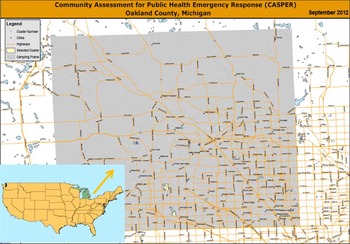
In September 2012, the Oakland County Health Division (OCHD), the Michigan Department of Community Health (MDCH), and the CDC conducted a community assessment for public health emergency response (CASPER) survey of residents in Oakland County (Figure 1). 26 CASPER is a rapid household survey sampling methodology that can be used to assess a population's needs after a disaster, or preparedness for a disaster. It uses a 2-stage cluster sampling method originally developed by the World Health Organization to assess vaccine coverage.Reference Malilay, Flanders and Brodan 27 As part of Michigan's capability-based planning for public health emergency preparedness, and in conjunction with National Emergency Awareness Month, the purpose of the survey was to assess levels of household preparedness in Oakland County and to develop public health capacity for emergency preparedness and response. 28 Michigan has been subject to extreme weather events, and Oakland County is 50 miles from the Fermi nuclear power plant. The objective of this analysis was to determine if housing type was associated with household emergency preparations in Oakland County.
Oakland County, Michigan.

Methods
Sample Selection
We used the 30 × 7, 2-stage cluster design methodology described in CDC's CASPER toolkit to obtain a sample size of 210 households. 26 The sampling frame included the 527 255 housing units in Oakland County, according to the 2010 US Census data. 29 Clusters were defined as single census blocks, with size being based on the number of housing units in each census block. The first stage of sampling selected 30 clusters (blocks) using probability-proportionate-to-size.
In the second stage of sampling, interview teams systematically selected 7 households within each selected census block by choosing a starting point within the cluster and then every nth household, where n equals the total number of households in a cluster divided by 7. Teams made up to 3 attempts to contact each selected household before replacing the household from within the cluster. Interviewers recorded housing type by identifying households as single detached homes, or multi-unit dwellings as duplexes, townhomes, condominiums, and apartment buildings.
Survey Instrument
We developed a 2-page questionnaire on self-reported household level emergency preparedness. Team members asked respondents about their total number of household members and their age ranges; pet ownership; whether any household member had medical conditions including diabetes, hypertension/heart disease, respiratory condition, physical disability, developmental disability, or if they were immunocompromised; if any member had a medical need associated with a medical condition, including daily medication, use of a wheelchair/cane/walker, dialysis, home oxygen, home health care, or other medical needs.
Questions on emergency preparedness measures were grouped into 3 categories: emergency plans, training in emergency response, and ownership of emergency supplies. Households were asked if they had the following plans: (1) copies of important documents in a safe location, (2) multiple routes away from the home in case evacuation is necessary, and (3) an emergency communication plan, such as a list of telephone numbers and a designated out-of-town contact. Households were asked if anyone in the household had taken training in either first aid or cardiopulmonary resuscitation (CPR) in the last 5 years. Households also were asked if they owned the following emergency supplies: (1) 72 hours’ supply of food for each person, (2) 72 hours’ supply of water (1 gal/person/day), (3) a method to cook without utilities (eg, gas or charcoal grill), (4) a backup heat source, (5) a generator, (6) a fire extinguisher, (7) a working smoke detector, (8) a working carbon monoxide (CO) detector, (9) an emergency supply kit (with supplies such as flashlights, radio, and extra batteries, that is kept in a designated place in the home), and (10) a first-aid kit.
Data Collection and Analysis
Interview teams composed of staff and volunteers from OCHD, MDCH, and CDC were trained before conducting interviews. Teams conducted interviews from September 10 to 12, 2012. In each household, 1 adult representative, aged at least 18 years or older, was interviewed for household level responses. The survey purposely did not collect any identifiable or sensitive information (eg, household income) that may have hindered participation. Therefore, a household income was assigned to each household based on the inflation-adjusted median household income and benefits of their census tract from 2010 US Census data. 29 Households were divided into 3 income level categories (low, middle, and high), based on their tertile.
To compare households in single detached homes and multi-unit dwellings, we used SAS 9.3 (SAS Institute Inc). We determined their cluster, census tract, income-level distribution, and the mean, median, and range of median household incomes across their census tracts. We used χ2 tests to compare the survey-weighted frequencies of household demographics, medical needs and conditions, and emergency preparedness measures by household type. Survey-weighted logistic regression models were used to determine the unadjusted and adjusted odds ratios (OR) and their 95% CI for emergency preparedness measures. P values of <.05 were considered statistically significant. This study was part of a CDC EpiAid investigation and was determined to be exempt from human subjects review.
Results
Household Characteristics
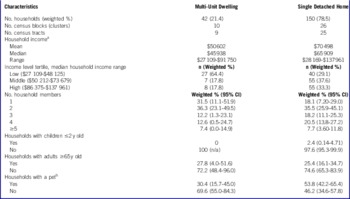
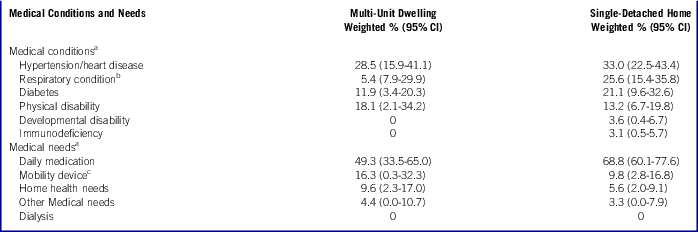
From the 30 clusters, contact was attempted at 517 households (including completed interviews, incomplete interviews, refusals, and nonrespondents). A total of 192 surveys (91%) were completed from the interview goal of 210 households. The households comprised 150 single detached homes and 42 multi-unit dwellings (Table 1). Households in multi-unit dwellings belonged to 10 clusters (representing 9 census tracts), and those in single detached homes belonged to 26 clusters (representing 25 census tracts). Almost two-thirds of the multi-unit dwelling households belonged to the low-income level category, and no multi-unit dwelling household belonged to a census tract with a median household income of $100 000 or more. Only 2% of households had children aged 2 years or younger, and no statistically significant differences were found between the 2 households groups for having adults aged 65 years or older. Households in single detached homes were more likely to own a pet (P < .05). Household size in multi-unit dwellings tended to be smaller, with 68% having only 1 or 2 members, but this was not a statistically significant difference. No statistically significant difference was noted in medical conditions and medical needs by housing type (Table 2).
Characteristics of Study Households in Multi-Unit Dwellings and Single Detached Homes, Oakland County, Michigan, 2012

aBased on census tract level median household income and benefits, inflation-adjusted (US Census 2010).
b P < .05
Weighted Percentages With 95% CI for Self-Reported Medical Conditions and Needs by Households in Multi-Unit Dwellings and Single Detached Homes

a P < .05
bAsthma/chronic obstructive pulmonary disease/emphysema.
cUse of a wheelchair/cane/walker.
Emergency Preparedness Measures
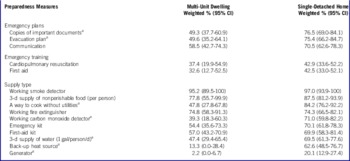
Weighted percentages for households in single-detached homes were the same or higher for all emergency preparedness measures compared to those in multi-unit dwellings (Table 3). More than 70% of households in single detached homes had all 3 types of emergency plans in place; whereas less than half of the households in multi-unit dwellings had copies of important documents or an evacuation plan (P < .05). Less than half of all households had someone in the home trained in CPR or first aid in the last 5 years, and no differences were found by housing type. For all households, a working smoke detector and a 72-hour supply of food were the 2 most common supplies, and a generator and a back-up heat source were the 2 least common supplies owned. The differences were statistically significant by housing type for having copies of important documents, evacuation routes, a way to cook without utilities, a 3-day supply of water, a back-up heat source, and a generator.
Weighted Percentages with 95% CI of Household Emergency Preparedness Measures for Households in Multi-Unit Dwellings and Single Detached Homes

a P < .05.
Association by Housing Type
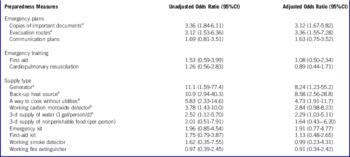
Based on studies of sociodemographic factors, we included income level in the adjusted model as the most likely source of confounding in the association with housing type.Reference Kohn, Eaton, Feroz, Bainbridge, Hoolachan and Barnett 15 , Reference Levac, Toal-Sullivan and O'Sullivan 16 Table 4 shows the unadjusted and adjusted ORs and their 95% CI for emergency preparedness measures in households in single detached homes compared to households in multi-unit dwellings. Of emergency plans, households in single detached homes had approximately 3 times the odds of having copies of important documents and evacuation routes (P < .05). There were no differences by housing type for having emergency training in CPR or first aid. There were 4 supply types that had statistically significant unadjusted and adjusted ORs: owning a generator, owning a back-up heat source, having a way to cook without utilities, and having a 3-day supply of water. The unadjusted OR for having a working CO detector was statistically significant, but its adjusted OR was 2.84 (P = .06). Households in single detached homes had lower odds of owning a working fire extinguisher, but this was not statistically significant.
Unadjusted and Income-Level Adjusted ORs With 95% CI of Household Emergency Preparedness Measures for Households in Single Detached Homes vs Multi-Unit Dwellings

a P < .05, both unadjusted and adjusted odds ratios.
b P < .05, unadjusted only.
Discussion
According to the US Census Bureau, 25.9% of housing units are within multi-unit structures. 30 With approximately one-quarter of households living in a multi-unit dwelling, understanding the influence by housing type has important implications for emergency planners. Previous studies have postulated an association between apartment buildings and emergency preparedness; however, to our knowledge, this is the first study to demonstrate an association between housing type (multi-unit dwelling vs single detached home) and specific emergency preparedness measures.Reference Olympia, Rivera, Heverley, Anyanwu and Gregorits 31
Households in multi-unit dwellings were less likely to own a generator, a back-up heat source, a way to cook without utilities, and a 3-day supply of water, and were less likely to have copies of important documents and evacuation routes. Studies on earthquake preparedness suggested that apartment dwellers may be constrained by building code requirements or other tenant policies set by their building owners.Reference Edwards 24 , Reference Turner, Nigg and Heller-Paz 25 Individuals living in multi-unit dwellings may be constrained by smaller spaces and lack of storage capacity, restricting their ability to stockpile bulky emergency supplies for a family. In addition, the use of cooking or heating devices that do not require electricity or gas may not be allowed due to risks from fire or CO exposure.
In this study, overall reported ownership of a working smoke detector was high; however, households in multi-unit dwellings were less likely to report owning a working CO detector. Without validating self-reports of ownership, it is unclear whether this represents an actual or perceived difference. Households in multi-unit dwellings may have their CO detector provided by their building operator, compared to those in single detached homes who have to purchase and install a detector themselves. Since 2009, newly constructed or renovated single-family homes and units in multi-unit dwellings in Michigan are required to have a CO detector. 32 Given the recent history of this requirement, older multi-unit dwellings may not have retroactively installed CO detectors in all units. Further research is needed to validate differences observed in this study.
We also found that households in multi-unit dwellings were less likely to have emergency plans or copies of important documents and multiple routes away from the home. One previous study found that families living in apartments 5 stories or greater were more likely to have a family emergency response plan compared to those in apartments less than 5 stories tall, town homes, row homes, and single-family homes, although that study did not assess specific components of an emergency plan by housing type.Reference Olympia, Rivera, Heverley, Anyanwu and Gregorits 31 Without ascertaining reasons for responses, the mechanism of influence by housing type on these preparedness measures is uncertain. Households that store their documents in a safe at home may face the same space limitations as for other bulky emergency supplies, but there are alternate ways to store documents, such as on an electronic server or in a bank safety deposit box that would be independent of housing type.
In terms of evacuation routes, building codes for multi-unit dwellings require alternate exits in case of fire. Households may be unaware of these routes, or may be unable to access them. In answer to the question, “does your household have multiple routes away from your home in case evacuation is necessary?” several respondents in single-detached homes said, “yes, I have a front door and a back door.” Considering this interpretation of the question, those in multi-unit dwellings would be less likely to report multiple evacuation routes. Understanding the differences in household preparedness by housing type requires further investigation. The possibility of storage limitations as outlined is one consideration. Another possibility is that those in multi-unit dwellings are, on average, less affluent, as they lived in census tracts with lower median household incomes. Therefore, they may be less likely to purchase recommended emergency supplies. This possibility seems less likely because the association between housing type and preparedness measures persisted after controlling for census tract income level. Identification of this association has implications for addressing the issue, because emergency planners could target interventions at all households in multi-unit dwellings, regardless of income level.
Limitations
Our study has several limitations. First, CASPER surveys are self-reported data from participating households, so responses may not reflect actual levels of emergency preparedness measures, and may be subject to response bias. Interviewers were trained in questionnaire administration and household selection to reduce this bias. 14 Second, there may have been residual confounding from sociodemographic factors, such as race, education, and house ownership. There may also have been residual confounding from using assigned income versus ascertained income. Last, this was a post hoc analysis of data collected from Oakland County's CASPER survey on emergency preparedness. The study design was not powered for detecting differences by housing type, which may have limited our ability to fully assess its association with preparedness measures. For the magnitude of effects seen in this analysis, and our ability to account for income level, the associations found are likely valid differences by housing type. Future research is required to further explore the precision of these estimates, the scope of the association between housing type and emergency preparedness, and the generalizability to other populations.
During a disaster, households in multi-unit dwellings may be vulnerable to overcrowding when funneled into limited exits and unsafe and disorderly evacuation onto the street.Reference Cutter, Boruff and Shirley 22 , Reference Tierney 23 Because of these risks, census information on housing is one component of disaster planning tools for identifying socially vulnerable populations, such as the social vulnerability index.Reference Flanagan, Gregory, Hallisey, Heitgerd and Lewis 33 The results of this study suggest households in multi-unit dwellings may also be vulnerable during a disaster from a lack of emergency preparedness measures. This finding is important to public health and emergency planners because, unlike other measures of social vulnerability such as socioeconomic status or language, multi-unit dwellings are readily identified within a local jurisdiction and provide opportunities for outreach to households within them, such as targeted preparedness campaigns.
Conclusions
Identifying and understanding the barriers that households may face in trying to improve their level of emergency preparedness are significant findings that might influence emergency planning and public health. This study provides evidence that housing type is associated with having emergency plans and owning certain emergency supplies. This information creates another avenue to improve household emergency preparedness by targeting interventions to those living in multi-unit dwellings and their building owners. Preparedness messaging on “getting a kit” may consider adjusting for limitations of living in a multi-unit dwelling. With fewer preparedness measures to enable sheltering-in-place during a disaster, as shown in this study, emergency planners might address accommodations for those living in multi-unit dwellings. Further research should explore strategies for improving household preparedness within different housing types.