Introduction
Attention-deficit/hyperactivity disorder (ADHD) is a psychiatric disorder characterised by difficulty in sustaining attention, impulsivity and hyperactivity, and is estimated to affect 5% of children and adolescents (Preuss etal. Reference Preuss, Ralston, Baldursson, Falissard, Lorenzo, Rodrigues Pereira, Vlasveld and Coghill2006), with about 60% of children continuing to be symptomatic as adults (Kooij etal. Reference Kooij, Bejerot, Blackwell, Caci, Casas-Brugue, Carpentier, Edvinsson, Fayyad, Foeken, Fitzgerald, Gaillac, Ginsberg, Henry, Krause, Lensing, Manor, Niederhofer, Nunes-Filipe, Ohlmeier, Oswald, Pallanti, Pehlivanidis, Ramos-Quiroga, Rastam, Ryffel-Rawak, Stes and Asherson2010).
To gain an insight into clinicians’ practices and beliefs surrounding ADHD, we conducted a pilot survey of healthcare professionals from different clinical specialties in seven European countries, and report the results here.
Methods
The survey, conducted in 2009, was developed by an international steering committee of ADHD experts (see Acknowledgements) and consisted of 64 multiple-choice questions relating to ADHD in children and adolescents, covering the following topics: attitudes, diagnosis, referral, treatment and improving care. The survey took ∼15 minutes to complete. Health professionals working with ADHD were identified through a medical marketing database (Medical Marketing Service Inc., IL, USA) and invited via email or by post to participate in the web-based survey. No incentive was offered for participation and the survey was only available in English.
Results
Respondent demographics
From a total of 22 050 email and postal invitations, 134 (0.6%) health professionals completed the survey, of whom 29 (22%) practised in the UK, 24 (18%) The Netherlands, 23 (17%) Germany, 15 (11%) France, 15 (11%) Spain, 14 (10%) Italy and 11 (8%) in the Republic of Ireland. The remaining three respondents answered ‘other’. Specialties included paediatrics (22%), psychology (21%), primary care (17%), child psychiatry (9%) and general/adult psychiatry (7%). Health professionals were experienced practitioners (85% were in practice for >10 years) who worked in both public and private practice settings.
Of the respondents continuing the care of patients already diagnosed with ADHD, 20% saw >10 patients per month, 16% saw 5–10, and 62% saw <5 patients per month. The average waiting time for specialist assessment after referral was generally 6 months or less (77%).
Validity of ADHD
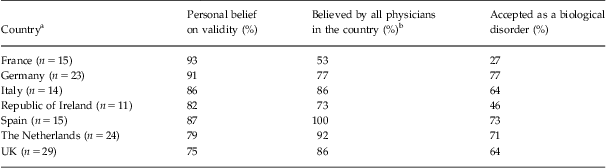
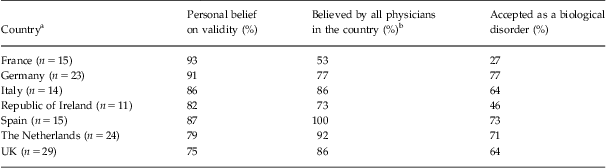
The majority (84%) of health professionals responded affirmatively that they viewed ADHD to be a valid diagnosis, 7% did not and 9% were unsure. Treating health professionals from France were least accepting, with only 53% accepting ADHD as a valid diagnosis compared with 86% of Italian and UK respondents and 100% of Spanish health professionals (Table 1). Psychologists were the specialist group that most frequently (19%) reported not believing in the diagnostic validity of ADHD. Overall, 62% of respondents believed ADHD to have biological underpinnings but variations existed between countries with only 27% of French health professionals reporting that they accepted ADHD as a biological disorder, compared with 46% of Irish and 64% of UK respondents (Table 1).
Percentage of all respondents, by country, indicating that ADHD is a valid diagnosis
ADHD, attention-deficit/hyperactivity disorder.
aThe remaining three respondents answered ‘other’.
bAs perceived by responding physicians.
There was significant variability and uncertainty about the rate of diagnosis among respondents. Almost one-third (31%) of respondents were unsure, while 27% thought that ADHD was underdiagnosed, 22% overdiagnosed and 12% thought the rate of diagnosis was appropriate (Fig. 1). Interestingly, country- and profession-specific differences were again observed. Respondents from Italy and France were most likely to report underdiagnosis (64% and 60%, respectively), compared with 27% in Ireland, 13% in The Netherlands and 14% in the UK and Germany, who were the least likely to report underdiagnosis of ADHD. Respondents from the UK were most likely to be concerned about overdiagnosis of ADHD (43%), compared with 18% in Ireland and 7% in Italy. Psychologists as a group were most concerned regarding overdiagnosis (31%), while paediatricians and psychiatrists were more concerned that ADHD was being underdiagnosed (37% and 33%, respectively).
Opinions on the appropriateness of diagnosis rate for attention-deficit/hyperactivity disorder, by country.

The Diagnostic and Statistical Manual of Mental Disorders (DSM-IV; 77%) (American Psychiatric Association, 2000) and International Classification of Diseases and Related Health Problems (36%) (World Health Organization, 2010) were cited as the reference criteria used, complemented by assessment scales (ADHD rating scale, 76%; Connors’ Parent Scale, 47%; Connors’ Teacher Scale, 38%) (Neurotransmitter.net, 2013). A total of 86% of respondents stated that they always documented the family history of ADHD. The vast majority (93%) of respondents agreed that ADHD persists into adulthood, typically presenting with new and different symptoms to those seen in children (56%). One-quarter of respondents believed that development of coping mechanisms would lead to reduced symptom expression in adulthood (25%), while a smaller number felt ADHD would continue into adulthood with a similar symptom profile as that seen in children (12%). The majority of respondents welcomed new diagnostic criteria in DSM-IV for different age groups [children of different ages (60%), adolescents (60%) and adults (64%)]. Following assessment, 84% of respondents make a provisional diagnosis, and 70% make an onward referral for specialist intervention and treatment, typically to a child psychiatrist or paediatrician. The majority of respondents (59%) engage in shared care. Treatment was personally viewed as efficacious by 84% of health professionals, but respondents perceived a less favourable evaluation by their colleagues (65%).
Treatment regimens
Initial treatment regimens most frequently prescribed by the respondents were combination pharmacological and non-pharmacological approaches (36%), followed by non-pharmacological (19%) and medication only (13%; Fig. 2). Recommended non-pharmacological treatments included psycho-educational therapy (recommended by 59% of respondents), parent training (by 49%), psychotherapy (by 51%) and occupational therapy (by 14%). For adult patients with ADHD, psychotherapy was recommended by 31%, and similarly, 31% recommended coping skills or psycho-educational therapy. A total of 18% stated that initial regimens varied based on individual patient characteristics. Figure 3 shows the proportions of patients who initially received specific types of pharmacological medications for ADHD as prescribed by the respondents. When prescribing medication, respondents most often used immediate-release methylphenidate, followed by modified-release stimulants, with 48% reporting using a non-stimulant as first-line medication in <20% of their patients. Respondents were asked to indicate which medication classes they found to be effective in the majority of their patients. Modified-release stimulants were cited by 38% of the sample and immediate-release formulations by 30%. Only 6% of the sample perceived non-stimulants to be effective in the majority of patients. When asked what medication was frequently used, i.e. in >20% of their patients, psychiatrists were equally likely to use either immediate-release (80%) or modified-release (80%) formulations. Paediatricians favoured modified-release formulations, with 60% using them often, compared with fewer than half (40%) who frequently used immediate release.
Initial choice of therapy type, by country.
Classes of medication initially prescribed for patients with attention-deficit/hyperactivity disorder.
A total of 102 respondents listed the side effects they were most concerned about, namely sleeping difficulties (66%), appetite problems (56%), mood/personality alterations (46%), growth problems (24%) and abuse potential (23%). A total of 18% were concerned about abuse or dependence, and 15% about cardiovascular effects. Seventy-one clinicians responded to the question regarding routine medical investigations before commencing medication. Overall, 25 (35.2%) did, with another 31 (43.7%) indicating this was not their role. Only 15 (21.1%) stated they did not. This differed by country, with respondents from Germany being most likely to request medical investigations (n = 11, 84.6%), compared with Ireland, Italy and Spain (25%). Of the eight respondents from France, five (63%) said they did not.
Barriers to treatment
The following barriers were rated by more than two-thirds (n = 100) of the respondents as being of ‘medium-to-high importance’: insufficient education of teachers, parents and patients (88%); parental fear of drug treatment (84%); inadequate availability of practitioners for non-pharmacological treatment (76%); inadequate training of primary care practitioners and paediatricians (76%); inadequate numbers of specialists for diagnosis and treatment (73%); parental fear of stigma (70%); and cost of non-pharmacological treatment (64%). Variation in response by clinical specialty was negligible.
Discussion
Although limited by an inability to verify actual practice from reported practice, an inability to accurately calculate a response rate based on expansive web-based invitation to participate and a possible response bias to those physicians able to speak English, this study offers some interesting insights into the similarities and differences with regard to the attitudes, beliefs, assessment and management of ADHD across different countries and professions. This survey revealed that there was general support among European health professionals about the validity of ADHD as a diagnosis (83%) and as having a biological basis (62%). Respondents from France were less likely to be convinced about the biological validity of ADHD than were respondents from other countries, but despite this, they were also the group that were most concerned about a diagnosis being missed, with more than half of them (60%) expressing a concern of underdiagnosis. While French respondents had a high personal belief about the validity of ADHD (93%) which was similar to other countries, French respondents were more likely to indicate a disbelief by other physicians in their country (53%) which might, in part, explain their worries about an underdiagnosis. Indeed, French respondents had a higher personal belief regarding the effectiveness of treatment (87%), compared with their perception of their colleagues’ beliefs (40%).
The differences between the American psychiatry diagnostic system (i.e. DSM) and the French Classification of Child and Adolescent Mental Disorders (CFTMEA) developed in 1983 (Mises etal. Reference Mises, Quemada, Botbol, Burzsteijn, Garrabe, Golse, Jeammet, Plantade, Portelli and Thevenot2002) might explain some of this country-specific difference in perception. Cultural differences in training and conceptualisation have recently been reported in the literature, with specific reference to ADHD (Vallée, Reference Vallée2011). Vallée contests that the French reference system relies openly on psychodynamic theory, and emphasises a psychosocial understanding of ADHD followed by psychosocial treatments (e.g. psychotherapy, family counselling) (Vallée, Reference Vallée2011). French clinicians are also hesitant about prescribing psychostimulants to children, with only 0.05% of French children taking psychostimulants, 80–120-fold lower than in the USA (Vallée, Reference Vallée2011). In the current study, however, this reluctance to prescribe was not seen and respondents from France reported a treatment approach evenly split between medication alone (20%), non-pharmacological treatment alone (20%), either pharmacological or non-pharmacological therapy (20%) and a combination of the two (33%). Barriers to effective treatment in France included inadequate education of primary care specialists (64%, medium level) and low education of teachers, parents and patients (43%, high level).
Most respondents believe that ADHD continues into adulthood and that there are benefits associated with treatment. This is consistent with recent studies. A systematic review of 351 studies on the long-term outcomes of individuals with ADHD found that, in general, individuals with untreated ADHD have poorer outcomes than those without ADHD (74%) and that for the majority (72%), treatment is associated with benefits in long-term outcome (Shaw etal. Reference Shaw, Hodgkins, Caci, Young, Kahle, Woods and Arnold2012), with the effect size being greatest for combined and non-pharmacological approaches. Although earlier reports from the Multimodal Treatment Study of Children with ADHD (MTA) suggested superiority of medication alone or in combination with psychotherapeutic approaches, subsequent naturalist follow up of this sample has not confirmed this (MTA (Multimodal Treatment Study of Children with ADHD) Cooperative Group, 1999; Jensen etal. Reference Jensen, Arnold, Swanson, Vitiello, Abikoff, Greenhill, Hechtman, Hinshaw, Pelham, Wells, Conners, Elliott, Epstein, Hoza, March, Molina, Newcorn, Severe, Wigal, Gibbons and Hur2007; Molina etal. Reference Molina, Hinshaw, Swanson, Arnold, Vitiello, Jensen, Epstein, Hoza, Hechtman, Abikoff, Elliott, Greenhill, Newcorn, Wells, Wigal, Gibbons, Hur and Houck2009). It is therefore impossible to know at present which therapeutic approach is associated with the best outcome for a child with ADHD.
Underdiagnosis was the predominant worry of approximately a third of paediatricians and psychiatrists, with respondents from France and Italy being most concerned. Given the risk of poorer outcomes associated with untreated ADHD, early recognition and appropriate treatment is necessary. This is in contrast with the findings of a recent survey of Irish adult psychiatrists, of whom a greater proportion (42%) believed childhood ADHD to be overdiagnosed (Beirne etal. Reference Beirne, McNamara, O'Keeffe and McNicholas2012).
In keeping with various ADHD guidelines, diagnostic reference manuals are being used, primarily the DSM-IV (77%). Just over a third (35%) of respondents recommended medical tests before prescribing medication, with significant differences emerging by country (the lowest rate of 16.7%, from Italian, to the highest rate of 85%, from German respondents) despite the lack of support for such routine assessments in the guidelines. Consistent with practice guidelines, general practitioners and family physicians tended to refer patients with suspected ADHD to a specialist, usually a child psychiatrist, for formal diagnosis, but most were keen to remain involved in shared care thereafter. Owing to the prevalence and long-term nature of ADHD, mental health resources are often not sufficient for managing the condition effectively. In the UK, community paediatricians are routinely involved in the assessment and treatment of children with ADHD, whereas in Ireland, ADHD is predominantly under the remit of child psychiatry. A recent survey of Irish paediatricians reported on their interest in receiving more formal training in ADHD and in being involved in the care of such patients (O'Keeffe & McNicholas, Reference O'Keeffe and McNicholas2011). Whether the development of Irish guidelines could bring together both disciplines and explore shared care arrangements more formally is worth exploring.
The most frequently cited initial approach to managing ADHD was the combination of medication and behavioural interventions, used by more than a third of respondents, and consistent with National Institute of health and Clinical Excellence (NICE) guidelines (Atkinson & Hollis, Reference Atkinson and Hollis2010). As European guidelines indicate behavioural therapy as first-line in most cases, particularly in younger patients or those with mild-to-moderate symptoms, the number of professionals using non-pharmacological therapy first was surprisingly low.
Pharmacological therapy alone, as advocated by the American Academy of Child Psychiatry (Pliszka, Reference Pliszka2007) was only used by 13%, suggesting that European clinicians are following European guidelines. Although misconceptions surrounding medication for ADHD are rife in the public domain, there was limited evidence of these misconceptions extending to health professionals. However, despite extensive literature reports as to the efficacy of medication in ADHD, few health professionals perceived any medication group to be efficacious in the majority of occasions, and this may have contributed to their overall low use. Only 6% rated the non-stimulant class as generally efficacious. The only non-stimulant medication licensed at the time of the study was atomoxetine. This is in contrast to the findings of a recent survey of Irish adult psychiatrists, in which atomoxetine was found to be more commonly prescribed than stimulant medications (Beirne etal. Reference Beirne, McNamara, O'Keeffe and McNicholas2012). Most physicians were aware of the potential adverse effects of medications and the possibility of misuse of stimulants, but these were not considered barriers to treatment. It is of interest that despite the Food and Drug Administration's concerns and guidance in 2005 (US FDA, 2010) over the risk of sudden unexpected death with stimulants in patients with pre-existing cardiac disease, these were cited by only 15% of health professionals as being major side effects of concern. The survey was not sufficiently detailed to establish whether clinicians were in fact aware of these potential side effects, or whether they believed either that these side effects were very rare or that they could be safely monitored. In fact, more recent studies and clinical consensus suggest that sudden death in ADHD-medicated children does not appear to exceed that of the general population and that these medications do not increase the risk beyond the risk associated with the underlying cardiac condition (Hamilton etal. Reference Hamilton, Rosenthal, Hulpke-Wette, Graham and Sergeant2011) The European Network of Hyperkinetic Disorders and the Association of European Paediatric Cardiology suggest these medications may be used in such patients under careful clinical management and often with a joint approach by a child psychiatrist and a paediatric cardiologist.
Accessibility and length of guidelines were mentioned as barriers to effective care. Respondents also indicated a desire for updated assessment tools. Given that many guidelines are freely available on the web, and many have summary versions [e.g. Canadian ADHD Resource Alliance (CADDRA) and NICE] and information on assessment tools, this response suggests a lack of awareness among health professionals about the availability of such guidelines (Atkinson & Hollis, Reference Atkinson and Hollis2010; CADDRA, 2011). Some countries are also hindered by local dictums of clinical practice, making it impossible for health professionals to follow the treatment algorithms advocated in the various guidelines. For example, in Italy, non-pharmacological treatments need to be tried for 6 months before commencing medication. For these reasons, country-specific guidelines, written by health professionals practicing in the area of ADHD, with both extended and short components and publicised to other health professionals within their field, might be of value.
One of the major limitations of this survey is the impossibility of accurately determining the response rate based on the methodology used. Web-based surveys are recognised as important and cost-effective epidemiological tools to establish cross-sectional data from a large, if uncontrolled group (Jones & Pitt, Reference Jones and Pitt1999). The fact that you cannot identify who has received or read the invitation makes it impossible to calculate a response rate. In this study, a very large group (>22 000) of health professionals on a database were sent the questionnaire, yet only a handful (n = 134) replied (Wyatt, Reference Wyatt2000). Two other key disadvantages of web-based surveys are that they draw on a population that are unrepresentative of the general population, restricting the generality and validity. Self-selection bias will apply, in that those who are interested and perhaps already treating patients with ADHD or with strong views on diagnosis or treatment, either positive or negative, will be more likely to reply. The results presented may therefore represent extremes of views. It is recognised that such bias may be exacerbated by offering incentives (Eysenbach & Wyatt, Reference Eysenbach and Wyatt2002). This kind of selection bias is considered more serious than the lack of generalizability as many confounding and unmeasured factors may be at play but with limited opportunity for interpretation by the researchers. Although this study did not offer any incentives, and chose a group who had a clinical link with ADHD, other limitations and unconrolled factors persisted. As such, this study should be seen to offer some interesting but uncontrolled perspectives of those who responded. Further studies using different methodologies are warranted.
In conclusion, this survey shows that, for the most part, ADHD is considered a clinically important and valid disorder, with biological underpinnings, continuing into adulthood and being responsive to treatment. Health professionals in Europe are generally familiar with clinical guidelines and medication side effects, but differences in practice and attitudes exist between countries and professional groups. Whether such differences in practice are due to idiosyncratic or cultural differences, or are due to the presence of different barriers across countries or services needs further exploration. Country-specific services (or lack thereof) and country-specific practice laws need to be taken into account when devising practice guidelines. A number of areas in the care of patients with ADHD that could be targeted to improve outcomes are highlighted by this research.
Acknowledgements
The authors thank the other members of the international steering committee [Philip Asherson (UK), Manfred Doepfner (Germany), Paulo Curatolo (Italy), Eric Konofal (France), Javier San Sebastián Cabasés (Spain), Laurens Vlasveld (The Netherlands)] and Linda Henson of Fishawack Communications Inc. (UK) for their input into the development and implementation of the European survey. The authors take full responsibility for the content of the paper but thank Amina Elsner, MD, and Manisha Madhoo, MD (both Shire Development Inc.), for constructive review; Debby Moss, PhD (Caudex Medical Ltd, Oxford, UK) for editorial assistance and collating the comments of authors and other named contributors; and Rachel Wright, PhD, of Fishawack Communications Ltd, for editorial assistance with an earlier draft of the manuscript, both funded by Shire Development Inc. The decision to submit the manuscript for publication in the Irish Journal of Psychological Medicine was made by the authors independently.
Funding
This research was funded by Shire Development Inc.
Conflicts of Interest
M. Fitzgerald has acted as a speaker for Lilly, Shire and Novartis and as a consultant for Lilly, Shire and Janssen Cilag. F. McNicholas has acted as a speaker for Shire and Janssen Cilag and is on an advisory board for Shire.