Blood lactate levels have been used as a metabolic surrogate for clinical status in children undergoing cardiac surgery. Reference Andersen, Mackenhauer and Roberts1–Reference Schumacher, Reichel and Vlasic3 Presumably elevations in circulating lactate levels reflect increased tissue hypoxia or ischaemia, leading to enhanced anaerobic metabolism and flux from pyruvate to lactate. However, lactate also serves as a major oxidative substrate feeding the citric acid cycle via pyruvate. Flux between lactate and pyruvate is bidirectional and catalysed by lactate dehydrogenase (Fig 1). Changes in lactate levels could also result from modification in tissue lactate or pyruvate oxidation within the mitochondria. Reference Duke4 In animal models emulating infant cardiopulmonary bypass with reperfusion, measures which increase pyruvate and lactate oxidation may improve cardiac function, while maintaining or reducing tissue lactate. Reference Olson, Hyyti and Cohen5 In contrast, impairments in mitochondrial respiration, which could occur without tissue hypoxia, would also result in increased lactate production and tissue efflux. Reference Olson, Hyyti and Cohen5 Thus, the lactate level as an isolated value provides an incomplete and undiscriminating picture of potential metabolic derangements occurring after cardiac surgical procedures in infants and children.
Triiodothyronine (T3) effects on glucose, lactate, and pyruvate metabolism. T3 supplementation increased lactate and pyruvate utilisation for energy production. Surgical stress including systemic inflammatory response syndrome (SIRS) and ischaemia–reperfusion disturbs myocardial energy metabolism at multiple steps in carbohydrate metabolism (glucose uptake and pyruvate oxidation). Reference Stanley, Lopaschuk and Hall17–Reference Floh, Manlhiot and Redington23 LDH=lactate dehydrogenase; PDH=pyruvate dehydrogenase.

Multiple studies have shown that thyroid hormone levels drop profoundly in infants and children after cardiopulmonary bypass. Reference Murzi, Iervasi and Masini6–Reference Portman, Slee and Olson8 Randomised placebo-controlled trials demonstrated that triiodothyronine supplementation, which prevents a decline in these circulating levels, improves clinical outcomes and cardiac function in selected populations. Triiodothyronine exerts ubiquitous actions which can improve clinical outcome in these patients. Reference Marwali, Boom and Budiwardhana7,Reference Portman, Slee and Olson8 Randomised controlled trials in two distinct populations of children undergoing cardiac surgery showed that triiodothyronine supplementation provided either intravenously or orally reduced time to extubation. Reference Marwali, Boom and Budiwardhana7,Reference Portman, Slee and Olson8 Additionally, the Oral Triiodothyronine for Infants and Children undergoing Cardiopulmonary bypass trial reduced the incidence of low cardiac output syndrome. Reference Marwali, Boom and Budiwardhana7–Reference Marwali, Caesa and Darmaputri9 Potential mechanisms for these triiodothyronine mediated benefits include direct promotion of calcium cycling in heart, as well as enhancement of fluid clearance from the lungs. Reference Danzi and Klein10,Reference Fazio11 However, studies in juvenile pig models have closely linked thyroid promotion of myocardial pyruvate entry into the citric acid cycle with positive inotropic effect (Fig 1). Reference Files, Kajimoto and O’Kelly Priddy12–Reference Olson, Bouchard and Ning14 To further explore this mechanism in patients, we used data and samples obtained in the Oral Triiodothyronine for Infants and Children undergoing Cardiopulmonary bypass (OTICC) trial to evaluate the effect of thyroid supplementation on lactate, glucose, and pyruvate metabolism after paediatric cardiac surgery. Reference Marwali, Boom and Budiwardhana7 This study also determined if parameters defining relationships between pyruvate, lactate, and glucose were indicative of clinical status and outcome, particularly low cardiac output syndrome.
Material and methods
Study design
This study was ancillary to the Oral Triiodothyronine for Infants and Children undergoing Cardiopulmonary bypass trial conducted as a single-centre study in the National Cardiovascular Center Harapan Kita, Jakarta, Indonesia. Reference Marwali, Boom and Budiwardhana7 Oral Triiodothyronine for Infants and Children undergoing Cardiopulmonary bypass trial was a randomised double-blinded placebo-controlled trial, which enrolled 208 patients, 104 to each placebo and the treatment group. Inclusion and exclusion criteria for Oral Triiodothyronine for Infants and Children undergoing Cardiopulmonary bypass trial (OTICC) are highlighted in ClinicalTrials.gov under identifier number NCT02521168, and in the manuscript outlining the trial results. Reference Marwali, Boom and Budiwardhana7 In brief, patients were 3 years old or younger, requiring cardiopulmonary bypass for two ventricle type repairs. Due to limited resources for pyruvate examination, for this ancillary study, we assigned a priori the first 48 patients consecutively randomised in Oral Triiodothyronine for Infants and Children undergoing Cardiopulmonary bypass trial. We also analysed all patients with lactate and glucose measurements (202 out of 208 patients) to evaluate the effect of T3 supplementation on lactate and glucose levels and their relationship with low cardiac output syndrome (Supplementary Fig 1). Study procedures for Oral Triiodothyronine for Infants and Children undergoing Cardiopulmonary bypass trial including administration of drug and methods of informed consent are also outlined in the parent study manuscript. Reference Marwali, Boom and Budiwardhana7 In summary, all OTICC patients were randomised into placebo and drug groups by way of block randomisation. The placebo (saccharum lactis) or oral T3 supplementation (1 mcg/kg BW/dose) was administered after anaesthesia induction and every 6 hours until 60 hours after the initial administration via nasogastric tube.
Measurements
Serum for determination of lactate and pyruvate concentrations was obtained from the right atrium via internal jugular vein access at the induction of anaesthesia and then 1 and 24 hours after cross-clamp removal for pyruvate, and 1, 12, and 24 hours for lactate. The pyruvate was analysed using Sigma-Aldrich reagent, an enzymatic assessment using bovine L-lactic dehydrogenase. Blood samples for the pyruvate measurement were dissolved in oxalate anticoagulant then immediately stabilised by deproteinisation to coagulate serum protein. Lactate was measured using a standard enzyme electrochemical method, based on the assessment of hydrogen peroxide concentration formed by an enzymatic reaction between lactate and oxygen molecules catalysed by lactate dehydrogenase. Serum glucose specimens were analysed from arterial line blood samples. Glucose infusion dextrose 5%: normal saline = 3:1 was initiated in all patients directly after surgery and titrated based on point of care blood glucose concentration. Accordingly, glucose concentrations were performed clinically and not part of the research protocol. Rather the glucose time point at induction and the nearest to study window for pyruvate and lactate sampling were used for analyses. Generally, this was within a few minutes for the 1 hour, and within 1 hour for the 24 hours. Steroid was administered to all patients following the peri-operative guidelines of cardiopulmonary bypass procedure in our centre.
Low Cardiac Output Syndrome (LCOS) assessment for the overall Oral Triiodothyronine for Infants and Children undergoing Cardiopulmonary bypass trial study population is detailed in a previous manuscript. In brief, the assessment for low cardiac output syndrome was conducted every 6 hours from 6 to 48 hours post-aortic cross-clamp removal. A modified version of low cardiac output syndrome criteria, based on the Prophylactic Intravenous use of Milrinone After Cardiac Operation in Pediatrics study was used in this study. Reference Hoffman, Wernovsky and Atz15 As regularly conducted in centres worldwide, low cardiac output syndrome was determined clinically as the presence of a minimum of two clinical findings (tachycardia, oliguria, poor peripheral perfusion, or cardiac arrest) and/or a central venous saturation less than 60% (oxygen extraction ratio higher than 40%), with or without metabolic acidosis, resulting in an escalation of therapy at the discretion of the consultant in charge at the time of assessment. Lactate levels were not included in the assessment of low cardiac output syndrome.
Statistical analysis
Data were collected and recorded in clinical research forms. All data were validated and signed by the principal investigator before digital input and analysis using SPSS program. Data were analysed using Statistical Package for the Social Sciences version 19 (International Business Machines Corporation, Armonk, New York, United States of America). A minimal sample size of 46 patients (23 for each arm) was needed to evaluate the difference of the lactate-pyruvate ratio in placebo and drug groups with an effect size of 5; 90% power and 5% alpha, and with an estimated 10% drop out rate. Serial measurements of the lactate-pyruvate ratio (the induction of anaesthesia, 1 and 24 hours after surgery) on both study groups were analysed using repeated analysis of variance. Further comparison analyses were performed using the Pearson’s Chi-square test (for categorical data) and the t-test (for normally distributed numerical data) or Mann–Whitney test (for abnormally distributed numerical data). Linear regression analysis was done to evaluate correlation between blood glucose, lactate, pyruvate, and the lactate-pyruvate ratio.
Results
Patient characteristics
With randomisation in the Oral Triiodothyronine for Infants and Children undergoing Cardiopulmonary bypass trial, 22 patients were assigned to the placebo group and 26 assigned to treatment, providing 48 patients for these metabolic studies. Most patients underwent VSD closure and TOF repair with a transannular patch; the Aristotle score, a variable considered in the parent study, ranged between 6 and 9. Reference Lacour-Gayet, Clarke and Jacobs16 Demographic characteristics (Table 1) were similar between these two groups. A full description of these variables has been described previously. Nutritional status was calculated prior to surgery using the z score of weight for height (W/H), based on the World Health Organization (WHO) child growth standard curves. Patients were classified as mildly, moderately or severely wasted using the z score thresholds of −1 to −2, <−2 to −3, and less than −3.
Demographic and surgical characteristics

ASD=atrioventricular septal defect; AVSD=atrioventricular septal defect; BH=body height; BW=body weight; CAVSD=complete atrioventricular septal defect; IAVSD=intermediate atrioventricular septal defect; IQR=interquartile range; PAPVD=partial anomaly pulmonary vein drainage; SD=standard deviation; TAPVD=total anomaly pulmonary vein drainage; TOF=tetralogy of Fallot; VSD=ventricular septal defect; Others=Mitral valve insufficiency (MI) repair and ASD closure
T3 effect on lactate, pyruvate, and glucose
Lactate-to-pyruvate concentration ratios was generally above 20:1 (Fig 2a). In both treatment groups, concentration for lactate and pyruvate (Fig 2b and c) increased significantly in parallel from induction of anaesthesia to 1 hour and then reversed towards baseline at 24 hours. The lactate concentration at 1 hour after aortic cross-clamp removal was significantly higher in the placebo compared to the treatment group (median (IQR) 1.70 (1.55–2.23) versus 1.50 (1.27–1.83) mmol/L, respectively; p = 0.04) although these values were still within normal limits (Fig 2c). An analysis of 202 patients in Oral Triiodothyronine for Infants and Children undergoing Cardiopulmonary bypass trial also showed no significant difference in lactate levels between groups (Supplementary Fig 2a). There were no significant differences for pyruvate (Fig 2b).
Serial median (95% confidence interval) lactate-pyruvate ratio ( a ), serum pyruvate (mmol/L) ( b ), lactate (mmol/L) ( c ), and blood glucose levels (mmol/L) ( d ) in placebo versus treatment group on the induction of anaesthesia, 1 and 24 hours post-cross-clamp removal (analysis in the first 48 patients of Oral Triiodothyronine for Infants and Children undergoing Cardiopulmonary bypass (OTICC) trial).
Ind=induction of aneasthesia; 1-hour AoX=1 hour after aortic cross-clamp removal; 24-hour Aox=24 hours after aortic cross-clamp removal.
*p < 0.05.

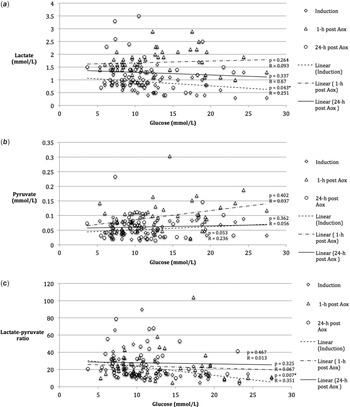
Random blood glucose levels showed a similar trend, increasing early during and after surgery and trending down afterward (Fig 2d). A significant difference was found in the random blood glucose levels, which were higher in the placebo group at 24 hours after aortic cross-clamp removal (median (IQR) 155.50 (130.30–213.0) mg/dl versus 132 (114.50–157.75) mg/dL, respectively, p = 0.03), despite no significant difference of glucose infusion rate given between the groups. Analysis of blood glucose in 202 patients also showed the same trends with significant differences at 1 hour after the ICU admission and 24 hours post-cross-clamp removal (Supplementary Fig 2b). The linear regression analysis showed significant correlations between blood glucose and lactate (p = 0.043, R = 0.25) (Fig 3a), glucose and pyruvate (p = 0.053, R = 0.24) (Fig 3b), glucose and lactate-pyruvate ratio (p = 0.007, R = 0.35) (Fig 3c) on the induction of anaesthesia. These significant correlations did not occur at 1 and 24 hours.
Scattered diagram and linear trend lines of the relationship between glucose and lactate ( a ), glucose and pyruvate ( b ), and glucose and lactate-pyruvate ratio ( c ) on the induction of anaesthesia, 1 and 24 hours post-cross-clamp removal (analysis in the first 48 patients of OTICC trial).

Low cardiac output syndrome and lactate-pyruvate ratio
Analyses in the full Oral Triiodothyronine for Infants and Children undergoing Cardiopulmonary bypass trial showed a higher incidence of low cardiac output syndrome in the placebo group compared to treatment. Reference Marwali, Caesa and Darmaputri9 The random subset of patients drawn from Oral Triiodothyronine for Infants and Children undergoing Cardiopulmonary bypass trial for these metabolic studies did not have similar statistical power to draw inferences regarding the treatment effect on outcome parameters. Rather, we compared metabolic parameters at each study time point for the low cardiac output syndrome patients with (identified at 6 hours post-cross-clamp) those without low cardiac output syndrome. Eleven patients in the placebo group showed at 6 hours versus five in the treatment group. We evaluated the correlation between low cardiac output syndrome, lactate, pyruvate and, and the lactate-pyruvate ratio within the placebo group only; few patients had low cardiac output syndrome with treatment rendering any statistical analyses futile. Comparisons were conducted between 11 low cardiac output syndrome and 11 non-low cardiac output syndrome in the placebo group. In the placebo group at 24 hours after aortic cross-clamp removal, non-low cardiac output syndrome patients had a higher lactate-pyruvate ratio (median (IQR) lactate-pyruvate ratio non-low cardiac output syndrome versus low cardiac output syndrome were 35.22 (22.08–65.75) and 17.05 (11.84–26.07), respectively; p = 0.007). Patients without low cardiac output syndrome in the placebo group had significantly lower serum pyruvate concentrations at 24 hours after aortic cross-clamp removal compared to those with low cardiac output syndrome [0.03 (0.02–0.04) mmol/L versus 0.08 (0.05–0.10) mmol/L, p ≤ 0.0001].
Clinical parameters including mixed venous saturation, O2 extraction ratio, inotropic score (IS), and the vasoactive inotropic score for low cardiac output syndrome and non-low cardiac output syndrome groups and results of statistical comparisons are reported in Supplementary Table 1. In general, low cardiac output syndrome patients exhibited lower mixed venous saturation and higher O2 extraction ratio and inotropic scores at multiple time points.
In 48 patients, the return for lactate and glucose to baseline was detected in non-low cardiac output syndrome at 12 hours, but not detected in low cardiac output syndrome until 24 hours, indicating a delay in clearing blood lactate and glucose in low cardiac output syndrome. Lactate levels at 12 hours post-cross-clamp removal and blood glucose levels at induction and 1 hour post-ICU admission were significantly higher in low cardiac output syndrome patients than non-low cardiac output syndrome patients (Fig 4). Similarly, analysis of 202 patients in the Oral Triiodothyronine for Infants and Children undergoing Cardiopulmonary bypass study showed that the glucose levels were significantly higher in low cardiac output patients during induction of anaesthesia (Supplementary Fig 3). No significant difference was found in terms of pyruvate and lactate-pyruvate ratio between those with and without low cardiac output syndrome.
Serial median (95% confidence interval) serum lactate (mmol/L) ( a ) and pyruvate levels (mmol/L) ( b ), lactate-pyruvate ratio ( c ), and blood glucose levels (mmol/L) ( d ) in the first 48 patients of OTICC trial with versus without LCOS.
Ind=induction of anaesthesia; LCOS 6 hours=low cardiac output syndrome at 6 hours post-cross-clamp removal; 1-hour, 12-hour, and 24-hour AoX=1, 12, and 24 hours after aortic cross-clamp removal; 1-hour, 4-hour, 12-hour, and 24-hour ICU=1, 4, 12, and 24 hours after ICU admission. *p < 0.05.

Discussion
Randomised clinical trials including Oral Triiodothyronine for Infants and Children undergoing Cardiopulmonary bypass trial have shown that triiodothyronine supplementation for infants and children, undergoing procedures using cardiopulmonary bypass, improves post-operative outcomes. Reference Marwali, Boom and Budiwardhana7 In the Triiodothyronine Supplementation in Infants and Children Undergoing Cardiopulmonary Bypass trial, Triiodothyronine supplementation concomitantly improved cardiac function while reducing the inotropic score. Reference Portman, Slee and Olson8 As thyroid hormones exert multiple ubiquitous actions, which can improve post-operative outcomes, the exact mechanisms for improved contractile function still require clarification. Elucidations of these mechanisms could serve to identify future therapeutic targets. Pyruvate supplementation during reperfusion following CPB and hypothermic circulatory arrest enhances myocardial pyruvate entry into the citric acid cycle, while improving cardiac function in a juvenile pig experimental model. Reference Olson, Hyyti and Cohen5 An enhanced flux of pyruvate into the citric acid cycle occurred through both oxidative and anaplerotic pathways. This finding suggests that the oxidative substrate metabolism plays an important role in improving cardiac contractile function after these procedures which create ischaemia–reperfusion conditions. Reference Stanley, Lopaschuk and Hall17 Although hypoxia is often implicated for the rise in lactate in post-operative patients, those studies in animal models suggest that an impairment in the pyruvate/lactate oxidation plays a substantial role. Importantly, triiodothyronine supplementation in the pig model promotes a myocardial pyruvate dehydrogenase flux while improving function, reinforcing the hypothesis that the thyroid-related mechanism of action is at least partially metabolic. Reference Files, Kajimoto and O’Kelly Priddy12–Reference Olson, Bouchard and Ning14,Reference Kajimoto, Ledee and Xu18
Our first objective was to determine if triiodothyronine supplementation modified pyruvate metabolism after cardiopulmonary bypass. As the measurement of pyruvate flux is not feasible in human infants, we chose to assess systemic lactate and pyruvate concentrations. Blood lactate has been used as a general surrogate for systemic metabolic status in these patients. Reference Agrawal, Das and Varma2,Reference Schumacher, Reichel and Vlasic3 Lactate participates in a bidirectional lactate dehydrogenase reaction. As lactate occurs at higher concentrations, it serves as a primary substrate in the heart in humans, superseding glucose as a contributor of acetyl-CoA to the citric acid cycle. Pyruvate is generally considered an intermediary between glucose or lactate and acetyl-CoA, which then enters the citric acid cycle. Then, blood, plasma, or serum lactate reflects the general balance between lactate oxidation to pyruvate, or pyruvate reduction to lactate through the dehydrogenase. The pyruvate pool is substantially smaller than the lactate pool, suggesting that lactate serves as a buffer, and limits potential detectable changes in pyruvate concentration. The very low pyruvate concentration makes an accurate detection of a challenging and laborious process, providing another plausible reason, we could detect no impact of triiodothyronine on pyruvate concentration. Relative changes in the pyruvate concentration at each time point within the protocol occurred in parallel to lactate and were relatively modest, resulting in no significant change in the lactate-pyruvate ratio.
Triiodothyronine did not reduce blood lactate concentration in a clinically relevant way shortly after cardiac reperfusion. The magnitude of this reduction, though significant, is relatively small and likely not clinically useful for assessment in an individual patient. However, this triiodothyronine response observed in the general systemic lactate pool supports findings in an experimental pig model, emulating the clinical scenario of infant CPB and reperfusion. Those animal studies showed that similar triiodothyronine supplementation increased myocardial lactate oxidation shortly after reperfusion by directly stimulating flux through pyruvate dehydrogenase.
Glucose has received much attention as an energy substrate in these post-operative patients. However, glucose undergoes glycolytic conversion to pyruvate before its utilisation in the citric acid cycle or metabolising to lactate. The positive correlations between glucose and both pyruvate and lactate in human plasma have long been recognised. Reference Levy, Sadoune and Gelot19–Reference Hatherill, Salie and Waggie21 More recently, preliminary studies employing large retrospective cohorts in surgical intensive care units have found similar correlations between these metabolites. Reference Adelsmayr, Brunner and Holzinger22 Accordingly, we found that glucose correlated significantly with lactate, and lactate-to-pyruvate ratio, though marginally to pyruvate prior to cardiopulmonary bypass. The subsequent surgical conditions with cardiopulmonary bypass and a direct systemic infusion with glucose as noted in methods disrupted this relationship. Importantly, the investigators followed the institutional standard of care glucose infusions for all patients. The low cardiac output syndrome patients showed significantly higher for glucose levels at various time points after surgery. The cyclical nature of glucose elevations in the low cardiac output syndrome, suggests some decreased sensitivity to insulin, as it was difficult to maintain steady-state glucose levels. Reference Floh, Manlhiot and Redington23
There are some limitations to these experimental findings. The sample size for metabolic studies was small compared to the entire Oral Triiodothyronine for Infants and Children undergoing Cardiopulmonary bypass trial cohort limiting our statistical power to define relationships between pyruvate and metabolic and clinical parameters. We committed to studying the first 48 patients in Oral Triiodothyronine for Infants and Children undergoing Cardiopulmonary bypass trial and the randomisation in the parent trial yielded unequal numbers per treatment group (22 for placebo and 26 for triiodothyronine supplementation). However, due to the double-blind design of the study, the uneven assignment was not known during the execution of the metabolic studies. The relatively low incidence of low cardiac output syndrome, particularly in the treatment population, also reduced our power. Due to the cost and laborious nature of measuring pyruvate, which is not commonly provided by clinical laboratories in Indonesia, we were unable to sample at more frequent time points. However, we were able to include the entire Oral Triiodothyronine for Infants and Children undergoing Cardiopulmonary bypass study population for glucose and lactate analyses, thereby increasing statistical power for detecting differences or changes in these metabolites.
In summary, we showed that triiodothyronine did not demonstrate any significant effect on blood lactate and pyruvate levels, but did reduce blood glucose levels, providing some insight into the mechanisms of this hormone direct action in these patients. Pyruvate levels were not predictive of low cardiac output syndrome, possibly due to buffering by the much larger lactate pool in blood.
Supplementary material
To view supplementary material for this article, please visit https://doi.org/10.1017/S1047951120003698.
Acknowledgements
We thank CRDF Global (USA) and the Osypka Foundation (Germany) for their grant support.
Financial support
Dr Marwali disclosed that the tetronine tablets were donated from Dalim Biotech, Korea. The remaining authors have disclosed that they do not have any potential conflicts of interest regarding this study.
Conflicts of interest
All authors declare that there is no potential financial or non-financial conflict of interests regarding this paper. All patients, their parents or legal guardians have been informed about the study and informed written consent was obtained before potential enrolment in the study.
Ethical statement
The study was approved by the Ethical Research Committee at the National Cardiovascular Center Harapan Kita with protocol number LB 05.01/1.4/235/2010 and is registered on ClinicalTrails.gov under identifier number NCT02222532. The complete study was performed according to the guidelines of the Helsinki declaration.