Introduction
Insects as a major group of animals possess enormous biodiversity and form a colossal biomass in nature (Ramos-Elorduy, Reference Ramos-Elorduy1997) and have played an important role in the history of human nutrition in Africa, Asia and Latin America (Bodenheimer, Reference Bodenheimer1951). The FAO (1995) notes that insects are an important non-wood forest product that poor people, particularly women and children, can gather. Insects are a popular food in many cultures all over the world, be it as occasional delicacies or as a replacement food in times of shortages, droughts, floods and war (Vantomme et al., 2004). The nutritional value of 14 species of edible insects in south-western Nigeria was studied, and it was concluded that because of the high nutritional value and ubiquitous presence, insects are a potential sustainable food source for humans. Grubs of the African palm weevil, Rhynchophorus phoenicis Fabr. (Coleoptera: Curculionidae), are fried and eaten in several parts of western Nigeria and in Delta and Edo States (Banjo et al., Reference Banjo, Lawal and Songonuga2006). The north-eastern region of India makes an ideal home for a number of wild sericigenous insects and is centre of wild silk culture, including muga, eri and oak tasar silk (Peigler and Naumann, Reference Peigler and Naumann2003). Silkworm pupae are traditionally used as fertilizer, animal feed, food material and medicine in some countries, such as China, Japan, Korea, India and Thailand (Zhou et al., Reference Zhou, Sun, Xu, Li and Zhao1996; Mishra et al., Reference Mishra, Hazarika, Narain and Mahanta2003; Zhu, Reference Zhu2004). Many tribal communities in China (Cao et al., Reference Cao, Shi and Sun1996) and India (Nagaraju, Reference Nagaraju2008) consume silkworm pupae. For the tribal communities in north-eastern India, according to Chowdhury (Reference Chowdhury1982), the ‘eri chrysalid (pupa) is a delicacy and the cocoon is more or less a by-product in silk production’.
The indigenous population in northeast India uses a variety of insects as food, one of which is the eri silkworm, Samia ricini Donovan (Lepidoptera: Saturniidae) (Longvah et al., Reference Longvah, Mangthya and Ramulu2011). Silkworm pupae have been put on the list of ‘novel food resources managed as common food’ by the Ministry of Health, P. R. China (Zhu, Reference Zhu2004). Information on consumption of silkworm pupae in some countries is available, but there are limited data on the nutrient composition. Fatty acids in insects serve as a primary source of energy during periods of non-feeding (Bozkus, Reference Bozkus2003). Dietary intervention and epidemiological studies have shown that fatty acid intake plays a key role in human health (Yang et al., Reference Yang, Siriamornpun and Li2006).
The consumption of silkworm larvae is popular among the tribal communities of north-eastern India, in general, and particularly in Karbi Anglong district of Assam (Ronghang and Ahmed, Reference Ronghang and Ahmed2010) and in East and West Khasi Hills and Ri-Bhoi district of Meghalaya. They are sold in the local markets (Paul and Dey, Reference Paul and Dey2013). The primary enterprise is silkworm rearing for the production of high-quality mulberry silk, which is promoted as a cottage industry by the Department of Sericulture, Shillong (East Khasi Hills district), and in Umsning and Nongpoh (Ri-Bhoi district) and is also a source of revenue for the State. Against this background, the present study was undertaken to evaluate the socio-economic significance of the eri silkworm locally known as Niang ryndai and to determine the nutritive parameters, namely fat-soluble vitamins A and E, lipids and amino acids, of silkworm larvae so that the information collected would be useful to conduct food consumption studies.
Experimental design
Study area
Meghalaya lies in the north-eastern region of India (latitude: 25°30′N and longitude: 91°E). The survey was conducted in East Khasi Hills (latitude: 25°07″ and 25°41″N and longitude: 91°21″ and 92°09″E), West Khasi Hills (latitude: 25°10′ and 25°51′N and longitude: 90°44′ and 91°49′E) and Ri-Bhoi district (latitude: 90°55′15″ to 91°16′N and longitude: 25°40′ to 25°21′E) through a questionnaire-based personal interview.
A household survey (three households in each district) was conducted using a structured questionnaire based on personal interviews to collect information on the use of silkworm, seasons of collection and mode of consumption. The samples were collected from the Iewduh market of Shillong. About 100 g of the samples were killed by freezing. Subsamples of the frozen larvae were thawed and dried in an air-drying oven at 40°C for 48 h (Akinnawo et al., Reference Akinnawo, Abatan and Ketiku2002).
Vitamins A and E were analysed using the ultraviolet–visible spectrophotometric method (Rutkowski and Grzegorczyk, Reference Rutkowski and Grzegorczyk2007). Nine essential amino acids (EAAs) (tryptophan (Sadasivam and Manickam, Reference Sadasivam and Manickam2008), methionine (Millard et al., Reference Millard, Jones and Blum1946; Sadasivam and Manickam, Reference Sadasivam and Manickam2008), histidine (Grundemeier and Andrews, Reference Grundemeier and Andrews1965), threonine (Neidig and Hess, Reference Neidig and Hess1952), lysine (Tsai et al., Reference Tsai, Hansel and Nelson1972), leucine (Knight and Hunter, Reference Knight and Hunter1968), isoleucine (Shah et al., Reference Shah, Rathod and Kanakia2007), valine (Matheson, Reference Matheson1963) and phenylalanine (Albanese, Reference Albanese1944)) were analysed spectrophotometrically using the standard procedures with slight modifications. Lipid analysis was carried out using gas chromatography (Clarus 480, PerkinElmer, Singapore) with an ELITE-5 (Crossbond® 5% diphenyl/95% dimethyl polysiloxane) column of 30 m × 0.25 mm ID and 0.20 μm df. The standard mix used for the study was Supelco® 37 Component FAME mix (Sigma-Aldrich, Kolkata, India; catalogue no. 47 885-U). The injection and detection temperatures were maintained at 260°C, and the volume of the sample injected was 1 μl with a split ratio 100:1. The column temperature was maintained at 140°C for 5 min and was programmed to 240°C at a rate of 4°C/min and kept at 240°C for 10 min. Nitrogen was used as the carrier gas. Fatty acid methyl esters were identified by comparison of retention times with standards and quantified by plotting a calibration curve with concentration on the X-axis and area of the standards on the Y-axis. The samples were prepared before analyses using a standard method (David et al., Reference David, Sandra and Wylie2003). In the subsequent analyses, lipid parameters were calculated using a standard formula (Ngeh-Ngwainbi et al., Reference Ngeh-Ngwainbi, Lin and Chandler1997). The EAA parameters such as chemical score (CS) (FAO/WHO, 1985), EAA index (Oser, Reference Oser1951), biological value (BV) (Oser, Reference Oser1959) and nutritional index (NI) (Crisan and Sands, Reference Crisan, Sands, Chang and Hayes1978) of frozen and oven-dried B. mori samples were calculated to determine the amount of amino acids present in the edible larvae, which will help us to understand the overall protein quality of silkworm.
All determinations were means of three replications. Solvents and chemicals used in this study were of the analytical reagent grade. Significance was tested by Tukey's test using Origin 7 software at the significance level of P< 0.05.
Results
Bombyx mori is a popular edible silkworm among the local inhabitants of East and West Khasi Hills and Ri-Bhoi district. It is available during the months of October and November and is considered a delicacy among the people of the State. It is locally referred to as Niang ryndai. The silkworms are brought from as far as Nongstoin (West Khasi Hills) and sold in the Iewduh market of Shillong. The larvae are generally handpicked, cleaned thoroughly in water, and consumed in the boiled or fried form.
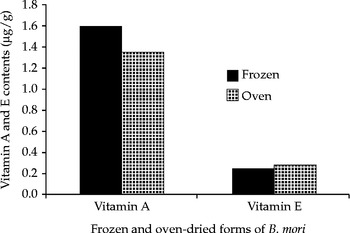
Vitamin analysis of frozen and oven-dried B. mori revealed that vitamin A content was significantly higher than vitamin E content (P≤ 0.05; Fig. 1). However, the frozen and oven-dried samples did not exhibit any significant difference in terms of the contents of both vitamins A and E (P≥ 0.05).
Vitamin A and E contents of frozen and oven-dried Bombyx mori (μg/g)

The fatty acid composition of frozen and oven-dried B. mori is summarized in Tables 1 and 2, respectively. Among the saturated fatty acids (SFAs), stearic acid (18:0) was detected in the frozen form. Among the monounsaturated fatty acid (MUFA), oleic acid (C18:1n9c), an essential fatty acid (EFA), was detected only in the oven-dried form. The frozen form contained omega-6 fatty acids such as linolenic acid (C18:2n-6c+t) (LA), γ-linolenic acid (C18:3n-6) (GLA), dihomo-γ-linolenic acid (C20:3n-6) (DGLA) and arachidonic acid (C20:4n-6) (AA). However, the oven-dried form lacked DGLA. Similarly, the identification of omega-3 fatty acids revealed that the frozen form contained fatty acids such as α-linolenic acid (C18:3n-3) (ALA) and docosahexaenoic acid (C22:6n-3) (DHA), whereas the oven-dried form contained linolenic acid (C18:3n-3), eicosatrienoic acid (C20:3n3), eicosapentaenoic acid (C20:5n3) (EPA) and DHA (C22:6n-3). To understand the overall lipid profile of B. mori such as SFA, MUFA, unsaturated fatty acids and polyunsaturated fatty acids (PUFAs), the PUFA:SFA (P:S) ratio and omega-6:omega-3 fatty acid ratio were calculated (Table 3).
Fatty acid composition of frozen Bombyx mori (%)± SD+

ND, not detected.
Values with the same letters are insignificant (P≥ 0.05).
+ Values are means of three replicates.
Fatty acid composition of oven-dried Bombyx mori (%)± SD+

ND, not detected.
Values with the same letters are insignificant (P≥ 0.05).
+ Values are means of three replicates.
Overall fatty acid composition of frozen and oven-dried Bombyx mori

From Table 3, it can be seen that saturated fat content was higher in the oven-dried form (5.75%) than in the frozen form (3.20%). On the other hand, the frozen form did not contain unsaturated fats, whereas the oven-dried form contained 0.65% of unsaturated fats. MUFA content was marginally higher in the frozen form (1.95%) than in the oven-dried form (1.28%). The trend observed in the case of omega-3 and omega-6 fatty acids indicates that PUFA (omega-3+omega-6) content was reasonably higher in the frozen form (3.76%) than in the oven-dried form (3.55%). To understand the dietary implications of PUFA, SFA, and omega-3 and omega-6 fatty acids, their ratios were calculated. The P/S ratio was found to be considerably higher in the frozen form than in the oven-dried form. A similar trend was observed in the case of omega-6:omega-3 fatty acid ratio. This indicates that the frozen form of B. mori had a comparatively better lipid profile than the oven-dried form.
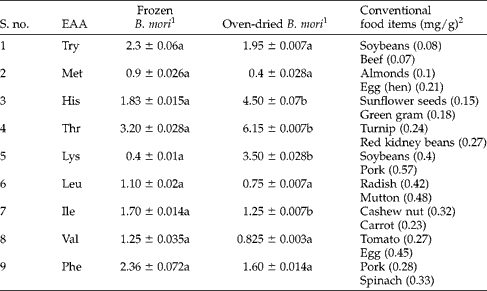
The EAA content of frozen and oven-dried B. mori is summarized in Table 4. The results indicate that the frozen form had a significantly higher amino acid content than the oven-dried form except for histidine, threonine and lysine. Both the forms had the highest concentrations of threonine, whereas the frozen form had the lowest concentrations of lysine and the oven-dried form had the lowest concentrations of methionine. The amino acid content of B. mori was compared with that of conventional food items to determine the overall amino acid standard.
Essential amino acid (EAA) content of frozen and oven-dried Bombyx mori (mg/g)

Values with different letters are significantly different (P≤ 0.05).
1 Values are means of three replicates±SD.
2 Gopalan et al. (1999).
The lowest amino acid score is used as the CS for the protein and it also predicts the first-limiting amino acid (Table 5). The CS of frozen and oven-dried B. mori ranged from 14.42 to 94.12 and 12.62 to 70.25, respectively. The EAA index of frozen and oven-dried B. mori ranged from 37.30 to 97.20% (Table 5). The BV of frozen and oven-dried B. mori ranged from 29.0 to 94.24% (Table 5). On the other hand, the NI of frozen and oven-dried B. mori ranged from 83.8 to 10.4% (Table 5). Generally, a protein material is said to be of good nutritional quality when its BV is high (70–100%) and also when the EAA index is above 90% and to be useful as a food when the value is around 80% and to be inadequate as a food material when the value is less than 70% (Oser, Reference Oser1959).
CS, BV, EAA index and NI of frozen and oven-dried Bombyx mori

CS, chemical score; BV, biological value; EAA, essential amino acid; NI, nutritional index.
Discussion
Silkworms are a delicacy among the local inhabitants and are even sold in the local markets of all major cities in the State and the north-eastern region, particularly in Assam and Meghalaya. This species is in great demand due to its palatability. The worms are deep fried or boiled with a pinch of salt as informed by the respondents. In Shillong, the silkworms are brought to the Iewduh market from as far as Umden in Ri-Bhoi district and Nongstoin in West Khasi Hills (Paul and Dey, Reference Paul and Dey2013). These yellowish-green worms are sold at a price ranging between Rs. 120 and 160/kg (2–3 USD) in different markets and are considerably cheaper than the conventional food items such as fish and meat. During the peak season, vendors sell an average of 10–12 kg of silkworms per day. A study conducted by Mech and Ahmed (Reference Mech and Ahmed2012) in Udalguri district of Assam revealed that participation of women is significantly higher than that of men in activities related to silkworm rearing, cocoon harvesting, spinning of yarn and marketing of spun yarn. A similar observation was made in Meghalaya where the sellers are generally women. It has also emerged that the sale of silkworms is particularly advantageous to the women as it requires little capital input and also serves as an additional source of income for them.
Vitamins are required in trace amounts for the normal functioning of the human body. These are required for growth, maintenance and reproduction. The fat-soluble vitamins (A and E) were analysed in frozen and oven-dried B. mori. Vitamin A content was found to be marginally higher than vitamin E content in the samples (P≤ 0.05). Adequate information on the vitamin content of edible insects, particularly silkworms, is scarce. Vitamin A and E contents have been found to be lower in B. mori than in conventional food items such as carrots, sweet potato, almonds and spinach (USDA, 2008).
The fatty acid analyses of B. mori revealed a variety of lipid components to be present in the frozen and oven-dried forms. People have no dietary requirement for SFAs; however, the Dietary Guidelines Advisory Committee (2005) addressed the issue of SFA intake and cardiovascular risk and concluded that SFA intake should be kept as low as possible with a recommendation of less than 10% of calories from SFA. The value obtained for saturated fat content in the present study was within the permissible limit. Several studies have shown that the effect of stearic acid on total cholesterol levels is minimal and not detrimental to human health (Judd et al., Reference Judd, Baer, Clevidence, Kris-Etherton, Muesing and Iwane2002). In the present study, the frozen form was found to contain stearic acid, whereas the oven-dried form did not contain this acid. Bhulaidok et al. (Reference Bhulaidok, Sihamala, Shen and Li2010) found the SFA content of Zhejiang and Guizhou ants to be 25.5 and 23.5%, respectively, which indicates that B. mori has a relatively lower SFA content, a fact that substantiates that consumption of the larva poses a lower risk for cardiovascular diseases as saturated fats are associated with heart disease, breast and colon cancers, and elevated total blood cholesterol levels (Lee, Reference Lee1997). Researchers have stated that the replacement of saturated fats with monounsaturated fats is also associated with decreased total, LDL and HDL cholesterol levels (Mensink and Katan, Reference Mensink and Katan1992); the presence of oleic acid in the larva supports this fact. Mariod et al. (Reference Mariod, Abdel-Wahab and Ain2011) determined the MUFA content of the melon bug Aspongopus viduatus F. and the sorghum bug Agonoscelis pubescens (Thunberg) (both Hemiptera: Pentatomidae) to be 56.78 and 43.04%, respectively, which exemplifies that the MUFA content determined in the present study is relatively low. Some fatty acids are termed as EFAs as the human body cannot synthesize them and hence these fatty acids must be incorporated through the diet. There are two main families of PUFAs: omega-3 and omega-6. LA, an essential omega-6 fatty acid, must be obtained through the diet as its deficiency leads to poor growth, fatty liver, skin lesions and reproductive failure. It has also been suggested (Iso et al., Reference Iso, Sato, Umemura, Kudo, Koike, Kitamura, Imano, Okamura, Naito and Shimamoto2002) that a higher intake of LA appears to protect against stroke, possibly through potential mechanisms of decreased blood pressure, reduced platelet aggregation, and enhanced deformability of erythrocytes. The analyses revealed that LA was present in both the forms. Several studies have confirmed that GLA reduces inflammation, tender joint scores and morning stiffness and decreases the need for non-steroidal inflammatory drugs (Calder and Zurier, Reference Calder and Zurier2001). Both the forms of B. mori contained this EFA.
AA, detected in both the forms of the larva, is of particular importance for growth and development of infants (Kakutani et al., Reference Kakutani, Ishikura, Tateishi, Horikawa, Tokuda, Kontani, Kawashima, Sakakibara, Kiso, Shibata and Morita2011). AA aids in the constriction of blood vessels and the formation of blood clots (Clandinin et al., Reference Clandinin, Foxwell and Goh1997). Hence, the detection of this fatty acid clearly indicates that B. mori will prove beneficial for the underprivileged sections of the society who cannot afford to include meat in their diet due to its high cost, particularly during pregnancy.
ALA is an essential omega-3 fatty acid known to have beneficial effects on coronary heart diseases (Ascherio, Reference Ascherio2002). Two other omega-3 fatty acids (DHA and EPA) have been reported to have health benefits (Mantzioris et al., 2002). These omega-3 fatty acids have been shown to prevent the development of cancer (Hardman, Reference Hardman2002) and cardiovascular disease (Simopoulos, Reference Simopoulos2002). DHA is also important during pregnancy for infant growth and brain development (Horrocks and Yeo, Reference Horrocks and Yeo1999) and reduces the incidence of premature births (Allen and Harris, Reference Allen and Harris2001). Generally, poor sections of the society cannot afford fish, considered to be a rich source of EPA and DHA. Particularly during pregnancy, when a diet rich in these two fatty acids is imperative for the proper growth and development of the foetus, the easily available and cheap alternative is the edible larva of B. mori, which may prove extremely beneficial to these sections if the positive health benefits associated with this insect can be popularized among the people.
Researchers have emphasized that the right ratio of omega-6:omega-3 fats is important for health. Simopoulous (Reference Simopoulos2002) indicated that a lower omega-6: omega-3 PUFA ratio ( < 5) is effective at suppressing the development of cardiovascular disease, cancer, and inflammatory and autoimmune diseases and decreasing the risk of breast cancer in women as well as many chronic conditions currently being observed; Yang et al. (Reference Yang, Siriamornpun and Li2006) indicated that consumption of PUFAs reduces the risk of or prevents the development of various chronic diseases. The ratio obtained for the frozen form of the edible larva was 4.97, which is marginally lower than the specified value, whereas that obtained for the oven-dried form was considerably lower. The P/S ratio has been widely used to indicate the cholesterol-lowering potential of a food. A P/S ratio of 0.2 has been reported to be associated with high cholesterol levels and with a high risk of coronary heart disorders, while a ratio as high as 0.8 has been reported to be associated with desirable levels of cholesterol and a reduced risk of coronary heart diseases (Mann, Reference Mann, Garrow and James1993). The ratio obtained for both the forms of B. mori is indicative of its potential in the dietary management of certain coronary heart diseases.
Amino acids are considered to be the building blocks of proteins, which act as antibodies to combat bacteria and viruses. EAAs hold more importance as the human body cannot synthesize them. The amino acids present at the highest concentrations were threonine, tryptophan and phenylalanine. The CS was calculated with reference to egg protein, which is considered to be biologically complete in all respects. Methionine, isoleucine and tryptophan scored 94.12, 85.43 and 72.19%, respectively; however, lower values were obtained for the oven-dried form (Table 5). The EAA index is useful as a rapid tool to evaluate food formulations for protein quality. However, it does not account for differences in protein quality due to various processing methods or certain chemical reactions. The EAA index obtained for the frozen and oven-dried forms was, respectively, 97.20 and 37.30%, which scored reasonably well when compared with egg or casein. The BV is a measure of the proportion of protein absorbed from a food retained by the body. The higher the protein BV, the more nitrogen the human body can use for protein synthesis. Animal proteins have a higher BV than plant proteins, among which whey proteins score the highest (104) and the egg has the second highest score of 100.With reference to this, the frozen form of the edible larva had a reasonably good score of 94.24%. The NI was fairly good for the frozen form; however, the oven-dried form had a low value (Table 5).
Conclusion
Besides its primary contribution to the silk industry, B. mori and its local trade for edible purposes can make a significant contribution to the livelihoods of the less-privileged sections of the society. Its contribution to the underprivileged rural populations in terms of quality nutrition and food supplementation cannot be overemphasized. Women undertake the major portion of the work related to the rearing, raising and nursing of silkworms. Besides, the above activities are very much suited to the physical strength of women. In addition, the collection and selling of the fifth instar larvae as food are also a woman-dominated enterprise, adding to their income. Thus, there is a need to promote silkworm rearing to generate additional income for people, particularly women, and also to increase the production and availability of a quality, cheaper alternative source of protein and energy. The results of the present study indicate that B. mori is indeed a good source of lipids, amino acids and vitamins and the contents are often at par or marginally higher than those in conventional food items. The EAA content was found to be considerably higher in B. mori than in conventional food items, indicating the potential of the larva as a source of quality protein.
The results of the present study clearly indicate that the samples had appreciable quantities of all the dietary elements needed for a healthy life. The rearing of this species and its popularization through the sericulture department for production of silk as a cottage industry can be considered as an important infrastructure already in place. A value addition to this industry in the form of promoting and popularizing the edible qualities of this cheap and rich source of nutrition is desirable and will help enhance the economic value of B. mori.
Acknowledgements
The authors are grateful to the respondents for sparing their valuable time and sharing their indigenous knowledge on the topic and to the Defence Research Development Organization of the Republic of India for providing the necessary funding for the research project.