INTRODUCTION
Currently, in intensive agricultural production, new insights are essential to increase competitiveness and minimize the environmental impacts of agricultural practices. Regarding crop development, establishing mutually beneficial associations between a host and micro-organisms in the rhizosphere has been demonstrated to be a profitable technique (Aroca et al. Reference Aroca, Ruíz-Lozano, Zamarreño, Paz, García-Mina, Pozo and López-Ráez2013). For instance, micro-organisms can contribute to soil recovery and with partial or total substitution of some agrochemical nutrients, leading to reductions in production costs (Azcón Reference Azcón, Alarcon and Ferrera-Caerratim2000). In particular, arbuscular mycorrhizal fungi (AMF) form one of the most interesting beneficial plant–micro-organism associations (Aroca et al. Reference Aroca, Ruíz-Lozano, Zamarreño, Paz, García-Mina, Pozo and López-Ráez2013) and are known to colonize the roots of the majority of land plants, including grapevines (Schreiner & Mihara Reference Schreiner and Mihara2009). Arbuscular mycorrhizal fungi are very common in terrestrial ecosystems and their importance has been widely accepted for: (i) transmitting nutrients to plants from a great distance, with the fungal hyphae undertaking the function of a widely spreading root system (Schnepf et al. Reference Schnepf, Roose and Schweiger2008), (ii) increasing the absorption of water and nutrients from the soil, acting as a bio-fertilizer (Sánchez-Blanco et al. Reference Sánchez-Blanco, Ferrández, Morales, Morte and Alarcón2004), (iii) raising the hydraulic conductivity of the plant root system and the photosynthetic capacity of the canopy (Sánchez-Blanco et al. Reference Sánchez-Blanco, Ferrández, Morales, Morte and Alarcón2004) and (iv) positively affecting plant growth and providing tolerance against biotic and abiotic stresses (Pozo & Azcón-Aguilar Reference Pozo and Azcón-Aguilar2007).
However, although a wide range of studies have demonstrated the positive influence of AMF on cultivation systems (Hamel & Plenchette Reference Hamel and Plenchette2007), their agricultural application has been very limited, probably due to inoculation ineffectiveness (Ryan & Graham Reference Ryan and Graham2002) or other factors involved in AMF persistence such as compatibility, carrying capacity, abundance and priority effects (Verbruggen et al. Reference Verbruggen, Van Der Heijden, Rilling and Kiers2013). Mechri et al. (Reference Mechri, Mariem, Baham, Elhadj and Hammami2008) also showed that AMF are very influenced by soil properties, since these constitute the physical–chemical environment in which this symbiosis occurs. In grapevines, for instance, Herrera-Peraza et al. (Reference Herrera-Peraza, Hamel, Fernández, Ferrer and Furrazola2011) indicated that AMF only work properly in a specific range of soil conditions and it is necessary to use species adapted to those specific soil conditions and that favour symbiosis with a given plant. Several studies concerning the association with AMF in grapevines have shown positive effects on plant development regardless of how they are applied, for instance as root inoculum (Schubert et al. Reference Schubert, Cammarata and Eynard1988), application to microplants (Schellenbaum et al. Reference Schellenbaum, Berta, Ravolanirina, Tisserant, Gianinazzi and Fitter1991) or cuttings (Waschkies et al. Reference Waschkies, Schropp and Marschenr1994), or directly through drip irrigation lines (Fernández & Juárez Reference Fernández and Juárez2011). In addition, most of the AMF previously found in grapevine roots are dominated by Glomus species (Schreiner & Mihara Reference Schreiner and Mihara2009).
In the present study, the effects of AMF root colonization on Crimson grapevine were evaluated for 2 years (2011–2012), in terms of nutrient uptake (macro- and micronutrients), gas exchange parameters (net photosynthesis and stomatal conductance), starch concentration and yield and quality of grapes. In relation to yield and quality of grapes, the fundamental commercial criterion followed to determine the harvest period was grape coloration.
To date and to our knowledge, this is the first study performed on a commercial vineyard for 2 consecutive years which has evaluated the effects of applying registered mycorrhizae through drip irrigation on physiology, nutrient uptake and yield. The second year of experimentation was used to examine the persistence effect of the mycorrhizae.
MATERIALS AND METHODS
Experimental design and growing conditions
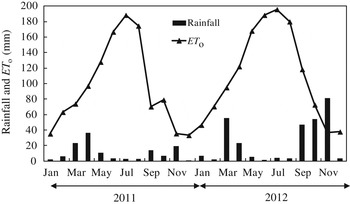
The experiment was conducted for 2 consecutive years (2011 and 2012) at a 1 ha commercial vineyard located in Jumilla, Murcia (South-eastern Spain, 38°19′N; 1°18′W; 335 m a.s.l.). This area is characterized by a Mediterranean semi-arid climate with warm, dry summer and mild winter conditions. The average annual temperature is 16·5 °C, reaching a maximum temperature of 33 °C in summer and a minimum temperature of 0·5 °C in winter. The annual rainfall averages 300 mm, with high seasonal and inter-annual variability. Most precipitation occurs during the autumn and winter months, but inter-annual droughts are also common (Martínez-Alvarez et al. Reference Martínez-Alvarez, Gallego-Elvira, Maestre-Valero and Tanguy2011). The seasonal variation of the monthly reference evapotranspiration (ET o) and the rainfall for the studied area are shown in Fig. 1.
Seasonal variation of the monthly reference ET o and rainfall.

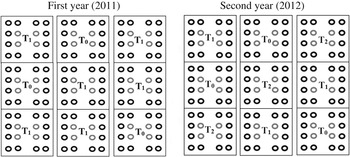
The experimental design was a randomized complete design composed of three blocks with three experimental plots per block (Fig. 2). The standard plot was made up of 16 plants, located in four adjacent rows. The four central plants of the two middle rows were used for the different measurements and the other 12 were guard plants.
Field experimental design. T 0, control treatment; T 1, inoculated Crimson grapevines; and T 2, Crimson grapevines inoculated during the first year and not inoculated during the second.

During the first year the following two treatments were performed: non-inoculated Crimson grapevine plants considered as the control treatment (T 0) (12 plants) and inoculated Crimson grapevine (T 1) (24 plants). During the second year, half of the plots that had been inoculated during the first year were used for evaluation of the persistent effect of the AMF, as these plants were not inoculated during the second year (T 2) (12 plants) (Fig. 2). In the second year, T 1 was inoculated again.
The selected grape was a 10-year old Crimson variety which has medium to large, elliptical-long, thin, crunchy and seedless red berries. Grapevines were planted with a separation of 4·0 m with rows spacing of 4·0 m and with a height of 2·3 m.
The soil had a silty clay texture with a pH of 8·51, electrical conductivity of the saturation extract of 1·06 dS/m and sodium absorption rate (SAR; [meq/l]0·5) of 0·22 measured in the saturation extract.
Grapevines were watered daily by drip irrigation with a mix of water transferred from the Tajo-Segura channel and groundwater to reach an electrical conductivity of c. 2 dS/m. Irrigation was performed to provide all of the daily crop evapotranspiration (ET c) requirements. This was estimated from the potential ET o, which was calculated from the Penman–Monteith equation (Allen et al. Reference Allen, Pereira, Raes and Smith1998) and using the crop coefficients (K c) proposed by Netzer et al. (Reference Netzer, Yao, Shenker, Bravdo and Schwartz2009) in a semi-arid Mediterranean region of Southern Israel with similar climatic conditions. Data used to calculate ET o were collected from an automated weather station placed at an elevation of 2 m above ground level and located 2 km from the experimental plots.
A total of 8126 m3 water/ha was supplied in the first year, of which 0·29 was supplied before the onset of ripening (veraison). In the second year, somewhat more water was applied (9305 m3/ha, of which 0·22 was before veraison). Drip emitters were spaced at 75 cm and had a nominal flow of 4 l/h. Each year, 550 kg/ha fertilizer (202 g total nitrogen (N)/kg, 69 g phosphorus (P)/kg, 401 g potassium (K)/kg, 323 g calcium (Ca)/kg and 6·1 g magnesium (Mg)/kg) was applied through the drip irrigation system.
Arbuscular mycorrhizal fungus inoculation
The AMF strain used, Glomus iranicum var. tenuihypharum sp. nova, was previously isolated in a sodium-saline soil with a high pH value ≈8·1. The multiplication of the strain was performed as proposed by Fernández & Juárez (Reference Fernández and Juárez2011). The inoculum (150 spores/g and 25 mg/g of extramatrical mycelium) was supplied through the drip irrigation system (injection pump regulated at 25 l/h) at the beginning of the vegetative growth phase at a dose of 4·5 kg/ha.
It should be noted that, according to the manufacturer, the small size of the particles composing the product (<100 μm) does not cause clogging problems in the filters, irrigation lines or emitters and once the inoculation was mixed with water it was actively located in close proximity to young roots, which are the most absorbent. Finally, the effectiveness of the inoculum (100 infective propagules/g) was eventually evaluated according to the most probable number test.
Measurements
Symbiotic development
At the time of grape veraison, young root samples and the surrounding rhizosphere soil were collected at a depth of 20–30 cm to assess the symbiotic development. Five root samples from eight grapevines per treatment were used with at least four replicates per root. The percentage of mycorrhizal root colonization was estimated following the gridline intersect method (Giovanetti & Mosse Reference Giovanetti and Mosse1980) under a microscope (100× magnification) after clearing washed roots (i) in 10% potassium hydroxide (KOH) for 10 min at 90 °C, (ii) in hydrochloric acid (HCl) 2 N for 10 min and (iii) staining with 0·05% trypan blue dissolved in lactic acid (v/v) (Phillips & Hayman Reference Phillips and Hayman1970).
Stem water potential (ψ stem)
The stem water potential (ψ stem) was measured at noon using a pressure chamber (Model PMS 3000; Soilmoisture Equipment Corp., USA). At present, there is a lack of agreement regarding the optimal stage for sampling, and although some authors propose two phenological stages (the end of flowering and veraison), others opt for veraison only (García et al. Reference García, Gallego, Daverède and Ibrahim2001). Bearing that in mind, measurements were carried out twice a month during the 1-year experimental period but to summarize results, only data from the veraison stage (average of two measurements in early and late July) are shown. In each plot, four healthy, fully expanded mature leaves (one leaf from each inner plant) from the main shoots in the middle and upper part of the vine canopy and located in the side opposite to the bunch were used (Kliewer Reference Kliewer and Rantz1991). Before collection and measurement, the leaves selected were enclosed within polyethylene bags covered with aluminium foil for at least 2 h before measurement (Begg & Turner Reference Begg and Turner1970).
Net photosynthesis and stomatal conductance
Instantaneous measurements of net photosynthesis (A) and stomatal conductance (g s) were performed on four leaves per plot (one leaf from each inner tree), using an open gas exchange system (Li-6400; Li-Cor, Inc., Lincoln, NE, USA) with an integrated leaf chamber fluorometer (Li-6400-40; Li-Cor Inc., Nebraska, USA). All measurements were performed on young, fully expanded leaves, at a photosynthetic photon flux density of 1500 μmol/m2/s to ensure light saturation, with a CO2 concentration in the cuvette of 400 μmol CO2/mol air (Pou et al. Reference Pou, Medrano, Tomàs, Martorell, Ribas-Carbó and Flexas2012). The sampling periods were the same as for ψ stem. Additionally, intrinsic water use efficiency (WUE) was determined and computed as the ratio of A/g s (Pou et al. Reference Pou, Medrano, Tomàs, Martorell, Ribas-Carbó and Flexas2012).
Leaf ion concentration
An inductively coupled plasma ICP (ICP-ICAP 6500 DUO Thermo, UK) was employed for determination of leaf macronutrients (P, K, Ca and Mg) and micronutrients (Fe, Zn, Mn, Cu and B). Nitrogen was determined following the Dumas method (Watson & Galliher Reference Watson and Galliher2001). In each plot, 20 leaves (five leaves from each inner tree) were collected according to the criterion followed for the selection of leaves to perform the measurements of ψ stem. The sampling periods were the same as for ψ stem. Ion concentration was compared with the macro- and micronutrient ranges determined by the Diagnosis and Recommendation Integrated System (DRIS). For grapevine, it is difficult to obtain reliable references due to the wide range of varieties, genetics, rootstocks, growing techniques, water regime or simply the variation across different climates and soils (Failla et al. Reference Failla, Bogoni, Porro and Stringari1997). In spite of this, and due to the lack of references in the literature regarding the optimal nutritional status for grapevine, the present study used the DRIS proposed by García-Escudero et al. (Reference García-Escudero, Romero, Benito, Domínguez and Martín2013) for Tempranillo grapevine as a rough guide.
Starch concentration
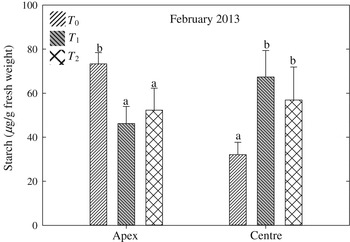
The starch concentration of grapevine roots was determined in February 2013, once the 2-year experiment finished, using the colorimetric assay described by Zapata et al. (Reference Zapata, Deléens, Chaillou and Magné2004) but somewhat modified. Five root samples (apical and central parts) from eight grapevines per treatment were used with at least four replicates per root (apical and central parts). Then, the apical and central parts were snap frozen with liquid nitrogen and extracted with Milli-Q H2O (1/10, w/v). Extracts were incubated at 100 °C for 15 min, and then centrifuged at 600 g for 2 min. The supernatant was mixed with absolute ethanol (1/3, v/v) and centrifuged at 9600 g for 5 min. The pellet, containing starch, was re-suspended in Milli-Q H2O and then diluted (1/10, v/v) if necessary (for samples containing high starch concentration). Finally, 1 ml of sample was mixed with 50 μl of Lugol solution (Sigma-Aldrich, Gillingham, UK) and the optical density was recorded at 595 nm using a Tecan-Sunrise plate reader. The starch concentration was calculated using a standard curve of pure rice starch (Sigma-Aldrich, Gillingham, UK) (0–200 μg/ml).
Yield and quality of grapes
As a result of the stepped grape maturation, two cuts, identified as first and second cut, were performed at commercial maturity as determined primarily by colour. The first cut was considered of the greatest commercial value. Finally, the total yield was determined as the sum of the yield weighed at each cut.
To determine the quality of grapes, 100 bunches and 100 individual grapes were selected randomly from each treatment. Then, the bunch and berry weights (Radwag WLC 1.2/B1, Poland), berry diameter, firmness (Durofel DFT 100 penetrometer, France), soluble solids concentration (Atago MASTER-T Refractometer, USA) and acidity (Metrohm 785 DMP Titrino + automatic sample changer Metrohm 760, Switzerland) were determined. The maturity index, which affects the perception of taste (sweetness and acidity) by the consumer and therefore influences their decision on whether or not to buy (Scandella et al. Reference Scandella, Kraeutler and Vénien1997), was computed as the ratio of soluble solids concentration to acidity.
Coloration of the fruits was determined using a Konica Minolta Sensing CR-10 colorimeter (Singapore) based on Lightness (L; describes overall intensity to how light or dark a colour is), Angle (Hue; describes a dimension of colour we readily experience when we look at colour) and Chroma (Ch; defined as the strength or dominance of the hue).
Statistical analyses
Data were analysed using a one-way analysis of variance using SPSS v. 21 for Windows to detect any significant differences between the parameters measured. In addition, when differences were significant, Tukey's range test at the 95% confidence level was carried out for comparison between treatments. Percentage values of root colonization were arcsine [square root (X)] transformed before statistical analysis.
RESULTS
Root mycorrhizal colonization
Table 1 shows the percentage of root colonization for the 2 years of experimentation. A natural AMF proliferation was detected in the control treatment (T 0) in both the first (to 10·3%) and the second year (to 19·0%). As expected, inoculated grapevines presented significantly (P<0·05) higher rates of colonization than the non-inoculated ones. During the first year, the mycorrhizal colonization rate increased significantly (P<0·05), to 60·0%. This value was notably higher in the second year (colonization increased to 89·0%) for T 1. During this second year, not inoculating the grapevines inoculated in the first year (T 2; Fig. 2) limited the percentage of AMF root colonization (root colonization of 43·0%), although a significant (P<0·05) increase of 24% (≈2·3 times higher) compared to T 0 was still observed (Table 1).
Percentage of root colonization and stem water potential (ψ stem, MPa) for the three treatments carried out in this experiment. Values correspond to the average ±s.e. of two measurements performed at the time of grape veraison (in early and late July)

* Native AMF.
Stem water potential (ψ stem)
During the first year of experimentation, the AMF inoculation significantly increased ψ stem levels (from −1·07 to −0·87 MPa). During the second year, a general increase in ψ stem compared to the first year was detected, but the effect of inoculation was only significant (P<0·05) between T 1 (−0·62 MPa) and T 0 (−0·80 MPa) (Table 1) plants.
Leaf-ion concentration
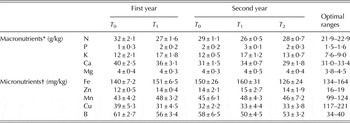
Table 2 presents the leaf-ion concentration (macro- and micronutrients) from the Crimson variety for the 2-year experimental period. During the first year, inoculated grapevines showed significantly (P<0·05) lower N but higher P and K concentrations compared to the control treatment (N=26·9 v. 31·6 g/kg, P=1·5 v. 1·0 g/kg and K=16·8 v. 11·7 g/kg). In contrast, Ca and Mg remained unaffected (Table 2). A similar trend was observed during the second year, where inoculated grapevines had significantly (P<0·05) reduced N and increased P, K and Ca compared to the control treatment (N=25·9 v. 28·7 g/kg, P=2·5 v. 2·0 g/kg, K=16·6 v. 12·3 g/kg and Ca=34·0 v. 31·0 g/kg). Overall, results in T 2 were similar to those observed in T 0.
Concentration of macronutrients (N, P, K, Ca and Mg) and micronutrients (Fe, Zn, Mn, Cu and B) on grapevine leaves from Crimson variety at the time of grape veraison for the 2-year experimental period. Values correspond to the average ±s.e. of two measurements performed at the time of grape veraison (in early and late July). Also the optimal macro- and micronutrients ranges calculated for grapevine ‘Tempranillo’ by the DRIS proposed by García-Escudero et al. (Reference García-Escudero, Romero, Benito, Domínguez and Martín2013) is shown

* N, nitrogen; P, phosphorus; K, potassium; Ca, calcium; Mg, magnesium.
† Fe, iron; Zn, zinc; Mn, manganese; Cu, copper; B, boron.
Concerning micronutrients, no significant differences were found between treatments regardless of the year under study, and concentrations of all micronutrients were similar in both the first and second year (Table 2).
Net photosynthesis and stomatal conductance
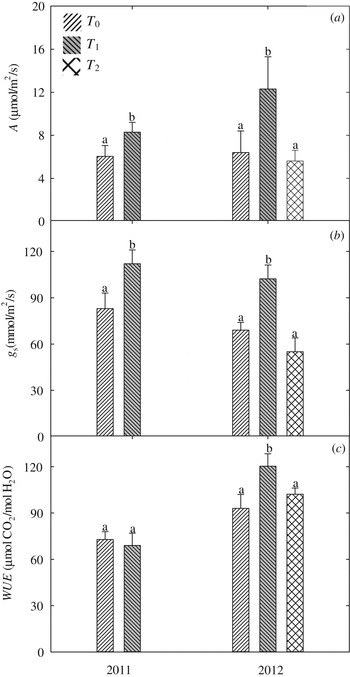
During the first year A and g s seemed to be dependent on inoculation, as inoculated plants (T 1) presented significantly (P<0·05) higher values (A=8·3 μmol/m2/s and g s=112 mmol/m2/s) (Figs 3(a) and (b)). Increases of 37·2% in A and 34·5% in g s with respect to T 0 were observed. In contrast, no significant differences were found between treatments T 0 and T 1 in WUE (≈70 μmol CO2/mol H2O). During the second year, the highest values of A and g s were found in T 1 (A=12·3 μmol/m2/s and g s=102·2 mmol/m2/s). These differences meant significant (P<0·05) increases in A and g s of 92 and 48%, respectively, compared to T 0. In contrast, the lowest A and g s values were found in both T 0 and T 2, where no significant differences were detected. A significant increase (P<0·05) was also seen for WUE in T 1 in the second year (120·3 μmol CO2/mol H2O), but not in T 2.
(a) Net photosynthesis (A, μmol/m2/s), (b) stomatal conductance (g s, mmol/m2/s) and (c) water use efficiency (WUE=A/g s; μmol CO2/mol H2O) for the three treatments carried out in this experiment. Values correspond to the average ±s.e. of two measurements performed at the time of grape veraison (in early and late July).

Starch concentration
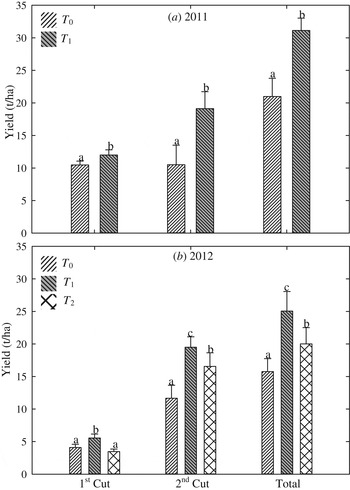
Figure 4 shows the starch concentration measured at the apex and the central parts of the roots for the three treatments, performed once the 2-year experiment finished (February 2013). A similar total starch concentration was measured in T 0, T 1 and T 2 treatments (105·4, 113·6 and 109·2 μg/g, respectively) although a slight trend towards increased starch with AMF inoculation was observed. In general, such higher starch accumulation observed in AMF-inoculated grapevines agreed with the higher A and WUE data (Figs 3(a) and (c)), as well as with the highest yield (Fig. 5).
Starch concentration (μg/g fresh weigh) at the apex and the central part of the root for the three treatments performed measured in February 2013 once the 2-year experiment finished. Data show the average value ±s.e.

Yield (t/ha) of Crimson grape variety for the 2-year experimental period for the three treatments performed. Data show the average value ±s.e.

Depending on the treatment carried out, starch was unevenly distributed between the apex and the central part of the root. For instance, in T 0 the starch concentration found in the apex (73·3 μg/g) was more than double that measured in the centre (32·1 μg/g) whereas in T 1 most of the starch concentration was found in the central part of the root (67·3 μg/g) compared to that observed in the apex (46·2 μg/g). Finally, starch concentration analysed in T 2 was evenly distributed between the apex and the central part of the root; 52·3 and 56·9 μg/g, respectively (Fig. 4).
Yield and quality of grapes
Figures 5(a) and (b) present the yield (t/ha) for the Crimson grape variety for each year of the experimental period, respectively. At the end of the first year, the yield in the control treatment (T 0) was 20·98 t/ha but inoculation significantly (P<0·05) increased the total yield by 48·3%, to 31·12 t/ha, with respect to T 0 (Fig. 5(a)). In inoculated plants (T 1), yield was unevenly distributed between the first and the second cut (0·39 and 0·61 of total yield, respectively) (Fig. 5(a)). For T 0 in the first year of the experimental period, half the yield was harvested in the first cut.
In the second year, a general reduction in yield compared to the first year was observed (Fig. 5(b)). For instance, in T 0 and in T 1 yield was reduced by 15 and 20%, respectively. However, as expected, inoculation significantly (P<0·05) increased the total yield of grape compared to the non-inoculated control (increase of 59·1%) (Fig. 5(b)). Such increases were also observed in both cuts and as occurred in the first year, the highest increase was found in the second cut (c. 67% of the total yield). The persistence of AMF, evaluated in treatment T 2, also increased the total yield significantly (P<0·05) but with a more moderate effect (yield of 20·01 t/ha; increase of 27·0% with respect to T 0). However, in contrast to T 1, this increase was only observed in the second cut, where most of the yield (c. 80% of the total yield) was harvested (Fig. 5(b)).
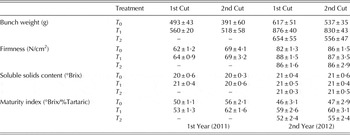
Table 3 presents the main fruit quality parameters for the grapes during the 2-year experimental period. During the first year, at the first cut, inoculation led to significant (P<0·05) increases in the bunch weight (from 493 to 560 g), berry firmness (from 61·9 to 64·4 N/cm2), soluble solids concentration (from 20·1 to 21·3 °Brix) and maturity index (from 50·2 to 52·8 °Brix/%Tartaric). No significant differences were detected in the equatorial diameter or berry weight (data not shown). In the second cut, significant (P<0·05) increases in T 1 were only observed in the bunch weight and maturity index (Table 3).
Quality fruit parameters for Crimson variety at the two cuts: bunch weight (g), firmness of the grain (pressure in N/cm2), soluble solids concentration (°Brix) and maturity index (°Brix %/Tartaric) for the 2-year experimental period in the three treatments performed. Data show the average value ±s.e.

During the second year, the quality of grapes was noticeably higher with respect to the first year. In the first cut, AMF inoculation led to significant increases in bunch weight (617–876 g), berry firmness (82–88 N/cm2), maturity index (45·8–58·5 °Brix/%Tartaric) and in the equatorial diameter (data not shown). However, the berries showed similar soluble solids concentration and weight with respect to T 0. In T 2 significant increases were found in the berry firmness (from 82·0 to 86·1 N/cm2), maturity index (from 45 to 52·3 °Brix/%Tartaric) and equatorial diameter (data not shown). In the second cut, a similar trend was observed. Overall, in the 2-year experimentation period for treatments T 1 and T 2, the increase of soluble solid concentration ranged from 1 to 6% and additionally a reduction of acidity ranging from 10 to 20% was observed.
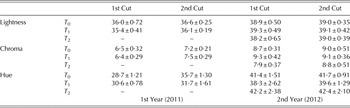
It must be highlighted that improvements in both yield and grape quality were not correlated with berry coloration, where almost no significant differences (P<0·05) between treatments were found. In fact, significant increases were observed only for L and Hue values in the second cut of the first year for the T 0 treatment, and for Ch in the first cut of the second year for T 0 and T 1 with respect to T 2 (Table 4).
Parameters indicative of the colour, Lightness, Chroma and Angle (Hue), for Crimson grapes for the 2-year experimental period. Data show the average value ±s.e.

DISCUSSION
The present study demonstrated that Crimson grapevines were heavily dependent on AMF. Successful establishment of inoculant was identified by the fact that the range of root colonization observed at the veraison moment in the first year was similar to those reported in previous research where the effect of AMF on different grapevines was investigated (Caglar & Bayram Reference Caglar and Bayram2006) and much higher in the second year. It is notable that when inoculation was performed during 2 consecutive years, the highest percentage of AMF colonization was reached. However, in the second year of the experiment in treatment T 2, an expected reduction in AMF colonization compared to T 1 was detected, although colonization was still much higher than that measured in the control treatment (T 0). On one hand, the high AMF colonization might have meant high compatibility between the AMF used for the experiment but on the other hand, the reduction in colonization seen in T 2 could be attributed to a certain degree of competition between the native and non-native strains of AMF (Verbruggen et al. Reference Verbruggen, Van Der Heijden, Rilling and Kiers2013).
A high presence of AMF in the root zone has been shown to aid in the uptake of water and to contribute to an improved water status in vines (Ruíz-Lozano & Azcón Reference Ruíz-Lozano and Azcón1995). In that sense, the significant increase observed in the present study in ψ stem for T 1 during the first year of experimentation could be attributed to root colonization by AMF. Additionally, this improvement in water status could also have been associated with improved host nutrition, particularly P (Giovanetti & Mosse Reference Giovanetti and Mosse1980). In the second year, the increasing percentage of root colonization, the large amount of water supplied after veraison and the improved host P nutrition probably induced the increase of ψ stem compared to the first year. In fact, the present study has highlighted that the higher the root colonization, the higher ψ stem may be observed.
It is not surprising that AMF enhanced both the grape growth and uptake of some nutrients such as P and K (Marschner & Dell Reference Marschner and Dell1994), since these improvements have been observed previously in grapevines (Possingham & Groot Obbink Reference Possingham and Groot Obbink1971), but also in other species such as cherimoya, prickly pear cactus, ancho chile pepper and lettuce (Azcón-Aguilar et al. Reference Azcón-Aguilar, Encina, Azcón and Barea1994; Estrada-Luna & Davies Reference Estrada-Luna and Davies2001, Reference Estrada-Luna and Davies2003).
Arbuscular mycorrhizal fungi have also been said to increase the utilization of different forms of N by plants (Hodge et al. Reference Hodge, Campbell and Fitter2001) and to take up N directly and transfer it to the host root (Johansen et al. Reference Johansen, Finlay and Olsson1996). However, the current results showed a reduced N concentration in the inoculated treatment T 1 regardless of the year of study. In spite of that, N concentration was always slightly above the optimal range found in the grapevine DRIS norm proposed by García-Escudero et al. (Reference García-Escudero, Romero, Benito, Domínguez and Martín2013). Nitrogen and K deficiencies at the veraison stage are often associated with a loss of berry colour, which obviously can have negative economic consequences for farmers (Delgado et al. Reference Delgado, Martín, del Álamo and González2004). In addition, landholders have reported that the veraison moment in Crimson grapes is especially complicated because fully coloured ripe grapes can coexist at the same time as unripe grapes that are not fully coloured. Therefore, it is widely agreed that the fundamental parameter in order to determine the harvest moment, apart from the size, is the grape coloration and hence a suitable equilibrium N/K must be reached. For inoculated treatments, regardless of the year of study, such reductions in N and increases in K led to a somewhat reduced N/K ratio, but a similar value as proposed in the literature by Martín et al. (Reference Martín, Benito, Romero, Domínguez and García-Escudero2013) was reached. In all treatments K concentration, although being slightly high, was also in concordance with the optimal ranges proposed by DRIS (García-Escudero et al. Reference García-Escudero, Romero, Benito, Domínguez and Martín2013).
In the case of P, Evelin et al. (Reference Evelin, Kapoor and Giri2009) reported that colonization of roots with AMF often improves the P nutrition of host plants growing with sparingly soluble P forms as they facilitate its mobility in the soil. Moreover, the increase in growth detected in plants inoculated with AMF has been mainly associated with phosphate absorption (Abbot & Robson Reference Abbot and Robson1991). Such positive effects have also been previously shown in grapevines (Karagiannidis et al. Reference Karagiannidis, Nikolaou and Mattheou1995). In the present study, the increase in P detected in the inoculated treatment (T 1) was hence attributed to AMF. In contrast, results from treatment T 2 did not show a significant increase in P compared to the control treatment (T 0), which indicated that the reduction in AMF colonization was likely to condition the absorption of this element. For the other macronutrients analysed, Ca (except in the second year for T 1) and Mg, no significant differences were found which is in agreement with a previous study (Schreiner Reference Schreiner2007).
Regarding micronutrients, some research identifies that certain micronutrients may be affected by inoculation with AMF. For example, Petgen et al. (Reference Petgen, Schropp, George and Romheld1998) found higher Zn and Cu concentrations in grapevines inoculated with mycorrhizae. In contrast, there is also research in grapevines that agrees with the results found in the present study, indicating the AMF do not have any effect on those elements (Karagiannidis et al. Reference Karagiannidis, Nikolaou, Ipsilantis and Zioziou2007). Bearing all this in mind, it is very likely that the differences in Zn and Cu found in the various studies arose from differences in cultivation conditions between studies, as well as from genotypic differences, since the plant response may also change with inoculation of different fungi (Kafkas & Ortas Reference Kafkas and Ortas2009).
At the veraison moment in the first year of experimentation, inoculation increased the A and g s rates significantly compared to T 0, although the high fruit load probably limited photosynthetic activity to a certain extent. However, in spite of these increases, WUE remained stable. In the second year, the suitable water status of grapevines, higher percentage of root colonization and lower fruit load led to considerable increases in both A and WUE in treatment T 1 (Evelin et al. Reference Evelin, Kapoor and Giri2009). In fact, AMF are known to exert a certain control over transpiration, allowing plants to maintain high levels of WUE (Navarro-Ródenas et al. Reference Navarro-Ródenas, Bárzana, Nicolás, Carra, Schubert and Morte2013). Such an increase, which is congruent with other studies of grapevine hosts (Nikolaou et al. Reference Nikolaou, Koukourikou, Angelopoulos and Karagiannidis2003), may also have accounted for the enhanced growth of plants colonized with Glomus species, most probably by enhancing CO2 fixation (Aroca et al. Reference Aroca, Ruíz-Lozano, Zamarreño, Paz, García-Mina, Pozo and López-Ráez2013).
It is well known that AMF can increase the demand for photo-assimilates, stimulating the A rate (Foyer Reference Foyer1987), and since a large proportion of photosynthetic product is allocated to the root of plants infected with mycorrhizae (Jakobsen & Rosendahl Reference Jakobsen and Rosendahl1990), this is one potential mechanism for the observed increases in A. In addition, there is research that suggests a close relationship between AMF colonization and carbohydrate availability (Valentine et al. Reference Valentine, Osborne and Mitchell2002).
Zapata et al. (Reference Zapata, Deléens, Chaillou and Magné2004) reported that storage of C in perennial tissues such as the roots is made mainly of starch and its mobilization has a substantial role in supporting vegetative and reproductive growth. In the present study it is remarkable that (i) in non-inoculated grapevines, most of the starch concentration was allocated to the apex, (ii) in grapevines inoculated during the first year but not the second, the starch was equally distributed between the apex and the central part of the root and (iii) in grapevines inoculated in both seasons, starch was primarily stored in the central part of the root. In this last case, the decrease in starch at the root apex could indicate a carbohydrate supply for the development of new roots and the energy demand for AMF activity (Marjanović & Nehls Reference Marjanović, Nehls and Varma2008). Also of note is the observation that although plants inoculated only in the first year showed similar A n, WUE, leaf nutrient content and water potential to plants from the control treatment in the second year, yield was notably increased, especially in the second. This could be explained by the higher concentration of starch stored in the centre of the root in the first season with respect to the control treatment, which was remobilized to the shoot, increasing fruit set and hence yield (Bennett Reference Bennett2002).
As expected, mycorrhizal symbiosis favoured the absorption of water and nutrients (Navarro-García et al. Reference Navarro-García, Bañon Árias, Morte and Sánchez-Blanco2011) and hence increased yield at both cuts regardless of the year of study. Additionally, the effect of the persistence of the AMF on yield was still significantly observed in T 2. Overall, the quality fruit parameters evaluated, bunch weight, firmness, soluble solids concentration and maturity index were also affected positively. In fact, it is remarkable how inoculation significantly increased the soluble solid concentrations and reduced more than proportionally the acid concentration. These improvements were not correlated with berry coloration, where very few significant differences between treatments were found.
In conclusion, the present study, which aimed to investigate the effects of a commercial registered AMF on growth and nutritional status of Crimson grapevine, has yielded invaluable knowledge on the physiological and chemical responses of this grapevine variety to AMF inoculation.
The AMF selected was demonstrated to colonize the Crimson grapevine roots satisfactorily. In the second year, plants inoculated during the first year and not in the second showed a reduction in the intensity of infection, although it was still higher than the control treatment.
The grapevines inoculated had improved water status, increased absorption of some nutrients such as P, K and Ca and in addition both yield and fruit quality were positively affected. Moreover, the ability of AMF to persist in the roots of grapevine in the second year also produced positive effects. It is also interesting that AMF could have favoured root development by mobilizing the apex starch reserves; hence its application led to a major concentration of starch in the central part of the root.
Finally, although it is very difficult to generalize since plant growth depends on several factors including the fungal species associated with the plant, the source of P nutrition, the variety or grapevine cultivar and environmental factors such as the water regime, the results found in the present study suggest that this straightforward application of AMF through the drip irrigation system is a promising technique. Hence, development of such symbiosis could be strongly justified in sustainable agriculture in arid and semi-arid areas. Moreover, competition between native and non-native AMF for soil colonization suggests that periodic monitoring of the percentage of mycorrhizal colonization should be carried out and re-inoculations applied in order to achieve all the positive effects evidenced in the inoculated treatment.
The authors acknowledge the Ministerio de Economía y Competitividad for the project CICYT (AGL2010-17553), the FEDER (Fondo Europeo de Desarrollo Regional) and the European Commission under the EFP7 project SIRRIMED (FP7-KBBE-2009-3-245159) for the financial support of this study. The authors also thank the efforts of the technician associate Bayona Gambín J.M.