Introduction
The fish fauna of the Antarctic continental shelf and slope includes about 225 species and is unique in the marine realm because its diversity is greatly restricted at higher taxonomic levels. The fauna consists primarily of ray-finned fishes (superorder Acanthopterygii), including a large radiation of notothenioids (46% of species) that exhibit great morphological and ecological diversity, accompanied by smaller radiations of liparids (31%) and zoarcids (11%) (Gon & Heemstra Reference Gon and Heemstra1990). Although notothenioids lack a swim bladder, they fill a host of niches ranging from small benthivores to a 2 m long, neutrally buoyant predator (Eastman Reference Eastman1993). They also dominate fish abundance and biomass on the high-Antarctic continental shelves (Eastman Reference Eastman2005). Most collecting activity has been devoted to defining the shelf fauna, which is now reasonably well known from both taxonomic and ecological perspectives. The continental slopes of the Southern Hemisphere, however, are among the least-sampled marine habitats with respect to fishes (Eschmeyer et al. Reference Eschmeyer, Fricke, Fong and Polack2010), especially in the Antarctic region. Furthermore, the longline fishery for the Antarctic toothfish (Dissostichus mawsoni Norman, 1937) operates at slope depths of 1000–2000 m (Hanchet et al. Reference Hanchet, Tracey, Dunn, Horn and Smith2012), and this has heightened interest in the composition of the slope fauna and the biology of bycatch species.
We had the opportunity to examine underwater photographic images of fishes obtained from two infrequently explored areas of West Antarctica: the slope of Marguerite Bay (68°30′S, 68°30′W), located between Adelaide and Alexander islands near the base of the Antarctic Peninsula, and the Amundsen Sea (73°00′S, 112°00′W) off Marie Byrd Land. While the pelagic fish fauna of Marguerite Bay is well documented (Donnelly & Torres Reference Donnelly and Torres2008, Cullins et al. Reference Cullins, DeVries and Torres2011), the benthic fauna is under-sampled, especially along the steep bathymetric gradients of the slope deeper than 800 m. The remote and perpetually ice-covered Amundsen Sea is the least sampled area of the high Antarctic. Given the circum-Antarctic distribution of most high latitude notothenioids (Eastman Reference Eastman1993), the fish fauna of the Amundsen Sea would be expected to resemble that of the East Antarctic zoogeographic province, especially the Weddell and Ross seas. Nevertheless, sampling in the Amundsen Sea has been sufficiently sparse that Andriashev (Reference Andriashev1987) indicated its affinity with a question mark when mapping zoogeographic subdivisions of the Antarctic.
Underwater photography has previously been used in the Antarctic to document the abundance and ecology of fishes in the Weddell and Lazarev seas (Ekau & Gutt Reference Ekau and Gutt1991, Gutt et al. Reference Gutt, Ekau and Gorny1994, Gutt & Ekau Reference Gutt and Ekau1996), but, with the exception of the work of Yau et al. (Reference Yau, Collins, Bagley, Everson and Priede2002) involving still and video cameras near South Georgia at depths to 1519 m, it has never been employed at slope depths. Here we present information on the depth ranges and approximate abundances of higher-level taxa, as well as some individual species, from the outer continental shelf to the lower continental slope of Marguerite Bay (MB) and the Amundsen Sea (AS). We also provide insights into the biology of notothenioid and non-notothenioid species derived from our images.
Materials and methods
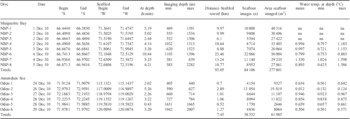
We conducted a photographic survey of sea floor communities in Marguerite Bay aboard the US Antarctic Program's RV Nathaniel B. Palmer (early December 2010), and we surveyed select sites in the Amundsen Sea (late December) aboard the Swedish RVIB Oden (Table I). We obtained images of the sea floor communities using SeaSled (Singh et al. Reference Singh, Roman, Pizarro and Can2007), a towed vehicle with high-dynamic-range cameras mounted side-by-side. A 150 w-sec strobe was mounted aft of the cameras to minimize backscatter. Every three seconds, slightly overlapping, paired high-resolution (1.4 mpixel or 1360 x 1024 pixels) digital images recorded c. 10 m2 of the sea floor (typical range 2–19 m2). Onboard sensors included an acoustic Doppler current profiler (ADCP; 1200 kHz Teledyne RD Instruments). The ADCP provided real-time navigation data via a standard conductivity-temperature-depth (CTD) cable. The navigation data enabled the SeaSled pilots to maintain the vehicle 3 m above the substrate to balance the trade-off between maximizing area coverage and maintaining good colour characteristics. Additional environmental data for every image were recorded with a Seabird SBE-49 Fast CAT 16-Hz CTD and a Paroscientific depth sensor.
Data for localities sampled and photographic images obtained with the towed vehicle SeaSled during December 2010 cruises of the RV Nathaniel B. Palmer and RVIB Oden. na=no data available.

We sampled in Marguerite Bay while the RV Nathaniel B. Palmer was underway and SeaSled was towed at ship speeds of 2–4 knots (3.2–7.4 km hr-1). Benthic communities were imaged along eight transects on the continental shelf and continental slope between 381 and 2282 m depth (Table I). Logistical constraints aboard the RVIB Oden limited the photographic surveys to periods when the ship was anchored to ice and drifting at speeds never greater than 0.3 knots (0.56 km hr-1) over sea floor depths of 405–2007 m. Upon recovery of SeaSled, we downloaded images at full resolution. We used formulas to determine the width of the area photographed for each image in each pair, subtracted the area of overlap imaged by the two cameras and converted that to total area photographed in square metres. Several batch-processing steps following Kaeli et al. (Reference Kaeli, Singh, Murphy and Kunz2011) were used to correct for lens distortion and colour attenuation.
We measured the approximate sizes of subjects with Critter Gridder, a graphical user interface custom-designed by one of us (JWK). A measurement grid was superimposed on the image and the spacing between the grid lines was mathematically derived from the image-linked ADCP data, specifically, how far the camera was from the bottom (ideally 3 m). The dimensions of the grid spacings were specified to the nearest 0.01 m to fine-tune the measurements. This procedure is accurate when the fish to be measured are on the substrate. There is less accuracy when the fish are in the water column. Their sizes are slightly overestimated because they are closer to the camera lens and, therefore, appear to cover more of the grid on the substrate. Unless otherwise noted, we provide total lengths (TL) for fishes.
The surveys were designed to capture images of large swaths of the sea floor and its invertebrate benthos, the fishes were an incidental finding. Images captured from a camera located 3 m above the sea floor are not ideal for identifying small species that require close scrutiny to resolve key taxonomic details. Although we were able to identify some fishes to species, others were identified to genus, family or sometimes simply as “fish.” JTE and MLM reviewed images for the presence of fish and used Gon & Heemstra (Reference Gon and Heemstra1990) and more recent taxonomic literature to make identifications. We selected the best quality images for Figs 1 & 2. Some images had multiple fish and some individual fish were present in multiple images, thus, presence in an image is used as an approximation of abundance.
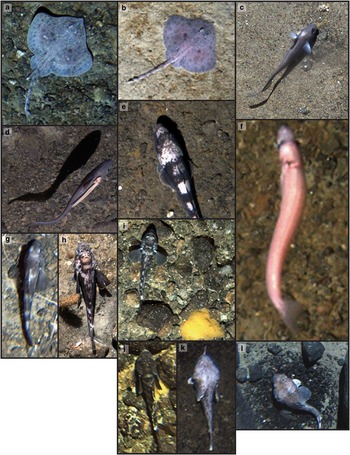
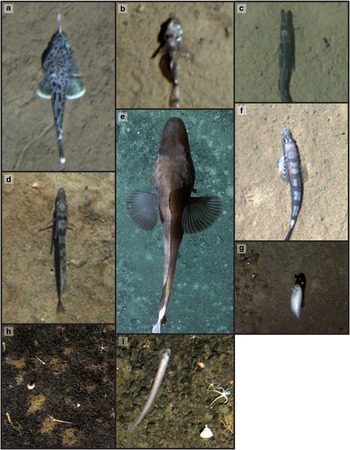
Fish images from the slope of Marguerite Bay (MB) and the Amundsen Sea (AS). a. Male specimen of Bathyraja maccaini showing claspers, identified on basis of rostral and snout morphology and overall colour pattern; body (disc) width = 15 cm, 543 m depth, MB. b. Female specimen of Bathyraja maccaini with sexual dimorphism evident in rounded less angular snout than in male; body (disc) width = 14.5 cm, 418 m, MB. c. Macrourus whitsoni near the substrate; total length (TL) = 36 cm, 1215 m, MB. d.Macrourus whitsoni swimming above the substrate with an attached copepod parasite 16 cm long; TL = 44 cm, 1346 m, MB. e. Juvenile Dissostichus mawsoni on substrate, displaying negative buoyancy at this stage in the life history; TL = 42 cm, 1277 m, MB. f. Neutrally buoyant Pleuragramma antarcticum in the water column employing subcarangiform locomotion; TL = 27 cm, 720 m, MB. g.Trematomus loennbergii showing characteristic wide, blunt snout and extensive white reflective head skin over dorsal aspect of eye; TL = 24 cm, 813 m, MB. h. Lepidonotothen squamifrons on the substrate showing diagnostic characters including wide head, dark stripe on head skin over eye, and trunk pigmentation pattern; TL = 37 cm, 414 m, MB. i.Lepidonotothen squamifrons, showing strobe flare off white patch posterior to dark eye-skin stripe (h.), in vicinity of an egg mass 16 cm in horizontal diameter; TL = 33 cm, 579 m, MB. j.Lepidonotothen squamifrons on a nest of eggs; TL = 30 cm, 581 m, MB. k. Deep-living Pogonophryne spp. of the mentella group, possibly P. bellingshausenensis; TL = 24 cm, 2127 m, MB. l.Pogonophryne scotti, on a rock nest with strobe flare off right pectoral fin (not eggs) responsible for light-coloured area in nest; TL = 20 cm, 767 m, AS.

Results
Approximate abundance of taxa
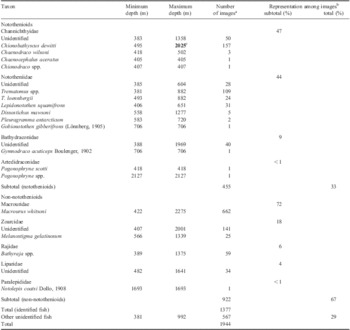
The RV Nathaniel B. Palmer travelled 93 km in Marguerite Bay while the SeaSled was at depth, allowing the vehicle to image a total of 277 801 m2 of the bottom. Similarly, while SeaSled was at depth in the Amundsen Sea, the RVIB Oden travelled a total of 7.5 km and the vehicle imaged a total of 61 985 m2 (Table I). Tables II and III summarize the depths of occurrence and approximate abundances of the taxa that we identified. The 1944 images from Marguerite Bay (Table II) included representatives of nine families, 15 genera, and 13 species; 33% were notothenioids and 67% were non-notothenioids. Among the notothenioids, channichthyids (47%) and nototheniids (44%) were the most abundant. The deep-living channichthyid Chionobathyscus dewitti Andriashev and Neelov, 1978 (74%) and species of the nototheniid genus Trematomus (66%) were the most abundant taxa within these two families. Among non-notothenioids, the macrourid Macrourus whitsoni (Regan, 1913) (at 72%) and zoarcids (at 18%) were most abundant. Twenty-nine percent of the images of fish lacked resolution and were not assigned to any taxon. The high proportion of normally deeper-living non-notothenioids may in part be attributable to the fact that 57% of the images we examined were from the outer shelf and slope at depths > 600 m where they are more common. Another possible influence, to be considered later, is the unique hydrography of Marguerite Bay, which facilitates the entry of offshore non-notothenioids onto the upper slope and shelf (Donnelly & Torres Reference Donnelly and Torres2008, Parker et al. Reference Parker, Donnelly and Torres2011).
Depth ranges, new depth record (bold) and approximate abundances (as indicated by presence in an image) for benthic fishes photographed on or near the sea floor of the outer shelf and upper slope of Marguerite Bay.
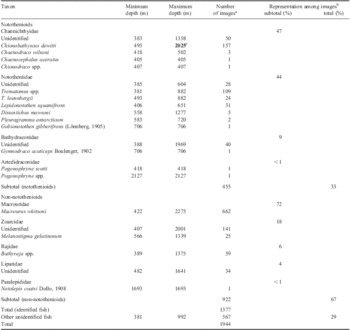
aA reasonably accurate approximation of the number of individual fish; some images had multiple fish and some individual fish were in multiple images.
bNot including “Other unidentified fish” category.
cNew maximum-depth record based on previous records of 2000 m in Gon & Heemstra (Reference Gon and Heemstra1990) and 2012m in Kock (Reference Kock2005).
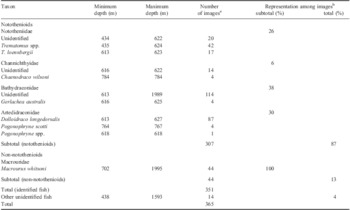
The 365 images from the Amundsen Sea (Table III) were not as representative of the fauna because they were obtained primarily from depths of 435–785 m and included only five families, six genera, and six species. Eighty-seven percent of the images were notothenioids and 13% non-notothenioids, the latter exclusively M. whitsoni. Among the notothenioids, bathydraconids (38%) and artedidraconids (30%), especially the small Dolloidraco longedorsalis Roule, 1913 (28%) were the dominant elements. Only 4% of the total images of fish were unassigned to a taxon.
Depth ranges and approximate abundances (as indicated by presence in an image) for benthic fishes photographed on or near the sea floor of the Amundsen Sea.
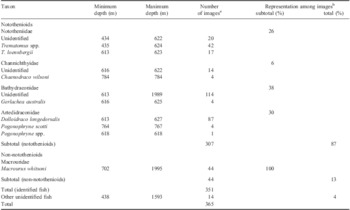
aA reasonably accurate approximation of the number of individual fish; some images had multiple fish and some individual fish were in multiple images.
bNot including “Other unidentified fish” category.
Discussion
Comments on fish in images
Rajidae (skates) (Fig. 1a & b). Six species of skates are the only chondrichthyan fishes in the Southern Ocean south of 60° (Stehmann & Bürkel Reference Stehmann and Bürkel1990). Bathyraja maccaini Springer, 1971, Bathyraja eatonii (Günther, 1876) and Amblyraja georgiana (Norman, 1938) are known from the area of our images (Arana & Vega Reference Arana and Vega1999, Kock et al. Reference Kock, Jones and Wilhelms2000). There are also undescribed species of Bathyraja in the Antarctic (Stehmann & Bürkel Reference Stehmann and Bürkel1990, Smith et al. Reference Smith, Steinke, McVeagh, Stewart, Struthers and Roberts2008). Identification is difficult and based partly on the size and pattern of thorns that requires handling of the specimens. We could not, therefore, identify most of our images to species and group them as Bathyraja spp. (Table II). A few images were sufficiently detailed, as exemplified by Fig. 1a & b, that we were able to identify male and female specimens of B. maccaini. Antarctic species of Bathyraja exhibit sexual dimorphism in the shape of the snout (Duhamel et al. Reference Duhamel, Gasco and Davaine2005, p.77).
Our images of skates spanned depths from 389–1375 m in Marguerite Bay. Bathyraja are found as deep as 1700 m around Kerguelen (Duhamel et al. Reference Duhamel, Gasco and Davaine2005), but most records from higher latitudes are from < 650 m (Stehmann & Bürkel Reference Stehmann and Bürkel1990). We also obtained images of several egg cases at depths of 397–412 m.
Macrouridae (grenadiers) (Fig. 1c & d). Macrourids have a worldwide marine distribution. There are four species in the genus Macrourus at slope depths in the sub-Antarctic and Antarctic (Iwamoto Reference Iwamoto1990), including, as revealed by nucleotide sequences of the cytochrome oxidase I gene, a cryptic species in the Ross Sea (Smith et al. Reference Smith, Steinke, McMillan, Stewart, McVeagh, Diaz De Astarloa, Welsford and Ward2011). In our images we encountered M. whitsoni, a circum-Antarctic species that is replaced by the sub-Antarctic and Magellanic species Macrourus holotrachys Günther, 1878 north of 65°S. Our identification is based on geographic location as well as the deep and angular head and snout, and larger eye than in M. holotrachys. Macrourus whitsoni was present in Marguerite Bay at depths of 422–2275 m. Only 5% of images were from < 600 m whereas, 30% were from 600–1000 m and 65% were from > 1000 m. Although the number of images of M. whitsoni from the Amundsen Sea was only 44, they covered a wide depth range of 702–1995 m, again with 65% of the images from depths > 1000 m.
Macrourus are abundant in deep trawl catches from the Lazarev Sea, yet images have not been captured during photographic surveys in that area (Gutt et al. Reference Gutt, Ekau and Gorny1994, Zimmermann Reference Zimmermann1997). Our numerous images of M. whitsoni from both Marguerite Bay and the Amundsen Sea indicate that it is both benthopelagic and benthic, living within a few metres of the substrate or resting on the substrate. It is one of the few large (88–96 cm maximum TL) fish at these depths (Arana & Vega Reference Arana and Vega1999, Marriott et al. Reference Marriott, Horn and McMillan2003) and its abundance reflects its importance in the ecosystem of the slope. For example, in experimental longlining along the western Antarctic Peninsula and in the Bellingshausen Sea, M. whitsoni was the most abundant species and had the second highest biomass (Arana & Vega Reference Arana and Vega1999). It is important in the diet of the Antarctic toothfish D. mawsoni. Examination of the stomachs of D. mawsoni taken by the longline fishery at slope depths in the Ross Sea has shown that M. whitsoni is the second most abundant dietary item, with a frequency of occurrence of 36.9% (Fenaughty et al. Reference Fenaughty, Stevens and Hanchet2003). Near Bouvetøya, M. whitsoni was the most important dietary item by both frequency of occurrence (82%) and wet weight (60%) in a sample of 376 D. mawsoni captured at 1300–1900 m (Petrov Reference Petrov2011a). The same is true at the South Sandwich Islands (Roberts et al. Reference Roberts, Xavier and Agnew2011). Macrourus whitsoni is a substantial bycatch species in the longline fishery for D. mawsoni in the Ross Sea (Smith et al. Reference Smith, Steinke, McMillan, Stewart, McVeagh, Diaz De Astarloa, Welsford and Ward2011) and, given that it is slow growing and long-lived (Marriott et al. Reference Marriott, Horn and McMillan2003), it is susceptible to overfishing.
Six of our images of M. whitsoni showed specimens parasitized by large copepods attached along the posterior head or anterior trunk. In one instance the parasite was 36% the length of the host (Fig. 1d). Three species of copepods infest M. whitsoni (Walter et al. Reference Walter, Palm, Piepiorka and Rückert2002) and we suspect that our images depict a member of the genus Lophoura because it is attached externally rather than in the oral or opercular cavities.
Nototheniidae (notothens). Dissostichus mawsoni (Antarctic toothfish) (Fig. 1e). In an image taken 2.2 m off the bottom, we identified a fish resting on the substrate at 1277 m as D. mawsoni. We made the identification based on its wide head, large eyes, protruding lower jaw, and distinctive pattern of six dark vertical bars encompassing the dorsal and anal fins - a pattern first described in juveniles by Gon (Reference Gon1988). Having measured the head length in this specimen as 12 cm, and knowing that head length is 28.4% of total length for D. mawsoni (Eastman, personal observation), we estimated that this was a juvenile specimen, 42.2 cm TL and 3–5 yr old (Brooks et al. Reference Brooks, Andrews, Ashford, Ramanna, Jones, Lundstrom and Cailliet2011). We encountered four other small specimens of D. mawsoni at depths of 565–1229 m.
Although exploratory longlining has documented its presence from Clarence Island (61°12′S) in the north to Peter I Island (68°49′S) and the Bellingshausen Sea (70°38′S) in the south (Arana & Vega Reference Arana and Vega1999), D. mawsoni is not as abundant along the western Antarctic Peninsula as it is in higher latitudes like the Ross Sea. Nevertheless, juvenile specimens of D. mawsoni 10–50 cm TL are regularly collected around the South Shetland Islands (M. La Mesa, personal observation), although a spawning location in this area is unknown. The significance of the specimen in Fig. 1e from the Marguerite Bay slope is that it offers a glimpse into the little-known life cycle of the major piscine predator in high-Antarctic waters, a species now subject to intensive commercial fishing. The image provides definitive proof that, unlike the neutrally buoyant adults (Eastman & DeVries Reference Eastman and DeVries1981), small specimens of D. mawsoni are not neutrally buoyant (Eastman & Sidell Reference Eastman and Sidell2002, Near et al. Reference Near, Russo, Jones and DeVries2003) and are associated with the sea floor. The image is more clearly identifiable as D. mawsoni than that provided by Eastman & Barry (Reference Eastman and Barry2002) of a larger juvenile resting on the substrate of the Ross Sea. Furthermore, it shows that small specimens can be found at considerable depths - in this case 1277 m.
Pleuragramma antarcticum Boulenger, 1902 (Antarctic silverfish) (Fig. 1f). Our cameras captured two images of Pleuragramma, including one large individual 27 cm TL (Fig. 1f), that we identified on the basis of the light-reflective integument, bluntly V-shaped and cartilaginous snout (appearing opaque), and partially visible eyes in dorsal view. Pleuragramma are neutrally buoyant and tend to hang motionless in the water column with their body axis straight. The image demonstrates that, when swimming, they employ trunk undulation rather than the pectoral stroking typical of most notothenioids. Given that their maximum depth of occurrence is 700–900 m (Gerasimchuk Reference Gerasimchuk1986, DeWitt et al. Reference Dewitt, Heemstra and Gon1990), most of our survey was conducted below their depth range.
Pleuragramma antarcticum, a key species in the high-Antarctic food web for other fishes as well as for penguins, Weddell seals and some whales (La Mesa et al. Reference La Mesa, Eastman and Vacchi2004), are suspected of declining in abundance along the western Antarctic Peninsula as a result of rapidly warming seawater and the attendant loss of sea ice (Massom & Stammerjohn Reference Massom and Stammerjohn2010). SCUBA divers observed Pleuragramma under sea ice at Anvers Island in 1975 (Daniels & Lipps Reference Daniels and Lipps1982). Pleuragramma are associated with sea ice, perhaps obligatorily, for reproduction. In the Ross Sea Pleuragramma spawn beneath the sea ice. Its eggs and early larvae float to incubate within the platelet ice, where the eggs are protected from freezing by the chorion (Vacchi et al. Reference Vacchi, La Mesa, Dalu and MacDonald2004, Cziko et al. Reference Cziko, Evans, Cheng and DeVries2006). Given the current warming along the western Antarctic Peninsula, the adult component of the population of Pleuragramma may be seasonally absent from Marguerite Bay. Although young stages of Pleuragramma constitute one of the most abundant species in the water column of Marguerite Bay (Donnelly & Torres Reference Donnelly and Torres2008), it is also possible that the adult population is contracting to the south, where there is more sea ice.
Trematomus loennbergii Regan, 1913 (Fig. 1g). We encountered this species at depths of 493–882 m. The distinguishing features are the wide, blunt snout and the extensive light-coloured head skin over the dorsal portions of the eyes. Although it is a high-Antarctic species, it has previously been found both north and south of Marguerite Bay (Daniels & Lipps Reference Daniels and Lipps1982, Matallanas & Olaso Reference Matallanas and Olaso2007), so its occurrence in Marguerite Bay is not surprising.
As documented by underwater still and video images (Ekau & Gutt Reference Ekau and Gutt1991, Gutt & Ekau Reference Gutt and Ekau1996), T. loennbergii is an epibenthic species, living on or in close proximity to the sea floor. It shares a circum-Antarctic distribution and epibenthic lifestyle with two other Trematomus spp., Trematomus eulepidotus Regan, 1914 and Trematomus lepidorhinus Pappenheim, 1911, although it is commonly found in deeper waters (Ekau Reference Ekau1990, Eastman & Hubold Reference Eastman and Hubold1999).
Lepidonotothen squamifrons (Günther, 1880) (Fig. 1h–j). Figure 1h is a clear image of L. squamifrons, Fig. 1i shows another individual of this species near a nest of eggs, and Fig. 1j depicts a third individual on a nest of eggs. The main diagnostic characters included the wide head, dark stripe on head skin over the eye, and pigmentation pattern on the trunk.
According to Schneppenheim et al. (Reference Schneppenheim, Kock, Duhamel and Jansen1994), the L. squamifrons group contains only one species, L. squamifrons (Günther, 1880), as Lepidonotothen kempi (Norman, 1937) and perhaps Lepidonotothen macrophthalma (Norman, 1937) are considered junior synonyms. In the Bellingshausen Sea, L. squamifrons is one of the most abundant nototheniids, generally caught at depths > 350 m (Matallanas & Olaso Reference Matallanas and Olaso2007). Its preference for deeper shelf waters is confirmed in our images from Marguerite Bay, where we recorded it at depths of 406–651 m. The several images showing adult L. squamifrons in the vicinity of and directly on clutches of eggs constitute the first substantial evidence of parental care by this species. This surmise is supported by previous studies, indicating that fertilized eggs of L. squamifrons are benthic and adhesive (Zaitsev Reference Zaitsev1989). The timing and location of the nesting behaviour we observed is consistent with what is known about the reproductive cycle of L. squamifrons, which spawns on the slope in November and December near the Antarctic Peninsula (Kock & Kellermann Reference Kock and Kellermann1991). Parental care is a common feature in the genus Lepidonotothen, as nest guarding has also been reported for Lepidonotothen nudifrons (Lönnberg, 1905) and Lepidonotothen larseni (Lönnberg, 1905) (Hourigan & Radtke Reference Hourigan and Radtke1989, Konecki & Targett Reference Konecki and Targett1989).
Artedidraconidae (plunderfishes), genus Pogonophryne (Figs 1k & l & 2a). Members of this genus are sedentary-benthic fishes with wide, triangular heads and distinctive mental barbels of various lengths and shapes. The genus is composed of 19 species that have experienced phyletic diversification unaccompanied by morphological and ecological diversification (Eakin et al. Reference Eakin, Eastman and Near2009). Although Pogonophryne is the most speciose genus of notothenioid fishes, many species are only known from a few specimens and little is known of their biology. They are difficult to identify because of their morphological similarity and the intraspecific variation in the length and appearance of the mental barbel. The barbel lacks taste buds but has free nerve endings and is thought to be a tactile device used to locate their prey (Eastman & Lannoo Reference Eastman and Lannoo2003), which consists primarily of amphipods and polychaetes (Olaso et al. Reference Olaso, Rauschert and De Broyer2000).
Pogonophryne spp., possibly Pogonophryne bellingshausenensis Eakin, Eastman & Matallanas, Reference Eakin, Eastman and Matallanas2008 (Fig. 1k). Outside of Pogonophryne immaculata Eakin, 1981 from 2542 m (Eakin Reference Eakin1990), this specimen is the second-deepest record for a species in this genus (2127 m, slope of Marguerite Bay). The specimen is significant because the deepest-living species are largely confined to a group within the genus, referred to as the unspotted Pogonophryne albipinna group, consisting of four species (Eakin Reference Eakin1990). However, this specimen is spotted and not a member of that group. It is similar to P. bellingshausenensis (Eakin et al. Reference Eakin, Eastman and Matallanas2008), which has a similarly shaped mental barbel of a similar length (12–13% of SL), and is from a similar locality and depth (66°88′S, 72°66′W, 2127 m) as the holotype and only known specimen of P. bellingshausenensis (68°91′S, 78°23′W, 1947 m).
Pogonophryne scotti Regan, 1914 (Fig. 1l). The fish is identifiable as P. scotti because the dorsum of the head is without dark markings, the posttemporal and supratemporal ridges are well developed, and the mental barbel is short and lacks a terminal expansion. It is a male because the anterior rays of the second dorsal fin are black and elongated. It occupies a rock nest with no eggs visible, although this is a potential site for laying eggs. Nesting and egg-guarding behaviour by males have recently been reported for this species at 240 m near the South Orkney Islands. This first record of nesting behaviour in the Artedidraconidae confirms the prevalence of the behaviour among all five Antarctic notothenioid families (Jones & Near Reference Jones and Near2012).
Pogonophryne sp. of the mentella group, possibly Pogonophryne lanceobarbata Eakin, 1987 (Fig. 2a). This species was identified as a member of the mentella group on the basis of the pattern of dark markings on the dorsum of the head, the lower jaw that projects beyond the upper, a mental barbel about 20% of standard length and the terminal expansion of the mental barbel about 40% of the barbel length.
Fish images from the slope of Marguerite Bay (MB) and the Amundsen Sea (AS). a.Pogonophryne spp. of the mentella group, possibly P. lanceobarbata, showing mental barbel with a terminal expansion deployed horizontal to the substrate; total length (TL) = 17 cm, 618 m depth, AS. b.Dolloidraco longedorsalis with erect first dorsal fin casting long narrow shadow to left and posterior to head, long thin mental barbel, and pattern of dark and light (with strobe flare) blotches on body; TL = 10 cm, 614 m, AS. c.Gerlachea australis showing characteristic narrow, tubular snout; TL = 20 cm, 618 m, AS. d.Chaenocephalus aceratus showing a sub-adult perched on the substrate; TL = 27 cm, 405 m, MB. e.Chionobathyscus dewitti in the water column employing labriform locomotion, with the broad, square snout that is distinctive among channichthyids. Pattern of four to five thick, regularly spaced, dark cross-bars on trunk are also evident; TL not given as fish is too far off sea floor for accurate measurement, 1360 m, MB. f.Chaenodraco wilsoni on the sea floor showing a narrower and shorter snout than C. dewitti and a pattern of five dark cross-bars (but thinner than those of C. dewitti); TL = 27 cm, 617 m, AS. g. Unidentified liparid, probably genus Paraliparis or Careproctus, hovering above substrate in a characteristic head-down position; TL = 16 cm, 1344 m, MB. h. Four small, white, unidentified benthic zoarcids among an assemblage of unidentified invertebrates including brittlestars; TL = 6 cm, 1260 m, MB. i. Pelagic zoarcid Melanostigma gelatinosum in the water column, showing head and eyes, as well as diagnostic tapering of trunk to confluence of dorsal and anal fins with caudal fin. Translucent gelatinous layer beneath skin also evident; TL = 20 cm, 932 m, MB.
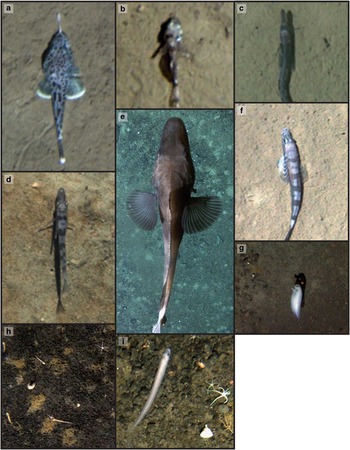
Dolloidraco longedorsalis (Fig. 2b). This small artedidraconid was common in the Amundsen Sea and is a typical representative of the East Antarctic or high-Antarctic fish fauna. The diagnostic characters include a long, narrow first dorsal fin, frequently projecting as a shadow on the substrate in our images, a relatively long barbel; and an irregular pattern of dark and light blotches on the body including the caudal fin.
Bathydraconidae (dragonfishes) (Fig. 2c). Bathydraconids were also common in the Amundsen Sea but their small size and generally similar morphology and colour patterns made species identification difficult. We were able to identify Gerlachea australis Dollo, 1900 (Fig. 2c), which is one of two bathydraconids with a long, tubular snout (the other is Cygnodraco mawsoni Waite, 1916). Our identification is based on the presence of four to five dark, vertical bars on trunk whereas Cygnodraco has a more irregular pattern of thinner bars and splotches (Gon & Heemstra Reference Gon and Heemstra1990). Gerlachea is also found in the nearby Bellingshausen Sea (Matallanas & Olaso Reference Matallanas and Olaso2007) and occurs at the depth where our specimen was photographed.
Channichthyidae (icefishes) (Fig. 2d–f). As was the case with bathydraconids, we could not identify many of the channichthyid images to species. A few species were recognizable (Tables II & III), including Chaenocephalus aceratus (Lonnberg, 1906) (Fig. 2d). For this species we based our identification on the distinctive ratios of various parts of the head and relative length of the pelvic fins. We also identified Chaenodraco wilsoni Regan, 1914 (Fig. 2f) based on the relatively short snout and the pattern of five dark bars on the trunk. The bars are thinner than those of Chionobathyscus dewitti (see below).
Chionobathyscus dewitti (Fig. 2e) was the most distinctive and abundant channichthyid we encountered. Identification of C. dewitti is facilitated by its wide, bluntly rounded almost squarish snout, clearly shown in the original species description (Andriashev & Neyelov Reference Andriashev and Neyelov1978, fig. 2) and in our image of the dorsum of the head (Fig. 2e). Furthermore, it is the only channichthyid that has a pattern of four to five thick, regularly spaced, dark bars on the trunk (Fig. 2e). At 2012 m, it is also the deepest-living channichthyid (Kock Reference Kock2005), and one of our specimens from Marguerite Bay edges the record slightly deeper to 2025 m. Our images support the notion that C. dewitti dwells primarily on the upper slope. In Marguerite Bay, for example, C. dewitti spanned a depth range of 495–2025 m, with 6% of images from < 600 m, 12% from 600–1000 m and 82% from > 1000 m.
Among channichthyids, C. dewitti has a low percentage buoyancy (1.22%) on the notothenioid spectrum, where 0% represents neutrally buoyant species and 6% characterizes benthic species (Near et al. Reference Near, Dornburg, Kuhn, Eastman, Pennington, Patarnello, Zane, Fernández and Jones2012, table S5). Many of our images are similar to Fig. 2e and show C. dewitti in the water column, thus reflecting its low percentage buoyancy compared to the 3–4% range common for the more benthic channichthyids (Eastman & Sidell Reference Eastman and Sidell2002, Near et al. Reference Near, Dornburg, Kuhn, Eastman, Pennington, Patarnello, Zane, Fernández and Jones2012).
Until recently C. dewitti was the least known (Balushkin & Prut'ko Reference Balushkin and Prut'ko2006) of the 16 channichthyid species, but some of its biology has been revealed as the longline fishery for D. mawsoni has moved to slope depths and has taken C. dewitti either as bycatch or stomach contents from D. mawsoni. Along the Antarctic Peninsula and in the Bellingshausen Sea, C. dewitti is the second-most important bycatch species (Arana & Vega Reference Arana and Vega1999). In the Ross Sea C. dewitti is the most common channichthyid taken as bycatch (Sutton et al. Reference Sutton, Manning, Stevens and Marriott2008) and its diet consists of a variety of mesopelagic and benthic fish and cephalopods (Kock Reference Kock2005, Petrov Reference Petrov2011b). Although not identified to species, in the Ross Sea C. dewitti is probably the most important dietary item of D. mawsoni captured at slope depths by the longline fishery (Fenaughty et al. Reference Fenaughty, Stevens and Hanchet2003). Being one of the larger channichthyids (Kock Reference Kock2005), C. dewitti is of considerable importance in the food web of the upper slope. Its ecological role is corroborated by its abundance in our images.
Liparidae (snailfishes) (Fig. 2g). One of two major non-notothenioid components of the Antarctic fauna, liparids were present on the slope of Marguerite Bay. Many new species have come to light recently (Eschmeyer et al. Reference Eschmeyer, Fricke, Fong and Polack2010), especially at slope depths in the Antarctic (Stein Reference Stein2012). They are difficult to identify, and we simply document their presence here. They frequently assume a head-down position with respect to the substrate (Stein et al. Reference Stein, Felley and Vecchione2005) as demonstrated in Fig. 2g.
Zoarcidae (eelpouts) (Fig. 2h & i). Zoarcids are the second major non-notothenioid component of the Antarctic fish fauna. They were well-represented on the slope in Marguerite Bay, where they were second to the macrourids in abundance among non-notothenioids. We were unable to identify most zoarcids. The majority were benthic and solitary, however, we did encounter the unusual assemblage seen in Fig. 2h. There were six small zoarcids (6 cm TL; two have been cropped out of the figure) on total area of 1.56 m2 of sea floor consisting of volcanic rubble with a dense assemblage of invertebrates including occasional brittlestars. Although zoarcids are most frequently seen on soft bottoms, this association on a hard bottom at 1260 m may be a feeding site, as the substrate appears richer in invertebrate taxa than most areas of the Marguerite Bay slope.
In addition to the benthic zoarcids, we encountered the pelagic species Melanostigma gelatinosum Günther, 1881 (Fig. 2i) in the water column a few metres above the substrate at depths of 566–1339 m (but usually > 800 m). They tended to “hang” in the water column with their body axis straight, suggesting that they are neutrally buoyant. We identified them (Fig. 2i) based on the short head, tapering trunk, confluence of the dorsal and anal fins with the caudal fin, and presence of a clear-appearing gelatinous layer (probably a buoyancy agent) beneath the skin of the trunk. They could be easily misidentified as P. antarcticum, but the tapering trunk and absence of a distinct caudal fin distinguish M. gelatinosum. The species is expected in Marguerite Bay, as mid-water trawling has shown that they are an important component of the pelagic fish biomass (Donnelly & Torres Reference Donnelly and Torres2008).
Many new zoarcid genera and species have been discovered recently in Antarctic waters (Matallanas Reference Matallanas2010), but little is known about the life history of most species. As a group associated with extreme and ephemeral deep-sea habitats worldwide, it is not surprising that zoarcids are also present in the vicinity of the only known deep-sea hydrothermal vent system in the Southern Ocean (Rogers et al. Reference Rogers, Tyler, Connelly, Copley and James2012).
Zoogeographic affinities of the fishes of the Marguerite Bay slope and the Amundsen Sea
The western Antarctic Peninsula, including Marguerite Bay, belongs to the West Antarctic or low-Antarctic zoogeographic province and, therefore, has a fish fauna dominated by the nototheniid genera Notothenia, Lepidonotothen, and Gobionotothen and the channichthyid and bathydraconid genera Champsocephalus, Chaenocephalus, and Parachaenichthys. There are relatively few of the 11 species of the primarily East Antarctic or high-Antarctic nototheniid genus Trematomus (Andriashev Reference Andriashev1987, Kock Reference Kock1992). Most of the common West Antarctic taxa occur in water < 250 m deep (Kock et al. Reference Kock, Jones and Wilhelms2000). Given that most of our images were captured at depths > 600 m and represent the slope fauna, we cannot offer any definitive zoogeographic analysis other than to say that the typically West Antarctic genera Lepidonotothen and Gobionotothen are present in our images. The only species of Trematomus we were able to identify, T. loennbergii, is a primarily a deep-water species that is expected to be in the area, as mentioned previously. Our images are unusual in documenting that offshore non-notothenioids, especially Macrourus whitsoni and zoarcids, extend into waters < 600 m deep and are the most abundant component of the sample at 67% (Table II). This may be due to the bias of our sampling toward deep-water sites, but it may also reflect the unusual hydrography of Marguerite Bay. A deep cross-shelf trough allows periodic intrusions of warm (+1–2°C) Circumpolar Deep Water onto the slope and shelf of Marguerite Bay and allows, in the case of pelagic fishes, mixing of offshore non-notothenioids with notothenioids typically found on the shelf (Donnelly & Torres Reference Donnelly and Torres2008, Parker et al. Reference Parker, Donnelly and Torres2011). Because the Marguerite trough is 1600 m deep (Meredith et al. Reference Meredith, Wallace, Stammerjohn, Renfew, Clarke, Venables, Shoosmith, Souster and Leng2010), it also offers a conduit into Marguerite Bay for offshore, deep-living benthic species like M. whitsoni and zoarcids.
The Bellingshausen Sea, located between Alexander and Thurston islands, is south of Marguerite Bay and, although little studied, has been considered part of the West Antarctic Zoogeographic Province (Andriashev Reference Andriashev1987). Recent collecting in this area, however, led Matallanas & Olaso (Reference Matallanas and Olaso2007) to conclude that the nototheniid and channichthyid genera characteristic of the West Antarctic were absent, and that the fauna was instead East Antarctic because it contained trematomid, artedidraconid, bathydraconid, and channichthyid species typical of this province. Matallanas & Olaso (Reference Matallanas and Olaso2007) also found that, unlike other East Antarctic areas, overall fish abundance and biomass at depths of 355–1947 m was dominated by zoarcids rather than notothenioids. They attributed this in part to their use of baited traps, which were more effective than trawls in catching the chemosensitive zoarcids.
To the south and west the Bellingshausen Sea is contiguous with the Amundsen Sea, so the latter would also be expected to have an East Antarctic fish fauna. Although we had relatively few images from the Amundsen Sea and the taxonomic diversity was low, the fish fauna is consistent with the East Antarctic Province. Bathydraconids are especially numerous in the coldest, deepest shelf waters at the highest latitudes (Eastman Reference Eastman1993), and their relatively high abundance in the Amundsen Sea supports the East Antarctic character of the fauna. For example, in our images bathydraconids and artedidraconids were 38% and 30% of notothenioid diversity, respectively (Table III). Moreover, aside from unidentified bathydraconids, the artedidraconid D. longedorsalis was the second-most abundant taxon. This is similar to the East Antarctic Weddell and Ross seas where D. longedorsalis is the most abundant artedidraconid and is especially numerous at depths > 600 m (Ekau Reference Ekau1990, Eastman & Hubold Reference Eastman and Hubold1999).
Finally, our images from the Marguerite Bay and the Amundsen Sea also document the relatively high abundance of M. whitsoni and C. dewitti on the Antarctic slope, especially at 1000–2000 m. As discussed above, their presence has also been noted in other sectors of the Southern Ocean, primarily from the longline fishery for D. mawsoni, in which both species are major components of the bycatch and the stomach contents of D. mawsoni. As the largest and most abundant fishes in the ecosystem of the slope, their importance is just beginning to be appreciated.
Acknowledgements
We authors gratefully acknowledge John Bailey, Roberta Challener, Frank Weyer and the crews of the RV Nathaniel B. Palmer and RVIB Oden for field assistance. We also thank Danette Pratt for her work on the figures and Meghan Ange for her assistance with image analysis. Richard Eakin and Esteban Barrera-Oro provided advice on the identification of fishes. The constructive comments of the reviewers are also gratefully acknowledged. Our research was supported by a collaborative grant from the National Science Foundation Office of Polar Programs to RBA (ANT-0838846) and JBM (ANT-0838844). JTE was supported by National Science Foundation grant ANT-0436190. MLM was supported by the PNRA (Italian National Antarctic Research Program). This paper is Contribution No. 74 from the Institute for Research on Global Climate Change at the Florida Institute of Technology.