Lexical access in bilingual language comprehension and production appears to be largely language non-selective (Costa, Reference Costa, Kroll and De Groot2005; Kroll, Bobb & Wodniecka, Reference Kroll, Bobb and Wodniecka2006; Kroll & Dussias, Reference Kroll, Dussias, Bhatia and Ritchie2013; Kroll & Gollan, Reference Kroll, Gollan, Goldrick, Ferreira and Miozzo2014). That is, bilinguals activate words from both languages when listening, reading, or speaking in one of their languages, although language mode (Grosjean, Reference Grosjean and Nicol2001) and language context can mitigate influences from the non-target language (Wu & Thierry, Reference Wu and Thierry2010). Cross-language activation does not only occur in learners newly acquiring a second language, but also in bilinguals highly proficient in both languages (Van Hell & Tanner, Reference Van Hell and Tanner2012). Further, language co-activation appears to be largely independent of the structural similarity of the languages involved (e.g., Hoshino & Kroll, Reference Hoshino and Kroll2008; Marian, Blumenfeld & Boukrina, Reference Marian, Blumenfeld and Boukrina2008; Thierry & Wu, Reference Thierry and Wu2007).
Cross-language activation during comprehension tasks is often assumed to result from bottom-up sub-lexical perceptual competition in phonological input between the two languages (Dijkstra & Van Heuven, Reference Dijkstra and Van Heuven2002; Shook & Marian, Reference Shook and Marian2013). Similarly, cognate production studies and picture–word interference studies have yielded evidence for phonological activation of the non-target language during language production tasks (e.g., Costa, Caramazza & Sebastián-Gallés, Reference Costa, Caramazza and Sebastián-Gallés2000; Costa, Miozzo & Caramazza, Reference Costa, Miozzo and Caramazza1999; Hermans, Bongaerts, De Bot & Schreuder, Reference Hermans, Bongaerts, De Bot and Schreuder1998; Hoshino & Kroll, Reference Hoshino and Kroll2008). For instance, Hermans et al. (Reference Hermans, Bongaerts, De Bot and Schreuder1998) asked Dutch–English bilinguals to name pictures in L2 English (e.g., mountain) while they were presented with unrelated Dutch distractor words or Dutch words that were phonologically related to the English target word (e.g., mouw, “sleeve”). Stimulus onset asynchrony (SOA, presentation of distractor word relative to target picture) was −300 ms, −150 ms, 0 ms or +150 ms. Phonological distractors showed facilitation at +150 ms SOA, presumably reflecting phonological priming across the two languages. The finding that word production is affected by cross-linguistic phonological distractors has since been replicated in subsequent studies with different types of bilingual participants (e.g., Costa, Colomé, Gómez & Sebastián-Gallés, Reference Costa, Colomé, Gómez and Sebastián-Gallés2003; Costa et al., Reference Costa, Miozzo and Caramazza1999; Hermans, Reference Hermans2004).
Although there is robust evidence for phonological activation of the non-target language during speech production, the relative contributions of sub-lexical and lexical sources of co-activation to cross-language phonological priming effects in production tasks are unclear (Costa et al., Reference Costa, Miozzo and Caramazza1999; Hermans, Reference Hermans2004). Furthermore, although most theoretical models of bilingual word production allow for activation of non-target language alternatives at multiple levels in the speech production planning process, models differ in whether candidates from both languages also compete for selection (for a recent review, see e.g., Kroll & Gollan, Reference Kroll, Gollan, Goldrick, Ferreira and Miozzo2014). Bilinguals fluent in a spoken language and a sign language, i.e., bimodal bilinguals, can provide unique insight into the mechanisms of cross-language activation and competition during bilingual language processing. In contrast to bilinguals fluent in two spoken languages, i.e., unimodal bilinguals, the two languages for bimodal bilinguals do not recruit the same perception and production systems. As a result, perceptual cues to language identity are unambiguous for bimodal bilinguals, and the articulators for each language do not compete for selection (Emmorey, Borinstein, Thompson & Gollan, Reference Emmorey, Borinstein, Thompson and Gollan2008; Emmorey, Luk, Pyers & Bialystok, Reference Emmorey, Borinstein, Thompson and Gollan2008). Furthermore, because spoken and sign languages have non-overlapping phonological systems, language co-activation in bimodal bilinguals cannot occur at the sub-lexical level. The present study investigated language co-activation and lexical selection in bimodal bilinguals using a bilingual picture–word interference paradigm. Specifically, we asked whether hearing ASL–English bilinguals co-activate ASL translations of auditory English distractor words, and whether signs and words compete for selection during lexical production.
Lexical contributions to cross-language activation
Several recent studies have investigated co-activation of sign translations during written or spoken word comprehension in deaf or hearing bimodal bilinguals. For instance, Morford, Wilkinson, Villwock, Piñar and Kroll (Reference Morford, Wilkinson, Villwock, Piñar and Kroll2011) found that phonological overlap between sign translation equivalents affected semantic judgments to written English word pairs in deaf ASL–English bilingual adults. Semantically-related word pairs (e.g., bird and duck) were judged more quickly when their ASL sign translation equivalents overlapped in sign phonology (the ASL signs for bird and duck overlap in location and movement, but differ in handshape). Similarly, semantically unrelated word pairs were judged more slowly when their ASL sign translation equivalents overlapped in sign phonology. These findings extend results from Thierry and Wu (Reference Thierry and Wu2007) with Chinese-English bilinguals showing that orthographic or phonological overlap is not required for co-activation to occur during written word comprehension (for related findings, see Kubus, Villwock, Morford & Rathmann, Reference Kubus, Villwock, Morford and Rathmann2014; Morford, Kroll, Piñar & Wilkinson, Reference Morford, Kroll, Piñar and Wilkinson2014; Ormel, Hermans, Knoors & Verhoeven, Reference Ormel, Hermans, Knoors and Verhoeven2012).
Further evidence for cross-language activation in bimodal bilinguals was obtained by Shook and Marian (Reference Shook and Marian2012), who used the visual world paradigm to examine co-activation of signs during spoken word recognition instead of written word recognition by hearing ASL–English bimodal bilinguals (see also Giezen, Blumenfeld, Shook, Marian & Emmorey, unpublished manuscript). They presented participants with spoken words, while they were looking at displays with four pictures that included the target word and a cross-linguistic phonological competitor, for instance, a picture of paper in a trial with the English target word cheese. Although cheese and paper are phonologically unrelated in English, the ASL signs for cheese and paper overlap in location and handshape, but differ in movement. ASL–English bilinguals looked more at the cross-linguistic phonological competitor than at unrelated distractors in the first 500 ms post word-onset, suggesting they co-activated ASL signs during English auditory word recognition.
Although these studies with bimodal bilinguals examined cross-language activation during written or spoken language comprehension, to our knowledge no study has yet investigated whether cross-language activation of a spoken and a sign language affects language production (but see Zou, Abutalebi, Zinszer, Yan, Shu, Peng & Ding, Reference Zou, Abutalebi, Zinszer, Yan, Shu, Peng and Ding2012 for evidence of neural activation in sign-specific (L2) areas during spoken word (L1) production in Chinese bimodal bilinguals). Given that the speaker controls the selection of which language to use and given the fact that the target and non-target language engage different articulatory systems in bimodal bilinguals, it is possible that language co-activation in bimodal bilinguals is limited to comprehension contexts and does not affect language production. Alternatively, the findings from previous comprehension studies with bimodal bilinguals suggest an important role for co-activation at the lexical level when there is no possibility for co-activation at sub-lexical levels, which may extend to production contexts. In the present study, we adapted the set of stimuli that yielded co-activation of signs during spoken word comprehension in the studies by Shook and Marian (Reference Shook and Marian2012) and Giezen et al. (unpublished manuscript) to investigate cross-language activation of auditory distractor words during sign production.
A few studies have used the picture–word interference paradigm to specifically investigate the contribution of lexical factors to phonological facilitation in unimodal bilingual speech production by presenting participants with distractor words that were phonologically related to the target picture through translation into the target or non-target language. For instance, Spanish–English bilinguals name a picture of dog in English in the context of the English distractor word lady, which translates as dama in Spanish (phonologically related through translation into the non-target language), or the Spanish distractor word muneca, which translates as doll in English (phonologically related through translation into the target language).
Using this design, Costa et al. (Reference Costa, Miozzo and Caramazza1999) did not find evidence of phonological facilitation when presenting Catalan-Spanish bilinguals with distractor words that were phonologically related through translation either in the non-target language or in the target language. Hermans (Reference Hermans2004) did find facilitation at −100 ms SOA when presenting Dutch–English bilinguals with picture–word pairs of the second type (phonologically related through translation in the target language), but in this study distractors also occurred as targets in other trials, which may have boosted phonological activation of the translations of the distractors. Finally, Knupsky and Amhrein (Reference Knupsky and Amrhein2007) observed phonological facilitation at 0 ms SOA for Spanish–English bilinguals when presented with distractors that were phonologically related through translation in either the non-target language or the target language. However, in this study participants named pictures in both their dominant and non-dominant language, which similarly may have increased the likelihood that they activated the translations of distractors. On the basis of studies with spoken language bilinguals, it would thus seem that lexical contributions to phonological facilitation in bilingual speech production are limited to contexts in which there is pressure to covertly translate.
The first aim of the present study, therefore, was to investigate lexical contributions to cross-language activation during language production in hearing ASL–English bilinguals. Specifically, we used the picture–word interference paradigm to examine whether phonological overlap between the ASL translations of the target picture and English distractor words affected sign production. That is, distractors were phonologically related through translation into the target language, which parallels previous studies with spoken language bilinguals that investigated the contribution of lexical factors to phonological facilitation (Costa et al., Reference Costa, Miozzo and Caramazza1999; Hermans, Reference Hermans2004; Knupsky & Amrhein, Reference Knupsky and Amrhein2007). In the present study, importantly, distractors never became response targets in the experiment and participants named pictures in a single language condition (naming in ASL, their non-dominant language), so there was no pressure to covertly translate. Under these circumstances, the above-mentioned studies failed to find evidence for cross-language activation. However, these studies involved bilinguals fluent in two languages that allow for overlap at the phonological level and thus sub-lexical priming across them. In contrast, as indicated earlier, the two languages of bimodal bilinguals do not allow for co-activation at the phonological level. Therefore, if in the present study we also fail to find evidence of co-activation, then it would indicate that phonological facilitation in bilingual speech production is driven by sub-lexical connections between the two languages. Alternatively, if we find evidence for phonological facilitation, it would suggest that cross-language activation at the lexical level can yield phonological priming effects in bilingual word production, even when there is no pressure for participants to covertly translate during the experiment.
Lexical selection through competition
Importantly, the picture–word interference paradigm has not only been used to provide evidence of cross-language activation in bilingual speech production, but also as a window into the role of competition in lexical selection. The main question in this discussion is whether the activation level of non-target language lexical candidates, including translation equivalents, influences lexical access in the target language (Finkbeiner, Almeida, Janssen & Caramazza, Reference Finkbeiner, Almeida, Janssen and Caramazza2006; Kroll, Bobb, Misra & Guo, Reference Kroll, Bobb, Misra and Guo2008; Kroll et al., Reference Kroll, Bobb and Wodniecka2006). That is, whether lexical competition only occurs within languages (language-specific selection) or also across languages (language non-specific selection). Two robust, but at first sight contradictory, findings from picture–word interference studies have informed this debate: 1) semantically-related distractors across languages (e.g., naming dog in English with Spanish gato, “cat”, as distractor) slow down picture naming times (cross-language semantic interference; e.g., Costa et al., Reference Costa, Colomé, Gómez and Sebastián-Gallés2003, Reference Costa, Miozzo and Caramazza1999; Hermans et al., Reference Hermans, Bongaerts, De Bot and Schreuder1998), and 2) translation distractors (e.g., naming dog in English with Spanish perro, “dog”, as distractor) speed up picture naming times (translation facilitation; e.g., Costa & Caramazza, Reference Costa and Caramazza1999; Costa et al., Reference Costa, Miozzo and Caramazza1999).
The language non-specific selection account assumes that lexical alternatives, including translation equivalents, compete with each other during lexical selection. This rather straightforwardly explains why between-language semantic distractors yield semantic interference effects (dog competes with semantically-related gato, just as dog competes with semantically-related cat). Critically, according to the language-specific selection account, lexical representations from both languages are activated, but do not compete with each other during the selection process (Costa, Reference Costa, Kroll and De Groot2005). To explain semantic interference effects between languages, language-specific selection assumes that the distractor word in the non-target language (e.g., gato) activates its translation in the target language (i.e., cat) which then competes for selection with the target word dog (i.e., within-language competition).
Because lexical representations from both languages do not compete with each other during the selection process, the language-specific selection account can straightforwardly explain why translation distractors (e.g., dog—perro), which are inherently closely semantically-related, facilitate naming times and do not yield interference effects (in contrast to semantically-related distractors that are not translation equivalents). Specifically, the shared semantic features between translation equivalents yield semantic priming and thus facilitation. Because translation equivalents are assumed to compete with each other, translation facilitation in picture–word interference studies is slightly more problematic for the language non-specific selection account. However, Hermans (Reference Hermans2004) proposed that facilitation through shared semantic features and phonological activation of the target-language translation of the distractor may outweigh interference from cross-language competition.
Although language-specific selection still allows for competition between lexical items within each language, the role of competition in lexical selection in monolingual speech production has also come under debate recently, based on several findings from monolingual picture–word interference studies that appear to challenge competitive accounts of lexical selection (for discussion, see e.g., Mahon, Garcea & Navarrete, Reference Mahon, Garcea and Navarrete2012; Mulatti & Coltheart, Reference Mulatti and Coltheart2012; Spalek, Damian & Bölte, Reference Spalek, Damian and Bölte2013). One non-competitive account of lexical selection that has recently received considerable attention in the literature is the Response Exclusion Hypothesis (Mahon, Costa, Peterson, Vargas & Caramazza, Reference Mahon, Costa, Peterson, Vargas and Caramazza2007). The basic idea behind this hypothesis is that competition does not take place at a lexical level, but at a post-lexical pre-articulatory level. According to the Response Exclusion Hypothesis, the speed of picture naming is a function of how quickly response-relevant non-target responses can be rejected from the articulatory buffer. When the target and non-target candidate responses share more response-relevant features, it will take longer to reject the non-target response from the articulatory buffer.
Critically, the Response Exclusion Hypothesis assumes that auditory or printed word stimuli have privileged access to the articulatory buffer and automatically activate relevant articulatory processes (and can thus compete with articulatory preparation of the target word). Other distractor stimuli, e.g., pictures, do not have privileged access to the articulatory buffer and as a result do not yield semantic interference effects in picture-picture paradigms (e.g., Damian & Bowers, Reference Damian and Bowers2003; Navarrete & Costa, Reference Navarrete and Costa2005).
Bimodal bilinguals provide a unique opportunity to further test the role of an articulatory buffer in lexical selection. Whereas bilinguals with two spoken languages necessarily have competition between their two languages during production because they use the same set of articulators for their two languages, bimodal bilinguals engage different articulatory systems for each of their languages. Because of the distinct articulators involved in speaking and signing, there is no competition between the two languages in the articulatory response buffer for bimodal bilinguals. According to the Response Exclusion Hypothesis, therefore, bimodal bilinguals should not show semantic interference when naming pictures in sign in the context of semantically-related written or auditory distractor words, because there are no direct links between English and ASL phonological features, and English distractor stimuli thus do not have privileged access to the ASL articulatory buffer, or vice versa (also see Hall, Reference Hall2011). Instead, the priming of overlapping semantic features in the absence of response competition should likely yield facilitation (Mahon et al., Reference Mahon, Costa, Peterson, Vargas and Caramazza2007). Words and signs can compete at the lexical level, however, as shown by co-activation findings in comprehension studies with bimodal bilinguals. Lexical selection through competition at the lexical level would therefore predict semantic interference for bimodal bilinguals also. The second aim of the present study was to test these opposing predictions. If semantic interference effects are found for bimodal bilinguals, then this strongly suggests that lexical selection occurs through competition at the lexical level.
The present study
Hearing ASL–English bilinguals named pictures in ASL while hearing English distractor words. The distractor words were either a direct translation equivalent of the ASL target sign, phonologically related to the target sign through their ASL translation, semantically related to the target sign (but phonologically unrelated), or unrelated to the target sign. A facilitation effect in the translation-equivalent condition would extend previous findings in studies with unimodal bilinguals to bilinguals with translation equivalents across different language modalities. A facilitation effect in the phonologically-related-through-translation condition would provide evidence for lexical contributions to cross-language phonological facilitation effects in bilingual word production. The absence of a facilitation effect in this condition would indicate that sub-lexical overlap between the two languages is required for cross-language phonological priming in bilingual word production. An interference effect in the semantically-related condition would provide evidence against the Response Exclusion Hypothesis and in favor of lexical competition. The absence of an interference effect, or even evidence for a facilitation effect in this condition would instead be consistent with the idea that lexical selection occurs in an articulatory output buffer that is not shared between speech and sign articulators.
We also included a control group of monolinguals who did not know ASL and who named the pictures in English. The primary reasons for including a monolingual control group were a) to rule out the possibility that the phonological facilitation effect for the bilingual participants, if found, was not due to a stimulus artifact, and b) to demonstrate that the manipulation in the semantically-related condition was successful in monolingual English speakers.
Methods
Participants
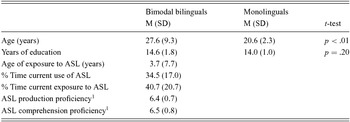
Twenty bilingual users of English and ASL (11 females, M age = 27.6 years, SD = 9.3 years) participated. An additional five ASL–English bilinguals were tested, but excluded from analyses because of technical malfunction (N = 2) or because their overall picture-naming accuracy was lower than 70% (N = 3). Self-ratings for ASL proficiency and current ASL exposure and use were collected through a language background questionnaire. A control group of monolingual English speakers completed a monolingual version of the experiment (N = 16, 16 female, M age = 20.6 years, SD = 2.3 years). Summary information for the bilingual and monolingual participants is provided in Table 1. All participants reported normal hearing and (corrected) vision, and no history of neurological problems.
Demographic information for bilingual and monolingual participants.

1Self-ratings from a language background questionnaire; proficiency was rated on a 7-point scale ranging from ‘almost none’ to ‘like native’.
Stimuli
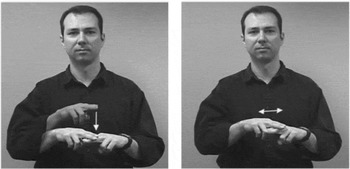
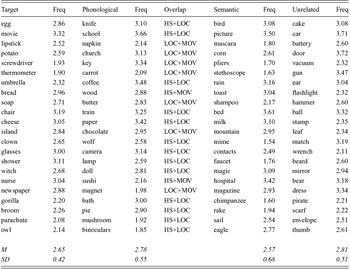
A set of 22 black-and-white line drawings of common objects were selected as target stimuli from the International Picture Naming Database (Székely, Jacobsen, D’Amico, Devescovi, Andonova, Herron, Lu, Pechmann, Pleh, Wicha, Federmeier, Gerdjikova, Gutierrez, Hung, Hsu, Iyer, Kohnert, Mehotcheva, Orozco-Figueroa, Tzeng, Tzeng, Arevalo, Vargha, Butler, Buffington & Bates, Reference Székely, Jacobsen, D’Amico, Devescovi, Andonova, Herron and Bates2004). Each picture (e.g., chair) was paired with four distractor words that made up four different conditions. In the translation-equivalent condition, the distractor word was the English label of the target picture (i.e., chair). In the phonologically-related-through-translation condition, the distractor word was phonologically related to the ASL label of the target picture through its ASL translation (e.g., train; chair and train are phonologically related in ASL, see Figure 1). ASL pairs were selected that were highly similar on two out of the three major phonological parameters, i.e., handshape, location and movement (see Appendix). In the semantically-related condition, target pictures and distractor words were semantically related, but phonologically unrelated (e.g., bed). Finally, in the baseline condition, the distractor word was unrelated to the target picture (e.g., ball). A list of all picture–word pairs in each condition can be found in the Appendix.
Illustration of the signs for chair and train in ASL. The two signs have the same location and handshape, but differ in movement.

English labels for the target pictures did not differ significantly from the semantic, phonological or unrelated distractors in lexical frequency, phoneme length and concreteness (all ps > .20). Furthermore, target pictures and distractors were phonologically unrelated in English. To ensure that the semantic distractors were in fact semantically related to the target pictures, fifteen monolingual English speakers who did not take part in the study rated all the target-distractor pairs for semantic similarity on a 1–7 scale ranging from ‘not similar at all’ (1) to ‘very similar’ (7). Picture–word pairs in the semantic condition were rated significantly higher for semantic similarity than picture–word pairs in the baseline condition, M = 5.8 (SE = .14) vs. M = 1.4 (SE = .06), t(14) = −31.43, p < .001, and in the phonological condition, M = 5.8 (SE = .14) vs. M = 1.6 (SE = .10), t(14) = −26.71, p < .001.
Another set of 22 pictures were selected as filler items and paired with three different sets of unrelated distractor words to increase the proportion of unrelated trials in the experiment. In the final experiment, 66 out of a total of 154 trials (43%) were related. The distractor words were recorded at 44.1 kHz, 32 bits by a female, monolingual speaker of English and amplitude-normalized.
Procedure
Each picture-naming trial started with a 500 ms central fixation cross, followed by simultaneous presentation (SOA = 0 ms) of the target picture and auditory distractor words through headphones. Psyscope X60 (Cohen, MacWhinney, Flatt & Provost, Reference Cohen, MacWhinney, Flatt and Provost1993) was used to present the stimuli and record naming latencies on an iMac desktop (OS 10.6 or 10.7). Bilingual participants named each picture in ASL. They started each trial by pressing and holding the spacebar with the fingers of their dominant hand. Key release times were recorded as a measure of signing onset. Naming latencies were calculated from the onset of the picture display. Monolingual participants named the pictures vocally. Voice onset latencies were recorded using the built-in voice key component of the ioLab USB response box and calculated from the onset of the picture display. Participants’ responses were recorded on video and checked for accuracy by a native ASL signer (bilingual participants) and a native English speaker (monolingual participants).
At the start of the session, each picture was presented for 2000 ms at the center of the screen together with the corresponding English label to familiarize participants with the target pictures and their names. Following this familiarization phase, the picture-naming experiment consisted of seven blocks of 22 trials, and was preceded by 12 practice trials with unrelated picture–word pairs. Trial presentation within each block was pseudo-randomized such that a) trials with related distractor words (from any of the related conditions) were always separated by at least one unrelated trial and b) trials with related distractor words from the same condition were separated by at least two unrelated trials. Furthermore, the first trial in each block was always a filler trial and the same picture was never presented twice in the same block. Block order was randomized across participants.
Data analysis
Picture-naming data were analyzed with the IBM© SPSS© 21 statistical software package and entered into two one-way repeated measures ANOVA, one for bilingual participants and one for monolingual participants, with Condition as a within-subjects factor with four levels. We did not directly compare naming times for bilingual and monolingual participants because of the confounding effects of manual versus vocal articulation and because the bilingual participants named the pictures in their non-dominant language (ASL). Paired samples t-tests were used in planned post-hoc comparisons contrasting picture-naming times for unrelated distractors with naming times for translation distractors, phonological distractors and semantic distractors with the two-tailed significance level set at ɑ = .05. Trials with incorrect responses were excluded from the analysis of naming times. For the bilingual participants, this included trials with fingerspelled responses. In addition, trials with dysfluencies and trials with picture-naming times that were more than 2.5 standard deviations below or above the mean for each participant (across the four conditions) were excluded from the analysis of naming times, resulting in further exclusion of 1.8% of the trials for bilinguals and 0.9% of the trials for monolinguals.
Results
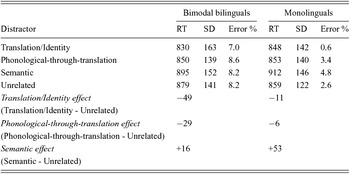
Means and standard deviations for bilingual and monolingual picture-naming times as well as error percentages in the four distractor conditions are presented in Table 2.
Mean Reaction Time (RT), Standard Deviation (SD) and Error % for the bimodal bilingual and monolingual participants in the four distractor conditions.

Bilinguals
Mean error percentage across the four conditions was 8.0% (SE = 1.8%) for the bilingual participants. None of the results of the error analyses for the bilingual participants were significant (all ps > .15).
Analysis of the bilingual naming latencies yielded a significant effect of Condition (F(3,57) = 7.96, p < .001, ƞp 2 = .30). Compared to unrelated distractor words, ASL–English bilinguals were faster to name the target pictures in ASL when the picture was presented together with the English translation equivalent, t(19) = −2.70, p < .05, d = 0.32, 95% CI [10.78, 85.76]. This result extends previous findings of translation facilitation in unimodal bilinguals to translation equivalents across two different language modalities. The bimodal bilinguals were also faster to name the target picture when the distracter word was phonologically related to the picture through ASL translation compared to the baseline condition, t(19) = −2.84, p < .05, d = 0.21, 95% CI [7.68, 50.57]. This finding indicates that the ASL–English bilinguals co-activated ASL translations of the English distractor words, resulting in phonological priming. Finally, the numerical difference between naming latencies in the baseline condition (M = 879ms, SD = 141ms) and the semantically-related condition (M = 895ms, SD = 152ms) was not significant (p = .19), suggesting that the bimodal bilinguals did not exhibit semantic interference.
Monolinguals
Mean error percentage across the four conditions was 2.8% (SE = 0.7%) for the monolingual participants. Analysis of the error rates yielded a significant effect of Condition (F(3,45) = 5.12, p < .01, ƞp 2 = .25). Error rates were significantly lower in the identity condition than the baseline condition (p < .05), and marginally significantly higher in the semantic condition compared to the baseline condition (p = .06). Error rates in the baseline condition and the phonologically-related-through-translation condition did not differ significantly (p = .42).
Analysis of the monolingual naming times yielded a significant effect of Condition (F(3,45) = 8.82, p < .001, ƞp 2 = .37). Surprisingly, naming latencies in the identity condition did not differ from the baseline condition (p = .39). Importantly, naming latencies in the phonologically-related-through-translation condition and the baseline condition also did not differ significantly (p = .51). This finding rules out the possibility that the facilitation effect observed for the bimodal bilinguals in this condition was due to a stimulus artifact. English monolinguals were significantly slower to name target pictures when presented together with a semantically-related English word, t(19) = −4.04, p = .001, d = −0.39, 95% CI [-80.13, −24.79]. Semantically-related distractors thus yielded semantic interference in monolinguals, but not bimodal bilinguals.
Discussion
Using a picture–word interference paradigm, we investigated whether hearing ASL–English bilinguals co-activate ASL translations of auditory English distractor words, and whether signs and words compete for selection during lexical production. Our results showed that the automatic lexical activation of sign translations of auditory distractor words facilitated the production of phonologically-related signs (phonologically-related-through-translation condition) or the sign translation itself (translation-equivalent condition). In contrast to English monolinguals, semantically-related distractors did not significantly affect picture-naming times for bimodal bilinguals (semantically-related condition).
Lexical contributions to phonological facilitation in bilingual word production
Our finding that co-activation of ASL translations of English distractor words affects sign production by hearing ASL–English bilinguals extends previous comprehension studies with deaf and hearing bimodal bilinguals that examined co-activation of signs during spoken word recognition (Giezen et al., unpublished manuscript; Shook & Marian, Reference Shook and Marian2012), visual word recognition (Kubus et al., Reference Kubus, Villwock, Morford and Rathmann2014; Morford et al., Reference Morford, Kroll, Piñar and Wilkinson2014, Reference Morford, Wilkinson, Villwock, Piñar and Kroll2011; Ormel et al., Reference Ormel, Hermans, Knoors and Verhoeven2012), and sentence reading (Bélanger, Morford & Rayner, Reference Bélanger, Morford and Rayner2013; Hosemann, Altvater-Mackensen, Herrman & Mani, Reference Hosemann, Altvater-Mackensen, Herrman and Mani2013). Spoken and signed languages do not have a shared sub-lexical level and cross-language activation can therefore only occur at the lexical level. Although it is possible that deaf signers develop particularly strong links between signs and orthographic representations when learning to read in bilingual educational settings (Hermans, Ormel, Knoors & Verhoeven, Reference Hermans, Ormel, Knoors and Verhoeven2008; Morford et al., Reference Morford, Kroll, Piñar and Wilkinson2014), hearing signers are less likely to create similar links. Instead, cross-language activation in hearing bimodal bilinguals more likely reflects links between spoken and signed lexical representations, either through lateral connections or through semantic mediation (Shook & Marian, Reference Shook and Marian2012). The present results show that co-activation between a spoken and a signed language not only impacts perceptually-driven comprehension processes (bottom-up), but also conceptually-driven production processes (top-down), despite the fact that the two languages do not compete at the perceptual or articulatory level.
Although there is substantial evidence for non-selective lexical activation during word comprehension and production by unimodal bilinguals (for review and discussion, see e.g., Costa, Reference Costa, Kroll and De Groot2005; Dijkstra, Reference Dijkstra, Kroll and De Groot2005; Kroll & Dussias, Reference Kroll, Dussias, Bhatia and Ritchie2013; Kroll & Gollan, Reference Kroll, Gollan, Goldrick, Ferreira and Miozzo2014), it should be noted that co-activation patterns in most studies can be attributed to sub-lexical sources of cross-language activation. That is, co-activation due to shared sounds or letters across the two languages. In fact, studies using the picture–word interference paradigm that specifically investigated the contribution of lexical sources of co-activation to phonological facilitation effects in bilingual word production either failed to find evidence for co-activation (Costa et al., Reference Costa, Miozzo and Caramazza1999) or only found such evidence in contexts that encouraged bilingual participants to covertly translate distractor words into the target language, e.g., by presenting distractors that were also potential target responses in the experiment (Hermans, Reference Hermans2004), or by having bilinguals name pictures in both their dominant and non-dominant language (Knupsky & Amrhein, Reference Knupsky and Amrhein2007).
In the present study there was no pressure for participants to covertly translate, yet ASL–English bilinguals consistently activated the ASL translations of English distractor words in the absence of any phonological overlap between the target name and distractor word. This finding provides strong evidence that lexical sources of co-activation can result in phonological priming of target responses in the picture–word interference paradigm. Furthermore, the presence of a phonologically-related-through-translation effect without apparent pressure to translate suggests that co-activation at the lexical level may play a larger role in bimodal bilingual word recognition than in unimodal bilingual word recognition. That is, lexical co-activation (e.g., activating Spanish perro, “dog”, when hearing English dog) appears to be a less automatic process in unimodal bilinguals’ word recognition than sub-lexical co-activation of words in the target and non-target language (e.g., activating Spanish perro, “dog”, when hearing English pear), and may occur only when there is a pressure to translate between the two languages. In contrast, bimodal bilinguals appear to readily activate translation equivalents in the non-target language during word recognition regardless of the experimental context, perhaps precisely because there are no sub-lexical connections between the two languages, allowing for stronger contributions of lexical connections.
A recent bilingual picture-picture interference study provides some further support for this possibility. Colomé and Miozzo (Reference Colomé and Miozzo2010) presented Catalan–Spanish bilinguals with distractor picture stimuli that were phonologically-related-through-translation to the target picture and found significant facilitation compared to unrelated distractor picture stimuli. Critically, in contrast to previous picture–word interference studies that found significant phonological facilitation for distractor words that were phonologically-related-through-translation to the target pictures (Hermans, Reference Hermans2004; Knupsky & Amrhein, Reference Knupsky and Amrhein2007), there was no pressure to covertly translate in this study. One possible explanation for why Colomé and Miozzo (Reference Colomé and Miozzo2010) observed a phonologically-related-through-translation effect is that the absence of visual or spoken word presentation allowed for stronger lexical contributions to phonological activation of the translations of non-target language distractors.Footnote 1
The locus of cross-linguistic competition in lexical selection
Although there is a general consensus among researchers that bilinguals activate lexical candidates from the non-target language during speech planning, theories differ in whether target and non-target language alternatives compete for selection (Hall, Reference Hall2011; Kroll & Gollan, Reference Kroll, Gollan, Goldrick, Ferreira and Miozzo2014). Theories of lexical selection through competition generally assume that lexical representations are tagged for language membership and that speakers’ intent to speak one language or the other results in suppression of lexical representations in the non-target language (e.g., Green, Reference Green1998) or increased activation of lexical representations in the target language (e.g., De Bot, Reference De Bot2004). Non-competitive accounts of lexical selection generally assume that speakers’ intent to speak in one language leads to an early locus of selection of target-language alternatives only (e.g., Costa, Reference Costa, Kroll and De Groot2005).
As a recent example of the latter, the Response Exclusion Hypothesis (Mahon et al., Reference Mahon, Costa, Peterson, Vargas and Caramazza2007) abandons competition as means of lexical selection altogether, in monolingual as well as bilingual word production. According to this hypothesis, within- and between-language competition effects occur at a post-lexical pre-articulatory level. When target and non-target candidate responses share more response-relevant features, it will take longer to reject the non-target response from the articulatory buffer. Regardless of its potential to explain key findings from monolingual and unimodal bilingual picture–word interference studies, the Response Exclusion Hypothesis makes a strong prediction about the role of competition during lexical selection in bimodal bilinguals (Hall, Reference Hall2011). Since spoken and signed languages use distinct sets of articulators, spoken and signed lexical representations should not compete in the articulatory buffer. Therefore, no semantic interference or even facilitation is predicted when bimodal bilinguals sign picture names while hearing auditory distractor words (or vice versa). Instead, lexical selection through competition predicts semantic interference for bimodal bilinguals (similar to unimodal bilinguals).
In the present study, we did not observe a significant semantic interference effect in ASL–English bilinguals when naming pictures in ASL. Picture-naming times in the semantically-related condition were slower than picture-naming times in the unrelated condition, but the difference was not significant. In contrast, the monolinguals, who vocally produced the picture names, did show a robust semantic interference effect with the same items (see Table 2).
In a meta-analysis of monolingual and bilingual picture–word interference studies, Hall (Reference Hall2011) reported a similar effect size and time course for semantic interference effects in monolinguals and unimodal bilinguals when the semantically-related distractor was presented in the target language (e.g., naming dog with cat as distractor). Furthermore, interference effects for semantically-related distractors in the target language and non-target language (e.g., naming dog with Spanish gato, “cat”, as distractor) for bilinguals were similar in effect sizes and time course, with strongest effects between −150 ms and +150 ms SOA, which includes the SOA used in the present study (0 ms). Based on this meta-analysis, therefore, it would seem reasonable to also expect a similar time course for semantic interference effects in monolinguals and bimodal bilinguals. Thus, the difference between the monolinguals and bimodal bilinguals in the present study is even more remarkable given Hall's (Reference Hall2011) meta-analysis results.
The results from the present study appear to be consistent with the predictions of the Response Exclusion Hypothesis. Specifically, the absence of a cross-linguistic semantic competition effect in bimodal bilinguals may suggest a post-lexical locus of competition in monolingual and bilingual word production, where words and signs do not compete because of their distinct articulatory properties. That is, (semantically-related) English distractor stimuli do not have direct access to the ASL articulatory buffer and as a result, non-relevant distractor and relevant target responses do not compete for selection, and semantic interference effects are not observed. It should be noted, however, that the Response Exclusion Hypothesis would actually predict a semantic facilitation effect in this context through the priming of shared conceptual features of distractor and target stimuli, which was not found.
Importantly, the results of the present study correspond with findings from monolingual and bilingual studies that used the picture-picture interference paradigm (e.g., Colomé & Miozzo, Reference Colomé and Miozzo2010; Damian & Bowers, Reference Damian and Bowers2003; Navarrete & Costa, Reference Navarrete and Costa2005). According to the Response Exclusion Hypothesis, distractor pictures, in contrast to auditory or printed distractor words, do not have privileged access to the articulatory buffer and hence non-relevant responses (distractor names) do not compete for selection with relevant responses (target names). Indeed, picture-picture studies have generally failed to find semantic interference effects. Although these studies generally also do not find evidence for the facilitation effect predicted by the Response Exclusion Hypothesis (but see e.g., La Heij, Heikoop, Akerboom & Bloem, Reference La Heij, Heikoop, Akerboom and Bloem2003), semantic facilitation has been reported for distractor pictures in word translation contexts (for discussion, see Bloem & La Heij, Reference Bloem and La Heij2003; Navarrete & Costa, Reference Navarrete and Costa2009).
Although the absence of a semantic interference effect for the bimodal bilinguals appears to be consistent with a non-competitive account of lexical selection, we would like to caution against a strong interpretation of this null effect because there may be other possible explanations. For instance, one possibility is that the time course for semantic interference differs somewhat between bimodal bilinguals and monolinguals due to timing differences in the planning of manual versus vocal production. Specifically, although the triggering of the voice key roughly corresponded to the onset of the first sound of the word produced by monolinguals, the manual key release by the signers corresponded with the start of a transitional movement of the hand(s) towards the location in signing space or on the body where the sign was produced. As a result, it could be argued that, relative to the picture onset, the actual sign onset was slightly shifted compared to the word onset. Because of these time course differences, semantic interference effects in bimodal bilinguals may only be observed at positive SOAs (i.e., the picture is presented before the distractor) for sign production.
Alternatively, a shift in the time course of semantic interference effects in bimodal bilinguals relative to unimodal bilinguals and monolinguals may be explained by differences in the nature of cross-linguistic competition processes. Hoshino (Reference Hoshino2006) compared Spanish–English bilinguals and Japanese–English bilinguals in a picture–word interference paradigm with visually presented cross-linguistic distractors and found semantic interference effects at +25ms SOA in the Spanish–English bilinguals, but not in the Japanese–English bilinguals. She argued that, because Japanese and English do not share the same script and the distractor words were presented visually, the Japanese–English participants may have used early perceptual information as a language cue to select the target language before the semantics of the distractor word were activated. At that point, non-target language alternatives would no longer compete for selection and could no longer affect production of the target word. Similarly, bimodal bilinguals in the present study could have used the perceptual differences between English and ASL as a language cue to facilitate lexical access in the target language. Crucially, activation of this language cue would have to occur after phonological and lexical activation of the distractor word in order to explain the facilitation effects in the translation-equivalent and phonologically-related-through-translation conditions. If this explanation is correct, then semantic interference effects would likely be observed at earlier (i.e., negative) SOAs, allowing for semantic activation of the distractor word before selection of the target language through a language cue.
Translation facilitation across modalities
In the present study, we found evidence for translation-equivalent facilitation in bimodal bilinguals, but no evidence for target identity facilitation in monolinguals. Both effects generally show the strongest effects between −200 ms SOA and −100 ms SOA, but are typically also observed at 0 ms SOA (Hall, Reference Hall2011). Furthermore, translation priming effects in bilinguals tend to be weaker than identity priming effects in monolinguals (e.g., Costa et al., Reference Costa, Miozzo and Caramazza1999). The absence of target identity facilitation for the monolinguals in the present study is therefore surprising, and we currently do not have an explanation for this unexpected finding. However, at least one other study also failed to find evidence for significant identity facilitation at 0 ms SOA using auditory distractors (Brooks & MacWhinney, Reference Brooks and MacWhinney2000; they did observe significant facilitation at −150 ms SOA). Furthermore, although monolingual naming latencies were not significantly affected by identity distractors, error rates were significantly lower in the identity condition than the baseline condition, suggesting that the identity distractors did have some facilitative effects on monolingual naming performance in the present study.
Our finding of translation facilitation effects in bimodal bilinguals extends reports of translation priming in unimodal bilinguals to translation equivalents in different language modalities. Costa et al. (Reference Costa, Miozzo and Caramazza1999) interpreted translation facilitation effects as support for language-specific lexical selection. They argued that, if lexical selection occurs through competition, then translation equivalents should be the strongest possible cross-linguistic semantic competitors. Hence, interference effects would be expected when naming pictures in the context of distractors that are translation equivalents of the picture name. However, exactly the opposite is observed, namely facilitation. They therefore propose that lexical selection is language-specific and that the target and its translation equivalent do not compete. Instead, the priming of overlapping semantic features between the target name and its translation equivalent yields facilitation. However, Hermans (Reference Hermans2004) argued that translation facilitation effects can be accounted for by language non-specific models of lexical selection if it is assumed that phonological and semantic facilitation effects can offset cross-linguistic competition effects.
Costa et al. (Reference Costa, Miozzo and Caramazza1999) argued that the absence of phonologically-related-through-translation effects in their study speaks against contributions to translation facilitation effects from phonological priming. However, Hermans (Reference Hermans2004) observed facilitation for phonologically-related-through-translation distractors during L2 picture naming when the L1 distractors were also used as targets in the experiment, which suggests that phonological activation of the L2 translation of L1 distractors can increase phonological activation of the L2 picture name under specific circumstances (cf. Knupsky & Amrhein, Reference Knupsky and Amrhein2007). Our finding of facilitation effects with phonologically-related-through-translation distractors in ASL–English bilinguals provides further support for phonological contributions to translation facilitation effects. That is, activation of the ASL translations of English distractor words increased phonological activation of the ASL picture name, either by activating part of the target sign (phonologically-related-through-translation condition) or the actual target sign (translation-equivalent condition). However, it remains to be seen to what extent phonologically-related-through-translation effects are dependent on experimental constraints and structural properties of the two languages in question.
Conclusion
The present study shows that, similar to that in unimodal bilinguals, cross-language activation between a spoken and signed language in bimodal bilinguals is not limited to comprehension contexts, but also impacts language production processes. Using a picture–word interference paradigm, we found evidence for phonological priming in the production of ASL signs through the co-activation of phonologically-related sign translations of auditory English distractor words. Semantically-related distractors did not significantly affect picture-naming times, however, suggesting that lexical target and non-target language alternatives may not compete for selection, because there is no articulatory competition between the two languages, or may not compete along the same time course as for unimodal bilinguals. Finally, because signed and spoken languages do not have a shared sub-lexical level, our findings provide strong empirical support for contributions of lexical sources of cross-language activation to phonological facilitation effects in bilingual word production.
Target pictures and distractor words with their English word frequency for the phonological condition (including overlapping phonological parameters), semantic condition and unrelated condition.