Introduction
Schistosomiasis is a parasitic infection caused by flatworms of the genus Schistosoma (Rey, Reference Rey2010) and among human parasitic diseases it is second only to malaria as a cause of morbidity–mortality (Berriman et al., Reference Berriman, Haas, LoVerde, Wilson, Dillon, Cerqueira, Mashiyama, Al-Lazikani, Andrade, Ashton, Aslett, Bartholomeu, Blandin, Caffrey, Coghlan, Coulson, Day, Delcher, DeMarco, Djikeng, Eyre, Gamble, Ghedin, Gu, Hertz-Fowler, Hirai, Hirai, Houston, Ivens, Johnston, Lacerda, Macedo, McVeigh, Ning, Oliveira, Overington, Parkhill, Pertea, Pierce, Protasio, Quail, Rajandream, Rogers, Sajid, Salzberg, Stanke, Tivey, White, Williams, Wortman, Wu, Zamanian, Zerlotini, Fraser-Liggett, Barrell and El-Sayed2009). It affects people living in tropical and subtropical regions (Stothard et al., Reference Stothard, Hughes and Rollinson1996) and the World Health Organization estimates that more than 207 million people are infected worldwide, most of them in poor communities and 85% living in Africa (Guerrant et al., Reference Guerrant, Walker and Weller2011). Perhaps 700 million people are at risk of infection due to agricultural, domestic or recreational activities involving contact with contaminated water, in which intermediate hosts (freshwater snails) have released the infectious larval forms of Schistosoma (King, Reference King, Guerrant, Walker and Weller2011). Among the described species, S. mansoni is the main cause of intestinal schistosomiasis, which is endemic in Africa and South America (Rey, Reference Rey2010).
Schistosoma spp. use a wide range of strategies to evade host immunity and thus facilitate their own development and transmission (Karanja et al., Reference Karanja, Colley, Nahlen, Ouma and Secor1997; He et al., Reference He, Salafsky and Ramaswamy2001; Cardoso et al., Reference Cardoso, Macedo, Gava, Kitten, Mati, de Melo, Caliari, Almeida, Venancio, Verjovski-Almeida and Oliveira2008); for example, infectivity, pathogenicity and immunogenicity can vary within the same species, strain and sex of schistosome (Nino Incani et al., Reference Nino Incani, Morales and Cesari2001). The host immune response is also important for the outcome of infection, with both invariant natural killer T (iNKT) cells and the Th3 cytokine transforming growth factor beta (TGF-β) affecting parasite development and embryogenesis (Oliveira et al., Reference Oliveira, Carvalho, Verjovski-Almeida and LoVerde2012).
Molecular biology techniques such as random amplification of polymorphic DNA–polymerase chain reaction (RAPD-PCR) have been used to detect genetic diversity in isolates of S. mansoni from Brazil and other endemic areas (Pillay & Pillay, Reference Pillay and Pillay1994; King, Reference King, Guerrant, Walker and Weller2011). Researchers also identified genetic differences between S. mansoni populations resistant or tolerant to praziquantel (PZQ), oxamniquine (Oxa) and hycanthone (Hyc) by RAPD-PCR (Tsai et al., Reference Tsai, Marx, Ismail and Tao2000). Although some genetic differences are likely to be neutral and simply reflect divergence time, some polymorphisms may be markers of, or adaptations to, the immune systems of different hosts (Berriman et al., Reference Berriman, Haas, LoVerde, Wilson, Dillon, Cerqueira, Mashiyama, Al-Lazikani, Andrade, Ashton, Aslett, Bartholomeu, Blandin, Caffrey, Coghlan, Coulson, Day, Delcher, DeMarco, Djikeng, Eyre, Gamble, Ghedin, Gu, Hertz-Fowler, Hirai, Hirai, Houston, Ivens, Johnston, Lacerda, Macedo, McVeigh, Ning, Oliveira, Overington, Parkhill, Pertea, Pierce, Protasio, Quail, Rajandream, Rogers, Sajid, Salzberg, Stanke, Tivey, White, Williams, Wortman, Wu, Zamanian, Zerlotini, Fraser-Liggett, Barrell and El-Sayed2009). Such genetic polymorphisms may give the parasite the capacity to colonize different hosts with distinct immunological backgrounds (Tsai et al., Reference Tsai, Marx, Ismail and Tao2000; Gentile & Oliveira, Reference Gentile and Oliveira2008).
C57BL/6 mice are widely used in the development of genetically modified mice (Smith, Reference Smith2002). Mutant strains of this lineage have been generated with different immune environments (Wakao et al., Reference Wakao, Kawamoto, Sakata, Inoue, Ogura, Wakao, Oda and Fujita2007; Dwivedi et al., Reference Dwivedi, Tousif, Bhattacharya, Prasad, Van Kaer, Das and Das2011), such as Jα18− / − (deficient exclusively in iNKT cells) and TGFβRIIdn (expressing a dominant-negative form of TGFβ receptor). Jα18− / − and TGFβRIIdn mice have been used as models for autoimmune disease, anti-tumour immune responses, inflammatory bowel disease (Mi et al., Reference Mi, Li, Yang, Liu, Wang, Ma, Wang, Liu, Sun and Hu2011) and schistosome infections (Osman et al., Reference Osman, Niles, Verjovski-Almeida and LoVerde2006; Mallevaey et al., Reference Mallevaey, Fontaine, Breuilh, Paget, Castro-Keller, Vendeville, Capron, Leite-de-Moraes, Trottein and Faveeuw2007).
The aim of the present study was to evaluate genetic differences between adults of the Belo Horizonte (BH) strain of S. mansoni able to successfully infect mice with distinct immunological backgrounds, and to determine whether specific S. mansoni DNA markers are associated with different host immune backgrounds.
Materials and methods
Parasitological procedures
The Belo Horizonte (BH) strain of S. mansoni was obtained from the Medical Parasitology Unit of Instituto de Higiene e Medicina Tropical (Lisbon). These clonal parasites are originally from Belo Horizonte city, Brazil, and have been continuously maintained for 20 years by successive passage through CD1 mice (Mus musculus) and Biomphalaria glabrata snails. In this study, mouse lineages CD1 and C57BL/6J (as controls), Jα18− / − and TGFβRIIdn, supplied by The Jackson Laboratory (Bar Harbor, Maine, USA), were infected by exposing their tails to 50 cercariae of S. mansoni in 50 ml of water for 2 h. Infection occurred by dermal penetration. Seven weeks post-infection, eggs were observed in faeces, using the Telemann–Lima and Kato–Katz techniques (World Health Organization, 2003). One week after infection adult worms were recovered as described by Duvall & DeWitt (Reference Duvall and DeWitt1967). Recovered worms from each mouse strain were divided into groups of males, females and pools of males and females.
Molecular analysis
DNA was extracted from each pre-defined group of worms using a modified cetyltrimethylammonium bromide (CTAB) protocol (Stothard et al., Reference Stothard, Hughes and Rollinson1996). Briefly, worms were ground to a fine powder using liquid nitrogen, 600 μl of extraction buffer was added to each sample, then the sample was ground again and 10 μl proteinase K (10 mg/ml) was added prior to incubation at 55°C for 90 min with agitation. An equal volume of chloroform : isoamyl alcohol (24:1) was added and gently mixed 30–40 times, then briefly centrifuged. To the supernatant was added 800 μl cold absolute ethanol and the mixture was centrifuged at 8000 g for 20 min at room temperature. The pellet was washed twice with 70% ethanol at 8000 g for 15 min. The final pellet was air-dried and dissolved in Tris-EDTA (TE) buffer (50 ml). Finally ribonuclease (RNase, 10 mg/ml) was added, the DNA incubated at 37°C for 30 min and then stored at − 20°C until use.
For RAPD-PCR, ten-mer oligonucleotides described by Tsai et al. (Reference Tsai, Marx, Ismail and Tao2000) were tested and used individually (i.e. a single primer per reaction). For a final volume of 25 μl, 50 μm MgCl2, 10 pmol each primer, 25 μg DNA and milli-Q water (Merck Millipore, Lisbon, Portugal) were added to Illustra PuReTaq Ready-to-Go PCR Beads (GE Healthcare, Amersham, UK). Amplification reactions were performed in a thermocycler (Mechatronic Systems GmbH, Wies, Austria) as described by Tsai et al. (Reference Tsai, Marx, Ismail and Tao2000). Electrophoresis was carried out in 1.5% agarose gels, 20 cm in length, with 0.5% ethidium bromide (EtBr) staining. All samples amplified with the same primer were included in the same gel. DNA fragments were visualized and photographed under UV light (Alphamager®HP, Alpha Innotech, San Leandro, California, USA). The resulting amplification patterns were digitized and analysed automatically. A negative control and male and female S. mansoni DNA from CD1 and C57BL/6J (as positive controls) were used in all amplifications.
Primers that produced patterns with defined reproducible bands were selected. A data matrix was constructed of DNA fragments produced by four RAPD primers (OPI-3, OPI-7, OPI-12 and OPI-18) encoded as present (1) or absent (0). A neighbour-joining dendrogram was built using NEIGHBOR from a Modified Nei distance matrix produced by the programme RESTDIST in PHYLIP (Felsenstein, Reference Felsenstein1989), and analysed as restriction sites 20 bp long, with a default transition/transversion ratio of 2. The resulting tree was visualized and edited in MEGA5.10 (Tamura et al., Reference Tamura, Peterson, Peterson, Stecher, Nei and Kumar2011). No bootstrap analysis was performed due to the small number of polymorphic DNA fragments.
Results
Adult worms of the S. mansoni were collected from infected CD1, C57BL/6J, Jα18− / − and TGFβRIIdn mice and DNA was prepared for RAPD-PCR analysis. Of the ten primers tested by RAPD-PCR, all but one (OPI-5) produced amplification products, which were between 200 and 2000 bp in size. Four (OPI-3, OPI-7, OPI-12 and OPI-18) of the nine successful primers gave polymorphic patterns.
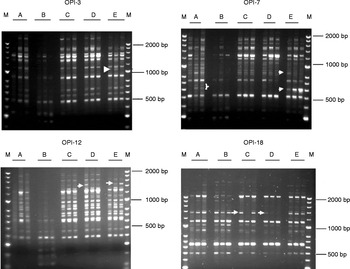
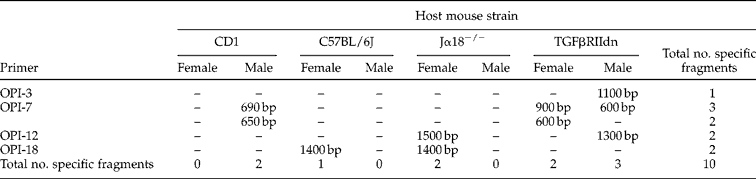
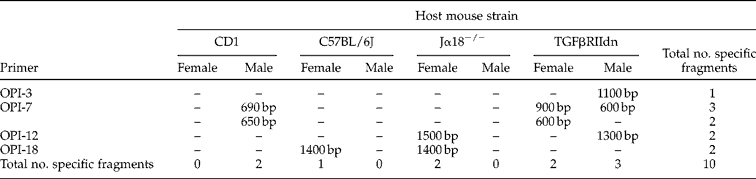
For each class of host, the male worms recovered could be distinguished from females by at least one of the amplification patterns obtained with the four RAPD primers (fig. 1). Sex-specific fragments were more often found in females than males, and only worms from TGFβRIIdn mice gave rise to sex-specific fragments for both sexes. In the case of males recovered from CD1 and TGFβRIIdn, two sex-specific fragments were identified (table 1). The 1400 bp fragment amplified with primer OPI-18 was female-specific only for worms from C57BL/6J and Jα18− / − hosts, while in other mouse strains both male and female schistosomes gave rise to this fragment. Primer OPI-7 amplified a fragment of 600 bp only from DNA of males and females infecting TGFβRIIdn (table 1).
RAPD-PCR profiles using four primers OPI-3, OPI-7, OPI-12 and OPI-18 of adult worms of the BH strain of Schistosoma mansoni from wild-type mouse strains CD1 (lanes A, B) and C57BL/6J (lane C) and mutant mouse strains Jα18− / − (lane D) and TGFβRIIdn (lane E) with 2000 bp molecular weight markers (lanes M). Pools of female, male and mix of female and male worms are indicated from left to right of each lane, with specific fragments arrowed (white).

The size of specific RAPD fragments in Schistosoma mansoni populations relative to mouse strain and primer.
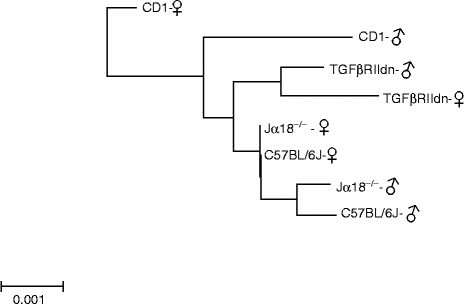
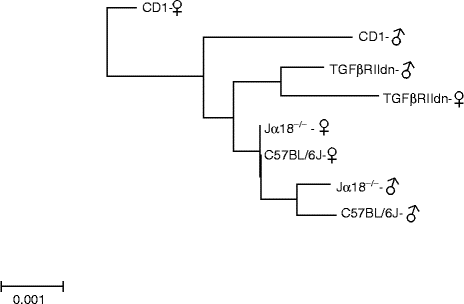
A neighbour-joining dendrogram, built from the fragment data produced by the four polymorphic RAPD primers (fig. 2), showed that S. mansoni females and males isolated from CD1 mice were more distantly related to each other than males and females from other hosts. For example, S. mansoni males and females from TGFβRIIdn mice were less distinct than those from CD1 mice. Finally, S. mansoni females isolated from C57BL/6J and Jα18− / − had indistinguishable profiles, whereas their respective males were distinct and more related to each other (table 1).
Dendrogram analysis of RAPD pofiles. Neighbour-joining dendrogram built by NEIGHBOR from a Modified Nei distance matrix produced by the programme RESTDIST in PHYLIP (Felsenstein, Reference Felsenstein1989), with 57 characters in total from four RAPD primers analysed as restriction sites 20 bp long with a transition/transversion ratio of 2. The tree was visualized and edited in MEGA5.10 (Tamura et al., Reference Tamura, Peterson, Peterson, Stecher, Nei and Kumar2011).
Discussion
RAPD-PCR uses a single primer to produce amplification fragments that can be scored as present or absent (Avise, Reference Avise2004). The technique allows the identification of genomic regions of interest without needing prior information about the organism being investigated (Welsh et al., Reference Welsh, Petersen and McClelland1991). As a result, RAPD-PCR has been widely used for genetic mapping, development of genetic markers linked to a trait of interest, population studies, evolutionary genetics, and plant and animal breeding (Bardakci, Reference Bardakci2000). The ten RAPD-PCR primers used in this study had previously been evaluated by Tsai et al. (Reference Tsai, Marx, Ismail and Tao2000) for the study of genetic diversity in S. mansoni and, in our hands, polymorphic profiles were observed using primers OPI-7, OPI-12 and OPI-18. Male and female S. mansoni worms were recovered after infection of different mouse strains to investigate whether the host influences the genetic diversity of the parasite population. Interestingly, for each host tested, the female schistosome recovered could be distinguished from males according to their RAPD-PCR profiles. This suggests some form of sex-linked genetic polymorphism, although it was not possible to determine the gene(s) involved. Such sex-linked polymorphism found in our study could be explained by the peculiar biology of these parasites. In the blood vessel of the definitive host, male and female form a linked couple (Rey, Reference Rey2010). Males accommodate females in their gynecophoric canal and modulate their development (Guerrant et al., Reference Guerrant, Walker and Weller2011).
As well as sex-specific differences, worms isolated from different mice also showed distinct RAPD-PCR profiles. NKT cells have properties of both T and NK cells, forming a heterogeneous group that expresses an invariant T-cell receptor (TCR) α-chain rearrangement; in mice this is Vα14Jα18, while in humans it is Vα24Jα18. These iNKT cells are important for the balance of Th1 and Th2 immune response in S. mansoni infection (Arosa et al., Reference Arosa, Cardoso and Pacheco2007; Mallevaey et al., Reference Mallevaey, Fontaine, Breuilh, Paget, Castro-Keller, Vendeville, Capron, Leite-de-Moraes, Trottein and Faveeuw2007). In our study, we used Jα18− / − mice, which do not have iNKT cells; therefore this is likely to affect the populations of schistosomes. In the TGFβRIIdn background, in which a dominant-negative form of the TGF-β receptor is expressed, both male and female RAPD-PCR profiles were quite distinct from each other and from those of other strains, although each S. mansoni male–female pair belonged to a single branch. This suggests that TGF-β deficiency selects quite specific subsets of worms and, strikingly, genetically distinct male and female populations, consistent with selectively advantageous genotypes in each sex.
The effect of human TGF-β (hTGF-β) expression on adult profiles of S. mansoni has been shown to promote genetic variations in helminths (Oliveira et al., Reference Oliveira, Carvalho, Verjovski-Almeida and LoVerde2012). In fact, host gene expression has been associated with the morphology, development and life cycle of S. mansoni (Arosa et al., Reference Arosa, Cardoso and Pacheco2007) and that could reflect on subtle genetic changes that we have observed in our study. Thus, we could speculate that the immunological background of the host might select genetic variation, since TGF-β can acts a regulator of chronic helminthic infection (Ziegler, Reference Ziegler2006).
In summary, we have demonstrated that RAPD-PCR is a useful tool for assessing genetic differences between experimental populations of S. mansoni and could lead to the discovery of specific host interaction markers. The molecular mechanisms involved in host–parasite interaction are complex and imply bilateral cross-talk, with signals in both directions (Arosa et al., Reference Arosa, Cardoso and Pacheco2007) giving rise to distinct genetic variants. However, further experiments are needed to elucidate the role of the host environment in the evolution of S. mansoni populations and to better understand the molecular mechanisms involved in infection. For example, microsatellite and sequencing of major specific fragments between worms from hosts with different immunological backgrounds could be useful for better understanding of the molecular mechanisms involved in murine schistosomiasis assays.
Acknowledgements
The authors are very grateful to Dr Milton Moraes and Dr Tufária Mussá for their assistance and technical support in the writing of this article.
Financial support
This work was supported by the Foundation for Science and Technology (Pest-OE/SAU/UI0074/2011), Lisbon, Portugal.
Conflict of interest
None.
Ethical standards
The study was approved by the Portuguese Commission on Ethics and Animal Welfare (Ref. 0421/2013), and all animals were treated and maintained in accordance with National and European legislation on the protection of animals used for scientific purposes (2010/63/UE adopted on 22 September 2010).