Bao'ensi Temple was built by Zhu Di, the emperor of the Ming Dynasty, on the foundations of Changgan Temple (长干寺) and Tianxi Temple (天禧寺). The Nanjing Bao'ensi site is located in the Ancient Changganli area outside the Gate of Ming Zhonghua in Nanjing, covering an area of ~250,000 m2. The site is the largest and highest-ranking royal temple in the Ming Dynasty. The Bao'ensi pagoda of the temple is famous worldwide. It was destroyed during the war of the Taiping Heavenly Kingdom during the late Qing Dynasty (Wang, Reference Wang1984). The site is generally divided into two areas: the southern area and the northern area. The Nanjing Institute of Archaeology conducted a comprehensive and systematic archaeological excavation in the northern area in 2007–2010 and in the southern area in 2017.
Ancient works (Nanjing Museum, 1962; Lu, Reference Lu1996) present clear records of the firing of glazed tiles during the Ming Dynasty. The ‘Collected Statutes of the Ming Dynasty’ (明会典) state: ‘In 1393, the bricks and tiles needed for Nanjing construction were fired in Jubaoshan kiln for glazed tiles every year, and the clay used for glazed tiles came from Taiping Palace.’ Combined with archaeological reports, this has led some researchers to posit that the glazed tiles of the Bao'ensi site were fired mainly in the Jubaoshan kiln for use around Nengrenli Temple (能仁里) and Yanxiang Temple (眼香庙) in Nanjing, with the body clay coming from Dangtu in Anhui Province (Chen, Reference Chen2009, Reference Chen2015). Several scholars have selected five collections of yellow-coloured and green-coloured glaze components (Liu et al., Reference Liu, Li, Jiang, Quan, Zhang, Jiang and Meng2007) collected from the vicinity of Yanxiang Temple (眼香庙) in Yaogang Village (窑岗村) in Nanjing in the 1960s for scientific and technological investigation. These components were presumed to be glazed arch elements from the Bao'ensi site (Zhang, Reference Zhang2003). The results showed that the raw materials used in the bodies of these glazed components are the same as those from Dangtu.
Based on previous work (Ding et al., Reference Ding, Duan, Kang, Wu and Miao2011, Reference Ding, Li, Duan, Kang, Chen and Miao2013; Huang et al., Reference Huang, Wang, Lei, Dong, Zhang and Wang2015; Qi, Reference Qi2015, Reference Qi2018; Qi & Zhou, Reference Qi and Zhou2015), 56 glazed tile samples unearthed from the archaeological excavation site in the southern area of the Bao'ensi site were selected to determine systematically and comprehensively the body-firing process used and the source of the raw material. The phase composition, firing temperature and chemical composition of the body samples were studied using X-ray diffraction (XRD), thermal dilation (TD) and energy-dispersive X-ray fluorescence (EDXRF). The EDXRF data were processed using multivariate statistical analysis. Our results can provide scientific and technological support for investigations into the production, circulation and management systems of imperial kilns from the Ming Dynasty.
Experimental samples and methods
Samples
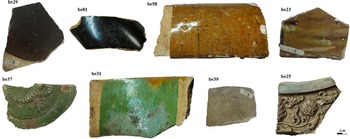
A total of 56 samples with yellow, green and black glaze colours were collected from the southern area of the Bao'ensi site. Typical samples are shown in Fig. 1.
Typical glazed tiles from Bao'ensi Temple in Nanjing.

Experimental methods
The phase composition of the body samples was analysed using XRD (SmartLab X, Japan) in the scanning range of 10–80°2θ with Cu-Κα radiation at 30 mA/40 kV. The XRD traces were analysed using the Jade 6 program, by which the phase composition of each sample body was obtained. The samples to be analysed using XRD were separated by cutting and cleaned with deionized water in an ultrasonic cleaner. After drying in an oven, the bodies were ground into powder in an agate mortar.
The thermal behaviour of the body samples was measured using TD (LINSEIS DIL L175, Germany) at a resolution of 0.05 nm from room temperature to 1200°C at a rate of 5°C min–1. The glaze layer of the selected samples was removed and cut into rectangular bars, washed with deionized water in an ultrasonic cleaner and dried in a drying oven.
The chemical composition of the body samples was determined using EDXRF (XGT-7000, Japan) with a Si–Li detector with a beam spot of 1.2 mm, an operating voltage of 30 kV and an operating current of 250 μA. The data-acquisition time was 120 s. Na2O was not determined because of the poor fluorescence yields and low counting signal obtained with the EDXRF instrument. The selected samples were cleaned and then dried in a drying oven.
Results and discussion
Phase-composition analysis of the glazed tile bodies from the Bao'ensi site
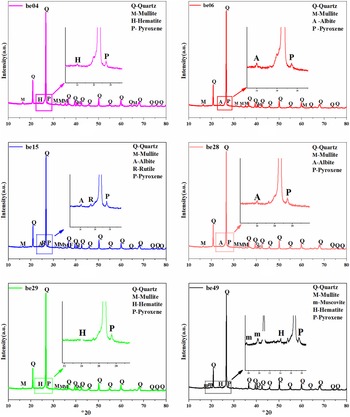
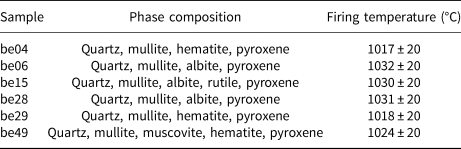
The XRD traces of the glazed tile bodies are shown in Fig. 2. The phase composition of each body sample was obtained, as shown in Table 1.
XRD traces of representative body samples.

The phase compositions and firing temperatures of representative Bao'ensi site body samples.

The glazed tile bodies of the Bao'ensi site consist mainly of quartz and mullite, along with trace amounts of albite, rutile, muscovite, hematite and pyroxene (Table 1). Therefore, the body materials have a comparable composition, along with certain differences, suggesting partial consistency in the selection of body materials.
A series of physical and chemical changes took place during the firing process of the glazed tiles. The mineralogical composition of the tiles reflects the heating changes of the original materials, mainly clays. Clays with various mineralogical compositions yield various end products when heated, which may be used to identify the mineralogical composition of the original clay (Li, Reference Li2001). The glazed tiles were fired under low temperatures. Kaolinite (Al2O3⋅2SiO2⋅2H2O) is the main source of mullite (3Al2O3⋅2SiO2) detected in all of the samples (Dubois et al., Reference Dubois, Murat, Amroune, Carbonneau and Gardon1995). Therefore, the quartz phase in the body materials belongs to α-quartz. The main component of quartz is SiO2, which often contains a number of impurities such as Al2O3, Fe2O3, CaO, MgO, TiO2, etc. These impurities represent other minerals (e.g. carbonate (dolomite, calcite and magnesite), feldspar, rutile, mica and iron oxide) being included in the process of mineral formation. The structural water in kaolinite is released during hydroxylation and the crystal structure is destroyed to form metakaolinite in the temperature range of 450–650°C (Equation 1). Metakaolinite begins to transform into Al–Si spinel-type structures at 925°C (Equation 2), and the Al–Si spinel begins to transform into mullite and cristobalite at 1050–1100°C (Equation 3). Due to the presence of flux oxides (such as K2O and CaO), the formation temperature of mullite in the body is reduced, and cristobalite does not form in the body phase, implying that the firing temperature of the body was ~1000°C. Through thermal expansion analysis (Tite, Reference Tite1969), it can be inferred that the firing temperature of the glazed tile body was 1000–1100°C (Table 1).


The melting point of albite (NaAlSi3O8) is ~1100°C, and the melting of quartz and mullite at high temperatures is rapid in the presence of albite flux. Muscovite usually coexists with feldspar and quartz. Pyroxene is a common silicate mineral. Hematite is the main mineral form of Fe2O3, and it has a melting point of ~1250–1270°C. Rutile, a TiO2 polymorph generally containing >95% TiO2, has a melting point of ~1500–1600°C.
The phase composition combined with the firing temperature indicate that the raw material was concentrated and that the firing processes of the glazed tile body samples had similarities.
Analysis of the chemical composition of the glazed tile bodies
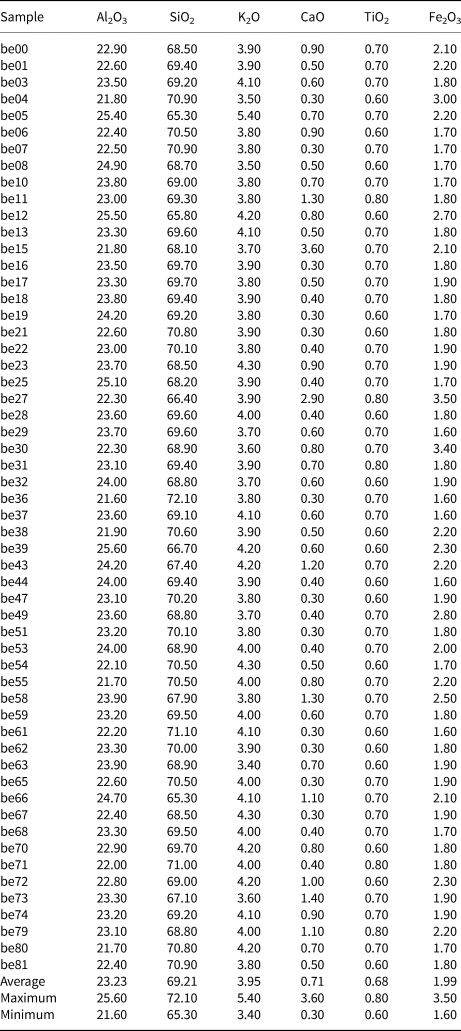
The chemical compositions of the 56 glazed tile sample bodies were determined using EDXRF. Some of the EDXRF data are shown in Table 2.
Chemical composition of the Bao'ensi glazed tile body samples (wt.%).

Archaeological reports show that the Nanjing Jubaoshan kiln site was the main location for providing royal and official buildings in Nanjing with glazed pottery products (Nanjing Museum, 1962; Chen, Reference Chen2009). In addition, ancient works such as the ‘Collected Statutes of the Ming Dynasty’ (明会典), ‘Exploitation of the Works of Nature’ (天工开物) and ‘Taiping Prefecture Chorography’ (太平府志) report that the material that makes up the body of the Jubaoshan glazed tiles consists of a white clay from the Dangtu area, Anhui (Chen, Reference Chen2009). Based on this information, the data from the Dangtu glazed tile body samples from previous research (Ding et al., Reference Ding, Duan, Kang, Wu and Miao2011; Yang, Reference Yang2018), numbered as AM(DY), were used to explore whether the raw material of the glazed tile bodies from the Bao'ensi site originates from Dangtu.
Analysis of the EDXRF data
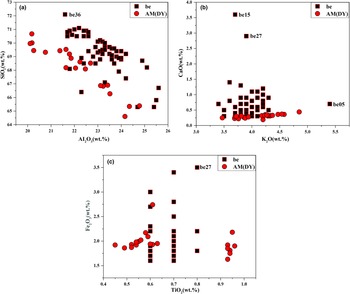
The chemical composition of the glazed tile bodies analysed (Fig. 3) was used to determine the possible differences between the glazed tile bodies from the Bao'ensi area and the Dangtu area.
Dispersion analysis of the glazed tile body samples. AM(DY) = Dangtu glazed tile body samples.

The Al2O3 content of the Bao'ensi site body samples varies between 22.10% and 25.60%, while the Al2O3 content of the Dangtu glazed tile body samples varies between 20.11% and 24.78% (Fig. 3a & Table 2). The two sets of samples have generally comparable Al2O3 contents, with only a few samples having different Al2O3 contents. The SiO2 content of the Bao'ensi site body samples varies between 65.30% and 72.10%, while the SiO2 content of the Dangtu glazed tile body samples varies between 64.60% and 70.67%. Hence, the two sample sets have comparable SiO2 contents. In addition, the K2O contents of the Bao'ensi site body samples and the Dangtu glazed tile body samples are comparable (3.40–5.40% and 3.47–4.58%, respectively). In contrast, the Bao'ensi site body samples have a greater CaO content than their Dangtu glazed tile body sample counterparts (0.30–3.60% and 0.19–0.44%, respectively; Fig. 3b). In addition, the TiO2 contents of the two sets of samples are generally variable (Fig. 3c). Finally, the Fe2O3 contents of the Bao'ensi site bodies and the Dangtu glazed tile body samples are generally comparable (1.60–3.50% and 1.63–2.74%, respectively), with some samples from the Bao'ensi site having a greater Fe2O3 content. Therefore, the two sites have comparable chemical compositions overall.
Factor analysis of the EDXRF data
Factor analysis converts multiple variables into a few uncorrelated comprehensive indicators, establishes the possible correlations between multiple variables and extracts two to three factors that most reflect the data. Based on such an analysis, the results (data points) reflect the relationships between samples (i.e. adjacent sample points have similar properties and belong to the same group) and the relationships between elements and samples (variables). Thus, data points within the same area will be characterized by adjacent variables (Xue, Reference Xue2013).
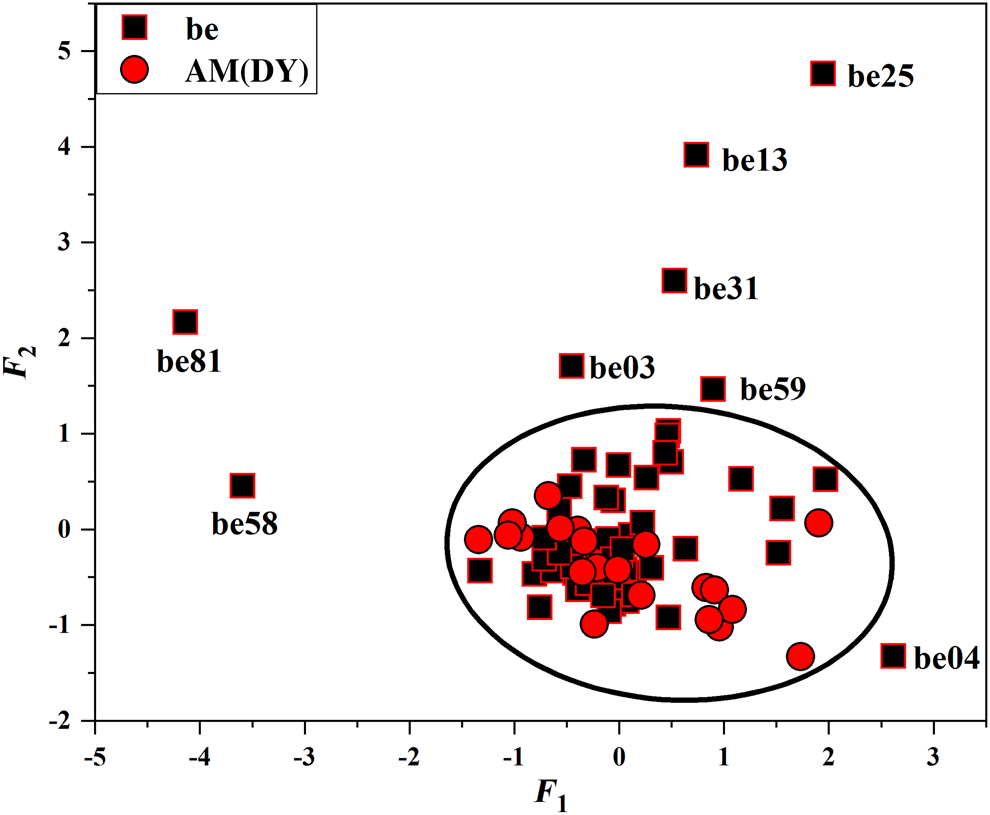
Figure 4 depicts the factor-loading diagram of the glazed tile body samples from the Bao'ensi site and the Dangtu glazed tile body samples. Factor analysis was performed using the SPSS software package. Five chemical components, namely Al2O3, SiO2, K2O, CaO and Fe2O3, were selected for factor analysis, and two factors (i.e. F 1 and F 2) were extracted, explaining 73% of the total variance (Equations 4 and 5):


Factor analysis of the glazed tile body samples. AM(DY) = Dangtu glazed tile body samples.

Figure 4 shows that the data points for the Bao'ensi site glazed body samples display considerable scattering, and those for the Dangtu glazed tile body samples plot in the same area, overlapping with a significant proportion of the Bao'ensi site glazed body samples thus indicating similarities in the chemical composition of the two groups of glazed tile samples. Therefore, the raw materials for some of the Bao'ensi site glazed body samples may originate from Dangtu. However, some of the Bao'ensi site glazed body samples do not match the composition of the Dangtu samples (Fig. 4), indicating that there was another source of the raw materials for these samples.
Conclusion
The glazed tile samples from the Bao'ensi site in Nanjing, China, consist mainly of quartz and mullite, with some samples also containing trace amounts of albite, rutile, muscovite, hematite and pyroxene. The firing temperature of the glazed tile matrix samples from the Bao'ensi site was ~1000–1100°C. The firing temperature combined with the mineralogical composition indicate that the different Bao'ensi site glazed tile body samples had concentrated raw materials and underwent similar firing processes, indicating a strict and unified management system of official kilns and high-level manufacturing. Most samples from the Bao'ensi site and their counterparts from the Dangtu kiln for glazed tiles in Anhui have a comparable chemical composition, indicating a common origin. The raw material of the majority of the glazed tile bodies in the Bao'ensi site come from the Dangtu kiln, whereas the sources of the rest of the samples remain to be studied further.
Financial support
This work was supported by the National Natural Science Foundation of China 11975210 and the National Social Science Fund of China 17CKG016.