Introduction
The African continent today has the greatest percentage of rural population in the world. It is striking that a continent where most of the population works in agricultural, silvicultural, pastoral, fishing and mining activities is also the place on the planet where hunger, undernourishment and poverty are most clearly manifested, and where so-called food sovereignty is far from being achieved, while the demand for land and the subsequent rise in its price, as well as the creation and/or expansion of peasant movements and struggles, became more evident at the beginning of the twenty-first century (Berry Reference Berry2002; Moyo and Yeros Reference Moyo and Yeros2005; Rosset Reference Rosset2013). International agencies admit that paying attention to African agriculture is key to reducing the problem of food production and poverty on the continent in the coming years (Conceição et al. Reference Conceição, Levine, Lipton and Warren-Rodríguez2016). This is not a new problem, but it has worsened due to demographic growth.
If deficient agrarian structures (property systems and associated economic relations) explain the present quandary in African agriculture, what have been the outcomes of agrarian reforms relating to such agrarian structures? Or, more precisely, can an evaluation of the application of agrarian reforms in Africa in the period from 1980 to 2016 be conducted? The aim of this article is to answer the latter.
Our hypothesis is that the new agrarian reforms implemented in the period 1980–2016, far from resolving the problem in Africa, are helping to: increase unequal property structures in favour of very large properties and at the expense of customary land; develop tenure systems and non-capitalist contractual labour relations in new ways, both non-associative (vast land-grabbing) and associative (renewed control over customary lands by traditional authorities); and force peasant expropriation and the subsequent increase in the number of landless non-proletarianized peasants.
After presenting our objectives and hypothesis, the first section of this article provides conceptual clarifications, including a definition of concepts. These concepts, which in some cases have been scarcely used in the literature on agrarian reform, guide the arguments of this article. The second section deals with the fact that, in our view, the agrarian reforms implemented during this period have a clear objective: the direct or indirect privatization of African communal lands. The achievement of this strategic aim of privatizing enormous tracts of communal land led to the implementation of several types of agrarian reform that resulted from the social, economic and political backgrounds of the African countries involved: redistributive agrarian reforms; land registration and titling reforms; and agrarian reforms in post-totalitarian (former socialist one-party) countries (on occasion, several types have been combined in one country). This is all explained through an analysis of a number of examples. Finally, in the last part of the article, we argue that several of the agrarian reform policies implemented, with varying degrees of success, are behind the emergence of land-grabbing.
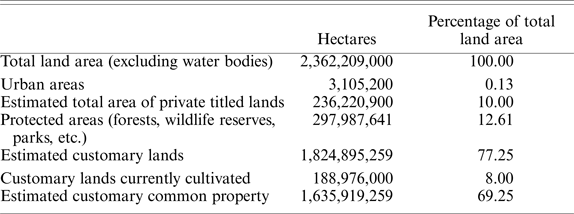
Estimated customary land area in sub-Saharan Africa in 2003.

Source: Alden Wily (Reference Alden Wily2011a).
The sources utilized to conduct this synthesis are bibliographic (mainly in English, but also in French, Portuguese and Spanish and from some African countries), documents drawn up by private and governmental international agencies (FAO, World Bank, GRAIN, La Vía Campesina), several institutional websites that specialize in agriculture, as well as brief periods of research in Morocco, Tunisia and Cape Verde.
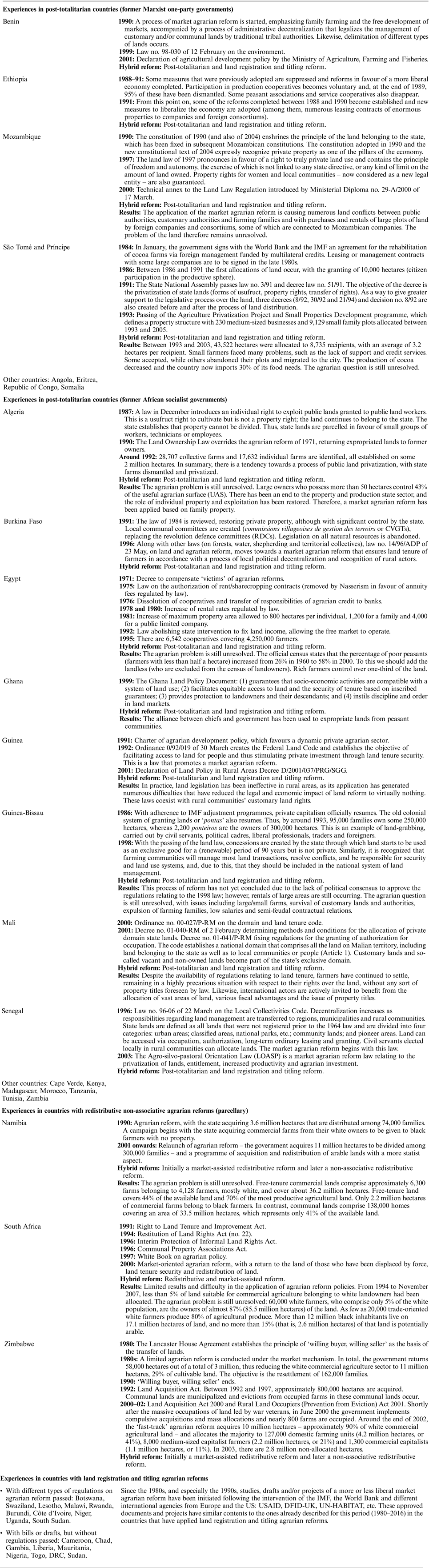
The extensive Table 2 is a synthesis of our study of the documentary sources. It summarizes each of the agrarian reform policies that have been applied in Africa since the 1980s, mainly in countries where so-called totalitarian (socialist, one-party) governments arose, led by the bureaucratic factions of their ‘big bourgeoisies’. Thus, we synthesized agrarian reform processes by country as long as we found the following information: starting and noteworthy dates of the process, regulations passed, typology of the reform, degree of implementation, and results of the process's application with respect to the modification of agrarian structures.
Main characteristics of agrarian reforms in Africa by country (1980–2016).

Source: Based on references and documentation consulted by the authors.Footnote 1
Conceptual clarifications
After independence in the former colonies and the foundation of African countries − although this is a general phenomenon in the so-called global South − state systems were created by governments that were made up of the big bourgeoisie and semi-feudal landowners. The historical weakness of the national bourgeoisies and the fact that they did not break with their former metropoles generated the state systems led by such classes.
However, within the big bourgeoisies there were two different factions: the comprador bourgeoisie (private and commercial) developed thanks to its relations with the colonial system, while the bureaucratic bourgeoisie (statist) was created and then expanded in many African countries between the 1970s and 1980s. The bureaucratic bourgeoisie was composed of the state and its state-owned companies (which were involved in economic planning, the control of foreign trade, currency and domestic prices and the implementation of agrarian reforms, among other policies), and began to play a major role in the economic development of many African countries, especially those where the anti-colonial struggle turned into national liberation wars.
The bureaucratic faction of the big African bourgeoisies adopted a Western and nationalist anti-imperialistic attitude, but they quickly began establishing neocolonial bonds with their former metropoles, and especially with the new social-imperialist power, the USSR. These bureaucratic bourgeoisies declined in the 1980s and 1990s with the end of the Cold War and the USSR, but recently, in some African countries where national liberation struggles against apartheid and similar systems were reactivated (in South Africa, Namibia and Zimbabwe), the bureaucratic faction has taken state power (although in South Africa the post-struggle state ended up with a pact with the white minority).
Governments led by these bureaucratic factions of the African big bourgeoisies have been defined in different ways: as African socialisms and one-party governments, or as popular democracies when they have been defined as Marxist, and, more recently, as totalitarian governments.
African totalitarian governments carried out agrarian reforms that often received overwhelming support from rich countries and international organizations (El-Ghonemy Reference El-Ghonemy2003), especially in the 1960s and 1970s, with the objective of stopping the revolutionary processes of the global South leading to proletariat dictatorships. These were the so-called redistributive agrarian reforms; they were also statist, due to the nationalization of lands and their direct or indirect use by the state. More or less extensive and more or less radical, these agrarian reforms mainly used two formulas:
• The associative: this was the most commonly implemented, through state supervision and corporate mobilization, and transformed peasants into members of cooperatives or ‘associates’. There were both peasant and state cooperatives, but this did not mean that land was given to peasants; property went to the state and the state became a big landowner.
• The non-associative: The parcellary system was less common but offered peasants the talisman of an ownership title to the land. However, through mortgage and usury, this resulted in ruin and the loss of property.
The non-associative formulas are used most often when the comprador faction of the big bourgeoisie reclaims power in the current neoliberal period, which started at the end of the 1980s. Now, non-associative forms such as land granting to big local and foreign investors have been added to the parcellary systems; this is what has been called the land-grabbing process. Thus, so-called market agrarian reforms take place. Recently, in some countries, redistributive agrarian reforms have been combined with market agrarian reforms (in South Africa, and initially in Namibia); these are referred to as ‘market-assisted’ or ‘market-friendly’ redistributive agrarian reforms (Sikor and Müller Reference Sikor and Müller2009).
Associative forms are followed by non-associative ones: the former prepare the ground for the latter. Therefore, in this work we have focused on post-totalitarian countries with the objective of demonstrating this.
Sikor and Müller (Reference Sikor and Müller2009) state that the agrarian reform agenda has become more diverse in the neoliberal period, as it is no longer limited to redistributive reform – that is, the transfer of land rights from big landowners to landless people, tenants and small landowners through state action. Acknowledging the contribution of other authors, Sikor and Müller (ibid.) point out that, today, the term ‘agrarian reform’ is commonly used to refer to colonization programmes in publicly owned lands, land registration, the consolidation of fragmented holdings, tenancy improvements and land taxation in addition to redistribution.
Following the work of these authors on the typology of agrarian reforms, three main approaches can be highlighted:
• Classic redistributive agrarian reform is less important today but is applied in countries such as Zimbabwe and South Africa. It includes the expropriation of land from big landowners by government, and this land is subsequently assigned to the rural population.
• A more common approach is agrarian reform with land registration and titling. In the past, these programmes focused on the registration of individual lands reclaimed for their titling and were not concerned with customary tenure systems. More recently, efforts have been made to formalize customary land claims by collective actors (peoples or ethnic groups) and/or to recognize customary leaders over land.
• Agrarian reforms in post-totalitarian countries that have given back control over land that was previously administered by agricultural and state groups to former owners (South Africa and Mozambique are examples of this).
There is an incipient fourth agrarian reform approach that Sikor and Müller (Reference Sikor and Müller2009) call community-based. They criticize previous forms of agrarian reform as having been conceived in a top-down fashion, always led by the state, which is why they were not supported by relevant actors. Instead, they propose community-based land reform, which is led not by the state but by the community. Thus far, the only achievement in this regard has been the recognition of the community in the three kinds of agrarian reform programmes listed above. Thus, reforms have been implemented that give ownership titles to communities but that keep the most important principles of state-led reforms; or more significant strategies have recognized the role of communities in relation to their authority over the land and the nature of the processes of customary land tenure that take place. Here, the community also experiences difficulties in leading the agrarian reform process, and the objective of all peasant families or women accessing land on equal terms is not always achieved due to the presence of hierarchies and chiefs. Hence, the traditional peasant community should not be idealized as an egalitarian institution, neither in the past nor in the present (Jerez and Martín Reference Jerez Darias and Martín Martín2018).
Since the publication of Hardin's article ‘The tragedy of the commons’ (Reference Hardin1968), scholars have analysed common goods, both to defend them and to justify their disappearance. The Hardinian ‘tragedy of the commons’ could be avoided only through privatization or through state management. Nevertheless, in a later publication, Ostrom pointed out the unviability of privatization in many cases, and concluded that monitoring costs would be lower if such monitoring were carried out by system users rather than by an external authority, with the condition that the rules of the game were designed by users themselves (Ostrom Reference Ostrom1990). Ostrom took for granted that, in the irrigation communities of eastern Spain that she was studying, eight circumstances or success principles were present: (1) clearly defined borders; (2) congruence between appropriation rules, provision rules and local conditions; (3) collective agreements; (4) monitoring; (5) graduated penalties; (6) mechanisms to resolve conflicts; (7) a minimal recognition of the right to self-organize; and (8) ‘nested structures’ (ibid.).
Garrido moderately criticizes both Hardin's and Ostrom's conclusions: common property is not destined to suffer any inevitable ‘tragedy’, but looking at it in an excessively idealized way does not seem appropriate either. The sustainable governance of common goods requires that not everyone has access to them, among other things, and so the presence of vigorous communal institutions may be compatible with that of many excluded people and may feature high levels of social inequality (Garrido Reference Garrido2011).
A new agrarian development strategy for Africa: facilitation of a land market in exchange for customary lands
With the passing of the 1980s, it was clearly observed that governments dominated by the bureaucratic faction of the big bourgeoisies in African countries were heading for a crisis: the unsustainable rise of external debt, a drop in industrial and agrarian production, the increase of conflicts and wars, and the growth of poverty. With regard to the land, the so-called ‘lost decade’ in Africa meant the beginning of a new internal reorganization that was to be run by the World Bank, the International Monetary Fund (IMF) and several development agencies in the US and Europe through ‘structural adjustment policies’. For them, African land continued to be a problem; yet, from now on, African state systems would play a secondary role in resolving that problem and would cease to be the main actors in agrarian policies. The so-called ‘African socialisms’ or ‘one-party states’ with close connections to the USSR, until its dissolution, evolved more or less into multiparty democracies, or were replaced by the comprador bourgeoisie and big landowner governments. The new interest in African lands and their resources has its basis in a tempting prize: the possibility of privatizing, in one way or another, customary or communal lands. In twenty-first-century sub-Saharan Africa, these lands still cover more than 18 million square kilometres – almost two-thirds of the whole continent.
This new strategy of agrarian reform that is now being implemented means: (1) a change from what has previously been understood as agrarian development; (2) the dismantling of the associative forms of the past; (3) the development of market agrarian reform laws; (4) the implementation of land-titling processes that affect both peasant and state customary lands; and (5) as a result of the above, the creation of a land market that favours private investment, thus leading to the appearance of land-grabbing in its various forms.
In general, the essence of the new reform programme can be found in the neoliberal belief in the necessity of consolidating land markets and rural financial markets, as well as of developing registry institutions. This programme affirms that production will be boosted and poverty relieved in those countries where agriculture is still the key sector for the majority of the population, especially among small producers in Africa.
In a sequence of connected causal events, the expectation is that the security provided by registering property will generate a predisposition in owners to invest, as well as a process of purchases and leases that will mobilize financial resources, thus attracting credit flows.
Implementation of this reform comes as a result of a series of studies conducted in the last decades by the World Bank, the IMF, the United States Agency for International Development (USAID), the Department for International Development in the United Kingdom (DFID), and other European and American agencies in collaboration with experts from several universities.
Examples of the different types of agrarian reform
Let us look at some examples of what has happened to agrarian reform in some countries. It must be borne in mind that the classification followed in this article, as proposed by Sikor and Müller (Reference Sikor and Müller2009), does not consider hybrid agrarian reforms – that is, strategies that combine elements from two or even three types of reform. As mentioned above, this is due to the fact that the aim of such reforms is to attack and privatize communal lands (for a summary of what has happened country by country, see Table 2).
Survival of redistributive agrarian reforms
Southern African countries reflect certain specificities that are a result of their recent political evolution. In the old settlements of this part of the continent (present-day Zimbabwe, Namibia and South Africa), national liberation wars did not succeed, or they fell by the wayside, ending in agreement between the white minority and the black majority, thus allowing a government of the black bureaucratic bourgeoisie. This is how hybrid agrarian reforms have arisen belatedly in these countries (Holden and Otsuka Reference Holden and Otsuka2014). These have involved a combination of state and market reforms, from the 1990s to the present (see the cases studied in Moyo Reference Moyo, Boron and Lechini2006; Reference Moyo, Mançano Fernandes, Medeiros Marques and Suzuki2007a; Reference Moyo2007b).
In 1948, Namibia was annexed by South Africa, thus extending the apartheid system. In response to this, several forces opposing the regime arose; of these, the South West Africa People's Organization (SWAPO) was the most important and ultimately became the official representative of the people of Namibia at the UN during the South African occupation. After many years of war and under international pressure, South Africa agreed to leave the territory and supervise the transition to its independence. In 1989, SWAPO leader Sam Nujoma was elected the country's first president.
In January 2001, Nujoma appointed Hifikepunye Pohamba as Minister of Lands, Resettlement and Rehabilitation. This government promotion of the veteran politician signified a boost to the campaign that had started in 1990 of the state's expropriation of commercial farms from their white owners so they could be given to black landless peasants. This policy, known as ‘willing seller, willing buyer’, depended on the principle of good will, with buyer and seller sharing a mutual interest in the transaction taking place. From 2001 to 2005, Pohamba, clearly influenced by radical agrarian reform (the confiscation of farms without compensation) that President Robert Mugabe undertook in Zimbabwe, gave the programme of acquisition and redistribution of arable farms a more aggressive and more statist aspect; this included imposing special taxes on uncultivated land and on owners who were absent from their plantations, or the forced expropriation of certain farms that were left unattended by their owners. However, the distribution of the land has barely changed, and a few thousand white farmers still possess 80 per cent of the best arable lands and 55 per cent of total land in the country.
In South Africa, the alienation and expropriation of land involved the seizure by the state of land to be given to settlers and the enactment of racist laws. The outcome was that, in terms of access to land, approximately 55,000 commercial farmers owned 102 million hectares (more than 80 per cent of the land) in 2007, whereas 11.2 million black households had access to 17 million hectares. Agrarian reform law was passed in 2000, but the slowness in redistributing land through allocation and restitution is shown by the fact that these figures remain practically the same (Manji Reference Manji2001; Hebinck et al. Reference Hebinck, Fay and Kondlo2011).
In Zimbabwe, the implementation of a structural adjustment programme in 1990 was followed by the occupation of lands throughout the 1990s. When the second adjustment plan was to be implemented, the social and economic crisis was in full swing and even the government itself was called into question. War veterans working as security officers demanded social improvements and salary rises. In this context, besides breaking the agreement with the IMF and the World Bank, a shift occurred from a market agrarian reform reached by consensus to a state agrarian reform that questioned the whole property structure of the country, where land was mostly in the hands of white farmers and was to be permanently expropriated. According to Moyo and Yeros, ‘the racial conflict would produce a particular scenario marked by deep resentment and race tampering by both whites and blacks (the latter in order to obtain concessions and the former to “disguise” the monopolistic capitalism with black managers)’ (Reference Moyo and Yeros2005). It was with the disintegration of this ‘black management’ due to the occupation of land led by war veterans that the agreement with the comprador bourgeoisie and the big white landowners was broken. The outcome was radical agrarian reform against white settlers, but that move emphasized the crisis of the government system. And the situation came full circle: for some years now, contracts between the black government and white investors have been signed, and a process of land-grabbing that has been facilitated by the agrarian reform has been initiated (Matondi Reference Matondi, Matondi, Havnevik and Beyene2011).
Agrarian reforms with land registration and titling
In the years following its independence, Malawi has been an example of the application of agrarian policies that align with those proposed by the current market agrarian reforms. However, since the 1990s, diverse peasant groups have occupied plantations devoted to tobacco and tea, as well as state nature reserves. The old agrarian policy that had granted lands to white settlers was maintained after independence, although, from then on, recipients would be Africans (politicians, civil servants and traders, with no previous experience in agriculture). The tools utilized in order to achieve de-racialization and the individualization of titles comprised various regulations passed by the parliament in 1967, including the Land Law, the Registered Land Law, and the Customary Land Development Law. These laws introduced the mechanism through which customary land became private and belonged to the state. Moreover, since 1981 the government has accepted directives from the IMF and the World Bank. The passing of the 1994 constitution legislated further all the country's neoliberal policies (Kanyongolo Reference Kanyongolo, Moyo and Yeros2005). It is not surprising that peasant communities are rising up against this expropriation process.
The experience of land occupations in Malawi, Ghana and other countries, along with failures of market agrarian reforms that aimed only for the securitization of individual private or state lands, and the general rejection of such reforms by peasant communities who own the rights to communal or customary lands have shifted the focus of reformers in order to accommodate peasant communities in legislation. This is what is happening in countries such as Benin, Burkina Faso, Madagascar and Senegal, while other countries tend to recognize such communities due to the conflicts caused by tensions between them and the state (Eritrea, Guinea, Guinea-Bissau and Mali), or peasant communities continue to operate on the fringes of legislation passed by the state.
Customary lands can survive in spite of agrarian laws: whether laws have been passed, are in the process of being passed or do not exist, customary lands and traditional authorities are still important in Africa. A significant case is Cameroon, a country where continual attempts since colonial times to ‘modernize’ agriculture by removing both customary rights and communal lands were reflected in the land law of 1974, which abolished the recognition of customary rights over the land. The only way to acquire private property is through ownership of title to the land and the state is authorized to look after non-registered lands (at the national level). The land tenure system of 1974 is still in force, but it is generally considered ineffective, except by a small minority of non-residents who are interested in purchasing land and obtaining resources. The acquisition of land by agribusinesses tends to limit access opportunities for the people, mostly poor peasants. Nowadays, conflicts are increasingly related to the rapid development of a land market that is not based on a legal entitlement system, but rather on local informal practices governed by local chiefs. This situation leads to a double sale and creates conflicts and illegal occupations of various portions of the land (‘grignotage’) (OECD 2006). The conflicts are varied – between migrants and locals, due to ethnic differences, and between shepherds and farmers.
Agrarian reforms in post-totalitarian countries
Here, reform involves the dismantling of associative forms with the granting of lands and/or the creation of independent cooperatives. The elimination of prices guaranteed by the state for all or most crops, cuts to or elimination of subsidies to producers and consumers, privatization of the supply of consumables and liberalization of agrarian commerce have occurred throughout Northern Africa since the beginning of the 1990s. Moreover, a process of dismantling associative forms has occurred: state cooperatives and producer cooperatives have been dismantled under state intervention. Thus, land is allocated to individuals (São Tomé and Príncipe) and/or independent agrarian communities are created (Algeria, Tunisia and Egypt).
In countries that previously had one-party regimes, it is striking that new state policies that suggest agrarian liberalization also maintain state ownership of and control over old customary or communal lands, thus facilitating land-grabbing through a system of concessions or leases issued by the state for the land to be used for the production of food, biofuels and minerals. This has happened in Ethiopia, Guinea-Bissau (Cahen Reference Cahen1995; Chéneau-Loquay Reference Chéneau-Loquay and Cahen1995), Mozambique (Moyo Reference Moyo, Boron and Lechini2006; ORAM 2006; Hall Reference Hall2012), Burkina-Faso, Guinea (OECD 2006), Congo and Tanzania (Manji Reference Manji2001; Hall Reference Hall2012; Pedersen Reference Pedersen2016), although this phenomenon also occurs in many other countries that never had one-party political regimes, such as Cameroon and Chad (OECD 2006) and Malawi (Hall Reference Hall2012).
The principle of state ownership of the land was set out in both the 1990 and 2004 Mozambican constitutions. However, both constitutions expressly recognize that private property is one of the pillars of the economy. The 1997 land law pronounced in favour of the right to a truly privatized use of land and contained the principles of freedom and autonomy, the exercise of which should not be determined by any state directive, nor by any kind of limit on the amount of land owned. Property rights for women and local communities – now considered as a new legal entity – were also guaranteed. This was the outcome of the period of market agrarian reform and the academic debate on the acceleration of land- and water-grabbing in Africa.
Land-grabbing (sometimes referred to as a land rush) was revived with great force at the beginning of the twenty-first century and has affected not only traditional agribusinesses (agriculture for the production of both food and biofuels, farming and forestry, including the use of water) and mining, but also new activities such as the construction of major infrastructure, urban expansion, tourism, protected areas (biodiversity) and carbon markets (climate change) (Boix Reference Boix2012; Lyons and Westoby Reference Lyons and Westoby2014).
With regard to large-scale land- and water-grabbing (major investments in the purchase or lease of large areas of land), while some of the literature emphasizes the decisive role of actors at the international level, such as the overlap of interests between financial capital, foreign capital groups and funds, and international agencies (Daniel Reference Daniel2012; GRAIN 2012; Anyang’ Nyong'o Reference Anyang’ Nyong'o2013), other literature on access to land focuses on the local level, for instance the role of the state (Wolford et al. Reference Wolford, Borras, Hall, Scoones and White2013), local chiefs or peasant communities (Camara Reference Camara2013; Peters Reference Peters2013b). Also, studies pointing out the importance of small-scale land-grabbing by local actors have started to appear (Kandel Reference Kandel2015). According to empirical research, the academic literature is increasingly recognizing the importance of actors at the national level, but the analytical implications of such findings are not clear (Pedersen Reference Pedersen2016). Recent work by Ruth Hall establishes at least five types of business model linked to land-grabbing, incorporating both external and internal actors: (1) the extraction model (stripping of resources without investment): (2) enclave model (the same as the extraction model but with the construction of infrastructure); (3) colonist model (the arrival of commercial farmers, generally white); (4) outgrower model (small farmers under contract are incorporated into the operations of large investors); and (5) commercialization model in situ (small and medium-sized farmers with no connection to a large investor are incorporated into the latter's operations). These last two models are more common than it may first appear: numerous family farms and contracts between large investors and peasant communities are devoted to producing the same crops as large farms grabbed by foreign investors, since national policies favour these crops and small peasant farmers supply large processing companies: an example of this is the cultivation of crops for biofuel production (Hall Reference Hall2012). This recalls the old slavery economy of colonial times.
These land-grabbing business models are already shaping the land to a significant extent. The International Land Commission together with four other international agencies suggest that up to 70 million hectares in over thirty countries in Africa (the equivalent of the whole surface area of a country such as Zambia or Turkey) may have been leased or negotiated since 2007 (Deininger et al. Reference Deininger, Byerlee, Lindsay, Norton, Selod and Stickler2011; Cotula et al. Reference Cotula, Vermeulen, Leonard and Keeley2009; GTZ 2009; Alden Wily Reference Alden Wily2011a).Footnote 2
A theoretical debate has started to develop on land-grabbing and its current and future meaning for Africa (Peters Reference Peters2013a; Baglioni and Gibbon Reference Baglioni and Gibbon2013; Obeng-Odoom Reference Obeng-Odoom2015). But this attention is also due to the numerous peasant struggles that have occurred as a result of land-grabbing, as this process is causing the expulsion of thousands of farming families and the subsequent exploitation of an increasing number of landless peasants (Matavel et al. Reference Matavel, Dolores and Cabanelas2011; Hall et al. Reference Hall, Edelman, Borras, Ben White and Wolford2015; GRAIN-UNAC 2015).
As we pointed out above, drawing on Moyo, the most significant change in terms of land policy for more and more African countries – and perhaps the one with the most power to concentrate land tenure – has been the introduction of legal amendments that allow the traditional forms of tenure under which most farmers live. These allow peasant communities to lease their land to developers via long-term contracts and agreements that grant access to natural resources. These policy developments generally emulate the traditional tenure agreements and also extend existing leasing practices to lands owned by the state and to the systems of ownership of public natural resources. These policy orientations have received great support from international funding organizations (Moyo Reference Moyo, Boron and Lechini2006).
Many African countries are in a transitional phase characterized by tensions between the old traditional systems and the new management approaches. A common problem noted by the authors who defend these new formulas is that the old and new systems operate simultaneously, and the introduction of the modern system is often superficial (Massyn Reference Massyn2007; Robins and van de Waal Reference Robins and van der Waal2008).
Conclusions
The justification for and defence of market agrarian reforms are based on land titling and the creation of a land market (Holden et al. Reference Holden, Deininger and Ghebru2011; Holden and Otsuka Reference Holden and Otsuka2014). In this new period of agrarian liberalization, this land titling is trying to revive the role of traditional authorities (which represent social capital that needs to be taken into account in new rural development policies, according to the paradigm of the new institutional economics (NIE)) under the umbrella of international agencies such as the World Bank (Grischow Reference Grischow2008; Collins and Mitchell Reference Collins and Mitchell2018); this means a return to former colonial policies but in a globalized world (Ece Reference Ece2008).
Land-grabbing is taking place in communal and customary lands over which rights are being reclaimed by peasant communities (Cotula et al. Reference Cotula, Vermeulen, Leonard and Keeley2009; Alden Wily Reference Alden Wily2011a; Reference Alden Wily2011b). Therefore, although there is increasing resistance, the occupation of lands and peasant struggles (often violent), various African land laws include such customary rights and give significant political power to traditional peasant authorities via processes of administrative decentralization.
The liberalization of agrarian policies and the implementation of market agrarian reforms have facilitated the expansion of land-grabbing – and land-grabbing is cheap because the tenure rights of those who utilize and claim the land (peasants) are recognized neither in law nor in practice. Besides, this is a race in which African states themselves are leading the way (Hall Reference Hall2012), because, along with customary authorities (Collins and Mitchell Reference Collins and Mitchell2018), they act as their own sellers.
This period of agrarian reform, initiated in the 1980s and not yet complete, has facilitated the acceleration of land- and water-grabbing in Africa. Thus, the agrarian question in Africa is evolving but is still unresolved. Phenomena continue such as the contradiction between large and small farms, the survival of customary lands and authorities alongside the expulsion of thousands of farming families and even entire communities from their lands, and low salaries and semi-feudal contractual relations within the poor peasant sector, the rural proletariat and the semi-proletariat.
Our initial analysis shows these conclusions as a trend. Nevertheless, although the agrarian reform laws represent a consensus of the domestic elite and are having repercussions for African agriculture, they are not always fully implemented. On occasion, international donors sponsor laws that rulers accept to please them but that are not always implemented or are implemented only selectively (as shown in Table 2). Moreover, agrarian legislation, like any other law, has limitations and should be accompanied by other policies, notably economic and financial ones (Collins and Mitchell Reference Collins and Mitchell2018).
Future research on agrarian reform policies should delve into aspects such as the degree of incidence of such policies and case studies of countries or regions that allow the actual implementation of reforms to be measured. Additionally, it seems necessary to clarify the identity of the old and new rural actors in agrarian reform policies, and, for example, the new role (of support, neutrality or resistance) of traditional communal systems and their chiefs, as well as their typology. With regard to rural actors, it will be of interest to know about how local and international actors coexist and relate to each other. Finally, in order to prove that the African agrarian question is not yet resolved, detailed fieldwork will have to be conducted to link the nature of social relations of production with everyday socio-economic survival in the African rural world.
Acknowledgements
We gratefully acknowledge the assistance provided from Spain by our colleague researcher Juana Moreno, who brought us into contact with economist and professor Najib Akesbi at the University of Rabat and researcher Houria Elattaoui in Rabat, as well as various peasant unions in that country. Thanks also to our colleague – and Macaronesia expert – Rubén Barone, who introduced us to geographer and professor at the University of Cape Verde José María Semedo.