Introduction
The temperature of the environment and the body temperature of an organism reflect the average kinetic energy of its particles and are important for understanding the processes that regulate all forms of life, including the fungi. Temperature is considered one of the most influential factors for fungi growth, spore production and maintenance of these microorganisms in the environment (Li et al., Reference Li, Wadsö and Larsson2009; Lasram et al., Reference Lasram, Oueslati, Valero, Marin, Ghorbel and Sanchis2010; Carrillo-Inungaray et al., Reference Carrillo-Inungaray, Hidalgo-Morales, Rodríguez-Jimenes, García-Alvarado, Ramírez-Lepe, Munguìa and Robles-Olvera2014).
Gastrointestinal parasitic nematodes cause productive and financial losses in bovine production systems (Grisi et al., Reference Grisi, Leite, Martins, Barros, Andreotti, Cançado, León, Pereira and Villela2014). The use of anthelmintic compounds aims to decrease nematode-infecting larvae in the pasture by decreasing the population of adult parasites in the animals. However, the use of anthelmintics has limitations, such as drug residues in animal products, toxic effects on non-target organisms, pollution of the environment and anthelmintic resistance (Fazzio et al., Reference Fazzio, Sánchez, Streitenberger, Galvan, Giudici and Gimeno2014; Gasbarre, Reference Gasbarre2014). In order to minimize the use of anthelmintics, biological control through the use of nematophagous fungi is a method to reduce parasitic nematode-infecting larvae in pastures where cattle are raised.
A method for the dissemination of these fungi in the environment is the incorporation of fungal structures (mycelium and spores) in the bovine diet. After passing through the gastrointestinal tract, the fungi colonize the faeces, forming a network of hyphae that differentiate into traps that capture and destroy infective larvae (L3) of bovine parasitic nematodes (Braga & Araújo, Reference Braga and Araújo2014). The dispersion of fungal structures directly into faeces, where eggs hatch and larvae become infective (L3), is one of the forms used to establish biological control of gastrointestinal parasitic nematodes in cattle (Paz-Silva et al., Reference Paz-Silva, Francisco and Valero-Coss2011).
Duddingtonia flagrans, A. cladodes and P. chlamydosporia are nematophagous fungi with great potential for use in the biological control of the parasitic nematodes of cattle (Silva et al., Reference Silva, Braga, Araújo, Benjamim, Souza and Carvalho2011; Oliveira et al., Reference Oliveira, Carvalho, Vieira, Campos, Freitas, Araujo, Braga and Araújo2018a, Reference Oliveira, Vieira, Carvalho, Campos, Freitas, Araujo, Braga and Araújob; Vieira et al., Reference Vieira, Oliveira, Campos and Araújo2019). Arthrobotrys cladodes and D. flagrans produce traps that promote adhesion, immobilization, penetration and destruction of nematode larvae (Grønvold et al., Reference Grønvold, Nansen, Henriksen, Larsen, Wolstrup, Bresciani, Rawat and Fribert1996; Oliveira et al., Reference Oliveira, Carvalho, Vieira, Campos, Freitas, Araujo, Braga and Araújo2018a). Pochonia chlamydosporia parasites eggs of nematodes through structures known as apressories, which promote egg penetration by mechanical and enzymatic action (Zare et al., Reference Zare, Gams and Evans2001; Stroze et al., Reference Stroze, Santiago and Baida2013) and presents larvicidal action on bovine parasitic nematodes (Vieira et al., Reference Vieira, Oliveira, Campos and Araújo2019). According to Mukhtar & Pervaz (Reference Mukhtar and Pervaz2003), Van Ooij (Reference Van Ooij2011) and Yang et al. (Reference Yang, Liang, Li and Zhang2013), enzymes and toxins produced by P. chlamydosporia are capable of killing of nematode larvae.
Changes in environmental temperature and daily variations in the temperature of the faecal environment containing nematophagous fungi, after passing through the gastrointestinal tract of animals, can affect the growth, chlamydospore production and nematicidal activity of these fungi; therefore, it is necessary to know how the temperature affects such characteristics of nematophagous fungi. In this study, the fungi D. flagrans, A. cladodes and P. chlamydosporia were evaluated under various temperature conditions for mycelial growth, chlamydospore production and nematicidal activity on the infective larvae (L3) of bovine parasitic nematodes.
Material and methods
The fungi D. flagrans (AC001 strain), A. cladodes var. macroides (CG719 strain) and P. chlamydosporia (VC4 strain) used in this study are part of the collection of the Laboratory of Parasitology, Department of Veterinary, Federal University of Viçosa, where they are kept at 4°C in the dark in test tubes containing 2% corn meal agar (2% CMA).
Evaluation of mycelial growth
Discs (1 cm in diameter) containing P. chlamydosporia, D. flagrans and A. cladodes mycelium were obtained from plates on which these fungi had previously been grown in 2% CMA medium. Subsequently, these discs were transferred separately to the centre of 9-cm-diameter Petri dishes containing 2% potato dextrose agar medium (2% PDA) and incubated at 15, 20, 25, 30 and 35°C. For each temperature condition, ten replicates were used for each fungus.
The colonies were measured every 24 h in the orthogonal position for 10 days, resulting in ten readings. These values were used in the calculation of the mycelial growth rate index, according to the formula described by Oliveira (Reference Oliveira1991): ${\rm MGRI} = \sum {\lpar D-Da\rpar /N}$ , where MGRI is mycelial growth rate index; D is current mean diameter of the colony; Da is mean diameter of the colony from the previous day; N is number of days after inoculation.
Evaluation of chlamydospore production
Discs (1 cm in diameter) containing P. chlamydosporia, D. flagrans and A. cladodes mycelium were obtained from plates on which these fungi were previously grown in 2% CMA medium. Subsequently, these discs were transferred separately to the centre of 9-cm-diameter Petri dishes containing 2% PDA medium and incubated at 15, 20, 25, 30 and 35°C for 21 days. For each temperature condition, ten replicates were used for each fungus and 5 mL of distilled water was added to each plate; the surface of the culture medium was washed and scraped to obtain suspensions containing chlamydospores. Subsequently, the number of chlamydospores in these suspensions was determined using a haemocytometer, and the total number of chlamydospores produced in each treatment was calculated.
Evaluation of nematicidal activity
Gastrointestinal nematode larvae were obtained from naturally contaminated bovine faeces, collected directly from the rectum of 20 animals, at a farm, with no history of antihelmintic resistance, in the city of Abre Campo, state of Minas Gerais, southeastern Brazil, latitude 20°18′04″S, longitude 42°28′39″W. The collected samples were mixed and homogenized. Coprocultures were made with 20 g of faeces mixed with vermiculite and incubated for 12 days, at 26°C in the dark. After this period, the infective larvae (L3) were recovered using the Baermann funnel technique, with water at 42°C for 6 h and identified according to the criteria of Keith (Reference Keith1953). Suspensions were obtained containing 70.05, 19.23 and 10.72% of nematodes of the genera Haemonchus, Cooperia and Oesophagostomum, respectively. Such genera include important species of gastrointestinal parasites of cattle of long occurrence in Brazil.
Discs (1 cm in diameter) containing P. chlamydosporia, D. flagrans and A. cladodes mycelium were obtained from plates on which these fungi were previously grown in 2% CMA medium. Subsequently, these discs were transferred separately to the centre of 9-cm-diameter Petri dishes containing 4% water agar medium (4% WA) and incubated at 15, 20, 25, 30 and 35°C for 8 days. For each temperature condition, ten replicates were used for each fungus.
Subsequently, aliquots containing 1000 bovine gastrointestinal L3 were added to each plate containing 4% WA medium. Cultures remained incubated in the absence of light at the temperatures of 15, 20, 25, 30 and 35°C. After 15 days, live L3 were recovered by the Baermann method. The recovered L3 were quantified and identified under a light microscope (objective of 10×), obtaining the average number of live L3 per plate in each treatment.
The percentage of the reduction of L3 in the groups treated with nematophagous fungi, in relation to the control without fungus, was calculated according to the formula: % reduction = (mean control group larvae − mean group treated larvae) × 100/mean of control group larvae.
Statistical analysis
The mean values for the MGRI, chlamydospore production and recovered L3, for each temperature condition, were submitted to the Levene test and Kruskal–Wallis statistical test, at a significance level of 5%. All statistical analyses were performed using the IBM SPSS Statistics 2.0 software.
Results
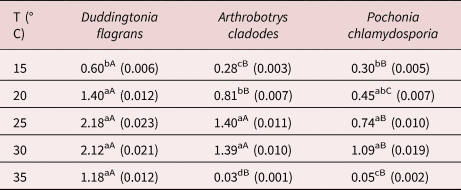
The fungal strains achieved mycelial growth, chlamydospores production and nematicidal activity on parasitic nematodes under all temperature conditions tested. The MGRI of D. flagrans, A. cladodes and P. chlamydosporia at different temperatures are presented in table 1. The fungi showed higher growth at intermediate temperatures (20, 25 and 30°C) than at the extremes of 15 and 35°C.
Means (standard errors) for the mycelial growth rate index (MGRI – mm/day) of the nematophagous fungi Duddingtonia flagrans (AC001), Arthrobotrys cladodes (CG719) and Pochonia chlamydosporia (VC4) grown for 10 days in 2% potato dextrose agar under different temperature conditions.

a,b,c,d,e,A,B,CDifferent capital letters in the same row and lower case letters in the same column indicate that there is statistical difference (P ≤ 0.05) between the data.
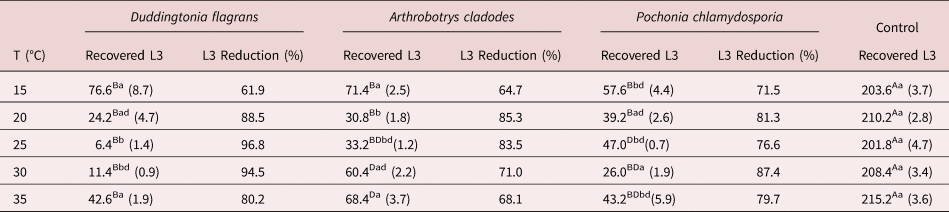
The mean values of the number of L3 (of the genera Haemonchus, Cooperia and Oesophagostomum) of bovine gastrointestinal parasitic nematode recovered from plaques in which D. flagrans, A. cladodes and P. chlamydosporia were inoculated at different temperatures are presented in table 2. The number of L3 recovered from the plates containing D. flagrans, A. cladodes and P. chlamydosporia were lower than the L3 values recovered from the control group without fungus at all tested temperature conditions.
Means (standard errors) for the number of recovered infective larvae (L3) of bovine parasitic nematodes and the percentages of the reduction of L3, after 15 days, on plates containing 4% water agar medium, in which the nematophagous fungi Duddingtonia flagrans (AC001), Arthrobotrys cladodes (CG719) and Pochonia chlamydosporia (VC4) were added under different temperature conditions.

a,b,d,A,B,DDifferent capital letters in the same row and lower case letters in the same column indicate that there is statistical difference (P ≤ 0.05) between the data.
The values of the percentages of the reduction of L3 in relation to the control group caused by the nematicidal action of D. flagrans, A. cladodes and P. chlamydosporia also are presented in table 2. At 25 and 30°C, D. flagrans achieved 96.8 and 94.5% nematicidal activity on bovine parasitic nematodes, respectively. A. cladodes effected nematicidal activity of 85.3 and 83.5% at 20 and 25°C, respectively. At 20 and 30°C, P. chlamydosporia realized nematicidal activity of 81.3 and 87.4%, respectively.
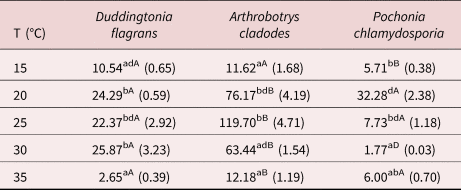
The mean values for the number of chlamydospores produced by D. flagrans, A. cladodes and P. chlamydosporia inoculated on plates containing 2% PDA medium for 21 days at different temperatures are presented in table 3. The maximum chlamydospore production was reached at 20, 25 and 30°C for D. flagrans, at 20 and 25°C for A. cladodes and P. chlamydosporia.
Means (standard errors) for the number of chlamydospores (×104) produced by the nematophagous fungi Duddingtonia flagrans (AC001), Arthrobotrys cladodes (CG719) and Pochonia chlamydosporia (VC4) under different temperature conditions and grown in 2% potato dextrose agar for 21 days.

a,b,d,A B,DDifferent lower case letters in the same column and capital letters on the same line indicate that there is statistical difference (P ≤ 0.05) between the data.
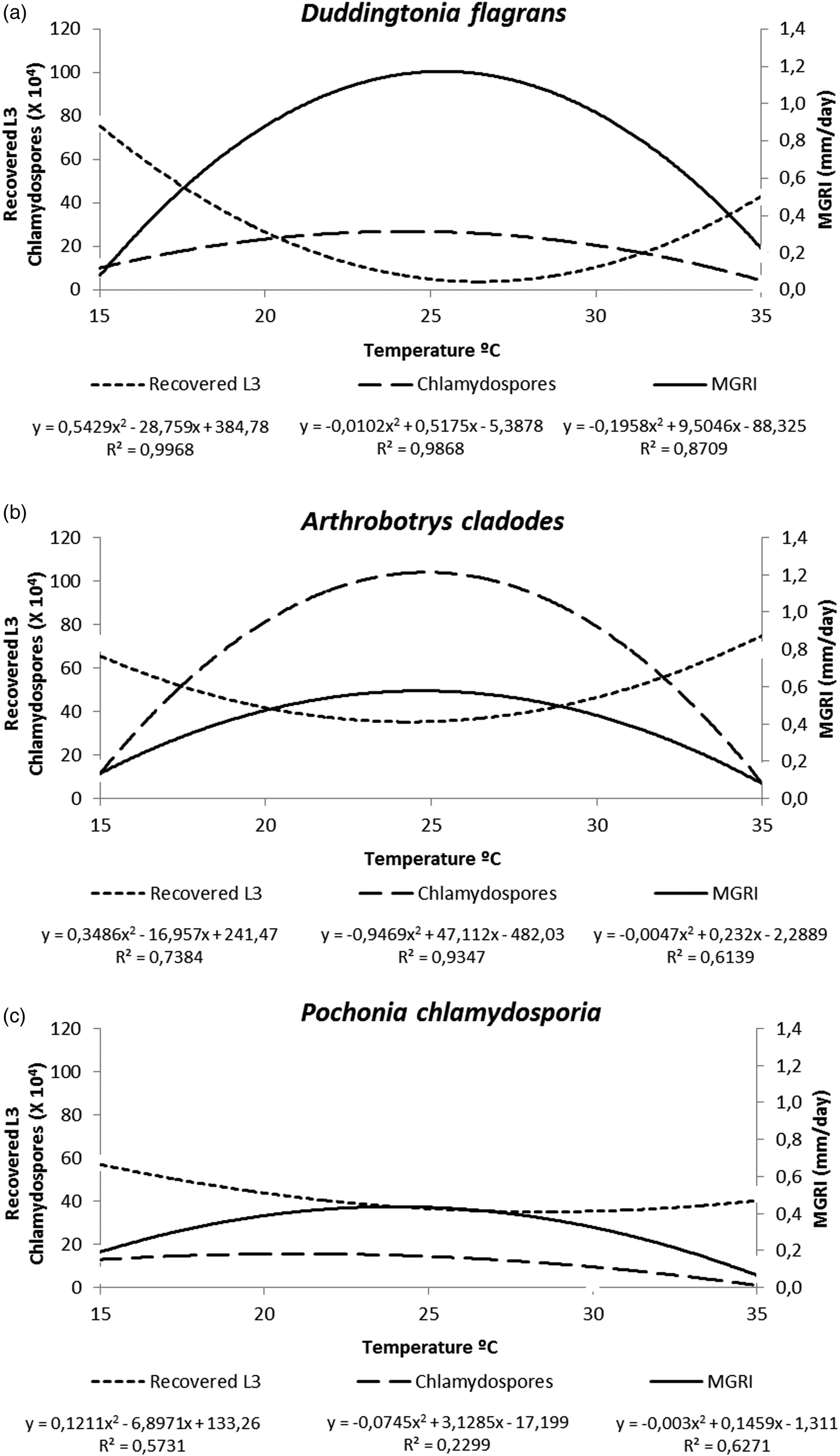
The polynomial regressions between the different temperature conditions and the MGRI values, the number of recovered infective larvae and the number of chlamydospores produced by the fungi D. flagrans, A. cladodes and P. chlamydosporia are presented in fig. 1. The regression equations and the values for the coefficients of determination (R 2) are shown in the figure. Most of the regression models achieved high R 2, indicating a high correlation between the real values observed for each variable and the predicted values by the regression equations. Nematicidal activity, MGRI and chlamydospore production of the three fungal strains tested were higher at intermediate temperatures (20, 25 and 30°C) than at temperature extremes (15 and 35°C).
Quadratic polynomial regression of the mycelial growth rate index (MGRI), the number of recovered infective larvae (L3) of bovine parasitic nematodes and the number of chlamydospores produced (×104) on plaques containing the nematophagous fungi Duddingtonia flagrans (a), Arthrobotrys cladodes (b) and Pochonia chlamydosporia (c) at different temperature conditions.

Discussion
The development and activity of microorganisms in the environment can be affected by several biotic and abiotic factors. Considering that the site of nematophagous fungi used for biological control are the faeces deposited in pastures, the fungal strains that demonstrate greater resistance to the adversities found in the environment would be the most suitable for use in control strategies. The temperature of the environment is a factor that can determine the success of biological control of parasitic nematodes of cattle by the use of nematophagous fungi, since daily temperature variations can affect the mycelial growth, chlamydospore production and nematicidal activity of these fungi.
In the present study, the MGRI results for D. flagrans were 1.40 and 2.12 mm/day at temperatures of 20 and 30°C. Grønvold et al. (Reference Grønvold, Nansen, Henriksen, Larsen, Wolstrup, Bresciani, Rawat and Fribert1996) reported that D. flagrans realized a growth rate of 2.14 and 8.57 mm/day at temperatures of 20 and 30°C, respectively; thus, our MGRI results for D. flagrans were lower than those of the reported by Grønvold et al. (Reference Grønvold, Nansen, Henriksen, Larsen, Wolstrup, Bresciani, Rawat and Fribert1996). The strains of P. chlamydosporia described by Zare et al. (Reference Zare, Gams and Evans2001) obtained colonies varying between 20 and 38 mm in diameter after 10 days of growth, with an optimal growth temperature between 24 and 30°C and a minimum growth temperature of 10°C. In the present study, the mycelial growth results for P. chlamydosporia were different from those reported by Zare et al. (Reference Zare, Gams and Evans2001). The differences observed in growth rates and optimal temperatures for fungal growth may be due to the use of different fungal strains or culture media, or to variations in experimental methodologies in each study.
The colonization of cattle faeces by nematophagous fungi and subsequent formation of traps or metabolites with nematicidal action depends of the mycelial growth of these fungi. Duddingtonia flagrans obtained higher MGRI than A. cladodes and P. chlamydosporia in most temperature conditions studied, which may explain the higher percentages of L3 reduction caused by D. flagrans than by A. cladodes and P. chlamydosporia.
In our experiment, D. flagrans had a higher nematicidal activity against the L3 of parasitic nematodes of cattle over the temperature range of 25 and 30°C, and the percentages of reduction were 96.81 at 25°C and 94.54 at 30°C. Different nematicidal activity of D. flagrans on nematodes has been reported in other papers. Fernández et al. (Reference Fernández, Larsen, Wolstrup, Grønvold, Nansen and Bjørn1999) reported that D. flagrans reduced the number of Cooperia oncophora larvae by 70–96% at 15°C and 63–98% at 20°C. Santos et al. (Reference Santos, Padilha and Rodrigues2001) reported that D. flagrans caused 90% reduction in the number of cyathostomes L3 larvae at 25 and 30°C. According to Buske et al. (Reference Buske, Santurio, Oliveira, Bianchini, Silva and Rue2013), the best temperature for the nematicidal action of D. flagrans was 30°C, in which the fungus was responsible for a 74.5% reduction of the L3 of Haemonchus contortus.
In the present study, A. cladodes had a higher nematicidal activity against the L3 of parasitic nematodes of cattle over the temperature range of 20 and 25°C and the percentages of reduction were 85.3 at 20°C and 83.5 at 25°C. Other studies report different nematicidal actions by A. cladodes. Ranjbar-Bahadori et al. (Reference Ranjbar-Bahadori, Rhazzagi-Abyaneh, Baya, Eslami, Pirali, Shams-Ghahfarokhi and Lotfollahzadeh2010) reported that there was no significant difference in the nematicidal activity of A. cladodes on H. contortus infective larvae at 15, 20 and 25°C, with percentages of reduction of 97.55, 96.71 and 95.93, respectively. Oliveira et al. (Reference Oliveira, Carvalho, Vieira, Campos, Freitas, Araujo, Braga and Araújo2018a) reported a 68.7% reduction in the L3 of the parasitic nematodes of cattle at 25°C due to the nematicidal activity of A. cladodes.
Pochonia chlamydosporia had maximum nematicidal activity over the L3 of bovine parasitic nematodes between 20 and 30°C (reduction percentages of 81.28 and 87.39, respectively). Zouhar et al. (Reference Zouhar, Douda, Novotny, Novakova and Mazakova2010) evaluated the nematicidal activity of P. chlamydosporia in phytopathogenic species; the mortality rates due to the action of P. chlamydosporia on the nematodes Globodera rostochiensis and Meloidogyne hapla were 20.0% and 39.0%, respectively. The P. chlamydosporia nematicidal activity described by Zouhar et al. (Reference Zouhar, Douda, Novotny, Novakova and Mazakova2010) was lower than that observed in the present study.
The differences observed in the nematicidal activity of nematophagous fungi described above may be due to the use of fungal strains with different nematicidal potential, the use of different species of host nematodes or variations in experimental methodologies in each study.
Extracellular enzymes (proteases and chitinases) produced by P. chlamydosporia are considered responsible for the destruction of nematode eggs and are capable of causing cuticle hydrolysis and death of nematode larvae (Van Ooij, Reference Van Ooij2011; Yang et al., Reference Yang, Liang, Li and Zhang2013; Braga et al., Reference Braga, Freitas Soares, Araujo, Fonseca, Hiura and Garschagen Gava2014). Mukhtar & Pervaz (Reference Mukhtar and Pervaz2003) reported that, in addition to enzymes, the fungus P. chlamydosporia produces toxins with nematicidal action. In the present study, the ovicidal activity of P. chlamydosporia was not evaluated; however, larvicidal activity was observed on parasitic nematodes of cattle, which may be due to the action of proteases and toxins produced by this fungus.
Most of the cited authors tested the influence of different temperatures on mycelial growth and nematicidal activity, but did not verify the production of chlamydospores by fungi. The establishment and permanence of most fungi in the environment is more influenced by spore production than by mycelial growth, since these spores serve as an inoculum in the distribution and maintenance of fungal species (Muller, Reference Muller1956). The fungus A. cladodes (CG719 strain) achieved at 20, 25, 30 and 35°C the highest production of chlamydospores among the strains; this fact may indicate a greater ability of A. cladodes (CG719 strain) to settle in the environment than D. flagrans (AC001 strain) and P. chlamydosporia (VC4 strain).
The combined use of different nematophagous fungi may lead to improvements in the efficacy of the biological control of the parasitic nematodes of bovines raised on pasture. Vieira et al. (Reference Vieira, Oliveira, Campos and Araújo2019) reported that the combined use of the fungi A. cladodes and P. chlamydosporia obtained, under laboratory conditions, higher nematicidal activity over bovine parasitic nematodes than A. cladodes and P. chlamydosporia used separately. It is necessary to carry out studies under natural conditions to evaluate the effect of combined use of nematophagous fungi on the biological control of bovine parasitic nematodes, since the temperature and nutrient availability conditions of the environment vary during the year and do not meet the needs growth of all fungal strains.
According to the National Institute of Meteorology of Brazil (INMET, 2018), the average compensated temperature varies between 24.01, 25.64, 26.55, 22.02 and 18.61°C for the midwest, northeast, north, southeast and south of Brazil, respectively. The fungal strains tested performed mycelial growth, nematicidal activity and the production of chlamydospores in these temperature ranges. Therefore, variations in ambient temperature that occur during the year are unlikely to affect the use of the fungal strains tested as biological controllers of bovine parasitic nematodes in Brazil.
In vitro experiments do not necessarily replicate the conditions observed in the environment, since other biotic and abiotic factors that are not studied in the experimental trials may be present and influence the activity of the tested fungal strains. However, laboratory conditions allow for greater control of the analysed factors, constituting an important step in the selection of potential candidates to be used in the development of biotechnological products for the biological control of gastrointestinal parasitic nematodes. The temperature influenced the development of distinct nematophagous fungi in different ways, so the extrapolation of these results to other fungi strains is not feasible; it is necessary to perform specific tests for each fungal strain.
The tested strains of D. flagrans, A. cladodes and P. chlamydosporia achieved mycelial growth, chlamydospore production and nematicidal activity over the L3 of bovine parasitic nematodes under all temperature conditions tested. Therefore, the use of these strains of fungi as biological control agents of parasitic nematodes is promising.
Acknowledgements
The authors thank ‘Coordenação de Aperfeiçoamento de Pessoal de Nível Superior’ (CAPES), ‘Conselho Nacional de Desenvolvimento Científico e Tecnológico’ (CNPq) and ‘Fundação de Amparo à Pesquisa do Estado de Minas Gerais’ (FAPEMIG) for the support in this study, in the form of a doctoral scholarship.
Financial support
None.
Conflict of interest
None.
Ethical standards
This study was previously approved by the Animal Use Ethics Committee of the Universidade Federal de Viçosa (protocol number 06/2017). The experimental test strictly followed all procedures recommended by the rules of conduct for the use of animals in teaching, research and extension of the Departamento de Veterinária of the Universidade Federal de Viçosa.