1. Introduction
There is always something to be learned from carefully observing failure. It is especially informative when one comes across a pedagogical approach that fails with almost complete consistency and uniformity (similar to the glue on a ‘post-it’ note!). Such was our former electroacoustic music programme. In our university's music department, we have witnessed a dramatic change in the quality, quantity and enthusiasm for electroacoustic music. In a very short time we have transitioned from an approach that failed to interest students in concertising their ‘term projects’ to a situation where students routinely concertise their electroacoustic pieces, organise their own electroacoustic concerts, and have their pieces selected and performed at major international conferences. This change came about primarily through a change in pedagogy. In short, we did just the opposite of what we had been doing before, and it worked. We cannot claim that the changes made are universally and unquestionably the ‘best practice’ for all student groups in music programmes worldwide. However, recent neuroscience has given us some clues as to why these changes have been so successful. There appears to be something generalisable to be learned from this radical pedagogical change that has moved electroacoustic music from a fringe ‘subject’ to a genre that is now commonplace in the department and becoming one of its defining features.
1.1. Today's environment
Some of our shift in pedagogical approach is due to the acknowledgement of the vast changes in technology, and in students themselves since the late 1990s. The days in which the computer music environment greeted us with a blinking grey cursor waiting resolutely for a properly formatted Unix command are long since over, along with their programmer-centric paradigm. In 1989, few would have argued with the notion that: ‘The aim of [electroacoustic] composition pedagogy must be to give the composer a set of tools’ (Emmerson Reference Emmerson1989: 136). But is that still the case? Today's technology for electroacoustic music has become much easier to learn, easier to use and readily affordable/accessible, if not free; students can do much of their work on their own laptops, and would prefer to do so. Thus, we need to rethink how much time it is necessary, or advantageous, to focus on the software and hardware of electroacoustic music versus the composition of electroacoustic pieces.
Although the tools of electroacoustic music have changed radically, other aspects have not changed at all, nor are they likely to in the near future. No matter how user-friendly, software environments do not give qualitative feedback on compositional aspects of a work in progress, any more than word-processing programs can alert you to weak arguments or incoherent large-scale structures. More importantly, software is unlikely to notice what's NOT present in a work: contrast, development, counterpoint/layering, pacing, balance and other aspects of a composition that require a trained composer to assess – and which justify the expense of attending a formal university course. More so than before, we need to be clear about what we are teaching and why – what we can offer that students can't download and learn themselves. Content is easily accessible; a coherent learning context and learning design needs to be custom-built.
In view of the above, the major argument of this paper is that the very pedagogical approach that enabled people of my generation to enter the field of electroacoustic music – the sometimes myopic focus on tools – now prevents the younger generation from focusing on the creation of art, which is the purpose for such tools.
2. Theoretical Background: A Pedagogical Disclaimer
This paper focuses upon the areas in which a consensus in neuroscientific research of various periods and methodologies aligns with empirical observations of pedagogical successes and failures. It does so, however, cautiously. However valuable they may be to particular circumstances, the plethora of learning theories, taken as a whole, lack coherence. Although one particular model may indeed prevail, the existence of contradictory scientific evidence suggests that many aspects of the learning process are highly individual and, at present, not well understood. Most experts agree (e.g. Sawyer Reference Sawyer2012). A recent article reviewing 72 experiments and 63 publications of electroencephalography (EEG), event-related potentials (ERP) and neuroimaging studies of creativity concluded: ‘A recent surge of interest into the neural underpinnings of creative behavior has produced a banquet of data that is tantalizing but, taken as a whole, deeply self-contradictory’ (Dietrich and Kanso Reference Dietrich and Kanso2010: 1). The field of educational neuroscience, equipped with neuroimaging, and thus a means of studying the brain while learning, has made explosive gains since the first application of functional magnetic resonance imaging (fMRI) in the early 1990s. Despite this progress, however, it must be seen as a relatively young science with instruments that do not at all approach the spatial/temporal resolution of instruments in physics and older fields.
Despite all the variables, on one thing all studies thus far concur: ‘Listening, performing, and composing music engage nearly every area of the brain we have so far identified, and involve nearly every neural subsystem’ (Levitin Reference Levitin2006: 9). Given this complexity, it is little wonder that the teaching and learning of music, in particular, remains a highly complex and personal endeavour, and teaching strategies do not always translate well to different learning environments and cultures.
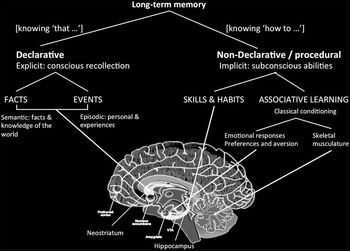
Studies also concur that the basic learning strategies and learning centres for musical abilities are not at all unique, and are generalisable across many different fields (Levitin Reference Levitin2006). There are also certain aspects of learning and the brain, particularly in the area of long-term memory, which represent well-structured problems that have been studied extensively via experimental neurobiology, long before the practicality of neuroimaging, which the technology has now confirmed. Key among these is the distinction between two types of long-term memory, declarative, located primarily in the hippocampus, and non-declarative, located primarily in the neostriatum (Figure 1). Features of these two learning centres of the brain are universal to all vertebrates, and the functional adaptation of the neostriatum is common to all known mammals. Studies in rats, for example, revealed that starting from a single point of entry (south), they can learn where the reward centre of a maze is located (west) using both types of memory; non-declarative/implicit, making the same body turn (left), or declarative/explicit, knowing its actual spatial location (west). When starting the rats at the north entry point of the maze, and using anaesthesia injected alternately into either their neostriatum or hippocampus, they could observe the two centres acting independently, and predict which learning method they would use to locate the reward – did they turn west, using spatial location, or did they turn east (left), using body movement (Packard, Hirsch and White Reference Packard, Hirsh and White1989)? They also observed that, in the beginning stages of learning the maze, the rats relied more on explicit memory, but in the later stages of learning they automatised it by shifting to their implicit or procedural memory. This has important implications as we differentiate how we, as experts, think of and use an environment from how a beginning student might think and use the same environment.
Simplified taxonomy/anatomy of the brain's two major learning centres (after Squire and Zola-Morgan Reference Squire and Zola-Morgan1996)

The same thing can be seen in humans, particularly those who suffer damage to one of these parts of the brain, such those suffering from amnesia or Alzheimer's (Poldrack and Packard Reference Poldrack and Packard2003). Whether learning to drive with a clutch, or learning to employ strategies in chess, beginners start off slowly and deliberately using explicit memory. As they become more advanced, the same moves shift to procedural memory and become automatic, and the learners’ attention and other brain activities are freed to focus on new stimuli.
3. Memory, Technology and Electro-Acoustic Composition
Although many principles are universal, a definitive answer to the question of ‘best practices’ remains elusive without a well-defined student group with known backgrounds and exposures, and, most importantly, well-defined pedagogical aims. Thus, this paper will make some assumptions for relevancy: that our population is mostly undergraduates, and that our two, distinct pedagogical aims are for students to:
-
1. become proficient with the use of music technology; and
-
2. achieve some level of expertise in electroacoustic composition.
The term ‘expertise’ is used deliberately because a level of ‘artistry’ is highly subjective and aesthetically dependent. Even those who would espouse that they are ‘open to anything’ may be surprised to find that their students know better than they where their instructor's aesthetic boundaries actually lie. However, expertise, and the learning processes with which it is acquired, is more easily generalisable. Indeed, researchers have found a virtual formula for generalised expertise that seems universal across all fields, including chess, swimming, business and music: practise something diligently for roughly 10,000 hours (about 20 hours per week for 10 years) and you become an expert (Ericsson, Krampe and Tesch-Römer Reference Ericsson, Krampe and Tesch-Römer1993). This was suspected as far back as 1896 when the French psychologist Binet demonstrated that the so-called ‘math prodigies’, who practised their art and earned a living performing amazing computations in front of mesmerised audiences, couldn't quite compete with senior cashiers at the local department store, before the days of cash registers (Restak Reference Restak2003 ). They too practised all day long, adding and multiplying numbers, and averaged 14 years’ experience doing so.
Fortunately, we already posses a fine model for the pedagogy of proficiency in music technology. Music institutions have, in a sense, been teaching ‘music technology’ for centuries – under the names of ‘orchestration’ and ‘instrumentation’, which comprises a detailed study of the means of sound production and manipulation using (predominantly) eighteenth- and nineteenth-century music technologies. We often do this in classes of thirty to forty students, using pre-prepared textbooks, lectures, detailed lesson plans, and written examinations in preparation for final projects. These projects are usually based on a pre-existing repertoire, where there is a rightness and wrongness about the orchestration techniques and appropriate style. In teaching orchestration, there are principles to be learned and facts to be memorised before one begins a project; winds do not use double-stops and strings do not use Harmon mutes. In the realm of neuroscience, orchestration is a subject that relies mostly on factual knowledge that can be learned using declarative (explicitly recalled) memory, associated largely with the hippocampus and medial-temporal lobes (as above).
In contrast, creative composition (as opposed to derivative composition or specific techniques) is a skill that must be practised, and relies mostly on non-declarative memory (a non-conscious ability) along with most other skills, regardless of whether they are predominantly physical, as in swimming, or mental, as in chess. These, in turn, reside in very different parts of the brain – the neostriatum, motor cortex and cerebellum – and from different stages in our evolutionary development (Morgane, Galler and Mokler Reference Morgane, Galler and Mokler2005). Although they work independently, studies suggest during the learning process they also compete with each other (Poldrack and Packard Reference Poldrack and Packard2003). This suggests a need for differentiation, if not separation, as in the problem of ‘thinking too much’ described below. This point is explicated by Runco's observation that: ‘Some forms of logic make creative thinking difficult. Deduction and induction, for example, sometimes constrain thinking such that it must move in a particular direction’ (Runco Reference Runco2006: 23).
Many studies pointed to this conclusion prior to neuroimaging's confirmation of the distinction. Teaching a non-declarative, procedural (mental) task to amnesiacs and Alzheimer's sufferers, for instance, produced completely opposite results. Weeks afterwards, the amnesiacs, who suffer neostriatum damage, could easily remember how to perform the task, but had no recollection of when, where or from whom they learned it. Alzheimer's patients, who suffer from hippocampus/medial cortex damage, could not remember how to perform the task, but could easily remember where, when and from whom they learned it (Squire Reference Squire2004).
Although approaches to the pedagogy of composition vary more widely than most other subjects, few view it as a principally declarative exercise – demanding fact memorisation and written examinations. Composition is more an intuitive skill, like learning to drive, and more highly individual than orchestration. Pedagogically, one needs to see what the student actually writes first, and one's teaching usually begins from there, not with a detailed lesson plan laid out before the semester began. Thus, there is a pedagogical and neuroscientific reason why we do not (hopefully) teach composition, performance and skill-related subjects as lectures in groups of thirty to forty students, and beginning orchestration as a private tutorial.
The neuroscience of memory reinforces this: it is better that students initially focus on these very different kinds of learning individually, separately, and integrate them (make neural connections between brain centres) later when they are better mastered (Redondo and Morris Reference Redondo and Morris2011). As students advance, composition and orchestration can become more closely integrated, and some orchestration issues will be inevitably covered in composition lessons. However, this integration is a higher-level function, which is achieved after a period of being separated at first to avoid confusion. Young composers would not be well advised to compose a large orchestral work unless they are already familiar with the instruments. The most likely result would be a mediocre piece, poorly orchestrated. They would be much better served by writing a good piano piece (if they are a pianist) and a good orchestration of a pre-existing piece.
In this light, the relationship of music technology, meaning the means of sound production and manipulation using (principally) twentieth- and twenty-first-century music technologies, to electroacoustic composition seems almost identical to the relationship between orchestration and acoustic composition. Initially, there is the information and concepts on the theory of operation of instruments and technology, their timbre and range, effective mixing and combining of instruments and techniques, and so on. After these have been mastered it is typical to assign projects, which are then realised and assessed in very similar ways, including overall effect, attention to detail, and appropriateness of style for the genre and period. Clearly, there are many more similarities in the way in which these subjects are taught, processed and learned. Thus, music technology, like orchestration, should preferably be taken before electroacoustic composition.
4. Memory Structures and The Teaching of Music Technology
Music technology is a typical declarative learning subject that can be efficiently covered in lectures, handouts, carefully defined projects and written or practical examinations. It may be useful, however, to review good practices for this type of class in relation to what we know about the passage between short-term and long-term memories.
We remember what we understand; we understand only what we pay attention to; we pay attention to what we want. (Bolles Reference Bolles1988: 23)
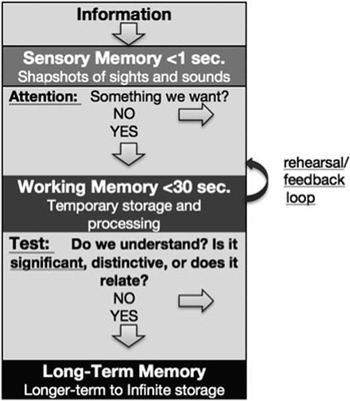
Exactly what we remember, for how long, and why, is a complex problem. Although there is still disagreement about the biological structure of sensory versus short-term memory (if indeed they are separate), the generic taxonomy shown in Figure 2, based largely on Bolles (Reference Bolles1988), may be helpful. The model suggests that at various stages in the learning process the brain makes judgements about what it will entertain, where and for how long. Thus, if a subject is presented such that a student wants to understand it – that it is important or significant to them in some way – then they will ‘rehearse’ it longer in working memory, processing it by trying to relate it to other things, and eventually understand it. If they understand it, and it still has significance for them, it has a much better chance of making the journey to the long-term structures of the brain as detailed above. Repetition along the same and different neural pathways reinforces the processes.
Memory structure

4.1. Make it relevant
To facilitate this movement from one part of the brain to another, it is important to periodically remind students of how often they are likely to encounter music technology now, and in the future, and the various ways it can make or break their careers; technology has put a lot of instrumentalists out of work since the mid-twentieth century, but made different work for others. Giving students a choice of assignments – some geared more towards performers, composers, music educators, and so on, but that require the same knowledge and skills – also facilitates this process. Some aspects of technology naturally remain relevant longer than others. Our focusing on a particular piece of software, which may be different next year and obsolete in 5 years, will not go unnoticed by many students. Focusing on those concepts of sound, electricity, transducers and digital audio that have remained virtually unchanged since their introduction, are more likely to be relevant for many decades to come. We let the students learn the specifics of various software packages largely on their own; most have been doing this their whole lives and have already developed skills in this area. Since the basics of mixers have not changed substantially since the early 1930s, and since many professionally oriented software programs are laid out and routed like ‘virtual’ mixers, we find our students gain a lot from becoming intimately familiar with a small (eight-channel) mixer early on, before progressing to other hardware and software.
Projects we find most beneficial to students are to produce a CD and/or DVD of their own playing (on acoustic instruments, as if they were applying for postgraduate studies), film scoring, pop-song arrangements and so forth. These are all activities for which they can focus on the use of technology to achieve a well-defined and familiar outcome or product.
4.2. Reversing the lecture–homework structure
Studies have consistently shown that rote repetition of material using the same modality (especially verbal) is as inefficient as it is uninspiring (Delazer, Ischebeck, Domahs, Zamarian, Koppelstaetter, Siedentopf, Kaufmann, Benke and Felber Reference Delazer, Ischebeck, Domahs, Zamarian, Koppelstaetter, Siedentopf, Kaufmann, Benke and Felber2005). Lectures that include a good deal of audio, visual and demonstrated material, reinforced at some later time by tutorials and tasks using these concepts, work well. However, lecturing of any kind comes with limitations. For information to be remembered and utilised it must be first be understood, a process which depends on the individual's previous knowledge and experience. Consider the following logic sequence:
-
• Previous knowledge and experience varies considerably for each individual.
-
• Thus, the ideal rate in which specific information should be delivered also varies considerably for each individual.
-
• Lectures disseminate information at a fixed rate that is usually the same for every topic.
-
• One key word, phrase or concept not understood can render the best of prepared lectures meaningless for certain individuals.
-
• This propensity increases as the English language comprehension of non-native listeners decreases.
-
• Unlike interactive media, in a lecture students cannot ‘pause’ to look up words in a dictionary or review previous concepts, ‘rewind’ to hear a topic particularly difficult for them, nor request to hear the whole lecture multiple times.
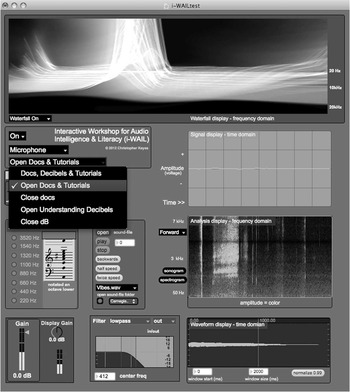
Thus, for the teaching of the basics of sound and music technology, the ‘Interactive Workshop for Audio Intelligence and Literacy’ (i-WAIL) was developed (Figure 3). In this environment, students (and readers) can download and work through material by themselves. It engages simultaneously visual, aural and tactile learning modalities with as few words and numbers as possible per topic. Since virtually all of our essential reading material is contained in i-WAIL, students can go through this material at their own pace, and class time can be spent interacting with students, asking and answering questions, and reinforcing the material with problem solving. With this there is ample time to provide individual help when students need it, or for them to help each other.
Downloadable ‘interactive workshop for audio intelligence and literacy’

4.3. Creating the right environment
The brain does not process information well under threat, stress or distraction (Lehmann Reference Lehmann2007). Thus, the wrong environment can greatly facilitate the passage of information, seemingly ‘in one ear and out the other’.
4.3.1. Assume students can succeed
Working under the assumption that students are not capable of understanding something, are not mechanically or scientifically inclined, or lack some ‘innate ability’ can quickly facilitate the blockage of information from reaching long-term memory. That generalised expertise, in any area, is largely a matter of practice (as above) and not innate ability is important to bear in mind. Music students may not be in the practice of dealing with numbers and scientific concepts, but there's little or nothing preventing them from doing so. It may be enabling for them to understand this.
4.3.2. Building confidence by teaching how to trouble-shoot
Trouble-shooting is a skill many of us have, but take for granted. If learned, it can not only save students’ time, but also inspire confidence. One valuable exercise is to set up a music system that is not functioning, which includes at least one faulty cable and an incorrect MIDI channel assignment, and then calmly and methodically ‘follow the signal’, thinking out loud, until everything is working. We emphasise to our students that this not an innate ability, but simply a skill that they can either practise and master for the rest of their lives, or continue to flounder aimlessly, as so many do.
All of this involves learning music technology by itself, as a separate entity from electroacoustic composition, directed towards projects and aims that are relevant to various student's career goals and aspirations. Composition, of any kind, is entirely different.
5. Teaching Electroacoustic Composition
The pedagogy of teaching creative activities (or better enabling and inspiring creativity) in any field bears little resemblance to the largely declarative teaching of orchestration or music technology, even though creativity is a part of excellence in these areas. Especially at first, it is a predominantly non-declarative process, like physically learning to drive a car, especially with a standard transmission (as distinct from learning the rules of the road) or learning to play chess. There is precious little to memorise, nor difficult concepts involved. In fact, you can learn to drive knowing almost nothing about how an automobile actually works.
In addition to simply being a non-declarative process, composition of any kind is classified as a ‘generative’ process, associated with problem creation as much, or more than problem solving (Lehmann Reference Lehmann2007). It is, perhaps, better described as ‘context creation’ and subsequent problem solving. Our context might be: ‘I want to combine traffic sounds with bells to create an “urban, zen-like” feeling’ (problem creation). ‘How can I process those two different sounds to make them blend well together?’ (problem solving). Both the problem creation and problem solving will involve creativity, but the former is an inherently generative process.
Conclusive studies on artistic creativity are, however, difficult to realise for many reasons, as evidenced from so many contradictory studies (Dietrich and Kanso Reference Dietrich and Kanso2010). One core difficulty for us lies in the reality that ‘generating music is an ill-structured problem; there are so many unknown constraints that the outcome is difficult to assess’ (Lehmann Reference Lehmann2007: 131). There is strong recent evidence that creative activity by itself is not localised anywhere in the brain, but occurs mostly in connection between different brain parts, particularly through the corpus callosum fibres that connect the two hemispheres. However, recent research has shown that the learning patterns for creative music-making are very similar to the learning patterns for other creative and skill-based activities. Every time we write or edit an email we are in fact engaged in composition. And merely carrying on a conversation, doodling on a piece of paper, or dancing at a party engages us in improvisation (Lehmann Reference Lehmann2007). So a pertinent question, especially for the beginner, is how do we learn to talk, write, dance and doodle?
5.1. Teaching creativity
If you accept that human beings are innately creative, whether it be manifested in doodling, cooking, gardening or even finance (witness the invention of derivatives), just as we are innately all swimmers, the pedagogy of beginning electroacoustic composition becomes closer to the pedagogy of teaching someone to swim (or drive, or play chess), which we do successfully, and with very little variation, world-wide. In driving we first secure a good safe environment – usually an empty car park. A composer's environment is largely the sum of everything they have ever heard, and for this reason we begin with intensive listening assignments, including presentations of pieces they personally like and what specifically they like about them. After 2–3 weeks of this, we then we start them on composition projects. We avoid over-explaining things for fear the student will begin to ‘think too much’, actually engaging their declarative memory rather than their skill-based non-declarative memory (at least initially), and, because of the potential conflict between the two, they will not learn as quickly as if they suspend their declarative thoughts and focus on the task. In sports, this conflict is known as ‘choking’, or not performing as well as usual because of too much conscious thought (from the hippocampus) interfering with the ‘flow’ or non-conscious skill (Cotterill Reference Cotterill2001). This typically happens when we are under stress.
For beginners – when teaching swimming, for example – background information concerning the principles of buoyancy and water displacement are ultimately more tedious than helpful. Lectures and examinations on the various muscle groups involved, and step-by-step instructions on how to move which muscle when can be more debilitating than efficient. Once learners are actually swimming they will be in a better position to take guidance on lengthening their strokes and using more of certain muscle groups. Likewise, once our composers are working on pieces, we can then guide them effectively. Composition also relies on the process of critical evaluation, and learning to identify and fix problems. Thus, having composed something from the first weeks in the semester, they can then observe their product objectively, and bring aspects of composition and/or technology to bear in evaluation and improvement.
With such a simple model one may ask, how can anyone possibly go wrong?
5.2. The anatomy of a pedagogical failure
‘Everybody out of the pool.’ The pedagogical point of view employed in our previous programme was that without a solid foundation in the hardware and/or software environment for which students are to use, they would surely not be able to use it well and would (in our metaphor) surely drown. Thus students should be discouraged from actually composing anything until they master the tools with which they are to use; in others words: the focus was on technology and not on composition. So students in our programme would accomplish some exercises in the first semester, but not actually compose a piece until the later part of second semester; only then they were put in the driver's seat. After all, students come to an institution to learn from us what we know, and the best way of actuating this process is to choose software or hardware that we can demonstrate well. If we are good, thorough teachers, we go through the manual in great detail, function by function, until the students have acquired all the knowledge that we have. In this analogy, we give them the information about buoyancy, water displacement and muscle groups, and then, and only then, tell them to jump into the pool and swim to the other side. So, in our programme, the two semesters for electroacoustic music were taken by third-year undergraduate music majors, all of whom have had one previous semester of composition, one semester of twentieth-century techniques and two previous semesters of music technology, and are in an environment with first-rate facilities in place. With all this preparation, we watched in horror as virtually all of our students drowned, year after year. Even the instructors admitted that they were unhappy with the students’ products.
5.2.1. So what's wrong with this pedagogical view?
-
1. The explanation of why the student's work was so poor (according to the instructor and observers, but also evidenced in the student's own uninterest in having their works performed in public) relied on the first misconception that creates poor environments: that our student population is innately, and possibly even genetically, predisposed to fail in this area.
-
2. Students did not get enough opportunities to practise the learning of a skill, which involves trial and error, before eventual success. (Few master a manual transmission without stalling a car at least once or twice.)
-
3. Whereas the focus on ‘properly handling tools first’ makes logical sense, no one masters a tool they have not used frequently, and the information was not made relevant to what they were trying to accomplish with the tools.
-
4. The instructor's major effort was to present information in a lecture-like format that was already well documented and easy for them to access as they needed it.
-
5. The principle pedagogical flaw was in the focus on the technology behind the compositions, instead of the compositions.
There will always be exceptions, but what the vast majority of students really need, that they cannot learn on their own, from their friends, nor online, is help with the compositional aspect; not how you do something, but:
-
• when to do it,
-
• for how long to do it,
-
• what to combine it with,
-
• what to contrast it with,
-
• what to layer it with, and
-
• how to develop it.
The ability to hear what's missing from a composition, or to give students guided listening assignments tailored for the kind of music they want to create, is also not easily gained without a knowledgeable teacher, and thus a better use of valuable resources. If lessons focus on these compositional issues, the students can largely find the how by themselves or with minimal instruction, and they will want to learn technical issues because they are immediately relevant to what they are trying to accomplish.
5.3. A different approach
Our current approach, which so far seems to have proven as successful as the previous approach had been fruitless, is largely doing the exact opposite. First, it is important to be clear about the aims for each class (technology versus electroacoustic composition). As above, we feel it best to separate the subjects as much as possible. If that is not possible in a given curriculum, it is important to be clear about which is the principle goal and adopt the appropriate teaching approach for that (principle) goal. If the subjects must be in the same class, split the class up, perhaps with a break in between, focusing on technology during one half and composition on the other.
5.3.1. What are the ‘best’ hardware or software environments for creativity?
Of course the answer to this (loaded) question will vary widely depending on student group, their previous experiences and skills, and our pedagogical and aesthetic goals. There's also the trade-off between flexibility and ease of use. However, especially for the beginner, we need to consider: exactly how much knowledge and how much time are absolutely necessary to create a successful electroacoustic composition? To answer this question we must put aside how much knowledge may be necessary for the work that we do, as experts, and consider the efficiency of the environment we are asking the students to work in for their current level, to reach our pedagogical aims.
To most undergraduate music students the C programming language would be a huge obstacle that would bear almost their entire attention, having little attention left to craft a good composition. For science-oriented students at MIT, who perhaps are already fluent in that language, it might be ideal. Conversely, anyone over the age of 16 can be given a folder of ten related and well-recorded samples (or a portable recorder) and a simple audio editor (e.g. Audacity, or something simple that can edit, mix and apply basic signal processing) and with virtually no previous knowledge create something decent in 2 to 4 weeks.
This then brings us back to the crucial question: what's our principle pedagogical goal, and, in order to reach that goal, what is the best environment for our students to work in, at their level, and why? It also raises a related question, is the environment we personally enjoy using in our own work necessarily the best environment for the majority of our students? In the same environment in which an expert swims, a beginner may drown. Environments that I use with great enthusiasm would not be appropriate for most of my undergraduate students, while environments in which my students accomplish astonishingly good work I introduce, but do not use myself (and frankly wasn't even all that familiar with when I introduced them).
5.3.2. The performance seminar as a pedagogical model
The area of performance is another area that involves the creative use of skill sets. In the creation of electroacoustic music, particularly genres that are, or involve, fixed media, we are concerned with exactly how the piece unfolds in time, and with the precise nuance of each moment. Thus it behooves us to examine how performers are trained in this similar skill.
In performance, typically the members of a studio will gather once a week for a ‘performance seminar’ in which they will practise performing in front of one another pieces that have just recently been brought up to performance level. It is usually a good, safe environment in which to fail, as frequently occurs. After each performance the teacher typically goes around the room asking students to comment on the performances: first, what did you like about it? Second, what would you suggest for improvement? Often the teacher will focus the performer or audience on the mood or imagery the piece or passage evokes. After these comments the teacher reinforces certain concepts and/or brings up immediately relevant issues of performance, and then moves onto the next performer.
Similarly, we now treat our electroacoustic music class like a performance seminar. Students are given assignments to create new works early on, and the bulk of each class is spent sharing works in progress, and having students comment first on what they feel works well, and second what they feel doesn't work about the compositions presented. The importance of having outside ‘testers’ in creativity was discussed by Emmerson (Reference Emmerson1989). This is supported by more recent work in Sawyer's Explaining Creativity, where he explains that it is a particularly Western myth that people are more creative working alone (2012: 211). In fact, in many fields, especially advertising, people are organised in ‘creative teams’ in which conversation plays a crucial role in the creative process. As in the performance seminar, the role of the instructor is largely the ‘team leader’ who focuses and reinforces what has already been said. Although they might not know how to articulate it in technical language, nor how to fix it, with five or more students in a class, they usually (collectively) identify most, if not all, of the problems we would normally spot. In fact, their final grades are largely determined by the group as well. Each student grades (anonymously) all projects and their combined grades, if reasonable and if with an overall consensus, are averaged in with the instructor's, so that the instructor's aesthetic does not dominate.
Many instructors find this approach uncomfortable; they prefer lecturing. Paradoxically however, our desire to teach can interfere with our student's ability to learn.
5.3.3. Mood as criteria for ‘good’ and ‘bad’ sound combinations
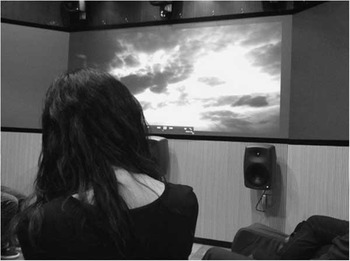
The attention to mood and image can be critical for the pedagogy of electroacoustic music. Our music is seldom completely notated, with visible expression markings and tempo indications (at least not for fixed media works). Mood is easy to lose track of while we grapple with the technology. Too often, beginning students will settle for any sound that initially attracts them, with no clear criteria for good or bad sounds or combination of sounds. To inform them of precisely what is ‘good’ and ‘bad’ is of course to assert far too much of our own aesthetic. Matching range, decay and timbral similarity are of course obvious criteria. Mood, however, is another criterion; as a whole, do the sounds present and sustain a coherent mood or multiple changing moods? This is one reason the use of images, either real or imagined, can be extremely useful. Given an image as a starting and reference point for a composition focuses the composer towards the creation and sustaining of a mood.
As students are engaged in and focused upon the creation of artistic projects, questions concerning certain aspects of technology will naturally arise and be thus handled in an inquiry-based paradigm; the students will want to know, pay attention, and remember (Figure 4). Paradoxically, the shift in emphasis from projects as a means to demonstrate the understanding of a particular technology, to technology as a means of creating art, often translates to students going deeper into the technological environment than they would otherwise, in order to accomplish more subtle and more creative nuances in their works.
Imagery as inspiration and focus

5.3.4. Roles of technology in an electroacoustic seminar
The instructor may also notice that there is a trend for a particular group of students to be making certain mistakes, or working inefficiently in some way. Like a seminar, we allocate these to specific portions (never the whole) of certain class meetings, usually towards the last 30 minutes. Whether they are in answer to student questions, or to further explain topics on a deeper level, they are always directly related to the musical works they are creating, and thus stand a much greater chance of entering long-term memory.
6. Inspiration and More Advanced Topics
The greatest difficulty for the students is to find out how they could compose without being inspired. The answer is: it is impossible. But as they have to do it, never-the-less, advice has to be given. (Schoenberg Reference Schoenberg1967: 215)
The quote above is probably the epitome of teaching derivative composition from a declarative point of origin. To teach, you must first inspire. Studies support the idea that the epiphany of inspiration, the ‘aha’ or ‘eureka’ moments of spark that seem to come from nowhere, are actually easily understood from the creator's mental trajectory: ‘Insights are combinations of bits of domain knowledge that the creator has mastered through long years of work. And new ideas are always combinations of prior experiences and learning’ (Sawyer Reference Sawyer2012: 404). On an advanced level, inspiration often comes from the realisation of relationships from many disparate subjects. Thus, we should not neglect other arts or other disciplines in helping to guide students towards their own trajectories of inspiration.
As students advance they begin to practise, much as a chess player, strategies adopted by other composers (chess players), and begin to find strategies of their own. Their learning becomes increasingly specialised. Thus, a crucial aspect of our environment is having them constantly listening to, and commenting on, other electroacoustic music and art. We keep a database of electroacoustic music on all the computers in our laboratories so that students always have access to pieces in a good listening environment.
Many students may benefit from having a vocabulary with which to discuss electroacoustic pieces. The introduction of Smalley's Spectromorphology (Reference Smalley1986; Reference Smalley1997) may prove very helpful. A more detailed, text-book-orientated approach lies in Landy's Understanding the Art of Sound Organization (Reference Landy2007) and a more conceptual approach can be found in Thoresen's ‘Spectromorphological Analysis of Sound Objects: An Adaptation of Pierre Schaeffer's Typomorphology’ (Reference Thoresen2007), and the seminal work On Sonic Art by Wishart and Emmerson (Reference Wishart and Emmerson2002).
7. Closing
It is an interesting paradox that despite how closely related electroacoustic music and indeed all digital arts are to technology, pedagogically they couldn't be further apart. While this may not seem logical, the structure of our brain was fashioned by evolution and adaptation, not by logic. Connections in the brain will multiply with experience, but technology and art, facts and skills, centre on two different and independent parts of the brain, distinct in location, evolution and methods of acquisition. For the expert, they complement and complete each other. For the beginner, they may compete and interfere with one another. Combine this realisation with the rapid pace of technological change, and it becomes clear that we need to keep a vigilant eye on recent discoveries in neuroscience and what they can tell us of learning, along with the latest thinking or creative work in and around our own field(s) of research and teaching. If our pedagogical approach bears a significant relationship to how we approached teaching the subjects 10 to 15 years ago, or, worse, how we ourselves were taught, then it is probably time for us to either change, or to retire.