1 Introduction
This paper examines some of the phonetic properties of Persian intonation. The study attempts to determine whether the tonal targets of the Persian Accentual Phrase (AP) are regularly timed against segments and how the existence of contrastive focus affects timing. This is done by comparing the alignment patterns of different types of Persian APs. Thus, this paper seeks to reach two main objectives. The first goal is to shed some light on the phonetic aspects of an intonationally under-documented language, and to verify whether the autosegmental-metrical (AM) theory of intonation (e.g. Pierrehumbert Reference Pierrehumbert1980, Ladd Reference Ladd1996) is the appropriate framework for studying this language. The second purpose is to take a step in enriching the typological studies of intonation by adding another language to the ones already investigated, and to pave the way to a more refined theory of intonation by comparing and contrasting a greater number of languages.
The research on alignment patterns started with Bruce's (Reference Bruce1977) work on Stockholm Swedish word accents, which differentiated between two accent types on the basis of two different alignment patterns of the F0 peak. Bruce observed that accented syllables are always characterized by a fall in pitch from a peak to a valley and found that the phonetic realization of this fall is different for the two accent types: in Accent I (or acute accent), the fall is aligned before the accented syllable, and in Accent II (or grave accent), it is aligned later, namely at the beginning of the accented vowel. The AM theory has, in recent years, motivated much research on the alignment patterns of tonal targets with respect to segmental landmarks, e.g. Prieto (Reference Prieto2002) on Catalan; Ladd, Mennen & Schepman (Reference Ladd, Mennen and Schepman2000) and Schepman, Lickley & Ladd (Reference Schepman, Lickley and Ladd2006) on Dutch; Arvaniti & Gårding (Reference Arvaniti, Gårding, Cole and Hualde2007) on American English; Grabe (Reference Grabe1998), Ladd et al. (Reference Ladd, Faulkner, Faulkner and Schepman1999), and Ladd & Schepman (Reference Ladd and Schepman2003) on British English; Welby (Reference Welby2002, Reference Welby2006) on French; Grabe (Reference Grabe1998) and Mücke et al. (Reference Mücke, Grice, Becker, Hermes, Baumann, Hoffman and Mixdorff2006) on German; Atterer & Ladd (Reference Atterer and Ladd2004) on Southern and Northern German; Arvaniti, Ladd & Mennen (Reference Arvaniti, Ladd and Mennen1998, Reference Arvaniti, Ladd and Mennen2000, Reference Arvaniti, Ladd and Mennen2006) on Greek; D'Imperio (Reference D'Imperio2001) on Neapolitan Italian; Gili Fivela (Reference Gili Fivela2002) on Pisa Italian; Ishihara (Reference Ishihara2003) on Japanese; Xu (Reference Xu1998, Reference Xu1999) on Beijing Mandarin; Frota (Reference Frota, Gussenhoven and Warner2002) on European Portuguese; Elordieta & Calleja (Reference Elordieta and Calleja2005) on two varieties of Basque Spanish; Willis (Reference Willis2003) on Dominican Spanish; Face (Reference Face2001) on Peninsular Spanish; Igarashi (Reference Igarashi, Bel and Marlien2004) on Russian; Bruce (Reference Bruce2003) on West Swedish. The present paper is a first attempt on the study of alignment in Persian.
Intonational research of this type has led to discussions in at least two different areas. One is the question of the fundamentals of an intonational analysis. Some researchers believe that pitch movements are the fundamentals of intonation, among which those of the British school (e.g. Crystal Reference Crystal1969) and the IPO school (’t Hart, Collier & Cohen Reference ’t Hart, Collier and Cohen1990) can be named. Such authors maintain that the intonation contours of a language are best described in terms of a set of discrete pitch movements. The AM researchers of intonation, on the other hand, believe that the primitives of intonation are pitch targets such as high and low, and the F0 movements are defined in terms of their beginning and ending points. The present paper will contribute to the above discussion.
The other issue concerns the alignment differences observed among languages. A summary of some of the attested languages and dialects includes the following. The alignment of L in pre-nuclear rises is at or slightly before the onset of the stressed syllable in Greek (Arvaniti et al. Reference Arvaniti, Ladd and Mennen1998), British English (Ladd et al. Reference Ladd, Faulkner, Faulkner and Schepman1999), Dutch (Ladd et al. Reference Ladd, Mennen and Schepman2000), Lekeitio Spanish and Vitoria Spanish (Elordieta & Calleja Reference Elordieta and Calleja2005). In Northern German, it is aligned later, i.e. well within the initial consonant of the stressed syllable, and in Southern German, it can be aligned still later, i.e. as far as early in the stressed vowel (Atterer & Ladd Reference Atterer and Ladd2004).
The alignment of H in pre-nuclear rises is just after the onset of the post-stress vowel in Greek (Arvaniti et al. Reference Arvaniti, Ladd and Mennen1998) and Northern and Southern German (Atterer & Ladd Reference Atterer and Ladd2004). In British English, it is aligned late in the post-stress consonant (Ladd et al. Reference Ladd, Faulkner, Faulkner and Schepman1999). In Dutch, it can occur near the end of the stressed vowel – if the vowel is phonologically long – and midway in the following consonant – if the vowel is phonologically short (Ladd et al. Reference Ladd, Mennen and Schepman2000). In Lekeitio Spanish and Vitoria Spanish, it is aligned before and after the offset of the stressed syllable, respectively (Elordieta & Calleja Reference Elordieta and Calleja2005).
In nuclear rises, the alignment of tones, specially that of H, is generally earlier than in pre-nuclear ones: two-thirds of the way through the stressed vowel in Greek (Arvaniti et al. Reference Arvaniti, Ladd and Mennen2006), in the second half of the stressed vowel in Dutch (Schepman et al. Reference Schepman, Lickley and Ladd2006), during the post-stress consonant in German (Mücke et al. Reference Mücke, Grice, Becker, Hermes, Baumann, Hoffman and Mixdorff2006), and with the stressed syllable in Lekeitio Spanish and Vitoria Spanish (Elordieta & Calleja Reference Elordieta and Calleja2005). The alignment of L in nuclear rises is earlier than the pre-nuclear counterpart in Vitoria Spanish (Elordieta & Calleja Reference Elordieta and Calleja2005).
Drawing on an analogy with voice onset time in plosives, Atterer & Ladd (Reference Atterer and Ladd2004) suggest that alignment differences among languages are gradient rather than categorical, in the sense that the underlying tonal association is the same in each case, and the alignment differences can be accounted for by language-specific phonetic implementation rules. The gradient vs. categorical differences in alignment patterns will be investigated in the present paper in relation to the Persian data. It will be seen whether the differences among the Persian AP types warrant separate phonological representations, or can be handled by the phonetics of Persian intonation.
The organization of the paper is as follows. The next sub-section provides an overview of Persian prosodic structure. Section 2 contains the details of the experiment, and section 3 concludes the paper. The stimuli used are provided in the appendix.
1.1 An overview of Persian prosodic structure
Persian is an Iranian language belonging to the Indo-Iranian sub-branch of the eastern branch of the Indo-European language family and is classified as an SOV language (Dabir-Moghaddam Reference Dabir-Moghaddam1982, Karimi Reference Karimi2005). Jun (Reference Jun and Jun2005) classifies Persian with English, German, Dutch, Greek, Italian, Spanish, Portuguese, Lebanese Arabic, and Bininj Gun-wok (a Northern Australian language) as ‘stress-accent’ languages, i.e. languages in which a certain syllable in a word is made more prominent than other syllables by phonetic factors, showing syntagmatic contrast. Nouns (∫un  ‘comb’), adjectives (kutáh ‘short’), and most adverbs (jævá∫ ‘slowly’) have word-final stress, and verbs are stressed on the final syllable of the main constituent (xæríd-æm ‘I bought’). For more on Persian stress, see e.g. Lazard (Reference Lazard1992), Same'i (Reference Same'i1996), Mahootian (Reference Mahootian1997), Vahidian-Kamyar (Reference Vahidian-Kamyar2001), Kahnemuyipour (Reference Kahnemuyipour2003), and Parmoon (Reference Parmoon2006). Pitch accents in Persian occur on the lexically stressed syllables (Eslami & Bijankhan Reference Eslami and Bijankhan2002, Eslami Reference Eslami2003).
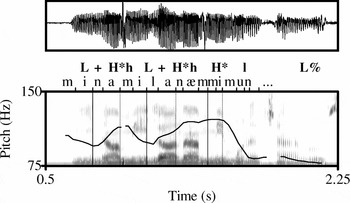
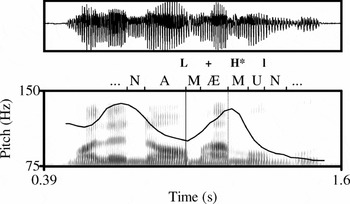
Researchers working in the framework of the AM theory of intonation assume that there are (at least) two levels in the hierarchy of Persian prosody, the Accentual Phrase (AP) and the Intonational Phrase (IP) (Jun et al. Reference Jun, Scarborough, Arbisi-Kelm, Esposito and Barjam2003, Mahjani Reference Mahjani2003, Sadat-Tehrani Reference Sadat-Tehrani2007). The Persian AP has only one configuration: a low followed by a high, characterized by the pitch accent L + H* which is associated with the stressed syllable. This pitch accent may be realized as an allophonic H* in, for instance, initially-stressed words and monosyllabic content words, when no segmental material is available for the realization of L. The Persian AP normally consists of one content word together with its possible clitics. A high (h) or low (l) boundary tone marks the right edge of an AP, the former being used in pre-nuclear APs and the latter in nuclear APs. A nuclear AP is always the last AP in simple mono-clausal sentences of all types, i.e. declaratives, interrogatives, and imperatives (for an account of the location of the nuclear pitch accent in Persian, see Sadat-Tehrani Reference Sadat-Tehrani2008). One or more APs form the next level, the IP, which is marked by a boundary tone L% or H% at the right edge. The number of APs in an IP is affected by factors such as speech rate; for instance, in fast speech, this number may be fewer compared to that in normal rate. The elements following the nuclear pitch accent are deaccented up to the IP end. Example (1) and figure 1 illustrate the prosodic structure of Persian. The nuclear AP is underlined and the stressed syllable of each AP is indicated by an acute accent mark. In the figure, the stressed syllable is demarcated by vertical lines, solid line for the onset and dotted line for the offset.Footnote 1
(1)


The above utterance consists of three APs, the subject (mina), the adverb plus its clitic (milan-æm), and the verb (mi-mun-ϵ). The first two carry the pitch accent L + H* and the third H*. The pre-nuclear APs have a high boundary tone and the nuclear one (the verb) a low boundary tone. The phrase t∫ænd ruz ‘a few days’ is deaccented, and the utterance ends low with an L% IP boundary tone which marks it as a declarative.
The utterance miná milán-æm mí-mun-ϵ t∫ænd ruz ‘Mina stays a few days in Milan too’. The voice analysis software used is Praat (Boersma & Weenink Reference Boersma and Weenink2007).

When an IP contains only one content word, that word is the sole AP and also the nuclear one, as exemplified in (2).
(2)
Word order changes do not alter the basic intonational structure. For instance, consider the utterance in (3) and its tonal pattern.
(3)
There are three APs in (3), the adverb (diruz), the subject (maman-ϵt), and the verb (umæd). Two other possible word orders of (3) (which result in different pragmatic nuances) are given in (4) together with their tonal patterns.
(4)
The basic intonational structure of the utterances in (4) is the same as that in (3). The verb is the nuclear AP and is characterized by L + H*l. Everything following it is deaccented.
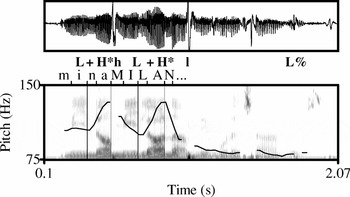
A contrastively-focused element forms its own AP.Footnote 2 The AP becomes the nuclear pitch accent of the utterance and has a low boundary tone (l). Everything after a focused element is deaccented. Example (5) and figure 2 illustrate these points (contrastive focus is indicated by capitalization).
(5)
In (5), which might be used to correct someone who has misheard the adverb Milan, the second AP is contrastively-focused and has caused deaccentuation in the materials to follow.Footnote 3
The contrastive focus utterance miná MILÁN-ÆM mi-mun-ϵ t∫ænd ruz ‘Mina stays a few days in MILAN too’.

2 Experiment
The experiment was set up to investigate certain phonetic aspects of Persian intonation and to examine the interaction of contrastive focus. To this end, three types of cliticized APs were studied and instrumentally compared. The comparison concerned the alignment of L and H relative to certain segmental landmarks, the normalized difference in the pitch of the valley and the peak, the rise-time, and the duration of the segments and of the whole AP. The APs under investigation all have an L + H pattern with an observable L and H. The choice of cliticized over non-cliticized APs was made due to the fact that the former are longer than the latter and hence all tones have enough space to be concretely realized.
2.1 Method
2.1.1 Design and materials
A total of 120 stimuli were used in this experiment, which comprised 30 utterances read by four native speakers. There were 10 utterances with a pre-nuclear high-boundary-toned test AP, 10 with a nuclear low-boundary-toned test AP, and 10 with a focused low-boundary-toned test AP. In what follows, the above three types are referred to as Pre-nuclear, Nuclear, and Focus types, respectively. A sample set is given in (6). The test AP is italicized. (The list of sentences used in this experiment is provided in the appendix.)Footnote 4
(6)
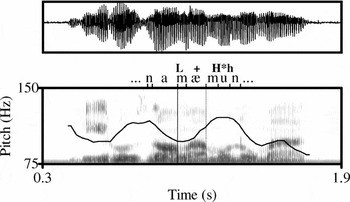
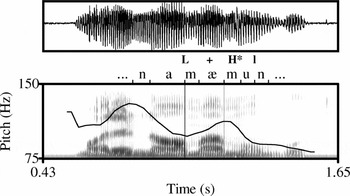
The waveforms and pitch tracks are given in figure 3 with the test APs specified. As before, the stressed syllable is demarcated by vertical lines.
The utterance dirúz namǽ-mun umǽd ‘Yesterday our letter arrived’ Pre-nuclear AP.

The utterance mál-ɛ namǽ-mun bud ‘It was for our letter’ Nuclear AP.

The utterance mál-ɛ NAMǼ-MUN bud ‘It was for OUR LETTER’ Focus AP.

Utterances were elicited by showing written version to speakers on cue cards in a random order. The speakers were asked to use a normal speech rate, neither fast nor slow. Each utterance was read once by each speaker, giving a total of 120 (10×3×4) utterances.Footnote 5 In cases where a speaker misread something or there were disfluencies in a production, the speaker was asked to re-read the utterance. Due to the fact that, in Persian, default nucleus placement follows rather straightforward rules (Sadat-Tehrani Reference Sadat-Tehrani2008), in most instances of Nuclear and Pre-nuclear sentences, showing the cue cards to the speakers and asking them to read with a normal (default) pronunciation sufficed to elicit the intended nuclear pitch accent and boundary tones. Only for one of the sentences (sentence (5) in the appendix, Nuclear), in addition to the cue card, a short context was given to the speakers for them to put the nucleus on the right word, since this sentence can have two different pronunciations and meanings. For the Focus type, a prompter question was always asked to cause the test AP to become contrastively-focused. Thus, every time a contrastive focus utterance came up on a card, the experimenter asked the speaker a question whose answer was the utterance on the card. For example, the question for the focus utterance in (6) was (7) below.
(7)
The test AP (e.g. namæ-mun ‘our letter’ in (6)) was designed to be always preceded and followed by other syllables in the utterance in order to reduce the unwanted utterance-initial and utterance-final effects. In addition, the test AP was always the second AP of the utterance so that it was equally affected in all utterances by possible downstep effects. The consonants surrounding the stressed vowel in the test word were always the sonorants /l/, /m/, /n/ in order for the F0 track of the test word to be smooth and connected.Footnote 6
2.1.2 Speakers
Four speakers, two female (F) and two male (M), took part in this experiment, one of the males being the author (M2). Their ages ranged from 27 to 41 years, all educated native speakers of Tehrani Persian who had lived in Iran all their lives before moving to Canada three to six years before the experiment, and who had grown up as monolingual speakers of Persian. They had been using Persian in some of their daily communications since they left Iran. However, it must be noted that alignment patterns of L1 can change under the influence of L2 (Mennen Reference Mennen2004), and so a study using pure monolinguals may be more representative of native Tehrani Persian alignment patterns.
2.1.3 Procedure
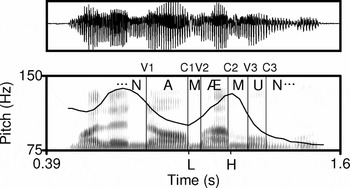
The productions of the speakers were recorded using a Marantz PMD660 professional digital voice recorder and a Shure KSM109 cardioid condenser microphone placed at a fixed distance of about 40 cm from the speaker. The recordings were analyzed in Praat (Boersma & Weenink Reference Boersma and Weenink2007). About 7.5% of the recordings were discarded since they did not have fully visible valleys and peaks due to the existence of plateaux. Such utterances were re-recorded in a second session. The measurement methodology was basically that of Atterer & Ladd (Reference Atterer and Ladd2004). The following eight landmarks were identified in each test AP.
V1: The beginning of the vowel preceding the stressed vowel (Vpre)
C1: The beginning of the consonant preceding the stressed vowel (Cpre)
V2: The beginning of the stressed vowel (Vstr)
C2: The beginning of the consonant following the stressed vowel (Cpost)
V3: The beginning of the vowel of the clitic (Vcli)
C3: The end of Vcli
L: The location of F0 minimum
H: The location of F0 maximum
Note that V1, C1, etc. refer to the boundaries between segments whereas Vpre, Cpre, etc. are the segments themselves. The above landmarks help us determine the alignment of the maximum and the minimum of the test AP with regard to the segments. They are also used to calculate the rise-time (H−L). The timepoints for H and L and their respective frequencies were obtained using Praat functions, which automatically move the cursor to the maximum or minimum of the selected part, and the timepoint and pitch can be read off the horizontal and the vertical axes, respectively. Visual inspection of the peak and the valley location supported the Praat judgments in most cases. In a few instances, the H or L was in the form of a short plateau rather than a single point. In such cases, the midpoint of the plateau was taken. The normalized pitch excursion was calculated by dividing the pitch difference of H and L by their mean, as given in (8).
(8) Normalized pitch excursion = (H−L) / [0.5(H + L)]
The other landmarks (i.e. segment boundaries) were determined visually with the help of wide-band spectrograms and waveforms. Figure 4 shows an example of the location of the above landmarks for the Focus sentence in (6), repeated here as (9).
(9)
The AP duration was calculated by adding the durations of the relevant segments. These segments were a series of consecutive consonants and vowels for all sentences (i.e. they all consisted of the string CVpreCpreVstrCpostVcli), which ensured the segmental uniformity of the data.
Landmarks for the AP NAMǼ-MUN ‘OUR LETTER’ in a focus production.

2.2 Results
2.2.1 Duration
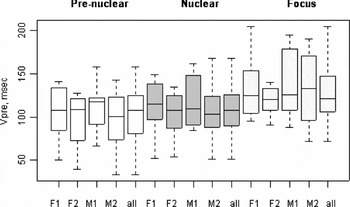
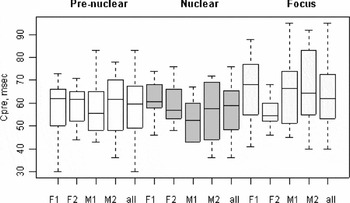
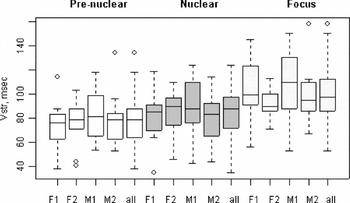
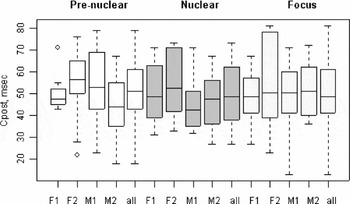
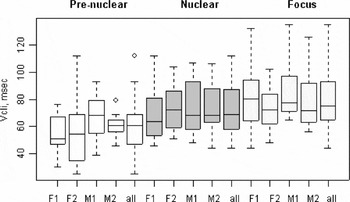
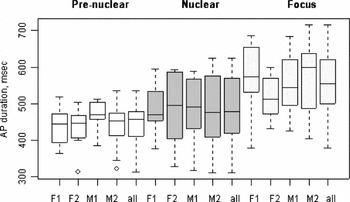
Figures 5–10 contain the box plots of the different segment durations and the AP durations for individual speakers and for all speakers. Note that the duration of the AP is not necessarily the addition of the durations of the five segments, since in some cases the AP contains another consonant before Vpre and/or after Vcli.
The duration of Vpre of the three AP types, for each speaker and for all speakers.

The duration of Cpre of the three AP types, for each speaker and for all speakers.

The duration of Vstr of the three AP types, for each speaker and for all speakers.

The duration of Cpost of the three AP types, for each speaker and for all speakers.

The duration of Vcli of the three AP types, for each speaker and for all speakers.

The duration of the three AP types, for each speaker and for all speakers.

A repeated-measures ANOVA on the speaker means (with the dependent variable being the AP duration, and the independent factor being the AP type and having three levels) showed that the durations of the three AP types are different (F(2,6) = 11.65, p <.01). A Tukey-Kramer multiple comparison test revealed that the duration of the Focus AP is significantly greater than that of the Pre-nuclear AP.Footnote 7 The duration of the Nuclear AP is between that of the other two types but not significantly different from either.
Of the five segments whose durations were measured, the vowels and not the consonants exhibited significant difference in the three types of AP, as the following repeated-measures ANOVA results show. The ANOVAs are on the speaker means, with the segment duration in each case being the dependent variable and the AP type the independent factor.
Vpre: F(2,6) = 8.70, p <.05
Cpre: F(2,6) = 1.47, p = .30
Vstr: F(2,6) = 12.75, p <.01
Cpost: F(2,6) = 0.16, p = .86
Vcli: F(2,6) = 31.16, p <.001
Tukey-Kramer multiple comparison tests performed for the vowels showed that the Vpre in Focus APs is significantly longer than in Pre-nuclear APs, and that of Nuclear APs is not different from the other two in this regard. The Vstr of the Focus type is longer than that of the other two types, and the Vcli of the Pre-nuclear type is shorter than that of the other two types.
2.2.2 Alignment
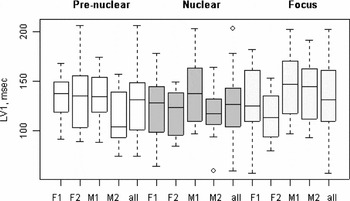
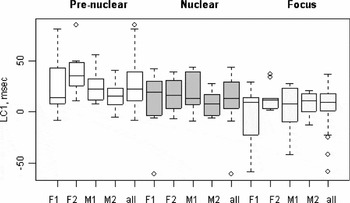
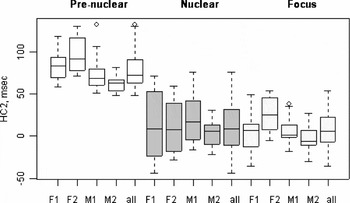
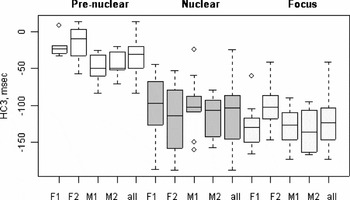
The box plots of alignment values for each speaker and for all speakers are given in figures 11–14. L and H alignments are given with regard to two reference points each: V1 and C1 for L, and C2 and C3 for H, hence the following variables:
LV1 = The temporal distance between F0 minimum and V1
LC1 = The temporal distance between F0 minimum and C1
HC2 = The temporal distance between F0 maximum and C2
HC3 = The temporal distance between F0 maximum and C3
The alignment of L relative to V1 (LV1) for the three AP types, for each speaker and for all speakers.

The alignment of L relative to C1 (LC1) for the three AP types, for each speaker and for all speakers.

The alignment of H relative to C2 (HC2) for the three AP types, for each speaker and for all speakers.

The alignment of H relative to C3 (HC3) for the three AP types, for each speaker and for all speakers.

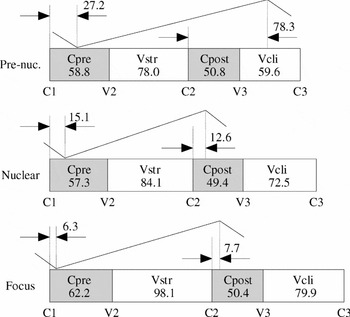
A negative number in the figures denotes that the minimum or maximum has occurred before the reference point. The alignment of L occurs in the consonant preceding the stressed vowel in all three types. A repeated-measures ANOVA on the speaker means with LC1 as the dependent variable determined significant difference among AP types (F(2,6) = 7.25, p <.05), and Tukey-Kramer multiple comparison tests showed that the difference lies between the Pre-nuclear and the Focus types: in the former, the valley is halfway through the consonant, while in the latter, it is at the consonant onset (an example of which can be observed when comparing figure 3a with figure 3c above). The Nuclear AP has an alignment between the two but not different from either. With regard to the reference point V1 (LV1 being the dependent variable), the alignment difference of L does not reach significance level (F(2,6) = 0.42, p = .68). This is due to the fact that L is further away from V1 than C1. Schepman et al. (Reference Schepman, Lickley and Ladd2006) state that the further away a landmark is, the more the probability of unrelated variances becomes, and that alignment is defined more appropriately as the time interval between a tone target and a nearby landmark. Therefore, the results from C1 reference point (which is closer to L than V1 is) are more realistic than those of V1, i.e. the alignment of L is different in Pre-nuclear and Focus APs.
The alignment of H is significantly different relative to both points (HC2: F(2,6) = 93.11, p <.0001; HC3: F(2,6) = 61.51, p <.0005), the Pre-nuclear type having later alignment than the other two (Tukey-Kramer tests). H is aligned with the middle of the vowel of the clitic in the Pre-nuclear type but in the beginning of the preceding consonant in the other two types. In other words, the AP type with a high boundary tone has a later alignment of H. In the Focus type, speakers F1 and M2 had negative means for LC1 and HC2, respectively. F1's low occurred in the vowel preceding the stressed syllable and M2's high occurred in the stressed syllable. However, these negative averages, which are mainly affected by large negative numbers in only a couple of utterances in each case, do not seem to play a significant role and are not large enough to make the grand mean negative.
Based on the mean alignment values, a schematic representation of alignment locations of L and H in different AP types is provided in figure 15.
Comparison of alignment in the three AP types (the amounts given are in msec).

2.2.3 Pitch excursion
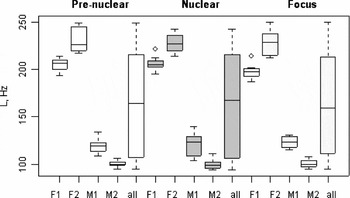
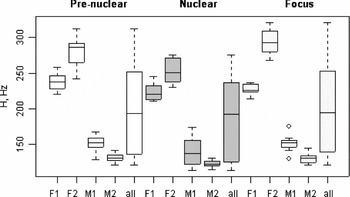
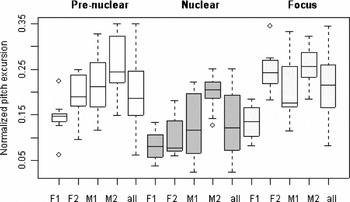
The box plots of the pitch values of L and H and their normalized pitch excursion (see the formula in (8) above) appear in figures 16–18. The mean Ls of the three AP types are similar and are not significantly different (F(2,6) = 0.30, p = .75). The Hs show more variation, but the variations do not reach significance level (F(2,6) = 4.37, p = .067). The normalized excursion is significantly greater in the Focus type than the Nuclear type (F(2,6) = 14.71, p <.01, and Tukey-Kramer test). The greater excursion of the Focus type is a way to make the contrastively-focused AP more prominent and to render it more salient pragmatically.
Frequency of L for the three AP types, for each speaker and for all speakers.

Frequency of H for the three AP types, for each speaker and for all speakers.

Normalized pitch excursion for the three AP types, for each speaker and for all speakers.

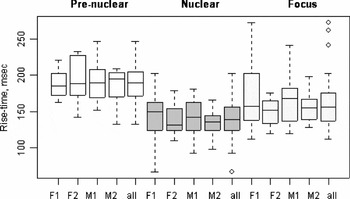
2.2.4 Rise-time
The box plots of the rise-time, i.e. the duration between the L and the H in milliseconds, for each speaker and for all speakers combined, are given in figure 19. As figure 19 shows, the rise-time is not of a fixed duration for any of the speakers, e.g. in the Pre-nuclear type, the rise-time ranges from 162.9 to 221.3 msec for speaker F1. This variable rise-time supports the idea that the rise per se is not a primitive of Persian intonation. This issue is further pursued in the Discussion section.
Rise-time of the three AP types, for each speaker and for all speakers.

2.3 Discussion
2.3.1 The issue of the fundamentals of Persian intonation
The results reported so far contribute to the question of whether tonal targets or pitch movements are the basics of intonation (see section 1 above). In Persian, the turning points are timed in a regular fashion with respect to the segmental string suggesting that pitch targets are the building blocks of Persian intonation, which is in turn supported by the variability of the rise-time in Persian APs. To further investigate this matter, several other measurements and analyses were performed. To check the degree of dependence of the rise-time on the pre-H segments, the correlation of the rise-time with these segments was calculated. For the Pre-nuclear type, this means the correlation of the rise-time with the temporal distance between L and the onset of Vcli, and for the Nuclear and Focus type, it means the correlation of the rise-time and the temporal distance between the L and the onset of Cpost. The assumption was that if target alignment rather than rise-time is primary, then this correlation must be high. The coefficient of determination (R2) together with the correlation test p-value is given in (10).Footnote 8
(10)
As can be seen, the pre-H segments are overall good predictors of the rise-time. This is in line with the fact that rise-time is not fixed and that it is determined by the temporal distance between L and the segment boundary right before H. Moreover, the correlation between the rise-time and the duration of the segment with which H is aligned is low, as evidenced by the results given in (11).
(11)
This means that the alignment of H is not related to the duration of the segment with which this tone is aligned. So for instance, in a Focus AP, the H is always aligned early in the consonant following the stressed syllable (Cpost), without the duration of that consonant playing a role in the alignment.
A related matter is the alignment of L, for which correlation analyses show the same trend as for that of H. The results are given in (12).
(12)
As can be seen in (12), the duration of the vowel preceding the stressed syllable (Vpre) is a good predictor of the alignment of L, but the duration of the following consonant (Cpre), with which L is aligned, is unrelated to it. So, L is aligned with Cpre (earlier for the Focus type and later for the Pre-nuclear type) without the duration of Cpre being relevant.
Also relevant to the targets vs. movements issue is the slope of the rise. If pitch targets rather than pitch movements are the primitives of Persian intonation, then there should not be any systematic relation between pitch excursion and rise-time. In other words, the slope of the rise should not be fixed, as would be in a framework where pitch targets play a secondary role to pitch movements. The correlation analysis supports this idea, as evidenced by (13), which contains the results of correlation analysis between rise-times and normalized pitch excursions.
(13)
The above analyses together suggest that pitch targets are the fundamental building blocks of Persian intonation rather than pitch movements which are a function of their starting and ending points.
2.3.2 Gradient vs. categorical differences
The next issue concerns the status of Persian with regard to other attested languages (see section 1 above for a summary of alignment patterns in some languages). Although a precise comparison among languages is impossible (due to the differences in factors such as location of the pitch accent in the sentence, methodology, segment type, etc.), an overview reveals the following. In Persian Pre-nuclear APs, the alignment of L is very similar to the North German case (Atterer & Ladd Reference Atterer and Ladd2004), i.e. midway in the consonant preceding the stressed vowel (Cpre), and that of H to the South German case (Atterer & Ladd Reference Atterer and Ladd2004), i.e. into the post-stress vowel (Vcli). In Nuclear APs, the L is aligned early in the stressed syllable, similar to Lekeitio Spanish (Elordieta & Calleja Reference Elordieta and Calleja2005) and the H with the post-stress consonant (Cpost), similar to German (Mücke et al. Reference Mücke, Grice, Becker, Hermes, Baumann, Hoffman and Mixdorff2006). Such similarities are in line with Atterer & Ladd's (Reference Atterer and Ladd2004) proposal that the alignment differences among languages are continuous and not categorical. Regarding the differences between AP types and specifically the pre-nuclear/nuclear contrast, the alignment of H in Persian nuclear rises is earlier than that in pre-nuclear ones, similar to Greek (Arvaniti et al. Reference Arvaniti, Ladd and Mennen1998, Reference Arvaniti, Ladd and Mennen2006), Dutch (Ladd et al. Reference Ladd, Mennen and Schepman2000, Schepman et al. Reference Schepman, Lickley and Ladd2006), varieties of German (Atterer & Ladd Reference Atterer and Ladd2004, Mücke et al. Reference Mücke, Grice, Becker, Hermes, Baumann, Hoffman and Mixdorff2006), and varieties of Spanish (Nibert Reference Nibert2000, Elordieta & Calleja Reference Elordieta and Calleja2005). This brings us to the question of whether the possible differences across the different AP types in Persian are categorical and warrant different phonological representations or not. A logical prerequisite to this discussion would be to re-examine the appropriateness of the phonological representation of the Persian AP, i.e. a bi-tonal pitch accent consisting of an L and an H*.
There is an obvious rise pattern in Persian which can be characterized by a low followed by a high, both of which are aligned outside the stressed vowel. With regard to the relation of the L and H tones to one another and the location of the star in the representation of rises, researchers have taken different approaches. For instance, based on the fact that Greek pre-nuclear rises have their low and high aligned outside the stressed syllable, Arvaniti, Ladd & Mennen (Reference Arvaniti, Ladd and Mennen2000) suggest five representation possibilities for the Greek pre-nuclear accents, namely L* + H, L + H*, LH, [LH]*, and L*H*, stating that their data are compatible with all five representations; or Atterer and Ladd (Reference Atterer and Ladd2004) show that British English, Dutch, Greek, Northern German, and Southern German all have the same type of targets – namely an L followed by an H – but exhibit subtly different patterns of alignment, and thus the authors abandon the idea of a starred tone (Elordieta & Calleja Reference Elordieta and Calleja2005 adopt the same view in their work on different varieties of Spanish). Given that the main aim of the present paper is to study the alignment patterns of the Persian AP, I will continue, in line with previous accounts of Persian intonation (e.g. Jun et al. Reference Jun, Scarborough, Arbisi-Kelm, Esposito and Barjam2003, Mahjani Reference Mahjani2003), to consider the H tone as the starred tone and regard the Persian rise pattern as L + H*.
Now, let us address the question of whether the different AP types, i.e. Pre-nuclear, Nuclear, and Focus, motivate different phonological representations. The three types have been represented throughout the paper as L + H*h, L + H*l, and L + H*l, respectively. With regard to the Focus AP, as the results of this paper show, the mean pitch excursion of the Focus AP is greater than that of the other two types and significantly different from the Nuclear type. The Focus AP is pragmatically distinct from the other two types, in that it contains an element which is highlighted and used in contrast to other elements in the discourse. This suggests that this AP type might have a distinct underlying pitch accent. Following Jun et al. (Reference Jun, Scarborough, Arbisi-Kelm, Esposito and Barjam2003), the possibility of the pitch accent L + ^H* for Persian Focus AP is suggested here. The diacritic ^ before H is used to denote extra high pitch and signifies the raised F0 in the Focus AP. Diacritics are used in intonational studies to mean both distinctive tonal targets and the phonetic realization of tonal targets; e.g. the diacritic ! has been used to show a distinctive pitch accent in English and German (H + !H*) and to denote a phonetic difference in Greek and Chickasaw (!H*) (Jun Reference Jun and Jun2005). In the present paper, the diacritic ^ is used in the former sense, i.e. as a marker of a phonological distinction.
The choice of a separate pitch accent for focus increases the number of Persian pitch accents and is a slight deviation from the two-target system; hence, it requires some justification. It might be argued that the extra high F0 characteristic of focus can simply be seen as part of the phonetic realization of focus. For one thing, the phonologically distinct representation of focus in Persian is cross-linguistically supported by the fact that in some languages or language varieties, focus is phonologically marked. Such is the case in Florentine Italian, Pisa Italian, Greek, and German, where speakers use a different or an additional pitch accent (Avesani & Vayra Reference Avesani and Vayra2003, Gili Fivela Reference Gili Fivela2004, Arvaniti et al. Reference Arvaniti, Ladd and Mennen2006, and Baumann et al. Reference Baumann, Becker, Grice and Mücke2007, respectively), and Korean, where speakers use a different phrasing (Jun Reference Jun1996). For instance, in Florentine Italian, non-contrastive focus is signaled by a bi-tonal pitch accent with a low target (H + L*), and contrastive focus is signaled by a high target, either a rising L + H* accent or a sustained high H + H* accent (Avesani & Vayra Reference Avesani and Vayra2003); in Pisa Italian, the autosegmental representations for broad and narrow focus are H + L* and [L + ]H* + L, respectively (Gili Fivela Reference Gili Fivela2004); or in Greek polar questions, an L* tone must co-occur with the stressed syllable of the word in focus, making it phonologically distinct (Arvaniti et al. Reference Arvaniti, Ladd and Mennen2006). Another issue concerns the relationship between focus and pitch excursion. As Arvaniti et al. (Reference Arvaniti, Ladd and Mennen2006) state, focus cannot be analyzed as a mere manipulation of pitch excursion. They show that the focused word in Greek polar questions is always associated with a final rise-fall movement, but the peak of this movement is aligned in different ways depending on the position of the nucleus: with the nucleus on the final word, the peak co-occurs with the utterance-final vowel (whether this vowel is stressed or not), and with the peak on an earlier word, the peak co-occurs with the stressed vowel of the last word. Arvaniti and colleagues conclude that focus and pitch excursion cannot be equated with one another, i.e. it cannot be said that focus is simply marked with an increase in pitch. This is backed up by the fact that other factors may be involved to signal focus more systematically than expanded F0, e.g. duration for Taiwanese Min (Pan Reference Pan2007). Finally, as mentioned earlier, focus and non-focus APs are quite different in meaning and if the pitch accent for the two were identical, then this meaning difference could not be captured in the tonal representation. The foregoing discussion suggests that the relationship between pitch and focus is, in Arvaniti et al.'s (Reference Arvaniti, Ladd and Mennen2006) words, ‘part of the grammar’ of Persian and hence is encoded in the phonology.
As for the distinction between Pre-nuclear and Nuclear APs, I argue that this difference need not be reflected in the pitch accent representation of the AP (namely, L + H*). The evidence for this claim comes from the fact that the choice between Pre-nuclear and Nuclear APs is directly related to the location of the AP in the sentence. As mentioned in section 1.1, it is always the last AP that is the nuclear AP, and being Nuclear or Pre-nuclear does not necessarily cause any semantic change. To clarify, consider the noun phrases in (14). As before, the nuclear AP is underlined.
(14)
In (14a), dæftær ‘notebook’ is the head noun and the semantic core of the noun phrase, and it is the nuclear AP. In (14b), ‘notebook’ is post-modified with the adjective sæd-bærg ‘hundred-sheet’ and as a result, the status of ‘notebook’ has changed from nuclear to pre-nuclear, while it is still the head of the noun phrase and its main semantic element. The nuclear AP is the modifier ‘hundred-sheet’ now. In (14c), yet another modifier is added (bozorg ‘large’) resulting in the same change, i.e. the shift of the nuclear accent from ‘hundred-sheet’ to the final AP ‘large’. So, the nuclear/pre-nuclear status of an AP has not affected its semantic load: the noun ‘notebook’ is nuclear in (14a) and pre-nuclear in (14b) and (14c), yet it is always semantically the most important element; also, the adjective ‘hundred-sheet’ is nuclear in (14b) and pre-nuclear in (14c), while in both, it is semantically secondary to ‘notebook’. The foregoing discussion suggests that the Pre-nuclear and the Nuclear pitch accents in Persian are phonologically the same (L + H*). These two are, however, distinguished by their boundary tones: high for the former (L + H*h) and low for the latter (L + H*l). Hence, the three AP types can be represented as in (15).
(15)
In sum, the greater excursion of the Focus AP is reflected in the pitch accent (L + ^H*) since this AP type is pragmatically distinct from the other two in that it highlights an element in contrast to others in the discourse. The difference between the Pre-nuclear and the Nuclear type is not caused by any change in meaning so there is no reason for them to have different pitch accents (both are L + H*); the two are distinguished by their boundary tone, which is high for Pre-nuclear and low for Nuclear APs.
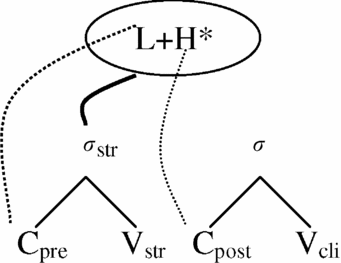
Before closing the paper, there should also be a mention of the notion ‘secondary association’. This concept, which is originally from Pierrehumbert & Beckman's (Reference Pierrehumbert and Beckman1988) work on Japanese tone structure, was later adopted by other authors, e.g. Grice (Reference Grice1995), Gussenhoven (Reference Gussenhoven2000), Grice, Ladd & Arvaniti (Reference Arvaniti, Ladd and Mennen2000), Lickley, Schepman & Ladd (Reference Lickley, Schepman and Ladd2005), Prieto, D'Imperio & Gili Fivela (Reference Prieto, D'Imperio and Fivela2005), Welby (Reference Welby2006), and Face & Prieto (Reference Face and Prieto2007). Views of secondary association suggest that phonetic alignment of tones indicates different kinds of phonological representations, and that tonal targets of pitch accents have a primary association to stressed syllables but may also have a secondary association to (the edges of) prosodic constituents. Following this view, the Persian Nuclear AP might be seen as having the pitch accent L + H* which is primarily (or underlyingly) associated to the stressed syllable, and secondarily associated to the left edge of the stressed and the following syllable (for L and H, respectively). For the Pre-nuclear AP, L and H have secondary associations to the consonant preceding the stressed vowel and the vowel following the stressed vowel, respectively. To illustrate the concept of secondary association, a schematic representation of primary and secondary associations of the Persian Nuclear AP is given in figure 20.
Schematic representation of primary and secondary associations in a Persian Nuclear AP (solid and dotted curved lines, respectively). σstr denotes the stressed syllable.

In figure 20, the pitch accent has primary association to the stressed syllable and the individual tones have secondary associations to the consonants at the sides of the stressed vowel. As far as the goals of the present paper are concerned, the secondary association analysis does not seem to have a crucial advantage over the alignment view adopted here, since this analysis approaches tonal alignment from a phonological viewpoint, while the concern of the present paper has been to deal with the realizational properties of Persian intonation in a quantitative manner. For this reason, the view is not pursued any further.
3 Conclusion
The experiment in this paper revealed certain phonetic characteristics of the Persian Accentual Phrase (AP). Three types of cliticized APs were studied: pre-nuclear pitch accent high-boundary-toned APs, nuclear pitch accent low-boundary-toned APs, and focus (low-boundary-toned) APs. The results showed that the alignment of L is always in the consonant preceding the stressed vowel of the AP. The L occurs as early as the onset of this consonant in the Focus AP and goes as far as the middle of the consonant in APs with a high boundary tone. The alignment of H is directly related to the boundary tone of the AP. For APs with a high boundary tone, the H is aligned in the middle of the vowel of the clitic. For APs with a low boundary tone, it is aligned earlier: in the preceding consonant, which is the consonant after the stressed vowel. The overall alignment patterns in Persian rises show subtle differences with those in other attested languages, implying that these differences are gradient in nature. The vowels of the Focus AP are on average longer than those of the non-focused counterparts. The consonants preceding and following the stressed vowel are of the same duration in all three AP types. The duration of the Focus AP is significantly greater than the Pre-nuclear AP. The pitch excursion of the Nuclear type is significantly less than the Focus type. This is caused by the frequency of the H rather than that of the L. Among the AP types, the Focus AP is underlyingly different and pragmatically distinct from the other two types, suggesting the pitch accent L + ^H* for focus constituents. The alignment of the L and the H and the variability of the duration and the slope of the rise in Persian suggest that in this language, tonal targets rather than pitch movements constitute the fundamentals of intonation, which in turn lends support to the appropriateness of the AM approach for studying Persian intonation.
Acknowledgements
I would like to thank Kevin Russell, Rob Hagiwara, the audience at the Speech Prosody 2008 conference, and the three anonymous reviewers of the Journal of the International Phonetic Association for their helpful comments and suggestions. I'm also grateful to the speakers who participated in the experiment of this paper.
Appendix. The data used in the experiment
The test AP is italicized; the contrastively-focused AP is in capitals.