There is strong evidence supporting the use of behavioural family interventions to assist parents with the upbringing of children. Specifically, research has found that empirically supported behavioural family interventions, such as the Triple P-Positive Parenting Program (Triple P; Sanders, Reference Sanders2012) can help improve parenting practices and reduce childhood emotional and behavioural problems (Sanders, Reference Sanders2012). Parenting programs do this chiefly through enhancing parenting skills and knowledge. Triple P is based on social learning principles and adopts behavioural strategies, within a self-regulation context, to help promote positive parenting practices. Many parents and children have benefitted from these parenting interventions, such as parents of children with a developmental disability (Whittingham, Sofronoff, Sheffield, & Sanders, Reference Whittingham, Sofronoff, Sheffield and Sanders2009), parents at risk of child maltreatment (Wiggins, Sofronoff, & Sanders, Reference Wiggins, Sofronoff and Sanders2009), parents experiencing separation and divorce (Stallman & Sanders, Reference Stallman and Sanders2007), and parents of teenagers (Ralph & Sanders, Reference Ralph and Sanders2004). However, grandparents are one parenting group that have not yet been targeted for assistance.
In Australia, grandparents provide a significant amount of informal child care, with approximately 936,000 grandchildren — 26% of all children aged between 0–12 years — receiving informal child care from their grandparents (ABS, 2012). Although helpful for families, negatives can arise when grandparents provide regular child care, such as tension and conflict in the grandparent-parent relationship about parenting issues (Rosenthal & Moore, Reference Rosenthal and Moore2012; Thomas, Reference Thomas1990), grandparents experiencing emotional exhaustion, isolation from friends, and feeling as though they are being taken for granted by the parents (Goodfellow & Laverty, Reference Goodfellow and Laverty2003).
When grandparents and parents are working together to help raise children, the relationship takes on a coparenting role. ‘Coparenting’ is defined as the ways that parenting groups work together in their roles as parental figures (Feinberg, Reference Feinberg2003). When coparenting conflict is evident (e.g., arguments between grandparent and parents around parenting strategies), it impacts child and family adjustment (Dorsey, Forehand, & Brody, Reference Dorsey, Forehand and Brody2007). Specifically, coparenting conflict has been found to undermine parental figures’ ability to model and assist children in regulating their emotions (Feinberg, Reference Feinberg2003), and also impact the psychological functioning (Low & Stocker, Reference Low and Stocker2005), and relationship quality of the parental figures (Halford, Markman, & Standley Reference Halford, Markman and Stanley2008). Despite these difficulties that grandparents encounter, to the authors’ knowledge, there appear to be no specific programs developed for grandparents providing informal child care to their grandchildren and no randomised control trials have evaluated the efficacy of a parenting program with this population.
Involving extended families in the management and prevention of conduct problems is in alignment with the nurturing environment concept postulated by Biglan, Flay, Embry, and Sandler (Reference Biglan, Flay, Embry and Sandler2012). The distinguishing features of nurturing environments include: (a) minimising biologically and psychologically toxic environments; (b) promoting and reinforcing prosocial behaviours such as self-regulatory skills; (c) reducing the opportunities for problem behaviour; and (d) encouraging psychological flexibility of individuals. When nurturing environments are created, it is theorised to reduce the levels of child conduct problems (Biglan et al., Reference Biglan, Flay, Embry and Sandler2012). Thus, engaging with extended family members, such as grandparents, is an important step to facilitate nurturing environments for children.
This article illustrates a major unresolved problem in the field of parenting (Kirby & Sanders, Reference Kirby and Sanders2012a); namely, how to meaningfully assist and engage with extended family members to help manage or prevent child disruptive behaviour problems. As there are no existing interventions available for this population, Kirby and Sanders (Reference Kirby and Sanders2012b) through a series of focus groups accessed the views of grandparents providing care to their grandchildren to determine what factors were needed in a program specifically developed for them. Based on this consumer approach to program design, grandparents highlighted three key areas they would like assistance with: (a) parenting strategies; (b) strategies to improve the relationship with the parent, and (c) strategies to manage stress and other unhelpful emotions that are experienced because of the caregiving role.
Blending the consumer feedback obtained (Kirby & Sanders, Reference Sanders2012b) with epidemiological research (ABS, 2012; Goodfellow & Laverty, Reference Goodfellow and Laverty2003; Rosenthal & Moore, Reference Rosenthal and Moore2012), Grandparent Triple P (GTP; Kirby & Sanders, in press) was developed. GTP is an iteration of the Triple P program, and it has been tailored to the concerns and needs of grandparents who provide care to their grandchildren. GTP is a 9-week parenting intervention aimed at providing grandparents with a refresher course in parenting, strategies on how to build a supportive relationship between themselves and the parent in the context of a coparenting team (e.g., communication skills to avoid grandparent interference), and strategies to assist with unhelpful emotions such as stress that comes with the caregiving role. A randomised controlled trial is currently evaluating the efficacy of GTP (Kirby & Sanders, in press).
This article describes the treatment outcomes of a 56-year-old grandmother (Dell), who provides 31–40 hours of care per week to her 2-year-old granddaughter (Cassie), who took part in GTP. Dell encountered great difficulty managing this caregiving role, as she often had arguments and disputes about parenting with her daughter (Melissa, 24 years old) who is the mother of Cassie, while also experiencing stress and depressive symptoms as a result of her caregiving role. It was hypothesised that GTP would help Dell's relationship with Melissa, and also improve Dell's stress and depressive symptoms.
Method
Case Presentation
Dell is a single Caucasian grandmother, who attended GTP primarily to help manage the difficulties in her relationship with Melissa (her daughter) about parenting Cassie. Dell reported not having great difficulty managing Cassie; however, she had great difficulty discussing aspects of parenting with Melissa. Dell indicated that unlike herself, Melissa experienced difficulty managing Cassie, and they had differing parenting styles. For example, Dell had a bed routine that she enforced when caring for Cassie; however, Melissa would not follow this routine, instead allowing Cassie to go to sleep when she felt tired. Dell reported that she could not speak to Melissa about parenting issues, as any form of communication they had about parenting would often result in yelling and disagreement. This would make Dell depressed, and she reported always feeling stressed when with Melissa, as she worried they would start to fight about parenting. Dell indicated before commencing this regular child care arrangement that she was not experiencing feelings of depression, and held the belief that her current child care arrangement was responsible for her depressive symptoms. In relation to child difficulties, Dell reported that that the main problem she was having with Cassie was her bed-time routine and that she often sought attention. Cassie was an only child. Similarly, Melissa also had difficulty with Cassie at bed time, but also had problems with Cassie regarding complying with instructions, being overactive, and crying easily. Currently, the living arrangement was such that Dell would provide care to Cassie over the course of the weekend, and occasionally one night during the week. Dell is retired, Melissa is a single parent, who studies part time while doing part-time retail work. Dell was seeking assistance for two key areas: improving her relationship with Melissa and also helping manage her feelings of depression and stress.
Assessment Process
Initial assessment involved a screening phone call with Dell about her concerns. At this point Dell identified some possible factors that could be maintaining the arguments she has about parenting with Melissa, such as: using emotive language when discussing parenting topics — for example, ‘you have no set routines’ and ‘you lie’; and being overly defensive when discussing parenting strategies ‘you don't spend the time with her that I do’. In addition, Dell reported feeling ‘guilty’ and ‘angry’ about having to provide care every week to Cassie without any financial reimbursement from Melissa as this makes Dell feel ‘used’. Dell and Melissa completed a series of standardised, well-validated questionnaires before starting the program, following program completion, and 6 months following program completion.
Measures
Child behaviour
The Eyberg Child Behaviour Inventory (ECBI; Eyberg & Pincus, Reference Eyberg and Pincus1999) is a 36-item measure of parental perceptions of disruptive behaviour in children between the ages of 2 and 16 years. It consists of a measure of the frequency of disruptive behaviours (Intensity) and a measure of the number of behaviours that are a problem for parents (Problem). The two scales have high internal consistency (α = .95 and .94, respectively), and the questionnaire has good test–retest reliability (r = .86) (Eyberg & Pincus, Reference Eyberg and Pincus1999).
Dysfunctional parenting style
The Parenting Scale (PS; Arnold, O'Leary, Wolff, & Acker, Reference Arnold, O'Leary, Wolff and Acker1993) is a 30-item questionnaire measuring three dysfunctional discipline styles. It yields three factors: Laxness (permissive discipline), Overreactivity (authoritarian discipline, displays of anger, meanness and irritability), and Verbosity (overly long reprimands or reliance on talking). Each scale has good internal consistency (α = .83, .82, and .63, respectively) and the scale has good test–retest reliability (r = .83, .82, and .79, respectively; Arnold et al., Reference Arnold, O'Leary, Wolff and Acker1993).
Parenting confidence
The Parenting Tasks Checklist (PTC; Sanders & Woolley, Reference Sanders and Woolley2005) is a 28-item measure that assesses parents’ task-specific self-efficacy. Two subscales measure parents’ confidence in dealing with difficult child behaviours like whining, interrupting, temper tantrums (Behavioral Self-Efficacy) and parents’ confidence in dealing with difficult behaviour in different settings such as shopping with their child or having visitors (Setting Self-Efficacy). Both subscales have excellent internal consistency (α = .97 and .91, respectively).
Grandparent adjustment
The Depression Anxiety Stress Scale-21 (DASS; Lovibond & Lovibond, Reference Lovibond and Lovibond1995a) is a 21-item questionnaire assessing symptoms of depression, anxiety, and stress in adults. It has good internal consistency for each scale (α = .97, .92 and .95, respectively). The DASS has good convergent and discriminant validity (Lovibond & Lovibond, Reference Lovibond and Lovibond1995b) and test–retest reliability (r = .71–.81 for each scale).
Grandparent-parent relationship quality
The Quality of Relationships Inventory (QRI; Pierce, Reference Pierce, Burleson, Albrecht and Sarason1991) is a 25-item scale assessing relationship quality on three dimensions: Support, Conflict, and Depth. The QRI has been used previously to measure relationship quality between parents and their adult children and demonstrated good internal consistency for the three scales with Cronbach's alpha ranging from .70–.94 (Pierce, Sarason, Sarason, Solky-Butzel, & Nagle, Reference Pierce, Sarason, Sarason, Solky-Butzel and Nagle1997).
Grandparent-parent communication
The Grandparent Communication Checklist (GCC; Kirby & Sanders, in press) is a newly developed measure of grandparent-parent communication over parenting issues (a construct for which there are currently no other available measures). The GCC is a 13-item measure asking grandparents to rate their confidence in discussing or negotiating parenting topics with the biological parent (i.e., their son or daughter) and the in-law parent (i.e., their son/daughter in-law). Grandparents are asked to rate their confidence on a scale from 1 (certain I cannot discuss it) to 10 (certain I can discuss it). Grandparents were asked ‘How confident are you in discussing or negotiating with the parents of your grandchild’ on topics such as ‘what times you provide child care’, ‘drop-off and pick-up times’, and ‘how you deal with your grandchild's behaviour’.
Assessment Findings
Self-report questionnaires were completed by Dell, and despite Melissa not participating in the program, data was also collected from her as a multiple informant. At baseline, Dell's score on the ECBI indicated that Cassie's behaviour was in the normal range for both frequency of behaviour problems and the number of problems experienced. On the PS Dell scored in the clinical range for the verbosity subscale, indicating clinical levels of dysfunctional parenting. According to the PTC, Dell reported high levels of confidence in dealing with difficult child behaviour in a range of different settings. Dell's score on the DASS indicated clinical symptoms of depression, stress, and anxiety. Dell's responses on the QRI revealed high levels of relationship conflict between herself and Melissa, with low levels of support and depth. Finally, Dell's scores on the GCC was extremely low, suggesting that Dell did not feel confident discussing parenting issues with Melissa.
In contrast, Melissa's score on the ECBI indicated that Melissa found Cassie's behaviour fell just below the clinical range for both frequency of behaviour problems and the number of problems experienced. Melissa's results indicated that Cassie was possibly at risk of developing an early onset disruptive behaviour disorder. In addition, Melissa also reported high levels of conflict on the QRI; however, also high levels of support and depth in the relationship with Dell.
Dell and Melissa also completed an observational communication task, where they recordered a conversation they had about a parenting issue they had a different view on. Dell and Melissa discussed the bed-time routine each had with Cassie in the attempt to resolve the issue. The conversation was rated in terms of negative and positive speaking skills, as per the Brief KPI (Halford, Osgarby, & Bouma, Reference Halford, Osgarby and Bouma2000). The reliability of the coding for the communication task was examined by an independent coder who was trained in the coding system by a supervisor (an author of the Brief KPI coding manual). As a result a high level of interrater reliability was found for Dell and Mellisa's conversation, K = .88 (p < .001), 95% CI [.84–.91]. At baseline both Dell and Melissa exhibited high levels of negative speaking and listening skills. All results can be found in Tables 2 and 3.
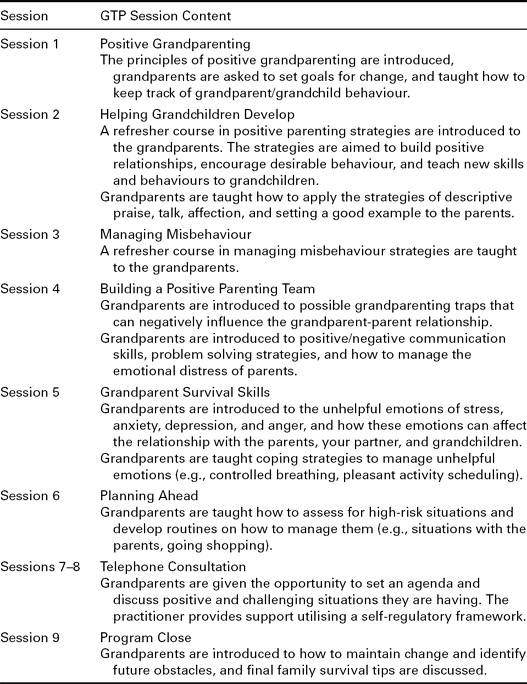
Procedure
Initially, informed consent was obtained from both Dell and Melissa. Following this, baseline results were then collected from grandparent and parent, and then Dell completed the GTP program. Melissa did not participate in GTP, as the program was developed only for grandparents to complete. The GTP program involves nine weekly sessions, with the first six sessions lasting 120 minutes, and the final three sessions being 15- to 30-minute telephone consultations. Table 1 provides an overview of the session content involved in GTP. The practitioner was a registered psychologist who followed a manualised protocol. Dell received a copy of the Grandparent Workbook (Kirby & Sanders, Reference Sanders2012a) that contained all session content, strategies, and homework exercises. Dell was motivated to participate, attending all sessions, and completing all assigned homework tasks.
Description of GTP Session Content

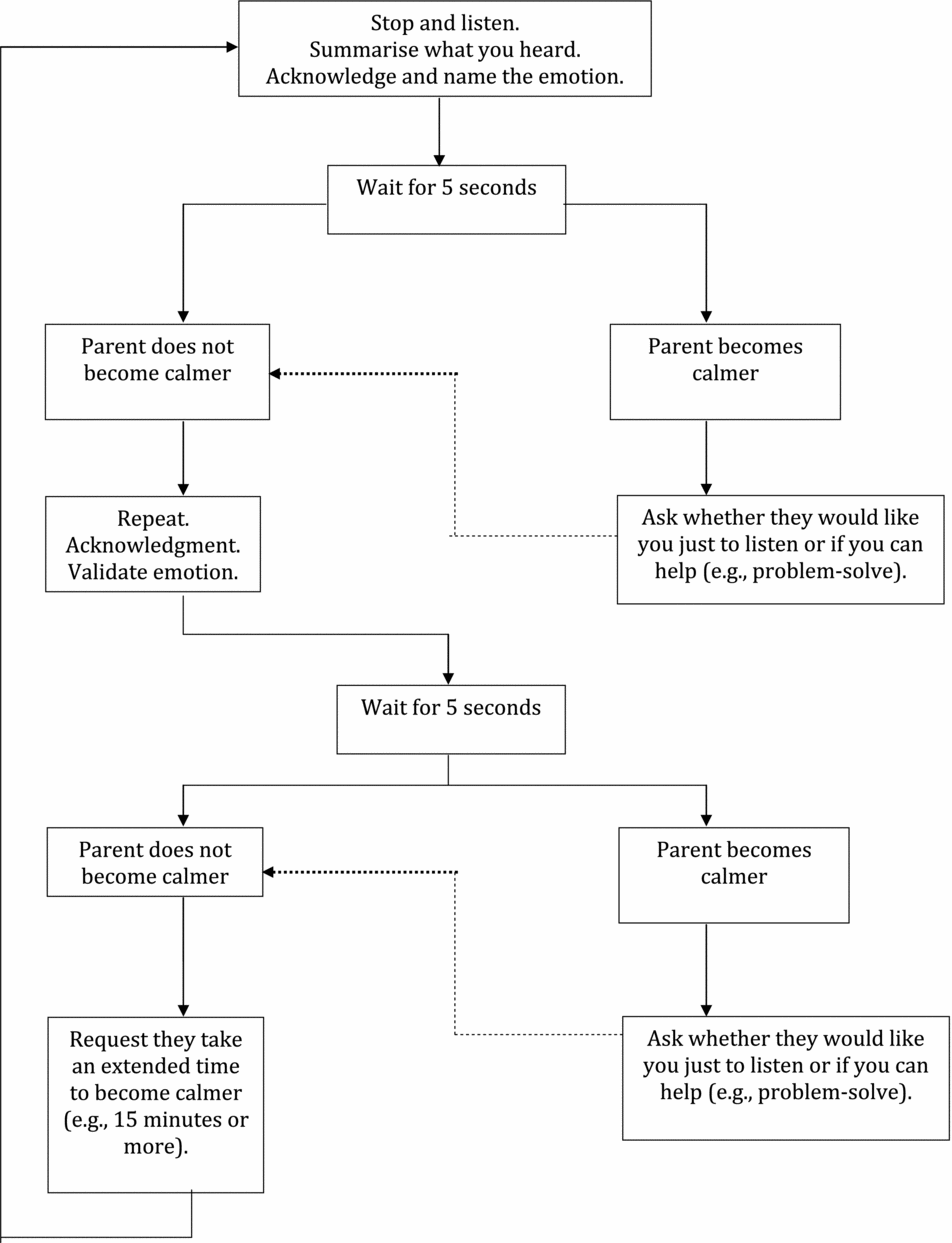
The first three sessions of the program focused on a refreshment course in parenting strategies, discussing the principles of GTP, strategies to encourage desirable behaviour (e.g., descriptive praise, attention, affection), and ways to manage child misbehaviour (e.g., setting clear ground rules, logical consequences). Session 4 covered strategies to build a positive parenting team with the parent, including communication strategies, discussing common grandparent traps (e.g., interfering and providing unsolicited parenting advice), problem-solving strategies, and a routine to deal with parent emotional distress. The routine for dealing with parent emotional distress focuses on the grandparent remaining calm when the parent is emotional (please see Figure 1 for a description of the routine that Dell was provided). The routine emphasises that the grandparent stop and listen to the parent, and try to acknowledge and name the emotion the parent is experiencing. The next step for the grandparent is to ask the parent if they would like them to continue to listen or provide help with problem-solving. If the parent requests help with solving the problem then the grandparent can provide suggestions; if the parent is still emotional a cooling-off period is recommended, and a time is arranged to discuss the issue later (e.g., the next day). The most important component of this routine is when the grandparent asks the parent what they would like them to do. In this way, the grandparent is avoiding the grandparent trap of providing unsolicited parenting advice to the parent, which is what parents dislike most about having grandparents involved with child care (Thomas, Reference Thomas1990).
The routine for dealing with parent emotional behaviour, adapted with permission from the Teen Triple P Group Workbook by A. Ralph and M.R. Sanders, Reference Ralph and Sanders2002, Triple P International.
Session 5 discussed coping strategies to manage unhelpful emotions such as stress, anxiety, anger, and depression. Coping strategies included controlled breathing, pleasant activity scheduling, progressive muscle relaxation, and acceptance. In addition, session 5 included an activity where grandparents are asked to consider having a discussion with the parent about the grandparent role. The aim of this discussion is for grandparents to ask the parents what they see the grandparent's role as being, expectations they have, and what they would like from the grandparent. In this way the grandparent gains insight into the parents’ perspective and ambiguous situations can be resolved. In Dell's instance, she was able to ask Melissa about expectations regarding discipline when they are together with Cassie; for example, Dell asked, ‘When we are together and if Cassie misbehaves what would you like me to do?’ This additional piece of information was able to reduce the anxiety and stress Dell experienced when with Melissa, as Dell indicated that Melissa requested that she not interfere in these situations and let her manage the situation herself.
Session 6 involved developing a planned activities routine around specific high-risk situations — in the case of Dell this meant developing a bed-time routine for Cassie. The final three sessions were telephone calls, where the practitioner continued to provide assistance in areas Dell found difficult. This meant focusing specifically on strategies to help manage Dell's stress and depressive symptoms. During this time Dell and Melissa both reported not accessing any other services while completing the parenting program. Melissa was informed that after collection of follow-up data, that a series of Triple P Tip Sheets that included all of the parenting strategies covered in Triple P would be posted to her.
Reliable and Clinically Significant Change
In order to assess whether the intervention results were reliable, the reliable change index was calculated utilising the Jacobson and Traux (Reference Jacobson and Truax1991) approach. Clinical significance was also calculated. Published clinical cut-offs were used and if none were available, the option c formula described by Jacobson and Truax (Reference Jacobson and Truax1991) was used to calculate a clinical cut-off when norms were available.
Results
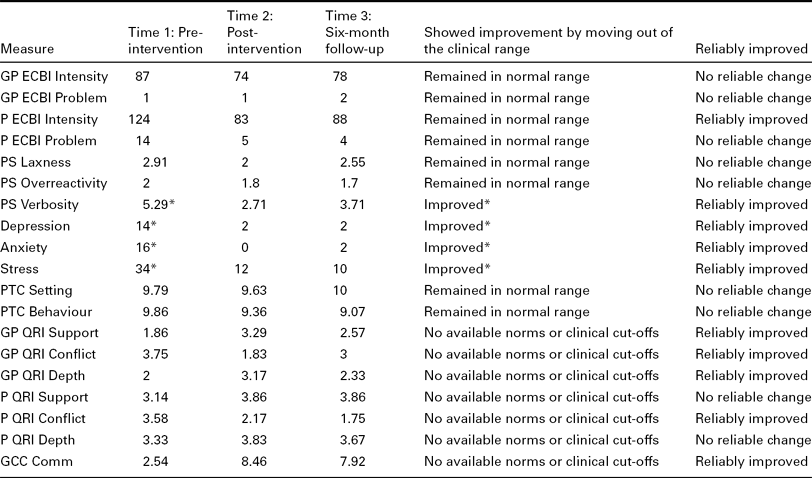
The success of the program was evaluated in terms of grandparent, parent, and grandchild outcomes at completion of the intervention and 6 months following the intervention. All results are displayed in Table 2, which documents whether there was clinical improvement or reliable improvements found for Dell, Melissa, and Cassie. In terms of child behaviour, Dell reported consistent scores on both the frequency and problem subscales, with Cassie staying in the normal range at all time periods. Conversely, Melissa reported a reliably improved finding on Cassie's frequency of problem behaviours.
Grandparent and Parent Results Before and After Completing GTP
Note: GP = grandparent; P = parent; ECBI = Eyberg Child Behavior Inventory; PS = Parenting Scale; PPC = Parent Problem Checklist; PTC = Parenting Tasks Checklist; QRI = Quality of Relationship Inventory; GCC = Grandparent Communication Checklist; *score falls in clinical range.
Dell's levels of depression, anxiety, and stress, improved over the course of the intervention, with Dell moving from the clinical to normal range. Moreover, Dell improved reliably on all three scales from baseline to 6-months follow-up. Dell's use of dysfunctional parenting strategies also decreased reliably from pre-intervention to follow-up, specifically her score on the verbosity subscale moved from the clinical to normal range. Dell's confidence regarding dealing with difficult child behaviour in a range of settings did not change and remained very high across the intervention.
Dell reported a reliable improvement on the conflict, depth, and support subscales of the QRI, indicating Dell perceived that the relationship with Melissa improved over the course of GTP. Melissa's responses on the QRI corroborated this, with Melissa reporting a reliable reduction in conflict with Dell over the course of the intervention. Dell's self-efficacy concerning her communication with Melissa over parenting issues reliably improved from baseline to follow-up intervention. Finally, these questionnaire findings were corroborated by the observational communication task with results depicted in Table 3. At post-intervention, Dell and Melissa both decreased in their use of negative speaking and listening skills, and utilised more positive speaking and listening habits.
Communication Task Between Grandparent and Parent Discussing Bed Time Routine at Pre- And Post-Intervention
Note: GP = grandparent; P = parent.
Discussion
Findings from this case study indicated that GTP resulted in benefits for grandchildren, grandparents, and also parents. To the authors’ knowledge, this is the first time a parenting program has demonstrated a three-generational benefit from a single intervention. Specifically, Dell managed to achieve her two major goals of improving her relationship with Melissa and also decreasing her feelings of depression and stress. Collectively, these results provide preliminary support for GTP to be used as an intervention for grandparents who are having difficulties when providing regular care to their grandchildren. Moreover, despite the parent not participating in GTP, Melissa still reported significant reductions in Cassie's child behaviour. This could be a result of Dell and Melissa's improved communication over parenting, and decreased relationship conflict; as such, improving the co-parenting team between grandparent and parent, and providing a more stable and calm environment for Cassie. The importance of this finding is that at baseline Melissa reported Cassie's behaviour on the borderline of clinical significance, as such GTP was able to reduce and also prevent Cassie from possibly developing an early onset disruptive child behaviour disorder. No changes were found for parenting confidence, with Dell having high levels of self-efficacy across the course of the intervention.
These initial findings provide support for the additional novel elements that were included in GTP, which are not included in a standard parenting program — that being the strategies to enhance the parent-grandparent relationship in the context of a co-parenting team and strategies to manage unhelpful emotions. Specifically, Dell's depressive and stress symptoms reliably improved and moved out of the clinical range, and the relationship with her daughter reliably improved.
There were also some notable strengths to this case study; specifically, the collection of data from both the grandparent and parent helped corroborate the obtained findings. Furthermore, the inclusion of the observational communication task helped the case study from relying solely on self-report questionnaires. Despite the encouraging results obtained in this case study for GTP, there were some limitations. First, although follow-up results suggested that outcomes were sustainable, evaluation of maintenance effects over longer time periods (e.g., 12 months) is recommended. Second, we were unable to collect follow-up data for the observed communication task. Third, as this study was an uncontrolled single case design we are unable to generalise findings beyond the current case to the population of grandparent families at large. Finally, as with most case studies, the data presented here is from only one family and there was no control condition; as such, we cannot completely discount competing explanations such as time for improvements made. For future research it is recommended that evaluating GTP in a randomised controlled trial is needed, with a range of grandparent families to support the widespread dissemination of this parenting program.
Collectively, this case study demonstrated preliminary support for the GTP program in assisting grandparents with improving the relationships with the parents, improving their own psychological wellbeing, and also reducing parent-reported child behaviour problems.
Disclosure Statement
The Triple P–Positive Parenting Program is owned by The University of Queensland. The university, through its technology transfer company Uniquest Pty Ltd, has licensed Triple P International Pty Ltd to disseminate the program worldwide. Royalties stemming from this dissemination work are paid to UniQuest, which distributes payments to the University of Queensland Faculty of Social and Behavioural Sciences, School of Psychology, Parenting and Family Support Centre, and contributory authors in accordance with the university's intellectual property policy. No author has any share or ownership in Triple P International. Matthew Sanders is the founder and lead author of the Triple P–Positive Parenting Program, and is a consultant to Triple P International. James Kirby is a co-author of Grandparent Triple P.