Percutaneous closure of the persistently patent arterial duct using the Amplatzer occluder has now become standard therapy, and can be achieved with few complications.Reference Al-Ata, Arfi, Hussain, Kouatli and Jalal1–Reference Marwah, Radhakrishnan and Shrivastava5 With the introduction of this device, transcatheter closure of moderate to large ducts is achieved safely and effectively, with excellent rates of occlusion reported in the short,Reference Vijayalakshmi, Chitra, Rajasri and Vasudevan3–Reference Thanopoulos, Hakim and Hiari6 intermediate,Reference Pass, Hijazi, Hsu, Lewis and Hellenbrand7 and long termReference Masura, Tittel, Gavora and Podnar8 follow-ups. We describe here our experience with percutaneous closure of an arterial duct, which had reopened subsequent to previous previous surgical ligation, the procedure being further complicated by the presence of a large thoracic aortic aneurysm involving the area of the ductal ampulla.
Case report
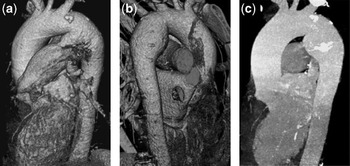
Our patient was aged 47 years, and complained of palpitation and shortness of breath during moderate activities. He had a past history of surgical ligation of a persistently patent arterial duct 30 years previously. As he had not had any symptoms at follow-up, he had not been evaluated during the intervening years. On physical examination, we found a continuous murmur, graded at 3 from 6, at the left upper sternal border. The second heart was moderately increased in intensity. Chest radiography and echocardiography demonstrated patency of the arterial duct, along with a large thoracic aortic aneurysm. Computed tomographic angiography confirmed the presence of the aneurysmal dilation of proximal portion of descending thoracic aorta, which measured 47 millimetres in its transverse diameter, and was 54 millimetres long. The aneurysm commenced at the level of the ductal ampulla (Fig. 1b, c). There was a significant shunt from the aorta to the pulmonary arteries through the arterial duct, which measured 8 millimetres in diameter (Fig. 1a). Even though he was a candidate for surgical treatment, both the patient and surgeon preferred to attempt endovascular treatment, the plan being to use an endovascular stent to treat the aortic aneurysm. The patency of the duct was a matter of considerable concern in the light of the potential for shunting from the pulmonary arteries to the posterior part of the stent subsequent to its placement, or leakage of blood between the stent and the aneurysm.Reference Rosen and Green9, Reference Preventza, Wheatley and Ramaiah10 We decided, therefore, first to close the duct percutaneously, and then subsequently to evaluate the thoracic aortic aneurysm for potential stenting.
Computed tomographic angiography demonstrates a large persistently patent arterial duct (a), and a thoracic aortic aneurysm at the level of the ductal ampulla (b, c).

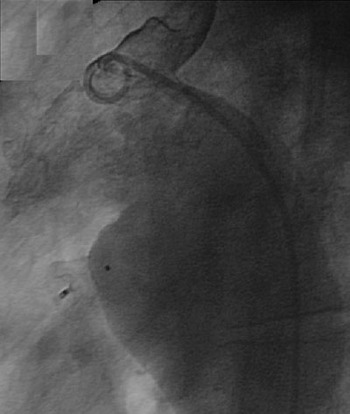
Having obtained informed consent, the patient was referred to the catheterization laboratory for possible closure of his duct. Under local anaesthesia, we catheterized both sides of the heart, administering heparin at 5000 international units. After baseline haemodynamic measurements, an aortogram revealed the maximum transverse diameter of the aneurysm to be 47 millimetres at the level of the ductal ampulla. The duct itself was long and conical, measuring 11 millimetres at its aortic end, but tapering to 7 millimetres at the pulmonary end. The midportion was 8 millimetres in diameter. Due to an unusual deformity of the left pulmonary artery, we were unable to insert the device using our routine approach via the right femoral vein and the pulmonary trunk. Thus, we passed the guidewire from the aorta using a Judkins right catheter, snared it in the pulmonary trunk, and it retrieved from the right femoral vein. A delivery sheath was then exchanged transvenously over the guidewire and passed into the descending aorta as described previouslyReference Al-Ata, Arfi, Hussain, Kouatli and Jalal1, Reference Butera, De Rosa and Chessa2. In the light of the unusual shape of the duct, and the risk of embolisation, we inserted an Amplatzer occluder of 14 by 12 millimetres. An aortogram revealed appropriate positioning of the device, and no residual shunting (Fig. 2). It also provided a better view of the thoracic aneurysm, permitting selection of a stent of appropriate size for its subsequent repair. The patient had been prescribed aspirin at 80 mg per day, which was commenced 2 days before the interventional procedure, and was continued for 1 month. After 1 month of follow-up, computed tomographic angiography showed the aneurysm to have a diameter of 45 millimetres, the patient being free from complications. His dyspnoea and clinical condition had ameliorated dramatically. In this light, we have deferred repair of the thoracic aneurysm, and we are now following him carefully with computed tomography.
The lateral view of the aortogram shows the deployment of the Amplatzer occluder in the duct in the area of the thoracic aortic aneurysm. The device is located completely within the duct, and there is no residual left-to-right flow.

Discussion
It is now well established that the Amplatzer ductal occluder is safe and efficacious at closing moderate- to large-sized ducts, the procedures having a high rate of success, and a very low risk of residual shunting.Reference Al-Ata, Arfi, Hussain, Kouatli and Jalal1–Reference Vijayalakshmi, Chitra, Rajasri and Vasudevan3 Significant complications such as pulmonary arterial obstruction, embolisation, bleeding, formation of pseudoaneurysms, and loss of femoral pulses have rarely been reported.Reference Butera, De Rosa and Chessa2, Reference Wang, Wu, Hwang, Chiang, Lin and Lue4, Reference Pass, Hijazi, Hsu, Lewis and Hellenbrand7 Percutaneous closure of the duct in the presence of large thoracic aortic aneurysms, however, is known to pose difficulties because of the fragile nature of the tissues, particularly in older patients or in redo situations, but is a well accepted alternative to surgery. We experienced difficulty during our initial attempted transcatheter closure because of the deformity of the left pulmonary artery, suggesting that crossing the duct from the arterial side is a better approach. After occluding the duct, we obtained a better view of the thoracic aneurysm. We presumed that the images obtained would help us choose a stent of the most appropriate size when the time came to repair the aortic aneurysm. Having closed the duct, however, we noted a decrease in the size of the aneurysm. At this stage, therefore, we have elected not to repair the aneurysm, but to follow him quarterly using computed tomography.