Introduction
Wild hogs (Sus scrofa Linnaeus, 1758) are carriers of viral, bacterial and parasitic infections of livestock, particularly domesticated pigs, and are a source of zoonotic diseases in several countries (Meng et al., Reference Meng, Lindsay and Sriranganathan2009). Human habitation changes resulting from population increase; changes in agricultural practices (including increased land use, deforestation and co-raising wild hogs with other wildlife); increased recreational hunting of wild hogs; and consumption of wild meat have variously contributed to increased exposure of wild-hog infections to both domesticated stock and humans (Meng et al., Reference Meng, Lindsay and Sriranganathan2009; Hamrick et al., Reference Hamrick, Smith, Jaworowski and Strickland2011; Centers for Disease Control and Prevention, 2014).
Historical accounts from Jamaica indicate that hogs (and cattle) originated as cargo imported at the request of Spanish colonial governors (Chipman, Reference Chipman1967). The earliest reports of problems with wild hogs in Jamaica date back to 1505 (Padrón, Reference Padrón2003) and were not parasitological. Rather, at that time the animals were implicated in killing cattle. Herds of hogs also destroyed crops of sugarcane and maize on several Caribbean islands, and reportedly attacked Spanish soldiers when surrounded (Mayer & Brisbin, Reference Mayer and Brisbin2009).
Given the common practices of subsistence and recreational wild-hog hunting in the Caribbean region, and the recent practice, in Jamaica in particular, of co-rearing wild hogs and domesticated pigs by livestock farmers to improve breeding stock and increase sales of ‘wild meat’, it is of concern that no published information on the gastrointestinal parasitic fauna of wild hogs exists for the region, which could inform discussions of the potential for transmission of helminth parasites to domesticated livestock or to humans.
This paper reports on the gastrointestinal helminths of wild hogs in Jamaica, and the potential risks posed by wild hogs as sources of livestock gastrointestinal helminthic infections and reservoirs of helminthic zoonoses. The work forms part of a larger research project designed to assess and improve the conservation status of the critically endangered Jamaican iguana (Cyclura collei Gray, 1845) and other endemic lizards in the Hellshire Hills (Wilson, Reference Wilson2011), a dry limestone forest that is of high conservation value (McLaren et al., Reference McLaren, Lévesque, Sharma, Wilson and McDonald2011).
Materials and methods
During the period June 2004 to August 2006, 31 wild hogs were snared along fresh or frequently used trails in the Hellshire Hills in southern Jamaica (17.9°N, 76.9°W). Animals were sexed and ethically euthanized in the field, and categorized into juveniles and adults based on the level of tooth development (see Magnell & Carter, Reference Magnell and Carter2007). In the laboratory, complete digestive tracts were opened, contents sieved and examined microscopically, and adult helminths removed. In addition, abdominal mesenteries and skeletal (jaw) muscle squashes were examined for Trichinella sp. larvae (trichinae). Parasite specimens were measured and stored in a solution of 10% glycerol and 70% alcohol. Representative vouchers were sent to the University Institute of Tropical Diseases and Public Health of the Canary Islands and the University of La Laguna, Tenerife, Canary Islands (Spain) for confirmation of identification.
Parasite descriptive terms of prevalence and mean intensity adhere to Margolis et al. (Reference Margolis, Esch, Holmes, Kuris and Schad1982) with improvements by Bush et al. (Reference Bush, Lafferty, Lotz and Shostak1997). Data were analysed using Sterne's exact method for parasite prevalence (Reiczigel, Reference Reiczigel2003), and exact unconditional tests to assess the univariate association of host age-class and sex with each species of parasite (Reiczigel et al., Reference Reiczigel, Abonyi-Toth and Singer2008). Bootstrap two-sample t-tests (based on 2000 replications) were used to compare mean intensities and to determine 95% confidence limits. The prevalence of each parasite was then modelled using binary logistic regression; significant (P< 0.05) risk factors in multivariate analyses were expressed as odds ratios (OR). Analyses were performed using Quantitative Parasitology v3.0 (Rózsa et al., Reference Rózsa, Reiczigel and Majoros2000; Reiczigel & Rózsa, Reference Reiczigel and Rózsa2005), and Statistical Package for the Social Sciences v12.0 and v22.0 for Windows® (SPSS Inc., Chicago, Illinois, USA).
Results
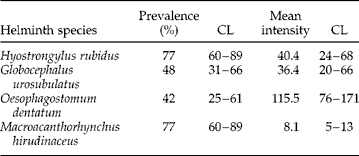
Up to 31 wild hogs were examined – 13 males and 18 females, five of which were pregnant. All but one of the hogs were infected with 1–3 species of gastrointestinal helminths: two (6.2%), ten (32.2%) and 18 (58.0%) hogs harboured one, two and three helminth species, respectively. The only uninfected host was a pregnant adult. In all, three adult nematodes, Hyostrongylus rubidus (Trichostrongylidae), Globocephalus urosubulatus (Ancylostomatidae) and Oesophagostomum dentatum (Strongyloidae), and one adult acanthocephalan, Macroacanthorhynchus hirudinaceus (Oligacanthorhynchidae), were recovered. The majority of the parasites were located in the small intestine. The overall prevalence of parasitic infection ranged from 42 to 77%, while mean intensities varied from 8.1 for M. hirudinaceus to 115.5 for O. dentatum (table 1).
Infection levels of gastrointestinal helminths in 31 wild hogs, Sus scrofa, from Jamaica. CL, 95% confidence limits, with mean intensities being bootstrapped.

A univariate association between G. urosubulatus and host age (exact unconditional test (two tailed); P< 0.03) was confirmed by binary logistic regression (odds ratio = 6.517), indicating that infections were more likely to occur in adult hogs. However, statistically significant associations were not observed between any of the parasites and host sex.
Discussion
No scientific study has yet been conducted to assess numbers or viability of wild-hog populations in Jamaica (Barker, Reference Barker1992), but these animals thrive in both dry and wet limestone forests, mainly in the southern and eastern parts of the island. There are no reports, currently, of wild hogs from western Jamaica, although early Maroons (escaped slaves who settled in both the western and eastern interior of Jamaica since 1738) were reported to supplement their diets with wild-hog meat (Gosse & Hill, Reference Gosse and Hill1851).
In a review of wild hogs as sources of diseases in livestock and humans worldwide, Meng et al. (Reference Meng, Lindsay and Sriranganathan2009) listed a single helminth parasite of humans, where ingestion of raw or under-cooked meat was the main source of infection, citing an outbreak of trichinellosis that was linked to the consumption of wild-boar meat in Canada. Trichinellosis is an emerging infectious disease in Europe, where human infections following the consumption of wild-hog meat have been documented (Dupouy-Camet, Reference Dupouy-Camet2006; Meng et al., Reference Meng, Lindsay and Sriranganathan2009). The introduction of Trichinella spp. to domestic hogs is also of major concern (Meng et al., Reference Meng, Lindsay and Sriranganathan2009). Despite efforts to detect Trichinella sp. microscopically, this parasite was not observed in any of the wild hogs examined in the present study. Similarly, Springer (Reference Springer1973) and Coombs & Springer (Reference Coombs and Springer1974), working in Arkansas and Texas, respectively, did not detect Trichinella sp. in any of the 29 wild hogs they examined, although the parasite had been recovered previously, at low prevalence, from wild hogs elsewhere in the United States (Hanson & Karstad, Reference Hanson and Karstad1959).
It is well established that the introduction of infected animals is the primary mode of between-herd transmission (McKenzie & Davidson, Reference McKenzie and Davidson1989; Cousins, Reference Cousins2001; Centers for Disease Control and Prevention, 2014), and this principle would apply to the introduction of wild hogs to domestic stock. Further, Meng et al. (Reference Meng, Lindsay and Sriranganathan2009) mentioned clustered cases of hepatitis E in humans who had consumed wild-boar meat in Japan, and infection of wild-hog hunters in Florida with Brucella suis, thereby reinforcing the importance of wild hogs in the potential transmission of infections to humans. In the present study, three species of nematodes, H. rubidus, G. urosubulatus and O. dentatum, and an acanthocephalan, M. hirudinaceus, were recovered. In the contexts of wild hog–domesticated pig co-rearing, and wild-hog hunting in the Caribbean, these pose a potential risk of infection to domestic livestock or humans.
Hyostrongylus rubidus, commonly referred to as the ‘red stomach worm’, showed a high prevalence of 77%, and mean intensity of 40.4 in our study. These elongated, blood-feeding nematodes were 5–10 mm in length, and are generally considered important parasites of pasture-raised pigs (Junquera, Reference Junquera2014). The life cycle of H. rubidus is direct, and infective larvae are consumed by foraging hogs. These enter the stomach mucosa, form nodules, complete two moults to become adults, and then return to the lumen. Given that it takes about 5 days from egg to infective larva, the life cycle can be broken if faeces are removed from contaminated pens with sufficient regularity. Our statistical analyses did not indicate any association between H. rubidus and the age or sex of the wild-hog hosts, although Junquera (Reference Junquera2014) reported that the nematode is more likely to occur in older, domesticated animals, with significantly higher mean intensities in females. In the Caribbean region, H. rubidus has been recorded at low prevalence in abattoir pigs in Belize (Gibbens et al., Reference Gibbens, Gibbens and Fielding1989) but in 87% of 60 free-range pigs studied in Nicaragua (Luna & Kyvsgaard, Reference Luna and Kyvsgaard2005). The occurrence of H. rubidis in wild hogs in Jamaica at high prevalence and intensity, together with the ease of transmission of infective stages, indicates that this nematode represents a potential risk to domesticated pigs in co-reared situations, particularly those that are poorly managed.
Globocephalus urosubulatus showed a prevalence of 90% in a sample of ten wild hogs in the United States (Coombs & Springer, Reference Coombs and Springer1974) and 25% of 137 abattoir pigs in Belize (Gibbens et al., Reference Gibbens, Gibbens and Fielding1989). In our study, this nematode showed a prevalence of 48%, with a mean intensity of 36.4. The life cycle of G. urosubulatus is typical of hookworms, with eggs being shed with the faeces of the infected host, hatching and developing into infective larvae in 8–10 days, thus allowing adequate time for removal from pig pens. Our multivariate analyses indicated a strong association between the prevalence of G. urosubulatus and older hosts, in agreement with Tamboura et al. (Reference Tamboura, Banga-Mboko, Maes, Youssao, Traore, Bayala and Dembele2006) who reported a higher prevalence of Globocephalus spp. in old adult hogs when compared with young and young-adult scavenging pigs in Burkina Faso. Infections generally result from ingesting infective larvae, but young animals may also be exposed through skin penetration (Junquera, Reference Junquera2014). Following a pulmonary migration, the larvae return to the gut where they complete development to adults, 5–6 mm long, attach to the gut lining and feed on blood. The transmission characteristics of G. urosubulatus indicate that this nematode represents a potential risk, particularly to co-reared domestic pigs if pens are not sanitized on a frequent basis.
Oesophagostomum dentatum or ‘nodule worm’ occurred as 10-mm-long adults in lesions mainly in the large intestine of 42% of the wild hogs in our sample. This nematode showed the highest mean intensity (115.5) of any of the helminths encountered. Regionally, a prevalence of 45% has been documented in 137 abattoir pigs in Belize (Gibbens et al., Reference Gibbens, Gibbens and Fielding1989) and in 70% of 60 free-roaming pigs in Nicaragua (Luna & Kyvsgaard, Reference Luna and Kyvsgaard2005). Once in the environment, eggs release first-stage larvae that complete development to infective third-stage larvae in about a week. Infective larvae are normally ingested with forage; they then burrow into the wall of the intestine, remain for 10–14 days and form large (10–15 mm) nodules. Adults re-enter the intestine to lay eggs (Junquera, Reference Junquera2014) which are passed with the faeces. Again, this nematode should not present a transmission risk in well-maintained pig pens.
Nodule worms are currently of human health concern only in some African countries, e.g. northern Togo and Ghana, where they represent a serious public health problem (Polderman & Blotkamp, Reference Polderman and Blotkamp1995; Bogers et al., Reference Bogers, Storey, Faile, Hewitt, Yelifari, Polderman and Van Marck2001). Infections have also recently re-emerged in Uganda (Ghai et al., Reference Ghai, Chapman, Omeja, Davies and Goldberg2014). Three species – O. bifurcum, O. aculeatum and O. stephanostomum – have been implicated with certainty in human infections (Polderman et al., Reference Polderman, Krepel, Baeta, Blotkamp and Gigase1991; Polderman & Blotkamp, Reference Polderman and Blotkamp1995). While O. dentatum is clearly a risk to co-reared domesticated pigs, its zoonotic significance is currently unknown.
In the Caribbean and Central America, M. hirudinaceus is recognized primarily as an acanthocephalan of domesticated pigs (Gibbens et al., Reference Gibbens, Gibbens and Fielding1989; Luna & Kyvsgaard, Reference Luna and Kyvsgaard2005), but it has been documented elsewhere in a large number of other mammals (Samia et al., Reference Samia, Boufana, Boubaker and Landolsi2014), including humans (Tesana et al., Reference Tesana, Mitrchai and Chunsuttwat1982). Resistant eggs with larvae are found in the soil and are consumed by the intermediate host, usually a beetle larva. Swine (and humans) are infected when they ingest infected grubs. Adults attach to the intestinal wall of the host. At a prevalence of 77%, M. hirudinaceus poses a serious risk to domesticated pigs under co-reared conditions. However, these worms seldom mature in human hosts, and the cultural avoidance of ingesting insect larvae in Jamaica would suggest that human infection with M. hirudinaceus is unlikely to become a public health concern.
All four species of helminth parasites recovered from this sample of wild hogs in Jamaica can be transmitted to domestic stock if infected wild animals are not dewormed prior to introduction. Poor husbandry, allowing for reinfection of animals in poorly maintained hog pens, is likely to exacerbate the situation.
Acknowledgements
The work was conducted while C.K.O. was a MPhil student at the University of the West Indies, Jamaica (UWI).
Financial support
We thank the Graduate Student Research Fund (UWI) for financial support.
Conflict of interest
None.
Ethical standards
The authors assert that all procedures contributing to this work comply with the ethical standards of the University of the West Indies (Mona) Ethics Sub-Committee on the Use of Animals in Research.