Introduction and background
Unique benefits of lithium therapy
Although it was introduced over 60 years ago, lithium still has the strongest evidence base for effectiveness; it continues to be recommended as a first line treatment for bipolar disorder in guidelines such as the National Institute for Health and Care Excellence (NICE) and the Canadian Network for Mood and Anxiety Treatments guidelines (Yatham et al. Reference Yatham, Kennedy, Parikh, Schaffer, Beaulieu, Alda, O’Donovan, MacQueen, McIntyre, Sharma and Ravindran2013; NICE, 2014). A search of the literature yielded several studies confirming lithium’s unique efficacy in the treatment and prevention of relapse in patients suffering from bipolar affective disorders (BPAD). For instance, a meta-analysis of five placebo-controlled lithium maintenance trials (n=770) found that lithium reduces the risk of manic relapses by 38% and depressive relapse by 28% (Geddes et al. Reference Foy, Hempel, Rubenstein, Suttorp, Seelig, Shanman and Shekelle2004). Furthermore, it has now been over 30 years that lithium salts are known to enhance the effects of anti-depressants in the treatment of refractory depression (de Montigny et al. Reference Moher, Liberati, Tetzlaff and Altman1981). Since then, several meta-analytic reviews as well as national and international guidelines have confirmed that augmentation with lithium is the best documented strategy for the treatment of unipolar depression in treatment-resistant patients (Bauer & Dopfmer, Reference Bauer and Dopfmer1999; Bauer et al. Reference Bauer, Adli, Bschor, Pilhatsch, Pfennig, Sasse, Schmid and Lewitzka2010, Reference Bauer, Pfennig, Severus, Whybrow, Angst and Möller2013). Moreover, several studies have suggested an additional role for lithium as a prophylactic agent in the treatment of recurrent depressive disorder (Baastrup et al. Reference Baastrup, Poulsen, Schou, Thomsen and Amdisen1970; Burgess et al. Reference Burgess, Geddes, Hawton, Taylor, Townsend, Jamison and Goodwin2001; Cipriani et al. Reference Cipriani, Hawton, Stockton and Geddes2006; Bschor, Reference Bschor2014).
It is an accepted fact that the risk of suicide-related mortality is substantially higher (between 10–70 times greater, according to the literature; Muller-Oerlinghausen & Lewitzka, Reference Muller-Oerlinghausen and Lewitzka2010) in psychiatric patients when compared with the general population; this is especially true of patients with affective disorders such as BPAD and major depressive disorder. Faced with this knowledge, researchers have been searching for a therapeutic agent which could also help decrease suicide in this particularly vulnerable patient group. Early epidemiological and observational studies were the first to suggest a potential link between long-term lithium therapy and suicide prevention (Barraclough, Reference Barraclough1972; Kessing et al. Reference Keogh2005). In the first randomized control trial on the subject, Lauterbach et al. (Reference Kuper, Lingard and Levinson2008) found that lithium therapy was associated with a significant decrease in the risk of completed suicide among patients with affective disorders who had recently attempted suicide. The results of several meta-analyses carried out in the last decade further support the view that lithium plays a role in reducing the rates of suicide and suicide attempts (Cipriani et al. Reference Cipriani, Smith, Burgess, Carney, Goodwin and Geddes2005, Reference Cipriani, Pretty, Hawton and Geddes2013; Baldessarini et al. Reference Baldessarini, Tondo, Davis, Pompili, Goodwin and Hennen2006). In a meta-analytic review of 31 studies comparing suicide rates in patients receiving lithium therapy versus those without lithium treatment, the overall risk of suicide attempts was found to be five times lower in patients who had been treated with lithium (Baldessarini et al. Reference Baldessarini, Tondo, Davis, Pompili, Goodwin and Hennen2006). Further evidence emerged from two systematic reviews carried out by Cipriani et al. (Reference Cipriani, Smith, Burgess, Carney, Goodwin and Geddes2005, Reference Cipriani, Pretty, Hawton and Geddes2013). In both the initial review and the updated meta-analysis, lithium was found to be significantly more effective than placebo in reducing the number of suicides; it was also associated with a reduced risk of deliberate self-harm when compared with carbamazepine (Cipriani et al. Reference Cipriani, Pretty, Hawton and Geddes2013).
In conclusion, there is a strong body of evidence supporting the proposal that lithium has unique properties for reducing suicide risk. These effects, combined with lithium’s proven efficacy in the treatment and prophylaxis of both bipolar and unipolar depression, contribute to maintaining lithium’s status as a first line, evidence-based management option for patients suffering from affective disorders.
Lithium toxicity and the need for monitoring
Despite the clear beneficial effects of lithium described above, lithium therapy is complicated by its narrow therapeutic index and associated potential for toxicity and adverse effects. Thus, treatment with lithium necessitates serum levels to be checked regularly as well as frequent monitoring of patients’ renal, thyroid and parathyroid function. A review of concurrent medication is also advised as there exists potential for interaction with certain drugs such as angiotensin converting enzyme inhibitors and non steroidal anti-inflammatory drugs (as these may potentiate renal impairment). Safe monitoring of lithium levels is crucial if one is to avoid the risks of toxicity. Clinical incidents relating to lithium toxicity have been reported in several studies carried out in both the United Kingdom and Ireland. For instance, the UK’s National Patient Safety Agency (NPSA) reported that some patients taking lithium were harmed because their dosage had not been adjusted based on regular monitoring of their bloods (NPSA, 2009). The NPSA received a total of 567 incident reports relating to lithium between October 2003 and December 2008, two of which were ‘severe harm’ and 34 of ‘moderate harm’ (NPSA, 2009). Another study investigating lithium toxicity in the Cork region in Ireland identified 130 cases of toxicity over a 5-year period, of which 50% involved drug–drug interactions, suggesting a real need for improvements in the standards of lithium monitoring (Dennison et al. Reference De Montigny, Grunberg, Mayer and Deschenes2011).
In light of such incidents, several guidelines (e.g. NICE, 2014) have been issued to help clinicians achieve optimal standards for the safe monitoring of patients receiving lithium therapy. To determine whether the standards outlined in these guidelines are being met by the different prescribing agencies such as primary care trusts or specialist mental health services, it is essential to conduct regular audits as they allow performance to be assessed and areas requiring improvement to be identified.
Shared care protocol
Patients receiving lithium therapy are often under the care of both a specialist mental health clinician and a general practitioner. When this is the case, it is important that effective communication is achieved between both parties involved in the patient’s care in order to provide optimal and safe monitoring of their treatment. Shared care models have been proposed as a way to achieve this. A working definition commonly used in the literature describes shared care as ‘the joint participation of primary and specialty care practitioners in the planned delivery of care for patients with a chronic condition, informed by an enhanced information exchange, over and above routine discharge and referral notices (…)’ (Hickman et al. Reference Glynn1994, cited in Smith et al. Reference Smith, Allwright and O’Dowd2008: 213).
There exists several different interventions which fall under the general umbrella term of ‘Shared Care,’ with varying degrees of interaction between primary and secondary care (Foy et al. Reference Eagles, McCann, MacLeod and Paterson2010). A shared care agreement or protocol for drug prescribing is a simple yet effective type of shared care intervention that specifically deals with the shared prescribing and monitoring of medicines between specialist services and primary care. The purpose of such an agreement is to allow the responsibilities for managing the prescribing of a medicine to be clearly outlined and shared between the specialist and a primary care prescriber. In the United Kingdom, due to its potential for toxicity, lithium is classified as an ‘amber’ class drug; as a result, regionally agreed shared care guidelines for the prescribing and monitoring of lithium were introduced in a number of National Health Service (NHS) primary care trusts. As part of these guidelines, a local Shared Care Agreement must be signed by both the mental health specialists and the GPs prior to transferring patients to be monitored in primary care. This practice is supported by NICE guidance, which states that ‘lithium therapy should not be started [in primary care] for people who have never taken lithium before, except under shared care arrangements’ (NICE, 2014: 18).
No such agreements appear to be in place in the Irish healthcare setting. It is worth mentioning, however, that the HSE issued a document in 2013 entitled Advancing the Shared Care Approach between Primary Care and Specialist Mental Health Services (HSE National Vision for Change Working Group, Reference Hickman, Drummond and Grimshaw2013) as part of an initiative to increase shared care between specialist mental health services and primary care. According to the most recent progress report entitled A Vision for Change Nine Years On: A Coalition Analysis of Progress, progress in the area of shared care has been slow at best; the authors state that ‘although some plans have been made on the development of a “shared care” collaborative approach to mental health delivery in Ireland, national systems for shared care are not yet in place’ (Mental Health Reform, Reference Lauterbach, Felber, Muller-Oerlinghausen, Ahrens, Bronisch, Meyer, Kilb, Lewitzka, Hawellek, Quante and Richter2015: 20).
Objective
The aims of this review are twofold: (1) to search the relevant literature evaluating the evolving patterns of lithium monitoring in the United Kingdom and Ireland in order to determine if they have been consistent with the accepted monitoring standards and (2) to assess the literature discussing existing examples of shared care agreements for patients on lithium therapy and to ascertain whether these were shown to improve the quality of monitoring.
Methods
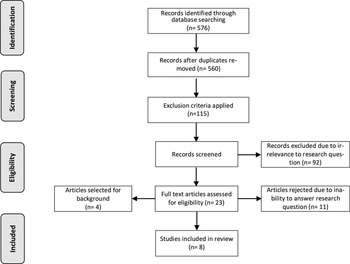
A search strategy using several recognized electronic databases was employed to identify those articles most relevant to our two research objectives. As there are two research objectives, we ran two separate searches. Articles underwent a thorough selection process, which can be divided into five phases. Phase 1 consisted of the initial search strategy using selected keywords and MeSH terms. In phase 2, exclusion criteria were applied to narrow the search down. Phase 3 involved reading the titles and abstracts of the remaining articles and selecting those most relevant to the research questions. Finally, during phase 4 the remaining articles were read in their entirety to determine their ability to answer the research question and those that were deemed suitable progressed to stage 5 for inclusion in this review (See Fig. 1 for a simplified flow chart of this search process, based on the PRISMA guidelines (Moher et al. Reference Moher, Liberati, Tetzlaff and Altman2009). All phases of the search process were conducted by a single researcher.
Literature search and selection process for search number 1.

Search number 1
Phase 1: Initial search strategy
A search strategy using PubMed, Scopus, and EBSCO databases (Academic Search Complete, CINAHL, PsycARTICLES and PsychInfo) was conducted to identify articles relevant to our first research objective. The literature search was conducted up to and including 9 April 2016. We employed the following search criteria:
-
i. One or more Lithium terms: ‘Lithium/therapy’ [MesSH] OR ‘Lithium’ [Mesh] OR ‘lithium’ [All fields]
AND
-
ii. One or more drug monitoring terms: ‘Drug Monitoring’ [Mesh] OR ‘Drug monitoring/standards’ [Mesh] OR ‘Drug Monitoring/methods’ [Mesh]
AND
-
iii. One or more terms relating to standards: ‘standards’ [Subheading] OR ‘standards’ [All Fields] OR ‘reference standards’ [MeSH]
The full search strategies used for each individual database can be found in Online Appendix 1.
Phase 2: Applying exclusion criteria
Studies were excluded from this review if they were not:
-
i. Available in full text
-
ii. Published in a peer reviewed journal
-
iii. In English
-
iv. Concerned with human adults >18 years of age
-
v. Carried out in the UK or Ireland.
Phase 3: The titles and/or abstracts of potentially relevant studies were screened.
Phase 4: Full-text copies of articles identified as potentially relevant were retrieved and individually assessed for inclusion in the review stage.
Phase 5: The selected articles were individually assessed with a recognized critical appraisal tool.
Search number 2
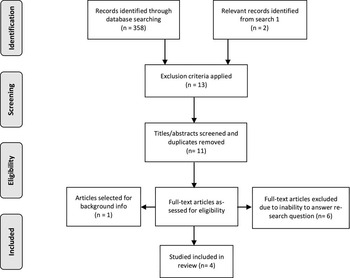
First, articles selected in the previous search, as well as their reference lists were screened to see if any of the studies discussed the concept of shared care agreements. A second search strategy was then constructed to find additional studies concerned with the subject of shared care arrangements developed for the purpose of monitoring lithium therapy. The same databases as in search 1 were used and articles went through the same five phases to be selected for inclusion in this review. Fig. 2 is a simplified flowchart illustrating this combined search process.
Literature search and selection process for search number 2.

Results
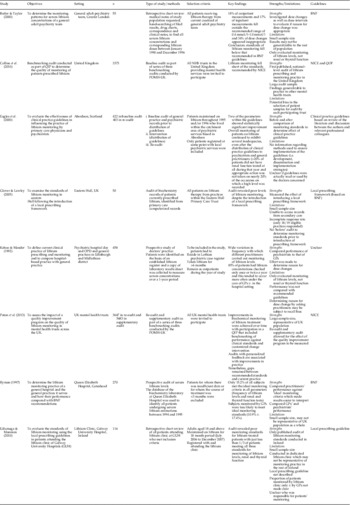
Our first search identified 576 articles. After applying the exclusion criteria and rejecting studies that were unable to answer our research questions, a total of eight articles were selected for review. All studies consisted of audits intended to determine the quality of lithium monitoring in various settings across the United Kingdom and Ireland, spanning a time frame of 25 years. Two studies were designed as ‘before/after’ audits to determine the effect of an intervention conducted to improve monitoring standards (Eagles et al. Reference Dennison, Clarkson, O’Mullane and Cassidy2000; Paton et al. Reference Paton, Adroer and Barnes2013). Paton et al. (Reference Paton, Adroer and Barnes2013) conducted three audits (baseline, re-audit and supplementary audit) to assess the impact of a quality improvement program run by the Prescribing Observatory for Mental Health. An older study by Eagles et al. (Reference Dennison, Clarkson, O’Mullane and Cassidy2000) set out to determine whether the distribution of clinical practice guidelines improved monitoring quality. Interestingly, the literature search yielded only one study concerned with lithium monitoring in Ireland (Udumaga & Mannion, Reference Udumaga and Mannion2010). Table 1 summarizes the key findings of each individual study included in this review.
Studies evaluating lithium monitoring patterns in the United Kingdom and Ireland

BNF, British National Formulary; QIP, quality improvement program; POMH-UK, Prescribing Observatory for Mental Health-UK; NICE, National Institute for Health and Care Excellence; QOF, quality outcomes framework; OPD, outpatients department; NHS, National Health Service.
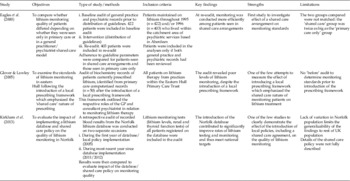
As for our second research question, only three studies (Eagles et al. Reference Dennison, Clarkson, O’Mullane and Cassidy2000; Buckley & Sharrard, Reference Buckley and Sharrard2003; Glover & Lawley, Reference Geddes, Burgess, Hawton, Jamison and Goodwin2005) specifically addressed whether the implementation of shared care protocol for patients on lithium therapy would improve monitoring quality. Two of these studies (Eagles et al. Reference Dennison, Clarkson, O’Mullane and Cassidy2000; Glover & Lawley, Reference Geddes, Burgess, Hawton, Jamison and Goodwin2005) had already been identified in the first search, while the third was identified by searching through reference lists (Kirkham et al. Reference Kessing, Søndergård, Kvist and Andersen2013). The second search strategy did not yield any additional studies with the potential to answer our research question. The key findings of these three studies in relation to the second research objective are summarized in Table 2.
Studies investigating the effect of shared care agreements on monitoring quality

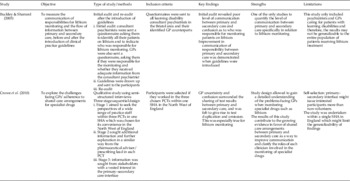
In addition to this, our search strategies identified two studies discussing the level of communication between primary and secondary care in relation to the prescribing and monitoring of lithium treatment (Buckley & Sharrard, Reference Buckley and Sharrard2003; Crowe et al. Reference Crowe, Cantrill and Tully2010). The key findings of these studies are summarized in Table 3.
Studies evaluating the level of communication between primary and secondary care in relation to lithium monitoring

PCT, primary care trust; SHA, strategic health authority.
Assessment of the validity of included studies
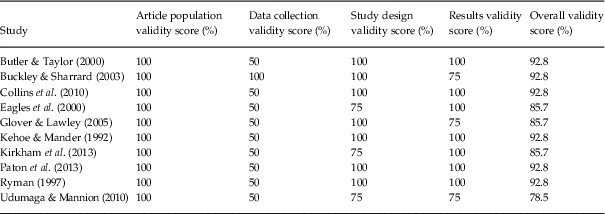
The validity of each study included in this review was assessed by means of a verified critical appraisal tool. The 10 quantitative studies were analyzed by means of the evidence-based librarianship (EBL) critical appraisal checklist (Glynn, Reference Glover and Lawley2006), while the validity of the qualitative study was assessed by using the guidance offered in the BMJ article Critically Appraising Qualitative Research (Kuper et al. Reference Kirkham, Bazire, Anderson, Wood, Grassby and Desborough2008). Validity of the 10 articles is illustrated in Table 4. All 10 studies demonstrated full overall validity (i.e. an EBL score ⩾75%). A full table illustrating the calculation of these scores may be seen in Online Appendix 2. In general, the main limitations were related to methodology and study design; for instance, several studies failed to describe the guidelines used as the reference standard against which performance would be assessed, or how these guidelines were distributed to audit participants (Kehoe & Mander, 1992; Eagles et al. Reference Dennison, Clarkson, O’Mullane and Cassidy2000; Udumaga & Mannion, Reference Udumaga and Mannion2010). The qualitative study (Crowe et al. Reference Crowe, Cantrill and Tully2010) met all criteria for validity, as can be seen in Online Appendix 3.
An illustration of section validity and overall validity scores of articles assessed by the evidence-based librarianship critical appraisal checklist

Discussion
Monitoring standards
This review, which spans 25 years of lithium monitoring shows an overall positive trend in the improvement of monitoring quality with older studies reporting more instances of substandard monitoring than audits conducted more recently. However, none of the studies included in this review reported complete adherence to monitoring guidelines. Studies which evaluated monitoring practices before and after the active distribution of guidelines did find a significant improvement in monitoring standards (Eagles et al. Reference Dennison, Clarkson, O’Mullane and Cassidy2000; Paton et al. Reference Paton, Adroer and Barnes2013). These results confirm the importance and need for regular auditing and active guideline distribution and implementation. There was a paucity of data regarding monitoring standards in Ireland. Our search yielded a single audit revealing disappointing results, with only 1/3 of patients meeting the standards in all monitoring parameters (Udumaga & Mannion, Reference Udumaga and Mannion2010). It is worth noting that the Irish Medication Safety Network (IMSN) had previously reported on this significant lack of available data in 2012; they noted that ‘no national guidelines are in place for prescribing and monitoring lithium therapy in Ireland, and national statistics are not available for adherence with accepted monitoring standards’ (IMSN, 2012: 3).
Some older studies sought to compare the performance of psychiatrists versus general practitioners to see whether patients receiving care from specialist psychiatric clinics received a better quality of monitoring than those cared for solely in primary care. Two studies found that patients monitored by GPs were less likely to meet ideal monitoring standards (Kehoe & Mander, 1992; Ryman, Reference Ryman1997), while a study by Eagles et al. (Reference Dennison, Clarkson, O’Mullane and Cassidy2000) found that monitoring was conducted more efficiently for patients seen as part of a joint care agreement between psychiatrists and GPs. Unfortunately, there was no recent studies conducted on the subject.
Poor communication between primary and secondary care
Poor communication between primary and secondary care was one of the main reasons advanced to explain failure to meet monitoring standards. Buckley & Sharrard (Reference Buckley and Sharrard2003) conducted an audit investigating the level of communication between primary and secondary care in the monitoring of lithium therapy. They found the main problem to be that GPs and psychiatrists were not clear about who was responsible for the monitoring. They conducted a re-audit after the introduction of lithium monitoring guidance sheets and found that communication was vastly improved as both parties were much clearer on their respective responsibilities. A limitation of this study was that it only included clinicians caring for patients with learning disabilities, and thus cannot be generalized to the entire population of patients receiving lithium therapy.
A more recent study by Crowe et al. (Reference Crowe, Cantrill and Tully2010) sought to identify GPs and stakeholders’ views on shared care arrangements for specialist drugs by means of semi-structured interviews. Participants identified the lack of a shared care protocol for lithium as one of the factors contributing to problems with monitoring, such as test duplication or worse, omission, due to confusion surrounding who was responsible for the monitoring tests. In light of this evidence, the idea of shared care management emerged as a potential way of increasing communication between GPs and psychiatrists, as well as clarifying their respective roles and responsibilities, ultimately leading to a better quality of lithium monitoring in both the primary and secondary care setting.
It should be kept in mind that the development of a shared care agreement is but a stepping stone in the move toward more seamless communication. Its implementation in practical terms depends on a multitude of factors including but not limited to technical, logistical and financial determinants. For instance, access to shared online laboratory data and clinical information is a basic requirement for successful communication at the primary/secondary interface. Moreover, the development of new guidelines and policies is a lengthy and costly process, which relies on an integrated organizational structure comprised of dedicated committees and regulatory bodies. While these essential structures are already in place in most Clinical Commissioning Groups in the UK’s NHS, the situation is more difficult to assess in Ireland. The Irish mental health services underwent a major restructuring in 2006 as part of the health service executive’s (HSE) A Vision for Change policy, yet from what we can gather from interim progress reports, this process seems far from being complete (Keogh, Reference Kehoe and Mander2009; Mental Health Reform, Reference Lauterbach, Felber, Muller-Oerlinghausen, Ahrens, Bronisch, Meyer, Kilb, Lewitzka, Hawellek, Quante and Richter2015). As such, the introduction of a shared care agreement would represent a greater challenge than in the United Kingdom, where most healthcare services are already integrated within and funded by the NHS. Adherence to guidelines and the effective communication between primary and secondary care depends not only on the clinicians themselves but also on the healthcare management systems supporting them and their ability to provide adequate resources for sharing information.
Shared care agreements
The second objective of this review was to determine whether the introduction of local shared care agreements had the potential to improve the standards of lithium monitoring. Our literature search found a number of studies addressing various interventions (e.g. telepsychiatry, joint consultations or videoconferencing) falling under the general umbrella term of ‘shared care’ and their effects on a variety of mental health outcomes such as patient factors (e.g. severity of mental illness or symptom improvement) or health economics factors (e.g. health services use and cost) (Foy et al. Reference Eagles, McCann, MacLeod and Paterson2010). However, we struggled to find studies investigating existing shared care agreements designed specifically for the purpose of lithium monitoring and the effects such agreements might have on monitoring standards.
In addition to assessing lithium monitoring standards before and after the distribution of clinical guidelines, the study by Eagles et al. (Reference Dennison, Clarkson, O’Mullane and Cassidy2000) also sought to determine if monitoring standards were higher for patients seen under a general practitioner/psychiatrist shared care arrangement versus those seen solely in primary care. They found that patients who were in shared care arrangements received better monitoring across the majority of parameters examined when compared with patients seen solely by general practitioners. A potential limitation of this study lies in the fact that this comparison was not originally designed to be the focus of the study, and as a result subjects in the two groups compared were not matched; indeed, the ‘shared care’ group was twice as big as the ‘primary care only’ group.
Glover & Lawley (Reference Geddes, Burgess, Hawton, Jamison and Goodwin2005) also addressed the effect of introducing a local shared care framework on the quality of lithium monitoring. The results of this audit revealed poor levels of lithium monitoring despite the introduction of a local prescribing framework. However, as their methodology did not include a ‘before’ component to the study, it is not possible to determine whether the shared care framework might have improved standards that were initially worse. A more recent study conducted by Kirkham et al. (Reference Kessing, Søndergård, Kvist and Andersen2013) in Norfolk set out to determine the impact of implementing a lithium database and shared care policy on the quality of lithium monitoring. They found that the development of a lithium database and the move toward shared care contributed to the improvement of monitoring quality by aiding communication between primary and secondary care. Unfortunately, this study also contained some limitations; the lack of variation in the Norfolk population may limit the generalizability of the findings to the rest of UK population. In addition, details of the shared care policy used were not fully described.
Strengths and limitations of this review
Our study consists of a thorough review of the literature on a topic for which there is a paucity of available data. Several databases were used to find articles relevant to the research objective. However, all phases of the search process were conducted by a single researcher. For this reason, there remains a potential for bias and misinterpretation of the literature assessed in this review. In addition, validity of this review was not assessed by an independent reviewer.
Perhaps a more detailed search of the gray literature could benefit this review if it were to uncover additional information or examples on the use of informal shared care agreements that might exist between individual GPs or GP practices and secondary care.
Finally, to compare an investigation of lithium monitoring practices in the setting of two different countries with two different models of healthcare organization is not optimal. What applies to the UK’s NHS might not translate to the situation in the Irish health services limiting our ability to draw comparisons or extrapolate findings from the UK studies into the Irish setting; further research is needed to investigate the feasibility of shared care arrangements for lithium monitoring in Ireland.
Conclusion
The literature reviewed suggests that overall, the quality of monitoring lithium therapy has been improving in the United Kingdom in the last 25 years; regular auditing and active implementation of monitoring guidelines have played an important role in improving these standards. However, monitoring habits are still failing to fully meet all the parameters outlined in the guidelines. This may in part be due to a lack of effective communication between primary and secondary care (Buckley & Sharrard, Reference Buckley and Sharrard2003; Crowe et al. Reference Crowe, Cantrill and Tully2010).
Several shared care interventions have been described in the literature but there is a paucity of studies concerned with the effects of local shared care arrangements designed specifically for the purpose of lithium monitoring. A total of three studies attempting to evaluate the impact of shared care agreements on lithium monitoring in the United Kingdom were identified (Eagles et al. Reference Dennison, Clarkson, O’Mullane and Cassidy2000; Glover & Lawley, Reference Geddes, Burgess, Hawton, Jamison and Goodwin2005; Kirkham et al. Reference Kessing, Søndergård, Kvist and Andersen2013). Two of them showed that such agreements have the potential to improve standards by allowing the responsibilities for managing the prescribing of lithium to be clearly defined and shared between primary and secondary care (Eagles et al. Reference Dennison, Clarkson, O’Mullane and Cassidy2000; Kirkham et al. Reference Kessing, Søndergård, Kvist and Andersen2013). While the limited amount of evidence precludes us from drawing any robust conclusions concerning the role of shared care agreements in the improvement of monitoring standards, this review does provide new insights into the important issue of drug monitoring and communication at the primary/secondary care interface. Finally, the marked lack of Irish data prevents us from evaluating the evolution of monitoring quality in Ireland or the impact of any strategy aimed at its improvement.
Acknowledgments
None.
Financial Support
This research received no specific grant from any funding agency, commercial or not-for-profit sector.
Conflicts of Interest
The authors declare that they have no conflicts of interest.
Ethical Standards
The authors assert that all procedures contributing to this work comply with the ethical standards of the relevant national and institutional committee on human experimentation with the Helsinki Declaration of 1975, as revised in 2008.
Supplementary material
To view supplementary material for this article, please visit https://doi.org/10.1017/ipm.2017.2