INTRODUCTION
The aim of radiotherapy is to deliver a high dose of irradiation to the clinical target volume without causing excessive toxicity to the surrounding organs. In localized and low-risk prostate cancer, the target volume for radiotherapy includes only the prostate gland, and prostate brachytherapy is a well-established treatment modality.Reference Boehmer, Maingon, Poortmans, Baron, Miralbell, Remouchamps, Scrase, Bossi and Bolla1,Reference Salembier, Lavagnini, Nickers, Mangili, Rijnders, Polo, Venselaar and Hoskin2 More than 15 years experience with I-125 implants have established prostate brachytherapy as the treatment of choice for low-risk prostate cancer.Reference Hilaris3–Reference Sylvester, Grimm, Wong, Galbreath, Merrick and Blasko8
This report presents our long-term experience with I-125 implant in 181 patients with localized low-risk prostate cancer. The end points are biochemical-free survival and treatment-related urinary toxicity.
PATIENTS AND METHODS
Brachytherapy is the treatment of choice for patients with localized and low-risk prostate cancer referred to our department since December 2000. The criteria for I-125 implant were pathologically confirmed prostate adenocarcinoma, Gleason score ≤ 6, PSA ≤ 10 ng/ml and clinical stage T1-T2A. In addition, prostate volume should be ≤ 50 ml, IPSS score ≤ 15 and maximal urine flow > 10 ml/second. Patients meeting these criteria and having a prostate volume of more than 50 ml were advised to receive a short course of hormonal therapy in an attempt to reduce the volume before the implant. The hormonal therapy included Casodex (Bicalutamide) 50 mg/day for 28 days and two injections of LH-RHAA at 3-month intervals. The I-125 implant was performed after the second LH-RHAA injection when the maximum prostate volume reduction was achieved.
From December 2000 to March 2009, 181 patients who met these criteria underwent I-125 prostate implant. The brachytherapy was performed in two steps, the first including a prostate volume study and implant planning and the second, the I-125 implant and dosimetry study. The prostate volume study and the implant were performed in the operating theater with the patient under epidural anesthesia in the lithotomic position. For the volume study, the prostate gland was scanned longitudinally and axially by transrectal ultrasound. The axial scanning was done in 5 mm intervals and the margin of the prostate gland was contoured on each slice and the volume was automatically calculated. The plan for the implant was created in conformance to the TG 43 guidelines.Reference Nag, Beyer, Friedland, Grimm and Nath9 The prescription dose was 145 Gy and the 95% isodose line covered the entire volume. The maximal dose to the urethra was less than 210 Gy. During the implant, a normal rectangular template was fixed at about 2 cm from the perineum. Two needles were inserted into non-active coordinates to keep the prostate from moving laterally, the needles being inserted at the appropriate coordinate to the correct length under TRUS guidance. Since the insertion of a needle caused the prostate to elongate, it was inserted beyond the gland, withdrawn and then reinserted. The insertion of the needles into the prostate started with the superior lines. The radioactive sources were deposited by keeping the obdurate steady while withdrawing the hollow needle in a rotating movement. We used standard seed with an activity of 0.357(mCi) (supplied by Amersham). Orthogonal x-rays with a C-arm were used to check the final source distribution pattern.
The work-up before the volume study included transrectal ultrasound to determine prostate volume, blood count and biochemistry, PSA, chest x-ray, pelvic and abdominal CT, urine flow metric and completion of the IPSS form. Four weeks after the implant, a chest x-ray to detect migrating lung seeds and a pelvic CT scan for the dosimetry study were done. The efficacy and toxicity of the implant were evaluated every 3 months during the first year and every 6 months after that. The tumor response evaluation was based on digital rectal examination and serum PSAReference Roach, Hanks, Thames, Schellhammer, Shipley, Sokol and Sandler10 and the urinary toxicity was based on IPSS form. In case of biochemical failure (PSA value = nadir + 2 ng/ ml), a work-up was done for local and systemic evaluation.
Statistical analysis
The Kaplan–Meier method was used to calculate means and medians of disease-free survival. Mann-Whitney and Kruskal-Wallis nonparametric tests were used to compare between PSA and IPSS values during time points by patients’ categorical characteristics.Reference Kaplan and Meier11,Reference Mann and Whitney12 Two-tailed p-values of 0.05 or less were considered as statistically significant. SPSS (Statistics Products Solutions Services) 17.0 software for Windows was used for statistical analysis.
RESULTS
From December 2000 to March 2009, 181 patients with localized prostate cancer received treatment with I-125 implant. The median age was 68 years and median PSA was 6.6 ng. Of the 181 patients, 101 had T1C and 170 had Gleason scores of 6 (3 + 3). The median IPSS was 6 and the median maximal urine flow was 15 ml/second (Table 1).
Patient characteristics

The median follow-up from implant to last visit of the entire group was 51 months (range, 15.4–105 months). Seven patients were lost from follow-up.
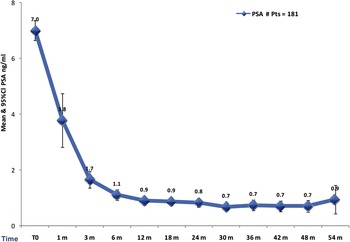
Treatment efficacy was evaluated by testing the serum PSA values post-implant. The mean post-implant value of the entire group is shown in Figure 1. The mean values of serum PSA at 1, 6, 12, 24, and 36 months were 1.8, 1.1, 0.9, 0.8 and 0.7 ng/ml, respectively. In a median follow-up of 5 years, the mean PSA value was 0.7 ng/ml.
Post-implant serum PSA for the entire group.

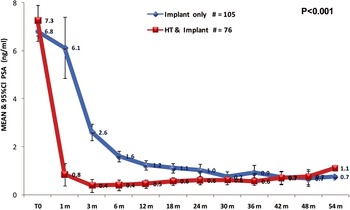
Seventy-six patients (42%) received a short course of hormonal therapy for volume reduction prior to implant with good results. The prostate gland was reduced by 40% to a median volume of 31.3 cc before the implant. The impact of hormonal therapy on post-implant PSA was evaluated (Figure 2). The rate of decrease in PSA values during the first post-implant year was significantly rapid in the hormonal therapy group as compared with the group that did not received that therapy (p < 0.001).
Post-implant serum PSA for the implant-only group and for the hormonal therapy and implant groups.

Nine patients had biochemical failure according to the RTOG-ASTRO Phoenix definition (Nadir + 2.0 ng/ml).Reference Nag, Beyer, Friedland, Grimm and Nath9 Of these, one patient who wished to maintain his sexual potency refused hormonal therapy, eight patients received hormonal therapy with a decreased serum PSA to 0.0 ng/ml. No patient developed clinical disease.
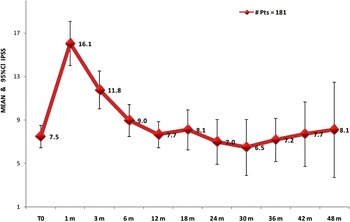
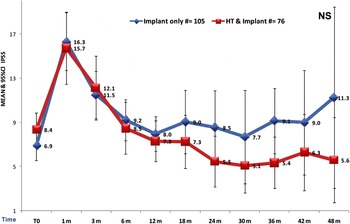
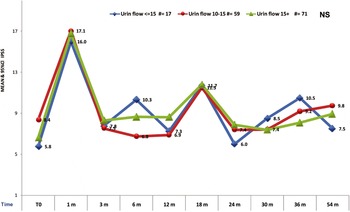
The most common side-effect was urinary disturbance. All patients suffered from acute urethritis. The impact of this disturbance is well demonstrated in the IPSS score (Figure 3). One month after implant, the mean IPSS increased from 6 to 16 and then slowed down to the initial level. The mean IPSS at 3, 6, 9, 12 and 18 months post-implant was 11, 9, 9, 7 and 6, respectively. The impact of hormonal therapy on post-implant IPSS was evaluated. The mean IPSS value was less in patients who received hormonal therapy as compared with those who did not (Figure 4) particularly after 12 months, but this difference was not statistically significant. The impact of pre-implant urine flow on post-implant IPSS was also evaluated (Figure 5). The mean values of post-implant IPSS were similar in three groups of patients with different urine follow < 10 ml/second, 10–15 ml/second and > 15 ml/second. Seventeen (9.4%) patients experienced acute urinary retention and two underwent TUR-P.
Post-implant international prostate systemic score for the entire group.

Post-implant international prostate systemic score for implant-only and for implant and hormonal therapy group.

Post-implant international prostate systemic score according to pre-implant urine flow.

Seven patients developed second malignancy: larynx – 1, bladder – 1, lung – 2, pancreas – 1 and colon cancer – 2 patients. Two of them, one with lung and one with pancreas cancer, died.
DISCUSSION
The treatment approach in localized prostate cancer is controversial and treatment options range from active surveillance to radiotherapy to radical prostatectomy (13–15). Any decision should be based on the prognostic factors: tumor stage as determined by DRE and MRI examination (preferred Endorectal MRI), serum PSA values and Gleason scores. Patient’s age, co-morbidity and general medical condition should be taken into account.
In patients with low-risk localized disease tumor stage T1C-T2B, serum PSA ≤ 10 ng/ml and Gleason score ≤ 6, the risk of extra-capsular extension and seminal vesicles involvement is very low.Reference Partin, Kattan, Subong, Walsh, Wojno, Oesterling, Scardino and Pearson16 Therefore, the target organ for treatment should be the prostate gland only. Low-doserate prostate brachytherapy with I-125 implant is the optimal radiotherapy modality. The procedure is short (1 day), well tolerated and effective based on serum PSA results. The end point of efficacy in this particular disease is the serum PSA.Reference D’Amico, Moul, Carroll, Sun, Lubeck and Chen17
The results of our study are similar to others.Reference Hilaris3–Reference Sylvester, Grimm, Wong, Galbreath, Merrick and Blasko8 The 8-year actuarial PSA-free survival was 94%. The PSA decline rate was influenced by pre-implant hormonal therapy. In the first year, post-implant was significantly rapid in patients who received prostate reduction hormonal therapy compared with those who received implant only. The biochemical failure rate was low (5%) and no patients developed clinical relapse.
Seven patients suffered from a second malignancy in different sites, including colon, urinary bladder and pancreas. Because of the relatively short follow-up after the implant, these malignancies lack any connection to the implant.
The treatment was well tolerated and the most common side effect was urinary disturbance, which the IPSS reflected. The maximal urinary disturbance occurred 1 month after the implant and 17 patients experienced acute urinary retention. This incidence of urinary complication is similar to the literature.Reference D’Amico, Moul, Carroll, Sun, Lubeck and Chen17,Reference Gelblum, Potters, Ashley, Waldbaum, Wang and Leibel18 The impact of hormonal therapy on the urinary disturbances was evaluated. Patients who received hormonal therapy experienced lower IPSS values as compared with those who underwent implant only, but the difference was not statistically significant. The impact of pre-implant urine flow on post-implant IPSS was evaluated. No difference was found among three different urine-flow groups and this finding was not correlated with other reports.Reference Terk, Stock and Stone19,Reference Williams, Millar, Duchesne, Dally, Royce and Snow20 Therefore, low urine flow should not be an absolute contraindication for prostate brachytherapy.
In conclusion, I-125 implant is an effective and well tolerated treatment and should be the treatment of choice for patients with low-risk prostate cancer.