Introduction
Demodex mites belong to the class Arachnida, Order Acarina, Family Demodicidae and are found in human pilosebaceous follicles. There are two species of demodex in humans. Demodex follicularium which is about 0.3–0.4 mm long and has a longer opisthosoma and usually resides in the hair follicles, and Demodex brevis, about 0.2–0.3 mm long, and has a shorter opisthosoma and usually resides in sebaceous and meibomian glands (Cheng et al. Reference Cheng, Sheha and Tseng2015). The body of demodex is covered by chitin exoskeleton and is composed of three parts, gnathosoma (mouthpiece: oral needle and bi-claws), podosoma (four pairs of legs with claw-like appendices) and opisthosoma (the tail). The male reproductive organ is on the dorsal side of the podosoma and the female reproductive opening is on the ventral side of the podosoma (Maraghi et al. Reference Maraghi, Rafiei and Kaydani2013). In humans, demodex mites can be found on the skin or eyelashes of the asymptomatic individual, demodicosis only manifests when their density reaches a certain threshold, especially in elderly or immunocompromised population (Lacey et al. Reference Lacey, Kavanagh and Tseng2009).
Current treatments, side-effects and resistance in human demodicosis
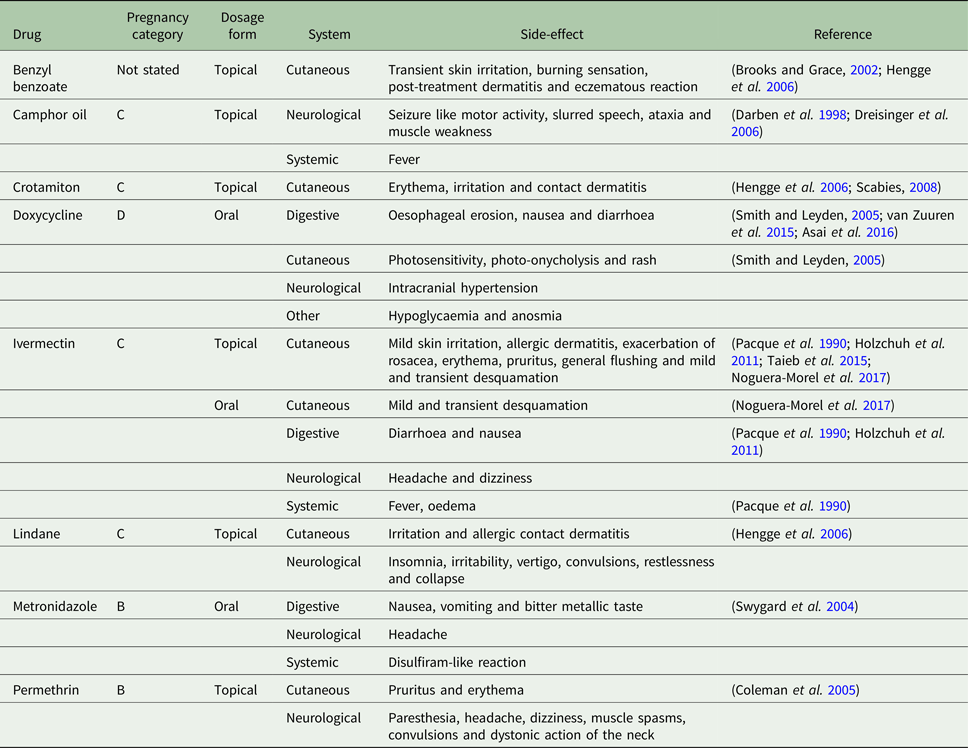
Various drugs are currently available for management of human demodicosis. The most common topical treatments include metronidazole, ivermectin, crotamiton, lindane, permethrin and benzyl benzoate. The frequently used oral treatments are metronidazole, ivermectin and doxycycline. Anti-parasitic drugs such as ivermectin as well as anti-bacterial drugs such as doxycycline are used in human demodicosis, which support the hypothesis of the multi-factorial pathogenesis of demodex infection. For example, direct damage inflicted by the mites and the inflammatory response caused by the endosymbiotic bacteria in the mites, such as Bacillus oleronius. Ivermectin and metronidazole, when administered orally show good efficacy against the demodex infection, by lowering and normalizing the mite counts, especially in cases such as blepharitis and rosacea (Salem et al. Reference Salem2013). Combined therapy may be used if a single medicament is not sufficient to control the refractory cases. A combination of oral ivermectin and topical permethrin has been used in acute lymphoblastic leukaemia and AIDS-associated demodicosis showing significant improvement in reducing the lesions without recurrence (Aquilina et al. Reference Aquilina, Viraben and Sire2002; Damian and Rogers, Reference Damian and Rogers2003). All demodex treatments, especially the oral medications, are associated with moderate to severe sides-effects (Table 1) and may be potentially harmful especially in patients with hepatic or renal dysfunction. Furthermore, current treatments such as ivermectin and metronidazole are not universally effective (Forton, Reference Forton1998; Hervás Ontiveros et al. Reference Hervás Ontiveros2014).
Common adverse effects and pregnancy category of reviewed treatments in human demodicosis.

Category A: Controlled studies show no risk or find no evidence of harm.
Category B: Animal studies show no risks, but there are no controlled studies on pregnant women.
Category C: Animal studies have shown risk to the fetus, there are no controlled studies in women, or studies in women and animals are not available.
Category D: There is positive evidence of potential fetal risk, but the benefits from use in pregnant women may be acceptable despite the risk (i.e. life-threatening condition to mother).
Category X: Studies in animals or human beings have demonstrated fetal abnormalities, or there is evidence of fetal risk. The drug is contraindicated in women who are or may become pregnant
Source and components of tea tree oil (TTO)
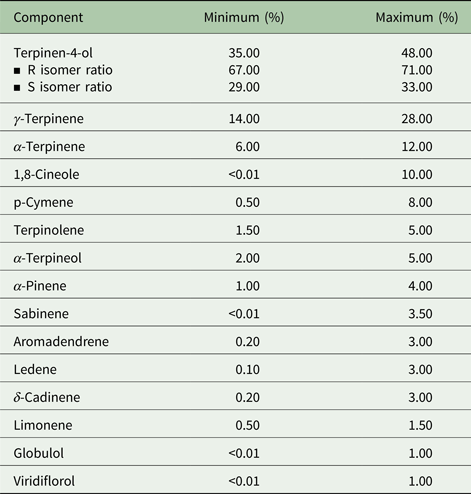
TTO is an essential oil, extracted by a steam-distillation process from the leaves and terminal branches of an Australian native plant called Melaleuca alternifolia Cheel. TTO contains more than 100 ingredients and consists largely of cyclic monoterpenes (Brophy et al. Reference Brophy1990), nearly 50% of which are oxygenated and the remaining 50% are hydrocarbons (Cox et al. Reference Cox2000). The international standard ISO 4730 terpinen-4-ol (T4O) type of melaleuca oil contains 15 major components: T4O [35–48%, in which (R) isomer: 67–71%, (S) isomer: 29–33%], γ-terpinene (14–28%) and α-terpinene (6–12%), which comprise about 70% of the whole oil, while 1,8-Cineole, ρ-cymene, terpinolene, α-terpineol and α-pinene account for about 20% of the oil (Australian Tea Tree Industry Association, 2017). Moreover, the ISO 4730: 2017 standard stipulates several physical parameters of the TTO oil such as appearance, colour, odour, relative density, refractive index, optical rotation and miscibility in 85% (v/v) ethanol at 20 °C (Australian Tea Tree Industry Association, 2017). The range and the chemical structures of the 15 main constituents of TTO are shown in Table 2 and Fig. 1.
Chemical structures of the 15 main constituents of tea tree oil.

Main constituents and their range in pure Australian TTO (ISO 4730: 2017 standard)

Biological activities of TTO
Melaleuca alternifolia has been widely used by the indigenous Australians as a natural remedy for millennia due to observed benefit for skin and other conditions (Carson and Riley, Reference Carson and Riley1993; Budhiraja et al. Reference Budhiraja1999) now explained by its anti-microbial, anti-inflammatory, anti-fungal, anti-parasitic and immunomodulatory activities of the TTO extracted from the plant (Hart et al. Reference Hart2000; Carson et al. Reference Carson, Hammer and Riley2006; Low et al. Reference Low2015). It also exhibits effectiveness in the management of a variety of inflammatory, infectious and parasitic dermatological conditions (Koh et al. Reference Koh2002; Halcon and Milkus, Reference Halcon and Milkus2004; Thomas et al. Reference Thomas2016). Moreover, lid scrub with different concentrations of TTO and its extract, especially T4O, has been reported to be effective in reducing demodex mite counts and ocular surface inflammation associated with blepharitis, conjunctivitis, keratitis and chalazion (Liang et al. Reference Liang2010; Liu et al. Reference Liu, Sheha and Tseng2010; Tighe et al. Reference Tighe, Gao and Tseng2013; Yam et al. Reference Yam2014; Hirsch-Hoffmann et al. Reference Hirsch-Hoffmann2015). In this review, we explore the use of the TTO in ocular and other demodex related diseases in humans and summarize the results of trials using TTO as a treatment for human demodicosis.
Possible therapeutic mechanisms of TTO in human demodicosis
Inhibition of acetylcholinesterases in parasites
TTO, especially its extract such as T4O and 1,8 cineole, competitively block the neurotransmitter terminating enzyme acetylcholinesterases (AchE) in parasites that may contribute to the arthropodicidal effect (Mills et al. Reference Mills2004); however, it has been suggested that the inhibition of AchE by TTO may be more potent than that of the primary monoterpenoid constituents due to the synergistic or additive effect caused by a combination of components instead of a one single strong inhibitor (Miyazawa and Yamafuji, Reference Miyazawa and Yamafuji2006).
Anti-inflammatory, immunomodulatory and anti-oxidant effects
T4O is the major TTO component and exhibits potent inhibition of substance P-related inflammatory reactions; it may also modulate substance P-initiated endothelial nitric oxide (NO) release (Khalil et al. Reference Khalil2004). Furthermore, T4O is a potent inhibitor of lipopolysaccharide-induced cytokines, such as IL-1β, IL-6 and IL-10, produced by macrophages upon activation of toll-like receptor (TLR) 4 and TLR2/4; this inhibition was mediated by interfering with the NF-κB, p38 or ERK MAPK pathways (Nogueira et al. Reference Nogueira2014). In addition, T4O significantly reduced the histamine-induced wheal and flare response and histamine-induced erythema index, but not 1,8-cineole and α-terpineol, which exhibited anaesthetic properties (Khalil et al. Reference Khalil2004).
It is also reported that TTO can reduce the production of superoxide ions, pro-inflammatory factors such as tumour necrosis factor (TNF), IL-1, IL-8 and prostaglandin E2 in monocytes and modulate vasodilation and plasma extravasation associated with histamine-induced inflammation in humans (Khalil et al. Reference Khalil2004). It also increased the levels of monocyte chemo-attractant protein 1, EGFR (epidermal growth factor receptor), matrix metalloproteinase 1 (MMP-1) and tissue inhibitor of metalloproteinase-1 and -2 in the human dermal fibroblast, which is consistent with the anti-proliferative activity, tissue remodelling and wound healing properties of TTO (Han and Parker Reference Han and Parker2017). TTO has also demonstrated antioxidant activity which was attributed to α-terpinene, α-terpinolene and γ-terpinene (Kim et al. Reference Kim2004).
Anti-microbial effects
The anti-demodicosis effect of TTO is still not fully characterized. But TTO could disrupt various membrane structures of bacteria, fungi, protozoa and enveloped viruses by its lipophilic properties (Low et al. Reference Low2017). When TTO is added to the suspensions containing Staphylococcus aureus cells, leakage of potassium ions and inhibition of cellular respiration were detected within 10 min, caused by disruption of the cytoplasmic and mitochondrial membranes (Cox et al. Reference Cox2000). Moreover, in S. aureus, autolysin activity of TTO was observed due to the release of membrane-bound cell wall autolytic enzymes that resulted in cell death (Carson et al. Reference Carson, Mee and Riley2002).
Possible mechanisms of action in TTO against human demodicosis
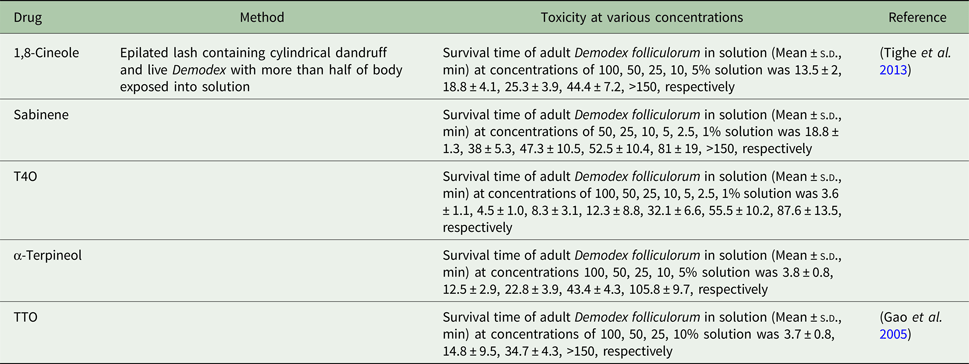
T4O is the only component of TTO that displayed killing effect on demodex at a concentration as low as 1% in mineral oil, and at a given concentration, its killing effect is greater than TTO at an equivalent concentration, followed by α-terpineol and 1,8-cineole (Tighe et al. Reference Tighe, Gao and Tseng2013). For example, 5% T4O exerted an average mite survival time of 32.1 ± 6.6 min similar to 34.7 ± 4.3 min of 25% TTO (Tighe et al. Reference Tighe, Gao and Tseng2013). Moreover, T4O exhibited a positive synergistic effect with terpinolene, and dyssynergistic effect with α-terpineol and no positive or negative effect with γ-terpinene in killing the mites, the decreased potency may be due to the decreased solubility when mixing with other ingredients (Tighe et al. Reference Tighe, Gao and Tseng2013). Furthermore, the influence of TTO in cytokine production was marked, as the chitin exoskeleton of demodex may activate the inflammatory cascade in keratinocytes through the TLR-2 pathway (Koller et al. Reference Koller2011) and infestation of demodex mites can increase tear cytokine levels, especially IL-1β and IL-17, which can cause inflammation of the lid margin and ocular surface (Kim et al. Reference Kim, Chun and Kim2011a, Reference Kimb). One in vitro study showed that T4O can decrease the production of pro-inflammatory cytokines such as INF-γ, IL-1β, IL-6, IL-17 and anti-inflammatory cytokines such as IL-4 and IL-10 upon TLR-2 activation in Escherichia coli (Nogueira, Reference Nogueira2013). This is consistent with the study of Kim et al. in which the IL-1β and IL-17 cytokines levels in tears were reduced after TTO treatment of demodex blepharitis (Kim et al. Reference Kim, Chun and Kim2011a). Demodex can act as a vector to bring in common skin bacterial flora like Staphylococcus and Streptococcus spp. and their superantigens may play a role in demodex-related rosacea (Lacey et al. Reference Lacey, Kavanagh and Tseng2009). Therefore, the anti-microbial properties of TTO are one of the important aspects of managing demodex infection.
Our current understanding is that because of its acaricidal, anti-bacterial, anti-inflammatory, wound healing and immunomodulatory effects, TTO shows promising results in managing ocular demodicosis in humans (Gao et al. Reference Gao2005, Reference Gao2007, Reference Gao2012).
Clinical trials and case studies of TTO in ocular human demodicosis
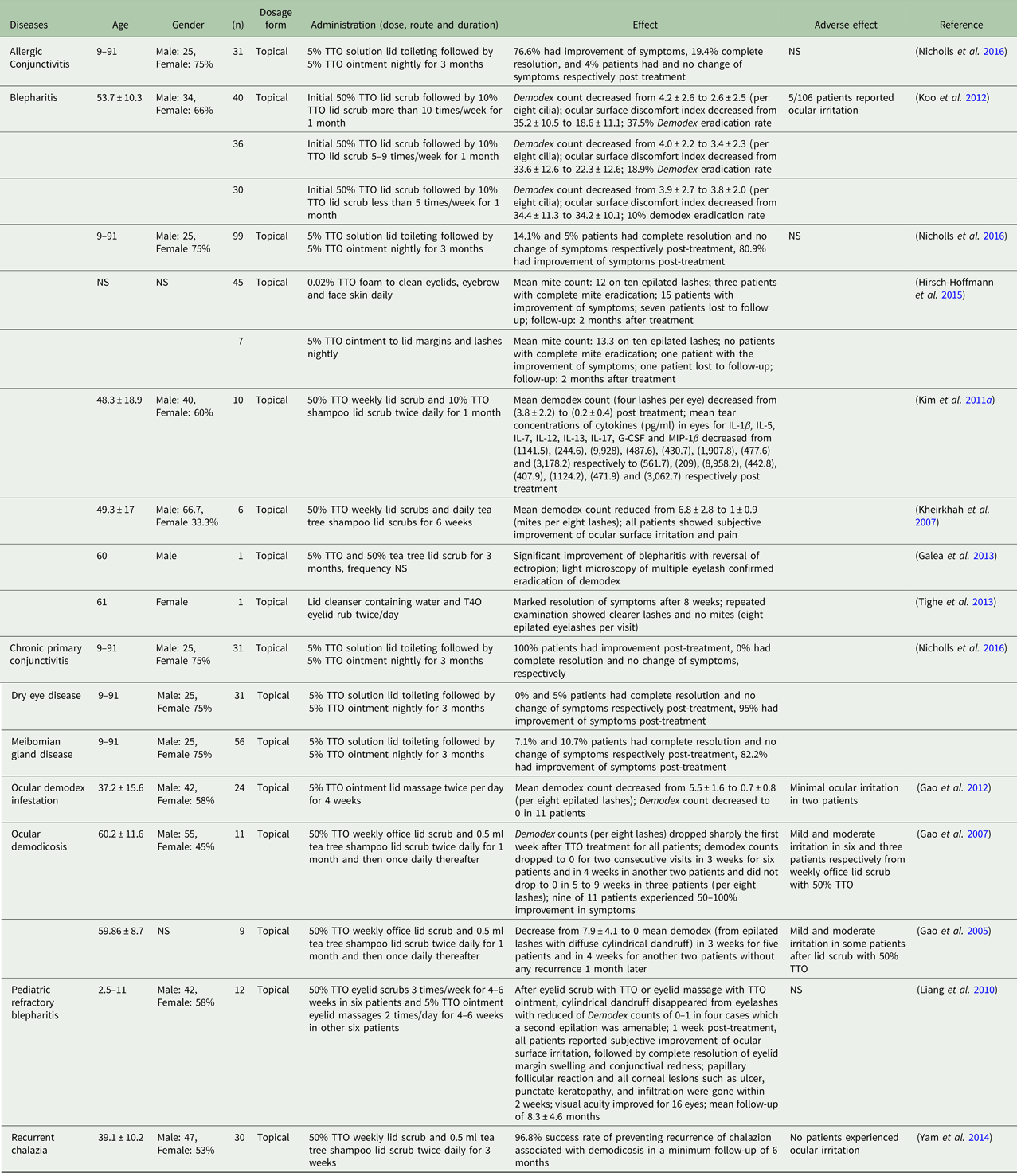
There are no randomized double-blind placebo-controlled trials of TTO in the treatment of human demodicosis; however, there are a limited number of case series reported by a number of researchers. Various dosage regimens of TTO have been demonstrated against ocular diseases including blepharitis and external ocular disorders manifested by demodicosis. In the study by Koo et al. 106 patients with typical symptoms of blepharitis due to demodicosis, mean demodex count decreased from 4 to 2.3 per eight epilated lashes after an initial 50% TTO lid scrub followed by 10% TTO daily lid scrub for 4 weeks (Koo et al. Reference Koo2012). Comparably, lid scrub with 10% TTO twice daily for 4 weeks reduced mean demodex count from 3.8 to 0.2 mites per four epilated lashes in ten patients (Kim et al. Reference Kim, Chun and Kim2011a); and lid scrub at 50% for 6 weeks decreased mean demodex count from 6.8 to 1 mites per eight epilated lashes in six patients (Kheirkhah et al. Reference Kheirkhah2007; Galea et al. Reference Galea2013; Tighe et al. Reference Tighe, Gao and Tseng2013). On the other hand, 50% TTO eyelid scrubs alone two to three times per week for 4–6 weeks resolved ocular surface irritation, followed by complete resolution of eyelid margin swelling and conjunctival redness 1-week post-treatment in 12 patients (Liang et al. Reference Liang2010). Moreover, in two different patient case studies, 5% TTO for 3 months and lid cleanser containing water or T4O eyelid rub twice daily alone resulted in significant improvement of ocular symptoms and complete eradication of mites. Other therapies such as 5% TTO ointment and solution toileting for 3 months resulted in 80.9% improvement of ocular symptoms post-treatment, but results were unsatisfactory with ointment alone (Hirsch-Hoffmann et al. Reference Hirsch-Hoffmann2015; Nicholls et al. Reference Nicholls2016). Surprisingly, 0.02% TTO foam to clean eyelids, eyebrow and face skin daily improved the symptoms of seven patients and eradicated demodex in three out of 45 cases (Hirsch-Hoffmann et al. Reference Hirsch-Hoffmann2015).
Other clinical trials and case studies showed that TTO can manage demodex-related external ocular disorders such as conjunctivitis, dry eye disease, meibomian gland disease and chalazia. In a prospective case series, 31 patients with allergic conjunctivitis from underlying demodex infestation, 5% TTO solution lid toileting followed by 5% TTO ointment nightly for 3 months resulted in 76.6% with an improvement of symptoms and 19.4% with complete resolution post-treatment (Nicholls et al. Reference Nicholls2016). In the same trial, patients with chronic primary conjunctivitis and dry eye disease using the same dosing regimen resulted in 100 and 95% improvement of symptoms; however, complete resolution was not achieved. On the other hand, patients with meibomian gland disease had 82.2% improvement of symptoms, but 10.7% had no change of symptoms (Nicholls et al. Reference Nicholls2016). In another study with 24 patients, 5% TTO ointment lid massage twice day alone for 4 weeks decreased mean demodex count from 5.5 to 0.7 per eight epilated lashes and demodex count was undetectable in 11 patients (Gao et al. Reference Gao2012). Moreover, Gao et al. demonstrated 50% TTO weekly office lid scrub and 0.5 ml tea tree shampoo lid scrub twice daily for 1 month and then once daily thereafter is effective in eradicating ocular demodicosis (Gao et al. Reference Gao2005). Similarly, 50% TTO weekly lid scrub and 0.5 ml tea tree shampoo lid scrub twice daily for 3 weeks had a 96.8% success rate of preventing recurrence of chalazion associated with demodicosis in a trial of 30 patients (Yam et al. Reference Yam2014). The TTO dosage, direction and administration form shown effective against the human demodicosis in vivo are summarized in Table 3. In vitro studies of TTO and its extracts against Demodex folliculorum are summarized in Table 4.
TTO dosage, administration, effectiveness and adverse effects in treating human demodicosis

n: number of patients
NS: Not specified
G-CSF: granulocyte-colony stimulating factor
MIP-1β: macrophage inflammatory protein-1β
In vitro studies of TTO and its extracts against Demodex folliculorum

Acaricidal effects of TTO on other parasites
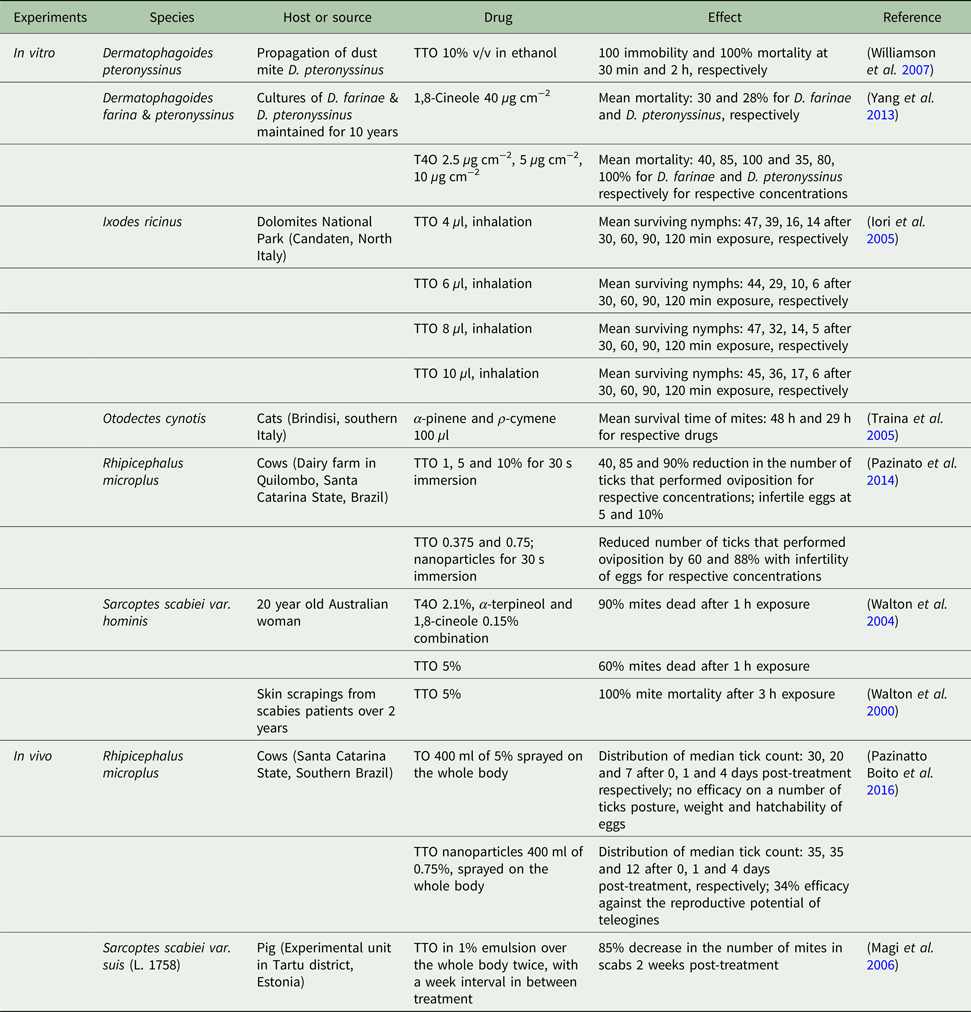
In addition to anti-demodex activity, TTO has also demonstrated promising potential as an effective acaricide in numerous in vitro and in vivo studies. In the in vitro study, Dermatophagoides pteronyssinus showed 100% immobility at 30 min and 100% mortality at 2 h in vitro after exposure to a 10% TTO formulation (Williamson et al. Reference Williamson, Priestley and Burgess2007). And 100% mortality of D. pteronyssinus and Dermatophagoides farina were observed when exposed to T4O at 10 µg cm−2 (Yang et al. Reference Yang2013). Sarcoptes scabiei var. hominis 60 and 85% died an hour later when exposed to 5 TTO and 2.1% T4O, respectively (Walton et al. Reference Walton2004). In an in vivo study of Sarcoptes. scabiei var. suis infestation in pigs the number of mites diminished by 85% in 2 weeks and 98.55% in 4 weeks after topical treatment with 1% TTO weekly (Magi et al. Reference Magi, Järvis and Miller2006). In Rhipicephalus microplus, there was a 75% reduction in tick count and 0% viable eggs after topical application of 5% TTO application to the infested cows (Pazinatto Boito et al. Reference Pazinatto Boito2016). Acaricidal effects of TTO in other parasites are summarized in Table 5.
Acaricidal effects of TTO on other parasites

Adverse effects of topical TTO
Topical TTO, typically in diluted form, is usually well tolerated. In five clinical trials with 158 patients there was 1–5% incidence of side-effects with 1–100% TTO (Buck et al. Reference Buck, Nidorf and Addino1994; Knight and Hausen, Reference Knight and Hausen1994; Southwell et al. Reference Southwell, Freeman and Rubel1997; Enshaieh et al. Reference Enshaieh2007; Kwon et al. Reference Kwon2014). They are mostly skin and ocular allergic or irritant reactions to the oil, in which irritant reactions were usually concentration dependent but allergic reaction was not (Hammer et al. Reference Hammer2006). Patients who were allergic to 1% TTO also reacted to one or more of the components such as D-limonene, α-terpinene, aromadendrene, T4O and α-phellandrene at 1, 5 or 10% (Knight and Hausen, Reference Knight and Hausen1994). Irritant reaction to TTO has been reported as low as 5% (Veien et al. Reference Veien, Rosner and Skovgaard2004). Ascaridol, ketoepoxide, ρ-cymene and 1,2,4-trihydroxy menthane, resulting from the oxidation of TTO are responsible for the skin irritation. Moreover, some anecdotal reports suggest TTO may increase the sensitivity of the skin towards other irritants (Hausen et al. Reference Hausen, Reichling and Harkenthal1999; Harkenthal et al. Reference Harkenthal, Hausen and Reichling2000). Systemic side-effects of topical TTO are very uncommon owing to its high volatility and minimal penetration into deeper skin, therefore, TTO is considered to be a safe product used topically (Cross et al. Reference Cross2008). There are no published clinical trials for oral administration of TTO and ingestion is contraindicated due to the high incidence of toxic side-effects, including skin irritation, diarrhoea, hallucinations and coma (Hammer et al. Reference Hammer2006).
Resistance to TTO
Clinical resistance of demodex to TTO or its monoterpenes constituents have not been reported. The enhanced anti-infective activity in the presence of two outer cytoplasmic membrane permeabilizers, such as EDTA (ethylene diamine tetra acetic acid) and PMBN (polymyxin B nonapeptide) (Mann et al. Reference Mann, Cox and Markham2000; Vaara, Reference Vaara1992), suggests that one or more target sites for TTO and/or T4O lie within the cell (Longbottom et al. Reference Longbottom2004). Furthermore, the multiple active components in TTO and multiple mechanisms of interactions between cell membranes and TTO may significantly reduce the potential of resistance because multiple mutations may be required to overcome all the pharmacological actions of the individual components (Carson et al. Reference Carson, Hammer and Riley2006). No parasite resistance to TTO has been reported up to now. Also, no evidence supports the concern that increased use of TTO will induce antibiotics resistance (Hammer et al. Reference Hammer, Carson and Riley2012) or resistance to conventional antibiotics of microorganisms which might lower the susceptibility to TTO, suggesting that cross-resistance is unlikely to occur (Carson et al. Reference Carson, Hammer and Riley2006). However, some in vitro studies had shown marginal decreases in susceptibility of S. aureus and E. coli in TTO (Nelson, Reference Nelson2000; Gustafson et al. Reference Gustafson2001).
Discussion
Can TTO manage human demodicosis beyond the ocular manifestation, such as facial rosacea?
Until now, no clinical trials have been done to evaluate the efficacy of TTO in managing facial rosacea. However, clinical observation by Hom et al. noted improvement in adjacent facial rosacea when treating patients with demodex-related blepharitis with TTO (Hom, Reference Hom2015). The pathogenesis of rosacea is multi-factorial when demodex is involved (Zhao et al. Reference Zhao2010; Rios-Yuil et al. Reference Rios-Yuil and Mercadillo-Perez2013). Overproliferation of mites can plug the pilosebaceous ducts, leading to a rosacea-like facial eruption (Zeytun et al. Reference Zeytun2017). The acaricidal, antibacterial, antipruritic, anti-inflammatory and wound-healing effects of TTO (Thomas et al. Reference Thomas2016) may be able to manage demodex-related dermatological conditions. Buhl et al. demonstrated many aspects of how the skin is affected in papulo-pustular/non-pustular type of rosacea, including an increase in CD4 + T cells (much more than CD8 + T cells), upregulation of Th1/Th17 polarizing gene sets and presence of IFN (interferon)-γ and IL-17A (Buhl et al. Reference Buhl2015). Koo et al. also demonstrated the elevated levels of pro-inflammatory cytokines IL-7, IL-12 and IL-17 in patients’ tears in demodex blepharitis, which were normalized after TTO treatment (Koo et al. Reference Koo2012). Furthermore IL-17 can affect the expression of the antimicrobial protein LL-37 in human epidermal keratinocytes (Woo et al. Reference Woo2016), induce angiogenesis in rosacea through VEGF (vascular endothelial growth factor) (Gerber et al. Reference Gerber2011) and stimulate the inflammatory and allergic reaction which further enhances the expression of IL-6, MMP-1 and MMP-9 (Woo et al. Reference Woo2016). This may indicate the potential targeting mechanism of TTO in treating facial rosacea.
The use of nanotechnology and microencapsulation of TTO
TTO has high volatility with limited solubility in water and a relatively strong irritant effect on the skin which may limit its dermatological uses in humans at high concentration (Carson et al. Reference Carson, Hammer and Riley2006). In order to improve these properties and increase TTO effectiveness, dosage form modification technologies can be used, such as nanotechnology and microencapsulation (Pazinatto Boito et al. Reference Pazinatto Boito2016; Zhang et al. Reference Zhang2017).
Through nanoparticles, TTO can maximize its pharmacological effects and achieve some other advantages, such as greater stability and bioavailability with less toxicity by the slow controlled release delivery (Pazinato et al. Reference Pazinato2014; Souza et al. Reference Souza2017). These can improve patient's compliance and convenience (Ravi Kumar, Reference Ravi Kumar2000) as lower concentration may be needed to achieve the similar or even superior acaricidal effect (Pazinato et al. Reference Pazinato2014). Moreover, nanoparticles can enter various cells more easily through the extracellular matrix, such as releasing the TTO into fungus (Souza et al. Reference Souza2017) and Pseudomonas biofilms (Comin et al. Reference Comin2016) resulting in enhancement of antimicrobial effect (Rai et al. Reference Rai2017). It is believed that bactericidal effect of nanoparticles is inversely proportional to the size, and the shape of the particles may be a factor as well (Santos et al. Reference Santos2014). Various trials showed that truncated triangular-shaped particles have a greater bactericidal effect compared with rod- and spherical-shaped particles, the latter being more commonly used in many clinical trials (Panacek et al. Reference Panacek2006; Pal et al. Reference Pal, Tak and Song2007).
Microencapsulation offers a possible effective solution to extend the stability of TTO by reducing environmental degradation and controlling release rates (Yim et al. Reference Yim2016). TTO microcapsules absorbed moisture and expanded, which resulted in crevices on the outer surface of the capsules and release of the TTO oil (Zhang et al. Reference Zhang2017). Several chemicals have been used to encapsulate TTO in different trials, such as amphiphilic methyl cellulose–chitosan–alginate polymer (Zhang et al. Reference Zhang2017), β-cyclodextrin (Yim et al. Reference Yim2016), glutaraldehyde crosslinked gelatin (Ocak et al. Reference Ocak, Gülümser and Baloğlu2011) and melamine–formaldehyde resin (Sánchez-Navarro et al. Reference Sánchez-Navarro2011). The encapsulation efficiency was dependent on the structure and the properties of wall material, while the release rate was dependent on the TTO content, the degree of crosslinking molecules and polymer wall concentration (Zhang et al. Reference Zhang2017).
Effect of the excipients in different formulations on TTO
The effect of the excipients of the products can be significant on the activity of TTO in the formulation. Surfactants such as sodium lauryl sulphate and alkyl dimethyl betaine, are used to solubilize the TTO in aqueous solution in different commercially available products (Thomsen et al. Reference Thomsen2011), thereby enhancing the antimicrobial effect (Hammer et al. Reference Hammer, Carson and Riley1999). However, certain lipophilic surfactants may compromise the antimicrobic activity of TTO by forming micelles to enclose the TTO, therefore preventing it from exhibiting its germicide action on microorganisms (Hammer et al. Reference Hammer, Carson and Riley1999). Other excipients, such as alcohol, can increase the overall antimicrobial activity of TTO and act as a co-solvent in aqueous solutions in different formulations (Thomsen et al. Reference Thomsen2011).
Concluding remarks
Multiple studies suggest TTO and its extract T4O have positive results in controlling demodex-related ocular conditions, in alleviating the mite counts and related symptoms. TTO is simple to use and has better side-effect profile compared with the current treatments. The acaricidal, anti-bacterial, anti-pruritic, anti-inflammatory and wound-healing properties of TTO (Thomas et al. Reference Thomas2016) suggest it may have the potential to be an alternative treatment to manage other demodex-related dermatological conditions such as rosacea. To evaluate the effectiveness of TTO, rigorous double-blind controlled clinical trials are needed to evaluate its potential especially for those patients who have failed currently recommended treatments such as metronidazole.
Financial support
This publication was supported by the grant from Science and Technology Planning Project of Guangdong Province, China (grant no. 2011B080701069).
Conflicts of interest
These authors declare no conflict of interest.
Ethical standards
Not applicable.