Introduction
In Western countries, the reported estimated lifetime prevalence of eating disorders (ED) is around 0.5, 0.5–1, and 1–2% for anorexia nervosa (AN), bulimia nervosa (BN), and binge eating disorder (BED) respectively, and about three–eight times higher among females for all EDs (Hudson et al., Reference Hudson, Hiripi, Pope and Kessler2007; Preti et al., Reference Preti, Girolamo, Vilagut, Alonso, Graaf, Bruffaerts, Demyttenaere, Pinto-Meza, Haro and Morosini2009; Kessler et al., Reference Kessler, Berglund, Chiu, Deitz, Hudson, Shahly, Aguilar-Gaxiola, Alonso, Angermeyer, Benjet, Bruffaerts, de Girolamo, de Graaf, Maria Haro, Kovess-Masfety, O'Neill, Posada-Villa, Sasu, Scott, Viana and Xavier2013).
EDs are a cluster of psychiatric disorders at high risk of mortality (Arcelus et al., Reference Arcelus, Mitchell, Wales and Nielsen2011; Keshaviah et al., Reference Keshaviah, Edkins, Hastings, Krishna, Franko, Herzog, Thomas, Murray and Eddy2014; Monteleone and Brambilla, Reference Monteleone and Brambilla2015), not only for medical complications associated with disordered eating and associated behaviors (dieting, fasting, and binge/purging), but also for a strong association with suicide (Arcelus et al., Reference Arcelus, Mitchell, Wales and Nielsen2011; Preti et al., Reference Preti, Rocchi, Sisti, Camboni and Miotto2011; Keshaviah et al., Reference Keshaviah, Edkins, Hastings, Krishna, Franko, Herzog, Thomas, Murray and Eddy2014; Smith et al., Reference Smith, Zuromski and Dodd2017).
Death by suicide accounts for a significant proportion of mortality in subjects affected by AN (Arcelus et al., Reference Arcelus, Mitchell, Wales and Nielsen2011; Keshaviah et al., Reference Keshaviah, Edkins, Hastings, Krishna, Franko, Herzog, Thomas, Murray and Eddy2014; Kask et al., Reference Kask, Ekselius, Brandt, Kollia, Ekbom and Papadopoulos2016; Keski-Rahkonen and Mustelin, Reference Keski-Rahkonen and Mustelin2016). Although in BN and in other EDs the rate of death by suicide appears lower than in AN, the incidence of suicide attempts is however high. BN also have a higher risk for non-suicidal self-harm (Cucchi et al., Reference Cucchi, Ryan, Konstantakopoulos, Stroumpa, Kacar, Renshaw, Landau and Kravariti2016), which is associated with increased risk for suicide attempts (Victor and Klonsky, Reference Victor and Klonsky2014).
Three reviews of the studies published between 1985 and 2017 (Franko and Keel, Reference Franko and Keel2006; Kostro et al., Reference Kostro, Lerman and Attia2014; Smith et al., Reference Smith, Zuromski and Dodd2017) consistently indicated higher rates of death by suicide in AN, but a higher risk for attempted suicide in BN and other EDs. A further recent meta-analysis of longitudinal studies (Smith et al., Reference Smith, Velkoff, Ribeiro and Franklinin press), indicated ED diagnosis and symptoms as significant, albeit weak, predictors of attempted suicide. However, due to the limited number of longitudinal studies, the authors were unable to analyze the role of specific ED subtypes as predictors of suicidal risk.
It has been suggested that the lower risk of suicide attempts in AN might be driven by the restrictive AN subtype (AN-r), while the binge-purging AN subtype (AN-bp) would have a risk of suicide attempts roughly like BN. In addition, purging behaviors (vomiting, laxatives/diuretics use, and enemas) have been indicated among the clinical correlates of suicide attempts in EDs, along with depression, substance use, and history of childhood sexual/physical abuse (Franko and Keel, Reference Franko and Keel2006).
Several studies showed a higher risk of suicide attempts in patients with the AN-bp subtype than AN-r (Pryor et al., Reference Pryor, Wiederman and McGilley1996; Favaro and Santonastaso, Reference Favaro and Santonastaso1997, Oliosi and Dalle Grave, Reference Oliosi and Dalle Grave2003; Fedorowicz et al., Reference Fedorowicz, Falissard, Foulon, Dardennes, Divac, Guelfi and Rouillon2007; Foulon et al., Reference Foulon, Guelfi, Kipman, Adès, Romo, Houdeyer, Marquez, Mouren, Rouillon and Gorwood2007; Bulik et al., Reference Bulik, Thornton, Pinheiro, Plotnicov, Klump, Brandt, Crawford, Fichter, Halmi, Johnson, Kaplan, Mitchell, Nutzinger, Strober, Treasure, Woodside, Berrettini and Kaye2008; Forcano et al., Reference Forcano, Álvarez, Santamaría, Jimenez-Murcia, Granero, Penelo, Alonso, Sánchez, Menchón, Ulman, Bulik and Fernández-Aranda2011), though some discordant reports (Herzog et al., Reference Herzog, Dorer, Keel, Selwyn, Ekeblad, Flores, Greenwood, Burwell and Keller1999; Eddy et al., Reference Eddy, Keel, Dorer, Delinsky, Franko and Herzog2002; Pisetsky et al., Reference Pisetsky, Thornton, Lichtenstein, Pedersen and Bulik2013). An early meta-analysis of five studies comparing AN-r with AN-bp found a significantly increased frequency of suicidal attempts in AN-bp patients (Foulon et al., Reference Foulon, Guelfi, Kipman, Adès, Romo, Houdeyer, Marquez, Mouren, Rouillon and Gorwood2007). Evidence for a strong association between purging behaviors and suicidal risk has been reported as well (Milos et al., Reference Milos, Spindler, Hepp and Schnyder2004; Pisetsky et al., Reference Pisetsky, Thornton, Lichtenstein, Pedersen and Bulik2013; Stein et al., Reference Stein, Zinman, Halevy, Yaroslavsky, Bachar, Kreitler and Orbach2013; Portzky et al., Reference Portzky, van Heeringen and Vervaet2014).
Concerning suicidality in other EDs, especially BED, only few data have been reported in the literature (Kostro et al., Reference Kostro, Lerman and Attia2014; Conti et al., Reference Conti, Lanzara, Scipioni, Iasenza, Guagnano and Fulcheri2017). BED was already described in Eating Disorder Not Otherwise Specified (EDNOS) within the Diagnostic and Statistical manual for Mental disorder (DSM), 4th edition (American Psychiatric Association, 1994) but subsequently the DSM-5 (American Psychiatric Association, 2013) has reclassified BED as an independent diagnosis. In BED, rates of attempted or completed suicide range between 2.3% and 34% (Conti et al., Reference Conti, Lanzara, Scipioni, Iasenza, Guagnano and Fulcheri2017). BED rates of death by suicide appear lower compared with other EDs, but not consistently so (Suokas et al., Reference Suokas, Suvisaari, Gissler, Löfman, Linna, Raevuori and Haukka2013), whereas suicide attempts seem relatively high (Grucza et al., Reference Grucza, Przybeck and Cloninger2007; Carano et al., Reference Carano, De Berardis, Campanella, Serroni, Ferri, Di Iorio, Acciavatti, Mancini, Mariani, Martinotti, Moschetta and Di Giannantonio2012; Pisetsky et al., Reference Pisetsky, Thornton, Lichtenstein, Pedersen and Bulik2013; Welch et al., Reference Welch, Jangmo, Thornton, Norring, von Hausswolff-Juhlin, Herman, Pawaskar, Larsson and Bulik2016). However, there is still a lack of clarity as to whether these rates equate or differ from other ED diagnoses (Pisetsky et al., Reference Pisetsky, Thornton, Lichtenstein, Pedersen and Bulik2013; Suokas et al., Reference Suokas, Suvisaari, Grainger, Raevuori, Gissler and Haukka2014; Wade et al., Reference Wade, Fairweather-Schmidt, Zhu and Martin2015; Fichter and Quadflieg, Reference Fichter and Quadflieg2016).
Overall, despite convincing evidence, a systematic demonstration of increased suicidal proportion in specific subgroups of EDs has not yet been produced. Further, current knowledge of suicidal risk in BED, as compared with other EDs, is unsatisfactory. Therefore, by this study, we aimed to systematically investigate the proportion of suicide attempts in the ED diagnostic subgroups, in particular AN-r, AN-bp, BN, and BED, through a meta-analysis of data reported in previously published studies. By this study we aimed to test the hypothesis of a different risk potential in EDs subgroups, and in particular a greater risk of suicidal attempt in ED characterized by binge/purging disorders, as indicated by Franko and Keel (Reference Franko and Keel2006). A better understanding of clinical features associated with suicidal behavior may have substantial implications for the adoption of better strategies of assessment and prevention in this psychiatric population.
Methods
This meta-analysis was performed according to the Preferred Reporting Items for Systematic Reviews and Meta-Analyses Statement (PRISMA) (Moher et al., Reference Moher, Liberati, Tetzlaff and Altman2009).
Study selection
We conducted literature search in two bibliographic databases, MEDLINE and SCOPUS. These databases offer optimal coverage of relevant literature in the medical field (https://handbook-5-1.cochrane.org/chapter_6/6_searching_for_studies.htm; Burnham, Reference Burnham2006). We used combination of search and mesh terms for ED [bulimi*, anorexi*, (binge AND eating), (eating AND disorder*)] and for suicide attempts (suicid*), limiting our research to published or online published (ahead of print) articles in English from 1994 up to June 2017. We applied a time limitation (from 1994) to capture only studies published after the DSM-IV publication date (American Psychiatric Association, 1994) to comply with the diagnostic inclusion criteria (see below). The reference list of the identified studies was systematically reviewed to identify additional references. The corresponding authors of articles we did not have full-text access (n = 11) were contacted to obtain a copy or data. Response rate was 100%. Two authors (first and second author) assessed study eligibility independently. In case of discrepancy, a third author (third author) was asked to participate to the discussion and to aid to reach a consensus.
Inclusion and exclusion criteria
Inclusion criteria were represented by:
1. studies on non-overlapping samples of adolescent or adult patients with AN-r, AN-bp, unspecified AN subtype, BN, and BED;
2. studies on at least two ED subgroups (other than EDNOS) for comparability reasons;
3. studies reporting on the number of participants with a lifetime history of suicide attempt, either retrospectively or prospectively evaluated, by clinical interview, review of clinical charts, national registry, or questionnaire. Cross-sectional, longitudinal, or national-registry based studies were considered; and
4. studies using DSM-IV, DSM-IV-TR (text revision), DSM-5, or International Classification of Diseases, 10th version (ICD-10) (World health organization, 1990) diagnostic criteria.
Studies evaluating suicidal ideation, broad suicidality (i.e. either attempted suicide or suicidal ideation), non-suicidal self-injury or completed suicide only (without evaluation of suicide attempts history) were not considered eligible. Studies should report a clear definition of suicidal attempts (e.g. a non-fatal, self-directed, injurious behavior with an intent to die as a result of the behavior) or refer to that concept without leaving any doubt as to the possibility of other forms of non-suicidal self-injurious behaviors. The assessment of suicide attempts should be clearly stated in methods. In two cases (Sallet et al., Reference Sallet, De Alvarenga, Ferrão, De Mathis, Torres, Marques, Hounie, Fossaluza, Rosario, Fontenelle, Petribu and Fleitlich-Bilyk2010; Huas et al., Reference Huas, Godart, Foulon, Pham-Scottez, Divac, Fedorowicz, Peyracque, Dardennes, Falissard and Rouillon2011b) the method of assessment of suicide attempts was not specified clearly in the text. The authors were therefore contacted and details about assessment were obtained: self-reported by questionnaire (Huas et al., Reference Huas, Godart, Foulon, Pham-Scottez, Divac, Fedorowicz, Peyracque, Dardennes, Falissard and Rouillon2011b) and clinical interview (Sallet et al., Reference Sallet, De Alvarenga, Ferrão, De Mathis, Torres, Marques, Hounie, Fossaluza, Rosario, Fontenelle, Petribu and Fleitlich-Bilyk2010).
Where two or more studies had overlapping participant samples (Favaro and Santonastaso, Reference Favaro and Santonastaso1996, Reference Favaro and Santonastaso1997; Herzog et al., Reference Herzog, Dorer, Keel, Selwyn, Ekeblad, Flores, Greenwood, Burwell and Keller1999; Oliosi and Dalle Grave, Reference Oliosi and Dalle Grave2003; Favaro et al., Reference Favaro, Caregaro, Di Pascoli, Brambilla and Santonastaso2004; Franko et al., Reference Franko, Keel, Dorer, Blais, Delinsky, Eddy, Charat, Renn and Herzog2004; Milos et al., Reference Milos, Spindler, Hepp and Schnyder2004; Spindler and Milos, Reference Spindler and Milos2004; Wildman et al., Reference Wildman, Lilenfeld and Marcus2004; Fedorowicz et al., Reference Fedorowicz, Falissard, Foulon, Dardennes, Divac, Guelfi and Rouillon2007; Wildes et al., Reference Wildes, Marcus, Gaskill and Ringham2007; Forcano et al., Reference Forcano, Fernández-Aranda, Álvarez-Moya, Bulik, Granero, Gratacòs, Jiménez-Murcia, Krug, Mercader, Riesco, Saus, Santamaría and Estivill2009; Forcano et al., Reference Forcano, Álvarez, Santamaría, Jimenez-Murcia, Granero, Penelo, Alonso, Sánchez, Menchón, Ulman, Bulik and Fernández-Aranda2011; Huas et al., Reference Huas, Caille, Godart, Foulon, Pham-Scottez, Divac, Dechartres, Lavoisy, Guelfi, Rouillon and Falissard2011a, Reference Huas, Godart, Foulon, Pham-Scottez, Divac, Fedorowicz, Peyracque, Dardennes, Falissard and Rouillon2011b; Swanson et al., Reference Swanson, Crow, Le Grange, Swendsen and Merikangas2011; Crow et al., Reference Crow, Swanson, Le Grange, Feig and Merikangas2014; Pisetsky et al., Reference Pisetsky, Wonderlich, Crosby, Peterson, Mitchell, Engel, Joiner, Bardone-Cone, Le Grange, Klein and Crow2015; Smith et al., Reference Smith, Pisetsky, Wonderlich, Crosby, Mitchell, Joiner, Bardone-Cone, Le Grange, Klein, Crow and Peterson2016), we included the largest sample or the one with the highest informational value (e.g. the article reporting on suicide attempts in more ED diagnostic subgroups). All the studies had to report data on at least two ED subgroups (excluding EDNOS) in order to allow the comparison of suicide attempts proportions. In four cases, data on different subgroups of ED, but obviously taken from the same recruitment center or researchers group, were reported in different publications (Pryor et al., Reference Pryor, Wiederman and McGilley1996; Wiederman and Pryor, Reference Wiederman and Pryor1996; Eddy et al., Reference Eddy, Keel, Dorer, Delinsky, Franko and Herzog2002; Favaro et al., Reference Favaro, Caregaro, Di Pascoli, Brambilla and Santonastaso2004, Reference Favaro, Santonastaso, Monteleone, Bellodi, Mauri, Rotondo, Erzegovesi and Maj2008; Franko et al., Reference Franko, Keel, Dorer, Blais, Delinsky, Eddy, Charat, Renn and Herzog2004; Huas et al., Reference Huas, Godart, Foulon, Pham-Scottez, Divac, Fedorowicz, Peyracque, Dardennes, Falissard and Rouillon2011b; Huas et al., Reference Huas, Godart, Caille, Pham-Scottez, Foulon, Divac, Lavoisy, Guelfi, Falissard and Rouillon2013). In such cases, although separately published, we compared the ED subgroups.
We excluded EDNOS because of the high heterogeneity of this ED subgroup, as well as the high risk of inclusion of participants meeting DSM-5 criteria for BED, but also AN and BN participants in studies using DSM-IV criteria (Call et al., Reference Call, Walsh and Attia2013).
We selected only studies using diagnostic criteria non-antecedent to DSM-IV or ICD-10 in order to maximize the homogeneity and representativeness of the diagnoses. Indeed, between DSM-III or DSM-III-R (revision) (American Psychiatric Association, 1980, 1987) and DSM-IV there are more substantial differences than between DSM-IV and DSM-5 (Call et al., Reference Call, Walsh and Attia2013), especially regarding AN diagnosis (Sunday et al., Reference Sunday, Peterson, Andreyka, Crow, Mitchell and Halmi2001). Further, DSM-III and DSM-III-R did not include BED. As for ICD, versions antecedents to the 10th edition included BED but did not distinguish AN subtypes (AN-bp and AN-r). Studies on samples originally evaluated with criteria prior to DSM-IV or ICD-10, but employing DSM-IV or ICD-10 converted criteria, were considered eligible.
Data extraction and study quality assessment
Two authors (first and second) independently extracted data from eligible studies using the same template, which allowed collection of the following information, when available: date of publication, recruitment center, country, study design (cross-sectional, longitudinal), sample under investigation (ED patients, other clinical samples, population sample, national registry), total sample size, diagnostic criteria for ED (DSM-IV or DSM-IV-TR, DSM-5, ICD-10), suicide attempts evaluation (lifetime/current, self-reported by interview or questionnaire, clinical records, national registry), mean age of participants at the time of assessment, and percentage of males. The outcome measure was the number of suicide attempts over the total number of participants diagnosed with any ED subtype (AN-r, AN-bp, BN, and BED). In case of discrepancy in data extraction, the third author was asked to participate to the discussion and to establish a consensus.
The methodological quality of the studies was assessed by a modified version of the Quality Assessment Tool (QAT) for Observational Cohort and Cross-Sectional Studies (https://www.nhlbi.nih.gov/health-topics/study-quality-assessment-tools). The tool consists of 14 items that cover the description of the purpose of the study (item 1), the reference population (items 2 and 3), sample selection procedures (items 4 and 5), measurement of the exposure before the outcome (item 6), sufficient timeframe to prove an association between exposure and outcome (item 7), levels or amount of exposure in relation to outcome (item 8) and control for confounding factors (item 14), valid exposure (item 9) and outcome assessment (item 11), repeated measurement of the exposure (item 10), blinded outcome measurement with respect to exposure (item 12), and follow-up loss of <20% (item 13). Considering ED diagnosis as the exposure and suicide attempts as the outcome, we excluded four items that did not fit the nature of most studies here considered (items 6, 10, 12, and 13). For each item satisfied, a point was given. Items not satisfied or for which sufficient information was not available were evaluated as 0. A cumulative score was then calculated.
Data analysis
Suicidal proportions in pairs of ED subgroups were entered and analyzed using Open Meta-Analyst (http://www.cebm.brown.edu/openmeta/). Data were analyzed using a binary random effect model for proportions. Arcsine Risk difference (RD) and 95% confidence intervals (CI) were calculated. Although adjustments for multiple tests are not routinely used in systematic reviews and are not generally recommended (https://handbook-5-1.cochrane.org/chapter_16/16_7_2_multiplicity_in_systematic_reviews.htm), given the multiple comparison planned, we used a restrictive significance of the pooled estimate at a two-tailed p value of 0.01.
Heterogeneity, i.e. variability in effects evaluated in the different studies as a consequence of clinical and/or methodological diversity among the studies (https://handbook-5-1.cochrane.org/chapter_9/9_5_1_what_is_heterogeneity.htm), was systematically assessed by the χ2 test. A p value lower than 0.05 indicates significant heterogeneity. The heterogeneity coefficient I 2 indicate that heterogeneity among studies is null or might not be important when ranging between 0% and 40%, moderate when between 30% and 60%, substantial when between 50% and 90%, and considerable between 75% and 100%. Heterogeneity was explored by meta-regression and sensitivity analyses (see Section ‘Meta-regression and sensitivity analysis’) according to Cochrane recommendations (https://handbook-5-1.cochrane.org/chapter_9/9_5_3_strategies_for_addressing_heterogeneity.htm).
Publication bias
Publication bias refers to the greater probability that studies with positive results and/or in line with the hypotheses formulated have a greater possibility of being published compared with negative studies. This is a critical problem for systematic reviews and meta-analysis, since published studies are no longer a representative sample of the available evidence (Rothstein et al., Reference Rothstein, Sutton and Borenstein2005). Publication bias can be evaluated by the visualization of funnel plot, a simple scatter plots of the treatment effects estimated from individual studies against a measure of study size. Asymmetry of the funnel plot indicates the probable presence of publication bias. In our study, the pooled estimates (RD) of the meta-analyzed studies and their CIs were visualized in funnel plots to evaluate presence of asymmetry suggestive of publication bias. Statistical tests for the evaluation of the publication bias have also been developed. We systematically employed the Egger's test (Egger et al., Reference Egger, Smith and Phillips1997) or the Arcsine AS-Thompson test (Rucker et al., Reference Rucker, Schwarzer and Carpenter2008) in R-environment (The R Foundation for Statistical Computing, 2017), using the ‘meta’ package (Schwarzer, Reference Schwarzer2007). The Egger's test is commonly employed in meta-analyses as it has high power to detect publication bias compared with other statistical methods. However, error rate increases as the degree of heterogeneity and the number of included studies increase (Jin et al., Reference Jin, Zhou and He2015). Therefore, in the presence of heterogeneity, the Arcsine AS-Thompson test was employed, since performing best when heterogeneity is present (Rucker et al., Reference Rucker, Schwarzer and Carpenter2008; Jin et al., Reference Jin, Zhou and He2015).
Meta-regression and sensitivity analysis
Meta-regression and sensitivity analysis are common approach to investigate heterogeneity (https://handbook-5-1.cochrane.org/index.htm#part_2_general_methods_for_cochrane_reviews.htm). Meta-regression allows examining the impact of moderator variables on study effect size using regression-based techniques. We employed meta-regression analysis to evaluate the impact of methodological characteristics of the studies on the estimates (RD). Regression analysis was done with SPSS (IBM SPSS v.23) by removing predictors one at a time. The following predictors were regressed on the AS of the single studies: year of study publication, place of origin of the sample (Europe, USA, America, and Asia), sample mean age, male percentage, study design (cross-sectional and prospective–retrospective), diagnostic criteria for ED (DSM-IV, DSM-5, and ICD-10), and assessment of suicide attempts (interview, questionnaire or self-reported, and records).
In meta-analysis, sensitivity analysis tests if the results are sensitive to restrictions on the data included (https://handbook-5-1.cochrane.org/chapter_9/9_7_sensitivity_analyses.htm). We used sensitivity analysis when one or more predictors significantly influenced the estimates, by excluding the studies characterized by the predictor and recalculating the pooled estimate, its significance, and the degree of heterogeneity. For example, if the estimates were influenced by a specific ethnicity, studies on patients belonging to that specific ethnic group were removed. In the case that the predictor was a continuous variable (e.g. age), studies on samples characterized by a lower age (or greater) of the first (or third) tertile of the mean age of all the samples included in the analyses were removed.
Results
Included studies
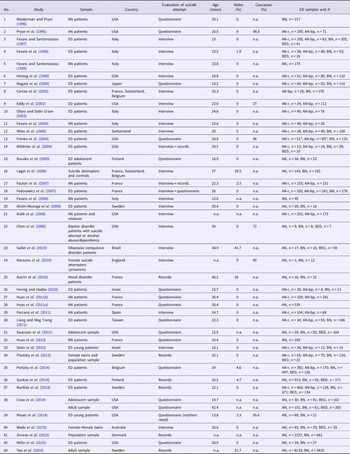
The search retrieved 1172 references. After a first independent revision of the title and abstract of the studies, the two reviewers (first and second author) agreed on a preliminary pertinence for 261 articles (22.3%). Out of the 261 articles, 43 (16.5%) satisfied inclusion and exclusion criteria and were entered in the analysis (see Fig. 1 for the flow diagram). Details of the studies included are displayed in Table 1.
Studies identification and selection.
LEGEND: ED, Eating disorders; DSM, Diagnostic and Statistical Manual for mental disorders; ICD, International Classification of Diseases.

Descriptive characteristics of the 43 publications that were included in the meta-analyses

ED, eating disorder; AN, anorexia nervosa; AN-r, anorexia nervosa, restring; AN-bp, anorexia nervosa binge-purging; BN, bulimia nervosa; BED, binge eating disorder.
Most of the studies selected were conducted on samples of ED patients, but some focused on other psychiatric samples (n = 5, 11.6%) such as bipolar disorder and/or alcohol dependence (Chen et al., Reference Chen, Brown, Harned and Linehan2009), obsessive compulsive disorder (Sallet et al., Reference Sallet, De Alvarenga, Ferrão, De Mathis, Torres, Marques, Hounie, Fossaluza, Rosario, Fontenelle, Petribu and Fleitlich-Bilyk2010), mood disorders (Azorin et al., Reference Azorin, Kaladjian, Besnier, Adida, Hantouche, Lancrenon and Akiskal2010; Marzano et al., Reference Marzano, Fazel, Rivlin and Hawton2010), psychiatric samples of suicide attempters (Laget et al., Reference Laget, Plancherel, Stéphan, Bolognini, Corcos, Jeammet and Halfon2006; Marzano et al., Reference Marzano, Fazel, Rivlin and Hawton2010), and population samples (n = 7, 16.3%) (Doll et al., Reference Doll, Petersen and Stewart-Brown2005; Swanson et al., Reference Swanson, Crow, Le Grange, Swendsen and Merikangas2011; Pisetsky et al., Reference Pisetsky, Thornton, Lichtenstein, Pedersen and Bulik2013; Crow et al., Reference Crow, Swanson, Le Grange, Feig and Merikangas2014; Wade et al., Reference Wade, Fairweather-Schmidt, Zhu and Martin2015; Zerwas et al., Reference Zerwas, Larsen, Petersen, Thornton, Mortensen and Bulik2015; Yao et al., Reference Yao, Kuja-Halkola, Thornton, Runfola, D'Onofrio, Almqvist, Lichtenstein, Sjölander, Larsson and Bulik2016).
Most of the studies were conducted on adult samples, while some on adolescents and young adults (n = 5, 11.6%) (Ruuska et al., Reference Ruuska, Kaltiala-Heino, Rantanen and Koivisto2005; Swanson et al., Reference Swanson, Crow, Le Grange, Swendsen and Merikangas2011; Stein et al., Reference Stein, Zinman, Halevy, Yaroslavsky, Bachar, Kreitler and Orbach2013; Crow et al., Reference Crow, Swanson, Le Grange, Feig and Merikangas2014; Mayes et al., Reference Mayes, Fernandez-Mendoza, Baweja, Calhoun, Mahr, Aggarwal and Arnold2014). Suicide attempts assessment was mainly based on clinical or semi-structured interviews, questionnaires, clinical record, or national registry. In a study performed on a sample of children and adolescents (Mayes et al., Reference Mayes, Fernandez-Mendoza, Baweja, Calhoun, Mahr, Aggarwal and Arnold2014), suicide attempts were rated by the mothers through a validated questionnaire. Most studies reported lifetime history of suicide attempt prior or at the time of assessment, with only two exceptions. Chen et al. (Reference Chen, Brown, Harned and Linehan2009) evaluated suicide attempts in the year preceding patients’ assessment. Suokas et al. (Reference Suokas, Suvisaari, Grainger, Raevuori, Gissler and Haukka2014) assessed suicide attempts in the 5 years preceding hospital admission and in the follow-up period (mean 8.7 years). In latter case we collected the total number of persons who had attempted suicide in the whole study period, as reported in the paper.
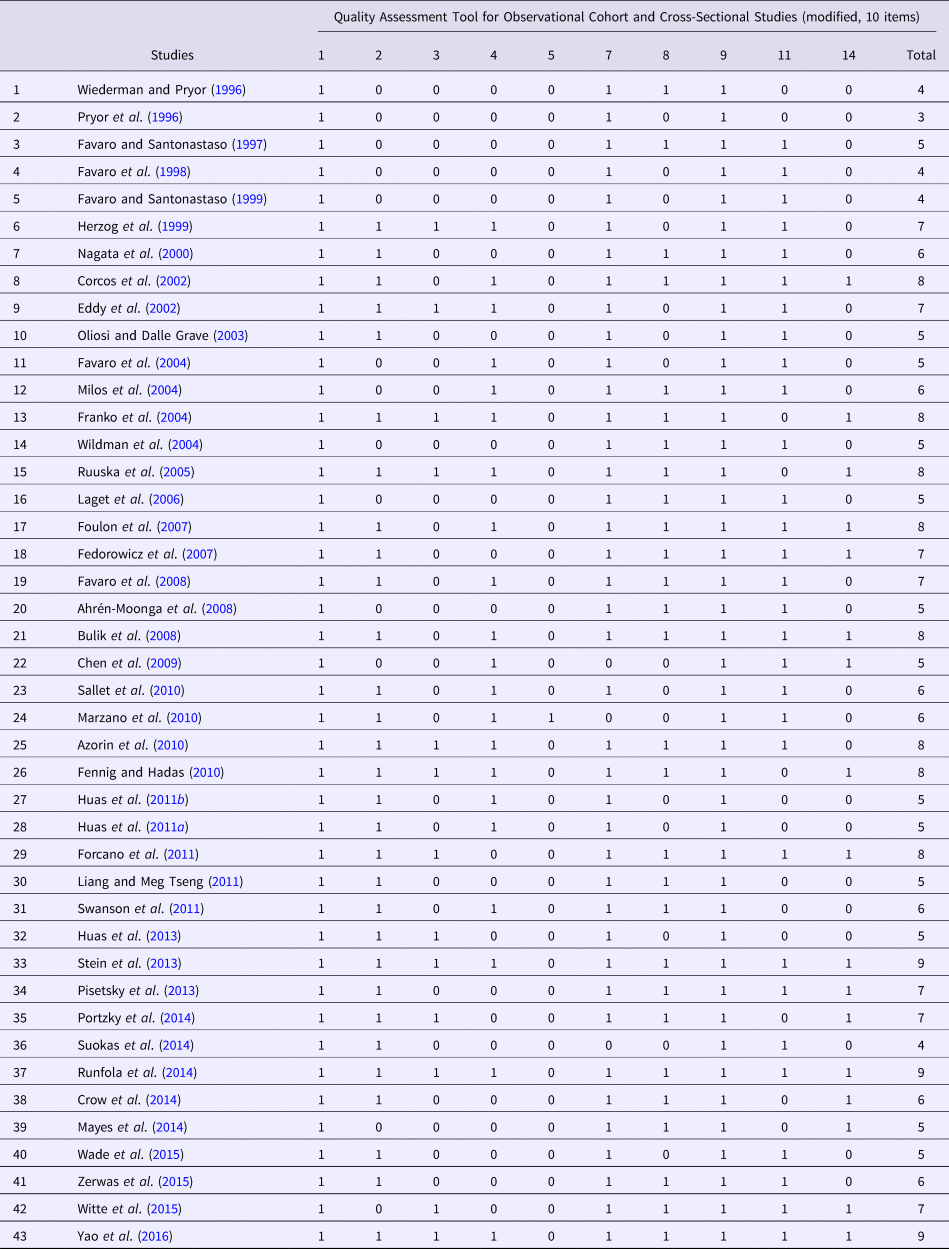
Out of 43 studies, only four studies were of low quality in data reporting (scores of 3–4 at the QAT) (Pryor et al., Reference Pryor, Wiederman and McGilley1996; Wiederman and Pryor, Reference Wiederman and Pryor1996; Favaro et al., Reference Favaro, Dalle Grave and Santonastaso1998; Favaro and Santonastaso, Reference Favaro and Santonaso1999; Suokas et al., Reference Suokas, Suvisaari, Grainger, Raevuori, Gissler and Haukka2014), while the remaining were of moderate-high quality (nine with QAT scores ⩾8). Overall, most studies were of moderate-high quality (Table 2).
Study quality assessment

1. Was the research question or objective in this paper clearly stated?
2. Was the study population clearly specified and defined?
3. Was the participation rate of eligible persons at least 50%?
4. Were all the subjects selected or recruited from the same or similar populations (including the same time-period)? Were inclusion and exclusion criteria for being in the study pre-specified and applied uniformly to all participants?
5. Was a sample size justification, power description, or variance and effect estimates provided?
7. Was the timeframe sufficient so that one could reasonably expect to see an association between ED and suicide attempt if existed? *1 = lifetime history of suicide attempt.
8. Did the study examine different levels of the EDs as related to the suicide attempt (e.g. categories of ED, ED symptoms, DEP symptoms)?
9. Were ED diagnoses clearly defined, valid, reliable, and implemented consistently across all study participants?
11. Were suicide attempts clearly defined, valid, reliable, and implemented consistently across all study participants? *1 = assessed by structured or semi-structured clinical interview or by questionnaire when ‘self-injurious behavior with intent to die’ was specified.
14. Were key potential confounding variables measured and adjusted statistically for their impact on the relationship between ED diagnoses and suicide attempts?
Suicide attempt proportions in AN subtypes
Eighteen studies, published between 1996 and 2014, could be analyzed to compare suicide attempts proportions between AN-r and AN-bp, over 3698 participants (Fig. 2a). The pooled proportion of suicide attempts was significantly lower in AN-r (9.3%) than in AN-bp (25%), with a RD of −0.21 (CI −0.26 to −0.17) (p < 0.001). There was minimal heterogeneity among the studies (I 2 = 27%, p = 0.14) and no funnel plot asymmetry (online Supplementary Fig. S1a). The Egger's test indicated absence of publication bias (t = 1.22, df = 16, p = 0.24).
Each box shows the studies entered in the 4 meta-analyses comparing suicide attempt events in Anorexia restricting vs. Anorexia binge-purging (a), Anorexia vs. Bulimia (b) and Anorexia subtypes vs. Bulimia (c, d). Weight and single Arcsine Risk difference (RDs) of the studies, forest plot of the RDs, total effect estimate, heterogeneity test are displayed.

Suicide attempt proportions in BN and AN
Thirty-nine studies (three coupled since performed by the same authors on comparable samples), published between 1996 and 2016, could be analyzed to compare suicide attempts proportions between AN and BN, over 23 632 participants (Fig. 2b). The pooled proportion of suicide attempts was significantly lower in AN (12.3%) than in BN (20.5%), with a RD of −0.12 (95% CI −0.16 to −0.08) (p < 0.001), but with a substantial heterogeneity among the studies (I 2 = 72.5%). The visual analysis of the funnel plot revealed some degree of asymmetry (online Supplementary Fig. S1b) and the AS-Thompson test revealed significant publication bias (t = 2.49, df = 34, p = 0.018).
Given the significantly different proportion of suicide attempts between AN-r and AN-bp, we compared separately the two subgroups to BN. Fourteen studies (two coupled) could be analyzed over 4219 participants. Results are displayed in Fig. 2c. Briefly, the pooled proportion of suicide attempts was significantly lower in AN-r (10.2%) than in BN (21.8%) [RD of −0.22 (CI −0.32 to −0.13)] (p < 0.001), but with a considerable heterogeneity among the studies and some degree of asymmetry of the funnel plot (online Supplementary Fig. S1c). No publication bias was however detected (AS-Thompson test: t = 1.26, df = 11, p = 0.23).
Sixteen studies (four coupled) could be analyzed to compare suicide attempts proportions between AN-bp and BN, over 4233 participants (Fig. 2d). The pooled proportion of suicide attempts was not significantly different in AN-bp (25.6%) and BN (21.2%) [RD = 0.02 (CI −0.02 to 0.06) p = 0.34], with no significant heterogeneity, relevant asymmetry of the funnel plot (online Supplementary Fig. S1d) and no publication bias (Egger's test: t = 0.71, df = 13, p = 0.49).
Suicide attempt proportions in AN and BED
Twelve studies, published between 1997 and 2015, could be analyzed to compare suicide attempts proportions between AN and BED, over 3717 participants (Fig. 3a). The pooled proportion of suicide attempts was only marginally and not significantly lower in AN (10.2%) than in BED (11.4%) [RD = 0.04 (CI −0.01 to 0.08) p = 0.065]. There was no heterogeneity across studies (I 2 = 3%) and asymmetry of the funnel plot (online Supplementary Fig. S2a). The Egger's test indicated absence of publication bias (t = −0.25, df = 12, p = 0.81).
Each box shows the studies entered in the 4 meta-analyses comparing suicide attempt events in Anorexia nervosa vs. Binge aeting disorder (a), Bulimia nervosa vs. Binge eating (b) and Anorexia subtypes vs. Binge eating (c, d). Weight and single Arcsine Risk difference (RDs) of the studies, forest plot of the RDs, total effect estimate, heterogeneity test are displayed.

Despite the limited number of the studies (k < 10) for each comparison, we also separately compared AN-r and AN-bp with BED. Six (6) studies could be analyzed to compare suicide attempts proportions between AN-r and BED, over 1419 participants (Fig. 3c). The pooled proportion of suicide attempts was not significantly different in AN-r (7.7%) and BED (9.9%) [RD = −0.03, (CI −0.09 to 0.03) p = 0.31], with no heterogeneity, asymmetry of the funnel plot (online Supplementary Fig. S2c), and no publication bias (Egger's test: t = −1.54, df = 4, p = 0.20).
Six studies could be analyzed to compare suicide attempts proportions between AN-bp and BED, over 840 participants (Fig. 3d). The pooled proportion of suicide attempts was significantly higher in AN-bp (16.7%) than BED (9.9%) [RD = 0.10 (CI 0.03–0.17) p = 0.006], with no heterogeneity across the studies, no asymmetry of the funnel plot (online Supplementary Fig. S2d) and no publication bias (Egger's test: t = −0.79, df = 4, p = 0.47).
Suicide attempt proportions in BN and BED
Eleven studies, published between 1997 and 2015, could be analyzed to compare suicide attempts proportions between BN and BED, over 2880 participants (Fig. 3b). The pooled proportion of suicide attempts was significantly higher in BN (17%) than BED (12.1%) with a RD of 0.13 (95% CI 0.06–0.20) (p < 0.001). There was no relevant heterogeneity among the studies (I 2 = 48%) and no asymmetry of the funnel plot (online Supplementary Fig. S2b). The Egger's test indicated absence of publication bias (t = 0.58, df = 11, p = 0.50).
Meta-regression and sensitivity analysis
In the analysis comparing AN-r v. AN-bp, place of origin of the samples (Europe, USA, and Asia) showed an impact on estimates (RD) (β = 0.51, p = 0.039). Two samples from Asia (Nagata et al., Reference Nagata, Kawarada, Kiriike and Iketani2000; Liang and Meg Tseng, Reference Liang and Meg Tseng2011) produced indeed larger estimates compared with the 15 samples from Europe and USA. Removing these samples from the analysis, AN-r still had a lower suicide attempts proportion compared with AN-bp [RD = −0.20 (95% CI −0.25 to −0.16), p < 0.001, I 2 = 25% n.s.].
In the analysis comparing AN-r v. BN, trends were evident indicative of participants age, origin (Europe, USA, and Asia) and study design (cross-sectional and retrospective/prospective) influencing estimates (respectively β = −0.50, p = 0.070; β = 0.50, p = 0.065; β = −0.50, p = 0.071). Again, the two studies on Asian samples (Nagata et al., Reference Nagata, Kawarada, Kiriike and Iketani2000; Liang and Meg Tseng, Reference Liang and Meg Tseng2011) produced larger estimates compared with the 12 from Europe and the USA. Studies with patients younger than 22 (lowest tertile of mean age of all samples analyzed) (Pryor et al., Reference Pryor, Wiederman and McGilley1996; Wiederman and Pryor, Reference Wiederman and Pryor1996; Liang and Meg Tseng, Reference Liang and Meg Tseng2011; Stein et al., Reference Stein, Zinman, Halevy, Yaroslavsky, Bachar, Kreitler and Orbach2013) had a trend to produce larger estimates. Contrastingly, the three studies employing prospective/retrospective design (Herzog et al., Reference Herzog, Dorer, Keel, Selwyn, Ekeblad, Flores, Greenwood, Burwell and Keller1999; Pisetsky et al., Reference Pisetsky, Thornton, Lichtenstein, Pedersen and Bulik2013; Runfola et al., Reference Runfola, Thornton, Pisetsky, Bulik and Birgegård2014) tended to produce smaller estimates than the 11 cross-sectional studies. Removing these samples, AN-r still had a lower risk of suicide attempts compared with BN [RD = −0.20 (95% CI −0.24 to −0.15) p < 0.001] and no more heterogeneity across the studies was present (I 2 = 1.15%, p = 0.41).
Age and study design, but not place of origin, also affected estimates when comparing AN-bp to BN (age: β = −0.63, p = 0.012, study design: β = −0.52, p = 0.049). Studies with patients younger than 22 (lowest tertile of mean age of all samples included) (Pryor et al., Reference Pryor, Wiederman and McGilley1996; Wiederman and Pryor, Reference Wiederman and Pryor1996; Liang and Meg Tseng, Reference Liang and Meg Tseng2011; Stein et al., Reference Stein, Zinman, Halevy, Yaroslavsky, Bachar, Kreitler and Orbach2013) produced larger estimates; prospective/retrospective designs (Pisetsky et al., Reference Pisetsky, Thornton, Lichtenstein, Pedersen and Bulik2013; Runfola et al., Reference Runfola, Thornton, Pisetsky, Bulik and Birgegård2014) functioned to attenuate estimates compared with cross-sectional methods. By removing these samples, AN-bp and BN still had the same risk for suicide attempts [RD = 0.04 (95% CI −0.02 to 0.09), p = 0.19, I 2 = 26.6%, n.s.].
Discussion
This meta-analysis of published studies confirms previous evidence of a higher proportion of suicide attempts in patients with AN-bp and BN compared with AN-r. Additionally, this analysis suggests that patients with BED have a risk of suicide attempts similar to AN-r patients.
To our knowledge, this is the first systematic attempt to compare, through a set of meta-analyses, suicidal attempts proportions in ED subtypes, including BED. Obtaining reliable estimates of the risk of suicide attempts in individuals with distinct ED subtypes is critically important (Franko and Keel, Reference Franko and Keel2006).
In developed countries, the lifetime prevalence of suicide attempts is 1.9–8.7%, with more than half of suicide attempters suffering from a mental disorder (Nock et al., Reference Nock, Borges, Bromet, Cha, Kessler and Lee2008; Nock et al., Reference Nock, Hwang, Sampson, Kessler, Angermeyer, Beautrais, Borges, Bromet, Bruffaerts, de Girolamo, de Graaf, Florescu, Gureje, Haro, Hu, Huang, Karam, Kawakami, Kovess, Levinson, Posada-Villa, Sagar, Tomov, Viana and Williams2009). Though our study did not aim to evaluate the incidence of suicide attempts in EDs (events/totals over a period of time), but rather, their proportions (events/totals only) in different ED sub-groups. We calculated pooled (mostly lifetime) proportions equaling 11.5% (in BED) to 25% (AN-r), which are higher than the reported lifetime rates of suicide attempts in the general population. ED patients are also at high risk for non-suicidal self-injury (27.3%), highly prevalent in suicidal subjects, and especially BN patients (32.7%) (Victor and Klonsky, Reference Victor and Klonsky2014; Cucchi et al., Reference Cucchi, Ryan, Konstantakopoulos, Stroumpa, Kacar, Renshaw, Landau and Kravariti2016). These data suggest that suicidal risk, taking into account previously known risk factors, should be routinely evaluated in ED patients.
The higher proportion of suicide attempts in participants with BN and AN-bp supports the hypothesis that binge-purging behavior (and/or related features) might actually be a strong risk factor for suicidal behavior in ED patients (Franko and Keel, Reference Franko and Keel2006). The mechanism that puts patients with binge-purging more at risk of completing a suicide attempt is not known (Franko and Keel, Reference Franko and Keel2006; Kostro et al., Reference Kostro, Lerman and Attia2014; Smith et al., Reference Smith, Zuromski and Dodd2017). The association between binge-purging and suicide attempts has been hypothesized to be mainly mediated by impulsive traits and emotional dysregulation (Favaro and Santonastaso, Reference Favaro and Santonastaso1996; Milos et al., Reference Milos, Spindler, Hepp and Schnyder2004; Fedorowicz et al., Reference Fedorowicz, Falissard, Foulon, Dardennes, Divac, Guelfi and Rouillon2007; Foulon et al., Reference Foulon, Guelfi, Kipman, Adès, Romo, Houdeyer, Marquez, Mouren, Rouillon and Gorwood2007; Forcano et al., Reference Forcano, Álvarez, Santamaría, Jimenez-Murcia, Granero, Penelo, Alonso, Sánchez, Menchón, Ulman, Bulik and Fernández-Aranda2011; Bodell et al., Reference Bodell, Joiner and Keel2013; Pisetsky et al., Reference Pisetsky, Thornton, Lichtenstein, Pedersen and Bulik2013). Other associated features can be substance use/abuse (Favaro and Santonastaso, Reference Favaro and Santonastaso1997; Fedorowicz et al., Reference Fedorowicz, Falissard, Foulon, Dardennes, Divac, Guelfi and Rouillon2007), persistent and impairing symptoms in binge-purging disorders (Favaro and Santonastaso, Reference Favaro and Santonastaso1997; Wade et al., Reference Wade, Fairweather-Schmidt, Zhu and Martin2015), and an overall higher rate of other comorbid psychiatric disorders (von Lojewski et al., Reference von Lojewski, Boyd, Abraham and Russell2012). However, according to some evidence, increased comorbid disorders in binge-purging ED subtypes would not fully explain the increase of suicidal risk (Fedorowicz et al., Reference Fedorowicz, Falissard, Foulon, Dardennes, Divac, Guelfi and Rouillon2007: 128; Bodell et al., Reference Bodell, Joiner and Keel2013: 68). The high levels of impulsivity and instability in patients with binge-purging disorders has led to hypothesize suicidal behavior as more oriented to the regulation of negative affects rather than a strong will to die, closer to non-suicidal self-injury. This would also explain the lower death rates for suicide in BN compared with the AN (Fairweather-Schmidt, Reference Fairweather-Schmidt and Wade2016).
To our knowledge, this is the first study to provide a pooled estimate of suicide attempts in BED, though we considered only studies that analyzed suicidal proportions in mixed samples of EDs. Based on a recent systematic review of the literature, the rate of complete and attempted suicide ranges between 2.3% and 34% (Conti et al., Reference Conti, Lanzara, Scipioni, Iasenza, Guagnano and Fulcheri2017). Similarly, looking at previous sparse studies, the rates of suicide attempts in BED is between 2% and 57% (Favaro and Santonastaso, Reference Favaro and Santonastaso1997; Favaro et al., Reference Favaro, Dalle Grave and Santonastaso1998; Ackard et al., Reference Ackard, Neumark-Sztainer, Story and Perry2003; Wildman et al., Reference Wildman, Lilenfeld and Marcus2004; Chen et al., Reference Chen, Brown, Harned and Linehan2009; Sallet et al., Reference Sallet, De Alvarenga, Ferrão, De Mathis, Torres, Marques, Hounie, Fossaluza, Rosario, Fontenelle, Petribu and Fleitlich-Bilyk2010; Swanson et al., Reference Swanson, Crow, Le Grange, Swendsen and Merikangas2011; Carano et al., Reference Carano, De Berardis, Campanella, Serroni, Ferri, Di Iorio, Acciavatti, Mancini, Mariani, Martinotti, Moschetta and Di Giannantonio2012; Pisetsky et al., Reference Pisetsky, Thornton, Lichtenstein, Pedersen and Bulik2013; Crow et al., Reference Crow, Swanson, Le Grange, Feig and Merikangas2014; Portzky et al., Reference Portzky, van Heeringen and Vervaet2014; Runfola et al., Reference Runfola, Thornton, Pisetsky, Bulik and Birgegård2014; Suokas et al., Reference Suokas, Suvisaari, Grainger, Raevuori, Gissler and Haukka2014; Wade et al., Reference Wade, Fairweather-Schmidt, Zhu and Martin2015). According to our findings, the proportion of suicide attempts in BED is between 10% and 12%, without significant deviation from AN-r (8–10%). These data indicate the need for careful assessment of suicidal risk, considering all known factors, also in patients with BED.
The lower proportion of suicide attempts in BED as compared AN-bp and BN also suggests that it might be actually purging (and not binging) to increase suicidal risk. Purging is indeed present in both AN-bp and BN, but not in BED (and in AN-r). Observations on the potential association between purging and suicidal behavior are present in previous literature (Milos et al., Reference Milos, Spindler, Hepp and Schnyder2004; Franko et al., Reference Franko, Dorer, Keel, Jackson, Manzo and Herzog2008; Crow et al., Reference Crow, Swanson, Le Grange, Feig and Merikangas2014; Mayes et al., Reference Mayes, Fernandez-Mendoza, Baweja, Calhoun, Mahr, Aggarwal and Arnold2014; Runfola et al., Reference Runfola, Thornton, Pisetsky, Bulik and Birgegård2014; Witte et al., Reference Witte, Zuromski, Gauthier, Smith, Bartlett, Siegfried, Bodell and Goodwin2015). Some hypothesized that the repeated experience of painful purging practices can increase the propensity to severe self-injury, through the habituation to pain and fear (Selby et al., Reference Selby, Smith, Bulik, Olmsted, Thornton, McFarlane, Berrettini, Brandt, Crawford, Fichter, Halmi, Jacoby, Johnson, Jones, Kaplan, Mitchell, Nutzinger, Strober, Treasure, Woodside, Kaye and Joiner2010; Witte et al., Reference Witte, Zuromski, Gauthier, Smith, Bartlett, Siegfried, Bodell and Goodwin2015). Within the theoretical framework of the Interpersonal theory of suicide (Joiner, Reference Joiner2005), habituation to pain and fear through repeated practice and exposure to painful stimuli corresponds to the acquisition of a capacity for suicide (‘acquired capability for suicide’), a prerequisite for implementing severe self-injury (Joiner, Reference Joiner2005). However, extreme fasting and starvation is also a recurrent painful experience, with a similar potential to predispose to self-injury. In AN-r, extreme starvation can indeed increase suicidal risk (Selby et al., Reference Selby, Smith, Bulik, Olmsted, Thornton, McFarlane, Berrettini, Brandt, Crawford, Fichter, Halmi, Jacoby, Johnson, Jones, Kaplan, Mitchell, Nutzinger, Strober, Treasure, Woodside, Kaye and Joiner2010), but according to other authors, it might not increase acquired capability to suicide (Witte et al., Reference Witte, Zuromski, Gauthier, Smith, Bartlett, Siegfried, Bodell and Goodwin2015). However, to date, the exact mechanism underlying the relationship between purging and suicidal risk is not known, and a synergy of multiple factors is likely to occur. To date, according to our knowledge, there are no studies able to clarify this issue.
It is noteworthy that some characteristics of the studies influenced suicidal risk estimates in AN subtypes and v. BN. Two studies on Asian populations (Nagata et al., Reference Nagata, Kawarada, Kiriike and Iketani2000; Liang and Meg Tseng, Reference Liang and Meg Tseng2011) provided considerably lower suicide risk estimates in AN-r compared with AN-bp and BN. The low number of studies and the low number of participants do not allow any conclusions to be drawn. However, a lower prevalence of suicidal behaviors in Asian populations has been previously reported (e.g. Evans et al., Reference Evans, Hawton, Rodham and Deeks2005; Hu et al., Reference Hu, Dong, Chen, Liu, Ma, Liu, Zheng, Mao, Chen and He2015). Studies on young samples also reported a significantly lower proportion of suicide attempts in AN-r and AN-bp than in BN (Pryor et al., Reference Pryor, Wiederman and McGilley1996; Wiederman and Pryor, Reference Wiederman and Pryor1996; Liang and Meg Tseng, Reference Liang and Meg Tseng2011; Stein et al., Reference Stein, Zinman, Halevy, Yaroslavsky, Bachar, Kreitler and Orbach2013). Some have shown a lower risk of suicide in young ED patients compared with older adults (e.g. Cumella and Kally, Reference Cumella and Kally2008); therefore, this effect may suggest that young BN patients have an even greater suicidal risk than same age AN. However, this conclusion is entirely speculative, both because of the low number of studies and small samples size, and for the inability of the present study to stratify the individual subtypes for their actual age at the time of the evaluations. Finally, studies conducted on national registers or longitudinal studies (Herzog et al., Reference Herzog, Dorer, Keel, Selwyn, Ekeblad, Flores, Greenwood, Burwell and Keller1999; Eddy et al., Reference Eddy, Keel, Dorer, Delinsky, Franko and Herzog2002; Franko et al., Reference Franko, Keel, Dorer, Blais, Delinsky, Eddy, Charat, Renn and Herzog2004; Pisetsky et al., Reference Pisetsky, Thornton, Lichtenstein, Pedersen and Bulik2013; Runfola et al., Reference Runfola, Thornton, Pisetsky, Bulik and Birgegård2014) showed less marked differences between AN and BN. It is difficult to explain this effect, but it is possible that the methodologies used to detect suicide attempts over a long period of time might be less sensitive.
Strength and limitations
Our findings must be viewed in the context of a number of limitations. The use of only two databases (MEDLINE and SCOPUS) may have prevented the identification of further relevant studies. However, the revision of the reference lists of the retrieved articles and reviews should have partly compensated this limitation. The studies selected and analyzed were mixed for several methodological issues, sometimes influencing risk estimates, as highlighted above. In many cases, studies were also different for the primary aim of investigation. We indeed included in the analysis studies that were not strictly focused on suicide attempts assessment in ED subgroups. The lack of focus may have resulted in a lower accuracy in data collection and reporting. On the other hand, the inclusion of studies not primarily aimed at evaluating suicide attempts can balance a number of biases that may characterize more focused studies (e.g. overestimation of the outcome). In addition, the inclusion of such studies has allowed us to include more samples, which increases the solidity of the meta-analysis. In the majority of cases, analyses were not affected by consistent heterogeneity and publication bias, suggesting no major impact of studies methodological/focus divergence on estimates. We tried to control the impact of some methodological aspects, as discussed, by meta-regression analysis and sensitivity analysis. However, many other aspects not considered in this study could have affected the estimates, especially comorbidity with other mental disorders, and especially mood, anxiety and substance use disorders (Nock et al., Reference Nock, Hwang, Sampson, Kessler, Angermeyer, Beautrais, Borges, Bromet, Bruffaerts, de Girolamo, de Graaf, Florescu, Gureje, Haro, Hu, Huang, Karam, Kawakami, Kovess, Levinson, Posada-Villa, Sagar, Tomov, Viana and Williams2009). In one case, i.e. when comparing AN-r to BN, the exclusion of studies whose methodology affected the estimates resulted in a marked reduction in heterogeneity.
Evaluation of the quality of the studies through appropriate assessment scales is a procedure often used to increase the reliability of the results of a meta-analysis (Zeng et al., Reference Zeng, Zhang, Kwong, Zhang, Li, Sun, Niu and Du2015). We conducted a quality analysis of the studies, but also given the general good level we relied more on well-defined inclusion/exclusion criteria in the studies selection process. Other limitations that can be identified are the selection of studies published in English language only and the exclusion of participants with ED not otherwise specified (EDNOS). The main strengths of this study are the attempts to base on diagnosis as homogeneous as possible (DSM-IV, -5, or ICD-10 criteria), the high number of studies that could be included in the analyses, to have taken into account some methodological aspects potentially affecting the estimates. These strengths have resulted in suicidal risk proportions on a large number of subjects in many cases, with the result of having potentially very reliable estimates.
Conclusions
This meta-analysis of previous studies confirms higher proportions of suicide attempts in patients with BN and binge-purging AN than in patients with restrictive AN. The proportion of attempted suicide is not different in binge-purging AN and BN. In addition, in BED, we found proportions of attempted suicide as high as in AN. Further, though completely preliminary, the indications that a young age in AN (but not BN) patients and Asian ethnicity are protective factors for suicide attempts may have significant value, to be evaluated in further studies. In conclusion, suicidal behavior is a major issue in ED and needs to be taken into account in the evaluation, prevention, and treatment practices. Patients who exhibit binge/purging behaviors should be monitored carefully, taking into account additional known risk factors for suicidal behavior. The role of binge/purging behaviors in suicidal risk needs to be better elucidated.
Acknowledgements
None.
Financial support
This research did not receive any specific grant from funding agencies in the public, commercial, or not-for-profit sectors.
Author ORCIDs
Laura Mandelli 0000-0001-9726-1802.
Conflict of interest
None.
Supplementary material
The supplementary material for this article can be found at https://doi.org/10.1017/S0033291718003549