Introduction
The formation of phyllosilicates in the Fe–Si–O–H system has been reported in various geological and engineering settings: on meteorites (Elmaleh et al., Reference Elmaleh, Bourdelle, Caste, Benzerara, Leroux and Devouard2015; Lauretta et al., Reference Lauretta, Hua and Buseck2000; Muller et al., Reference Muller, Kurat and Kracher1979; Zolensky et al., Reference Zolensky, Barrett and Browning1993; Zolotov, Reference Zolotov2014), on Mars (Bishop et al., Reference Bishop, Dobrea, McKeown, Parente, Ehlmann, Michalski, Milliken, Poulet, Swayze, Mustard, Murchie and Bibring2008; Ehlmann et al., Reference Ehlmann, Mustard, Murchie, Bibring, Meunier, Fraeman and Langevin2011), in deep-sea sediments (Badaut et al., Reference Badaut, Besson, Decarreau and Rautureau1985, Reference Badaut, Decarreau and Besson1992; Baldermann et al., Reference Baldermann, Warr, Letofsky-Papst and Mavromatis2015; Marcus & Lam, Reference Marcus and Lam2014), in iron-banded formations (Eugster & Chou, Reference Eugster and Chou1973; Grubb, Reference Grubb1971), in ore deposits (Inoué & Kogure, Reference Inoué and Kogure2016; Rasmussen et al., Reference Rasmussen, Evans and Kuehner1998; Rivas-Sanchez et al., Reference Rivas-Sanchez, Alva-Valdivia, Arenas-Alatorre, Urrutia-Fucugauchi, Ruiz-Sandoval and Ramos-Molina2006), at iron-clay (Lanson et al., Reference Lanson, Lantenois, van Aken, Bauer and Plancon2012; Le Pape et al., Reference Le Pape, Rivard, Pelletier, Bihannic, Gley, Mathieu, Salsi, Migot, Barres, Villiéras and Michau2015; Pignatelli et al., Reference Pignatelli, Bourdelle, Bartier, Mosser-Ruck, Truche, Mugnaioli and Michau2014) and steel-glass interfaces (Carriere et al., Reference Carriere, Neff, Foy, Martin, Linard, Michau, Dynes and Dillmann2017, Reference Carriere, Neff, Martin, Tocino, Delanoë, Gin, Michau, Linard and Dillmann2021; Schlegel et al., Reference Schlegel, Martin, Brucker, Bataillon, Blanc, Chorro and Jollivet2016), and as a scale deposit in brine-handling equipment (Manceau et al., Reference Manceau, Ildefonse, Hazemann, Flank and Gallup1995). Thermodynamic modeling for some of these settings has been performed with the intention of estimating the physicochemical conditions which led to the formation of these minerals in the past (Chevrier et al., Reference Chevrier, Poulet and Bibring2007; Fritz & Toth, Reference Fritz and Toth1997; Zolotov, Reference Zolotov2014), or of estimating the evolution of physicochemical conditions for a given mineralogical composition with time (Ngo et al., Reference Ngo, Clément, Michau and Fritz2015; Wilson et al., Reference Wilson, Benbow, Sasamoto, Savage and Watson2015).
The incorporation of iron-rich phyllosilicates in such models is challenging for several reasons. First, for some settings such as iron–glass interfaces, the identification of newly-formed minerals is difficult because of their very small particle size. The thickness of the alteration layer between iron and glass is in the range of 1 μm (Carriere et al., Reference Carriere, Neff, Foy, Martin, Linard, Michau, Dynes and Dillmann2017, Reference Carriere, Neff, Martin, Tocino, Delanoë, Gin, Michau, Linard and Dillmann2021; Schlegel et al., Reference Schlegel, Martin, Brucker, Bataillon, Blanc, Chorro and Jollivet2016). Second, the information regarding experimentally measured thermodynamic properties of iron-rich minerals is very limited. Such data are available only for nontronite (Gailhanou et al., Reference Gailhanou, Blanc, Rogez, Mikaelian, Horiuchi, Yamamura, Saito, Kawaji, Warmont, Grenèche, Vieillard, Fialips, Giffaut and Gaucher2013) and greenalite (Tosca et al., Reference Tosca, Guggenheim and Pufahl2016). Finally, the minerals such as cronstedtite, hisingerite, berthierine, brindleyite, minnesotaite, and saponite are not widely abundant and not readily accessible for experiments. Given the lack of accessible material for experiments, an alternative approach is to infer the physicochemical properties by estimating the thermodynamic constants using various methods such as the summation of the properties of respective oxides (Tardy & Garrels, Reference Tardy and Garrels1974) or the decomposition into polyhedral units (Blanc et al., Reference Blanc, Vieillard, Gailhanou, Gaboreau, Gaucher, Fialips, Madé and Giffaut2015). However, these approaches do not take into account such aspects as polytypism or cation substitution. The study of Pignatelli et al. (Reference Pignatelli, Bourdelle, Bartier, Mosser-Ruck, Truche, Mugnaioli and Michau2014) discussed the mismatch between geochemical modelling results and experimental observations for T < 50°C, and attributed the discrepancy to the presence of different cronstedtite polytypes. Schulte and Shock (Reference Schulte and Shock2004) considered the difference of stability between greenalite and cronstedtite. The presence of ferric iron in tetrahedral coordination in cronstedtite might be the reason for the smaller stability field for cronstedtite (up to 100°C) compared to that of greenalite (up to 150°C).
Indeed, the characterization of mineral composition of the different settings often reveals the coexistence of several phyllosilicates (Badaut et al., Reference Badaut, Decarreau and Besson1992; Ehlmann et al., Reference Ehlmann, Mustard, Murchie, Bibring, Meunier, Fraeman and Langevin2011; Elmaleh et al., Reference Elmaleh, Bourdelle, Caste, Benzerara, Leroux and Devouard2015; Evans et al., Reference Evans, Kuehner, Joswiak and Cressey2017; Lanson et al., Reference Lanson, Lantenois, van Aken, Bauer and Plancon2012; Lauretta et al., Reference Lauretta, Hua and Buseck2000; Le Pape et al., Reference Le Pape, Rivard, Pelletier, Bihannic, Gley, Mathieu, Salsi, Migot, Barres, Villiéras and Michau2015; Marcus & Lam, Reference Marcus and Lam2014; Pignatelli et al., Reference Pignatelli, Bourdelle, Bartier, Mosser-Ruck, Truche, Mugnaioli and Michau2014; Tutolo et al., Reference Tutolo, Evans and Kuehner2019). Furthermore, for the same type of phyllosilicate mineral, the basic structure can be heterogeneous in terms of different types of layers (Chukhrov et al., Reference Chukhrov, Zvyagin, Drits, Gorshkov, Ermilova, Goilo and Rudnitskaya1979; Inoué & Kogure, Reference Inoué and Kogure2016; Suquet et al., Reference Suquet, Malard and Pezerat1987), iron distribution between octahedral and tetrahedral sheets (Gates et al., Reference Gates, Slade, Manceau and Lanson2002; Stucki, Reference Stucki, Bergaya and Lagaly2013), as well as the distribution of iron within the octahedral sheet (Vantelon et al., Reference Vantelon, Montarges-Pelletier, Michot, Pelletier, Thomas and Briois2003). Thus, Chukhrov et al. (Reference Chukhrov, Zvyagin, Drits, Gorshkov, Ermilova, Goilo and Rudnitskaya1979) reported ferric phyrophillite exposed to glycol and ethylene glycol having different types of layers (swelling vs non-swelling) suggesting a heterogeneous structure. Similarly, Suquet et al. (Reference Suquet, Malard and Pezerat1987) studied nontronite swelling and observed a continuous evolution of layer-to-layer distance as a function of relative humidity with no clearly distinguishable steps. Step-like behavior is characteristic of crystalline, homogeneous phyllosilicates suggesting that the studied nontronite samples might have a rather complex structure. A detailed study of chlorite with HRTEM by Inoué and Kogure (Reference Inoué and Kogure2016) also revealed a complex stacking structure of two different types of layers: berthierine and chlorite. In another study, Gates et al. (Reference Gates, Slade, Manceau and Lanson2002) explored the coordination of iron (tetrahedral vs octahedral) in various natural nontronite samples and reported different distributions between tetrahedral and octahedral iron in various samples. Finally, Vantelon et al. (Reference Vantelon, Montarges-Pelletier, Michot, Pelletier, Thomas and Briois2003) studied the distribution of iron in the octahedral sheet of different dioctahedral smectites and found three distinct groups: the first with an ordered distribution, the second with a random distribution, and the third group had clusters of iron.
The examples reported above illustrate the complexity of phyllosilicates at different levels: different mineral phases, different types of layers within one mineral, and different distributions of iron between and within sheets composing the layers. How do we address this complexity and obtain enough relevant material for experiments for the measurements of physicochemical properties of iron-rich phyllosilicates? A solution is to synthesize such materials in laboratory conditions. Moreover, the conditions of such a synthesis should be as close as possible to the studied system. This would enable the necessary quantities of phyllosilicates for detailed characterization of their properties and further experiments to be obtained.
The formation of phyllosilicates in the Fe–Si–O–H system has been reported previously under reducing (Farmer et al., Reference Farmer, Krishnamurti and Htjang1991; Flaschen & Osborn, Reference Flaschen and Osborn1957; Francisco et al., Reference Francisco, Mitsui, Ishidera, Tachi, Doi and Shiwaku2020; Harder, Reference Harder1976; Hinz et al., Reference Hinz, Nims, Theuer, Templeton and Johnson2021; Mizutani et al., Reference Mizutani, Fukushima, Okada, Kamigaito and Kobayashi1991; Pignatelli et al., Reference Pignatelli, Mosser-Ruck, Mugnaioli, Sterpenich and Gemmi2020; Tosca et al., Reference Tosca, Guggenheim and Pufahl2016) and oxidizing (Baron et al., Reference Baron, Petit, Tertre and Decarreau2016; Decarreau et al., Reference Decarreau, Bonnin, Badaut-Trauth, Couty and Kaiser1987; Decarreau et al., Reference Decarreau, Petit, Martin, Farges, Vieillard and Joussein2008; Roy & Roy, Reference Roy and Roy1954) conditions at neutral to basic pH and at various temperatures (from 23 to 470°C) and synthesis durations (4 days to 3 months). In the experiments with an Fe/Si initial molar ratio of 0.75 or less, the formation of nontronites was independent of the atmospheric conditions. The composition of the precipitated solid, in terms of the Fe/Si molar ratio, shows that the ratio is always greater than the initial Fe/Si molar ratio. The study of Baron et al. (Reference Baron, Petit, Tertre and Decarreau2016) showed that this ratio depended on the pH of the solution, which in turn determined the speciation of Si in the solution. For the initial Fe/Si molar ratio >0.75, the formation of 1:1 phyllosilicates was reported except in the study of Mizutani et al. (Reference Mizutani, Fukushima, Okada, Kamigaito and Kobayashi1991), where they observed the formation of 2:1 phyllosilicate at initial Fe/Si = 1.50. Thus, the predominance of one or the other kind of phyllosilicate depends not only on the physicochemical conditions (i.e. thermodynamics) but also on the respective formation kinetics, influenced by the temperature (activation energy). This agrees with the conclusions reached in a previous study (Boumaiza et al., Reference Boumaiza, Dutournié, Le Meins, Limousy, Brendlé, Martin, Michau and Dzene2020), where the kinetics of 2:1 clay-mineral formation was faster than for 1:1 clay mineral formation. Thus, the experiment at higher temperature would have faster kinetics and favor the formation of 2:1 phyllosilicates. Indeed, the experiment of Mizutani et al. (Reference Mizutani, Fukushima, Okada, Kamigaito and Kobayashi1991) was performed at 150°C. In comparison, the experiment of Tosca et al. (Reference Tosca, Guggenheim and Pufahl2016) performed at room temperature reported the precipitation of greenalite (1:1 phyllosilicate) at an initial Fe/Si = 0.8.
These previous results show that the initial Fe/Si molar ratio influences the type of phyllosilicate formed. Therefore, the aim of the current study was to investigate the effect of a wider range of Fe/Si molar ratio (0.50–2.33) on the formation of phyllosilicates. The synthesis of the products was performed at hydrothermal conditions in order to maximize the yield and crystallinity of the products (Decarreau et al., Reference Decarreau, Petit, Martin, Farges, Vieillard and Joussein2008).
Experimental
Synthesis of Materials
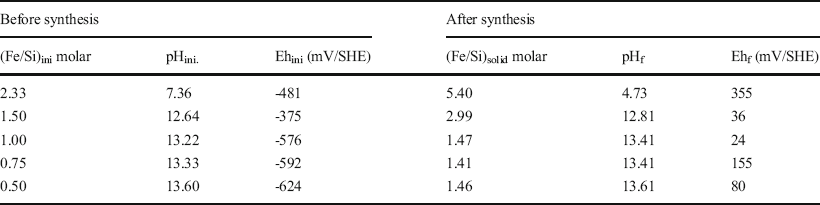
Iron(II) sulfate (FeSO4·7H2O, purity of 99.5%; Sigma Aldrich, India) was dissolved in 70 mL of deionized water (18.2 MΩ∙cm), then 0.041 g (0.5 wt.%) of sodium dithionite (Na2S2O4, purity of 85%; Alfa Aesar, Kandel, Germany) was added to the solution to limit Fe2+ oxidation. Next, a certain amount of sodium orthosilicate (Na4SiO4; Alfa Aesar, Karlsruhe, Germany) was added to the Fe(II) solution; the quantities of Fe(II) sulfate and sodium orthosilicate were calculated assuming a theoretical yield of 2 g of phyllosilicate with initial Fe/Si molar ratios ((Fe/Si)ini ) ranging from 0.50 to 2.33 (Table 1). The amount of reactants used in the synthesis for each sample is reported in Supplementary Information Table S1. The suspension was homogenized for 2 h by stirring at 200 rpm. The pH was then measured in an aliquot withdrawn from this initial suspension (pHini) and then again in an aliquot of the supernatant withdrawn after the synthesis (pHf) using a combination pH electrode (HANNA Instruments, Nusfalau, Romania) that was calibrated at 20°C before the measurements using two pH buffer solutions (pH = 7.00 and pH = 10.00). Preliminary tests with standard solutions revealed that the probe gave accurate measurements until pH = 13.60. The redox potential was measured after 2 h of stirring (Ehini) in an aliquot withdrawn from the suspension and in the aliquot of the supernatant after the synthesis (Ehf) using a combination redox electrode (HANNA Instruments, Nusfalau, Romania). The redox probe was calibrated with a standard solution of +200.00 mV (ORP buffer solution, Hach, Loveland, USA) before the measurements. The reported values were recalculated with respect to potential of the standard hydrogen electrode.
Initial Fe/Si molar ratios and solution characteristics before and after the synthesis. (Fe/Si)solid molar ratio after the synthesis was calculated using XRF results

The synthesis was performed in 150 mL Teflon-lined stainless-steel mineralization bombs (Ref.: 2148.6000, Top Industry®, Vaux-le-Pénil, France) at 150°C for 7 days, the pressure corresponded to the saturation pressure at 150°C. After 7 days, the autoclaves were removed from the oven and left to cool down. The samples were removed from the autoclaves and washed with deionized water three times by centrifugation at 10,000 rpm (12,860×g) for 10 min.
Characterization Methods
Powder X-ray Diffraction
Data were collected with a powder diffractometer D8 ADVANCE A25 from Bruker (Karlsruhe, Germany) in Bragg-Brentano reflection geometry θ–θ (goniometer radius 280 mm). This diffractometer was equipped with the LynxEye XE-T high resolution energy dispersive 1-D detector (CuKα1,2), leading to ultra-fast X-ray diffraction measurements. A motorized anti-scatter screen was used for effective suppression of instrument background, most importantly air-scatter at low angles. Optical components were limited to two Soller slits (2.5°) for primary and secondary optics, and motorized divergence slits. The conditions for data collection were as follows: angular area 3–70°2θ, step size 0.017°2θ, time per step 1.8 s (total time per step was 345 s), variable divergence slits mode (irradiated sample length 15 mm), total time for acquisition 2 h. During data collection, powder samples were rotated at 5 rpm. All the data were converted and presented into fixed divergence slits mode.
After the identification of phyllosilicates by powder X-ray diffraction, three samples with (Fe/Si)ini = 1.00, 0.75, and 0.50, containing 2:1 phyllosilicates were saturated with Ca2+ using 1 M CaCl2 (≥99.0%, Sigma Aldrich, Steinheim, Germany) solution (Bergaya & Lagaly, Reference Bergaya, Lagaly, Bergaya and Lagaly2013) to limit a possible impact of relative humidity conditions during the characterization. After washing, the samples were dried at 40°C, ground by hand in a mortar, and stored in glass vials at room conditions. To differentiate between chlorite and swelling 2:1 phyllosilicates, these three samples were exchanged with 1 M CH3COONH4 (>98%, Emsure, Darmstadt, Germany) for 24 h.
X-ray Diffraction of Oriented Preparations
To discriminate between swelling/non-swelling phyllosilicates, orientated preparations were made by dispersing synthesis products in ~1 mL of distilled water. Oriented preparations allow enhancement of 00l reflections characteristic of layered minerals. Saturation with ethylene glycol was performed by exposing oriented slides to an ethylene glycol-saturated atmosphere in a desiccator for 2 days. Samples were recorded immediately after the removal from the desiccator from 2 to 15°2θ angular range on an X'Pert Pro from PANalytical (Almelo, The Netherlands) equipped with an X’Celerator real-time multiple strip detector operating with an angular aperture of 2.12°2θ using CuKα radiation with a wavelength of 0.15418 nm. Diffractograms were recorded at room temperature with a step size of 0.017°2θ and a scan time of 4 s per step (total time per step was 220 s). The divergence slit, the anti-scatter slit, and the two Soller slits were 0.0625°, 0.125°, and 2.3°, respectively. To ensure that the sample did not evolve during the recording, the diffraction pattern was recorded twice for some samples. As no change was observed between the two recordings, it was concluded that during the recording time the sample remained stable.
X-ray Fluorescence
The Fe/Si ratio in synthesis products was determined by X-ray fluorescence with a PANalytical (Almelo, The Netherlands) Zetium spectrometer. Dry samples of 200 mg were pressed into 13 mm diameter pellets by applying a pressure of 4 T for 5 min.
Infrared Spectroscopy
The FTIR spectra were recorded using a Bruker Equinox 55 FTIR spectrometer (Karlsruhe, Germany) equipped with a DTGS detector in transmission mode. The spectra were recorded in the mid-infrared region (MIR) from 4000 to 400 cm–1 with a resolution of 4 cm–1. Samples were prepared in the form of KBr pellets obtained by mixing 1 mg of sample with 100 mg of KBr, pressed, and dried at 120°C.
Mössbauer Spectroscopy
Mössbauer spectroscopy was performed at 290, 77, 15, and 4 K with a constant acceleration device. The Mössbauer spectrometer was equipped with a 512 multichannel analyzer (Halder Electronic Gmbh, Seehausen, Germany) and a 50 mCi source of 57Co in a Rh matrix. Data were obtained from appropriate amounts (10 mg of Fe per cm2) of solid samples to get optimal experimental conditions. In order to avoid the condensation of oxygen and water on the walls of the cryostat, samples were transferred rapidly under an inert He atmosphere to a cold-head cryostat, equipped with a vibration isolation stand and developed in the LCPME Laboratory. The recordings at 290, 77, and 15 K were performed on a spectrometer equipped with the Advanced Research Systems cryostat (model DE-204SF), while the recordings at 4 K were done on the spectrometer coupled to the Janis Cryostat (model SHI-850-5). Both cryostats operate in a closed cycle on the principle of the Gifford-Mc Mahon refrigeration. Mössbauer spectra were collected in transmission mode. The 50 mCi source of 57Co in a Rh matrix was maintained at room temperature (RT) and mounted at the end of a Mössbauer velocity transducer. The spectrometer was calibrated with a 25 μm foil of α-Fe at RT. Analysis of the Mössbauer spectra consisted of least-squares fitting of data with a combination of two-peak quadrupole components (doublets) and, when present, six-peak magnetic hyperfine components (sextets). The Voigt-based fitting method of Rancourt and Ping (Reference Rancourt and Ping1991) for quadrupole splitting distribution (QSDs) and magnetic hyperfine fields (HFDs) was used to fit spectra.
Transmission Electron Microscopy Coupled with Energy Dispersive X-ray Spectroscopy
For observations by transmission electron microscopy (TEM), a few particles of sample were dispersed in chloroform using ultrasound and deposited on a 300-mesh copper TEM grid. Images were acquired using an ARM200 field emission transmission electron microscope (JEOL, Tokyo, Japan) equipped with an ultra-high resolution pole-piece operating at 200 kV. The TEM images were analyzed using Digital Micrograph software. Chemical analysis of selected zones was performed using energy dispersive X-ray spectroscopy. The reported semi-quantitative values of the chemical compositions (or ratios) were the mean of five measurements.
Raman Spectroscopy
Raman spectra were obtained using a Horiba LABRAM 300 confocal-Raman spectrometer (Lille, France) equipped with a Compass 315M-50 laser (50 mW, 532 nm), diffraction gratings of 600 grooves mm–1 and a CCD matrix detector. Laser focusing and sample viewing were performed through an Olympus BX40 microscope fitted with ×50 objective lens. The spot size was ~15–20 μm with a resolution of 4 cm–1. Laser power could be reduced by filters to ~1, 0.1, and 0.01 mW.
Results
Mineralogical and Chemical Composition of Synthesis Products
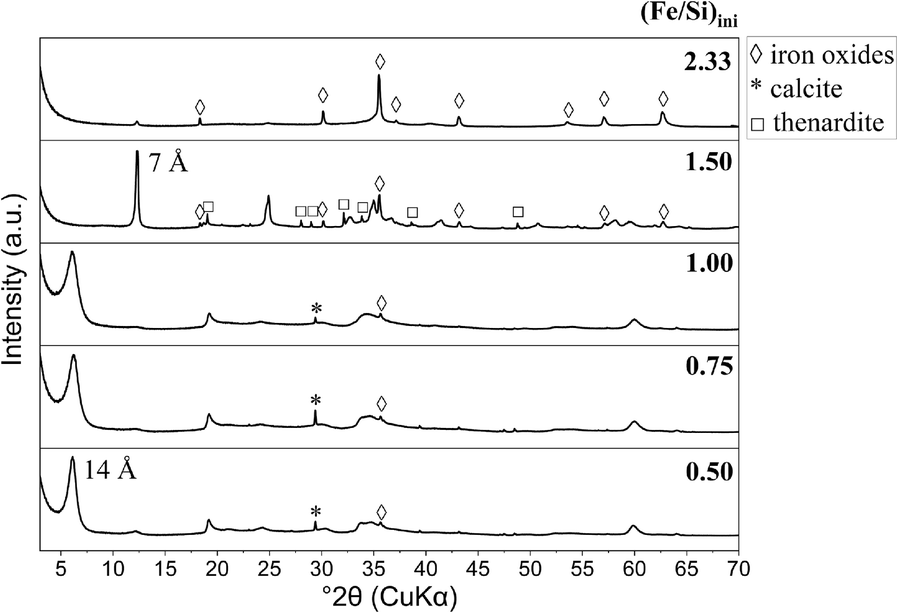
Crystalline phase analysis of synthesis products showed that for (Fe/Si)ini ≤ 1.00, 2:1 phyllosilicate was formed (Fig. 1). The 2:1 phyllosilicate was identified in XRD by its characteristic reflections at 6.26; ~19.20–19.30; ~34.00, and 60.06°2θ (i.e. 14.11, 4.62–4.58, 2.60, and 1.54 Å, respectively) (Brindley & Brown, Reference Brindley and Brown1982). Calcite (CaCO3) was also present as an impurity. This could be due to the use of dithionite, in which calcite was used as a stabilizer; or it may have been the result of precipitation of carbonate upon the sample saturation with calcium during post-synthesis treatment. For (Fe/Si)ini > 1.00, a 1:1 phyllosilicate was identified (Fig. 1) based on characteristic reflections at 12.36, 24.91, 35.01, 41.33, 50.84, 58.21, and 59.56°2θ (i.e. 7.16, 3.57, 2.56, 2.19, 1.79, 1.59, and 1.55 Å, respectively) (Bailey, Reference Bailey and Bailey1988; Hybler, Reference Hybler2006). For the sample with (Fe/Si)ini = 1.50, thenardite (Na2SO4) was identified, due to the use of dithionite and sulfate as anions during the synthesis. For samples with (Fe/Si)ini = 2.33, various iron oxide phases were identified.
Powder X-ray diffractograms of the synthesis products for 0.50 ≤ (Fe/Si)ini ≤ 2.33

Analysis by XRF of synthesis products showed that the Fe/Si molar ratio after the synthesis was greater than the Fe/Si molar ratio introduced in the mixture, suggesting only partial iron-rich phyllosilicate precipitation and the formation of other Fe-bearing phases (Table 1). This is in agreement with the crystalline phases identified. For the sample with the initial Fe/Si = 2.33, the pH dropped significantly upon precipitation and after synthesis due to the hydrolysis and condensation of iron and silicon into various solid phases (Eqs 1 and 2).


The solubility of silica is lower in acidic pH compared to basic pH (Iler, Reference Iler1979). This explains the absence of phyllosilicates and the presence of various iron oxides identified only by XRD. Magnetite was identified in the sample with (Fe/Si)ini = 1.50 and hematite in samples with (Fe/Si)ini ≤ 1.00. Although the system was in reducing conditions upon precipitation (negative Eh), after synthesis it clearly became oxidizing (close to zero or positive Eh) (Table 1).
Characterization of 1:1 Phyllosilicate Containing Synthesis Product
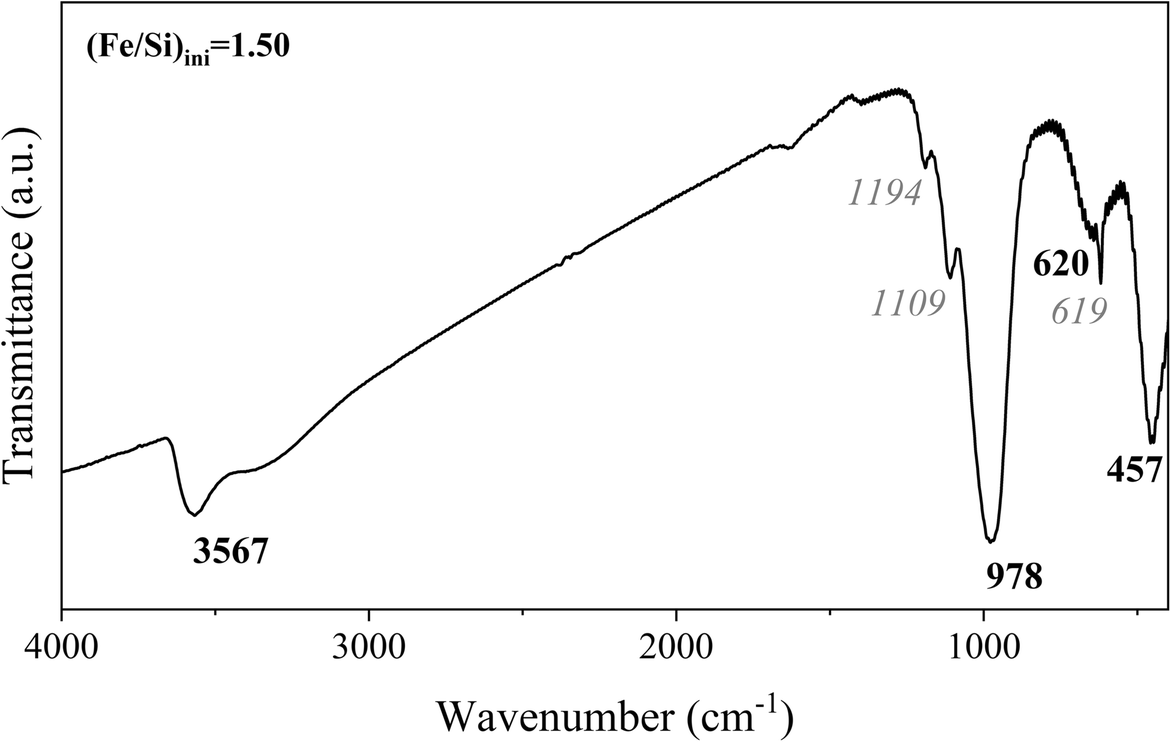
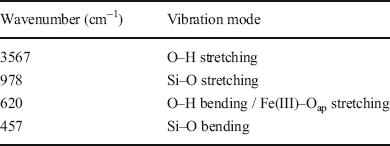
The sample with (Fe/Si)ini = 1.50 was chosen for a more detailed characterization as it indicated a superior phyllosilicate phase crystallinity compared to the sample with (Fe/Si)ini = 2.33 (Fig. 1). Infrared spectroscopy showed O–H and Si–O bond stretching and bending vibrations (Fig. 2 and Table 2). Sharp peaks at 1194, 1109, and 619 cm–1 correspond to thenardite, which was also identified by pXRD (Farmer, Reference Farmer and Farmer1974). The 620 cm–1 band could be a combination of O–H deformation and Fe(III)–Oapical stretching vibrations (Neumann et al., Reference Neumann, Petit and Hofstetter2011). Previous studies reported that the presence of Fe(II) in phyllosilicate makes the spectra featureless (Fialips et al., Reference Fialips, Huo, Yan, Wu and Stucki2002; Manceau et al., Reference Manceau, Lanson, Drits, Chateigner, Gates, Wu, Huo and Stucki2000), suggesting that some of the iron might have been incorporated as Fe(II). Note that the intensity and position of bands can be affected by sample orientation, and polytypic sequence. Two low-intensity bands at 1634 and 1400 cm–1 correspond to vibrations of water molecules and carbonate anions, respectively.
FTIR spectrum of the (Fe/Si)ini = 1.50 synthesis product

Identified FTIR bands and corresponding vibration modes for (Fe/Si)ini = 1.50

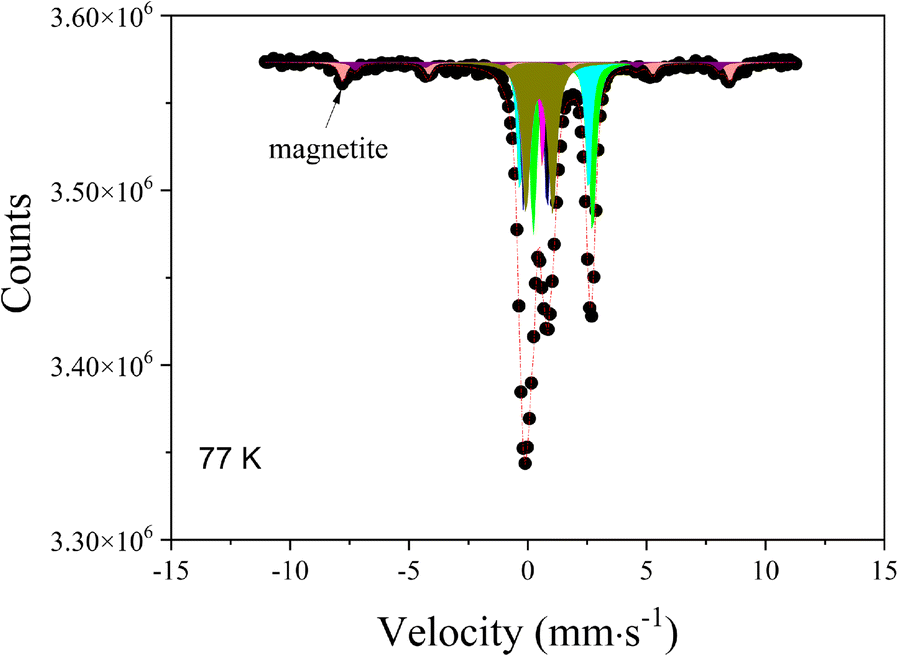
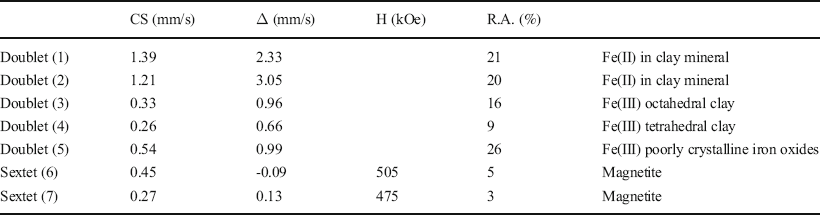
To check if Fe(II) was present in the sample as suggested by FTIR, further analysis using Mössbauer spectroscopy was performed. The Mössbauer spectrum at 77 K was chosen to be presented and discussed here, as at this temperature iron oxides can be differentiated from phyllosilicates. Often, the spectrum recorded at 4 K is considered as a true diagnostic for the presence of most minerals. However, in the case of polymineralic samples at very low temperature, to discern the presence of magnetite and its multiple sextets might be challenging due to the overlap of the magnetite sextets with other phases (e.g. spectra at 15 and 4 K in Figs. S1 and S2 in Supplementary Information). Using the spectrum at 77 K is more convincing, even if the magnetically ordered phase was much less abundant than the paramagnetic component. The spectrum at room temperature showed just a few traces of the magnetically ordered phase in the background noise (Fig. S1 in Supplementary Information). This component was more enhanced at 77 K due to the temperature effect. The spectrum of (Fe/Si)ini = 1.50 sample obtained at 77 K clearly confirmed the presence of Fe(II) as two doublets with chemical shift of 1.21 and 1.39 mm/s (Fig. 3 and Table 3) (Murad, Reference Murad, Theng, Lagaly and Bergaya2006). In total, five doublets and two sextets were necessary to describe the spectra obtained experimentally (Table 3). The two sextets corresponded to magnetite (Stucki, Reference Stucki, Bergaya and Lagaly2013), which was identified also by pXRD. It is generally agreed that below the Vervey temperature the magnetite spectrum is fitted with five sextets (Vandenberghe et al., Reference Vandenberghe, Barrero, da Costa, Van San and De Grave2000). In the current case, given the abundance of the magnetically ordered component, it seemed misleading to fit the spectrum part corresponding to magnetite with five components as indicated in the literature. It seemed more convincing to fit with only two sextets of the most abundant components instead. Three doublets with center shifts of 0.26, 0.33, and 0.54 mm/s were attributed to Fe(III). Two doublets with center shifts of 0.33 and 0.26 mm/s corresponded to octahedrally and probably tetrahedrally coordinated Fe(III) of 1:1 phyllosilicate, respectively (Baron et al., Reference Baron, Petit, Pentrák, Decarreau and Stucki2017). The third doublet of Fe(III) with center shift of 0.54 mm/s could be attributed to amorphous or poorly crystalline iron oxides not revealed by pXRD. Finally, the two doublets with large values of center shifts of 1.21 and 1.39 mm/s corresponded to Fe(II) of 1:1 phyllosilicate (Chemtob et al., Reference Chemtob, Nickerson, Morris, Agresti and Catalano2015). Mössbauer spectroscopy revealed the significant complexity of the sample having several mineral phases: phyllosilicates, magnetite, and poorly crystallized iron oxide.
Mössbauer spectrum for the synthesis product with (Fe/Si)ini = 1.50 at 77 K

Mössbauer parameters for the synthesis product with (Fe/Si)ini = 1.50 at 77 K, where CS is center shift, Δ is quadrupole splitting, H is hyperfine field, and R.A. is relative abundance

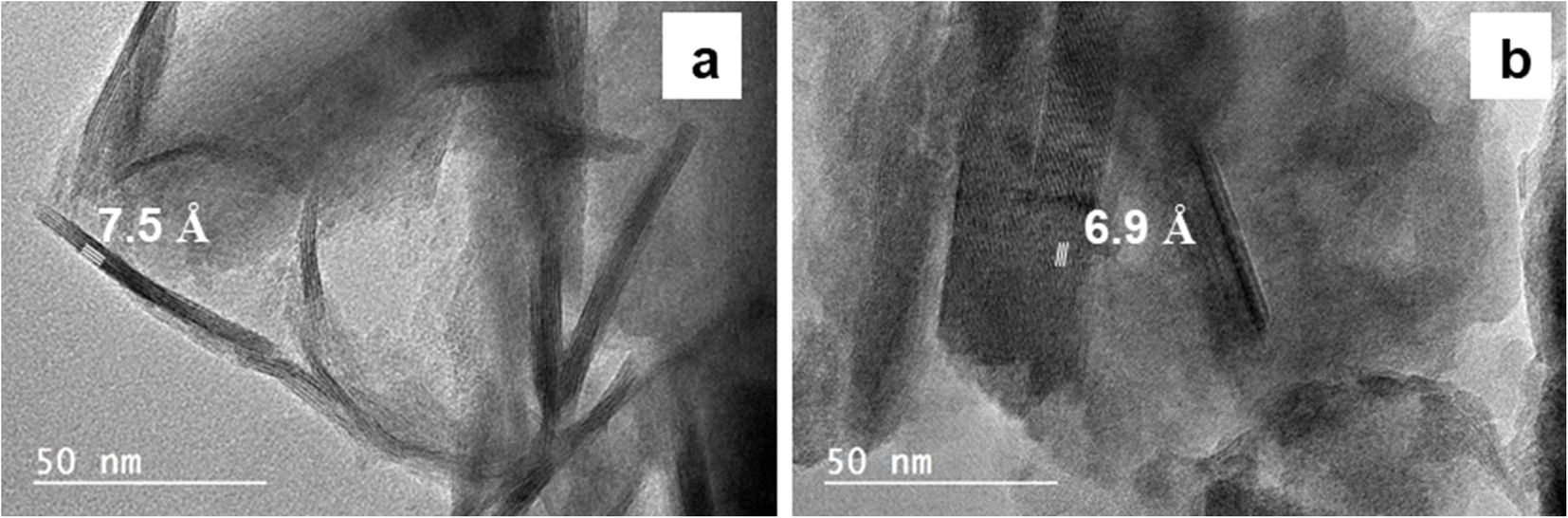
Considering the complex mineralogy of the sample, the particles were examined under transmission electron microscopy (TEM) to understand in greater detail the structure and chemistry of phyllosilicates only. Observations by TEM revealed the layer-structure characteristics of 1:1 phyllosilicates with an average layer-to-layer distance of 7 Å (Fig. 4). Particles with different thicknesses were observed, ranging from a few layers to several tens of layers.
TEM images of the synthesis product with (Fe/Si)ini = 1.50

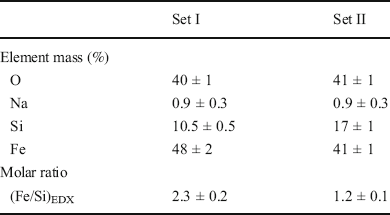
Chemical analysis revealed two sets of zones (Table 4): one with an (Fe/Si)EDX molar ratio of 2.3 and the second with a ratio of (Fe/Si)EDX = 1.2. Both ratios were less than determined by XRF (Table 1). The results of XRF analysis gave the average composition for the entire synthesis product which contained different phases as shown by XRD and Mössbauer spectroscopy. However, EDX was performed over a limited zone of particles dispersed on the copper grid and, as suggested by observations, related to phyllosilicate particles.
Semi-quantitative chemical analysis of particles of sample (Fe/Si)ini = 1.50 by TEM-EDX

Considering the information gathered from different characterization techniques, it could be concluded that the synthetic sample contained 1:1 phyllosilicate with Fe(III) and Fe(II) entities. The (Fe/Si)EDX = 2.3 was close to the ratio corresponding to the crystal chemistry of cronstedtite, where Fe was located in both the octahedral (with presence of ferrous and ferric cations) and tetrahedral sheets (containing ferric cations), whereas (Fe/Si)EDX = 1.2 corresponded to greenalite, where Fe is located only in the octahedral sheet (only ferrous cations). Such variation in Fe/Si suggested important heterogeneity in the chemistry of the neoformed phyllosilicate phases.
Characterization of 2:1 Phyllosilicate Containing Synthesis Product
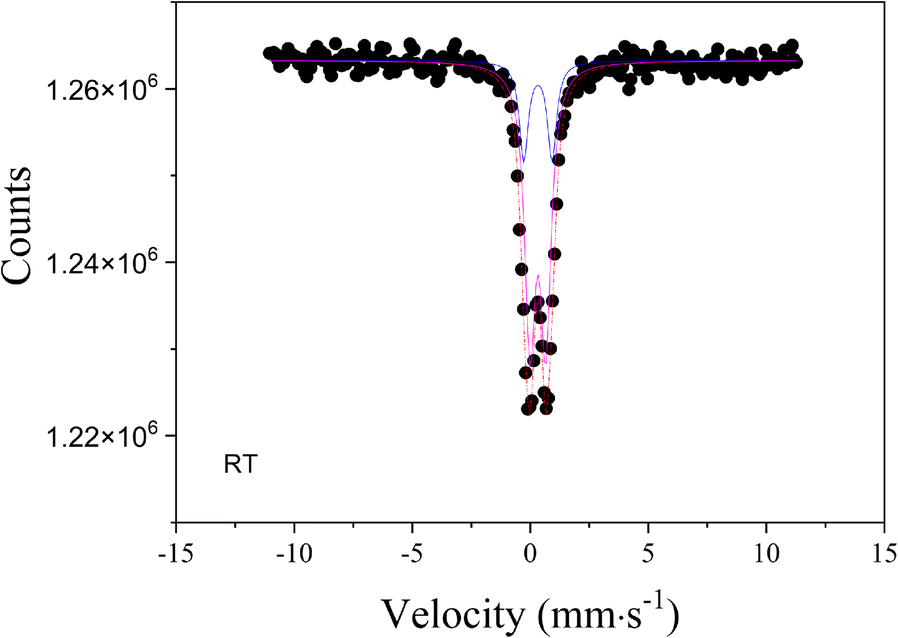
Powder XRD traces of synthesis products with (Fe/Si)ini from 0.50 to 1.00 were very similar and two iron-containing crystalline phases were identified: 2:1 phyllosilicate and iron oxide (Fig. 1). Analysis of the sample with (Fe/Si)ini = 0.75 by Mössbauer spectroscopy at room temperature showed the presence of Fe(III) only (Fig. 5). Due to the low signal/noise ratio and the complexity of data, further analysis of Mössbauer spectra obtained at 4 K was not performed. The spectrum at room temperature permitted the hypothesis of the presence of Fe(II) in the sample to be discarded (Table 5).
Mössbauer spectrum for the synthesis product with (Fe/Si)ini = 0.75 at 290 K

Mössbauer parameters for the synthesis product with (Fe/Si)ini = 0.75 at 290 K , where CS is center shift, Δ is quadrupole splitting, ε quadrupole shift, H is hyperfine field, and R.A. is relative abundance

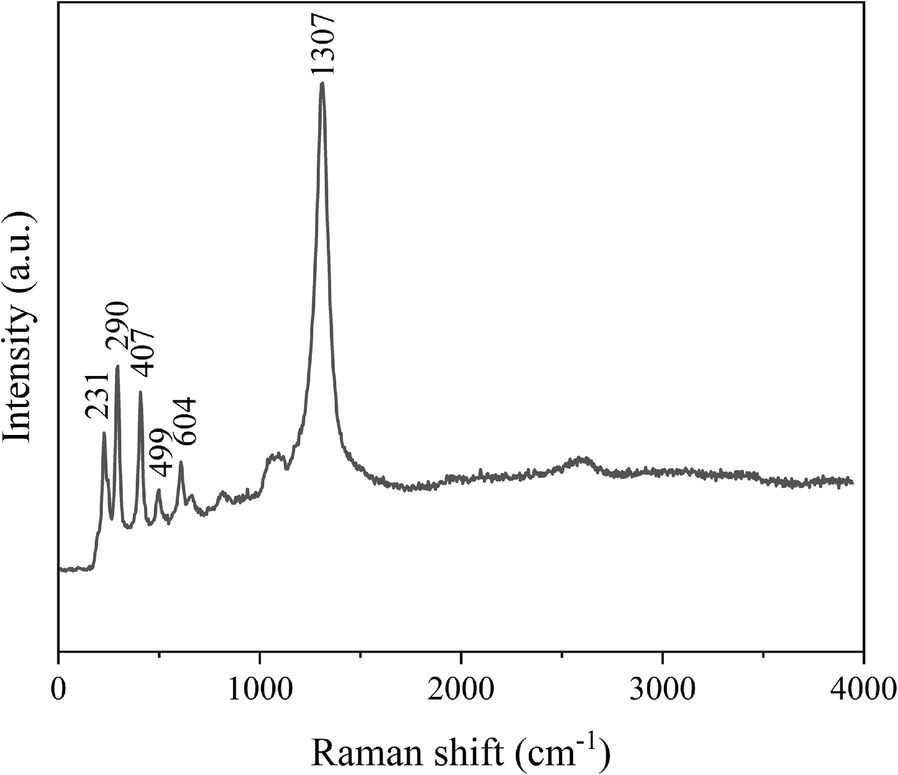
Owing to the complexity of the results from the Mössbauer spectroscopy, Raman spectroscopy was performed for this sample to investigate in more detail the possible iron oxides present in the sample (Fig. 6). Different powers were applied to examine if iron oxide would oxidize under the beam. However, the same spectral pattern was obtained, confirming that no changes happened to the sample upon its exposure to the beam. The spectrum obtained corresponded to hematite with characteristic intense bands at 231, 290, 407, 499, 604, and 1316 cm–1 (Hanesch, Reference Hanesch2009).
Raman spectrum for the synthesis product with (Fe/Si)ini = 0.75

In summary, Raman spectroscopy allowed the type of iron (III) oxide to be identified (not possible by XRD). This information gave a more complete view of the complexity of the sample, where hematite was present along with 2:1 Fe(III)-rich phyllosilicate. Further characterization by XRD (oriented slides), FTIR, and TEM were undertaken to investigate in more detail the 2:1 phyllosilicate.
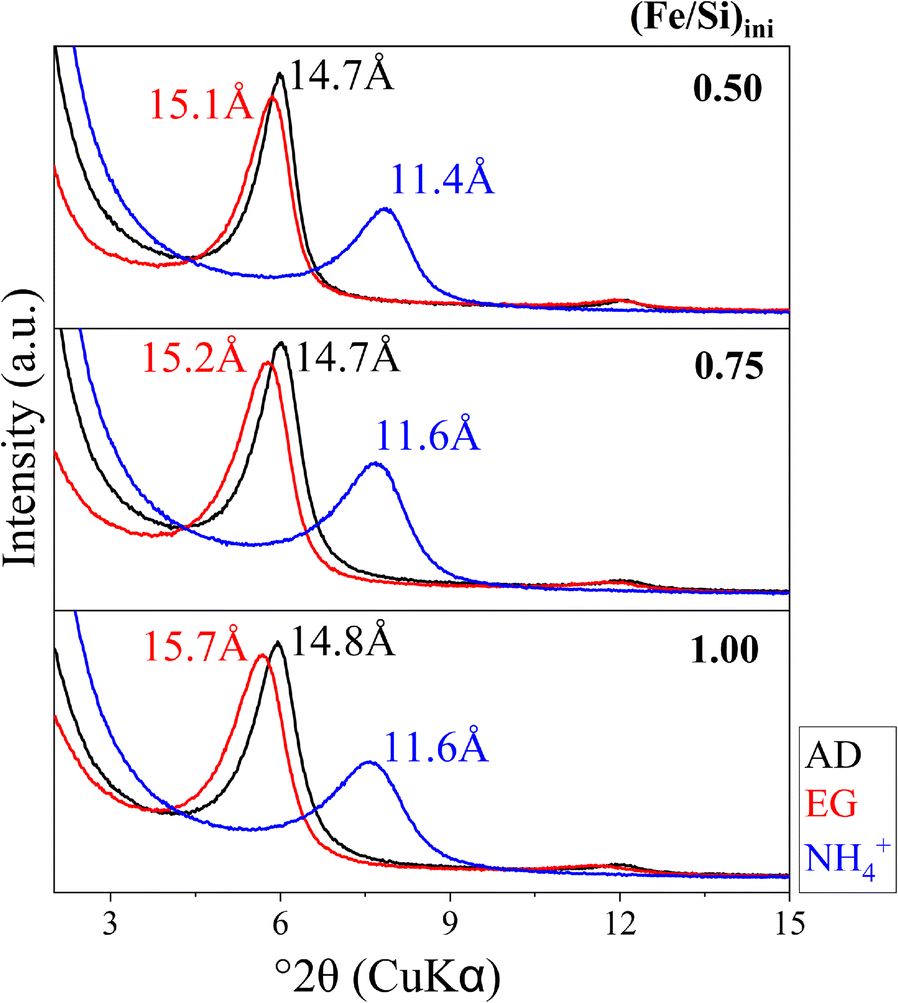
Regarding the 2:1 phyllosilicate, air-dried oriented preparations (AD) treated with ethylene glycol (EG) did not exhibit significant swelling, suggesting high-charge smectite or chlorite (Fig. 7). The exchange with NH4 + allowed the hypothesis of chlorite to be discarded; however, the asymmetry and broadness of peaks suggested a rather heterogeneous sample in terms of layer chemistry.
X-ray diffractograms of oriented preparations for samples with (Fe/Si)ini from 0.50 to 1.00. AD corresponds to air-dried preparations, EG – saturated with ethylene glycol and NH4 +- exchanged with NH4 +

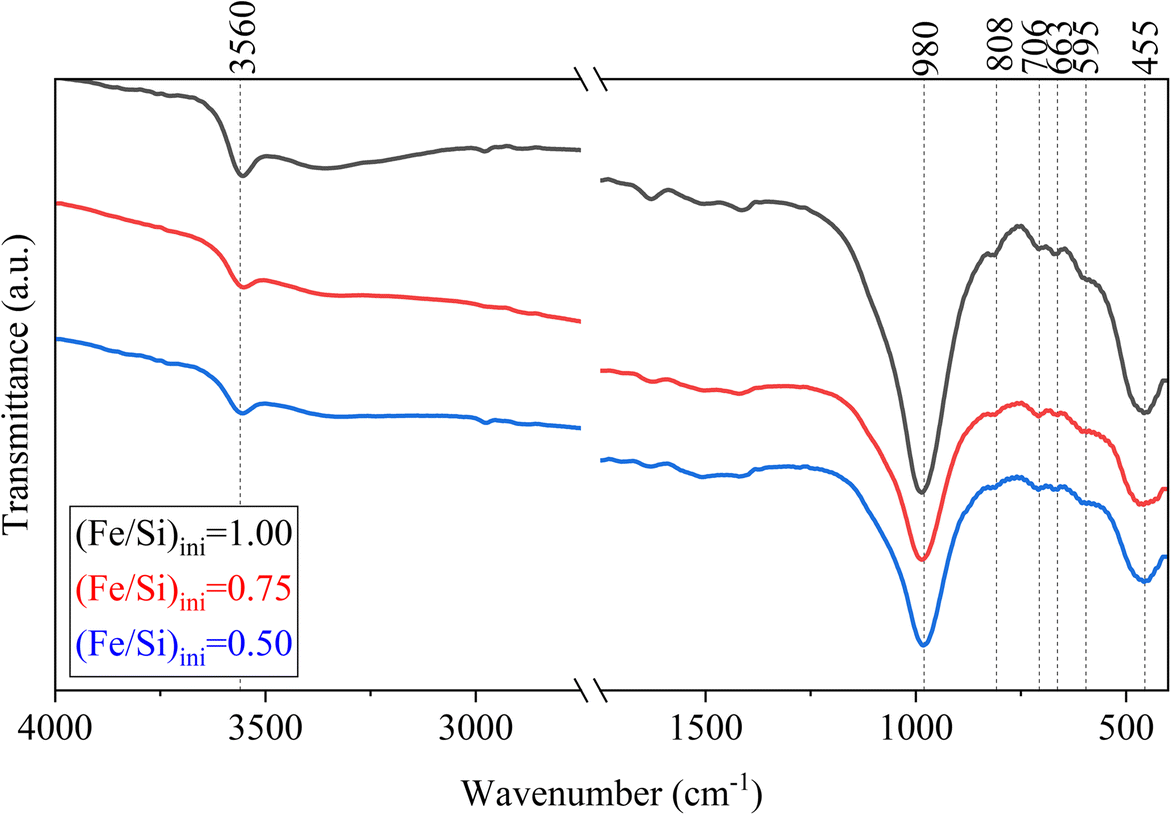
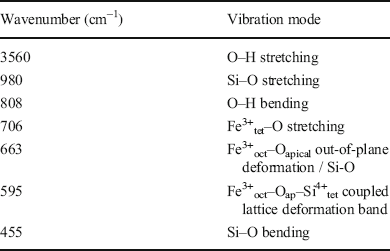
Analysis of FTIR spectra showed characteristic O–H and Si–O vibrations (Fig. 8). The low value of Si–O stretching at 980 cm–1 suggested Fe(III) substitution in the tetrahedral sheet (Baron et al., Reference Baron, Petit, Tertre and Decarreau2016). The band of O–H stretching at 3560 cm–1 corresponded to the O–H group linked to Fe(III). Other characteristic bands of Fe-rich smectites (nontronites) could also be identified according to literature (Table 6) (Neumann et al., Reference Neumann, Petit and Hofstetter2011).
FTIR spectra for samples with (Fe/Si)ini = 0.50, 0.75 and 1.00

Identified FTIR bands and corresponding vibration modes for (Fe/Si)ini from 0.50 to 1.00

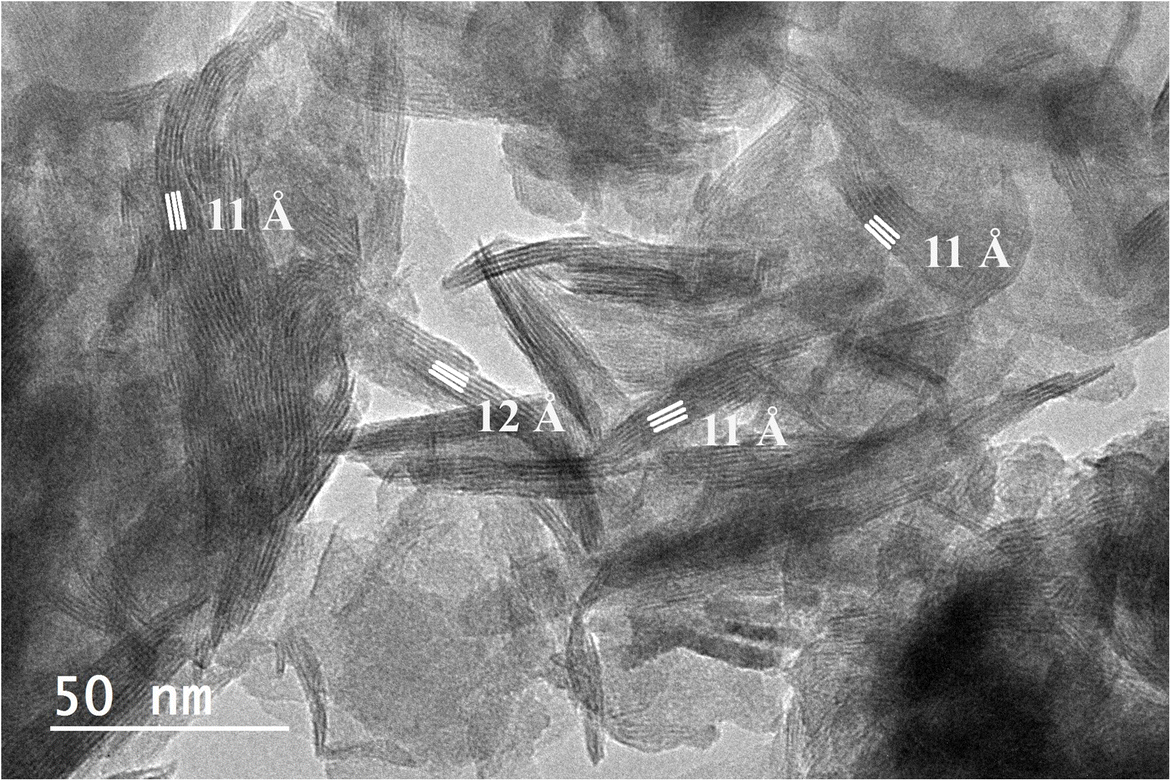
Observation of the sample under TEM revealed the presence of platy-like particles (Fig. 9). A clear layer-type structure could be distinguished, characteristic of phyllosilicates. The measured distances between layers were in the range 11 to 12 Å, corresponding to one of 2:1 phyllosilicates. In constrast to the (Fe/Si)ini = 1.50 sample, all observed particles were just a few layers thick.
TEM image of the synthesis product with (Fe/Si)ini = 0.75

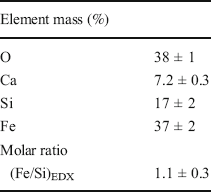
The measured chemical composition for the zones corresponding to phyllosilicates showed homogeneous distribution of elements (Table 7) contrary to two distinct zones observed previously for the sample (Fe/Si)ini = 1.50. The calculated average (Fe/Si)EDX = 1.1 ± 0.2 suggests that the average chemical composition for smectite should be INTCa0.50-0.75 VI[Fe3+2]IV[Si2.5-3Fe3+1.0–1.5]O10(OH)2. This result is in agreement with the experiments reported by Baron et al. (Reference Baron, Petit, Tertre and Decarreau2016). They reported a synthesis of high-charge nontronite with tetrahedral Fe(III) between 1.0 and 1.5 atoms per formula unit when pH > 13.
Semi-quantitative chemical composition of a sample with (Fe/Si)ini = 0.75 determined by TEM-EDX

Discussion
Initially, the choice was made to perform the synthesis at hydrothermal conditions in an attempt to increase the yield and crystallinity of the final synthesis product. On the one hand, this objective was reached as crystalline phyllosilicates were produced in most of the samples during synthesis. Their amount and crystallinity allowed a sufficiently detailed characterization to be carried out. On the other hand, the use of hydrothermal conditions led to processes which were difficult to control at this temperature and pressure, and which caused the experimental variables to evolve. This resulted in a rather complex mineralogy: phyllosilicates, magnetite, and/or hematite were identified in synthesis products. In addition, for the sample with (Fe/Si)ini = 2.33, a large decrease in pH occurred during the precipitation of the precursor and as the hydrothermal treatment “moved” this system out of the phyllosilicate stability field. The synthesis performed at lower temperatures, closer to room temperature, enabled better and continuous control of experimental conditions, and thus a precipitation of a single mineralogical phase, as was shown in the experiments of Tosca et al. (Reference Tosca, Guggenheim and Pufahl2016) and Hinz et al. (Reference Hinz, Nims, Theuer, Templeton and Johnson2021). However, such an experiment requires a significantly longer time (3 months in the case of Tosca et al., Reference Tosca, Guggenheim and Pufahl2016) or a subsequent hydrothermal treatment at higher temperatures as in the case of Hinz et al. (Reference Hinz, Nims, Theuer, Templeton and Johnson2021) to obtain sufficient quantities of the material for further characterization, while yield products were still very low in crystallinity.
Despite the complex mineralogy obtained, study of the phyllosilicates was still possible, as well as verifying the current hypothesis that a single phyllosilicate would form at a given initial Fe/Si. For (Fe/Si)ini < 1.50, a 2:1 phyllosilicate, a high-charge nontronite was synthesized. Very similar samples were obtained regardless of the (Fe/Si)ini for this range. The formula unit found in this study was in agreement with nontronite synthesized by Baron et al. (Reference Baron, Petit, Tertre and Decarreau2016) at the same pH. This suggested that in the case of nontronite the pH could be the main governing factor determining the formation of this Fe(III)-rich smectite as evidenced by Baron et al. (Reference Baron, Petit, Tertre and Decarreau2016). Their results and the current study are also in agreement with previous findings (Boumaiza et al., Reference Boumaiza, Dutournié, Le Meins, Limousy, Brendlé, Martin, Michau and Dzene2020). Those authors showed that among three synthesis parameters, namely, time, temperature, and initial OH/Fe molar ratio, the last named (and consequently the pH) had the most important effect on the final synthesis product.
Another conclusion of the Boumaiza et al. (Reference Boumaiza, Dutournié, Le Meins, Limousy, Brendlé, Martin, Michau and Dzene2020) study was that the kinetics of the formation of 2:1 phyllosilicate in the Fe–Si–O–H system for a given (Fe/Si)ini was faster compared to 1:1 phyllosilicate. As discussed already in the Introduction, this could then explain, for a given (Fe/Si)ini, why the stoichiometry corresponds to a 2:1 phyllosilicate rather than to a 1:1 phyllosilicate. Therefore, a compromise between the increase in temperature and yield, yet limiting the formation of a 2:1 phyllosilicate, must be found.
In the current study, the formation of the 1:1 phyllosilicate was achieved for (Fe/Si)ini ≥ 1.50. However, the phyllosilicate phase which formed was rather heterogeneous, showing two chemical compositions, and thus possibly two types of phases, cronstedtite and greenalite. A more rigorous control of synthesis conditions (Eh, pH) may be necessary in this particular system to synthesize a homogeneous phyllosilicate. Indeed, Pignatelli et al. (Reference Pignatelli, Bourdelle, Bartier, Mosser-Ruck, Truche, Mugnaioli and Michau2014) presented the calculated stability fields of hematite, cronstedtite, magnetite, and greenalite, and showed that the stability field of cronstedtite at 150°C is very narrow.
In summary, the 2:1 phyllosilicate seemed to be less sensitive to redox conditions. For the 1:1 phyllosilicate, its formation also depended on pH, and also was strongly dependent on the redox conditions of the system. Indeed, Rivard et al. (Reference Rivard, Montargès-Pelletier, Vantelon, Pelletier, Karunakaran, Michot, Villieras and Michau2013) had shown that, in a kaolinite-iron system under anoxic conditions, a berthierine-like phase was formed which dissolved upon introduction of O2 into the system. It has to be noted that, even if a synthesis of homogeneous phyllosilicate could be achieved, the synthesis time was relatively short compared to the expected formation of such phyllosilicate analogues in Nature. As a consequence, synthetic iron-rich phyllosilicates could be expected to be more heterogeneous than natural ones (Baker & Strawn, Reference Baker and Strawn2014).
The implications of the results of this study are important for engineered systems, where soluble silicon and iron species might be present. The study showed that the (Fe/Si)ini ≤ 1.50 in aqueous solution can lead to the precipitation of phyllosilicates, and thus possibly induce corrosion or scale formation. Three cases can be mentioned regarding engineered systems where such conditions might occur: (1) the scale formation in solution-conducting pipes; (2) the corrosion of steel containers or pipes; and (3) the corrosion of glass. First, regarding scale formation in solution-conducting pipes, such conditions can occur for basic solutions where the concentration of silica is high, and iron can be present such as in hyper-saline brines (Manceau et al., Reference Manceau, Ildefonse, Hazemann, Flank and Gallup1995). Such scale formation can then clog pipes and damage other equipment. Second, corrosion of the metal container or pipe can occur in an environment where such pipes or containers are surrounded by cement material. The pH of cement material is basic. As a result, some dissolved silica is expected to be present if the material is wet and porous. In contact with metal where some Fe2+ could be leached, the formation of phyllosilicates can then be expected, leading to further dissolution of steel. Indeed, previous studies of such a system reported the presence of phyllosilicates (Lanson et al., Reference Lanson, Lantenois, van Aken, Bauer and Plancon2012). Third, most glass compositions contain a large amount of silica. Thus, on the glass surface a significant amount of Si–OH species can be present. In contact with steel or dissolved Fe2+, phyllosilicate precipitation can then be expected due to a high Si/Fe ratio (i.e. low Fe/Si ratio). Silica consumption can then lead to glass corrosion. Indeed, the study of Carriere et al. (Reference Carriere, Neff, Martin, Tocino, Delanoë, Gin, Michau, Linard and Dillmann2021) identified phyllosilicate phases on the glass–steel interface.
Conclusions
The synthesis performed in the Fe–Si–H2O system at 150°C showed that the initial Fe/Si molar ratio and the pH are critical parameters with regard to specificity of neoformed phases. The formation of ferrous serpentine (Fe(II)-containing) appears to be restricted to high iron concentration in solution and a very low redox range at high temperature (i.e. 150°C). In addition, a heterogeneity of formed phases (cronstedite or greenalite) was identified. For lower initial Fe/Si molar ratio, formation of a single high-charge nontronite phase was observed. The ion exchange experiments with NH4 + suggested some layer heterogeneity. Thus, the hypothesis of the formation of a single type of homogeneous clay mineral was not proven. However, for lower initial Fe/Si molar ratios, one kind of mineral, nontronite, was formed. Progress is still needed to achieve better selectivity, purity, and yield for structural, chemical, and thermodynamic characterizations. The findings and study in general are of interest for engineering systems where soluble iron and silicon species might be found, in glass and steel corrosion, and scale formation in pipes.
Supplementary Information
The online version contains supplementary material available at https://doi.org/10.1007/s42860-022-00204-6.
Funding
The study was conducted within the framework of R&D project between the French National Agency for Radioactive Waste Management (ANDRA) and CNRS.
Data Availability
All data generated or analyzed during this study are included in this published article and its supplementary information files.
Code Availability
Not applicable.
Declarations
Conflicts of Interest
On behalf of all authors, the corresponding author states that there is no conflict of interest.