Disasters are characterized by low-frequency, high-economic losses, and devastating tolls on human life. The United Nations Department of Humanitarian Affairs defines disaster as a situation or event that “overwhelms local capacity, necessitating a request to a national or international level for external assistance”.Reference Boslaugh 1 Disasters are classified as natural disasters such as floods, earthquakes, hurricanes, and tornadoes; or manmade disasters such as chemical, biological, radiological, nuclear, and explosive (CBRNE) events.
A total of 80% of the area of India is susceptible to natural disasters. Overall, 58.6% of the landmass is at risk of earthquakes and 12% of it is subject to floods and river erosion. Of the 7516-km long coastline, approximately 5700 km is at risk from cyclones and tsunamis; 68% of the cultivatable area is vulnerable to drought; and hilly areas are at risk from landslides and avalanches. Vulnerability to disasters or emergencies of CBRNE origin also exists in India.Reference Colvard, Lampiris and Cordell 2
Disasters in any form threaten the health and welfare of all civilized societies. Massive disasters are capable of destroying local health care facilities, clinics, and hospitals; paralyzing the whole health care system; and limiting the capability of response personnel to act effectively in a post-disaster scenario. 3 Disasters interrupt the progress of an entire nation and are capable of devastating the achievements of conscientious developmental efforts, often pushing nations in pursuit of progress back by several decades. Given the increasing frequency and intensity of disasters in recent times, the need for an active approach for the efficient management of disasters has come into sharp focus in India and abroad. 4 This approach indicates the need for capacity-building measures, so that the impact of these disasters can be managed effectively.
The aftermath of disasters can be so severe or diffuse that its response poses a great challenge. One of the first critical lines of defense is the adequate number of trained health care professionals.Reference Han, Alfano, Psoter and Rekow 5 Conventionally, medical professionals are involved in disaster management. A shortage of personnel is a major stumbling block during emergencies; hence, the need for potential sources from other than conventional medical personnel, such as those in dentistry, can contribute effectively in disaster management.
The profession of dentistry is highly regarded as a significant component of the health care delivery system. Based on their extensive academic training and practical skills, dentists can fulfil various roles ranging from forensic activities to treating orofacial injuries, controlling infection, extracting information from medical histories, administering injections, suturing wounds, developing immunization procedures, prescribing drugs, providing triage services, and providing public information.Reference Jeffcoat 6 - Reference Psoter, Park, Boylan, Morse and Glotzer 12 These attributes thus reinforce the role that dental professionals can play in disaster preparedness and management. RekowReference Rekow 8 and GalliganReference Galligan 13 have observed that dental professionals might represent a resource that is untapped and overlooked. With their basic knowledge, skills, and training, dental professionals might contribute effectively and significantly during emergencies.
Currently, the information on the readiness of dental professionals to respond to disasters has been limited. Katz etalReference Katz, Nekorchuk, Holck, Hendrickson, Imrie and Effler 9 have reported a low prevalence of previous training regarding bioterrorism among Hawaiian dentists. However, Colvard etalReference Colvard, Naiman, Mata, Cordell and Lampiris 14 have reported that Illinois dentists required minimal additional training to render their services as dental emergency responders. In addition, Rajesh etalReference Rajesh, Chhabra, Shetty, Prasad and Javali 15 have reported that Indian dental postgraduates had high attitude but low knowledge and behavior scores regarding disaster management.
Mobilizing dentists for disaster management has the potential to be immensely helpful, as they are widely distributed within the communities, similar to medical personnel. Moreover, new dental colleges are increasing in India. At present, the total number of dental institutions in India is 301, and the number of students completing a bachelor of dental surgery in 1 year is 23 690. 16 This growing population constitutes a vast number of health care professionals who can offer crucial help during emergencies. These figures emphasize the potential for appropriate utilization of these professionals to optimize disaster preparedness and response in developing countries with scarce resources such as India.
To our knowledge, no studies have explored the role of dental graduates in disaster preparedness and management in India. The aim of the present study was to assess the knowledge, attitude (defined as ‘‘a relatively enduring organization of beliefs around an object, subject or concept which pre-disposes one to respond in some preferential manner.’’Reference Park 17 ), and behavior of dental house surgeons in a private dental institution in India about disaster management. This pilot study can provide further support for multicentric study in India. It also can provide valuable baseline information that can pave the way for organizing dentistry's response within the local emergency response plan, disseminate public health information regarding disaster management, and support the possibility of incorporating disaster management in undergraduate and postgraduate dental curriculum in India.
Subjects and Methods
The pilot study was conducted in Sri Dharmasthala Manjunatheshwara College of Dental Sciences and Hospital, Dharwad, Karnataka, India. A list of all house surgeons was obtained from the administrative office of the institution. Permission to conduct the study was obtained from the college authorities, and ethical clearance was obtained from the institution's ethical committee of its institutional review board.
The house surgeons were gathered together, told the purpose of the survey, and given instructions for filling in the questionnaire. After this, they were given a packet consisting of informed consent, instructions, and a questionnaire; they had 1 hour in which to complete and return the questionnaire.
The close-ended and self-administered questionnaire was developed by the investigators. It elicited knowledge, attitude, and behavior of the study subjects regarding disaster management. These items were generated for this instrument from 4 sources: theory, research, observation, and expert opinion.Reference Rajesh, Chhabra, Shetty, Prasad and Javali 15 , Reference Streiner and Norman 18 A total of 26, 8, and 8 items assessed respondent's knowledge, attitude, and behavior, respectively. Attitude was assessed by means of a 5-point Likert scale: definitely yes, yes, neutral, no, and definitely no. The response options for items assessing behavior were: less than 1 month, 1 to 6 months, 6 to 12 months, more than 1 year, and never. Demographic information such as age, gender, place of residence, and religion was also obtained.
The range of possible scores for knowledge, attitude, and behavior was 0 to 26, 8 to 40, and 8 to 40, respectively. Correct and wrong answers for knowledge questions were given scores of 1 and 0, respectively. Attitude scores ranged from 5 (definitely yes) to 1 (definitely no), and behavior scores ranged from 5 (<1 month) to 1 (never).
A total of 26 questions on disaster management focused on common disasters in the local region, biological agents, identification of signs and symptoms of common bioterrorism-related diseases, identification of victims, triaging, and tagging. Questions related to attitude included whether dentists should be actively involved in disaster management activities, if they should act in coordination with other professionals toward disaster management, if they should constantly update their knowledge on disaster management, and if they should maintain proper dental records of their patients and assist in identifying persons during disasters. Questions pertinent to behavior assessed how frequently the respondents perused scientific journals and the Internet regarding disaster management, if they maintained accurate patient records, and if they attended training programs regarding disaster management.
The questionnaire was pretested with 40 house surgeons before the start of the study. Cronbach alpha and split-half reliability values were 0.72 and 0.86 for knowledge; 0.86 and 0.91 for attitude; and 0.82 and 0.87 for behavior, respectively. The questions underwent subsequent revisions before the main study. The revisions were to clarify 7 questions of knowledge and 2 questions each for attitude and behavior. The results of the pretested questionnaire were not included in the main study; only its reliability and validity were assessed. The participants for the pretested questionnaire did not take part in the pilot study.
Statistical Analysis
The data were entered into a spreadsheet (MS Excel Office version 2007, Microsoft), and the Intercooled STATA version 9.2 (StataCorp) was used to perform statistical analysis. The level of significance was set at 5%. Differences in knowledge, attitude, and behavior of study subjects with respect to gender, residence, religion, and year of study were assessed by a Kruskal Wallis test. Associations among knowledge, attitude, and behavior of study subjects and age of study subjects with knowledge, attitude. and behavior were assessed with use of Pearson correlation analysis. Associations of residence, religion, and year of study with knowledge, attitude, and behavior of study subjects were assessed by using a χ2 test.
Results
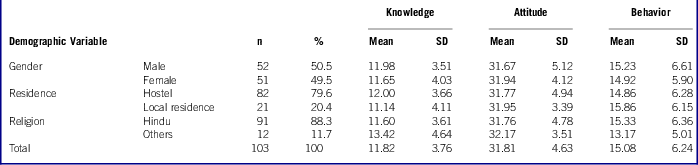
A total of 103 of 104 study subjects completed and handed in the survey questionnaire, with a response rate of 99.04%. The mean age of study subjects was 23.11 years. A total of 52 respondents were men (50.5%), and 51 were women (49.5%); a majority of 82 respondents resided in hostels (79.6%), while 21 resided in their homes in Dharwad; a majority of 91 respondents were Hindu, and 12 belonged to other religions (Table 1). No differences in knowledge, attitude, and behavior were found among gender, religion, and residence of the study subjects.
Demographic Variables and Knowledge, Attitude and Behavior About Disaster Management Among Study Subjects

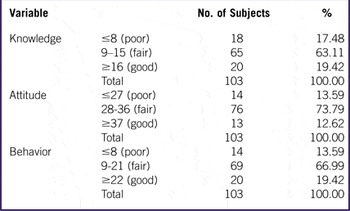
Knowledge, attitude, and behavior scores were categorized as good, fair, and poor by using mean ±1 SD values (ie, poor, less than mean -1 SD; fair, from mean +1 SD to mean -1 SD; and good, greater than mean +1 SD). Results also indicated that a majority of subjects (63.11%, 73.79%, and 66.99%) had fair knowledge, attitude, and behavior scores, respectively (Table 2).
Knowledge, Attitude and Behavior Scores Among Study Subjects

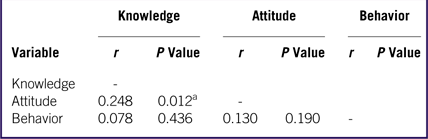
Correlation analysis revealed a statistically significant association between knowledge and attitude on disaster management among study subjects (r = 0.248, P = .012). No significant associations were observed between knowledge and behavior or between attitude and behavior regarding disaster management among study subjects (Table 3). Results indicated a statistically significant association between religion and knowledge about disaster management among study subjects (χ2 = 10.108, P = .006). No other statistically significant associations were observed between other demographic variables and knowledge, attitude, and behavior about disaster management among study subjects (Table 4).
Correlation Analysis of knowledge, Attitude and Behavior Among Study Subjects Using Pearson Correlation

a Significant at 1% level of significance.
Correlation Analysis of Demographic Variables With Knowledge, Attitude, and Behavior About Disaster Management Among Study Subjects Using χ2 Test

aPearson correlation was performed with age as continuous variable.
bSignificant at 0.1% level of significance.
Discussion
This pilot study was conducted to explore various issues related to the involvement of dental professionals in disaster management in India. This study, we believe, is the first to investigate knowledge, attitude, and behavior about disaster management among dental house surgeons in a private dental institution in India. Disaster management includes disaster response, disaster preparedness, and disaster mitigation.Reference Park 17 , 19
Contributions of dentists in disaster management as forensic odontologists,Reference Galligan 13 , Reference Vale and Noguchi 20 , Reference Guay 21 disaster mortuary operational response teams,Reference Psoter, Park, Boylan, Morse and Glotzer 12 in the armed forces,Reference Flores, Mills and Shackelford 22 during instances of natural disasters,Reference Bajaj 23 - Reference Wang, Wei and He 32 terror attacks,Reference Hinchliffe 28 and accidents, Reference Brannon and Morlang 33 - Reference Brannon and Morlang 37 identification of human remains,Reference Nuzzolese, Liuzzil and Quarta 38 unidentified bodies,Reference Nedel, Nedel, da Silva and Lund 39 mass graves and suicides,Reference Brannon and Morlang 40 - Reference Djuric, Milenkovic and Djukic 42 homicides,Reference Pretty and Sweet 43 burns,Reference Valenzuela, Martin-de las Heras, Marques, Exposito and Bohoyo 44 and more have been documented in the literature. Kieser etalReference Kieser, Laing and Herbison 25 have stressed the importance of accurate data collection and data management, and Wang and colleaguesReference Wang, Wei and He 32 have reported the need for incorporation of oral and maxillofacial surgeons in disaster management. Irrespective of the type of disasters or emergencies, dental professionals have been capable of treating injuries, controlling infection, managing patients, extracting information from medical histories, administering injections, suturing wounds, developing immunization procedures, prescribing drugs, providing triage services, and providing public information.Reference Jeffcoat 6 - Reference Psoter, Park, Boylan, Morse and Glotzer 12
Findings in the present study indicated that the knowledge and behavior scores of respondents were low, while their attitude scores were considerably high. Low scores of knowledge about disaster management were also reported among Hawaiian dentists by Katz etalReference Katz, Nekorchuk, Holck, Hendrickson, Imrie and Effler 9 and among dental postgraduates by Rajesh and coworkers,Reference Rajesh, Chhabra, Shetty, Prasad and Javali 15 but higher scores were reported by Colvard etalReference Colvard, Naiman, Mata, Cordell and Lampiris 14 among Illinois dentists. Lack of any formal training programs about disaster management and the absence of disaster management in the undergraduate curriculum in India may have led to low knowledge scores among the respondents. A high attitude score among the respondents was a positive indicator, signaling that respondents may be more receptive regarding disaster management training.
Limitations
The present pilot study revealed no statistically significant differences in knowledge, attitude, and behavior regarding disaster management by gender, religion, or residence in the study population. This finding may have been due to the inclusion of only 1 dental institution in the present study. As all the respondents were being trained according to a common curriculum, there may not have been any differences across the demographic variables. Further studies involving larger samples would be essential to clarify this finding.
A statistically significant association was found between knowledge and attitude scores of respondents, but not between knowledge and behavior or between attitude and behavior. Knowledge, attitude, and behavior might not share a linear relationship. Also, biases would need to be considered, such as acquiescence or yea saying bias; deviation or faking bad bias; social desirability or faking good bias; the halo effect; positive skew; and end-aversion bias.Reference Streiner and Norman 45 Further studies are necessary to explore the relationships among these variables.
Regression analysis revealed a statistically significant relationship between religion of the respondent and their knowledge on disaster management, but this significance may have been due to the uneven distribution of subjects in different religions (90% Hindus, 10% others); hence, additional studies should be conducted with an equal distribution of subjects from different religions to assess the true relationship. No significant relationship was noted among the demographic variables on the knowledge, attitude, and behavior of the respondents. Additional studies would be necessary to verify these relationships regarding disaster management.
Almost all forms of disasters of the modern era can be considered manmade disasters. Natural disasters are increasing because of population expansion, urbanization and industrialization, development within high-risk zones, environmental degradation, and climate change. Terrorist activities are growing because of disharmony and hostility between nations and people. Hence the frequency, variety, and intensity of mass disasters and catastrophic events are increasing daily.
Emergencies created by catastrophic events differ from daily emergencies by the number of casualties and magnitude of the injuries and physical damage. These situations are further worsened by damaged and blocked roadways and the disruption of telephone lines and electricity, which may overstretch and strain emergency response and public health systems.Reference Glotzer, Psoter and Rekow 46 Having an adequate number of trained medical, dental, and paramedical professionals who are willing and available to assist in these events will promote effective and efficient disaster management.
The recent disasters in India have highlighted the inadequacies in disaster management and scarcity of health care professionals. O'NeillReference O'Neill 47 and Olson etalReference Olson, Leitheiser, Atchison, Larson and Homzik 48 have observed that disaster management involves coordination and cooperation of professionals among different geographic and governmental jurisdictions. The integration of these various jurisdictions may be crucial for effective disaster management in India. Dental professionals represent an untapped and often overlooked resource. The findings of the present study emphasize the need to incorporate disaster management in the undergraduate dental curriculum. In a meeting on dentistry's response to bioterrorism conducted by the American Dental Association in June 2002, it was recommended that training of dental professionals on bioterrorism be included at the predoctoral level.Reference Guay 21
Psoter and coworkersReference Psoter, Herman and More 49 and Colvard etalReference Colvard, Naiman, Mata, Cordell and Lampiris 14 have observed that the current dental training already contains elements of the proposed competencies required for disaster management. Existing courses can undergo modest refinements to provide information relating to terrorism and catastrophe response. Practical skills regarding disaster management can include hands-on training sessions, practical demonstrations, and simulation drills. To promote intersector coordination, dental students will require training in a multidisciplinary team during emergencies.
By refining the current curriculum, scarce training budgetsReference Colvard, Naiman, Mata, Cordell and Lampiris 14 will not be overly burdened, and the results will ultimately lead to an enhanced learning experience for the students.Reference Psoter, Herman and More 49 With the increasing likelihood of disasters, resources from the dental curriculum should be modified and incorporated into the educational experience provided to students so that future practicing dentists can serve as early responders in catastrophic events.
Additional challenges to incorporating disaster management in the dental curriculum have been reported by Chmar etal.Reference Chmar, Ranney, Guay, Haden and Valachovic 50 In addition to financial considerations, these challenges include regional variations and management of basic science curriculum. Some legal issues also will influence the potential role of dentists in disaster management. State laws will have to be amended for the dental profession's effective participation.Reference Colvard, Lampiris and Cordell 2 , Reference Rekow 8 Other challenges will arise from the diversities in India regarding the diversity of the language, culture, religion, and other social determinants of the people; their access to the health care system; and the disparity in the system's infrastructure.
Hsu etalReference Hsu, Thomas, Bass, Whyne, Kelen and Green 51 have indicated that one of the major challenges in disaster management training of health care workers is to identify best practices. Also, the authors report a need for rendering disaster management training specific to different job categories to account for the diversity in the early training, work experience, and baseline skills of dental health care workers. All of these issues will have to be addressed for optimum disaster management in India.
Further studies regarding the potential role of general dental practitioners and dental students representing various parts of India should be conducted. Incorporation and role of other health care professionals like pharmacists, nursing personnel, physiotherapists, members of alternative systems of medicine like ayurveda, homeopathic medicine, etc in disaster management in India is also needed. There is a definite need for greater involvement of various health care professionals in disaster management in India. Health care professionals should update their knowledge from other resources like web-based resources, scientific journals, etc about disaster management and participate actively in disaster management activities in their local communities.Reference Frykberg 52 There is also a need to follow evidence based disaster planningReference Auf der Heide 53 to effectively offset the ever-growing threat of natural and manmade disasters in India.
Savoia et al have reported in their review that research on public health systems has increased at a rate of 33% per year.Reference Savoia, Massin-Short, Rodday, Aaron, Higdon and Stoto 54 They however observed that most of the studies reported lacked rigorous design. In 2 separate reviews on training health care professionals in disaster response, Williams et alReference Williams, Nocera and Casteel 55 and Huttington et alReference Huttington and Gavagan 56 have observed that there was insufficient evidence pertaining to the effectiveness of training health care professionals in improving their knowledge and skills related to disaster management.
Brock et alReference Brock, Mecozzi, Sumner and Kost 57 , in their review on pathogen tests and device specifications needed for emerging point-of-care (POC) technologies used in disasters, have highlighted the need for POC technologies that incorporate setting-specific designs. They have stressed the need for funding research that will lead to the development of hand held and portable devices to test for pathogens during the times of disasters. The Centre for Disease Control and Prevention (CDC) commissioned the Evidence-Based Gaps Collaboration Group (EBGC Group) to review training reports published in the peer-reviewed literature. Authors observed that there was disconnect among trainers, policy makers and public health agencies. Authors also observed that the usefulness of training programs for trainers and educators was rated only “fair” to “good”.Reference Potter, Miner, Barnett, Cadigan, Lloyd, Olson, Parker, Savoia and Shoaf 58 Challen et alReference Challen, Lee, Booth, Gardois, Woods and Goodacre 59 have reported a scoping review to identify location, source and quality of publications related to emergency planning, which was commissioned by the UK National Institute of Health Research. They observed in their review that most of documents were related to emergency planning and response; very few of them were pertaining to hazard analysis, mitigation or capability assessment. They also noted that current evidence was not used to inform policy and practice.
Conclusions
Although the scores in knowledge and behavior regarding disaster management among the dental graduates in the study were low, the association between knowledge and attitude of study subjects toward disaster management was statistically significant. Our findings indicated that these subjects might be receptive to have training programs on disaster management. Further studies would be required to clarify these variables.
This pilot study highlights the need for incorporating disaster management in the undergraduate dental curriculum in India. Also needed is to provide continuing education programs for dental professionals on disaster management in India. Preparing for catastrophic events is in the national welfare, particularly because of the increased risk of catastrophic events. The dental profession, by its meaningful involvement in disaster management, will be fulfilling its responsibility to safeguard and protect the health and welfare not only of the local community but of the nation as well.