Introduction
Terrestrial molluscs (slugs and snails) (Mollusca: Gastropoda), of which several species are a major pest of many crops, are mostly controlled using chemical molluscicides. One possible alternative for the control of molluscs is biocontrol using mollusc-parasitic nematodes (MPNs), with Phasmarhabditis hermaphrodita (Schneider) Andrássy (Rhabditida: Rhabditidae) being one of two MPN species to have so far been commercially developed (Sheehy et al., Reference Sheehy, Cutler, Weedall and Rae2022). The nematode is currently mass-produced and sold by BASF (formally Becker Underwood) and Dudutech, under the tradenames Nemaslug® and SlugTech®, respectively (Rae et al., Reference Rae, Verdun, Grewal, Robertson and Wilson2007; Ross, Reference Ross2019). The nematode is capable of parasitizing various mollusc species from the families Agriolimacidae, Limacidae, Arionidae, Vagnulidae and Milacidae (Wilson et al., Reference Wilson, Glen and George1993; Iglesias & Speiser, Reference Iglesias and Speiser2001; Speiser et al., Reference Speiser, Zaller and Newdecker2001; Grewal et al., Reference Grewal, Grewal and Hammond2003). The nematode is sold in a formulation, with the active ingredient being the infective juvenile (IJ) stage, which, when suspended in water and applied, searches the soil for slug hosts, causing death 4–21 days after infection (Wilson et al., Reference Wilson, Glen and George1993; Tan & Grewal, Reference Tan and Grewal2001).
Phasmarhabditis hermaphrodita has been mass-produced using both in vivo and in vitro methods, although the former production method involves the field collection or rearing of mollusc hosts in the laboratory, which is not economically viable. Therefore, the majority of research so far has focused on the in vitro production of the nematode, either in xenic cultures, with a mix of unknown bacteria, or in monoxenic cultures, using only one pure bacterial species (Wilson et al., Reference Wilson, Glen, Pearce and Rodgers1995a). The use of monoxenic cultures, however, is known to offer more predictable results, with it being more effective in producing a high number of IJs, with consistent pathogenicity (Wilson et al., Reference Wilson, Glen, Pearce and Rodgers1995a; Ehlers & Shapiro-Ilan, Reference Ehlers, Shapiro-Ilan, Grewal, Ehlers and Shapiro-Ilan2005).
In the search for a bacterial species for the monoxenic culturing of P. hermaphrodita, Wilson et al. (Reference Wilson, Glen, George and Pearce1995b) tested the pathogenicity of nine bacterial isolates, which were isolated from within dauer larvae of P. hermaphrodita, by means of injecting 10 μl of each into the haemocoel of Deroceras reticulatum Müller (Agriolimacidae). Of the bacterial isolates tested, only Aeromonas hydrophila (Chester) Stanier (Proteobacteria: Aeromonadacaea) and Pseudomonas fluorescens (Flügge) Migula (Proteobacteria: Pseudomonadacea) caused significant mortality in the slugs. However, as A. hydrophila has not been proven to support the growth of P. hermaphrodita, it was not considered as a monoxenic bacterial candidate. Bacterial isolates that supported the growth of P. hermaphrodita were then used in monoxenic foam chip cultures and/or liquid cultures, in combination with the nematode concerned, after which the pathogenicity of the nematode was tested on D. reticulatum in a soil-based bioassay system. The results indicated that P. hermaphrodita caused significant mortality in slugs, producing the highest yields of IJs when grown together with the bacterial isolate Moraxella osloensis (Bøvre and Henriksen) Bøvre (Proteobacteria: Moraxellaceae), even though it did not cause significant mortality when injected into the haemocoel of the slug. The above-mentioned bacterial species was, therefore, chosen for the commercial production of P. hermaphrodita (Wilson et al., Reference Wilson, Glen, George and Pearce1995b).
The BASF P. hermaphrodita product is produced in large-scale fermenters using in vitro liquid culture, like that which is used for the commercial production of entomopathogenic nematodes (EPNs), and in a monotonic association with the bacterium species M. osloensis (Morand et al., Reference Morand, Wilson, Glen and Barker2004; Rae et al., Reference Rae, Verdun, Grewal, Robertson and Wilson2007). It has however recently been discovered that the bacterial isolate used for the commercial production of P. hermaphrodita was possibly misidentified and is Psychrobacter faecalis Kämpfer, Albrecht, Buczolits and Busse (Proteobacteria: Moraxellaceae) (Sheehy et al., Reference Sheehy, Cutler, Weedall and Rae2022). Establishing a monotonic nematode–bacteria combination that can be grown in a liquid medium is essential for the consistent production of high IJ yields, and to be able to eliminate the risk posed by the presence of the other pathogenic bacteria in the medium (Poinar & Hansen, Reference Poinar and Hansen1986; Wilson et al., Reference Wilson, Glen, Pearce and Rodgers1995a). The IJ life stage is produced when stressful environmental factors occur, or when the food sources become depleted (Ross, Reference Ross2010). Depending on the growth medium concerned, and on the prevailing conditions in the bioreactors, different levels of IJ concentrations are produced, with yields of over 100,000 IJs/ml having been achieved (Glen et al., Reference Glen, Wilson, Pearce and Rodgers1994).
The discovery of the potential of nematodes as the biocontrol agents of insect and mollusc pests has led to widescale interest in the use of various methods for their mass production. In addition, a vast body of research exists on the mass production techniques used for EPNs, which can be translated into the mass-culturing of MPNs. Depending on the costs, time, resources, expertise and amount of product required, EPNs can be mass-produced, using in vivo or in vitro solid/liquid culturing methods (Ehlers & Shapiro-Ilan, Reference Ehlers, Shapiro-Ilan, Grewal, Ehlers and Shapiro-Ilan2005; El-Sadawy, Reference El-Sadawy2011; Abd-Elgawad et al., Reference Abd-Elgawad, Askary and Coupland2017). Although in vivo and in vitro solid culturing methods are labour-intensive, they require relatively little capital investment, whereas the in vitro liquid culture is the method of choice for large companies in developed countries, with the method requiring sophisticated engineering, a high level of capital investment and running costs, and close monitoring (Ehlers & Shapiro-Ilan, Reference Ehlers, Shapiro-Ilan, Grewal, Ehlers and Shapiro-Ilan2005; Lacey & Georgis, Reference Lacey and Georgis2012; Dunn et al., Reference Dunn, Prasanna and Malan2021).
The aim of the current study was to isolate, identify, culture and test the pathogenicity of bacterial isolates capable of supporting the in vitro culture of three MPN species, namely P. papillosa, P. kenyaensis and P. bohemica. In addition, the study also focused on optimizing the in vitro liquid culture method of successful nematode–bacteria candidates, by means of testing the effect of bacteria inoculum and IJ inoculum density on the total nematode/IJ yield and on the proportion of IJs found to be present after 14 days.
Materials and methods
Source of nematodes
The nematode species used for this study include P. bohemica Nermuť, Půža, Mekete & Mráček (Nematoda: Rhabditidae), P. papillosa (Schneider) Andrássy (Nematoda: Rhabditidae) and P. kenyaensis Pieterse, Rowson, Tiedt, Malan, Haukeland and Ross (Nematoda: Rhabditidae). The P. papillosa, which were obtained from a collection held by the Department of Conservation Ecology and Entomology at Stellenbosch University, were initially collected during a survey by Pieterse et al. (Reference Pieterse, Malan, Kruitbos, Sirgel and Ross2017a, Reference Pieterse, Tiedt, Malan and Rossb). Phasmarhabditis papillosa is a gonochoristic nematode that has been proven to cause mortality in slugs. The P. bohemica isolate used in the study, which was obtained from the Biology Centre CAS, Institute of Entomology ASCR, Laboratory of Entomopathogenic Nematodes, Czech Republic, was isolated during a study conducted by Nermuť et al. (Reference Nermuť, Půža, Mekete and Mráček2017) and is a gonochoristic, facultative MPN. The P. kenyaensis, which was obtained from the International Centre of Insect Physiology and Ecology (icipe), Kenya, is a gonochoristic nematode which was obtained during a study conducted by Pieterse et al. (Reference Pieterse, Rowson, Tiedt, Malan, Haukeland and Ross2020). Its pathogenicity to molluscs has not yet been tested.
Isolation and source of bacterial isolates
A total of ten bacterial isolates were used in the current study. Five bacterial candidates were isolated by means of dissecting Deroceras invadens Reise, Hutchinson, Schunack & Schlitt (Mollusca: Agriolimacidae) which were found dead in the field, by swabbing the intestine and body cavity, and streaking bacteria onto nutrient agar plates (3 g beef extract, 5 g Tryptone, 8 g sodium chloride (NaCl), 15 g agar in 1 l of water, autoclaved for 20 min at 121°C), which were incubated at 25°C for 48 h. The plates were then visually inspected, with different bacterial colonies being sub-cultured onto fresh plates, until only a single species remained on each plate. Five of these isolates were chosen at random for this study. Two additional bacterial isolates, which were obtained from a collection held by the Department of Conservation Ecology and Entomology at Stellenbosch University, were collected during a similar survey conducted by Pieterse (Reference Pieterse2016). These isolates were initially obtained by swabbing the intestines of dissected Deroceras reticulatum (table 1). Three EPN-associated bacterial species were included in the study and were also obtained from the collection held by the same department at Stellenbosch University and were isolated from EPNs in previous studies. Photorhabdus heterorhabditis Ferreira, Van Reenen, Endo, Tailliez, Pagès, Spröer, Malan & Dicks was isolated from the EPN species Heterorhabditis zealandica Poinar (Ferreira et al., Reference Ferreira, van Reenen, Endo, Tailliez, Pagès, Spröer, Malan and Dicks2014), Photorhabdus luminescens subsp. noenieputensis Ferreira, Van Reenen, Pagès, Tailliez, Malan & Dicks from Heterorhabditis noenieputensis Malan, Knoetze & Tiedt (Ferreira et al., Reference Ferreira, van Reenen, Pagès, Tailliez, Malan and Dicks2013a) and Xenorhabdus khoisanae Ferreira, Van Reenen, Endo, Spröer, Malan & Dicks from Steinernema khoisanae Nguyen, Malan & Gozel (Ferreira et al., Reference Ferreira, van Reenen, Endo, Spröer, Malan and Dicks2013b) (table 1).
The partial 16S rRNA gene accession numbers of seven bacterial isolates from Deroceras invadens collected from sample sites in George, Western Cape, South Africa and three bacterial isolates collected from entomopathogenic nematodes obtained from the collection housed at the Department of Conservation Ecology and Entomology at Stellenbosch University, with United States National Center for Biotechnology Information (NCBI) matches and with identity and coverage of between 98% and 100%.

a Identified during this study.
Identification of bacteria
Bacterial isolates isolated from dissected D. invadens in the present study were identified by means of extracting the total genomic DNA, using a Zymo Research fungal/bacterial DNA kit (Zymo Research Corporation, Irvine, California, USA). The DNA of the 16S rRNA gene was amplified, using the primer pair 8F and 1512R (Felske et al., Reference Felske, Rheims, Wolterink, Stackebrandt and Akkermans1997). The amplified products were then sequenced by the Central Analytical Facilities at Stellenbosch University. Sequence traces were inspected and assembled, using the software CLC Main Workbench 7.6.4 (CLC Bio, Aarhus, Denmark, http://www.clcbio/products/clc-main-workbench/) and analysed using the Basic Local Alignment Search Tool of the United States National Center for Biotechnology Information (NCBI) (https://blast.ncbi.nlm.nih.gov/Blast.cgi) (table 1). Sequences were then uploaded to the GenBank database (http://www.ncbi.nlm.nih.gov/) at NCBI.
Bacteria pathogenicity
Bacterial isolates were streaked onto nutrient agar plates (3 g beef extract, 5 g Tryptone, 8 g NaCl, 15 g agar in 1 l water), autoclaved at 121°C for 20 min and grown at 25°C for 24 h. The plates were then washed with 5 ml autoclaved 0.9% saline solution under sterile conditions, with 10 μl of each bacterial isolate being injected directly into the haemocoel of ten D. invadens specimens. The control slugs were injected with 10 μl sterile 0.9% saline solution. After having been treated in terms of each bacterial isolate, ten slugs were placed in plastic containers (145 mm × 205 mm × 80 mm) lined with moist tissue paper, each of which was then covered with a perforated lid. The boxes were kept at 18°C for five days, with the slugs being provided with carrot discs as their food source, which was replaced daily. After five days, the number of dead slugs was counted. The experiment was repeated with a fresh batch of slugs.
Bacterial feeding preference
Each of the ten bacterial isolates detailed above was streaked onto five Wout's agar plates (9.5-cm-diam.) in turn and left at 25°C for 24 h (Wouts, Reference Wouts1981). Wout's agar plates were used to support bacterial and nematode growth. A hundred IJs of the three nematode species (P. bohemica, P. papillosa and P. kenyaensis), contained in approximately200 μl distilled water, were added to the plates. Nematodes were washed with distilled water before being added to the plates. After covering the plates with parafilm and leaving them at 18°C for five days, the plates were visually inspected with a light microscope (Leica MZ7s), to determine whether the nematodes had survived, recovered and reproduced in association with the different bacterial isolates. A recovered IJ refers to an IJ that reacts on an environmental stimulus to open its mouth and start feeding. The experiment was repeated three times, on different test dates. The plates were scored based on four categories: dead (0); alive (1); recovered (2); and reproduced (3). Plates categorized as ‘dead’ contained only dead IJs (100%), whereas those categorized as ‘Alive’ showed that, despite the IJs involved having survived their treatment, the individuals concerned neither recovered nor developed. Those plates that were categorized as ‘recovered’ showed that the IJs present had developed into adults, but had not reproduced, while the contents of those that were categorized as ‘reproduced’ showed the presence of adult nematodes, along with next-generation juveniles (J1–J3).
Axenization of nematodes
As P. bohemica showed good survival, recovery and reproduction rates among a range of bacterial isolates (see the previous subsection), it was used in the monoxenic cultures. To establish such cultures, the eggs were harvested from adult female nematodes. IJs were added to 9.5-cm- diam. Petri dishes, lined with a piece of moist filter paper, containing freeze-killed D. invadens. The Petri dishes were sealed with parafilm and left at 18°C. The IJs of P. bohemica were then left for 96 h to develop into adult males and females, and to enable the females to be able to form fertilized eggs. The plates were then washed with saline solution and passed through a 212-μm aperture sieve to remove any life stages other than that of the adult females. The adult females were added to Eppendorf tubes, in which they were lightly crushed for 30 sec with an autoclaved plastic grinding rod. A mixture of bleach and sodium hydroxide (NaOH) (2.25 ml bleach, 0.2 g NaOH in 10 ml distilled autoclaved water) was added to the tubes, with it being left to work on the nematode mix for 8 min. The mixture in the tubes was then centrifuged and washed three times with sterile water, to remove all bleach and NaOH solution, until only a pellet remained with eggs in the water. After pipetting the mixture into 200 μl sterile tryptone soy broth in 24-well plates, they were sealed with parafilm and left for two days at 25°C, so as to allow for testing for bacterial contamination. If, after two days, no bacterial growth had occurred, and the nematodes concerned had hatched out, the J1 and J2 nematodes were used as the inoculation for liquid media culturing.
Establishing a liquid culture
For the liquid culture experiments, the bacterial isolates Pseudomonas sp. (AP1) (GenBank accession number: KX531096) and P. bohemica were used, as they had demonstrated a good response in the experiment so far (see the bacterial feeding preference subsection above). Previous research on Steinernema jeffreyense Malan, Knoetze & Tiedt proved that the use of 30 ml media as opposed to 50 ml media in 250-ml flasks resulted in increased IJ recovery and yield ascribed to efficient oxygen exchange (Dunn et al., Reference Dunn, Belur and Malan2020). Thirty ml of Luria broth (LB) (10 g NaCl, 10 g Tryptone, 5 g yeast extract/L water, autoclaved at 121°C for 20 min) in a 250-ml Erlenmeyer flask was thus inoculated with Pseudomonas sp. (AP1) and incubated on an orbital shaker (140 rpm), at 28°C for 48 h. A 250-ml Erlenmeyer flask containing 30 ml liquid culture medium (LCM) (9 g pig kidney, 17.4 g yeast extract, 8.6 g egg yolk powder, 52.6 g sunflower oil/L water, autoclaved for 20 min at 121°C) was then inoculated with 1.2 ml (4%) of Pseudomonas sp. (AP1) in LB. The flask was again incubated on an orbital shaker (140 rpm) at 28°C for 48 h. Once the bacteria had grown for 48 h inside the LCM, the sterile eggs and juvenile stages obtained after the axenization of the nematodes were added to the flasks. The flasks were then incubated at 18°C on orbital shakers at 140 rpm for 14 days, at which point most of the population in the flask were at the IJ stage. The flask involved was used as inoculum for the following experiments, with it coming, hereinafter, to be referred to as the ‘inoculum flask’.
Bacterial inoculum concentration
To test the impact of bacteria inoculum density, nine 250-ml Erlenmeyer flasks containing 30 ml LCM were inoculated with three different Pseudomonas sp. (AP1) inoculum concentrations, consisting of 1%, 3% or 5%. After three replicate flasks were set up per treatment, P. bohemica IJs from the inoculum flask were added to them all, to achieve an initial nematode density of 2000 IJs/ml. All nine flasks were incubated at 18°C on an orbital shaker (140 rpm) that was kept in the dark for 14 days. Every two days, the total number of nematodes and of IJs was recorded by taking a 200 μl aliquot from each flask. Aliquots were then observed under a light microscope (Leica MZ7s) to examine and count the nematodes present in each flask. The experiment was conducted twice.
Nematode inoculum concentration
To test the impact of nematode inoculum density, nine 250-ml Erlenmeyer flasks containing 30 ml LCM were inoculated with 1.2 ml (4%) Pseudomonas sp. (AP1) in LB, after which they were incubated on an orbital shaker (140 rpm) at 28°C for 48 h. Three treatments were established using the P. bohemica inoculum flask: 1000 IJs/ml, 2000 IJs/ml, and 3000 IJs/ml, with three replicate flasks per treatment. The flasks were incubated at 18°C on an orbital shaker (140 rpm) that was kept in the dark for 14 days. Every two days, the total number of nematodes and of IJs was recorded by taking a 200 μl aliquot from each flask. Aliquots were then observed under a light microscope (Leica MZ7s) to examine and enumerate the nematodes present in each flask. The experiment was conducted twice.
Statistical analysis
Obtaining the bacterial pathogenicity data involved using a generalized linear model with a Poisson distribution and a log link function. The findings made were confirmed by means of conducting a log-likelihood ratio test, giving a Chi-squared value of 2.7844 and P < 0.001. The liquid culture data were then analysed, using a repeated-measures analysis of variance, with the compound symmetry assumption being performed on the correlations over the days concerned.
Results
Identification of bacteria
The five bacterial isolates, consisting of three Pseudomonas spp. (AP2, AP3 and AP4), an Aeromonas sp. and a Buttiauxella sp., as used in the current study, were identified from the intestine and body cavity of D. invadens, with the 16S rRNA sequences generated being submitted to GenBank (table 1). GenBank details of the additional slug-associated bacterial species and of the EPN-associated bacterial species used in the study are indicated in table 1.
Bacteria pathogenicity
Bacterial isolates were tested on 20 slugs each. All the bacterial isolates tested, apart from for the Buttiauxella sp., caused significant mortality (F 10,11 = 35.800; P < 0.001) in the slug host D. invadens in the current study. Pseudomonas sp. (AP3), Kluyvera sp. and Aeromonas sp. all caused 100% mortality five days after they were injected into the slugs. Photorhabdus heterorhabditis caused mortality in 16 slugs and Pseudomonas sp. (AP4), Xenorhabdus khoisanae and Pseudomonas sp. (AP1) caused mortality in eight of the 20 slugs studied after five days. Pseudomonas sp. (AP2), Photorhabdus luminescens and Buttiauxella sp. were found to be the least pathogenic, with Pseudomonas sp. (AP2) and P. luminescens only managing to kill four slugs, and Buttiauxella sp. managing to kill none (fig. 1).
Mortality of Deroceras invadens (F 10,11 = 35.800; P < 0.01), five days after being injected with bacterial isolates: (A) Pseudomonas sp. (1); (B) Kluyvera sp.; (C) Pseudomonas sp. (2); (D) Pseudomonas sp. (3); (E) Pseudomonas sp. (4); (F) Aeromonas sp.; (G) Buttiauxella sp.; (H) Photorhabdus heterorhabditis; (I) Photorhabdus luminescens; and (J) Xenorhabdus khoisanae and the control (water only). Different letters above bars indicate significant differences (P < 0.05) between different bacteria and slug mortality.

Bacterial feeding preference
Phasmarhabditis bohemica was able to reproduce when feeding on the Pseudomonas sp. (AP1), (AP2), (AP3) and (AP4) and on the Buttiauxella sp., as well as on the P. luminescens and X. khoisanae from the EPNs. Although the IJs recovered and developed into adults, they did not reproduce when feeding on Kluyvera sp. When tested with Aeromonas sp. and P. heterorhabditis, the nematodes survived, although they remained in their IJ phase (table 2).
Ability of different bacterial isolates to support the growth of the nematodes Phasmarhabditis bohemica, Phasmarhabditis papillosa and Phasmarhabditis kenyaensis.

Score: 0 = dead; 1 = alive; 2 = recovered; and 3 = reproduced.
Phasmarhabditis papillosa only reproduced when they were tested with Pseudomonas sp. (AP4). When tested with Pseudomonas species (AP1), (AP2) and (AP3), as well as with Kluyvera sp., Aeromonas sp. and X. khoisanae, the IJs, despite developing into adult males and females, did not reproduce. When tested with Buttiauxella sp. and P. luminescens, the P. papillosa IJs survived, but did not recover. In the case of P. heterorhabditis, all the IJs involved died (table 2).
Phasmarhabditis kenyaensis reproduced when tested with Pseudomonas sp. (AP1), Kluyvera sp. and Buttiauxella sp., but died when it was tested with any of the other bacterial candidates (table 2).
Bacterial inoculum concentration
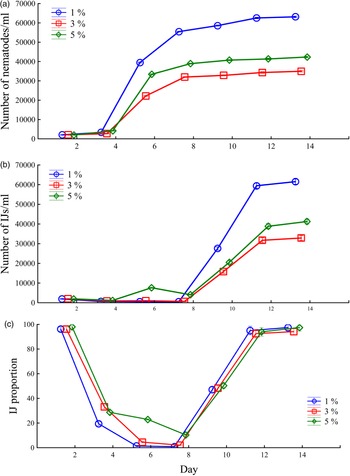
The analysis of the results using different bacterial inoculum concentrations showed a significant difference between the total numbers of nematodes of all developmental stages yielded (F 30,180 = 3023; P < 0.001) after 14 days. All flasks displayed exponential growth in terms of the combination of P. bohemica and Pseudomonas sp. (AP1), regarding the total number of nematodes between days 2 and 6. The rate of growth slowed down between days 6 and 10, and even more between days 10 and 14. The flasks that were inoculated with 3% and 5% bacteria seemingly neared a stationary phase in total nematode numbers by day 14. The flasks containing 1% bacterial inoculum exhibited a significantly higher (P < 0.05) total number of nematodes throughout the experimental period than did the other flasks, reaching an average count of 63,126 ± 165 nematodes/ml on day 14. The flasks inoculated with 5% bacteria contained the second highest total amount of nematodes throughout the experiment, reaching an average count of 42,340 ± 167 nematodes/ml on day 14. In contrast, the flasks inoculated with 3% bacteria had the lowest total nematode yield throughout the experiment, reaching only 34,965 ± 146 nematodes/ml by day 14 (fig. 2A).
Effect of different bacterial densities (1%, 3% and 5%) (95% confidence interval) of Pseudomonas sp. (AP1) on the development of Phasmarhabditis bohemica on: (A) the total number of nematodes/ml (analysis of variance, F 30,180 = 3023; P < 0.001); (B) total number of infective juveniles (IJs)/ml (F 30,180 = 336.23; P < 0.0010; and (C) IJ proportion in total nematode population (F 30,180 = 38.99; P < 0.001) over a period of 14 days.

Analysis of the results using different bacterial inoculum concentrations showed a significant difference between the numbers of IJs (F 30,180 = 336.23; P < 0.001) over a period of 14 days. Very low IJ numbers were observed from day 2 to day 6, by which time most of the IJs had recovered and developed into other stages. However, by day 8, the population numbers reached a point where IJ formation was again induced, causing a sharp increase in IJ numbers for all the bacterial concentrations involved. The formation of IJs then slowed down again for all flasks from day 12 onwards, reaching an almost stationary phase by day 14. The flasks inoculated with 1% bacteria had a significantly (P < 0.001) higher total number of IJs (61,515 ± 941 IJs/ml) on day 14 than did those that were inoculated with 3% or 5% bacteria (fig. 2B). The flasks inoculated with 5% bacteria had 41,270 ± 610 IJs/ml on day 14, whereas the flasks that were inoculated with 3% had the lowest number of IJs, with a concentration of only 32,909 ± 546 IJs/ml (fig. 2B).
The proportion of IJs analysed showed a significant difference (F 30,180 = 38.99; P < 0.001) after the 14-day period. A sharp decrease in the IJ proportion was seen from day 2 to day 4, with the proportion slowing down by day 6, and reaching a low at day 8, as the IJs recovered and the other life stages came to comprise a larger portion of the population than before. However, between days 8 and 12, an exponential increase occurred in the IJ proportion of the population, as overcrowding in the flasks induced the formation of the IJ stage. By day 12, the increase in IJ proportion slowed down, again nearing a stationary phase by day 14. The flasks inoculated with 1% and 5% bacteria had the same proportion of IJs on day 14, both reaching a total of 97 ± 1.5% IJs. The proportion was significantly higher (P < 0.001) than it was for the IJ proportion of flasks inoculated with 3% bacteria, which yielded 94 ± 1.5% IJs (fig. 2C).
Nematode inoculum concentration
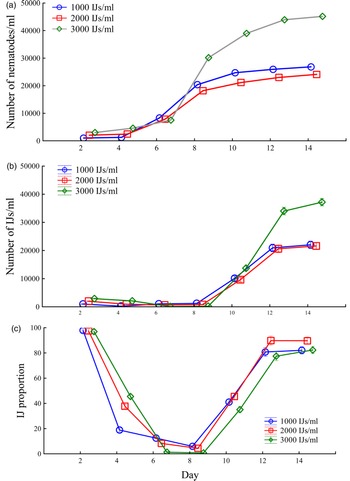
Analysis of the total number of nematodes of all developmental stages over a 14-day period showed a significant difference (F 180,30 = 3023; P < 0.001). The flasks in the IJ inoculum density experiment showed a low total number of nematodes on day 4, which slowly increased between days 4 and 6, and then showed exponential growth between days 6 and 8. However, after day 8, the increase in the total number of nematodes started to slow down, and to near a stationary phase by day 14 in all the flasks. The flasks inoculated with 3000 IJs/ml showed a rise in total nematode numbers after day 6, yielding a significantly higher total number of nematodes (45,156 ± 138 nematodes/ml) by day 14 than did the other inoculum concentrations. Flasks inoculated with 1000 IJs/ml yielded 26,849 ± 154 nematodes/ml, which rate was also significantly higher (P < 0.05) than was that of the 24,110 ± 149 nematodes/ml yield of flasks inoculated with 2000 IJs/ml (fig 3A).
Influence of different Phasmarhabditis bohemica infective juvenile (IJ) inoculum densities (1000, 2000 and 3000 IJs/ml) (95% confidence interval) on: (A) number of nematodes/ml (analysis of variance, F 30, 180 = 3023; P < 0.001); (B) number of IJs/ml (F 30,180 = 336.23; P < 0.001); and (C) IJ proportion in nematode population of monoxenic cultures containing Pseudomonas sp. (AP1) (F 30,180 = 336.23; P < 0.001), over a period of 14 days.

The number of IJs present over the 14 days differed significantly (F 30,180 = 336.23; P < 0.001), with all the flasks showing a slow decrease in the total number of IJs from day 2 onwards, as the IJs recovered and developed into other life stages. The number of IJs reached a low at day 8, after which a sharp increase in numbers was observed in all the flasks between days 8 and 12, as overcrowding in the flasks induced the formation of IJs. The formation of IJs slowed down from day 12 onwards, nearing a plateau by day 14. The flasks inoculated with 3000 IJs/ml had significantly higher numbers of IJs from day 10 onwards, reaching a high of 37,177 ± 796 IJs/ml by day 14. No significant difference (P > 0.05) was found in the total number of IJs in the flasks inoculated with 1000 IJs/ml (22,038 IJs/ml) and in the flasks inoculated with 2000 IJs/ml (21,621 IJs/ml) (fig. 3B).
The analysis of the proportion of IJs showed significant difference over the 14-day period (F 30,180 = 38.99; P < 0.001). On days 10 and 12, significant differences (P < 0.05) were found in the IJ proportions of the three treatments, with the flasks inoculated with 2000 IJs/ml having the highest proportion of IJs, followed by the flasks inoculated with 1000 IJs/ml, with the 3000 IJs/ml flasks having the lowest IJ proportion. However, by day 14, the flasks inoculated with 2000 IJs/ml had a significantly higher (P < 0.001) IJ proportion (90 ± 0.7%) than did the other two treatments, which showed no significant difference (P > 0.05) in IJ proportion, with both having an average of 82% IJs each (82 ± 1.1% for 1000 IJs/ml and 82 ± 1.9% for 3000 IJS/ml inoculum) (fig. 3C).
Discussion
In the current study Pseudomonas sp. (AP1) was the bacterium that was preferred most by all the nematode species, leading to recovery and reproduction in all the species concerned. In their search for a bacterial species suitable for the monoxenic culturing of P. hermaphrodita, Wilson et al. (Reference Wilson, Glen, George and Pearce1995b) tested A. hydrophila, finding that it could cause mortality in D. reticulatum. Although it was isolated from the intestines of P. hermaphrodita IJs, it was not capable of successfully supporting growth in P. hermaphrodita. Wilson et al. (Reference Wilson, Glen, George and Pearce1995b) also tested two isolates of P. fluorescens in foam chip cultures, finding the species concerned capable of supporting the growth of P. hermaphrodita. A possible reason for the inability of P. kenyaensis to grow on the bacterial isolates from this study is that the bacteria were all isolated locally. Bacterial isolates from Kenya should be tested for their ability to support growth of P. kenyaensis.
The pathogenicity tests of the bacterial species isolated from slugs, and of the three bacterial species associated with EPNs, showed that Pseudomonas sp. (AP3), Kluyvera sp. and Aeromonas sp. were most pathogenic of all, causing 100% mortality of the slugs involved. Buttiauxella sp. was the least pathogenic of the bacteria tested, as it was found to cause zero mortality. The other bacterial isolates, including the species associated with EPNs, despite causing significant mortality in the slugs, were comparatively less pathogenic. A possible reason for the inability of some bacterial isolates to cause mortality in the slugs is that these bacteria occur naturally in the soil and the slugs have developed immunity to infection.
In EPN studies, the association between the mutualistic bacteria of EPNs is very strong, with it having always been believed that, in the case of Steinernema, each nematode species was inevitably associated with its own unique bacterial species (Dreyer et al., Reference Dreyer, Malan and Dicks2018). However, X. khoisanae has been found to be able to switch between nematode species, and even between distantly related clades (Dreyer et al., Reference Dreyer, Malan and Dicks2018). Lee & Stock (Reference Lee and Stock2010) show that at least 17 host switches of strains of Xenorhabdus species occur between Steinernema species, and even between species of different clades. In the case of the slug nematode P. hermaphrodita, the association between the nematode and the bacteria concerned is relatively weak, and many bacterial species have been tested to determine the optimum production and viability that could be attained from them being grown together with P. hermaphrodita (Wilson et al., Reference Wilson, Glen, George and Pearce1995b).
While selecting a bacterium for the monoxenic culturing of P. hermaphrodita, Wilson et al. (Reference Wilson, Glen, George and Pearce1995b) found that, when M. osloensis was injected into the body cavity of D. reticulatum, it was not pathogenic. However, when P. hermaphrodita was grown in a monoxenic liquid culture together with M. osloensis, and the pathogenicity of the resulting nematodes was retested, the combined force was found to be pathogenic to D. reticulatum. Such was especially the case when the pathogenic bacteria species were injected into the body cavities of the slugs concerned. Wilson et al. (Reference Wilson, Glen, George and Pearce1995b) concluded that the interaction between the bacterium, the nematode and the immune system of the slug host is important, when testing for the pathogenicity of different nematode–bacteria combinations.
Again, reflecting on previously conducted EPN studies, EPNs have shown not to rely solely on the bacteria concerned to kill the host after infection, but that, after recovery, the IJs tend to release venom proteins that are lethal and that synergistically contribute to the nematode–bacterium complex pathogenicity (Lu et al., Reference Lu, Macchietto, Chang, Barros, Baldwin, Mortazavi and Dillman2017). Therefore, the bacteria that were tested for pathogenicity in the current study, by means of being injected into the haemocoel of several slugs, also need to be tested in combination with a slug-parasitic nematode species.
In the present study, P. bohemica was established in in vitro liquid cultures with the bacterial species, Pseudomonas sp. (AP1). The culture methods employed were then further refined by means of testing the effect of bacterial inoculum density and the number of IJs added to flasks on the total nematode yield, and on the IJ yield and proportion. The results obtained showed that the flasks inoculated with 1% bacteria had significantly higher total nematode and IJ yields than did the flasks inoculated with 3% or 5% bacteria. The flasks inoculated with 1% and 5% bacteria had the same IJ proportions by day 14, which were higher than were those proportions that were obtained with those inoculated with 3% bacteria. The higher total nematode and IJ yields obtained with 1% bacteria inoculation confirm the recommendation made by Ehlers (Reference Ehlers2001) that the inoculum density of the symbiotic bacteria should be between 0.5% and 1% of the culture volume when mass-producing EPNs.
The flasks inoculated with 3000 IJs/ml had the highest yield of nematodes and the highest yield of IJs when compared to the yield of flasks inoculated with 1000 IJs/ml or 2000 IJs/ml. The flasks inoculated with 2000 IJs/ml, however, had a significantly higher IJ proportion (90%) than did the flasks inoculated with 1000 or 3000 IJs/ml. The results differ from those made in the EPN study conducted by Dunn et al. (Reference Dunn, Belur and Malan2020), who found that an inoculum concentration of 1000 IJs/ml gave a higher IJ yield in LCM flasks of Steinernema jeffreyense than did a concentration of either 2000 or 3000 IJs/ml. However, the effect of inoculum concentration seems to vary between nematode species, as Heterorhabditis bacteriophora Poinar tends to produce optimal yields with intermediate inoculum density, whereas Steinernema carpocapsae (Weiser, Reference Weiser1955) Wouts, Mráček, Gerdin & Bedding tends to produce higher yields, in higher inoculum concentrations, and Heterorhabditis indica Poinar, Karunakar & David appears to be unaffected by inoculum concentration (Han, Reference Han1996; Ehlers et al., Reference Ehlers, Niemann, Hollmer, Strauch, Jende, Shanmugasundaram, Mehta, Easwaramoorthy and Burnell2000; Shapiro-Ilan & Gaugler, Reference Shapiro-Ilan and Gaugler2002).
The small volume of media (30 ml) used in the current study is a possible reason for the high IJ yields obtained from all the flasks by day 14. The finding is like the results that were obtained in the EPN study conducted by Dunn et al. (Reference Dunn, Belur and Malan2020), who found that 30 ml of LCM produced higher yields of S. jeffreyense IJs than did flasks with 50 ml of LCM. Dunn et al. (Reference Dunn, Belur and Malan2020) postulate that the higher nematode yield in lower media volumes can be accredited to the greater surface-area-to-volume ratio in the flasks, which leads to the enhanced transfer, or distribution, of oxygen. A possible reason for the large proportion of the IJs present in the cultures is the subsequent overcrowding in the media used, which leads to the accumulation of waste products and ammonia (Shapiro-Ilan et al., Reference Shapiro-Ilan, Lewis, Paramasivam and McCoy2000; San-Blas et al., Reference San-Blas, Gowen and Pembroke2008). High concentrations of ammonia are produced when nematode populations are overcrowded, which has been proven to induce the emergence of IJs in the EPN Steinernema feltiae (Filipjev) Wouts, Mráček, Gerdin & Bedding (Wright, Reference Wright, Gaugler and Bilgrami2004; San-Blas et al., Reference San-Blas, Gowen and Pembroke2008). Ross (Reference Ross2010) also demonstrates that P. hermaphrodita tends to secrete a series of small-molecule pheromones when they encounter starvation or overcrowding, which facilitates communication between the nematodes, and which causes the formation of IJs.
In future research, MPNs and bacterial candidates should undergo similar testing, if they are to be developed for commercial production. Such testing is required to determine the ability of the bacteria to support the growth of the nematodes concerned, and to cause mortality in various slug hosts that are known to be pestiferous. The best nematode–bacterium combination should then be grown in in vitro liquid cultures, with the pathogenicity of the nematode–bacterium combination being retested for pathogenicity on the relevant slug hosts. If a nematode–bacterium combination is found that grows well and that causes significant mortality in its slug hosts, its production should be optimized by means of testing the effect of different growth conditions on the IJ yield, as was done in the current study.
Financial support
This research was funded by the National Research Foundation of South Africa (NRF-THRIP TP14062571871) and by the Council for Scientific and Industrial Research, South Africa.
Conflicts of interest
None.
Ethical standards
The authors assert that all procedures contributing to this work comply with the ethical standards of the relevant national and institutional guides on the care and use of laboratory animals.
Author contributions
AP, JR and AM conceived and designed the research, while AP conducted the experiments concerned. All the authors contributed nematode isolates. While AP, JR and AM analysed the data obtained, AP wrote the manuscript, which all the authors involved read and approved.
Data availability
The datasets generated and/or analysed during the current study are available from the corresponding author on reasonable request.