Introduction
Perna perna is a Mytilidae mussel native to the African continent, which has become a naturalised exotic species in various parts of the world, including Brazil (Resgalla et al., Reference Resgalla, Weber and Conceição da2008; Silva et al., Reference Silva, Souza, Lima, Fernandes, Macario, Netto, Alves, Carvalho, Aguilera and Duarte2018). In natural habitats, this species typically reaches maturity at around 14 months, with a shell length of 4–5 cm, exhibiting an average growth rate of 0.59 cm/month, and a lifespan of 24 months (Marenzi and Branco Reference Marenzi and Branco2005; Resgalla et al., Reference Resgalla, Weber and Conceição da2008). Perna perna is a coastal benthic filter-feeder, sessile, eurythermal, and euryhaline species, widely cultivated in Brazilian mytiliculture farms (Pierri et al., Reference Pierri, Fossari and Magalhães2016). It also serves as a crucial resource for local communities engaged in its harvest along the Brazilian coast (Antunes and Mesquita Reference Antunes and Mesquita2018; Jablonski et al., Reference Jablonski, Azevedo and Moreira2006).
The determination of the geographical origin of fishery products has gained increasing attention, driven by concerns related to quality control, traceability, and consumer food safety. Consumers are progressively more interested in knowing the provenance of the seafood they consume (Ortea and Gallardo Reference Ortea and Gallardo2015). In this context, stable isotope analysis has proven to be a valuable tool for tracing the origin of aquatic organisms targeted by fisheries. For instance, Del Rio-lavín et al. (Reference Del Rio-lavín, Weber, Molkentin, Jiménez, Artetxe-Arrate and Pardo2022) investigated Mytilus galloprovincialis mussels collected from eight regions spanning the Mediterranean Sea, the European Atlantic coast, and the Chilean Pacific coast. By combining stable isotope ratios and trace element fingerprinting, the authors identified significant spatial differences in chemical composition, particularly between specimens from distinct marine regions. The most informative tracers for provenance discrimination were δ13C, δ1⁵N, Pb, Ba, Mn, and Al. In the southeast Atlantic coast of Brazil, de A Ferreira et al. (Reference de A Ferreira, Braga and Di Beneditto2021) used stable isotope ratios of carbon and nitrogen to differentiate stocks of three shrimp species exploited by small-scale coastal fisheries across six distinct areas. Their results demonstrated the effectiveness of stable isotopes in distinguishing fishing grounds at a regional scale. Conversely, Wilson et al. (Reference Wilson, McGill, Steingrund and Trueman2025) assessed whether the stable isotope ratios of carbon, nitrogen, and sulphur could be used to identify 10 catch regions of Atlantic cod (Gadus morhua) in the northeast Atlantic. Although the approach was generally effective, not all catch regions exhibited isotopically distinct signatures. Beyond geographic origin, stable isotope ratios have also been employed to differentiate between wild-caught and farmed specimens (de A Ferreira et al., Reference de A Ferreira, Braga and Di Beneditto2021, Reference de A Ferreira, Braga and Di Beneditto2022; Del Rio-lavín et al., Reference Del Rio-lavín, Weber, Molkentin, Jiménez, Artetxe-Arrate and Pardo2022; Li et al., Reference Li, Ren, Dong and Feng2018), further demonstrating their utility in seafood traceability frameworks.
In animal tissues, isotopic ratios reflect a combination of ingested food sources and isotopic fractionation occurring in body tissues after digestion and excretion processes (Fry Reference Fry2008). Isotopic carbon ratios vary among primary producers and are used to identify the sources of organic matter supporting trophic chains and webs (terrestrial vs. marine, coastal vs. oceanic, or benthic vs. pelagic). Isotopic nitrogen ratios are normally used as indicators of the feeding habits of organisms and its trophic position (Fry Reference Fry2008).
The COVID-19 pandemic was a global epidemiological event that resulted in millions of deaths worldwide and had a profound impact on the quality of life across countries. Stringent global lockdown measures from 2020 to 2021 suspended or significantly reduced anthropogenic activities such as tourism, transportation (land, sea, river, and air), and non-essential industries and commerce. Despite these challenges, the pandemic period brought about positive changes in coastal ecosystems, including reduced pollutant concentrations, cleaner waters, and the recovery of aquatic life (Buzzi et al., Reference Buzzi, Menéndez, Truchet, Delgado and Fernández2022; Di Beneditto et al., Reference Di Beneditto, Pestana, Lima and Franco2024; Edward et al., Reference Edward, Jayanthi, Malleshappa, Jeyasanta, Laju, Patterson, Raj, Mathews, Marimuthu and Grimsditch2021; Lima et al., Reference Lima, Di Beneditto, Pestana and Franco2024a). Di Beneditto et al. (Reference Di Beneditto, Pestana, Lima and Franco2024) and Lima et al. (Reference Lima, Di Beneditto, Pestana and Franco2024a) highlighted that during the pandemic, the P. perna mussel in Rio de Janeiro State, southeast Brazil, experienced notable positive changes. Specifically, the concentration of trace elements in their shell and soft tissues significantly decreased. Di Beneditto et al. (Reference Di Beneditto, Pestana, Lima and Franco2024) stated that the COVID-19 pandemic as a short-term conservation event that positively impacted the mussels.
This study presents the isotopic ratios of carbon (δ13C) and nitrogen (δ1⁵N) in the soft tissues of P. perna mussel from six natural populations in Rio de Janeiro State. This approach is innovative in Brazil, using isotopic ratios to distinguish the origin of P. perna specimens, and analysing the power of discrimination on a smaller scale. The natural banks of P. perna are regularly accessed by local communities and visitors for mussels’ harvest, which are used for commercialisation, consumption, and bait. Additionally, the COVID-19 pandemic served as temporal reference in this study, providing an opportunity to verify whether the suspension or significant reduction of anthropogenic activities in coastal waters over a short period of time (2020–2021) influenced the isotopic ratios of the mussels.
Materials and methods
Samplings
In 2020, 2022, and 2023, adult P. perna mussels were sampled from natural populations in Rio de Janeiro State, southeast Brazil, between July and August of each year (Figure 1). The sample size varied among the sampling sites due to the variable occurrence of adult individuals (Table 1). Considering the growth rate of P. perna, it can be assumed that the 2020 samples represented mussels that settled between May and July 2019 (or earlier), the 2022 samples represented those that settled between May and July 2021 (or earlier), and the 2023 samples represented those that settled between May and July 2022 (or earlier). For mussels extracted in 2020, most of the growth occurred before the COVID-19 pandemic. In contrast, for 2022 mussels, most of the growth occurred during the pandemic, when anthropogenic activities in the coastal environment were partially resuming. For 2023 samples, the growth occurred in a post-COVID-19 scenario. Similar assumptions about mussel settlement and its relationship to the COVID-19 pandemic, as a temporal reference, were considered by Di Beneditto et al. (Reference Di Beneditto, Pestana, Lima and Franco2024) and Lima et al. (Reference Lima, Di Beneditto, Pestana and Franco2024a)
Sampling sites of Perna perna in Rio de Janeiro State, southeast Brazil: ATA (Atafona Beach), AÇU (Açu Beach), BZM (Armação dos Búzios, marina area); BZG (Armação dos Búzios, Geribá Beach), BAG (Guanabara Bay), and PAV (Vermelha Beach). Sites BZM, BZG, BAG and PAV are highlighted on the right side.

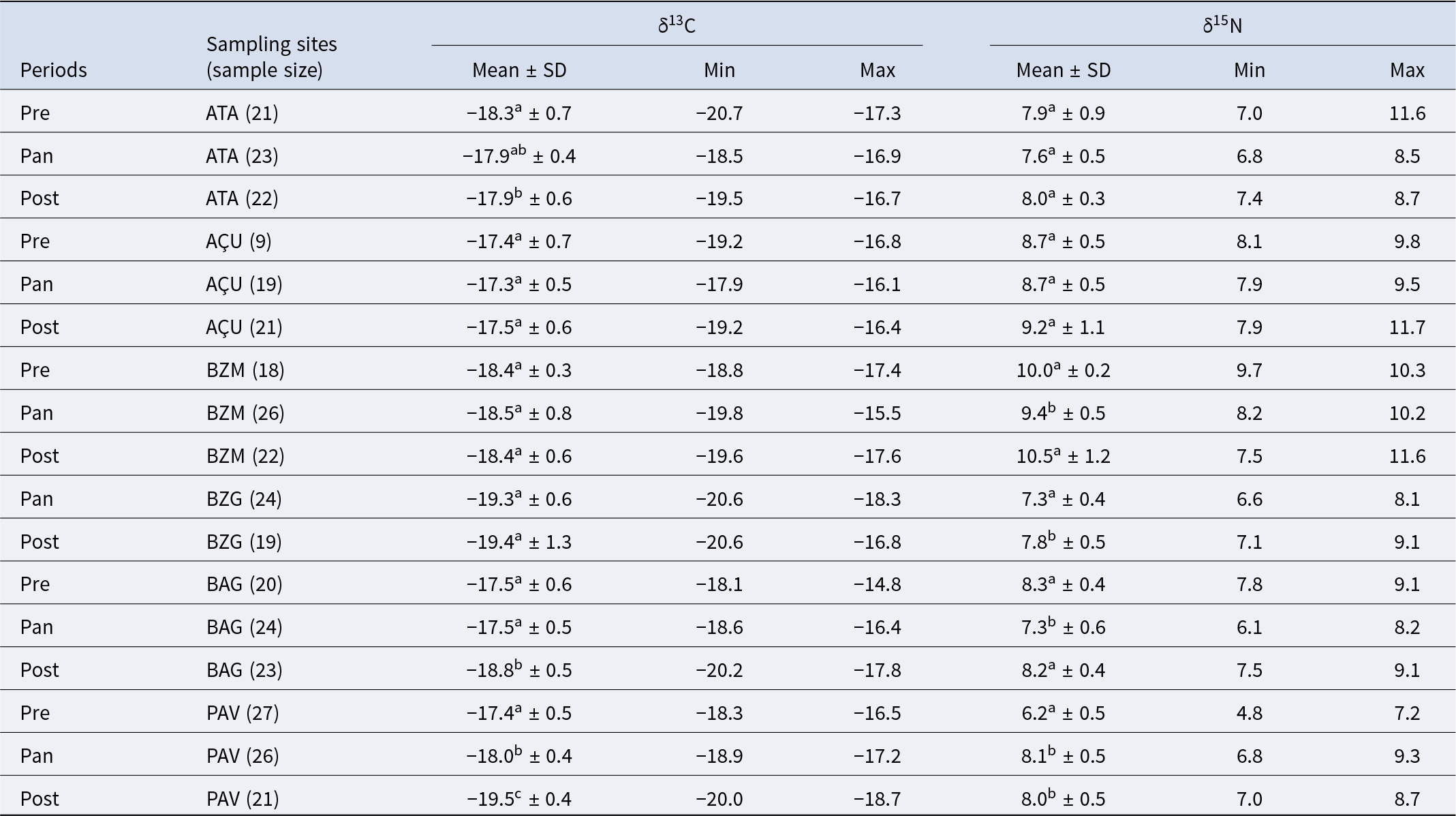
Isotopic ratios (δ13C and δ15N) in the soft tissues of Perna perna mussels from Rio de Janeiro State, southeastern Brazil, during pre-pandemic (Pre), pandemic (Pan), and post-pandemic (Post) periods. Values represent mean ± standard deviation (SD), with minimum (min) and maximum (max) ranges. Lowercase letters compare temporal changes (Pre vs. Pan vs. Post) within each individual sampling site. Different letters (a, b, c) within the same site indicate statistically significant differences between periods (PERMANOVA with pairwise comparisons, p < 0.05)

In Brazil, the end of the Public Health Emergency of National Importance due to COVID-19 was officially declared on 22 May 2022, although vaccination began in the first half of 2021, leading to a gradual relaxation of restrictions. In the studied area, the lockdown measures suspended or reduced anthropogenic activities in the coastal environment, as vessels and boats traffic, fisheries, and tourism (Di Beneditto et al., Reference Di Beneditto, Pestana, Lima and Franco2024).
In 2020, sampling was conducted at ATA (Atafona Beach), AÇU (Açu Beach), BZM (Armação dos Búzios, marina area), BAG (Guanabara Bay), and PAV (Vermelha Beach), whereas in 2022 and 2023, a sixth site (BZG – Armação dos Búzios, Geribá Beach) was added (Figure 1). The sites are different in terms of river runoff, salinity levels, open or sheltered areas, and anthropogenic activities. ATA is an open sandy beach close to the mouth of the Paraiba do Sul River. This river has a medium-sized watershed (57,000 km2), extending through the most urbanised, industrial, and agricultural areas of southeastern Brazil. There is not a natural rocky shore in this area, and the mussels were sampled from buildings that collapsed in 2008 due to the advance of the sea on the coastline. AÇU is an open sandy beach located 30 km south of the mouth of the Paraiba do Sul River, and the mussel samples were obtained from rockfill of Açu Harbor. The harbour operations began in 2014, and cargoes handled include solid and liquid bulk, iron ore and oil. In BZM site, the samples were obtained from rockfill at the entrance of a marina for recreational boats. The marina was built in 1990, in a sheltered area, without the influence of rivers. BZG, in contrast, is a pristine open beach located on the opposite side of BZM. Samples from BAG were obtained from rockfill within the bay, located 2 km from its entrance. The Guanabara Bay is a semienclosed oceanic bay with an area of 400 km2 and intense ship traffic since the beginning of the nineteenth century. The area around the bay is densely populated (∼12 million people) and industrialised (∼6,000 industries). In PAV, the mussels were obtained from natural rocky shores. This site is a short urban sandy beach (300-m beach arc), with calm waters bordered by two hills, and located before the entrance of Guanabara Bay.
Determination of isotopic ratios (δ13C and δ15N)
After sampling, each mussel was transported to the laboratory and kept frozen at −18°C until sample preparation. All soft tissues were removed from the shell, freeze-dried, and homogenised with a mortar and pestle. Freeze-dried samples (0.5 mg) were used to analyse δ13C and δ15N. Although no prior extraction of lipids was performed on the soft tissue samples, the intraspecific comparison ensures that the interpretation of δ13C values is not compromised (Post et al., Reference Post, Layman, Arrington, Takimoto, Quattrochi and Montaña2007). The isotopic ratios were determined at the Laboratório de Ciências Ambientais, Universidade Estadual do Norte Fluminense Darcy Ribeiro, using a Delta V Advantage isotope ratio mass spectrometer (Thermo Scientific, Germany) through the ConFlo-VI interface (Model BR30140, Thermo Scientific) coupled to an elemental analyser (Flash 2000, Thermo Scientific). The reference values used for carbon and nitrogen analyses were Pee Dee Belemnite (PDB) and atmospheric N2, respectively.
Samples were analysed with analytical blanks and urea analytical standards (IVA Analysentechnik-330802174; CH4N2O Mw = 60, C = 20%, N = 46%) with certified isotopic compositions (δ13C = −39.89‰ and δ15N = −0.73‰). Analytical controls were performed for each set of 10 samples using certified isotopic standards (Elemental Microanalysis Protein Standard OEA): δ13C = −26.98‰ and δ15N = +5.94‰. The analytical reproducibility was based on triplicates for each of the 10 samples, yielding ± 0.2‰ for δ13C and ± 0.3‰ for δ15N. The isotopic values were calculated using the formula: X = [(R sample/R reference) − 1] × 1000, where X = δ13C or δ15N and R = δ13C:δ12C or δ15N:δ14N. The isotopic results are expressed in parts per thousand (‰).
Data analysis
Differences between the periods (2020, herein named as pre-pandemic; 2022, herein named as pandemic; and 2023, herein named as post-pandemic) within the sampling sites regarding isotopic ratios were analysed using two-way permutational multivariate analysis of variance (PERMANOVA) with pairwise comparisons (α = 0.05). PERMANOVA was selected for its ability to handle non-parametric data analysis using Euclidean similarity, with 999 permutations per test (Anderson Reference Anderson2001, Reference Anderson, Balakrisnan, Colton, Everitt, Piegorsch, Ruggeri and Teugels2017).
K-means clustering was employed to determine the contribution of each stable isotope to the identification of the mussels’ origins, considering each period separately. This method classifies the analysed objects into multiple groups to minimise intra-cluster variation, using the sum of squared Euclidean distances between clusters and their centroids. The Euclidean distance matrix was used as input to plot two-dimensional graphs representing the clustering. For the analyses, the R packages ‘cluster’ (Maechler et al., Reference Maechler, Rousseeuw, Struyf, Hubert and Hornik2019) and ‘factoextra’ (Kassambara and Mundt Reference Kassambara and Mundt2020) were used for calculating and visualising the distance matrix, while the ‘tidyverse’ package (Wickham et al., Reference Wickham, Averick, Bryan, Chang, McGowan, François, Grolrmund, Hayes, Henry, Hester, Kuhn, Pedersen, Miller, Bache, Müller, Ooms, Robinsos, Seidel, Spinu, Takahashi, Vaughan, Wilke, Woo and Yutani2019) was used for graphical representations.
Results
P. perna mussels analysed were adult individuals with average shell lengths of 4.7 ± 0.6 cm (2020), 6.2 ± 0.7 cm (2022), and 6.4 ± 0.8 cm (2023). The isotopic ratios of δ13C and δ15N in the soft tissues are indicated in Table 1. Mussels sampled at AÇU had the highest δ13C values across all periods, whereas the lowest values were recorded in mussels from BZG, followed by BZM. Regarding δ15N, the highest values throughout the sampling periods were associated with mussels from BZM. Conversely, the lowest δ15N value was recorded in mussels from PAV (pre-pandemic). The PERMANOVA results for the isotopic values (δ13C-δ15N) indicated significant differences between the sampling sites across the three periods considered. Exceptions were found between AÇU and BAG (p (perm) = 0.18), ATA and PAV (p (perm) = 0.07), and BZG and PAV (p (perm) = 0.46) during the pre-pandemic, pandemic, and post-pandemic periods, respectively. The spatial variation of δ13C-δ15N data in the analysed mussels was greater than the temporal variation. All PERMANOVA results are in the supplementary material.
The k-means clustering method effectively distinguished four of the five mussel sampling sites in the pre-pandemic period, with only AÇU and BAG not being correctly differentiated (Figure 2A). During this period, δ15N variation was the primary factor distinguishing the natural mussel populations (Figure 2A).
Biplot clustering of δ13C (Dim1 = Dimension 1) and δ15N (Dim2 = Dimension 2) for the Perna perna mussel from Rio de Janeiro State, southeast Brazil during (A) pre-pandemic, (B) pandemic, and (C) post-pandemic periods.

During the pandemic, the method classified six groups (Figure 2B). No group was predominantly composed of mussels from ATA and PAV, with individuals from these sites being distributed among other groups. In this period, δ15N variation remained the primary distinguishing factor for the natural mussel populations (Figure 2B).
In the post-pandemic period, the mussels were grouped into six groups, with two clusters predominantly consisting of mussels from one site: BZM (Figure 2C). The significant individual variation in δ15N values was responsible for the two distinct clusters for BZM. Additionally, two other clusters represented samples from various sites, making it challenging to determine their origin. Consequently, only three sampling sites were accurately distinguished: BZM (two clusters), BZG, and AÇU. In the post-pandemic period, δ13C variation accounted for the distinction of four clusters, while δ15N values differentiated the two BZM cluster (Figure 2C).
Discussion
The isotopic values of P. perna mussels from Rio de Janeiro State, southeast Brazil, fall within the expected range for the species (Allan et al., Reference Allan, Ambrose, Richoux and Froneman2010; Puccinelli et al., Reference Puccinelli, McQuaid, Dobretsov and Christofoletti2019). Filter-feeding organisms like mussels obtain their food by filtering suspended organic matter from the water column, including phytoplankton, macroalgae detritus, and bacteria (Berry and Schleyer Reference Berry and Schleyer1983). The spatial variation of δ13C and δ15N in the soft tissues of the analysed mussels probably reflects differences between sampling sites in terms of food sources diversity, primary productivity, and input of nutrients and organic matter into coastal waters. The sites are variable in their environmental features, as highlighted previously in Lima et al. (Reference Lima, Gonçalves, Pestana, Di Beneditto and Franco2024b).
Puccinelli et al. (Reference Puccinelli, McQuaid, Dobretsov and Christofoletti2019) investigated the stable isotopes composition in three tissues of P. perna from upwelling and non-upwelling systems. The authors recorded lower δ13C values at upwelling sites, but found little effect of upwelling on δ15N values. The sampling sites BZM and BZG are highly influenced by the upwelling of South Atlantic Central Water (SACW), a cold-water mass enriched in nutrients that increase local primary productivity (Coelho-Souza et al., Reference Coelho-Souza, López, Guimarães, Coutinho and Candella2012). This may explain the lower δ13C values in the soft tissues of mussels from these sites compared to others.
Suspended organic matter is the main source for benthic filter-feeders, and its δ13C values generally decrease from onshore to offshore, reflecting a decrease in the influence of macroalgal detritus and terrestrial inputs, and a shift to domination of the suspended organic matter by phytoplankton (Hill et al., Reference Hill, McQuaid and Kaehler2006). According to Puccinelli et al. (2016), the low δ13C values observed for filter-feeders at upwelling sites indicate a greater dependence on phytoplankton blooms generated by upwelling.
It appears that upwelling did not significantly affect the δ15N values of the mussels, as individuals from BZM and BZG (upwelling sites) showed distinct values from each other, aligning with the findings of Puccinelli et al. (Reference Puccinelli, McQuaid, Dobretsov and Christofoletti2019). However, the spatial variations in δ15N values among the samples were considerable, with differences reaching up to 4.6‰ (e.g. BZM in the post-pandemic period vs. PAV in the pre-pandemic period), as shown in Table 1. Differences in the isotope composition of nitrogen sources for primary producers can propagate through food chains and webs, reflecting in the δ15N values of primary consumers (McClelland et al., Reference McClelland, Holl and Montoya2003). Coastal waters are variable and dynamic environments, influenced by terrestrial and anthropogenic inputs that can affect the δ15N values of primary consumers (Puccinelli et al., Reference Puccinelli, McQuaid, Dobretsov and Christofoletti2019). Furthermore, the high diversity of phytoplanktonic organisms in the waters of Rio de Janeiro State (Rodrigues et al., Reference Rodrigues, Marinho, Jonck, Gonçalves, Brant, Paranhos, Curbelo and Falcão2014), which serve as food sources for the mussels, may also contribute to local variations in their isotopic values. As a result, isolating the main factors responsible for the observed differences in δ15N values becomes challenging.
Despite the spatial differences, the δ13C-δ15N data were only partially effective in distinguishing the origin of natural populations of P. perna across the studied area over the considered time interval. The k-means clustering method correctly identified 80% of P. perna populations during the pre-pandemic period, 67% in the pandemic, and 50% in the post-pandemic. Conversely, previous studies have successfully used stable isotopes (and other tracers) to discriminate mussel populations in various parts of the world. For instance, Del Rio-lavín et al. (Reference Del Rio-lavín, Weber, Molkentin, Jiménez, Artetxe-Arrate and Pardo2022) traced the geographical origin of farmed M. galloprovincialis mussels harvested along the Mediterranean Sea, European Atlantic Ocean, and Chilean Pacific Ocean, correctly assigning 97% of individuals to their harvest location by analysing δ13C, δ15N, Pb, Ba, Mn, and Al. Similarly, Kang et al. (Reference Kang, Zhao, Tan, Ning, Zhai and Zheng2022) investigated the origin traceability of M. edulis mussels collected from four farms in the Yellow Sea and East China Sea, correctly assigning more than 90% of mussels using C, N, δ13C, δ15N, and δ18O.
The difference between our results and those in the literature could be explained by non-mutually exclusive factors, as: (i) the distance between sampling sites (300 km in our samples vs. thousands of kilometres in the studies by Del Rio-lavín et al. (Reference Del Rio-lavín, Weber, Molkentin, Jiménez, Artetxe-Arrate and Pardo2022) and Kang et al. (Reference Kang, Zhao, Tan, Ning, Zhai and Zheng2022)); (ii) the greater diversity of food sources in tropical waters (our study area) compared to temperate and subtropical waters (Del Rio-lavín et al., Reference Del Rio-lavín, Weber, Molkentin, Jiménez, Artetxe-Arrate and Pardo2022; Kang et al., Reference Kang, Zhao, Tan, Ning, Zhai and Zheng2022), potentially complicating the isotopic discrimination of mussel populations; and (iii) the number of variables used to discriminate the origin of mussels differs among studies.
Isotopic discrimination may be limited at smaller spatial scales, where increased local environmental heterogeneity can obscure isotopic variations that would otherwise be more pronounced at broader geographic scales (Barnes et al., Reference Barnes, Jennings and Barry2009). As noted by Cui et al. (Reference Cui, Jiang, Huang, Liu and Wu2023), tropical marine ecosystems are characterised by a high diversity of primary producers, which contributes to a complex array of isotopic signatures. This complexity can hinder precise identification of the energy sources assimilated by consumers, thereby complicating isotopic discrimination. The authors emphasise that, in tropical regions, the combined use of multiple tracers can mitigate the uncertainties associated with the variability of individual tracers, thereby enhancing the resolution in distinguishing food sources and dietary patterns among different consumer species.
In most samples, the spatial variation of δ15N (tracer of food source variability; Fry Reference Fry2008) was the primary variable distinguishing the groups of mussels. This finding contrasts with Allan et al. (Reference Allan, Ambrose, Richoux and Froneman2010) for P. perna in South Africa, where δ13C (tracer of sources of organic matter; Fry Reference Fry2008) was the main discriminating variable among natural populations. It is noteworthy that Allan et al. (Reference Allan, Ambrose, Richoux and Froneman2010) did selective sampling, avoiding the collection of mussels near rivers and estuaries. In our study, sampling was randomised, encompassing sites with diverse environmental and anthropogenic features (details in Lima et al., Reference Lima, Gonçalves, Pestana, Di Beneditto and Franco2024b). This difference in sampling methodology might explain the disparities in isotopic discrimination between the studies. Our results suggested that environmental features play a more significant role in distinguishing the isotopic profile of mussels than intraspecific characteristics and/or trophic position (filter-feeder primary consumer), which is consistent with other taxonomic groups (fish, crayfish, and zoobenthos: Veselý et al., Reference Veselý, Ercoli, Ruokonen, Bláha, Duras, Haubrock, Kainz, Hämäläinen, Buřič and Kouba2023).
In conclusion, the isotopic analysis of P. perna mussel soft tissues did not reveal a clear trend when using the COVID-19 pandemic as a temporal reference. The positive environmental changes resulting from the suspension or reduction of anthropogenic activities in coastal waters during 2020–2021 had minimal impact on the isotopic ratios of mussels in most sampling sites. This suggests that both the mussels’ food sources and the sources of organic matter in the sampling sites were unaffected by the temporary environmental changes. Additionally, the utilisation of δ13C-δ15N isotopic data to trace the origin of P. perna mussel from natural banks in Rio de Janeiro State, southeast Brazil, proved insufficient for distinguishing between populations. It is recommended that this approach be done along other regions of the Brazilian coast to assess the P. perna mussel isotopic variation on a broader spatial scale.
Supplementary material
The supplementary material for this article can be found at https://doi.org/10.1017/S0025315425100635.
Acknowledgements
We are indebted to Marcelo Gomes de Almeida for the laboratory analyses to determine the isotopic ratios in the mussels. We are also indebted to Thaluana Gonçalves for helping with mussel sample preparation.
Author contributions
Di Beneditto, A.P.M.: funding acquisition, conceptualisation, investigation, writing – original draft, writing – review and editing; Lima, D.F.: methodology, formal analysis, writing – review and editing; Ferreira, K.A.: formal analysis, writing – review and editing; Pestana, I.A.: formal analysis, writing – review and editing; Franco, R.W.A.: project administration, funding acquisition, writing – review and editing.
Funding
Conselho Nacional de Desenvolvimento Científico e Tecnológico (CNPq) (Grant number 302.598/2021-9) and, Fundação Carlos Chagas Filho de Amparo à Pesquisa do Estado do Rio de Janeiro (FAPERJ) (Grant numbers E-26/210.350/2022, E-26/200.797/2021, and E-26/210.498/2019), and Universidade Estadual do Norte Fluminense Darcy Ribeiro (UENF) (Postdoctoral Fellowship for D.F. Lima – Agenda 2030).
Competing interests
The authors declare no conflict of interests.
Data availability
Data will be made available on request.