There are long-term benefits for children's academic and social outcomes from a positive start to school (Entwisle, Alexander, & Olson, Reference Entwisle, Alexander and Olson1997). Children's early experiences of school are shaped by both classroom practices and the social contexts of school (Peters, Reference Peters2010). Across the early school years, children's experiences in different classrooms and with different teachers may vary considerably. These transitions into school and across classrooms in the early years of school are critical times to ensure children's ongoing adjustment and wellbeing, and are especially important for children with disabilities.
Policies on the inclusion of children with disabilities into regular school systems have been implemented across Western educational contexts for several decades. Successful implementation of inclusive education policies is particularly dependent on the school resources available to support inclusion, as well as the supports available to teachers who must accommodate the diverse learning needs of all children in their classrooms (Ferguson, Reference Ferguson2008). Research on inclusion of children with disabilities in regular classrooms has strongly focused on vulnerability and risk (Tisdall, Reference Tisdall2012), although current theoretical perspectives are increasingly framed around notions of recognising children's competence and their rights (Whitakker & Kenworthy, Reference Whitakker and Kenworthy2000). This study explores teachers’ perspectives on the benefits and challenges of inclusion of young children with disabilities in regular classrooms across the early years of school, teachers’ judgments on the appropriateness of such placements, and the adequacy of the support and resources available for inclusion.
Policies and Practice for Inclusive Schooling in the Australian Context
Policies of inclusion in education systems have sought to remove distinctions between special and regular education in order to provide education for all children in inclusive settings. Educational policy for inclusion in Australia is situated within the international social justice agenda (The Salamanca Statement; UNESCO, 1994). The Salamanca Statement signed by representatives of 92 countries called on governments ‘. . . to adopt the principle of inclusive education, enrolling all children in regular schools unless there are compelling reasons for doing otherwise’ (p. ix). The Salamanca Statement states that ‘. . . those with special educational needs must have access to regular schools which should accommodate them within a child-centred pedagogy capable of meeting these needs’ (p. viii). Inclusive education involves removing the barriers to engagement and participation of children with disabilities in regular classrooms (Curcic, Reference Curcic2009; Vakil, Welton, O'Connor, & Kline, Reference Vakil, Welton, O'Connor and Kline2009).
The Australian Professional Standards for Teachers (AITSL, 2011a) and the Australian Professional Standards for Principals (AITSL, 2011b) document expectations about the creation of inclusive school environments and pedagogies for Australian children. However, there are variations in the ways in which inclusive education is practised in different state jurisdictions across Australia, and responsibilities for implementing inclusion policies have increasingly devolved to individual schools. If children with disabilities are to be successful learners in inclusive classrooms, it is important to continue to monitor the quality of their experiences and the resources and supports that are available to support inclusion within specific school environments.
Teachers’ Attitudes to, and Practices for, Inclusion
While many teachers accept inclusion policies as socially just and equitable, they may nevertheless be reluctant about the inclusion of children with significant intellectual disabilities or emotional and behavioural problems (Avramidis & Norwich, Reference Avramidis and Norwich2002; Lalvani, Reference Lalvani2013). Many teachers struggle to accommodate all children amid concerns that time taken to support a few children may disadvantage other children in the classroom. Cook, Tankersley, Cook, and Landrum (Reference Cook, Tankersley, Cook and Landrum2000) noted that teachers’ perceptions of their own professional competence can be eroded when accommodating children with disabilities if these children do not achieve the expected learning outcomes, as required for other children in the classroom, or if their challenging behaviours reduce on-task engagement for all children.
While there is a range of challenges to inclusion for teachers that have been identified in research, there is also evidence that teachers’ attitudes to inclusion do change. Petriwskyj, Thorpe, and Tayler (Reference Petriwskyj, Thorpe and Tayler2014) reported that teachers’ concerns about inclusion are ameliorated with increased experience of inclusive education. Increased feelings of competence, over time, may also be the result of the development of teachers’ repertoires of professional skills for managing learning and behaviour in classrooms for diverse learners (Avrimidis & Norwich, Reference Avramidis and Norwich2002). When support across the school community for inclusion is evident, there is more likely to be a school climate that engenders a positive approach to solving the challenges that arise (Petriwskyj et al., Reference Petriwskyj, Thorpe and Tayler2014).
There is a now a body of evidence that indicates the importance of positive teacher attitudes to achieve greater acceptance for more inclusive education (e.g., Avramidis & Norwich, Reference Avramidis and Norwich2002; Curcic, Reference Curcic2009; Frankel, Gold, & Ajodhia-Andrews, Reference Frankel, Gold and Ajodhia-Andrews2010; Jordan, Schwartz, & McGhie-Richmond, Reference Jordan, Schwartz and McGhie-Richmond2009; Jordan, Glenn, & McGhie-Richmond, Reference Jordan, Glenn and McGhie-Richmond2010). This evidence suggests that more positive attitudes for inclusive education influence teachers’ pedagogy and practices to benefit both the children with disability as well as other children in the classroom.
The Present Study
The Transition to School Project tracked children from early intervention programs through their first year of entry to a regular school, and across the next 2 years. Teacher data were collected via questionnaires with children's classroom teachers. Primary research questions were:
-
• Do teachers in the early years of school consider that the placement of a child with developmental disabilities in their classroom is appropriate and do they judge the support and resources available to them as adequate?
-
• What benefits and challenges do teachers report in the inclusion of children with developmental disabilities through the early years of formal schooling?
-
• How does the nature of the benefits and challenges perceived by teachers in including children with developmental disabilities in their classroom change across the early years of school?
Methodology
The Transition to School Project followed children with disabilities across 3 years, commencing in the year in which the child was first enrolled in the Preparatory (Prep) year of a regular school while also attending an early intervention program. Families and children were recruited from 14 early intervention programs (Early Childhood Development Programs) operating in the public education system in south-east Queensland. Early intervention programs serve children who have a diagnosed disability or have approved admission based on a developmental assessment. Data for 143 children participating in the project who, across the 3 years of the study, remained in regular school settings and did not transfer to special schools were the foci for these analyses; 76% (n = 109) were male and their mean age at the beginning of the school year in which they enrolled in Prep was 5.2 years (SD = 0.5).
The QUT Human Research Ethics Committee provided ethical clearance for the conduct of the research. Approval for permission to approach early intervention programs and schools and to invite their participation in the research study was also granted by the Queensland Department of Education and Catholic Education.
Child and Family Recruitment and Participation
Families received research project information and a consent form if the child met the eligibility criteria for participation (aged from 4 to 6 years and concurrently attending an early intervention program as well as a Prep program in a regular school). At recruitment (Time 1 data collection), children usually attended the early intervention program for 2–3 days per week and a Prep program for the remainder of the week. Policy within the state jurisdiction at the time of data collection was that all children of eligible school age who were participating in early intervention programs should also be enrolled in a regular school. Children were expected to increase their level of participation in the regular Prep classroom to full-time attendance by the end of the school year.
A formal assessment organised by specialists, such as school guidance officers or other professionals, at the end of the Prep year determines whether children progress to Year 1, or are enrolled for another year in the Prep program, or a special school placement is considered more appropriate for the following school year. While children with disabilities are more likely than other children to repeat a school year, Australian educational policy and practice do not usually support repetition of a grade. Decisions on special school placements are also carefully determined. Children usually only attend a special school in a segregated setting if they have an assessment of significant intellectual disability.
School and Teacher Recruitment and Participation
At Time 1, participating families advised relevant detail about the regular school that the child was attending. Participating families were contacted at the beginning of successive school years (Time 2 and Time 3 data collection) to confirm their ongoing participation and to obtain information on the child's current school placement, school year level, and teacher's name.
The 143 children who remained in regular school across the 3 years of the project were enrolled in more than 100 different schools in each year of the study. Questionnaire return rates by teachers were 76% (109) at Time 1, 81% (116) at Time 2, and 78% (112) at Time 3. While the majority of children followed a standard school-year progression from Prep to Year 1 to Year 2, some children repeated Prep or Year 1. A small number were in multi-age classrooms at any time point.
Data Collection From Teachers
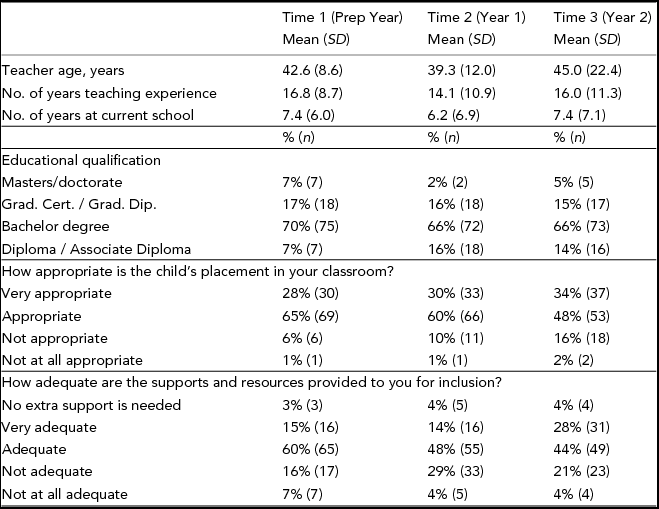
Questionnaires were sent to teachers in Terms 3 or 4 of the school year. Questions were primarily drawn from the Pre-Elementary Education Longitudinal Study (PEELS) for children with disabilities conducted in the United States (National Center for Special Education Research, n.d.). The focus was on classroom and transition practices, child's level of engagement, and measures of children's learning and behavioural competencies, as well as gathering teacher socio-demographic information (gender, age, teaching experience, years at current school and qualifications). Teacher participants at each time point were likely to be female (<95% at each time point) and hold a bachelor degree or higher qualification (<84% at each time point). There was large variability in teachers’ overall teaching experience and their teaching experience at their current school across each year of data collection. Teacher demographic information is presented in Table 1.
Teacher Demographics, Ratings on Appropriateness of Child Placement in the Classroom, and Ratings on the Adequacy of Supports and Resources for Inclusion

Note: The number of teacher questionnaires returned were: Time 1, 109; Time 2, 116; Time 3, 112. There was a minimal amount of missing data on some questions.
Teachers were also asked two open-ended questions: ‘What are the benefits of having this child in your classroom?’ and ‘What challenges are there for you in the inclusion of this child in your classroom?’ Analyses of the qualitative responses to these questions across the 3 years of data collection were a primary focus of this article. Other descriptive data, reported in order to provide contextual information about the children and the classrooms, include information about the developmental concern under which a child was eligible for additional support in the educational system, teacher ratings on the appropriateness of the child's placement in the classroom, and teacher ratings of the adequacy of resources and supports available to them for inclusion of the child. These data were analysed through SPSS (Version 22; IBM, 2013).
Qualitative Data Analysis
The open-ended questions on benefits and challenges of inclusion produced textual data that could be described as qualitative survey data. These data were analysed using NVivo 10 (QSR International, 2014). Guba and Lincoln (Reference Guba, Lincoln, Denzin and Lincoln1998) considered qualitative survey data relevant to both positivist and post-positivist research. Jansen (Reference Jansen2010) noted that analyses of qualitative survey information using textual data are largely exploratory and descriptive. The text data available for analyses comprised more than 100 teacher responses at each time point for the questions on benefits and challenges. These responses were relatively brief, usually less than 50 words, but could describe more than one benefit or challenge in the respective questions. A proportion of the responses was between 50 and 100 words, which made it more likely that a number of different benefits or challenges were described in a single teacher response.
Text responses to each question at each year were segmented into meaningful parts for analysis; for example, phrase(s) or sentence(s) on a specific topic. For example, consider the following response with respect to challenges described by a teacher: ‘Finding the time to monitor her participation and learning; her learning is not keeping up with her peers and so it is hard to juggle the curriculum to meet everyone's needs all the time; remembering to do the little things (e.g., pre-open toothbrush case, checking she has opened her lunchbox).’ This response had three different segments for analysis: finding the time to monitor the child's participation and learning; her learning is not keeping up with her peers, and so it is hard to juggle the curriculum to meet everyone's needs all the time; remembering to do the little things (e.g., pre-open toothbrush case, checking she has opened her lunchbox).
The analyses of responses or segments of response involved inductive coding using a constant comparative recoding process as originally proposed by Glaser and Strauss (Reference Glaser and Strauss1967). This is an iterative and inductive process. The process begins with open coding to develop categories in a first round of data reduction, followed by further recoding and reduction to allow core categories to emerge (Fram, Reference Fram2013). Steps similar to those proposed by Boeije (Reference Boeije2002) were applied: identification and comparison of data segments within any single teacher response; comparisons of data segments across respondents within each time point; and comparisons across the different time points.
Inductive coding commenced with one member of the research team classifying data segments into preliminary categories. These were reviewed and discussed by three members of the research team. Two members of the research team then undertook two further reviews of category names and checked the categorisation of data segments. In this process, team members brought current theoretical knowledge on school inclusion to the discussion on categorisation from their research and practice experiences. No single category was used more than once for any respondent. Frequencies in the use of identified categories about benefits and challenges at Time 1, Time 2, and Time 3 were calculated to identify the strength of any category across time points.
Findings
A primary focus in this section is on the reporting of the benefits and challenges that teachers identified about the inclusion of children with developmental disabilities in their classrooms. The teacher responses to two other quantitative questions also provide contextual information that adds understanding about the data on benefits and challenges. These questions are based on: (a) teachers’ ratings on the appropriateness of the child's placement in their classroom; and (b) teachers’ ratings on the adequacy of school support and resources provided for inclusion of the child. Additionally, the specific eligibility condition, as identified by teachers, for the focus child who warranted additional education support is first described.
Child's condition
Teachers were asked, ‘What is the primary reason that limits this child's ability to succeed in a regular classroom without additional support?’ Response categories matched the eligibility conditions for additional support used in the Queensland public educational system, with addition of an ‘other’ category. At Time 1 (Prep year) teachers reported the following conditions: autistic spectrum disorder (ASD) or Asperger's syndrome 46% (n = 50); speech language impairment (SLI) 22% (n = 24); intellectual impairment 11% (n = 12); physical impairments (including hearing and vision) 6% (n = 6); other conditions 16% (n = 17). Other conditions that teachers specified were either combinations of previous categories (e.g., intellectual and SLI; SLI and ASD) or identification of a quite specific condition (e.g., cerebral palsy; Prader-Willi syndrome).
Appropriateness of child's placement
At each time point, teachers rated the appropriateness of the child's placement in their classroom on a 4-point scale (very appropriate, appropriate, not appropriate, or not at all appropriate). At Time 1, 93% of teachers rated the child's placement in their classroom as either very appropriate or appropriate; at Time 2, the percentage was 90% and at Time 3, 82%. Overall, these high rates across time indicate teachers’ acceptance and support of the child's inclusion in their classroom (See Table 1).
Adequacy of school support and resources for inclusion
At each time point, teachers also rated the adequacy of the supports and resources available to the child on a 4-point scale (very adequate, adequate, not adequate, and not at all adequate). The most common rating, across time, was adequate: for Time 1, this rating was given by 60% of teachers; at Time 2, it was 48%; and at Time 3, it was 44%. There were relatively high proportions of ratings of not adequate or not at all adequate at each time point. At Time 1, 23% rated the support and resources available as not adequate or not at all adequate; at Time 2, 33%; and at Time 3, 25% (see Table 1).
What are the Benefits of Having This Child in Your Classroom?
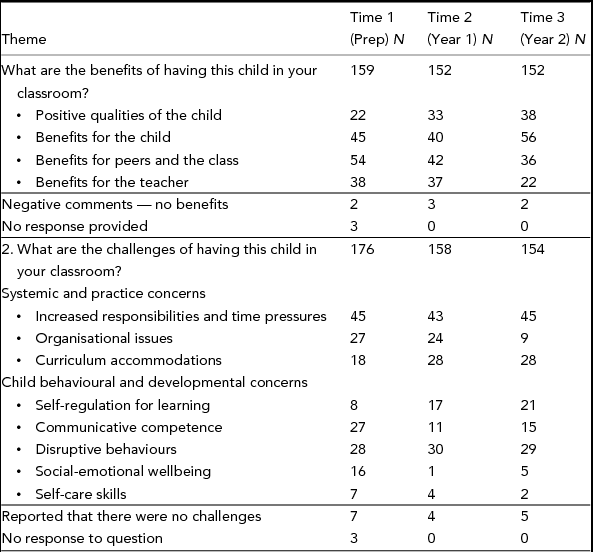
Benefits reported by teachers were differentiated into four broad-based categories: positive personal characteristics of the child; benefits for the child; benefits for peers and class; and benefits for the teacher. The categories are described as ‘broad-based’ categories because, for the latter three categories, teachers’ comments could be primarily differentiated according to the recipient of the benefit (child, peers, or teacher). The judgment on ‘who received the benefit’ was identified as the primary means for distinguishing between categories of benefits. The frequencies with which these categories were represented in teachers’ responses across each year of the study are presented in Table 2.
Frequencies on Categories Identified About the Benefits and Challenges of Inclusion

Note: The number of teacher questionnaires returned were: Time 1, 108; Time 2, 116; Time 3, 112. The numbers in categories could exceed the number of respondents for each question because teachers’ responses could address more than one category.
Positive qualities of the child
At all time points, many teachers responded with an opening statement on benefits that expressed an appreciation of the child's positive qualities. Commonly used words and phrases included ‘pleasure to teach’, ‘delightful’, and ‘happy’, and are summed up in this teacher's response:
I have a lovely relationship with [child]. He is a gorgeous student who has a great sense of humour and always makes me smile. [Child] is an absolute pleasure to teach and I will miss him next year. (Time 3)
This response focused on the likeability of the child, with explicit mention of the positive relationship between the teacher and the child that had been established. The importance of a positive relationship between students and teachers has increasingly been recognised as fundamental to achieving better learning and social outcomes for at-risk students (Split, Hughes, Wu, & Kwok, Reference Spilt, Hughes, Wu and Kwok2012) and also for teacher wellbeing (Spilt, Koomen, & Thijs, Reference Spilt, Koomen and Thijs2011).
Benefits for the child
Benefits for the specific child centred on intrapersonal and interpersonal advantages, but also identified values that teachers held about the importance of acceptance by peers and the importance of not singling out the child as being ‘different’ from other members of the class. This category had the highest frequency of responses from teachers at Time 3.
[Child] is a valuable class member.. . . He is completely accepted by his peers who see him as no different from them. (Time 2)
He is like all the children in my class — they are all special and all bring benefits to our class. (Time 3)
The teachers’ comments emphasise important qualities of a philosophy of inclusion about the ‘why’ to include rather than the ‘what’ or the ‘how’ of inclusion (Carlson, Hemmings, Wurf, & Reupert, Reference Carlson, Hemmings, Wurf and Reupert2012).
Benefits for peers
This was a more common category for teachers at Time 1 and Time 2 than at Time 3. Many teachers noted the learning opportunities that inclusion of the child provided for peers that emphasised moral values such as tolerance, acceptance and empathy.
Children have developed ways to communicate with [child] and interact with [child] in positive and inclusive ways. Other children have developed an understanding of tolerance. (Time 1)
Provides the general class population with strategies to show tolerance, understanding, resilience, getting along . . . most importantly, acceptance that others may be different from themselves. (Time 2)
As for the previous category, the comments emphasised the positive value that teachers placed on inclusive education. These opportunities for peers emphasised learning of moral values such as tolerance, acceptance and empathy.
Benefits for the teacher
Teachers’ comments in this category focused on their own professional learning through inclusion and how they were challenged to change their practices that could benefit all children in the classroom.
It makes you reflect on teaching strategies constantly, which benefits all children's learning. (Time 1)
For me, as a teacher, [child] provides a challenging opportunity to meet her needs and use differentiation in my planning. (Time 3)
The focus in these comments is not about the ‘why’ to include, as identified in the previous two categories, but on the ‘what’ and ‘how’ of inclusion (Carlson et al., Reference Carlson, Hemmings, Wurf and Reupert2012). The comments had a strongly pragmatic focus on teaching strategies and demonstrated teachers’ willingness to look for new ways to support children's learning.
What are the Challenges of Having This Child in Your Classroom?
Challenges were differentiated into eight categories that, on inspection, subsequent to the coding process could be broadly grouped as: Systemic and Practice Concerns and Child Behavioural and Developmental Concerns (see Table 2). The three categories comprising Systemic and Practice Concerns encompass the larger systems in which inclusive education operates, which have an impact on the work of the teacher, while the Child Behavioural and Developmental Concerns were about the specific behaviours of the child.
Systemic and Practice Concerns
Increased responsibilities and time pressures
Additional responsibilities added to time pressures that teachers experienced. This was the most common challenge reported by teachers, from Time 1 to Time 3. These responsibilities included meetings with specialist staff and parents and the time needed for planning and program development to ‘meet and discuss progress, as well as making program adjustments’ (Time 1); for ‘team communication’ (Time 2); and to provide ‘a completely modified curriculum’ (Time 3). Other demands on time were related to the need to provide one-on-one support to the child: ‘He takes up a lot of time and [this] can sap my energy’ (Time 1); ‘. . . Extra time [is] needed to “conference” [with] him as he takes a long time to reply to questions’ (Time 3).
Increased responsibilities for supervision to ensure the safety of the child were also noted: ‘The student has to be monitored constantly due to his unawareness of safety issues’ (Time 2); and the need for ‘constant vigilance’ (Time 3).
Organisational issues
These challenges focused on the need for extra resources, equipment, and specialist professional help. One concern at Time 1 was the policy that children had split placements each week with early intervention programs. This made it difficult for a young child to cope with different routines and teachers’ practices. Teachers at Time 2 and Time 3 had a similar concern because ‘constant withdrawals for specialised programs’ disrupted children's regular classroom routines. Many teachers also cited the need for ‘additional aide time’:
Not enough hands. I am ‘flat out’ coping with the demands of a full Prep class. (Time 1)
When teacher aide support is not available, he is often disengaged . . . being disengaged leads to behavioural issues and disruptive behaviour. (Time 3)
These identified issues could be described as forms of micro-exclusion (Cologon, Reference Cologon2013). These can take many forms but include when a child attends only for a part of the time in a mainstream setting or is removed from the regular classroom at various times in order to receive ‘additional support’.
Curriculum accommodations
Teachers identified challenges in modifying the curriculum to ‘meet everyone's needs all the time’ (Time 1), as well as the burden in ‘documenting the curriculum modifications’ (Time 2).
Inclusive approaches to teaching and learning require that teachers be highly flexible and find new ways of approaching curricula differentiation to accommodate and support a diverse range of learners. However, sufficient support and adequate resources need to be available to teachers to be able to enact modifications and accommodations to the curriculum.
Child Behavioural and Developmental Concerns
Self-regulation for learning
Children's difficulties in maintaining attention and staying engaged in learning activities were noted by teachers at all time points.
[Child] requires frequent adult support/monitoring to ensure he is staying on task which impacts on time [that] I can spend with rest of class. (Time 1)
[Child] requires constant one-on-one support to complete classroom activities . . . and is disruptive to other students when this cannot be provided. (Time 2)
Learning in classrooms requires a high level of behavioural and attentional self-regulation (McIntyre, Blacher, & Baker, Reference McIntyre, Blacher and Baker2006) and many children struggle with developing the necessary skills to focus and maintain attention on learning tasks in classrooms (McClelland, Acock, & Morrison, Reference McClelland, Acock and Morrison2006; Neuenschwander, Röthlisberger, Cimelli, & Roebers, Reference Neuenschwander, Röthlisberger, Cimelli and Roebers2012).
Communicative competence
A number of teachers expressed concerns about children's expressive and receptive language, especially at Time 1.
I cannot really assess what he knows/understands due to lack of language and non-compliance with tasks. (Time 1)
He does not always understand what I am saying and I do not always understand his speech. I have to be very patient. (Time 1)
The latter comment indicated that the teacher has taken responsibility for facilitating communication with the child — ‘I have to be very patient’ — rather than identifying this concern as a problem that only resides with the child.
Disruptive behaviours
Various forms of disruptive behaviour were noted by the teachers as major challenges, including ‘physical and verbal aggression’ (Time 1) and ‘erratic behaviour, refusal to complete most work’ (Time 2).
[Child] is very uncooperative when he has a meltdown or temper tantrum as his anger overrides all emotions. This can be time consuming to deal with when the teacher does not have another person to assist. (Time 1)
We find it hard to figure out what triggers his daily high anxiety outbursts, which constantly disrupts the other children. (Time 2)
Many of the behaviours that teachers identified as challenging were quite specific behaviours associated with children with ASD. This was the most common condition for children participating in this study, and these comments indicate that managing behavioural issues remain an important focus for professional support to which teachers need access.
Social-emotional wellbeing
Teachers also expressed concerns for the emotional wellbeing of some children, especially related to anxiety.
School can be a stressful place for special needs children. [Child] experiences some anxieties and it is a challenge to always think ahead to avoid [child] becoming anxious. (Time 1)
Self-care skills
Children's lack of independent skills for self-care skills, specifically for toileting, was also noted as a challenge, particularly at Time 1, when the children were in the Prep year and when the lack of aide time prevented the teacher from being able to assist promptly when the rest of the class also required supervision.
Changes in Frequencies of Benefits and Challenges for Inclusion Across the Early School Years
The frequencies of the different categories about benefits and challenges identified by teachers across the 3 years of data collection were relativity similar (see Table 2). Some variations across time included that Year 2 teachers were more likely to make positive comments about the personality characteristics of the child and identify specific benefits accruing to the child as the result of inclusion. However, Year 2 teachers were also more likely to give the comment of ‘no benefits’, which cannot necessarily be assumed to be a negative comment. Teachers at Year 2 were also less concerned about organisational issues, such as withdrawal disruptions for specialist programs or additional teacher aide time. This was more evident for the Prep and Year 1 teachers. The extent of curriculum accommodations needed was more frequently reported by Year 1 and Year 2 teachers than, as might be expected, by Prep teachers. Similarly, there were more concerns reported about poor learning-related behaviours by Year 1 and Year 2 teachers than by Prep teachers. However, across Prep, Year 1, and Year 2, teachers reported similar levels of challenges related to disruptive behaviours.
Discussion
The findings reported in this study provided some opportunity to triangulate the response data for the two quantitative questions on inclusion with the response data on the two qualitative questions about the benefits and challenges of inclusion. The first quantitative question asked teachers to rate the appropriateness of the child's placement in the classroom. The teacher ratings indicated that from Prep to Year 2 of school, the child's placement was judged as highly appropriate, although slightly less so by Year 2 teachers. In parallel, the qualitative data on benefits, as for the quantitative question on appropriateness, also provided an encouraging picture of teachers’ willingness to include children with disabilities in their classroom. The data also indicated constructive support by teachers for the child's inclusion and acceptance within the classroom. The second quantitative question asked teachers to rate the adequacy of support and resources for inclusion. These ratings provided a mixed picture. At best, the level of support and resources could be interpreted as adequate over time, but many teachers judged the support and resources as not adequate. In parallel, the qualitative data on challenges reflected high levels of challenges across a range of areas that appeared to require increased levels of support and resources. The teachers reported diverse challenges at consistent and relatively high levels over time to support the child's inclusion in their classroom. This overall relative agreement, across the quantitative and qualitative responses, is likely because the responses are from the same groups of teacher respondents. Nevertheless, the questions were asked in different ways, in content and form, and provide some consistency for overall interpretation about teachers’ current experiences of inclusion in the early years of school.
Inclusion is expected to promote equity, participation, respect for diversity, compassion, care, and entitlement (Ainscow, Booth, & Dyson, Reference Ainscow, Booth and Dyson2006). This study went beyond assessing teachers’ general attitudes to inclusion, to examine their beliefs about the benefits and challenges of inclusion in light of specific experiences with an ‘included’ child. It also explored how these attitudes changed as the child moved through the first 3 years of schooling. Teachers considered that a classroom in a regular school was an appropriate placement for the focus child but were less positive about the support and resources available to them for inclusion. For benefits of inclusion, teachers showed an appreciation of the positive qualities of the child and the benefits that accrued to the child as a result of inclusion. However, teachers also identified a significant number of challenges to inclusion that centred on the increase in their workload through additional tasks and responsibilities. Other common challenges were about disruptive behaviours by the child in the classroom and a lack of self-regulation to engage in learning tasks. However, these challenges were described for the very same children whom many teachers had described in quite positive terms. In the teacher responses on challenges, there was little focus on the specific condition and/or diagnoses for the child that may have warranted special support.
While other studies on the views of teachers in regular classrooms about inclusion have identified largely neutral or negative attitudes when talking abstractly about inclusive education (de Boer, Pijl, & Minnaert, Reference de Boer, Pijl and Minnaert2011), this study, with teachers’ responses linked to their experiences with specific children, indicated teachers’ willingness to include. While many educational systems now provide increased professional education for teachers to be inclusive of children with disabilities in their classrooms, it remains a priority that professional learning opportunities address the challenges that teachers continue to identify (Waitoller & Artiles, Reference Waitoller and Artiles2013). The findings in this study are in line with the findings of Carlson, Hemmings, Wurf, and Reupert (Reference Carlson, Hemmings, Wurf and Reupert2012) that positive teacher attitudes for inclusion may be pivotal to the delivery of inclusive practice. Positive inclusive attitudes create the conditions that result in more inclusive practice, which in turn generate more positive attitudes towards inclusive education. A commitment to ongoing professional development as a teacher is also critical to inclusive education in order to meet the needs of diverse learners.
In the context of an increasingly crowded curriculum, teachers face many competing demands to effectively engage all children in classroom routines and learning activities, and children with disabilities may require significant curricula and pedagogical accommodations to achieve expected learning outcomes. For example, across the past decade, teachers in primary schools throughout Australia have been increasingly accountable for children's achievement through national testing in order to improve literacy and numeracy standards (Smeed, Ehrich, Kimber, & Perry, Reference Smeed, Ehrich, Kimber and Perry2011). Constant pressures on teachers and schools to enhance learning performance for all children make it even more difficult for teachers to accommodate the range of diverse learning needs in classrooms (Petriwskyj et al., Reference Petriwskyj, Thorpe and Tayler2014).
While the findings from this research have provided insights of teachers’ perspectives on the inclusion of specific children in their classroom with a large sample of different teachers while the child progressed through the early years of school, it did so with relatively brief data from survey responses on questionnaires. Knowledge development in this area would benefit from more longitudinal research that tracks children across the primary school years, as well as also gathering data from their teachers to capture the contextual complexities in inclusive practice as teachers strive to navigate the various discourses on inclusive education and changing teaching priorities in their everyday practice in schools.
Financial Support
This research was supported under Australian Research Council's Discovery Projects funding scheme (Project number DP0877587). Jan Nicholson was supported by the Roberta Holmes Transition to Contemporary Parenthood Program at La Trobe University, Melbourne, Victoria.
Conflicts of Interest
None.