


‘Bookland’, Patrick Wormald once observed, is ‘one of the most fearsome devices on the Anglo-Saxonist’s workbench’.Footnote 1 Specialists in the period have certainly made heavy use of it, and for centuries historians of Norman England have invoked it as a point of contrast with tenurial conditions after 1066. The currently accepted accounts do, however, embody some unresolved difficulties and doubts. If those deserve revisiting, it is still more important to confront a problem that has barely been acknowledged, let alone addressed: whether the model of bookland proprietorship adduced from a limited range of southern and west midland archives, and from West Saxon prescriptive texts, applied equally – or even at all – to other parts of England.
To begin by rehearsing a very familiar model:Footnote 2 bookland tenure had its roots in late seventh- and early eighth-century royal diplomas for new monastic foundations, giving rights of full possession and free alienation in the lands granted, but was quickly bent to the purposes of aristocrats keen to escape traditional kinship structures. That process created a paradox, as land specifically freed from family ties came to be defined equally specifically as ‘hereditary’. Progressively detached from its ecclesiastical origins, bookland was openly granted to thegns by royal charter and became a characteristic form of aristocratic landholding – which for some historians stood in contrast to all other land (‘folkland’), still subject to ancient customary practices of control and inheritance.
This model, which emphasizes change during the eighth to mid-ninth centuries, has paid correspondingly less attention to how the character of bookland might have gone on changing through more than two centuries up to the Conquest. In the early 1990s Susan Reynolds developed a radical and quite iconoclastic reappraisal, arguing for a progressive assimilation of bookland to other forms of free ownership after 900, and questioning whether it still retained any meaningful identity by 1000.Footnote 3 Contributions since then have included a meticulous review of the evidence by John Hudson, and much-needed injections of social and anthropological analysis by Julie Mumby and Martin J. Ryan. Even so, Reynolds’ central hypothesis has been cited more than it has been seriously addressed, and there remains a tendency to treat bookland as a portmanteau explanatory tool for whatever was distinctive about later Anglo-Saxon landholding. Stephen Baxter’s critique of that position from 2006 bears repetition:
[I]t is crucial to distinguish between specific characteristics which are unique to bookland, which are few, and those common to bookland and other forms of tenure, which are many. Because royal diplomas occupy such a dominant place in the pre-Conquest evidence of land tenure, bookland has assumed a disproportionate significance in the literature; and as a result, certain phenomena which are demonstrably associated with bookland have come to be seen as a function of it. … [T]here has been a tendency for such points to harden into wider generalizations which cannot be sustained: for example, the idea that bookland was the principal if not only form of tenurial royal patronage; that all land held by thegns was bookland; that all land held with ‘sake and soke’ was bookland; or that military service was a function of bookland.Footnote 4
As a prelude to introducing a qualification of a different kind, the present contribution argues that Reynolds and Baxter were both – in their respective ways – right. In making that case, it is important to keep a distinction between landbooks and bookland: in other words, between royal charters as texts and physical objects, and the legal rights, inheritance strategies and social relationships that they are held to illuminate. As Ryan observes, ‘[t]he evidentiary value of a text, its legal standing, was constructed through the process of dispute settlement. It was not embedded in the text itself’.Footnote 5 Almost every aspect of Anglo-Saxon England changed between 700 and 1066, sometimes beyond recognition. It would be extraordinary if landed proprietorship in the real world remained set in stone, whereas petrification is the normal fate of official documentary formulae. We must be alive to the possibility that written sources present increasingly archaic concepts as though they were contemporary – just as, for instance, the convention of portraying commercial transactions as gifts tends to mask the realities of economic change.Footnote 6
To complicate matters further, folkland is even harder to pin down than bookland. Various definitions have been proposed from Vinogradoff and Maitland onwards, but recent opinion has favoured the catch-all ‘everything not bookland’. That again needs revisiting. The present analysis, which for the first time sets the documented cases of folkland in their topographical contexts, reverts instead to the narrower definition proposed by G. J. Turner in 1933: specifically public land near royal centres that was assigned to support administrative functions.
ROYAL DIPLOMAS AND THEIR LIMITATIONS
The evolution of royal diplomas is more securely understood than that of landed proprietorship.Footnote 7 It is useful to start by summarising it, in a series of chronological phases:
Phase 1 (c. 670–710): Charters were, by definition, alien intrusions into traditional Anglo-Saxon society. They were introduced to most (possibly all) kingdoms in the context of a huge boom in monastic foundation and endowment, directed by highly educated and cosmopolitan religious leaders and supported by kings. They had diverse models, most obviously Italian and Frankish. They were exclusively for ecclesiastical beneficiaries, who formulated them to confer maximal benefits on themselves, including freedom of alienation and immunity from royal demands and services. The title thus created was fundamentally different from traditional modes of using and transmitting land within kindreds and among secular elites.
Phase 2 (c. 710–70): As a wider range of aristocratic patrons embraced the monastic boom, they sought royal diplomas for ends that started to be financial and familial as well as religious. Paradoxically, freedom of alienation was increasingly used as a strategy for entailing inheritance to restricted lines of descent within wider kindreds. In 734, in a famous and uniquely northern comment, Bede complained that Northumbrian nobles ‘get hereditary right over these lands ascribed to themselves in royal edicts (in ius sibi haereditarium regalibus edictis faciunt asscribi), and have these documents of their privileges confirmed by the subscriptions of bishops, abbots and secular authorities’.Footnote 8 No such Northumbrian charters survive, but charters from other kingdoms illustrate exactly this process. However, the recipients were still nominally defined as abbots and abbesses, and most of them, at least in their own perceptions, were probably still running genuine religious establishments. Meanwhile, royal charters started to stipulate what in the next phase would become a standard set of reservations, making chartered land liable to perform major public services.
Phase 3 (c. 770–910): Early in this phase, the explicit granting of diplomas to laity broke the link between chartered proprietorship and monastic endowment. Disputes over inheritances proliferated, revealing that royal diplomas were often embedded in an increasingly complex and diverse body of estate documentation. It became standard for diplomas to exclude from exemption the three royal services of building bridges, maintaining forts and serving in the army. As monastic wealth and independence went into steep and eventually irreversible decline during the ninth century, and large land-units started to be broken up into smaller estates, the purely secular aspect of chartered land-holding became more prominent. The rise of vernacular documentation was another reflex of the same broad trend, even if it only influenced diplomas to a limited extent.
Phase 4 (c. 924–1005): After an apparent fourteen-year hiatus, royal (by definition West Saxon) diplomas were again issued, for both minsters and laity, but now in a more centralized and standardized manner. Numerically they reached a peak in the 940s to 960s – spectacularly so in the year 956 – when an exceptionally large number were issued to minor royal thegns; then they started to tail off again.Footnote 9
Phase 5 (c. 1005–1066): The number of genuine extant diplomas declined sharply, especially with the growing prominence of writ-charters towards the end of the period, and their formulation became less standardized.
As we explore what impact these documentary changes had on the reality of how land was possessed and transferred, some general principles – one about language, three about context – need to be understood and accepted. As regards language, the difference between purposeful reiteration and inbuilt redundancy is critical. Pleonastic pairings and other catch-phrases tend to become formalised with repetition: an instance might be ‘land and book’.Footnote 10 That does not necessarily entail loss of meaning, but it can progressively distance functional effect from etymology. Whether that applies to the very word bōcland is an important question here. It was a purely vernacular expression – no Latin compound meaning ‘charter-land’ ever emerged – and seems in the end to have taken on a life of its own that was not tied to its root meaning. It cannot be assumed that late Anglo-Saxons understood bōcland any more literally than modern house-owners understand ‘holding in fee simple’.
As regards context, the first point is that between the late seventh and mid-ninth centuries, ecclesiastical culture was extremely fashionable among the elite (and perhaps not-so-elite) laity. Royal diplomas were visibly and emphatically a product of that culture, and to possess one was, in a sense, to be accepted into it. That would have been a sufficient reason – and in the end may even have become a necessary one – for perpetuating the form and vocabulary of landbooks and bookland. Because diplomas are often our only source, historians have tended to see them as centrally-driven expressions of royal policy, but it seems as likely if not more so that their production at all periods was mainly beneficiary-led.
Secondly, in any literate society, whatever the modes of land-holding, it is desirable (even when not essential) for proprietors to have written documents attesting to their title. Royal diplomas were title-deeds, and that is why they are regularly mentioned in texts recording dispute-settlements and wills, and a major reason why people wanted to have them.Footnote 11 Charters were cited as proof of ownership and produced in formal processes, but surviving narratives never make explicit the precise status that they conferred: we have no means of knowing whether or not that changed over time, since the charters themselves present a façade of stability.
The third point is that Anglo-Saxon England was in any case a society in which decision-making and dispute-settlement depended on debate and testimony far more than on writing, even though our (necessarily written) sources obscure the fact. In a culture that set great store by oral and visual rhetoric, royal diplomas were splendidly symbolic objects to transfer ritually between owners and to brandish under the noses of witnesses, jurors and adversaries.Footnote 12 But they were just one element in face-to-face performances: they may have gained more of their legal force, and even of their effective meanings, from the progress of those performances than from the tradition-laden words written in them.Footnote 13
In Phases 1 and 2, we can accept the reality of bookland to the extent that royal charters created a distinctively ecclesiastical and desirably privileged mode of tenure. Even so, they did not necessarily say what they meant. Diplomas purporting to grant freedom to alienate could in reality be used to create entails, manipulating inheritance within the context of flexible and often complex family strategies.Footnote 14 It is also clear – both at this stage and at later ones – that some ostensible ‘grants’ of royal land were nothing of the kind, but were obtained to redefine existing family land in a different and more negotiable form.Footnote 15 From the 770s (Phase 3), as charters came to be issued openly to laity and as the exemption of bookland from major public burdens was progressively removed, its special status must surely have started to fray. If bookland had to discharge bridge-building, fort-service and army-service, from what public duties imposed on other land was it still exempt? Freedom to alienate was indeed a valuable asset while that remained restricted to chartered land, but the mere repetition of alienation formulae cannot tell us how long the restriction survived in practice.
The charters also lead one to suspect that their precise wording mattered less than historians tend to assume. As Ryan observes, the seeming arbitrariness with which formulae can be included or omitted makes it hard to see them as legally critical: ‘whatever the terms of the charter, the rights of landowners to freely dispose of their property were tied up with wider considerations and were inevitably the subject of negotiation and compromise’.Footnote 16 Nor was it even essential for written evidence to take the form of an original royal charter. In 736 × 737, a synod addressed the problem of a royal diploma that had given land to a nun to found a minster in Gloucestershire, but had since been lost or stolen to the detriment of her granddaughter and heir: the decision was that a cartula donationis, either of the donor kings or of the recipient nun, should be clearly written out and given to the girl (S 1429).Footnote 17 None of this is to say that documentation did not matter. But in a world where there was an increasing range of documentary forms, themselves contingent on oral procedures, the unique and continuing status of royal diplomas as the necessary condition for a unique form of tenure needs to be demonstrated rather than taken for granted.
THE LANGUAGE OF BOOKLAND TENURE FROM OFFA TO ALFRED
The function of a landbōc was ostensibly to create the distinct legal status of bōcland, but how exactly was that conceived? In about 827, Archbiship Wulfred claimed that Abbess Cwoenthryth had given him land ‘with the old charters belonging to it, and with the same freedom that she had previously had, in perpetual inheritance, to have and possess and after his own day to leave to whomsoever he might choose’ (cum propriis et antiquis telligraphis et cum eadem libertate quam ante habuerat, in perpetuam hereditatem, ad habendam et possidendam postque dies eius cuicumque ei placuerit derelinquendum) (S 1436).Footnote 18 In this most comprehensive and wordy fashion, he was enunciating the essential privileges that charters were held to record. Other texts do it more succinctly, but all as variations on one or more of Wulfred’s themes: documentary title, free possession, heritability and freedom to give or bequeath.
In the very first royal charter issued openly to a layman (S 114) – though one that does not confer rights of alienation – King Offa gave land in Gloucestershire to his thegn Dudda in 779 ‘in the right of ecclesiastical privilege (ius ecclesiasticae liberalitatis)’.Footnote 19 This munificently affirmed the comprehensive rights that minsters had enjoyed until recently, but its hypocrisy must have been obvious, and predictably it was dropped. Instead, the emphasis settled in the early ninth century on the capacity to pass land on to freely chosen heirs. Since the sources from this generation and the next are overwhelmingly Kentish, it is important to stress the deeply conflicted political context, as Mercian kings sparred with the church of Canterbury for power and resources. Against that background, it is unsurprising to find tenurial rights defined in new ways and more frequently – a point that may apply to both bookland and folkland.
Referring in Latin to his personal properties, Archbishop Wulfred of Canterbury consistently describes them and their charters in terms of ownership and heritability: meae proprie iuris (S 1264), iure perpetuo hereditatis (S 1265), cum propriis hereditaris libellis (S 1266), meae propriae hereditariae terrae (S 1268).Footnote 20 Switching languages, in a text probably from the 820s or early 830s (S 1622), Wulfred then gives us our very first witness to bōcland as a vernacular term. Responding to some complaint that he treats Christ Church land as his own alienable property, he urges the grumbler to understand
that it was never Christ Church land nor any man’s bookland before it was mine (ne nenges monnes boclond ær min). And then that person should consider and think about other people’s bookland, both in sanctuaries and outside, whether they are able to give away their own [bookland] or possess [it] during their lifetime as may be pleasing to them, or why mine ought to be more restricted than that of other people.Footnote 21
Two important points emerge from this passage. First, what Wulfred calls his bōclond in English is clearly equivalent to what he calls his propria hereditaria terra in Latin. Secondly, there is a more oblique but still quite distinct implication that his free disposal has been challenged because bookland should by definition belong to ecclesiastical institutions: he asks his critic to remember all those other proprietors – private as well as ecclesiastical – who have bookland and can do what they want with it. Given the vein of criticism from Bede onwards, accusations of abusing a form of tenure originally created to support the religious life would touch a tender spot.
Thereafter, it is some decades before the vernacular term bōcland reappears, and through most of the ninth century (at least in Kent, from which the wills providing the evidence all come) the standard lay expression for land granted by charter was ærfe, ‘inheritance’.Footnote 22 In normal speech this meant anything that one had inherited, but in these contexts the testators explicitly used it in the different sense of granted land; in two cases the charters conferring the land in question to the testators actually survive (S 41/ S 1500, S 296 / S 1510). In his will of the 830s (S 1482), the reeve Abba gave complex instructions for the descent of his ærfe ‘which I have and which God lent me and I received from my lords’, and which he could evidently dispose of as he wished.Footnote 23 Accordingly, ‘inheritance-land’ did not mean land that had descended through kindreds by traditional custom, but land that had been granted freely and could thereafter be passed down to heirs of choice. There were thus two parallel usages in ninth-century Kent: what Archbishop Wulfred called bōcland was identical to what contemporary lay testators called ærfe. It seems possible that the former (emphasising the charter) expresses the priorities of ecclesiastics, whereas the latter (emphasising absence of restrictions) expresses those of secular landowners. At all events the Alfredian translator of Orosius was still using bōcland in this specific sense when he rendered traditam per testamentum as to boclande geseald. Footnote 24
A problem with understanding bookland tenure, like all other tenures, is that the Anglo-Saxon lawcodes have remarkably little to say about it. The tiny number of clauses where bookland features never indicate in any clear way how it differed from other kinds of land. Consider the first instance, in Alfred’s code:
The man who has bookland, and his kinsmen left it to him: then we determine that he may not give it away from his kindred, if there is a writing or witness that it was enjoined that he might not do so by those who originally acquired it, and by those who gave it to him.Footnote 25
What is emphasised in this law (presumably a reaction to specific cases) is not the special status of bookland, but rather some private arrangement – whether by written document or oral witness – establishing an entail.Footnote 26
Bookland status, then, enhanced flexibility in testamentary arrangements, and to judge from the terminology that was a major attraction for the laity. But was it unique in that? Mumby’s exploration of the ‘customary’ descent of family land suggests that considerable flexibility, as well as considerable complexity, was in any case embodied in ordinary practice, while also citing cases where charters clearly did expedite the process.Footnote 27 If most traditional inheritance customs involved versions of partibility, the unitary status of an estate confirmed and described in a diploma may have acted as a brake on normal practice; but we cannot say that it was a complete brake, nor that it was the only available one. Bookland could certainly be bequeathed in wills, but the argument that land so bequeathed was normally bookland in the strict sense is hard to sustain.Footnote 28 Rather than a clear-cut contrast, it may be better to envisage a spectrum where bookland status made for greater flexibility, but ‘customary’ land was not completely restricted and bookland was not completely free.
FOLKLAND AND BOOKLAND: REVISITING AN ANCIENT PUZZLE
Here we confront a central crux: the widely-accepted view that bookland was defined pre-eminently by its contrast with folkland – whatever that might have been. Folkland is only explicitly mentioned in four documents, but a name so seemingly redolent of ancient liberties inevitably attracted the interest of seventeenth- and then nineteenth-century historians, with their respective (and probably equally inappropriate) concepts of the ‘folk’. Since we are never told what folkland was, it has been especially vulnerable to shades of political or romantic colouring. In 1626, Henry Spelman called it ‘popular land possessed by common right’, though he was true to the evidence in emphasising the negatives: not recorded in writing, not bookland, perhaps allod as against fief.Footnote 29 That has not deterred legal historians from discussing it interminably, if not always to better effect; a major exception is John Hudson’s thoughtful analysis in 2012, which took an important step forward.Footnote 30 To rehearse all the arguments yet again would be tedious, but the fundamental question – how far folkland defined the character of bookland – cannot be avoided here.
Building on Hudson and earlier scholarship, I take certain hypotheses as a starting-point: that the ostensibly catch-all term folclond (‘land of the people’, ‘public land’) does not inevitably imply either antiquity or comprehensiveness; that kings had extensive but not unqualified control over folkland, so that permanent disposal evidently required the assent of counsellors; that kings could, with such assent, turn folkland into bookland and occasionally vice versa; and that it seems to have been particularly associated with kingship and royal land. And as Hudson noted – crucially for the present argument – ‘it is far from clear … that folkland existed throughout England or even outside Wessex and Kent’.Footnote 31
My aim here is to give some further breadth and depth to the discussion: by pointing out that ‘folkland’ status can be inferred from the Latin terminology of some earlier Kentish charters where it has not been recognised hitherto, and by contextualising the known cases of folkland through an exploration of their local topographical contexts. The most important texts are in the archive of Christ Church, Canterbury, so the superb new edition by Brooks and Kelly makes this a good point to revisit them. The outcome will be a more restricted definition than the one currently fashionable, locating folkland specifically in the ambit of royal administrative centres.
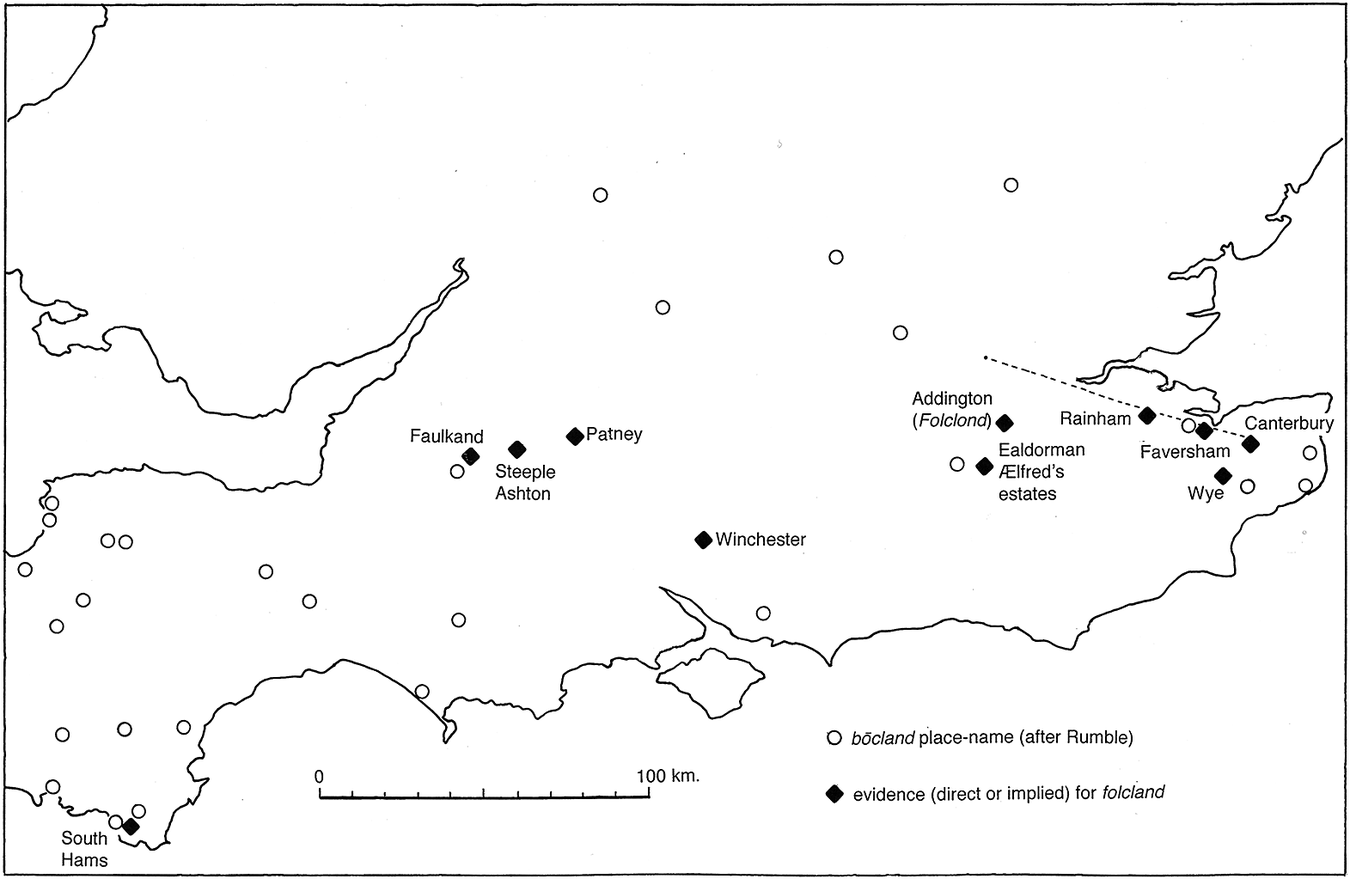
The starting-point is a pair of Latin charters from 811–812 recording gifts and exchanges of land in Kent between King Coenwulf of Mercia and Archbishop Wulfred (S 168, S 169).Footnote 32 In the first, Coenwulf with the consent of his council gives Wulfred three small holdings in the king’s propriae puplicae iuris – at Appincg lond ‘suburban to’ Rainham, at Graveney ‘suburban to’ Faversham, and in Canterbury – in perpetual inheritance. The second document is an exchange, made with consent of the sapientes of both parties: Wulfred gives to Coenwulf, and (apparently) donates into the status of public land,Footnote 33 two small holdings which he had bought and possessed in perpetual inheritance; Coenwulf gives in return two small holdings – at Graveney ‘suburban to’ Faversham, and at Caseborne in the region of Lyminge – in perpetual inheritance.
Opaque in themselves, these transactions make sense in the light of the transfers of status between folkland and bookland to be discussed shortly, for that is evidently what happened here. The king gave the archbishop properties that were currently in his own ‘public right’ and converted them (with the council’s permission) into heritable bookland; in exchange, the archbishop gave the king land that was heritable bookland already, but was now to be transferred to the ‘public’ status, presumably so that this category of asset should not be depleted. The likely context of these transactions was Coenwulf’s recent initiatives to develop transport and infrastructure, highlighted by the unique formulation in regione suburbana ad oppidum regis. The royal oppida of Rainham and Faversham were staging-posts along the Roman road from London to Canterbury, which Coenwulf may recently have re-opened by restoring Rochester bridge.Footnote 34 The blocks of former folkland (as we can surely call it), now alienated to give Wulfred footholds along this major route, had evidently been attached to these centres.
The phrase in suae propriae puplicae iuris, which defines Coenwulf’s right over the land as both personal and ‘public’, is abnormally specific. In the Kentish exchange-agreement of 858 to be examined shortly (S 328), the king simply describes the land given away as aliquam partem terre iuris mei, and it is only thanks to the vernacular endorsement that we know it to be folkland. Might other cases of folkland be lurking under the disguise of similar phrases?Footnote 35 It seems unlikely that the common formula ‘terra iuris mei’ always indicates folkland; explicit reference to consent by the king’s advisors appears to be a diagnostic feature, but is still not conclusive.Footnote 36 One interesting case is the charter whereby King Æthelwulf gives a villa and land near Canterbury, described as aliquantulam partem terre meae propriae iuris, to his reeve Badanoth in perpetual inheritance, with the consent of his council and for a payment of fifteen mancuses (S 296): this might be another conversion of folkland adjoining a royal centre. The grant was made at an assembly at the royal centre of Wye on 16 November 845, and it has been suggested that Badanoth (Beotting) – who would describe this very acquisition as his ‘heritable land (min ærfe lond)’ in his will (S 1510) – may have been the reeve there.Footnote 37 We will revisit Wye shortly; meanwhile, it is worth noting the ministerial context, and the intimation of a royal official buying his way into the landowning class by inducing the king to privatize a public asset.
That brings us to the first and best-known explicit reference to folkland, the land-exchange of 858 between King Æthelberht of Kent and his minister Wullaf (S 328).Footnote 38 The text of the diploma does not define the status of the properties, but a vernacular endorsement says that ‘the king gave and booked (sealde and gebocade) to Wullaf five sulungs of land at Wassingwell [lost, partly corresponding with Eastwell and Westwell] in return for the five sulungs at Mersham, and the king made the estate at Mersham [except some outliers] into folkland for himself (dyde ðet land et Mersaham him to folclande)’. The boundary-clause says that the Wassingwell land abuts westwards on ‘the king’s folkland which Wighelm and Wulflaf hold (ab occidente cyninges folcland quod abet Wighelm et Wulflaf)’.
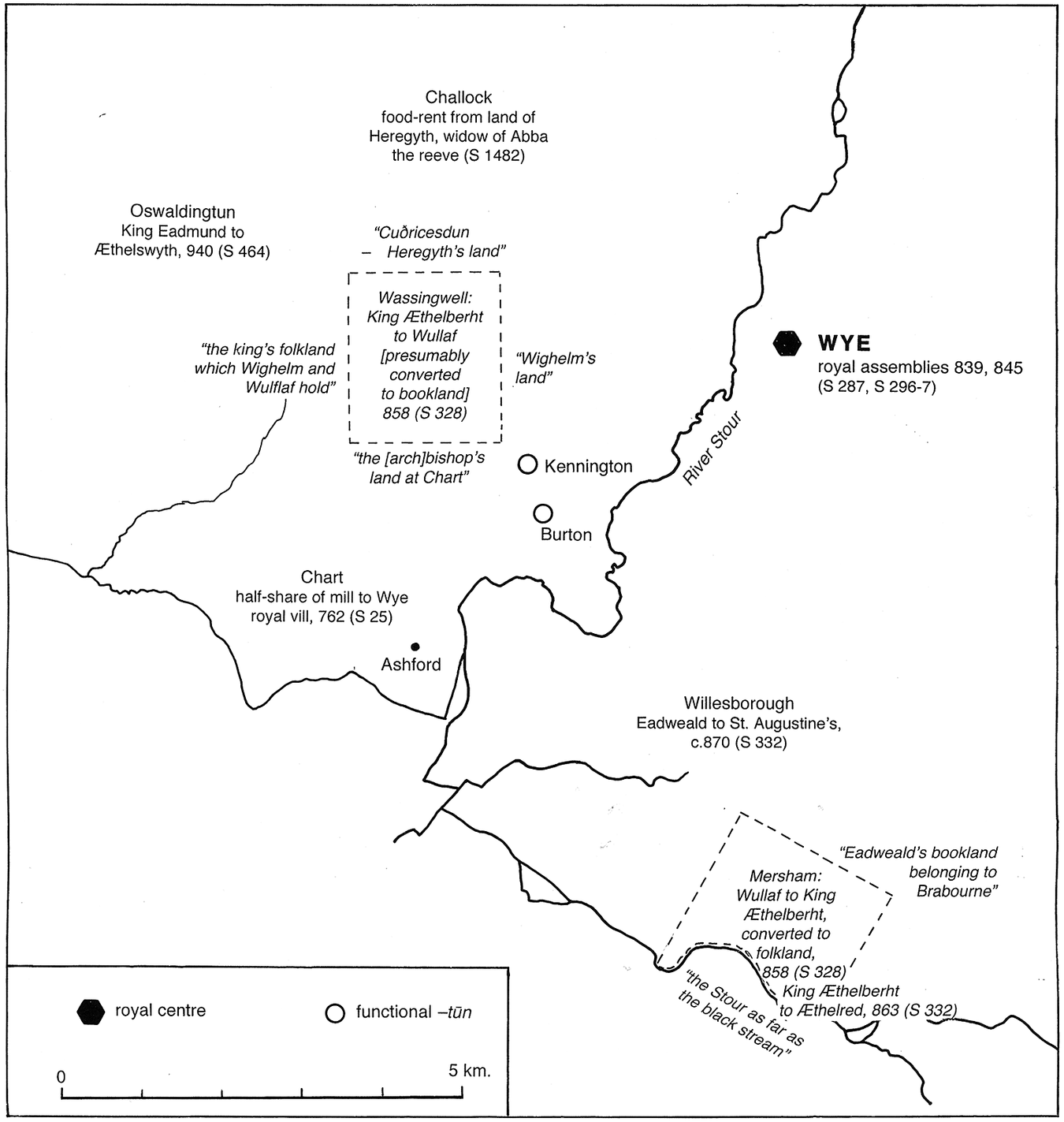
Oddly, none of the many attempts to understand these transactions has located them systematically on a map. When that is done, it is apparent that they have a very specific context: the periphery of the royal centre at Wye (Fig. 1). The notably orderly territorial structure of early Kent was configured in large land-blocks (‘lathes’) radiating into the Weald.Footnote 39 One of the lathe centres was Wye, near the modern town of Ashford: the Wealden common of the ‘Wye-dwellers’ is mentioned in 724 (S 1180), and the place-name (weoh, ‘pagan shrine’) suggests that it was a long-established ceremonial focus. It remained an important place into the eighth and ninth centuries, perhaps a link-point for commercial traffic from the Sussex coast onto the upper Stour, and thence to Canterbury and the Wantsum Channel.Footnote 40 The royal residence is mentioned specifically in 762 (S 25), and diplomas were issued at assemblies there in 839 and 845 (S 287, S 296–7).
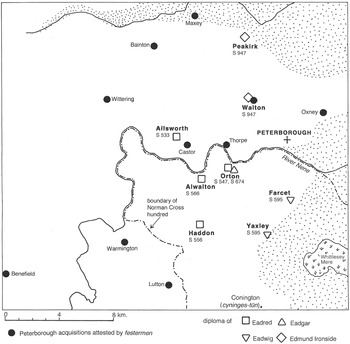
The royal complex around Wye, showing the context of the land-exchange documented in 858 (S 328).

Uniquely for Kent, Wye displays the complex structure of specialised functional dependencies and service holdings that has been recognized especially in the Mercian zone, and illustrated by case-studies of Bourton-on-the-Water (Glos.) and Bampton (Oxon.).Footnote 41 The royal core can probably be identified as a stretch of the Stour valley extending southwards from Wye, free of known land-grants but containing a pair of classic functional dependencies, a burh-tūn (Burton House) and a cyninges-tūn (Kennington).Footnote 42
In the territory on either side, a pattern of land-holding can be glimpsed thanks to the exceptional riches of the Canterbury archives. The Chartland west of the Stour contained a property of St Augustine’s monastery (from which a share of a mill was annexed to Wye in 762); a property of the archbishop; and a property given to the royal steward Æthelmod in 843.Footnote 43 Nearer to Wye were smaller holdings of a more ministerial aspect: one at Challock belonging to Heregyth, widow of the reeve Abba;Footnote 44 Wassingwell with the adjoining royal folkland, as listed in the 858 charter; and an adjoining ten-hide block granted out much later, in 940 (S 464).Footnote 45 This pattern continues east of the Stour, to the south of the royal core: the Mersham land brought back into royal folkland under the 858 agreement, but then apparently granted out again as bookland to a royal minister called Æthelred in 863 (S 332); ‘Eadweald’s bookland pertaining to Brabourne’ on which Mersham bordered eastwards; and a property at Willesborough in the hands of the same Eadweald.Footnote 46
The relevance of all this for present purposes is that Wassingwell and Mersham were integral components of a tightly-organised cluster, in which a balance evidently had to be struck between patronage of substantial individuals whom the king favoured, and conservation of land more firmly attached to the centre and presumably supporting routine activities. We might guess that Wullaf (if he was identical with the ‘Wulflaf’ of the charter-bounds) was a royal minister with aspirations to thegnly status, and that he wanted to consolidate his holding by re-locating his bookland next to his folkland.Footnote 47 The king agreed to this, and to the consequent change of status for Wassingwell, but accordingly switched Mersham’s status to become folkland. The claims of patronage pressed, however, and Mersham was re-booked after five years (S 332). There is a pattern in these transactions, which does indeed embody a difference between folkland (used flexibly for short-term needs that discouraged lasting alienation) and bookland (handed out irrevocably to reward the favoured). But the context – the immediate periphery of a major royal centre – gives no grounds for a general understanding of folkland as all land that was not bookland.
The will of Ealdorman Alfred, datable 871 × 889 (S 1508),Footnote 48 gives us another localized reference to folkland. He was a rich man, with several properties of various sizes in the easternmost – and organisationally most Kentish – part of Surrey.Footnote 49 The administrative topography is less coherent than in the Wye case, but it is still possible to grasp how Alfred’s holdings intersected with royal territorial power. The northern part of this region was dominated by three major land-blocks: the Christ Church estate of Croydon (originally a minster); the Winchester estate of Beddington; and Ealdorman Alfred’s own estate of Sanderstead, reckoned at thirty-two hides in the will.Footnote 50 Compared with these, the hundredal centre and Domesday royal manor of Wallington looks exiguous (its very name, wealh-tūn, denoting a functional dependency), and was surely a remnant of something once much larger.
Possibly more important was Thunderfield (another pagan cult name, ‘Thunor’s open ground’), a royal property that is mentioned in King Alfred’s will and was the site of a later royal assembly.Footnote 51 This lay well to the south, near the Sussex border and deep in the Weald. The explanation for this odd location – in addition, presumably, to traditional and ceremonial factors – is likely to have been an important trans-Weald route, running northwards from the Sussex coast past Thunderfield and then on to Croydon and eventually London.Footnote 52 Ealdorman Alfred’s Surrey properties lay mainly on the open chalk of the North Downs and its dip-slope,Footnote 53 but four of them – Linkfield (Reigate), Gatton, Waddington (Coulsdon), Sanderstead – were also close to this road or group of roads that crossed the Weald and Downs and continued north to Croydon. If he was ealdorman of Surrey (which is likely though not certain), this configuration could have something to do with his duties of administration, law-enforcement, and maintaining communications through the dense Wealden forest between the south coast and London.
The ealdorman’s wife and their joint child were to have the lion’s share of his landed wealth. To his own (perhaps illegitimate?) son Æthelwald, however, he left two small booklands, Waddington (two hides) and Gatton (one hide), plus a hundred pigs, with the further hope that ‘if the king is willing to grant him the folkland along with the bookland (him geunnan wille þes folclondes to ðem boclonde), let him have it and enjoy the use of it’.Footnote 54 If on the other hand the king should demur, Æthelwald could instead choose one of two booklands, either Horsley (ten hides) or Lingfield (six hides) – which presumably gives a broad sense of the size of the folkland in question. This folkland was not controlled by some family group but by the king (otherwise why was he involved?), and it could be that it went with the ealdormannic office. To see that as incompatible with the testator’s attempt to alienate it to ÆthelwaldFootnote 55 is to presume a static situation. But the situation was not static: we have already encountered at least two examples of folkland granted by charter to men in the king’s favour. The ealdorman could have hoped that King Alfred would connive in doing the same for his son – but, knowing him, perhaps did not hope too much. Though less clearly than at Wye, there is again a strong suggestion of a royal and ministerial context.
That exhausts the topographically-specific references to folkland. However, a curious group of diplomas in which kings book land to themselves become relevant at this point, since they imply transfers into bookland from some different and presumably less flexible status.Footnote 56 The word folkland (or its likely Latin equivalents) is never mentioned, but the texts are important in showing that the creation of distinct status by charter continued later than we would know otherwise, and in Devon and Wiltshire rather than just in Kent and Surrey.
In 846, with consent of his bishops and nobles, King Æthelwulf of Wessex booked to himself twenty hides in the South Hams of Devon (S 298). The southernmost point of England outside Cornwall, this coastal peninsula was of great economic and strategic importance for the West Saxon kingdom. The Burghal Hidage fort of Halwell was evidently designed to defend it, and the region contains the earliest known case of a herepað (‘army-road’), perhaps running from Halwell to the crossing and fort at Kingsbridge above Salcombe harbour.Footnote 57 At a time of growing danger from Vikings, there was every reason for Æthelwulf to take a strong interest in the region.
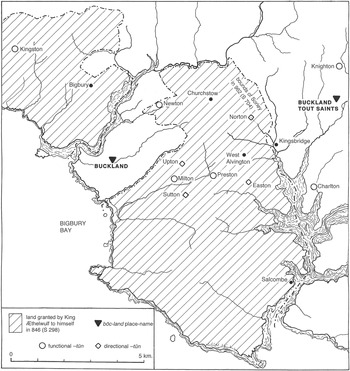
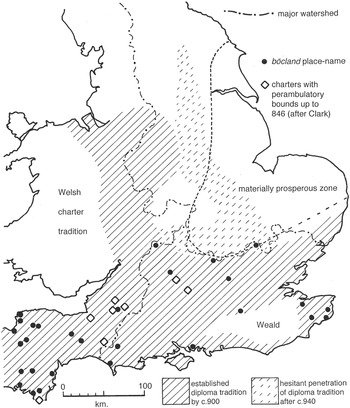
When the 846 charter-bounds are plotted in their local context (Fig. 2), interesting facts emerge.Footnote 58 The twenty hides lay in two discrete blocks, separated from each other by the parish of Thurlestone. It is remarkable that the focal settlement of this parish is a place called Buckland (Bochelande in Domesday Book), and that Buckland Tout Saints (Bochlande in Domesday Book) lies outside the boundary to the north-east.Footnote 59 We will consider bōcland place-names later, where it will be suggested that they were formed at a relatively early date, when bookland was scarce and distinctive. In these two cases, that surely happened before the larger land-unit between them was itself made into bookland in 846. The peninsula is also remarkably well-supplied with compound place-names of the ‘functional tūn’ type encountered at Wye. The smaller block of the 846 estate contains a Kingston (cyninges-tūn).Footnote 60 The larger block contains a prodigious cluster of satellites – Norton, Sutton, Easton, Upton, Milton, Newton, Preston (and Churchstow, presumably an associated church) – grouped around West Alvington, still a royal manor in 1086. Outside the estate-boundary to the east, on either side of Buckland Tout Saints, are Knighton (cniht-tūn) and Charlton (ceorl-tūn).
The South Hams region, showing the land booked by King Æthelwulf to himself in 846 (S 298) in relation to functional –tūn and bōcland place-names.

This is one of the most impressive groups of functional names in England,Footnote 61 and must represent an important royal core-zone with complex internal organisation. It is a reasonable guess that before 846, it consisted of ‘public’ land, assigned for the multiple tasks of servicing a royal centre, out of which two discrete blocks of bookland had already been carved. What Æthelwulf did was to ‘privatize’ a much larger proportion of it under his own unrestricted control, very possibly (as Janet Nelson has suggested) to reward urgently-needed military forces.Footnote 62 At least a small part of it was in royal hands in 962, when King Eadgar granted it out (S 704). In any case the context of this folkland (as again we can surely call it in essence if not in name) was again quite specific, both institutionally and topographically.
What looks like another case, if a rather odd one, is the record from 901 of Edward the Elder’s exchanges of small plots of land in Winchester preparatory to building the New Minster, some of which were booked to him by the West Saxon witan (S 1443). If this is to be understood in the same sense as the others, it implies that tenement-sized blocks within the walls of Winchester had a comparable status of ‘public’ land: had they for instance been used to support administrative officials?
Finally, King Eadgar booked land in Wiltshire to himself in two charters: in 963 at Patney (S 715), and in 964 at Steeple Ashton (S 727). These are very close in date – as well as much later than the others – and survive in different archives: given that both estates are on the edge of the Wiltshire Downs less than ten miles apart, they suggest connected and specific circumstances rather than random survival. The region is one with a strong royal presence. Patney forms a little cluster with Stanton St Bernard and Beechingstoke, where earlier grants of bookland were made.Footnote 63 Steeple Ashton is three miles north of Edington, a royal estate centre in King Alfred’s will. The institutional contexts, therefore, look potentially similar to the earlier cases. As evidence that a practice otherwise unknown after the 880s could occur as late as the 960s, these cases are important. On their own, though, they hardly prove that it was still mainstream: maybe Eadgar felt a special need to make gifts or testamentary arrangements at short notice, and employed an archaic device so that there would be no strings attached? In such a case the initial charter would continue to be an important title-deed when the land passed on to new proprietors, so it is suggestive that no other examples from this late date survive.Footnote 64
This survey of folclond on the ground suggests that its occurrences were restricted and specific. However, we now confront two prescriptive texts that seem to refer to something more generalized. It is difficult here to go much beyond Hudson’s careful assessment of the considerable problems, but the texts are worth revisiting in the light of the emphatically royal and administrative context now implied by the topographical analyses.
Edward the Elder’s first law-code prescribes penalties for anyone who ‘withholds another person’s rights in either bookland or folkland’. Footnote 65 The tariff of fines is the same for both categories; the only difference in treatment (in the fuller and evidently better manuscript) is that in the case of folkland the aggrieved proprietor must ‘fix a day when he [i.e. the withholder] will do justice to him before the reeve’. The forum for bookland disputes is not stated, but the message seems to be that occupants of both bookland and folkland have access to redress of wrongs, and equality in the sanctions protecting them. It is significant that this short code, which otherwise deals mainly with commercial matters, is addressed specifically to Edward’s reeves in their administrative and judicial functions.Footnote 66 One plausible interpretation is that mechanisms for protecting bookland already existed, and Edward now wanted to formalize arrangements for folkland in contexts where his reeves had oversight. He was, in other words, blurring the legal difference between them.
The other text is the mysterious fragment known as ‘Ymb Æwbricas’, apparently an extract from responses to a series of questions about sexual and perhaps other offences. It survives out of context but was evidently written in the tenth century, most likely its first half.Footnote 67 Its answer to a question about adulterers is that the female offender takes her forfeiture to the bishop and the male offender takes his to his lord, ‘be it bookland or folkland, be it of the king himself or any man’. As Hudson says, this might be ‘the strongest evidence for bookland and folkland together covering all land’,Footnote 68 so its opaqueness is frustrating. Later laws show the king taking forfeitures of male adulterers, so the text may refer to some abnormal context such as a specially privileged lordship. In any case it resembles Edward’s law in lumping bookland and folkland together rather than distinguishing clearly between them. Moreover, the way in which its phrase swa bocland swa folclond echoes Edward’s oððre on boclande oððre on folclande / ne on boclande ne on folclande raises suspicions of a pleonasm on its way to becoming formulaic.
Taking stock at this point, it seems fair to say that the topographical cases point strongly to an identification of folkland with royal central complexes; that Edward the Elder’s law could bear other interpretations but is compatible with this one; and that while a neutral reading of ‘Ymb Æwbricas’ would tend towards a more general definition, its context is too obscure for it to have much force as a lone piece of contrary evidence. Interpreted in the light of the 811 reference to land in ‘the king’s public right’, we would most naturally understand the Wye folkland as land specifically reserved to support the king’s duties as governor and administrator of the kingdom. Æthelwulf’s Devon charter points in the same direction, as does one possible reading of Ealdorman Alfred’s will. None of the other instances is incompatible with that view, and some of them are entirely compatible.
In a way, folkland looks rather like the inland of an ecclesiastical or private estate, which differed from later demesnes in containing the holdings of service tenants.Footnote 69 But apparently what made a king’s inland different was that it was ‘public’, to the extent that it provided the infrastructure for discharge of governmental and administrative functions: hence the oversight by Edward the Elder’s reeves. Perhaps the fact that it was therefore not under the customary control of kindreds was what – confusingly – identified it with folc: being land designated to support the whole community, it was outside traditional inheritance claims. What it emphatically was not was some ancient and murky volkish right.
It has been necessary to reinvent the wheel: these conclusions are very similar to those reached by G. J. Turner nearly a century ago.Footnote 70 Since Turner’s views have not been emphasised in recent decades, it is interesting to note how topographical analysis – which few historians would have contemplated in the 1930s – brings us back to the same point. It is accordingly worth quoting Turner’s concluding remarks:
It can scarcely be supposed that many of the royal thegns, whether humble or exalted, held the manors hereditarily; and there is a strong probability that they mostly held them for life only. But manors earmarked in this way for the service of the Crown might as properly be regarded as the land of the state as the land which the kings had held in demesne from time immemorial. For these reasons, then, I suggest that the word folkland denotes not the ancient demesnes of the Crown alone, but also the lands by which its officials and servants were supported.Footnote 71
We have already encountered people of this kind associated with folkland, and intimations that they were eager to turn temporary holdings into permanent ones when given the chance. Later, and in south-eastern Mercia, it has been shown that the royal manor of Bampton was structured as a mixture of service holdings and bookland, along similar lines to Wye and the South Hams case.Footnote 72 Something comparable to what we have identified as folkland therefore existed in other times and places, although not (so far as we know) under that name. Even less do we know what happened in the case of ordinary family land, still controlled in traditional ways, so we cannot rule out the possibility that its lost nomenclature included folkland. But there is no evidence that it did, and perhaps nobody would make the suggestion but for the element folc, that etymological false friend.
Nonetheless, terminology does matter. Folcland is a rare word because, unlike bōcland, it is absent from the corpus of post-Reform Old English texts in the Ælfric-Wulfstan circle and from contemporary glossaries. The term’s apparent obsolescence after the early tenth century suggests a declining interest in the bookland/folkland contrast, which might in turn reflect a reorientation of ideas about how land was controlled: perhaps away from the concentration on royal core zones and towards a broader and more fluid land-market? We return later to the difficult problem of how the seventh- to ninth-century categories were transmuted into the very different – and less differentiated – tenurial landscape of Domesday Book.
Against that background, we might see the two legislative references to bookland as part of a tidying-up exercise that initiated long-term evolutionary change: Alfred’s to make clear that estates equipped with charters were not exempt from the socially-accepted claims of kingship, Edward’s to homogenize definitions that were coming to seem rigid or archaic. Wormald saw Alfred’s reign as the point when oversight of bookland shifted from ecclesiastical to exclusively royal control,Footnote 73 and that change must have had some impact on its effective character. It does look as though West Saxon ideas about definitions of proprietorship may have undergone some re-thinking in the aftermath of the Viking wars.
DIPLOMAS AND BOOKLAND FROM ALFRED TO ÆTHELRED II: CONVENTION AND REALITY
That re-thinking might explain two strange developments shortly after 900: a campaign to replace lost charters, and the apparent cessation of new charter production in Wessex (though not entirely in Mercia, as attested by S 224 and S 225) during 910–24. Between the end of Alfred’s reign and 916, West Saxon and Mercian rulers allowed various landowners to rewrite charters lost through mishaps (burnt, dropped in water, stolen by pagans, just missing), in three cases letting the recipient reproduce them ‘in the same way as the originals had been written in so far as he could remember them’.Footnote 74 This looks like a mopping-up operation, but conducted with an odd casualness: it is an unusual legal system that allows landowners to rewrite their own title-deeds from memory.
Edward the Elder’s moratorium on charter production has puzzled historians, who have invoked fiscal prudence, conservation of the royal demesne, or the availability of alternative means of patronage.Footnote 75 But a simpler explanation is possible: that some bureaucratic reformer (King Alfred, for instance?) had decided that the production of further royal diplomas was simply not necessary. On that view, a function of Edward’s law was to establish formal protection for folkland as well as bookland, as he meanwhile took steps to ensure that nobody could henceforth claim ownership on the basis of lost charters, and then drew a line under the whole archaic and cumbersome system. Rather than high-level land transactions being frozen for fourteen years, which seems highly unlikely, they could have been attested by such alternative means as oral declarations before sureties and vernacular written agreements. When estates already had diplomas they could naturally keep them, and there can have been no question of cancelling vested rights: too many interests were at stake. What could have been envisaged, though, was a tenurial merging of estates with diplomas into a broader category of land that was freely and securely held, however that tenure was attested. Perhaps it was widely assumed that diploma-writing was gone for good.
If so, that assumption would have been wrong, but the tradition was transformed in its re-emergence. What happened next has been eloquently described by David Dumville, and notwithstanding his different interpretative framework, his comments are highly relevant here:
[O]nce we admit the improbability of a chance hiatus in the charter-series from 910 to 924, we have to allow for momentous deductions about matters of high policy. It therefore also becomes possible for us to acknowledge that Æthelstan was placed in a position to overhaul thoroughly the procedures for granting land and that the very different quality of the documentation produced under his government reflects that circumstance. … [T]here is a very great self-consciousness about his diplomas. The extravagant hermeneutic latinity which becomes characteristic of English writing in the tenth century is present already in Æthelstan’s earliest charters but becomes even more marked as the reign progresses. Extant originals are large in format – partly because of increased text-size but chiefly as a result of the substantial numbers of witnesses … These royal charters are, then, striking documents which differ dramatically in appearance from their ninth-century counterparts. The royal styles, too, are noticeably self-conscious, parading extravagant but by no means wholly insubstantial claims to quasi-imperial standing.Footnote 76
Why did Æthelstan reverse his father’s policy? If the hiatus was largely a West Saxon affair, his Mercian background suggests one possible explanation. Measured just in numbers, his revival (Phase 4) was undeniably successful: royal charter production rose steadily and sharply to its peak in the 960s. But before we assume that it was back to bookland as usual, it is worth trying to locate this episode in a cultural context rather that a purely legal one. One aspect – looking back, like so much else in this period, to the monastic golden age of the late seventh century – is that the revived diplomas were impressive demonstrations of royal magnificence, sophistication and Christian culture. Dumville’s comments may be compared with Karl Leyser’s on Ottonian imperial charters:
[W]hat diplomata lacked as substitutes for legislation they characteristically made up for by their sacral aura. Their solemn intitulatio, the divine grace formula and the arenga which employed the language of sermon and liturgy disseminated something of the theology of kingship to the local world of the grantee. Diplomata might be recited verbatim and then expounded in church, like a sermon. They helped to ward off the ‘iniquity of judges’ against which priests prayed.Footnote 77
It is often said that early medieval monarchies with limited administrative and legal powers projected their sacral image through sumptuous diplomas, more impressive in appearance than efficacy. The West Saxon monarchy was strong, at least in its heartlands, but that is no reason why grand documents should have held any less appeal. Diplomas were a splendid vehicle for the ‘imperial’ display of Æthelstan and his successors, and their stereotyped, grandly archaic style made an effective frame for contemporary royal aims and ideologies.Footnote 78 That may not have been the only reason for their production, but it could have been a sufficient reason.
Meanwhile, there had been a critical shift in terminology. As we saw, land granted by royal charter (at any rate in Kent) was described – apparently synonymously – in the ninth century as either bōcland, ‘charter-land’, or ærfe, ‘heritable land’. The reign of Alfred, however, provides two key texts that in combination suggest a shift in terminology and perception. The first is again the will of Ealdorman Alfred (S 1508), who begins the list of estates by announcing his intention to bestow his ‘inheritances and booklands’ (minas erfes and minas boclandes). This phrase has caused problems: whereas Wormald suggested that ‘we may not be justified in taking [it] … to mean “my inheritance” as opposed to “my bookland”’, the most recent editors think that the will ‘makes at the start a fundamental distinction between Ælfred’s inheritance (ærfe) and his booklands, over which he has greater freedom to dispose as he wishes’.Footnote 79 The problem with the second view is the clear evidence that ærfe could include bookland. The alternative conclusion – that the phrase is a literary word-pair which should really be translated as ‘my heritable booklands’ – is supported by the second text: King Alfred’s celebrated reference in his version of Augustine’s ‘Soliloquies’ to the man who lives on his lord’s land until he eventually deserves ‘bookland and perpetual inheritance’ (bocland and æce yrfe). Footnote 80 Likewise, in 901 Edward the Elder referred to land in Winchester that the witan had ‘booked to me in perpetual inheritance (me gebocodon on ece erfe)’ (S 1443). This semantic shift – from bookland as a synonym for perpetual heritability to bookland accompanied by perpetual heritability – was expressed from the late 930s onwards in centrally-formulated charter endorsements – apparently initiated by a royal scribe under Æthelstan – with the recurring formula ‘this is X’s landbook which King Y booked to Z his thegn in perpetual inheritance (þis is X’s landboc þe Y cing gebocode Z his þegne on ece yrfe’)’.Footnote 81
If bookland carried perpetual heritability, why was this formula necessary? It might be explained as a pleonasm, were it not for the usages of the verb ‘to book land’ (gebocian) that appear at just this time. In the Mersham-Wassingwell exchange of 858, the word refers to land granted perpetually by charter. In 899 × 904, however, Bishop Waerferth of Worcester leased land that the community had previously ‘booked’ to him for three lives (me gebocedan aer on ðreora monna dæg) (S 1283). If ‘booking’ gave perpetual possession this would be a contradiction in terms, but the lease is not an isolated anomaly. The same usage occurs regularly in Worcester leases from the 960s to 990s.Footnote 82 In a lease of 977 (S 1334), Oswald ‘booked’ land to Eadric his thegn ‘as he previously had it as loanland’. Another, of 984 (S 1347), refers to the land ‘which Archbishop Oswald gave to Cynelm his thegn as bookland, as he had previously let it to him as loanland (þe Oswold arcebisceop selð Cynelme his þegne to boc lande, swa he hit him ær hæfde toforlæten to læn londe)’. Both of these, however, were in fact leases for the usual three lives. The point is emphasized by three diplomas in the cartulary of Old Minster, Winchester, which are in fact leases, and where the rubrics (transcribing endorsements on the originals?) are accordingly adapted from the standard bocode … on ece yrfe to ‘booked … for three lives (bocode … þreora mannæ dæg)’ or simply bocode (S 430, S 467, S 565). One memorandum even says that an addition to an existing property is to be held ‘according to the same booking to which that land has been booked (to þære ilcan bocungæ þe þæt land gæboced is)’ (S 463).
The implication is that from the age of Alfred onwards, any land given out on secure – but not necessarily perpetual – free tenure could be ‘booked’. The leased-out land would not have been the lessees’ bookland on earlier definitions (though it may well have been the lessors’ bookland), but the expression selð … to boc lande in the three-life lease of 984 is fairly unambiguous. Evidently both the verb and the noun expanded in range to the extent that, when a grant was to be perpetually heritable, the fact had to be spelled out. Indeed, it looks as though boc had come to mean simply ‘document’, gebocian simply ‘to transfer with a document’, and bocland simply ‘land accompanied by some kind of document’. In the Worcester leases, the emphasis seems to have shifted from perpetual possession to the privileges and exemptions that came with acquiring land ‘by the book’, which did not need to be a royal diploma. The sources are too thin to allow a precise chronology, but the appearance of this new vocabulary from the 890s onwards – in Alfred’s immediate circle – tempt one to wonder whether Edward the Elder’s changes originated in land-reform plans by Alfred himself.
Lexical evidence becomes important here, since it corroborates this critical shift in definitions of bōcland. Post-Conquest translators certainly took the term to mean simply ‘free land’, ‘one’s own land’ or ‘allod’,Footnote 83 but how far back can such inclusive understandings be traced? Apparently the earliest witness is a homily, composed (by a Mercian?) between the late ninth and mid-tenth centuries, where bōcland is used to emphasise personal and unequivocal possession: gif ðu wene þæt hit þin bocland sie and on agena æht geseald, expanding the simple si terra tua est in the Latin source.Footnote 84 There are then two glosses: the first Cleopatra Glossary, written at Canterbury c. 930, where fundi is glossed grundas and then – in a hand datable between the primary text and the late tenth century – l boclandes;Footnote 85 and the Harleian Glossary, written at Canterbury c. 1000, where fundos is glossed bocland. l landrice. Footnote 86
The message of these combined sources is that by at least the mid to late tenth century, bōcland denoted secure and characteristically aristocratic proprietorship. A fundus in this sense is literally ‘fundamental’, the basis of any more transitory tenancies created out of it; landrice surely represents the missing lemma dominus fundi, an expression that would later become standard. This is probably the understanding of bōcland that we find in Cnut’s law about a man condemned for deserting his lord and comrades: ‘let the lord succeed to the land that he previously gave him; and if he have bookland, let that go to the king’s hands’.Footnote 87 For the Worcester thegns Eadric and Cynelm, being given ‘bookland’ may have flattered their vanity, even though it was less than perpetual: it assimilated them, mere long-term lessees, into the proprietorial class. But that certainly implies a significant blurring of boundaries.
Meanwhile, the emergence of a stereotyped dispositive formula for free land is a signal that conveyancing had broken free from the strait-jacket of traditional practice. Vernacular translations and adaptations of Latin diploma formulae occur as early as the 840s,Footnote 88 but the crystallization of the phrase ‘to have and to give away, during and after his/her life, to whomsoever he/she prefers (to habbane and to sellane on dæge and æfter dæge þam þe him leofust sy)’ marks a new departure: it became standardized in the later tenth century, and was used regularly thereafter for royal and private documents across the diplomatic spectrum. It appears – in a range of close variants – in endorsements of royal diplomas (S 715, S 898), in grants referring back to them (S 1427, S 1460), in purely private inter-personal transactions (S 1218a, S 1220, S 1459, S 1473), and even in an early writ of William I composed for (and presumably by) Regenbald.Footnote 89 It was modified as appropriate to suit mortgages (S 1387) and Worcester leases (S 1303, S 1362, S 1366, S 1394), where the precise adaptations suggest a new kind of lawyerly precision.Footnote 90 Significantly, a law of Cnut uses precisely this phrase to define the security and freedom of any landowner who has discharged public military obligations, with no reference to bookland or other specific status.Footnote 91 Like the habendum clause of later private deeds, this recurrent phrase has a routine quality. In a diversified economy and land-market, an accelerating volume of transfers must have cut a swathe through traditional modes and perceptions of transmitting land.Footnote 92
A PRESTIGIOUS ARCHAISM: THE LAST CENTURY OF ROYAL DIPLOMAS
Ultimately, the distinctive status of bookland and the physical production of charters both faded out, but they did so on different trajectories: royal diploma production reached its height,Footnote 93 in the middle decades of the tenth century, when the tenurial concept was becoming vague and new modes of describing land-transfers were emerging. One explanation for the survival of the archaic mode is surely that documentary splendour and sophistication appealed to recipients as well as to kings: more diplomas were written because owning one had become very fashionable. Many were still for religious houses, but thegns – some substantial, many otherwise unknown – were the fastest-growing category of grantees in the mid-century boom. It was a period of economic growth and transformative change, which propelled many humble men into the expanding ‘gentry’ class of the decades after 950.Footnote 94 Beyond its value as a title-deed, a royal diploma was redolent of ancient ecclesiastical culture and aristocratic status, conferred with solemn ritual at a royal assembly in the presence of bishops and nobles.Footnote 95 For parvenus, it was a mark of acceptance into a deep-rooted elite in the way that a grant-of-arms might be today. If an ambitious ceorl could walk around with a gold-plated sword in the hope of being taken for a thegn,Footnote 96 what would he have given for one of King Æthelred’s diplomas?
At the same time, diplomas did have more than purely symbolic value. In a dispute over a Huntingdonshire estate in the 970s, the shire court declared that ‘the person who had the charter was nearer [to the oath] that he should have the land than the one who did not have it’.Footnote 97 A twelfth-century monastic chronicler recalled a tiresome litigant who had ‘behaved in a particularly loud-mouthed fashion with the landbook (agebatque se loquatius cum landboc), … for he who had in his possession such writing could thereby dispute more confidently for any land’.Footnote 98 The implication in these cases is of a strong but not unqualified benefit: charters were extremely useful – one could argue one’s case with more conviction and aplomb while brandishing one – but did not necessarily sweep away all other kinds of claim. This makes sense if we see them as one component in the performative and strongly visual culture of shire and hundred courts, made colourful by other physical trappings of power, justice and sacrality.Footnote 99 Thegns were clearly still eager for royal charters (including, it seems, to confirm their existing lands as well as to acquire new ones), and we can safely assume that they paid accordingly.Footnote 100
A royal diploma, once granted, remained valid as it passed onwards with the land: could the decline in diploma production be simply an effect of this accretive process, as more and more estates gained bookland status? Almost certainly not: the implication – that most estates across England in the range of five hides and upwards had royal diplomas by 1066 – would entail insuperable problems. For one thing it hypothesizes tens of thousands of impressive, explicitly royal, and (being in Latin) plainly legible documents: it is implausible that in the twelfth and thirteenth centuries, when monasteries were energetically equipping themselves with non-existent diplomas by forgery, lay proprietors were comprehensively destroying their genuine ones. A more fundamental objection derives from the present argument that large areas of eastern and northern England never had diplomas at all. If that is true it can never have been the case, in the unified kingdom from Æthelstan to the Conquest, that thegnly and noble land was automatically bookland in the sense of being equipped with charters. The accretive argument has attractions at an abstract level, but it collapses in the face of quantitative and geographical realities.
Perhaps it was the monastic reform that gave royal diplomas their Indian summer. In so much of its ideology and rhetoric, it was a movement that looked back to the monastic golden age of c. 670–720. St. Æthelwold and his contemporaries – conflating their readings of Bede and of surviving charters – knew how lavishly the achievements of that age had been underpinned by diplomas issued by faithful Christian kings on the advice of holy bishops, and they had practical and symbolic incentives to replicate them. A charter such as Æthelred II’s for Winchester Old Minster, supposedly restoring a foundation endowment of 100 hides at Downton and Ebbesborne that had been expropriated to support royal servants (S 891), was a recuperation of the glorious past in symbolically traditional form.Footnote 101
By the same token, the numerical decline of diplomas after the 970s (Phase 5)Footnote 102 reflects the stalling of the reform dynamic, combined with political, economic and cultural change. The eleventh century saw new modes of aristocratic display, and – especially in Cnut’s reign – a progressive turning-away from traditional ecclesiastical modes; it was not just diplomas, but also law-codes and homilies, that started to dry up.Footnote 103 The land-market was also accelerating, and amid a multiplicity of other transfers the minority backed by royal diplomas may have looked increasingly marginal. The incorporation into the kingdom’s political community of East Anglian and Northumbrian magnates, for whom (as we will see) diplomas had little relevance, and with whom their peers would have exchanged views at royal assemblies, will also have diluted the esteem in which they were held. The rise and various reforms of the geld, with accompanying documentation that (on a maximal view) would eventually underpin the Domesday survey, could have created a new kind of title to land through the link between possession and geld-payment.Footnote 104 In this new world of power-relations, the cumbersome format of the diploma may have lost its prestige and started to look irrelevant. When King Cnut offered Archbishop Lyfing a charter of confirmation, Lyfing responded acidly that he had plenty of charters already, and how nice it would be if they weren’t so useless (S 985).
It is in Edward the Confessor’s reign that we can identify some critical top-down changes, which would have made the irrelevance of diplomas explicit even without a Norman Conquest. In summary, these are: the normalisation of the established principle that diocesan bishops could sometimes produce royal diplomas;Footnote 105 the appearance of the patent-sealed writ-charter with Edward’s great seal; and an apparent hiatus in diploma production during 1051–1058. Tom Licence’s new analysis has greatly clarified these developments,Footnote 106 but in the light of the present hypothesis, some loose ends can perhaps be tied up.
The magnificent double-sided pendent seal, apparently introduced in the early to mid-1050s, was probably unlike anything seen before in England.Footnote 107 It is a compelling depiction of royal majesty, like a coin on a giant scale, and indeed closely similar to one of Edward’s coins from around this time. Modern historians, privileging texts, have tended to treat it as an appendage; to a visually-focused late Anglo-Saxon audience it would have looked more impressive than the tiny writ-charter on which it hung. Patent sealing made it unnecessary to break the seal, leaving it as a permanent authentication and embellishment. Displayed to a shire court by a litigant, Edward’s seal would have had as much impact as any diploma, and maybe that was precisely the idea. The patent-sealed writ-charter with its giant seal had the obvious attraction of being harder to forge. But was it also envisaged as potentially replacing the diploma, giving the recipient a visual safeguard and legal weapon that looked entirely different but no less impressive?
That assumes that a writ-charter could function as a title-deed. Richard Sharpe has shown that writ-charters conferring privileges and immunities to religious corporations were normally renewed with each change of head and each change of king.Footnote 108 This requirement, however, is not demonstrable in the case of straightforward grants of land, as Sharpe acknowledged.Footnote 109 There is no evidence that writ-charters in such cases were time-limited, and at least one of them (S 1105) quotes the words on dæge and æfter from the standard dispositive formula. In 1086, writs of Edward the Confessor were still being cited at the Domesday sessions as evidence of title.Footnote 110 In any case the question may be wrongly posed, assuming as it does that documentation necessarily accompanied free land: the core of the present argument is that it did not. If the function of landbooks by this stage was largely rhetorical and visual, the king’s great seal could do the job as well if not better.
The gap in diplomas during 1051–1058 thus invites comparison with the one during 910–924, and is open to the same explanation: another Edward, another attempt to dispose of the archaic, cumbersome nuisance that was the royal diploma. The first sign that it did not entirely succeed comes from the writ-charter of 1053 × 1057 – also the earliest known use of the pendent seal – which gives the estate of Taynton (Oxon.) to Saint-Denis: it ends with the phrase ic wille þæt se biscop dihte boc þær to be minan fullan geleafan. It is a remarkable fact that both this writ-charter (S 1105) and the ensuing diploma (S 1028) are written in the hand of Baldwin of Saint-Denis, representing the beneficiary.Footnote 111 It has been inferred that the writ-charter was a temporary measure, needing the prospective boc to make it permanent,Footnote 112 but it can be read the other way round: the writ was what mattered, and the diploma was an optional extra. This is the writ that specifies tenure on dæge and æfter, and the last phrase can be translated ‘I am willing [rather than ‘I order’] that the bishop [i.e. of Dorchester] writes a charter for it with my full permission’. Similar formulae then occur in two other writ-charters: explicitly permissive for Archbishop Ealdred of York in 1060 × 1065, ‘it is my consent and my full permission that Archbishop Ealdred draws up a privilege for the lands (hit is min unna and min fulle leafe þæt Ealdred arcebiscop þæt he dihte priuilegium to þam landan)’ (S 1067); and repeating the Taynton formula – again with the new word priuilegium instead of boc – for Bishop Giso of Wells in 1061 × 1065 (ich wylle þæt se biscop dichte priuilegium þær to bi minon fullan gelifan) (S 1115).
Two of the three diplomas authorised by these writ-charters are extant (S 1028, S 1042), and both in their different ways are odd, non-standard documents.Footnote 113 The evidence for any regular production of royal diplomas after 1050 is exiguous and contestable, especially after Licence’s recent review: there now seem to be only five others – again miscellaneous and sometimes eccentric in formulation – on which any reliance can be placed (S 1027, S 1031, S 1032, S 1034, S 1037).Footnote 114 Diploma-production had apparently already been delegated to diocesan bishops – who as former royal priests were of course familiar with central practice – but now the delegation was leading to a breakdown of standardised norms. The most straightforward explanation is that in practice it just did not matter, however much the recipients still prized their stately sheets of parchment. For the court and its secretariat, it was by sealed writ-charters that the king provided evidence of possession. If certain ecclesiastics – Baldwin of Saint-Denis, Ealdred of York, Giso of Wells – still wanted to equip themselves with diplomas, they could be left to get on with it without bothering the king and his ministers. That is not to deny that diplomas were still fashionable in certain contexts and that some people still wanted them (a clutch of early forgeries implies as much), but it is to question how far they were still mainstream to normal conveyancing.
Taking stock so far, we can be confident that bōcland had largely lost its precise and restrictive meaning by at least the 960s, and had no precise meaning at all by the 1060s. Diploma production clung on, but as the dignified rather than the efficient element in transactions.Footnote 115 Terminology apart, the foundation of English landholding at the time of the Conquest is best understood as straightforward allodial possession.Footnote 116 Obviously that is not to deny the multiple complexities produced by soke-right, loanland, commendation, and the several other forms of dependent and specialized tenures that existed by the eleventh century.Footnote 117 It does, however, clear away the mirage of bookland as some quirky form of English exceptionalism that made everything slightly different.
REGIONAL VARIATION: REALITY, DISTORTION AND THE PROBLEM OF INCOMPLETE EVIDENCE
Even so, that is only part of the story. There is another dimension to bookland’s limited importance, and it matters as much as the others: regional variation, on both a local and a national scale. Here there is an important difference between the major monastic endowments of c. 670–730 (Phases 1–2) and the mainly smaller bookland grants to laity in the ninth and tenth centuries (Phases 3–4). Whereas the former transformed the status of large blocks on countryside in the context of a new and cosmopolitan elite culture, the latter were implicated in localized, often diverse configurations of administration and patronage. It is also from the later period that enough charters survive to give some hope of recognising local patterns, and of suggesting absences as well as presences. From here on, therefore, this discussion will concentrate on post-Viking matters, though the problem of earlier background traditions will be revisited at the end.
At a local level, most of the case-studies already discussed involve royal centres and clusters: the London-to-Canterbury road; Wye; Thunderfield; the South Hams group; the Wiltshire places in the royal heartland. It has also been noted that the exceptionally early documentation for Wye reveals a pattern in the ninth century that looks comparable to Bampton (Oxon) in the tenth to eleventh centuries: a zoned juxtaposition of royal core, functional dependencies, ministerial land and bookland. The South Hams case, where the two places called Buckland look like early enclaves carved out of a complex functional and ministerial cluster, suggests something similar.
What proportion of the tenth-century royal charters for thegns are from contexts of this kind? The broad-scale topographical mapping of Anglo-Saxon charters is still rudimentary, but even a cursory attempt shows concentrations. Some of these (around Worcester, Canterbury, Abingdon and Winchester, for instance) are obviously the effect of major archives. Many others, however, are more discrete, and geographically separate from archival centres. Not all tenth-century diplomas for thegns relate to these clusters, but a good many do. Since Bampton-type clusters can be big – up to six or eight miles across – they account for a significant proportion of the southern English countryside, but nowhere near all of it: at a very impressionistic guess, perhaps around a third.
Terminological changes in an era of social flux make it difficult to track the evolution of these core zones over time. It seems highly likely that at least some folkland is perpetuated in the more rigid types of ministerial holding (‘thegnland’, ‘reeveland’ and so on) attested by the end of the period. At the same time, the social aspirations of the expanding thegnly class will have prompted many folkland-based royal servants of the mid to late tenth century to seek diplomas. However much resisted or occasionally reversed, these pressures must, over time, have eroded the amount of land that was ministerial or under direct royal control. After 1000, however, new holdings of this kind are increasingly likely to have melted into the more generalised understanding of bookland that did not necessarily require charters.
As for developments outside the core zones, the hard fact is that before the eleventh century we are faced with a darkness illuminated by a series of spotlights, not an entire landscape; the Peterborough list of festermen discussed below might just give us a glimpse of the dark areas. How far the traditional – often partible – inheritance practices were modified by bookland or other elite interventions is beyond our grasp. Perhaps the non-core territory included some folkland; perhaps much of it comprised farm-sized units that required amalgamation to construct viable thegnly estates. Since the cluster-periphery contrast is relatively muted (if often still visible) in Domesday Book’s TRE data, there must have been a significant blurring of categories during the last Anglo-Saxon century. The process by which the core zones finally lost their distinctiveness seemingly went in parallel with the process by which bookland lost its precise meaning and came to designate all substantial estates. There is scope for more work on this problem.Footnote 118
Turning to variation at a national level, it will be noticed that all post-800 normative statements about bookland, and all sources for the bookland/ folkland dichotomy, come exclusively from two southern English contexts: the archive of Christ Church Canterbury (the Wulfred texts, King Æthelberht’s charter, the wills of the ealdorman Alfred and the reeves Badanoth and Abba); and the court circle and home territory of King Alfred and his successors (everything else). South-western Mercia – essentially the Worcester archive – provides references to ‘booking’ but no normative statements. If even those regions are challenging to understand, what can we make of the rest of England?
The very uneven geographical distribution of Anglo-Saxon documents is well-known, and is normally explained by reference to Viking destruction, the variable incidence of royal land and patronage, or the variable creation and curation of monastic archives. Weighty though these factors may be, they can become a blanket excuse for dismissing the undocumented areas with a tacit assumption that they must have been like Wessex. Levi Roach has approached the problem more thoughtfully, invoking all those possibilities, but nonetheless observing that the discrepancies go beyond archival filters and optical illusion:
A comparison between the well-preserved archives of Worcester and the Old Minster [at Winchester] is instructive in this regard: although the former preserves but a handful of royal grants from our period [871–978] (in contrast with large numbers of leases and private charters), in the latter late ninth- and tenth-century diplomas predominate. It is hard to know whether – and if so, to what extent – we can generalise from Worcester to Mercia and the Danelaw, but the contrast is certainly striking. The impression therefore is that fewer diplomas were issued for those regions and that royal charters became scarcer the further one travelled from central Wessex. Thus, for example, while Burton boasts a modest number of diplomas from these years, St Peter’s York, preserves but a handful and none at all survive from Durham.Footnote 119
Perhaps we can go one step further, and ask a more fundamental question: was the concept of bookland – even in the limited senses proposed here – universal in Anglo-Saxon England, or were there some regions where it never developed, at any rate beyond the monastic phase?
We cannot know whether early charters did or did not exist in regions where Viking activity destroyed all archives. Bede’s letter shows that bookland developed up to Phase 2 in at least some part of Northumbria, yet not a single relevant Northumbrian charter survives. If we had an equivalent narrative from Lincolnshire or East Anglia, it might reveal the same there. Even so, there is a point beyond which this argument becomes strained. Monastic proprietorship was sometimes remote, and documents could migrate; several of the major archives include a few items from outside their own areas. If eastern England was prolific in diplomas, it is curiously unlucky that not one has survived in that way. Also, we might expect regions with an embedded tradition of charter production up to the 870s to pick it up again after the West Saxon takeover. Where all earlier documents had perished, they would have been prime candidates for Edward the Elder’s re-writing campaign. At all events Vikings cannot be blamed for the destruction of documents written after the Viking era.
The likelihood that regional documentary cultures differed substantially can be illustrated by comparing two monastic archives from areas that were both firmly under Viking control for some decades: Burton-upon-Trent in the old Mercian heartland, and Bury St Edmunds in East Anglia. The Burton archiveFootnote 120 comprises one charter of Æthelflaed of Mercia (an interesting rarity stemming from the ninth-century Mercian tradition), twenty-six spread across the reigns from Æthelstan to Æthelred II, one of Edward the Confessor, and one important vernacular will. The chronological balance is commensurate with the entire surviving corpus, the only anomaly being a slight bias towards Æthelred II reflecting Burton’s late re-foundation. Vernacular material (other than the founder’s will) has presumably been discarded if it ever existed, but the archive of Latin texts is exactly what would be expected in an established diploma-using culture.
Entirely different in complexion is the archive of Bury, a richer and more important abbey.Footnote 121 It is chiefly notable for the abundance of its mid-tenth- to eleventh-century vernacular material: twenty-four wills and private charters, five miscellaneous items, and eighteen royal writs. By contrast, genuine diplomas are confined to one of Eadmund (S 483), one of Eadgar (S 703), and a dubious Cnut charter for St Benet at Holme, possibly contemporary but non-standard (S 984).Footnote 122 The monks of Bury may have differed from those of Burton in choosing to preserve a cache of informal and often ephemeral texts, but it is highly implausible that they also differed from them in discarding a run of permanent and manifestly valuable diplomas. It must be concluded that royal diplomas were simply not a significant aspect of landowning culture in the regions where Bury had estates.
Such conclusions have to be drawn in the face of archival distortions, so it is reassuring to corroborate them with one category of evidence – place-names – that does not rely on archives at all. The Old English compound bōcland generated a category of names – now normally Buckland – which have been helpfully collected and discussed by Alex Rumble.Footnote 123 Rumble lists twenty-nine such places in Domesday Book or earlier sources, nearly half of them in Devon, and the rest scattered through Berkshire, Buckinghamshire, Dorset, Gloucestershire, Hampshire, Hertfordshire, Kent, Middlesex, Somerset and Surrey. An unidentified Boclonde, which from the context was probably in or near Middlesex, is mentioned c. 827 in one of Archbishop Wulfred’s documents (S 1436):Footnote 124 this reference is thus coeval with the first known use of bōcland as a tenurial term, also by Wulfred. The other charter references are to Buckland Newton (Dorset, 941 and perhaps in the later ninth century: S 303, S 347, S 474);Footnote 125 West Buckland (Somerset, dubiously c. 900: S 380); Buckland Dinham (Somerset, 951: S 555); and Buckland (Berks., 957: S 639). In addition, we have already noted the strong implication of the South Hams charter (S 298) that Buckland in Thurlestone and Buckland Tout Saints existed as distinct enclaves before King Æthelwulf booked the intervening land to himself in 846.
What is especially striking about these names is their distribution (Fig. 3): mostly in Wessex and Kent, and in no case north of the southern midlands. Within that area, the compound seems to have been well-established, if not especially frequent, as a place-name by the mid-tenth century. We might expect it to be popular for estate-naming at a stage when bookland was rare enough to be distinctive and prestigious, so it could be that all of them date from around 800 or not long after. An implication of the argument so far is that many or most of these estates should have been formed out of ministerial land near royal centres, and a preliminary analysis tends to support that. Thus Buckland (Berks.) faces across the Thames to the royal complex of Bampton; Buckland (Bucks.) adjoins Aylesbury; Buckland Ripers (Dorset) is on the fringe of the elaborate group around Dorchester; Buckland Farm (Kent) is near the early royal centre at Eastry; and Buckland (Surrey) is close to some of Ealdorman Alfred’s properties. Especially suggestive is Buckland near Faversham (Kent), presumably a satellite of the royal centre where Archbishop Wulfred acquired land. Some of them also adjoin concentrations of tenth-century charters. Notwithstanding the South Hams pair, these associations seem to be weakest in Devon and Somerset, raising a possibility that distinct processes underlie the strong concentration of Bucklands in the south-west.
English place-names referring to bookland, in relation to topographically-specific evidence for folkland.

If labelling one’s estate as bookland was prestigious, the same probably did not apply to folkland, so it is unsurprising that folclond is a notably rare place-name compound. Only two cases seem to be known: Faulkland (Fouklande 1243) in Somerset, and a lost Folclond (c. 1230) in Addington, Surrey.Footnote 126 This is far too small a sample on which to base conclusions, but the associations are interesting nonetheless (Fig. 3). The first is ten miles west of Steeple Ashton, near another bōcland place-name (Buckland Dinham), while Addington is – remarkably – next-door to Ealdorman Alfred’s thirty-two-hide estate at Sanderstead.
Distribution maps of place-names have their problems, especially for the regions where a Scandinavian layer of naming was superimposed. Nonetheless, Old English estate-names are well represented across England, and if bōcland was a recurrent choice outside Wessex and southernmost Mercia, it is implausible that no cases survive. The onomastic evidence thus corroborates the other sources in suggesting that bookland and folkland were pre-eminently a southern English concept, at least in lay discourse and terminology, and were often associated with each other.
Here it is interesting to note that in its decline (Phase 5), the diploma culture retreated inside the same geographical bounds. Of forty-six certainly or plausibly authentic diplomas of Cnut, Harthacnut and Edward the Confessor,Footnote 127 twenty (forty-three per cent) are for estates in the four south-western shires,Footnote 128 eleven (twenty-four per cent) for Hampshire and Wiltshire,Footnote 129 and five (eleven per cent) for Sussex and Kent.Footnote 130 In other words, four-fifths of extant diplomas from between 1016 and 1066 refer to old Wessex and Kent, with a weighting towards the south-west. The remaining ten diplomas comprise a thin scatter northwards through Berkshire, Oxfordshire, Essex, Hertfordshire, Northamptonshire and Rutland,Footnote 131 with one each for Yorkshire and (probably) Herefordshire.Footnote 132 If it is right to see the eleventh-century demand for diplomas as more cultural than legal, these distributions imply a socially-embedded attachment to them that mapped onto the zones where Buckland place-names were formed two centuries earlier.
On the other hand, the Worcester archive provides abundant evidence for a rich western Mercian diploma tradition in the late seventh to ninth centuries. That does not conflict with the southern English picture, but rather should be viewed alongside it. The west midlands zone gives us many early diplomas, but with differences. There are few references there to bookland, and none to folkland; there is only one Buckland place-name. Some variations may reflect terminology rather than reality. Royal central clusters containing tenth-century grants by diploma were as common in southern Mercia as in Wessex, as the Bampton case illustrates: they imply a category of land out of which such grants could be made, whether or not it had the same distinctive character as Kentish and West Saxon folkland. Others could be deeper-rooted and more fundamental. For instance, there are very occasional Mercian diplomas in the vernacular (S 204, S 218, S 223)Footnote 133 but none known from Wessex or Kent. Even within Wessex, the strange clustering of Buckland names in Devon and Somerset, combined with the clustering of late diplomas in the same region, could point to something that was more localized but different again. By contrast, the West Saxon diploma tradition from Æthelstan onwards is relatively lightly represented in both the Canterbury and the Worcester archives. While we have become used to the idea of different agencies of charter production, it is now necessary to go further than that, and envisage distinct and varied regional traditions.
THE DIPLOMA FRONTIER: THE EAST MIDLANDS AND EASTERN ENGLAND
The argument will now narrow down to the east midlands, Lincolnshire and East Anglia in the post-Viking period. It proposes that this substantial zone of eastern England had its own modes of holding and transferring land that made little or no use of royal diplomas; and that although a ‘diploma culture’ did start to move eastwards from the midlands in the 940s, it never really took hold in Norfolk, eastern Cambridgeshire, and parts of Suffolk and Essex. This line of thought is not new. Cyril Hart noted the importance of public witness (as against documentation) implied by the late tenth-century list of sureties (festermen) from Peterborough, and considered that ‘everything points to the rarity of bookland in East Anglia’.Footnote 134 Susan Kelly, editing the same Peterborough list, observed:
It might seem that such records would have had a fairly ephemeral importance, since the role of the festerman was to give witness on a single occasion. But there could be a connection here with the fact that in no case is there any implication that the parties to the transactions were exchanging written title-deeds, or that the new ecclesiastical owners were anxious to acquire royal diplomas to underline their possession of bookland. The material in the Libellus Æthelwoldi gives a similar picture of multiple conveyances in which written documentation played little part … . Here we may catch a glimpse of a Danelaw society where landholding operated on a different basis, relying on oral witnesses and not requiring written title-deeds.Footnote 135
Alan Kennedy, on the other hand, took the opposite view of the ‘Libellus Æthelwoldi’ material, considering it ‘misplaced to argue that notices which refer to public aspects of conveyances, but are not explicit about documentary title, must refer to some other tenure than bocland’.Footnote 136 In reasserting the position of Hart and Kelly, I try here to locate these practices in a differentiated social and cultural landscape, offering a different viewpoint from the traditional ones of archival context and diplomatic form.
Largely undocumented in the pre-Viking era, the eastern zone of England has tended to be interpreted in the image of Wessex and central Mercia, or even tacitly perceived as a rather peripheral appendage to them. Archaeology now tells a very different story, revealing that in the eighth and ninth centuries the zone had a prosperous consumer society, a diverse and materially rich religious life, and a tradition of abundant, structured settlement forms: economically and culturally, it looks well in advance of the better-known kingdom centres.Footnote 137 It is at least a reasonable possibility that its social and land-management cultures were not only different, but also more developed and varied.
For the post-Viking period, we do have three major archives: Ely, with properties scattered through Cambridgeshire and East Anglia; Bury, with properties concentrated in Suffolk and extending into Norfolk and Lincolnshire; and Medeshamstede/Peterborough, with properties mainly in the east midlands extending northwards into the Trent valley and Lincolnshire.Footnote 138 Ely and Peterborough were reformed under the aegis of St Æthelwold, Bury slightly later under Cnut. On the pattern of normal monastic archives, we might expect this level of patronage and institutional continuity to yield a substantial clutch of genuine post-924 royal diplomas recording kings’ own grants and confirming the grants of aristocrats, together with occasional pre-Viking fragments, and reworkings and forgeries in the spirit of a remembered documentary tradition. Against that background, absences are more than just holes in the evidence. Given how much land Peterborough had in the Trent valley and Lincolnshire, for instance, why did it leave only one genuine royal diploma (an exceptional one) in the archive?
This stage in the argument focusses on the southern part of the region, and especially on the border zone between the east midlands and East Anglia for which evidence is thickest on the ground. It hinges on the special character of the region enclosed by the broken line on Figs. 4, defined hereafter as the ‘charter-free zone’. It must be stressed that this boundary is schematic except where it passes though Cambridgeshire and Northamptonshire, and also that it freezes a single stage – around 950 – of what was evidently an eastwards-moving frontier: it is therefore to some extent artificial. It does, however, serve to highlight a basic difference that becomes apparent once documentation is coherent enough to be informative.
Acquisitions recorded in the ‘Libellus Æthelwoldi’, distinguishing between those that are and are not said to have been cum cyrographo.

THE ‘LIBELLUS ÆTHELWOLDI’ AND THE GEOGRAPHY OF LATE ANGLO-SAXON DIPLOMATIC FORMS IN CAMBRIDGESHIRE, EAST ANGLIA AND ESSEX
A unique source for the fine detail of how a great estate could be built up and of how land-transactions worked is the ‘Libellus Æthelwoldi Episcopi’, an early twelfth-century Ely tract describing St Æthelwold’s acquisitions of many properties.Footnote 139 It translated abundant English-language documentation of the late tenth century then extant in the Ely archive, and (vocabulary apart) has almost the status of a contemporary source. It gives great prominence to the public attestation of land-transfers, and to the negotiation of disputes through a complex network of local courts and assemblies. Since most of the places can be located, the narrative affords our first comprehensive view of how chartered and non-chartered estates mapped onto the local landscape.
The ‘Libellus’ records acquisitions of land in thirty-four identifiable places. In just eight of these cases, the place-name is followed by the words ‘with the document’ (cum cyrographo),Footnote 140 an addition that was presumably purposeful rather than random. As viewed on the map (Fig. 4), seventeen of the places without specified charters are inside the ‘charter-free zone’; eight of them are outside it, as are all eight of the places cum cyrographo. That leaves one further place inside the zone, namely Ely itself: the ‘Libellus’ says that Æthelwold bought it from Eadgar, who confirmed it ‘with a privilege of eternal liberty’,Footnote 141 and indeed it had already been the subject of a royal diploma when King Eadwig gave part of it to Archbishop Oda in 957 (S 646). We will return later to this exception. Setting it aside for the moment, we may note the very striking fact that not a single other estate in the ‘charter-free zone’ is said to have had a title-deed of any kind, whether acquired with it by Æthelwold or granted to him later. The properties already equipped with documents were either in the fen-edge zone around Cambridge (Bluntisham, Horningsea, Hauxton, Newton), or outliers in south-east Essex (Ramsey, Sudbourne, Sproughton) and Hertfordshire (Hatfield).
In one documented case, Æthelwold followed up a transaction by obtaining confirmatory charters from Eadgar. The ‘Libellus’ says that he bought land at Bishampton (Worcs.) from Æthelflæd the wife of Leofric, and then gave it to the same Leofric in exchange for twelve hides at Linden (Cambs.) with its dependencies at Hill, Witcham and Wilburton.Footnote 142 In the course of these transactions, Eadgar issued two charters for Æthelwold in 970, granting him Bishampton and Linden respectively (S 1844, S 780).Footnote 143 Kennedy took these to be stray survivors from a presumed abundance of lost diplomas,Footnote 144 but it seems a remarkable coincidence – given that they passed into different archives – that they were issued in the same year in relation to the same linked transactions.Footnote 145 Rather, this looks like a co-ordinated deal whereby the Worcestershire and Cambridgeshire estates would equally be equipped with charters. In the case of Bishampton that made obvious sense, since royal diplomas had long been familiar in the west midlands. In the case of Linden we may note its location on the fen-edge, at the interface between the ‘charter-free zone’ and the region to its west where royal charters had become familiar by 970. If it had lain further east, would Æthelwold have bothered?
The message of this analysis is that while royal policies, scribal conventions and the needs of beneficiaries were determinant factors in charter production, geography did also matter. The relative keenness of proprietors to have charters may have been modulated by regional traditions of landholding, and by understandings of how far this particular mode of protection trumped customary modes, as enunciated in shire courts and other assemblies. In a specific case, the Huntingdonshire shire court thought that the possessor of a charter had the stronger claim, but can we be certain that the men of Norfolk, for instance, would have been equally clear on that point?Footnote 146
The ‘charter-free zone’ does have its documents, but their complexion is different. That point is highlighted by comparing them with the documents relating to areas immediately adjoining, on the three landward sides. South-westwards, the accumulation of monastic property near the fen-edge provides an unusually dense cluster of texts, to which we will return; suffice it to say here that as well as Ely’s lost charters for Bluntisham, Horningsea, Hauxton and Newton, and its Eadgar diploma for Linden, there are respectable diplomas of Eadred (S 533, S 547, S 556, S 566), Eadwig (S 595, S 649) and Eadgar (S 794) from a range of archives. South-eastwards, towards the Suffolk and Essex coasts, the lost Ely charters for Ramsey, Sudbourne and Sproughton are supplemented by diplomas of Eadred (S 517a, S 522a) and Eadgar (S 703, S 781), again from different archives. Southwards, towards the Thames and London, the zone is bounded by a heavily wooded area (where fewer documents are to be expected anyway) and then by the penumbra of Barking minster, whose archive demonstrates an early-established tradition of diploma production.
Turning to the ‘charter-free zone’, its texts are a mixture of inter-personal agreements and memoranda, wills, writs, and a few late and eccentric royal diplomas. Since the present argument is for change over time, it will be useful to consider this material in two chronological slices. For the period before 1016, King Eadmund’s grant of land at Southery (Norfolk) to Bishop Theodred in 942 (S 483) stands in anomalous isolation alongside Eadwig’s for Ely: again we will return to these. Otherwise, royal diplomas are conspicuously lacking: no Eadred, no Eadgar, no Æthelred II. Instead we have a strange adaptation of an Eadgar charter in the name of an aristocratic donor to Bury (S 1213) – surely an odd thing to do in any context where diplomas really mattered. There are then two aristocratic wills bequeathing land within the zone (S 1486, S 1810), a royal confirmation of a will (S 939), and two lay grants (S 1218, S 1219).
The time-slice from 1016 to the Conquest starts with diplomas of Eadmund Ironside for Peakirk and Thorney (S 947-8). Cnut’s diplomas of the early 1020s for St Benet Holme, Ely and Bury (S 984, S 958 and S 980 in descending order of confidence)Footnote 147 all contain eccentric formulations and are viewed with general suspicion, but they are made relevant here by the possibility that they could be local pre-Conquest productions from a time and place where they were largely symbolic. There are then a writ of Harthacnut (S 996), five writs of Edward the Confessor (S 1074, S 1076, S 1077, S 1080, S 1108), and four vernacular grants and agreements (S 1225, S 1468, S 1470, S 1481a).
The scarcity of mainstream diplomas after 1016 is not especially surprising, given that the diploma was by then in steep decline. In the period from Eadred through to Æthelred II, on the other hand, it requires explanation, and it is important to insist that the lack of this material constitutes negative evidence, not just absence of evidence. It is not as though we lacked documentary sources: the region contained estates of rich and important religious communities whose archives at least partly survive, but those archives do not include diplomas relating to it. The other records of the fenland abbeys portray an active and complex land-market in the late tenth century – duly reflected in the vernacular lay donations and agreements – and East Anglia and Essex were among the richest and most populous parts of Domesday England. If the charter culture had been established in this region, it is inconceivable that numerous diplomas would not survive in the monastic archives, or indeed in the exceptionally rich family archives of medieval Norfolk. It is surely significant that diplomas only started to appear in the region after the end of Æthelred’s reign, when they were becoming little more than a dignified icing on the tenurial cake. All of this corroborates the independent evidence of the cum cyrographo formulae – and the lack of them – in the ‘Libellus Æthelwoldi’.
THE EASTWARDS PERCOLATION OF DIPLOMAS FROM THE 940s
The last section took a synchronic approach to the geographical presence or absence of royal diplomas. But it is clear that the advance (like the eventual retreat) of the diploma culture was a dynamic process, extending across a century or more, and we need to explore change over time. A good case can be made for an eastwards-moving culture of charter production, driven from the political centre, which was never properly established in east Yorkshire, Lincolnshire or Norfolk but made moderate progress in parts of the east midlands. The boom in royal diplomas for recipients of thegnly status took off in the 940s. Even if shire and hundred courts viewed such diplomas as alien intrusions into their traditional and adequate modes of land-transfer, they had to take them seriously; over time their own perceptions would have shifted, as the judgement of the Huntingdonshire shire court again illustrates.
A fen-edge zone of Huntingdonshire and Northamptonshire (Fig. 5) provides a unique source for the culture of oral attestation on which royal diplomas were starting to encroach. This is the memorandum of festermen who stood surety, with the testimony of hundred meetings, for the good title of scattered properties acquired by Peterborough Abbey in the 970s and 980s.Footnote 148 These transactions were contemporaneous with Ely’s – a little way to the south-east – recorded in the ‘Libellus Æthelwoldi’, where festermen appear in the Latin guise of fideiussores and vades. Of course, sureties were not necessarily alternatives to charters – land-transfers could have been supported by both – but these are contexts in which charters are rarely mentioned. Both texts speak to us from a world in which public assemblies, and the testimony of witnesses and pledges, mattered more than documents.
Acquisitions in the list of Peterborough sureties, in relation to neighbouring estates known to have been granted by royal diploma.

Near these properties were others that already had royal diplomas. These are represented today by four diplomas of Eadred (S 533, S 547, S 556, S 566), one of Eadwig (S 595) and one of Eadgar (S 674); there is also one later charter in the name of Eadmund Ironside (S 947). Needless to say, we cannot know how many other properties in the area had charters that never entered monastic archives and therefore do not survive. Nonetheless, the six extant tenth-century diplomas – in the Peterborough, Thorney and Winchester archives – display some intriguing connections which identify them as a coherent group rather than random survivors. First, the estates at Haddon, Alwalton, Orton, Yaxley and Farcet were tightly clustered in the northern part of Norman Cross hundred; the sixth, Ailsworth, faced it from the Northamptonshire bank of the Nene. Secondly, they also cluster chronologically, half of them within 948–51 and the rest within 952–8. Thirdly, the background circumstances show some close links. All six are in favour of royal thegns, and three of the Eadred diplomas are probably for the same man, Ælfsige Hunlafing.Footnote 149 Norman Cross hundred also contained a cyninges-tūn (Conington),Footnote 150 but not a single property in the Peterborough list of sureties. Could it be that different rules applied inside and outside this hundred: ministerial land around a royal core that could potentially be chartered, as against ‘ordinary’ land immune from such constraints and conveyed traditionally by collective witness? If so, the Peterborough list gives us a rare glimpse of conditions outside a core zone.
In and adjoining Norman Cross hundred we evidently have another ‘Bampton-type’ scenario: the splitting of a block of old royal land into chartered estates for thegns. Its beginnings, however, can hardly be called conventional: Ælfsige Hunlafing acquired the Ailsworth estate through a lurid chain of events involving homicidal witchcraft, and it seems likely that he sought the diploma from King Eadred in 948 to protect his title against formidable enemies.Footnote 151 It was evidently in the aftermath of this that royal land on the Huntingdonshire bank of the Nene was doled out for the benefit of Ælfsige and of his fellow-thegns Frithuric, Ælfwine and Ælfheah. In the background to these rapid tenurial changes may have been some rapid economic ones, since it seems to have been around this time that a series of canals and drainage-channels were dug in the adjoining fenland to facilitate transport and the exploitation of resources:Footnote 152 economic growth may have been a prime factor in enabling segments of older, larger units to become self-sustaining.
This combination of local conflict, royal patronage and economic development was perhaps a typical scenario for how some properties started to acquire charters in regions that had hitherto lacked them. But the further east one looks, the more anomalous those charters seem. In that light, the odd fact that one of the diplomas (S 566, for Ælfsige Hunlafing in 955) is – very exceptionally – written in EnglishFootnote 153 might just possibly be a straw in the wind: was that a concession to a local legal culture that privileged the vernacular?
Informed by this local study of a transitional zone, we can now move eastwards to take a wider look at the whole North-Sea-facing zone of England from east Yorkshire to Suffolk, and ask whether the handful of plausibly authentic royal diplomas that relate to estates within it have any distinctive features in common. Including charters of Edmund, Eadwig and Edmund Ironside already mentioned, there are just eight of them:
S 483: King Eadmund to Theodred, bishop of London: 400 arvi segetes at Southery (Norfolk), 942.Footnote 154
S 646: King Eadwig to Oda, archbishop: forty hides at Ely (Cambs), 957.Footnote 155
S 681: King Eadgar as king of the Mercians to Quen, his faithful matrona: land at Howden and Old Drax (Yorks.), with eight listed dependencies, 959.Footnote 156 The recipient is an otherwise unknown but evidently important woman close to the king, probably either a noble widow or a vowess.Footnote 157 Howden later emerges as a large and very complex estate centred on the former minster and medieval collegiate church, with multiple dependencies in the later middle ages.Footnote 158
S 716: King Eadgar to Gunnar, his faithful dux: thirty hides at Newbald (Yorks.), 963.Footnote 159 Gunnar was an important ealdorman with lands elsewhere in Yorkshire.Footnote 160 Newbald was an established site of economic significance, and faced across the Humber to Barrow, the subject of the next charter; the stated hidage is a large one.
S 782: King Eadgar to Æthelwold, bishop: land at Barrow-on-Humber (Lincs.), 971.Footnote 161 The recipient was Eadgar’s main advisor. Barrow was a major early minster, and very unusually the text of this charter – which may however contain Peterborough interpolations – alludes to King Wulfhere’s gift of fifty hides to St Chad to construct a minster Adbeorw, as described by Bede.Footnote 162
S 947 and S 948: King Eadmund Ironside to Peakirk minster: one and a half hides and three perches at Peakirk and Walton (Northants.), 1016; the same to Thorney Abbey: five hides at Lakenheath (Suffolk), 1015 × 1016. Though these – unlike the others – look like standard transactions, they reflect an exceptional moment, when Eadmund was trying to establish a power-base in the east midlands independent of both his father and Cnut.Footnote 163
S 968: King Cnut to Ælfric, archbishop of York: forty-three hides at Patrington (Yorks.) and four named dependencies, 1033.Footnote 164 This is a very large estate, and although there is no written pre-Conquest evidence for a minster at Patrington, a piece of eighth-century cross-shaft, two clerici in the Domesday entry, and the exceptionally grand later medieval church tend in combination to point in that direction.Footnote 165
What defines this group as abnormal (apart from the pair of Eadmund Ironside diplomas, which are anomalous in a different way) is the exceptional importance of the transactions: special people, special places. These were high-level donations closely associated with the court, mostly involving former minster estates with large hidages. In such cases the archaic aura of a diploma may have been thought appropriate, as possibly illustrated by the unusual citation of Bede in S 782. Kings could, of course, issue whatever charters they chose: these kings chose, in giving these estates, to honour favoured courtiers and advisors with the solemn privilege of a diploma. Whether the diplomas resonated with local custom is another matter, and at this level probably not very relevant. The six diplomas tell us nothing about normal practice in the region: rather, they are exceptional manifestations of royal favour, outriders from the mixed land-holding culture that we identified in Huntingdonshire and east Northamptonshire.
Few other texts relate to places in the eastern zone. The supposed foundation documents of Medeshamstede are shaky ground on which to base any conclusions: some are spurious, the rest re-written, and most of the genuine elements in them probably hijacked from the minster of Breedon-on-the-Hill (Leics.).Footnote 166 A late eighth-century Medeshamstede lease relates to ‘Swineshead’, but it is unclear whether that is the place so named in Bedfordshire or in Lincolnshire.Footnote 167 That leaves just two vernacular agreements about minster estates in Lincolnshire, one of 852 (S 1440)Footnote 168 and the other of the early 1050s (S 1478). This exiguous total tells us little about documentary cultures of any kind. But if diplomas had ever been widespread in the region, it is surprising to say the least that not a single one of them managed to wander to the safety of an extant archive.
CONCLUSION: ANOTHER COUNTRY?
Bookland was less odd, less pervasive and generally less important than historians have supposed. What made early Christian England so distinctive was its rich, idiosyncratic amalgam of a traditional Germanic culture with an imported Mediterranean one: diplomas and bookland look distinctive because they emerged out of that amalgam. The buildings, precious objects, settlement planning and organisational modes of the monastic impresarios became quickly and widely fashionable, and so did their charter-based system of land-holding. Indeed, the birth and long life of the word bōcland was surely an invocation of that literate world and its cultural achievements, which remained prestigious even as it faded.
The secular realities became more overt during c. 750–850. In Wessex and Kent, for up to a century thereafter, bookland remained a distinctive legal mode to the extent that it was distinguished from a defined category of public ministerial land known as folkland, and sometimes formed out of it. Royal charters remained desirable, as impressive status-symbols and evidences of title that were good to flourish in disputes. Even so, we can be progressively less confident that bōcland status required a physical landbōc, and there are strong indications that by the last Anglo-Saxon century it had become quite unspecific. Reinforcing these limitations in legal scope are the limitations in geographical range. It is plausible – if unprovable – that charters were introduced along with other Mediterranean attributes in all the seventh-century kingdoms (Phase 1), and even that they were adopted in all of them by over-enthusiastic laity in the ways deplored by Bede (Phase 2). But with the eclipse of the cosmopolitan monastic culture (Phases 3 and 4), regional differences asserted themselves.
The gulf between this picture and the received one highlights the problems of writing coherent early medieval history from our fragmentary sources. We cannot avoid extrapolating, and we cannot extrapolate in a vacuum. Inescapably, the picture we reconstruct draws on preconceptions – sometimes concrete and acknowledged, sometimes inchoate and latent – about what the society was like. Even if we can now feel emancipated from the teleology of a political success story called ‘the rise of Wessex’,Footnote 169 we remain saddled with a deep-seated conviction that the many tiny flickers of light show a single homogeneous landscape called ‘England’. Extrapolation from West Saxon sources – undeniably the most abundant after the ninth century – has been relentless and automatic, which is why phenomena that may in reality have been confined to Wessex and Kent have so readily been labelled ‘English’.
If on the other hand our starting-point is to expect diversity rather than homogeneity, a host of such extrapolations melt away. That would be a preconception too, but there are good grounds for judging it a more reasonable one. Of course, the Anglo-Saxon kingdoms all displayed various articulations of the same broad cultural heritage, but it was a heritage that they shared with other large areas of north-western Europe. If eastern England is poor in documents it is now very rich in archaeological remains, and this new evidence of material culture reveals a society very different from those of western and southern England: more developed and active in production, exchange and consumption, more monetarized, and with a more structured built environment. In some respects – for instance language and religion – the closest affinities of the inhabitants of eastern England were indeed with the other peoples whom Bede labelled the Gens Anglorum. But in others – for instance commerce and the associated fashion for small-scale personal items – their closest affinities were with the inhabitants of the Continental littoral between Denmark and northern France. What their various other social and cultural alignments may have been should be investigated, not assumed.
The origins and incidence of bookland need to be seen in that context. Reynolds suggested that ‘perhaps because ideas about property were less developed in England when the church arrived than they were in Gaul, church property influenced the development of lay property in England differently. The division between bookland and other property before the tenth century seems to be unique’.Footnote 170 But was the ‘bookland/other property’ dichotomy in the various regions of England really so different from the ‘allod/other property’ dichotomy elsewhere? Those regions indeed differed from Francia because they were poised between the Frankish, British and Scandinavian spheres, but they also differed from each other. If the initial appeal to the laity of defining property-rights in ecclesiastical terms constituted a strongly cosmopolitan strand, it was as transient as the cosmopolitan monastic culture itself. Once that faded, progressive regional divergence should be expected. It is plausible, for instance, that modes for circumventing embedded social constraints survived in zones facing the post-Roman societies of France and the British west, whereas in zones facing the commercialized North Sea they were simply not needed.
Fig. 6 is a schematic attempt to delineate the known use of royal diplomas in Anglo-Saxon England, based on a mapping of places mentioned in extant genuine examples. In the light of the present argument, it distinguishes between zones that seem to have had established diploma traditions up to the time of Edward the Elder’s hiatus, zones to which they penetrated rather hesitantly during c. 940–1000, and zones where they are scarcely attested at all. It is a maximal interpretation – in some areas a ‘tradition’ is inferred from a small number of charters – and perhaps excessively so. In the present context, however, it is the large blank areas that matter.
The suggested distribution of diploma use in Anglo-Saxon England, compared with the three main drainage-basin provinces (Williamson) and the ‘eastern zone’ of rich material culture (Blair).

Which of the many modes of dividing England up should this pattern be measured against? Regional traditions were normally moulded by an interplay between physical geography and culture, and land-holding traditions need be no exception. Physically, the case made by Charles Phythian-Adams and Tom Williamson for extensive drainage-basins as natural provinces, and therefore for watersheds as natural frontiers, is supported by some striking correlations with cultural phenomena.Footnote 171 Williamson’s scheme of three principal drainage-provinces, mapped here onto Fig. 6, shows some elements of broad-brush conformity with the charter distributions. Putting that another way, it could be suggested that the Channel and Irish Sea provinces enthusiastically adopted (though perhaps from different sources) the practice of holding land by charter, whereas the North Sea province was largely immune to it.
Cultural contexts matter too: different regions of early Christian England were exposed to distinct traditions of charter formulation, which were not homogeneous. In Essex, Kent and Wessex, individual founders and communities were channels for individual strands of Italian and Frankish influence.Footnote 172 British and Irish influence is more difficult: a convincing case has been made for a distinctive and coherent charter tradition in Brittonic regions,Footnote 173 but any impact on Anglo-Saxon diplomatic has been elusive. An exception, though, may be the perambulatory boundary clause: recent contributions by Charles Insley and Amy W. Clark argue persuasively that this feature was absorbed into West Saxon diplomatic from the Brittonic tradition.Footnote 174 As Clark points out, the eight occurrences of perambulatory bounds in genuine Anglo-Saxon charters up to 846 have a strongly south-western distribution, six of them lying west of the Irish Sea watershed (Fig. 6). It is at least beyond doubt that there was extensive interaction between Mercians and the Britons of Wales, and between West Saxons and the Britons of Devon and Cornwall, in the seventh to early eighth centuries.Footnote 175
Perhaps the significant point is not the absence of verbal borrowings, but rather the presence of a culturally-embedded tradition of securing title through written documents in the names of rulers. As Insley says, Cornwall may ‘have been a society which had been using charters or similar instruments to convey property for a very long time, certainly long before the oldest surviving documents’.Footnote 176 In that light, the concentration of Buckland place-names in Devon is suggestive: do they reflect expectations that pre-dated the West Saxon takeover of Dumnonia in the eighth century?
East Anglia, Lincolnshire and north-east Britain certainly did not obtain any diploma tradition from their Frisian and Scandinavian neighbours. The charter-like memoranda written into the Liber Vitae of Durham and the Book of Deer between the late tenth and twelfth centuries represent a mode wholly different from West Saxon diplomatic, and one that surely developed against a background of performative oral testimony.Footnote 177 Earlier interactions between social structure, land-holding practices and the attesting of title in the North Sea zone of England are lost to us, since in that respect the region is effectively prehistoric. In Scandinavia, the various arrangements that become visible much later imply a background of allodial ownership by both magnates and ordinary farmers, modulated by the vested interests of kindred, leading to tensions between family claims and free alienability.Footnote 178 On the face of it, it seems a reasonable hypothesis that conditions in East Anglia – before as well as after the Viking settlementsFootnote 179 – were not dissimilar.
On the other hand, two factors gave at least parts of eastern England during c. 650–850 a different complexion from Scandinavia: its Christianity, which opened it up to Continental ecclesiastical culture, and its embeddedness in the monetarised commercial nexus centred on the Low Countries. If the second generated wealth that could have stimulated a free land-market, the first brought literacy. There were some major early monastic foundations, and probably a large number of small ones.Footnote 180 The corpus of Anglo-Saxon writing-styli, inscribed dress-fittings and inscriptions on lead and stone recovered by excavation and metal-detecting grows steadily as the years pass, and nearly all of them come from the eastern zone.Footnote 181 Plenty of people there could write, though the marked preference for runic over Roman script on inscribed small-finds, and on Offa’s East Anglian coins, indicates one strand of literacy that looked eastwards rather than westwards.
If it is reasonable to infer a relatively free farming society, a land-market more active than in England further west, and a capacity to record its outcomes in writing, it is in turn not unreasonable to suggest that there were records of proprietorship. Nor need they have lacked sophistication or complexity. What we cannot assume, though, is that they embodied the distinctive adaptations of monastic documentary modes to lay strategies that happened in other regions of England. Plenty of pre-modern societies have created security, heritability and alienability of landholdings by means other than bookland. Perhaps the people of eastern England never took to royal diplomas because they could get on very well without them.