It is generally understood that without changes in social behaviour and values, opportunities to develop a more ecologically sustainable way of life will be severely restricted. The construct of environmental awareness (Bechtel, Reference Bechtel1997) is one central element of modern environmental psychology and the increased drive to orientate human behaviour toward sustainability. Effective communication is widely recognised as significant in raising tourists’ awareness of local environmental issues (Ham, Reference Ham2007) and may facilitate future behavioural changes in opinion and practice in a tourism context (Iozzi, Reference Iozzi1989). It is reported that tourists gain a greater understanding of the value of a resource if they experience it firsthand through environmental education, which in turn can lead to greater protection (Kohl & Eubanks, Reference Kohl and Eubanks2008). Accordingly, environmental programs and initiatives cannot be developed without acknowledging awareness, opinions and values as central elements to how humans respond to the natural environment (Bechtel, Reference Bechtel1997). From this core psychological theory, this study contemplated the potential influence of environmental education on tourist opinions of animal culling in the Australian rangelands.
Research has shown that as a niche form of tourism, correctly managed ecotourism can be used as both an economic and conservation tool (Ceballos-Lascurain, Reference Ceballos-Lascurain1991; Higginbottom, Northrope, & Green, Reference Higginbottom, Northrope and Green2001). Research studies also show that the education component of ecotourism is a crucial form of communication between land managers and tourists, and a vital factor enabling the delivery of conservation goals (Munro, Morrison-Saunders, & Hughes, Reference Munro, Morrison-Saunders and Hughes2008). Although there are some difficulties in measuring these claims, this study contributes to understanding this broad notion by exploring tourist opinions of feral animal and kangaroo culling. The study tests the hypothesis that providing information about animal culling may help the public accept that reducing kangaroo numbers is part of a necessary solution to rangeland degradation and not a ‘travesty against the Australian coat of arms’ (Grigg, Reference Grigg, Lunney and Dickman2002).
The study investigated this hypothesis in a case study of the Flinders Ranges, an outback region of South Australia that embraces a wide-scale, award-winning ecological recovery program called Operation Bounceback (key locations in study site are presented in Figure 1). This program undertakes scheduled culls of native and non-native species as part of a whole-of-region approach by the state government Department of Environment, Water and Natural Resources (DEWNR) that also includes destruction of (feral) rabbit warrens, weed removal, revegetation, and the reintroduction of native animal species once abundant in the region (DEWNR, 2013). Native animal culling is used to refer to kangaroo culling, with the term kangaroo considered in its broadest sense to cover the group of large macropodid marsupials including red kangaroos, grey kangaroos and euros/wallaroos. The terms non-native or feral animal refer to any animal that has been introduced to an area it does not naturally occur, and some may have once been domestic pets that are now wild (Department of Sustainability, Environment, Water, Population and Communities [DSEWPC], 2011).
Study area of the Flinders Ranges, South Australia.

The study considered national parks and reserves and other conservation sanctuaries as part of a service sector dealing with people. Biological and conservation-based research efforts are unquestionably of value in these settings, but so too is social research that helps environmental managers gauge tourist opinions. Increased attention has been given in recent years to studies relating environmental education, interpretation and information to controversial resource management issues. Within a farming context, White and Whiting's (Reference White and Whiting2000) survey of public opinions on badger culling to control bovine tuberculosis in cattle found that the most preferred treatment was no culling and the least preferred method was widespread culling (with experimental trials falling in between). Respondents who favoured culling were on average more knowledgeable about the problem than respondents who favoured the no culling option.
Only a few studies exist that directly relate environmental education to the killing of animals (whether introduced species culled for conservation reasons, licensed culls for human consumption and pet meat, or the killing of endangered species through Indigenous subsistence hunting). Yodzis (Reference Yodzis2001) reported on the scientific debate regarding the culling of marine mammals to support fisheries, and Parsons (Reference Parsons2003) investigated tourist opinions in Scotland concerning whether seal populations should be reduced to manage their increasing numbers. The study, which focused on possible impacts on the tourism industry (as opposed to environmental education), showed that 60% of over 700 respondents believed seals should not be regulated.
From a tourism perspective, for those visiting a region where a range of possibly contentious practices are in place, information on controversial issues may not be provided as a precaution against potential conflicts between the conservation ethics of land managers and tourists, or among tourists themselves. While such methods are widely considered essential for managing human actions towards environmental resources, the importance of tourist satisfaction (and dissatisfaction) should not be overlooked. Tourist satisfaction helps managers find out how a tourist feels about a place, with the presence of certain attributes generating various levels of satisfaction for tourists. As certain negative situations or characteristics can also partially explain overall satisfaction and the intention to return to a site (Alegre & Garau, Reference Alegre and Garau2010), the correlation between satisfaction, repeat visitation and economic incentives for governments to protect the environment (e.g., through the allocation of land for national parks and other protected areas) are essential to consider in this study.
A suite of factors influence satisfaction levels, from operational considerations such as accessibility, presentation and staff friendliness (Tomas, Crompton, & Scott, Reference Tomas, Crompton and Scott2003) to quality of learning opportunities, provision of information and influence on visitor emotions (Davidson & Black, Reference Davidson and Black2007; Ostrenko, Reference Ostrenko2008). Studies have reported how these learning and engagement attributes are more significant as predictors of satisfaction than traditional (operational) service quality attributes (Crilley, Reference Crilley2008; Moskwa & Crilley, Reference Moskwa and Crilley2010). Munro et al. (Reference Munro, Morrison-Saunders and Hughes2008) examined several studies that identified these attributes as a means for encouraging increased/repeat visitation, longer stays and greater satisfaction. Ham and Weiler's (Reference Ham and Weiler2007) study similarly reported tourist satisfaction was ‘due mainly to their satisfaction with the interpretive dimensions of their visit, as opposed to other services and setting attributes’ (p. 18). These studies help place greater recognition on the need to use tourist insights in decision-making and planning processes, highlighting that environmental managers need to not only understand the land, its flora and fauna, but the people who visit. Where funding levels relate to tourist satisfaction, such as with the user-pays national parks system, it is consequently imperative to identify the influence of environmental education and information provision, especially when it could stimulate ethical clashes at a destination. Parsons’ (Reference Parsons2003) study found that 17% of respondents claimed the instigation of a seal cull would affect their decision to holiday in Scotland; in the Highlands alone this could represent over 100 million in lost tourism income.
Context
The final realisation of the degraded state of the rangelands, the typically unpredictable nature of the pastoral industry and the Australian public's increasing environmental understanding has contributed to a shift in land-use policy in relatively recent years (Ash & Stafford Smith, Reference Ash and Stafford Smith2003; Holmes, Reference Holmes2006). From what was once a purely productivist landscape, there has been a move towards an era of land management showing greater appreciation for environmental services and recreation values, causing many landholders to reflect on their produce yields and consider ways to enable conservation and leisure to exist alongside pastoral activity (Higginbottom, Northrope, & Green, Reference Higginbottom, Northrope and Green2001; Lesslie et al., Reference Lesslie, Hill, Woldendorp, Dawson and Smith2006). At the same time, ecotourism has received a great deal of interest since its popularisation throughout the early 1990s. Although its definition and principles have been debated in the literature (Medina, Reference Medina2005), the most common denominator is that it is based on nature (Cater, Reference Cater2006) and, notably in its meaning for this study, that it ‘presents an important opportunity to advance the cause of environmental education’ (Kimmel, Reference Kimmel1999, p. 44).
In landscapes such as the Flinders Ranges that have experienced high degrees of environmental change since European settlement (Bickford & Gell, Reference Bickford and Gell2005), the challenge presented is not only to conduct tourism in a manner that reduces negative impacts, but to encourage ecological recovery through on-ground conservation works and communication to foster an ethical guide towards the environment. Some studies have questioned whether messages sent by operators are the same as messages received (Hughes & Morrison-Saunders, Reference Hughes and Morrison-Saunders2005), while others have demonstrated that messages influence how people think, feel and behave (Armstrong & Weiler, Reference Armstrong and Weiler2002; Tisdell & Wilson, Reference Tisdell and Wilson2005). Different stakeholders may have different environmental viewpoints, particularly on sensitive issues, and one of the major impediments to reaching rangeland goals is perceived to be a lack of societal agreement (Woinarski & Fisher, Reference Woinarski and Fisher2003). This research therefore examined the extent to which tourists (as one stakeholder group interested in rangeland condition) agreed with ecosystem management practices of land managers (as a second stakeholder group). Opinion on animal culling was one component examined, as few previous studies were found on the topic from a tourism perspective, none of which were placed in an environmental education setting.
Method
Study Site
The Flinders Ranges was chosen as a case study that could operate as a general reference point to help highlight the broad characteristics of issues in question throughout much of the rangelands (Flyvberg, Reference Flyvberg2006). As a site where drought is not unknown and with clearly visible on-site degradation, the ecological disturbances arising from the grazing impact of introduced animals and native herbivores have led to the implementation of widescale recovery efforts by individuals and local and state governments (DEWNR, 2013). Non-native animals (e.g., feral cats, rabbits, goats and foxes) often cause problems such as killing native animals, spreading disease, out-competing native wildlife for food, shelter and nesting sites, erosion of soil and degradation of native vegetation. Control methods to reduce these impacts typically include baiting and shooting (animal culls). Liable to large fluctuations in size, kangaroo populations can also cause problems for environmental managers, with numbers arguably climbing too high in some locations to allow for recovery of degraded habitat (Neave & Tanton, Reference Neave and Tanton1989). Despite Tiver and Andrew's (Reference Tiver and Andrew1997) suggestion that kangaroos have a much smaller impact on vegetation degradation than domestic stock, and McCarthy's (Reference McCarthy1996) paper demonstrating the difficulties in calculating sustainable population levels, kangaroo culling is often viewed as necessary for controlling population explosions and addressing over-exploitation of natural resources (DEWNR, 2013; DSEWPC, 2011). Additionally, kangaroos can cause problems for landholders by reducing pasture to an ungrazable state and competing with sheep and cattle for food (Jonzen, Pople, Grigg, & Possingham, Reference Jonzen, Pople, Grigg and Possingham2005). Therefore, although native, kangaroo culling is called for on ecological and economic grounds.
Instrument
As a principal method for collecting data in applied social research, self-administered written questionnaires were used to capture tourist demographics, travel patterns and environmental opinions. This was practical and cost effective given that adult tourists could be approached personally on a ‘next-available’ basis while they were visiting the study area, through a convenience sampling method whereby samples are taken from large groups of the most accessible cases (Grimm & Wozniak, Reference Grimm and Wozniak1990). Respondents were intercepted by two researchers on site and completed the questionnaire for immediate return. They were generally approached in situations where they did not appear to be rushed or hurried, such as while they sat at campground picnic tables while using laundry facilities, waited outside visitor centres for their travel companions to finish souvenir shopping, waited for organised tours to commence, or while they awaited the arrival of a shuttle bus.
The three-page instrument comprising 18 questions was pilot-tested, refined, and carried out over the course of one year to reduce potential bias resulting from local media, seasonality or special events. To assure representation across these variables, data collection was undertaken over five separate periods each of three to six days’ duration. A number of tourism operators helped promote the survey to tourists visiting their businesses during these periods in order to increase awareness of the study should they be approached by the researchers.
The questionnaire first asked a series of questions regarding demographic characteristics and respondents’ travel patterns (e.g., number of previous visits to the region, length of stay, and purpose of visit). Respondents were then asked about their environmental attitudes and awareness of Operation Bounceback. The questionnaire concluded with two questions regarding opinions of animal culling: one relating to kangaroo culling and the other to non-native animal culling. The use of single questions for these measurements (as opposed to a series of questions) is acknowledged as one limitation of the study, but the scale used (see below) was designed to counter this to some extent.
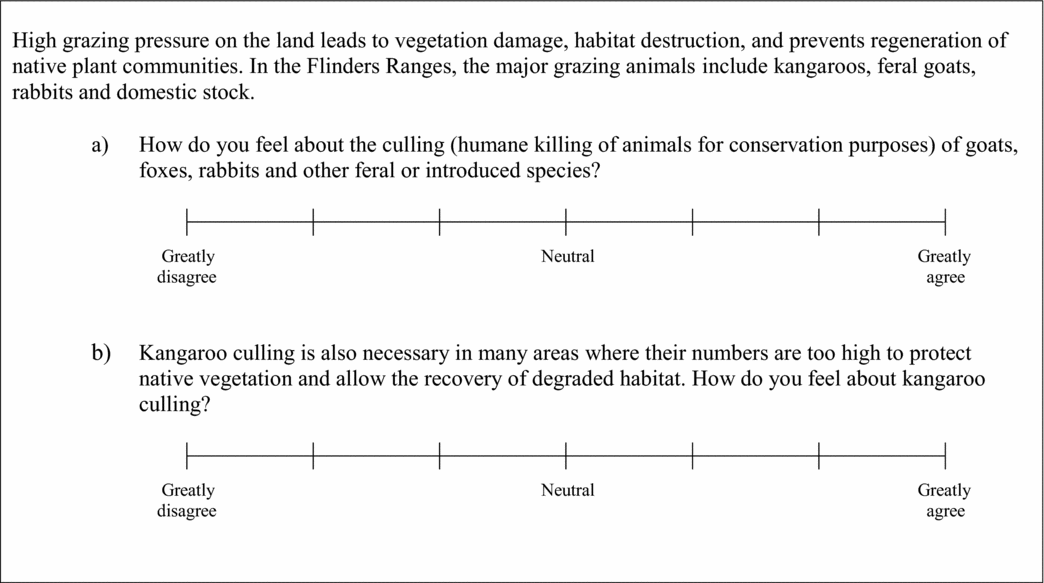
Within an experimental framework, two versions of the questionnaire were used to measure opinions of culling, with similar age and gender profiles recorded for each sample. Respondents to Survey 1 (S1, n = 464) were asked their level of support for native and non-native animal culling on a 7-point Likert scale from 1 (greatly disagree) to 7 (greatly agree) when no information about culling was supplied to them. In contrast, respondents to Survey 2 (S2, n = 325) were provided with information on the topic by means of a short text (Figure 2; designed in collaboration with National Park management). The mainly factual information provided was kept relatively basic with the intent to extend the study to a complete environmental education program at a later date. It was not the intent of park management to focus only on culling, but the aim was to explore the topic with tourists after a number of media reports drew attention to broader animal control measures throughout Australia.
Survey 2 (S2), the information provided concerning tourist opinions of animal culling.
In opinion surveys there can be a tendency for respondents to select what they deem are socially desirable response options (Smith, Reference Smith, Presser, Rothgeb and Couper2004). Considering the sensitive nature of the questions in this study, this may have played a part; however, this may be reduced by participant anonymity and the independence of the researcher from the government (the agency managing culling) and the pastoral and tourism industries. Other response problems associated with Likert scales may relate to the selection of extreme options or the tendency to select middle options. To address this, the questionnaire used verbal descriptions rather than numerical values, and a longer 7-point scale (not a 4- or 5-point scale). Studies have generally concurred these distinctions improve reliability and validity and may lead to greater variance, less score inflation, and less skewed data (Smith, Reference Smith, Presser, Rothgeb and Couper2004). Despite the inclination for respondents to choose middle options, an odd-point scale was considered appropriate as it enabled respondents the neutral middle point often chosen when addressing contentious issues (Ausubel & Tenzer, Reference Ausubel and Tenzer1970).
Sample
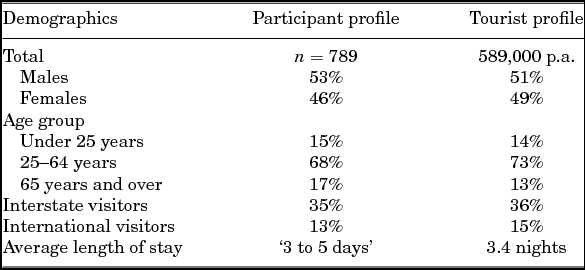
To reduce potential sampling error through non-coverage, data were collected from six sites within the Flinders Ranges including a combination of publicly managed national parks, privately run conservation reserves, and leasehold pastoral properties offering tourism experiences. These sites were located at Wilpena Pound, Arkaroola, Blinman, Parachilna, Leigh Creek and Lyndhurst. Participants were 789 tourists to the region; demographic data were compared to that of the tourist profile of the Flinders Ranges and matched reasonably, suggesting representativeness (Table 1).
Demographic Information of Respondents Compared to Typical Tourist Profile of Region
The response rate for the survey was 83%. There was a low outright refusal rate of 10% but a moderate number of invalid responses were also returned (whereby participants primarily completed only the demographic questions), which were further classified as refusals because they did not provide adequate information for analysis. The survey was not long; most respondents took 10 to 15 minutes to complete it, so the reason for the number of incomplete responses is unclear.
A range of nature-based tourism and ecotourism activities were popular (bushwalking, camping, bird watching, astronomy, four-wheel driving), with 62% strongly agreeing with the statement ‘I care a lot about conservation in the Flinders Ranges’ and 54% claiming to spend time learning about ways to help protect the environment. For many respondents, a high proportion of their experience was spent viewing nature, with 60% claiming to spend half or more of their leisure time specifically doing so (including more than 20% spending ‘most’ or ‘all’ of their time doing so). In total, 23% were aware of the local environmental program Operation Bounceback.
Results
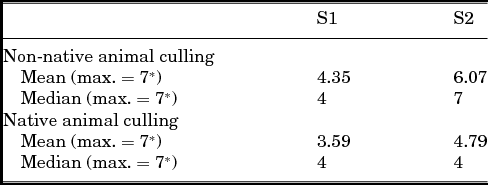
Data were analysed using SPSS Statistics. Respondents had higher levels of agreement with non-native animal culling (M = 4.92, SD = 1.95) than native animal culling (M = 3.97, SD = 1.51). A paired-samples t test revealed there was a significant difference in agreement levels between the two types of culling, t(694) = 16.01, p = .000, suggesting regardless of which questionnaire was completed, respondents’ degree of acceptance/non-acceptance differed significantly (with highest support for non-native culling). To highlight these results, the findings are presented separately for respondents of S1 and S2 (Table 2).
Agreement With Culling, S1 (No Information Provided) Compared S2 (Information Provided)
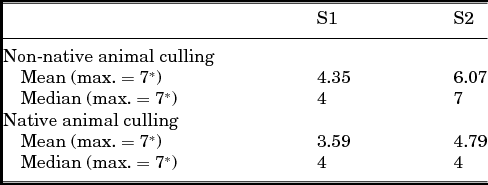
Note: *Where 1 = greatly disagree with culling, 4 = neutral, 7 = greatly agree with culling.
Average acceptance levels for both types of culling were highest among respondents who were given the information on culling when surveyed. Independent samples t-tests showed a significant difference between those completing S1 and S2 in their response to the level of support for non-native animal culling, t(749) = −14.34, p < .001, and native animal culling, t(693) = -9.67, p < .001. With the means for each questionnaire statistically different from each other, an experimental effect is indicated (Stuart & Ord, Reference Stuart and Ord1994), suggesting it is possible the information text (or lack thereof) influenced respondents’ agreement.
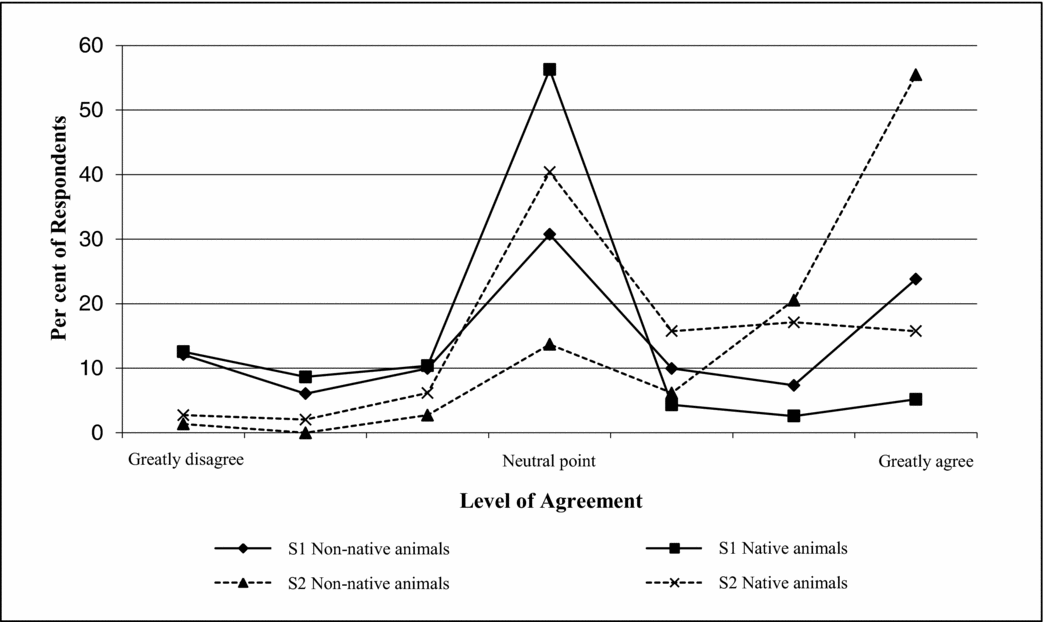
A large negative skew was evident for respondents of S2 (information provided) in their level of agreement with non-native culling (skewness = −1.294), emphasising the high proportion of respondents strongly agreeing with culling when provided with information (compared to S1, skewness = -.142). Although a similar pattern was also observed for native animal culling (with a negative skew for respondents of S2), this was to a lesser extent and remained within the bounds of normal (skewness = -1 to 1; Stuart & Ord, Reference Stuart and Ord1994). A clear central tendency range was evident for S1 native animal culling (more than 50% of respondents remained neutral; Figure 3). This may relate in part to the controversial nature of the topic and in part to the questionnaire design itself, or it may indicate that tourists are simply uncertain on the matter.
Respondents’ opinions on native and non-native animal culling, S1 (no information provided) compared S2 (information provided).
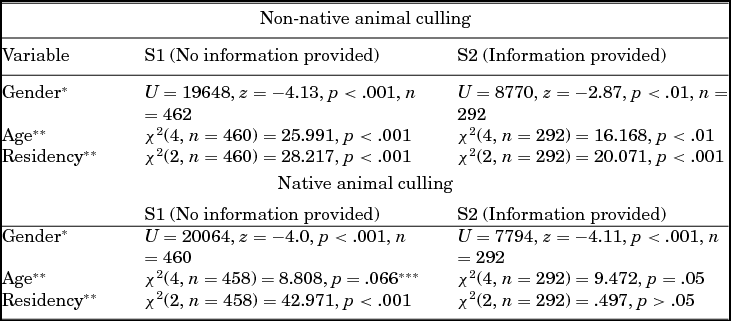
The mean levels of agreement were also compared for gender, age and residency, and tested for significant differences between variables (Table 3). A Mann-Whitney U test indicated that there was a significant difference between males and females in their degree of acceptance of culling, independent of which questionnaire was completed (with males on average more accepting of all culling). A Kruskal-Wallis test also revealed the existence of a significant difference between age groups of respondents and their acceptance levels (with respondents aged 25 years of age and under being less accepting than all other age groups). There was a significant difference between Australian and international tourists who were not provided the information text (S1) in their acceptance levels for both types of culling, but for respondents given the information (S2), there was no significant difference in acceptance levels of native animal culling based on place of residency.
Test Results for Demographic Variables, S1 Compared S2
Note: *Mann-Whitney U Test; **Kruskal-Wallis Test; ***Considered ‘marginal significance’ (p = .05 to .07).
Statistical analysis also revealed that respondents to S1 (no information provided) who claimed to spend ‘most’ or ‘all’ of their time viewing nature were less accepting of native animal culling than those spending ‘none’, ‘some’ or ‘half’ of their time doing so, χ2(2, n = 456) = 14.052, p < .01. In contrast, for those given the information (S2), there was no significant difference in acceptance levels based on viewing behaviour, χ2(2, n = 292) = 4.846, p > .05.
Discussion and Conclusions
Theoretical Implications
For the environmental philosopher, it is probably not surprising to see greater support for the culling of introduced species than native species. From an animal rights perspective, programs to cull any animals may be opposed as unethical, especially if shooters are considered inadequately trained; but the reader is reminded this study was aimed predominantly at examining opinions of a controversial management issue in a tourism setting, and subsequently it contributes to our understanding of the broader animal culling debate. If social acceptance is crucial for conservation to be sustainable (Belcher, Reference Belcher2001), this study adds new insight to the existing literature through a case study connecting aspects of environmental education, tourism, and animal management.
The significant difference in acceptance levels between native and non-native animal culling may relate to the degree of moral standing individuals extend to respective species (O’Neill, Holland, & Light, Reference O’Neill, Holland and Light2008). Certain species are sometimes perceived as ‘obligatory management species’ (Varner, Reference Varner1998) that require active management in the form of culling. Feral animals may be considered by many respondents to be in this category due to the damage they cause to native flora and fauna. On the other hand, kangaroos are native to Australia so the same reasoning is deemed less valid, simultaneously being viewed as ‘protected indigenous wildlife, [the] emblem of the nation, “pest” species, export product, and gourmet food’ (Thorne, Reference Thorne1998, p. 179). Indeed, some people will perceive kangaroos as obligatory management species for various reasons (e.g., to prevent greater suffering from starvation if overpopulated; to facilitate revegetation efforts; to reduce damage to pastoral land), but others may not look beyond the individual species unit to weigh up the costs and benefits to the entire community. Opinions may also be influenced by the characteristics of an animal species, with studies suggesting larger animals tend to elicit more emotions in wildlife tourism and more charismatic animals attract more conservation interest (Fuhrman & Ladewig, Reference Fuhrman and Ladewig2008; Knegtering, Hendrickx, van der Windt, & Schoot-Uiterkamp, Reference Knegtering, Hendrickx, van der Windt and Schoot-Uiterkamp2002).
Practical Applications
There were clear differences in opinion between those who received information and those who did not. The benefits of incorporating environmental information and conservation messages in tourism experiences have long been suggested (Orams, Reference Orams1996), stemming not only from the need for effective management in an industry needing to minimise human influence on ecosystems, but from the increased desire for tourists to engage with travel destinations (Ham & Weiler, Reference Ham and Weiler2007). This study suggests that controversial management issues may have a place in this engagement process, and there may not be the need for such caution when communicating with tourists about debated environmental practices. The large numbers of respondents who neither agreed nor disagreed with culling supports the idea that an environmental education program on culling is needed, especially in relation to native animals where more people are uncertain on the matter. It will be important, however, for the motivations behind any program to be understood and agreed on (Ernst, Reference Ernst2007); for example, whether the aim is to raise environmental awareness, for entertainment, to improve tourist satisfaction through learning and engagement opportunities, for greater public acceptance of government actions, or as ‘the mightiest weapon in the fight to preserve the environment’ (Pollak & MacNabb, Reference Pollak and MacNabb2000, p. 7).
Respondents to S1 (no information provided) spending higher proportions of their holiday viewing nature had lower average acceptance levels for native animal culling; these respondents may not look past the kangaroo species itself and consider their impact on the whole community. If a key part of tourism for many people is viewing natural attractions, and people visit the Flinders Ranges to see iconic wildlife such as kangaroos, it could be thought of as illogical to cull one of the main attractions. With some information or interpretive prompts, however, they may be reminded to contemplate the benefits of whole-of-ecosystem management (as suggested by S2 results). Indeed, in their evaluation of South Australian visitor centres, Pearce and Moscardo (Reference Pearce and Moscardo2007) reported that from some 1,150 tourists, over one third were ‘very interested’ in animal management. A practical implication could therefore relate to the value in promoting the interrelated nature of the ecological community of the Flinders Ranges when providing information on animal management to tourists, so the focus of their moral appraisal is not solely on individual species regardless of their impacts, but on whole ecosystem, with both nature-centred and human-centred concerns.
Environmental education has the ability to influence opinions (Tisdell & Wilson, Reference Tisdell and Wilson2005), but this study also revealed significant differences based on gender, age and residency. These variables add complexity when analysing environmental opinions, particularly residency, which is considered a proxy for diverse cultural differences (Peake, Innes, & Dyer, Reference Peake, Innes and Dyer2009), as although closely associated with environmental opinions, their explanatory power is weak (Diamontopoulos, Schlegelmilch, Sinkovics, & Bohlen, Reference Diamontopoulos, Schlegelmilch, Sinkovics and Bohlen2003). Nevertheless, the mean acceptance levels of culling were proportionally higher for both genders and all age groups for respondents of S2, indicating that although certain demographics may have different beliefs and opinions (e.g., females were on average less supportive of culling, as were younger respondents), environmental education may also have an explanatory role. A practical application of this finding might be to ensure strategies acknowledge tourists’ underpinning moral values as being central to environmental management while accepting that different segments are likely to also exist, based on demographic variables.
In the same way that the link between environmental opinions, demographic variables, and environmentally conscious consumption and actions can have important ramifications for the marketing strategies of companies, this link could have important ramifications for the marketing strategies of tourist destinations such as the Flinders Ranges (remembering the role educational dimensions play in tourist satisfaction). The recent land-use shift in the rangelands launched the development of an ethos of sustainability in a wider public context, and this study highlights the role tourism might play in the environmental education process of complex land management issues. Part of the solution to ensuring environmental objectives are met lies in communication and understanding (Ham & Weiler, Reference Ham and Weiler2007); as asserted by Croft (Reference Croft2000), ecotourism in particular will become increasingly significant in the rangelands as a financially profitable venture, and ecologically imperative to help set the stage for restoration. The education of tourists about animal management practices that aim to encourage the sustainability of the Flinders Ranges for future recreation, production and conservation uses could play a substantial role, and the study may offer appropriate contributions to the management of similar tourism settings where culling is undertaken.
Limitations and Recommendations
Detailed understanding of opinions of culling was limited by the survey design. Respondents were given the opportunity to provide feedback through an open-ended request for comments, but they were not specifically asked to put their views on culling into words. The vast majority of written comments related to tourism facilities and negative environmental impacts of tourism. It would be useful to understand how supportive tourists are of the extent and frequency of culling and the methods used; to determine, for example, if they are concerned about animal suffering or the safety of the public (where shooting is used). If we are to try to resolve our land-use problems, social studies cannot be separated from ecological studies, and an analysis from a qualitative approach would add a valuable contribution to the discussion by providing insight into underlying attitudes and moral values.
The study was also limited in numbers of international tourists. Further studies exploring the significance of cultural differences would be beneficial as the ways in which people are brought up to live in their society can greatly affect environmental opinions (Cater, Reference Cater2006). Additionally, Zeppel and Muloin (Reference Zeppel and Muloin2008) claimed few Australian wildlife sites use education strategies that recognise Aboriginal land management, so further studies could integrate Aboriginal interpretations to gain an understanding when spiritual, utilitarian and symbolic attitudes are all included. Research into tourist understanding of the science behind culling and other contentious management practices could also be undertaken to ensure messages are correctly understood and consequently more successful (Porter & Howard, Reference Porter and Howard2002).
One study is not capable of deciphering an ongoing debate encompassing ecological, social, ethical, political and economic arguments. It is also unrealistic to think that one study can demonstrate the influence of environmental education in an experimental design. There are fundamental challenges in trying to equate the information on culling provided to respondents with environmental education that might be delivered in a tourism experience, which is likely to have stronger interpretive elements and possibly a less captive audience. The study does, however, contribute to discussion concerning communication of a high priority land management issue in much of the rangelands of Australia, and highlights how addressing controversial issues is important particularly in today's highly mediated society.
Author Biography
Emily C Moskwa is a postdoctoral researcher with the School of Natural and Built Environments at the University of South Australia. Her recent research has focused on perceptions of biodiversity conservation in areas of high bushfire risk, and sustainability advocacy within a tourism context.