Introduction
Invasive plant species have been studied intensively because they make excellent models for understanding important evolutionary processes affecting species traits that appear to be fundamental to population and community ecology (Baker and Stebbins, Reference Baker and Stebbins1965; Mack, Reference Mack and White1985; Sakai et al., Reference Sakai, Allendorf, Holt, Lodge, Molofsky, With, Baughman, Cabin, Cohen, Ellstrand, McCauley, O'Neil, Parker, Thompson and Weller2001; Lee, Reference Lee2002; Sexton et al., Reference Sexton, McKay and Sala2002). The mechanisms by which an introduced species with no evolutionary history in a novel environment can establish, compete and reproduce successfully are sure to be a subset of common evolutionary tools. Processes that have a strong effect on invasion success include competition (Blossey and Notzold, Reference Blossey and Notzold1995), facilitation (Callaway and Walker, Reference Callaway and Walker1997), phenotypic plasticity (Bradshaw, Reference Bradshaw1965), chemical interactions (Callaway and Aschehoug, Reference Callaway and Aschehoug2000), genetic bottlenecks (Barrett and Kohn, Reference Barrett, Kohn, Falk and Holsinger1991; Meimberg et al., Reference Meimberg, Hammond, Jorgensen, Park, Gerlach, Rice and McKay2006), hybridization (Ellstrand and Schierenbeck, Reference Ellstrand and Schierenbeck2000), reproductive strategies (Leger and Rice, Reference Leger and Rice2003), maternal effects (Roach and Wulff, Reference Roach and Wulff1987) and seed dormancy (Meyer et al., Reference Meyer, Allen and Beckstead1997; Dyer, Reference Dyer2004). However, it has not been possible to identify a singular factor that governs invasibility in plants because many different factors may be contributory and they almost certainly interact (reviewed in Sakai et al., Reference Sakai, Allendorf, Holt, Lodge, Molofsky, With, Baughman, Cabin, Cohen, Ellstrand, McCauley, O'Neil, Parker, Thompson and Weller2001; Thompson et al., Reference Thompson, Hodgson, Grime and Burke2001; Lambrinos, Reference Lambrinos2004; Blumenthal, Reference Blumenthal2005).
A central question concerning plant invasions has been whether post-invasion adaptation to local conditions is common and necessary (Maron et al., Reference Maron, Vila, Bommarco, Elmendorf and Beardsley2004; Bossdorf et al., Reference Bossdorf, Auge, Lafuma, Rogers, Siemann and Prati2005) or whether invasive species are characterized by plastic responses that enable them to survive until local adaptation occurs (Rice and Mack, Reference Rice and Mack1991; Sexton et al., Reference Sexton, McKay and Sala2002; Dietz and Edwards, Reference Dietz and Edwards2006). Because locally adapted populations have been described in many non-native species, additional questions revolve around the time and conditions required for local selection to be effective (Bradshaw, Reference Bradshaw1965; Dietz and Edwards, Reference Dietz and Edwards2006). However, in many non-native species, particularly in highly self-compatible annuals, local genetic variation may be greatly restricted and phenotypic plasticity may play a primary role for successful establishment in new habitats (Baker and Stebbins, Reference Baker and Stebbins1965; Kawecki and Ebert, Reference Kawecki and Ebert2004). In highly seasonal habitats or those with highly variable resource availability, plasticity may be favoured over fixed traits (Volis et al., Reference Volis, Mendlinger and Ward2002; Dyer et al., Reference Dyer, Brown, Espeland, McKay, Meimberg and Rice2010) and local adaptation may be slow. However, it is also likely that successful invasive species possess a number of traits, both fixed and plastic, that facilitate the colonization process (Baker and Stebbins, Reference Baker and Stebbins1965; Kawecki and Ebert, Reference Kawecki and Ebert2004; Rice et al., Reference Rice, Gerlach, Dyer and McKay2013).
Successful invasion is predicated on propagule dispersal into suitable habitats and microsites (Levine, Reference Levine2000; Mack and Erneberg, Reference Mack and Erneberg2002). Therefore, seed traits should reveal important qualities of the invasive species and potential constraints to their invasiveness. Some traits should be highly conserved, such as maternal provisioning of seeds (Leishman et al., Reference Leishman, Wright, Moles, Westoby and Fenner2005; Rees, Reference Rees1994; Roach and Wulff, Reference Roach and Wulff1987), while other traits may vary with growing conditions, such as dormancy, total reproductive allocation, and seed number (Westoby, Reference Westoby1981; Stanton, Reference Stanton1984; Rees, Reference Rees1996). As with all plastic traits, the quality of the environment (e.g. growing conditions, length of the growing season) will influence the intensity of the response (Rice and Bazzaz, Reference Rice and Bazzaz1989; Alpert and Simms, Reference Alpert and Simms2002). As environmental conditions improve, because of increased resources, length of the growing season, or reduced competition, a parent plant should have additional internal resources available to allocate to reproduction and related processes (Chapin, Reference Chapin1980; Philippi, Reference Philippi1993). As a result, I predict that many seed traits, particularly those affecting dormancy, should exhibit plasticity correlated with the growing conditions experienced by the parent plant.
Seed trait plasticity in an introduced species is likely to be an integral element of successful establishment and eventual invasion success. Several studies have shown variation in germination rates among sibling seeds (e.g. Stanton, Reference Stanton1984; Venable, Reference Venable1985; Philippi, Reference Philippi1993), but little data have been reported on the relationship between this plasticity and a positive effect on invasion success. Here, I use Aegilops triuncialis L. (barb or barbed goatgrass) to address several hypotheses related to seed traits because this selfing annual grass produces full-sib, dimorphic seed pairs (caryopses) that are dispersed as a unit (see Materials and methods). The dimorphic seed pairs allow for the experimental separation of factors governing the regeneration and establishment process from those of survival and persistence in the new habitat. Specifically, the larger seed is never dormant, germinates and emerges quickly, and represents the primary annual cohort (Dyer, Reference Dyer2004). The smaller seed is half the mass of the larger seed, experiences induced dormancy, and represents a possible contribution to the soil seed bank. The strength of the induced dormancy of the small seed is variable and affected by a maternal component and by a sibling component (Dyer, Reference Dyer2004). The small seed is of greater ecological interest because its variable germination response is influenced by factors external to the seed such as the growing conditions experienced by the parent plant. Such trans-generational plasticity provides a mechanism for parent plants to produce seeds in response to a particular environment that may anticipate future growing conditions (Dyer et al., Reference Dyer, Brown, Espeland, McKay, Meimberg and Rice2010; Rice et al., Reference Rice, Gerlach, Dyer and McKay2013; Fenesi et al., Reference Fenesi, Dyer, Gered, Sandor and Ruprecht2014). For example, a longer, resource-rich growing season should result in large parent plants that can allocate more internal resources to reproduction. Greater investment could result in increases in mean and absolute seed mass and greater maternal control over germination (induced dormancy) in the subsequent growing season. Seasonal weather conditions can also interact in different ways with soil types and can change interspecific competition intensity (Rice et al., Reference Rice, Gerlach, Dyer and McKay2013).
From previous work with A. triuncialis, we know the strength of the maternal and sibling inhibition varies among populations and years suggesting germination plasticity related to environmental conditions (Dyer, Reference Dyer2007). Other studies reported very low genetic variation across the introduced range with only two or three genotypes distributed regionally in genetically uniform local populations (Meimberg et al., Reference Meimberg, Hammond, Jorgensen, Park, Gerlach, Rice and McKay2006, Reference Meimberg, Rice, Milan, Njoku and McKay2009, Reference Meimberg, Milan, Karatassiou, Espeland, McKay and Rice2010), yet populations showed strong adaptive phenotypic plastic responses to soil conditions (Rice et al., Reference Rice, Gerlach, Dyer and McKay2013). With such low regional genetic variation and significant phenotypic plasticity, we can conclude that local growing conditions (i.e., temperature, precipitation, soil type) very likely influence the growth response of the plant and therefore influence the germination responses from year to year.
In this study, I used 69 seed collections of A. triuncialis from 24 California populations across 13 years to examine the within- and among-population variation of the two seed types and the variation in germination responses of the small seed. I hypothesize: (1) that mass and germination patterns of small seeds from dimorphic seed pairs will show strong correlations to environmental variables, particularly those that correspond with resource availability and the length of the growing season; (2) as a potential contribution to the soil seed bank, small seeds should maintain viability under dry conditions for a longer period than the large seeds; and (3) soil characteristics will influence seed mass and germination patterns in different ways. Specifically, soils that provide greater resource availability will extend the length of the growing season resulting in greater inhibition of small seed germination.
By addressing these questions, I attempted to integrate the results from several studies to produce a more complete understanding of the mechanisms and variables influencing the success of A. triuncialis invasions in California. This understanding for A. triuncialis will also provide insights into the invasion behaviour of other annual plant species.
Materials and methods
Target species
Aegilops triuncialis L. is native to the Mediterranean Basin and an allotetraploid hybrid (2n = 28) of the diploids A. caudata and A. umbellulata, but with a far greater spatial distribution than either parent species (van Slageren, Reference van Slageren1994). Meimberg et al. (Reference Meimberg, Hammond, Jorgensen, Park, Gerlach, Rice and McKay2006) reported only two distinct genotypes in California, which probably represent two separate introductions (Gomola, Reference Gomola2014). The extreme genetic bottleneck belies a broad ecological tolerance because the two diploid progenitor species are among the most common species in the genus and possess the most common haplotypes (Meimberg et al., Reference Meimberg, Rice, Milan, Njoku and McKay2009).
Aegilops triuncialis was introduced to California about 1914 (Kennedy, Reference Kennedy1928) and established locally, but did not become a widespread nuisance in northern California for several decades (Peters et al., Reference Peters, Johnson and George1996). Gomola (Reference Gomola2014) studied herbarium specimens to conclude that the second introduction probably occurred about 1940. In the past three decades, A. triuncialis has spread rapidly, initially across northern California, but now is found as far south as San Diego county, east to Reno, Nevada, and north into southern Oregon. Of particular concern is the affinity of this species for harsh and low-productivity soils along roadsides and rangelands and, most notably, in serpentine-derived soils in low-elevation woodlands and grasslands. Meimberg et al. (Reference Meimberg, Milan, Karatassiou, Espeland, McKay and Rice2010) identified a third invasive lineage in California and determined that all three genetically uniform lineages showed higher reproductive fitness on serpentine compared with loamy soils.
Aegilops triuncialis is cleistogamous, as are many Eurasian annual grasses in California, with a selfing rate estimated at 97% (Pajkovic et al., Reference Pajkovic, Lappe, Barman, Parisod, Neuenschwander, Goudet, Alvarez, Guadagnuolo, Felber and Arrigo2014). The spike inflorescence produces 3–7 spikelets and the seeds (caryopses) remain in the spikelet after dispersal even though the spike may disarticulate. The lowest two spikelets typically contain dimorphic seed pairs; the upper spikelets including the terminal spikelet each contains a relatively small solo seed. The large seed of a pair is about twice the mass of the small seed (Dyer, Reference Dyer2007). After-ripened seeds do not show innate dormancy when removed from the spikelet, but the smaller seed of the pair (when in the spikelet) shows germination inhibition by both the maternal tissues of the spikelet (maternal effect) and by the presence of the larger full-sib seed (sibling effect) (Dyer, Reference Dyer2004). The large seed is never dormant even when in contact with the maternal tissues.
Dyer (Reference Dyer2004) reported that the maternal inhibition can be removed or reduced with serial washing of the spikelets and was therefore a chemical compound external to the seed coat. However, germination can also remain very low despite the serial washing procedure and this indicates year-to-year variation in the intensity of the maternal effect. Sibling inhibition can be eliminated by removing the large seed from the spikelet. Germination of the small seed can reach 100% while in the spikelet when both inhibitory factors are removed.
Collection sites
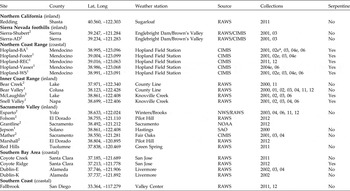
From 2000 to 2012, a total of 69 bulk collections of dry A. triuncialis spikes (May–July) from 24 populations were collected in California. The collection sites spanned a latitudinal range from San Diego County to Shasta County and longitudinally from the Coast Range mountains to the Sierra Nevada foothills (Table 1). Most of the populations were collected more than once, but none of the populations was collected in all years. As part of this long-term project, several collection sites were chosen based on the presence of low-fertility, serpentine (ultramafic) soils and within those sites seeds were collected from core (high intra-specific density) and edge populations (high inter-specific density) (see Rice et al., Reference Rice, Gerlach, Dyer and McKay2013). Seed production within populations varied across years. Seed mass was collected from every sample, but not all germination assessments were made for every year. Some populations in some years produced very few two-seeded spikelets or few spikelets with healthy large seeds, and in some years seed predation reduced seed availability.
Seed collection sites for Aegilops triuncialis from 2000 to 2012

Entire spikes were collected dry and stored as bulked samples at room temperature in dry conditions. Weather stations were the nearest to the sample site that reported appropriate data for the collection period (Western Regional Climate Center: http://www.wrcc.dri.edu and National Climate Data Center: http://www.ncdc.noaa.gov/). 1,2Superscript numbers indicate genotype according to Meimberg et al. (Reference Meimberg, Hammond, Jorgensen, Park, Gerlach, Rice and McKay2006); if no superscript, genotype was not assigned. *‘e’ after the year indicates that both core and edge populations were sampled. Weather station abbreviations: Remote Automatic Weather Station (RAWS), California Irrigation Management Information System (CIMIS), National Weather Service (NWS), National Oceanographic and Atmospheric Administration (NOAA), and Surface Airways Observation (SAO).
Environmental variables
I used precipitation and temperature records from the Western Regional Climate Center and National Climate Data Center for the weather stations nearest to the field sites (Table 1). The climate variables included: monthly precipitation for March, April and May; total precipitation from November to May; average daily temperature and average daily maximum temperature for March, April and May; and the Julian date of the first 27°C and 32°C mean daily temperature. I expected these variables to provide different, but related, measures of the length and quality of each growing season. Specifically, I predicted that lower temperatures and higher precipitation later in the spring would indicate longer growing seasons, and vice versa. Some field sites collected in the same year were sufficiently close to each other that the same weather data were used.
Seed development
Pre-senescent A. triuncialis plants from the Hopland Research and Extension Center (REC) population were harvested (by the Emilio Laca laboratory at University of California, Davis) prior to reproductive maturity and allowed to air dry. Estimates of seed maturity were made at the time of cutting as follows: when poked with a pin and squeezed, the seeds of individual plants were described as being in the ‘dough’ stage, ‘late dough’ stage, or ‘mature’ depending on the ease with which the endosperm could be expressed. After drying, 10 spikes of each stage were placed in Petri dishes and replicated eight times (n = 240 spikes), then wetted and allowed to germinate for 14 days. Germination was scored daily. Non-germinating seeds were counted after testing.
Seed mass
Seed pairs from 35–50 lower spikelets were weighed for each population and year (n = 69). Seed mass ratios, correlation coefficients, and slopes of the linear regressions between large and small seed mass were obtained. Coefficients of variation (CV) of seed mass were calculated for all populations and to compare serpentine and non-serpentine populations. Population CVs were also calculated for populations with ≥3 sample years.
Seed mass variation
To investigate the species-wide mass relationship between large and small seeds, I used the mean mass (±1SEM) and CV of small and large seeds from each population as data points in regressions using all of the sample populations.
Seed viability
Large and small seeds of A. triuncialis are not dormant (sensu Baskin and Baskin, Reference Baskin and Baskin2014) although small seeds show induced dormancy (Dyer, Reference Dyer2004) and therefore represent a different ecological role than large seeds. Large and small seeds from many populations (4–10 populations per year) were tested for viability from 2007 to 2012 to examine changes in germination with age. For example, 2006 seeds germinated in winter of 2007 were ‘on time’, but those germinated in 2008 were 1 year old and in 2012 were 5 years old. Seeds were placed on germination paper (Anchor Paper Company, MN, USA), wetted and kept at room temperature for 7 days. For each test, 50–75 large and small seeds were used in 3–5 replicates (depending on seed availability). Seeds were scored as ‘germinated’ only if both radicle and plumule were produced. The mean for a population was considered a single datum point. Some seed populations were used for more than one age test because field collections were not made in all years. All seeds used for these tests were stored under dry laboratory conditions and results are intended to reflect differences among seed types rather than seed viability under field conditions.
Genotype comparisons
Meimberg et al. (Reference Meimberg, Hammond, Jorgensen, Park, Gerlach, Rice and McKay2006) compared northern California populations to Eurasian populations of A. triuncialis and found evidence for only two genotypes in California. Genotype 1 dominates the foothills of the Coast Range to the west and was probably introduced about 1940 (Meimberg et al., Reference Meimberg, Hammond, Jorgensen, Park, Gerlach, Rice and McKay2006; Gomola, Reference Gomola2014). Genotype 2 dominates the eastern side of the state in the Sierra Nevada foothills and was introduced about 1914 (Kennedy, Reference Kennedy1928). There appears to be very little mixing of genotypes in California and also in Eurasia (Meimberg et al., Reference Meimberg, Hammond, Jorgensen, Park, Gerlach, Rice and McKay2006). Where possible, I separated populations by genotype (Table 1) according to Meimberg et al. (Reference Meimberg, Hammond, Jorgensen, Park, Gerlach, Rice and McKay2006) to make the same comparisons between seed types, germination variables, and environmental variables as described above for seed mass and germination. Statistical comparisons were made only when significant correlations had already been detected using the entire dataset. For these comparisons, the sample size was n = 38 for genotype 1, and n = 19 for genotype 2.
Inhibition of small seed germination
Two hundred lower spikelets (two-seeded) were removed for germination tests (see Dyer, Reference Dyer2004). Four treatments with 50 spikelets each were created: (1) seeds were soaked in deionized water for 18 hours, then air-dried, on four consecutive days to reduce the maternal chemical influence; (2) large seeds were removed to eliminate the sibling effect; (3) both washing and large seed removal were combined to reduce both inhibitors; and (4) neither treatment as a control for the natural levels of germination inhibition. Sample populations (n = 64) were planted in five replicates of 10 spikelets in seedling tubes (Stuewe and Sons, Corvallis, OR, USA), incubated in a Conviron environmental chamber at 20°C (12 h light) and 10°C (12 h dark). The soil was wetted daily with deionized water and emergence was monitored for 14 days. Spikelets that did not produce the expected number of seedlings were dissected to record whether non-germinated seeds were present and sample numbers were adjusted accordingly.
Dyer (Reference Dyer2007) reported that this process produced 100% emergence of large seeds for 12 populations, but significant maternal and sibling influences on the germination of small seeds during the initial wetting period. Emergence in a second wetting period, however, showed few treatment effects, which indicated that both influences were restricted to the initial germination period; the sibling effect was strong only in the presence of the ungerminated large seed and the maternal effect was removed by frequent watering during the initial germination period.
Environmental influences on seeds traits
To investigate the influence of environmental variables on the strength of germination suppression of the small seed, differential emergence values were calculated for the four treatments. For these tests, the mean value for each population was the sample mean (n = 69 sample populations). I used unwashed spikelets with the large seed present to establish control values for natural germination and suppression. The sibling effect was calculated as the difference in germination when the large seed was removed from washed spikelets (with the assumption that washing removed the maternal effect). The maternal effect was calculated as the difference in germination of small seeds in washed and unwashed spikelets in the absence of the large seed. The cumulative effect was measured as the difference in emergence between the control treatment and the combination treatment:

The use of four washes was consistent with the protocol established by Dyer (Reference Dyer2004). However, given the prediction that a longer growing season may elicit greater maternal germination suppression, for some years four washes may have been insufficient to remove the greater maternal influence (A.R. Dyer, unpublished observation). If true, in better years, the sibling effect may have been over-estimated because of residual maternal effects on the spikelets and the maternal effects may have been under-estimated. In those cases, removal of both effects did not result in 100% emergence of the small seeds.
Data analysis
To test for differences in seed traits between populations, genotypes and soils, I used one-tailed and two-tailed t-tests. The comparisons of seed mass among all populations were simple linear regressions. For these comparisons, P < 0.05 was considered significant. However, to test for influence of environmental variables on seed mass, genotypes, and measures of germination inhibition, I used a data screening function (JMP 9, SAS Corporation) to look for strong interactions. The screening procedure derives P-values for correlations from 10,000 Monte Carlo simulations of the Lenth t-ratio for main effects. For testing the influence of environmental variables on seed mass, I then ran protected ANOVA models using only significant environmental variables with correlations of P < 0.01. For germination variables, the ANOVA models included large or small seed mass as a covariate.
Results
Seed development
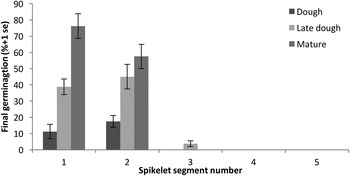
Seeds from non-senescent A. triuncialis were germinated in relation to their developmental age, but not their position on the spike (Fig. 1). A total of 843 seeds were germinated or extracted from 240 spikes. Seeds germinated almost exclusively from the first and second spikelets (n = 197 of 480 seeds), which are typically the two-seeded spikelets, only three of 238 seeds germinated from the third spikelet, and none of the 125 seeds germinated in the upper two spikelets. No spikelets produced two seedlings, suggesting that large seeds matured very rapidly in the developmental process, but small seeds follow a different developmental pathway.
Seed germination (% ± SEM) in spikelets of Aegilops triuncialis of differing maturity and according to spikelet position on the flowering spike. Dough, Late dough and Mature refer to the softness of the endosperm at the time of harvest. Spikelets were numbered from the base of the spike to the terminal spikelet. (Unpublished data from Emilio Laca, University of California, Davis.)

Seed mass
Seed size variation
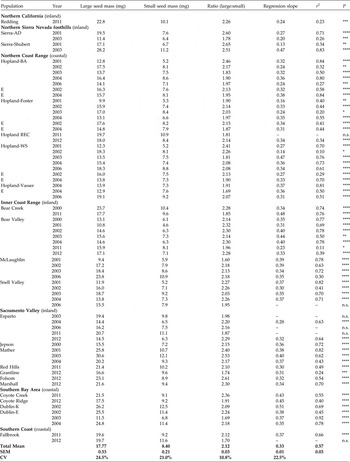
Large seeds had significantly greater mass than small seeds (P < 0.0001). Average mass of large seeds was 17.86 ± 0.52 mg (range 9.4–30.6) and of small seeds was 8.43 ± 0.21 mg (range 4.6–12.5) with a seed mass ratio of 2.12 ± 0.03 (range 1.59–2.61) (Table 2). CV was 24.5% for large seeds and 21.0% for small seeds across all samples (n = 69). Within the nine populations with ≥3 collections, mean CV was 20.7% for large seeds and 19.0% for small seeds. CV for the small seed to large seed mass ratio across all samples was 10.8%. These results suggest that (1) among-population variation in seed mass was high, (2) within-population variation in seed mass was lower, (3) average within-population variation was similar for both seed types, and (4) the ‘large’ and ‘small’ designation is not predicated on absolute seed mass, but on the size relationship between the seed pair which appears to be very stable across these populations.
Seed mass data for 68 samples from 24 populations collected in 2000–2012

All large and small seeds are from seed pairs from the lower spikelets on a flowering spike. ‘E’ before the 2002 and 2004 Hopland populations indicates an ‘edge’ population for comparison with the regular ‘core’ population found in serpentine soils. Statistical significance of large vs small seed mass regressions is indicated by asterisks: *P < 0.05, **P < 0.01, ***P < 0.001, ****P < 0.0001.
Influence of soil type
Mean seed mass of large seeds from populations on zonal soils (19.8 ± 0.84 mg, n = 30) was significantly greater (P < 0.01) than from serpentine soils (16.1 ± 0.50 mg, n = 34). Small seed mass on zonal soils (9.0 ± 0.36 mg) was significantly greater (P < 0.05) than from serpentine soils (7.9 ± 0.22). Seed mass ratio was greater (P < 0.01) on zonal soils (2.21 ± 0.04) than on serpentine soils (2.04 ± 0.03). Thus plants growing in non-serpentine soils produced 23% larger ‘large’ seeds and 14% larger ‘small’ seeds than those growing in serpentine soils. The decrease of 7% in the seed mass ratio between the two soil types indicates that small seeds in serpentine soil were relatively larger compared with the large seeds.
Differences between genotypes
When populations were compared by the putative genotypes (G1 and G2), large and small seed masses and their ratio for G1 (n = 38) were 15.5 ± 0.36 mg and 7.5 ± 0.19 mg and 2.07 ± 0.03, respectively, while seed masses and ratio for G2 (n = 19) were 20.3 ± 1.20 mg and 9.2 ± 0.44 mg and 2.21 ± 0.06, respectively. G2 large and small seeds were significantly larger than G1 seeds (32 and 33%, respectively; both P < 0.0001). These values reflect an influence of soil type because most of the G1 populations were collected on serpentine soil with two notable exceptions. In the Inner Coastal Range (inland), Bear Valley was G1 on non-serpentine soil and McLaughlin was G2 on serpentine soil. However, this difference may also reflect variation among the genotypes (see Discussion).
Seed mass covariation
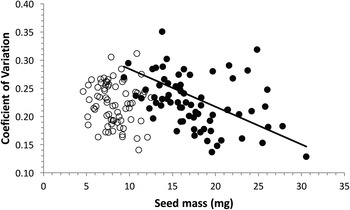
The relationship between large and small seed mass was significant in 63 of 69 sample populations. The mean slope for all samples was 0.33 ± 0.01 and mean r 2 was 0.57 ± 0.027 (Table 2). The means of the individual regression slopes did not differ between serpentine and non-serpentine populations or between genotypes. For the regression of each seed type against its CV, the relationship was only significant for large seeds (regression: P < 0.01), indicating that the variance in seed mass decreases as seed mass increases (Fig. 2). In comparison to the within-population variation for large and small seed mass (CV = 24.5 and 21.0%, respectively), the species-wide variation in large seed mass appears to be constrained as seed mass increases. However, small seed mass was significantly correlated with large seed mass in the majority of samples.
Coefficient of variation of mean seed mass of 50 dimorphic seed pairs from 24 Aegilops triuncialis populations collected from 2000 to 2012 (n = 69 samples) in California plotted against mean seed mass. Variance of large seeds decreased as mass increased (filled circles, mean = 0.23 ± 0.01, linear regression: P < 0.01); variance decreases as seed mass increases. Variance of small seeds did not change as mass increased (open circles, mean = 0.23 ± 0.01).

Influence of climate variables
From the data screening procedure, the mass of large seeds was positively correlated with April precipitation (P < 0.01) and May precipitation (P < 0.002). Small seed mass was positively correlated with May precipitation (P < 0.002), but negatively correlated with total precipitation (P < 0.01). None of the temperature variables yielded strong correlations with seed mass.
On serpentine soils, mass of large seeds was positively correlated with May precipitation (P < 0.002). Small seed mass was negatively correlated with May maximum temperature (P < 0.003).
When seed mass was examined by the putative genotype of the population, large and small seed mass for G1 appeared strongly influenced by environmental variables. Large seed mass was negatively correlated with March average temperature (P < 0.002) and May maximum temperature (P < 0.02). Small seed mass was negatively correlated with maximum temperatures in May (P < 0.0001). G1 populations were typical of serpentine habitats in these samples. In contrast, large and small seed mass of G2 populations (typical of zonal soils) did not show strong correlations with environmental variables.
Although the results were somewhat mixed, the masses of the two seed types appear positively affected by variables that lengthen the growing season although the genetic make-up of the population must be considered. High maximum temperatures, especially early in the season, are interpreted as being indicative of harsher growing conditions leading to shorter growing seasons.
Long-term seed viability
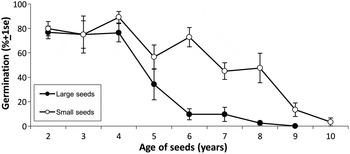
Viability of large seeds decreased quickly after 4 years to nearly zero by the seventh year (Fig. 3), while small seed viability decreased but remained significantly higher into the sixth and seventh years. The CV for large seed germination rose from about 10% in the first three years to 37% in the fifth year and nearly 50% in the sixth year, indicating increasing difference among populations in seed viability (data not shown). The CV for small seed germination was ≤20% until the eighth year.
Germination (% ± 1SEM) of large and small seeds of Aegilops triuncialis after storage under dry laboratory conditions. The x-axis indicates the number of years since the expected germination year, which was the first growing season after production. Sample points represent 50–75 large and small seeds (3–5 replicates depending on seed availability) from 4–10 populations placed on wetted germination paper and observed for radicle and plumule development for 7 days.

Seed germination
Seed mass vs strength of sibling effect
The different measures of germination inhibition of the small seed were not significantly correlated with the mass of the small seed. However, the control inhibition (P < 0.003, r = –0.30) of the small seed germination was negatively correlated and maternal inhibition (P < 0.006, r = 0.26) was positively correlated with the mass of the large seed.
Influence of climate variables
Measures of control germination inhibition were correlated with March maximum temperature (P < 0.002) and May maximum temperature (P < 0.003). Inhibition by the large seed (sibling effect) and inhibition by the maternal effect were not strongly correlated with any environmental variables, nor was the cumulative inhibition (sibling and maternal effects combined).
The influence of environment on germination within each genotype also varied. Mean March temperature was positively correlated with control germination in both G1 (P < 0.005) and G2 (P < 0.05), suggesting that early high temperatures influenced small seed sensitivity to inhibitory factors. Sibling and maternal influences on germination patterns in G1 or G2 were not strongly influenced by any environmental variables. Cumulative inhibition was positively correlated with March average temperature in G2 (P < 0.005) and maximum May temperatures (P < 0.005).
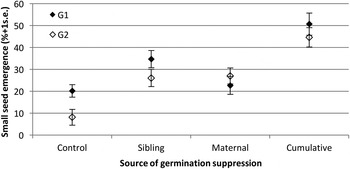
The strength of inhibition of germination of the small seed was correlated with seed size: germination inhibition of the G2 small seeds (9.2 ± 0.40 mg) was significantly lower than G1 small seeds (7.4 ± 0.19 mg) for the control treatment (P < 0.03, one-way ANOVA, small seed mass as covariate) and for the sibling effect (P < 0.02), but there were no differences between genotypes for the measures of maternal effect or cumulative inhibition (Fig. 4).
Effect of germination inhibitors and their removal on the germination (% ± 1SEM) of the small seed of Aegilops triuncialis. Control and sibling effects were significantly different (both P < 0.02, one-way ANOVA with seed mass as covariate) between G1 (n = 38) and G2 (n = 19) (from Meimberg et al. Reference Meimberg, Hammond, Jorgensen, Park, Gerlach, Rice and McKay2006), but not for the maternal or cumulative effects (P > 0.05). G1 was collected mainly from serpentine soil locations.

Influence of soil type
Across all populations and years, maternal and sibling inhibition of small seed germination was not different between serpentine and zonal soils (P > 0.05 for all measures).
Discussion
To improve our understanding of invasive plant species and invasiveness, it is essential that we understand seed ecology because of the central role of seed dispersal and recruitment in the spread of plant populations (Lockwood et al., Reference Lockwood, Cassey and Blackburn2005; Rice et al., Reference Rice, Gerlach, Dyer and McKay2013). Aegilops triuncialis has been a useful model species for studying invasions because of its recent rapid spread in northern California (Peters et al., Reference Peters, Johnson and George1996), clear evidence of phenotypic and adaptive trans-generational plasticity (Dyer et al., Reference Dyer, Brown, Espeland, McKay, Meimberg and Rice2010), very low genetic differentiation across large and small scales (Meimberg et al., Reference Meimberg, Hammond, Jorgensen, Park, Gerlach, Rice and McKay2006; Rice et al., Reference Rice, Gerlach, Dyer and McKay2013), and the presence of dimorphic seed pairs with differing germination patterns (Dyer, Reference Dyer2004). In this study, I asked specific questions concerning seed traits, and broader questions related to invasiveness because of our ability to test the importance of both genetic and environmental influences on seed traits.
Although neither the large nor small seed type is inherently dormant (sensu Baskin and Baskin, Reference Baskin and Baskin2014), the smaller seed in a pair is sensitive to biotic and abiotic factors and forms a short-lived seed bank. A number of environmental variables can influence germination patterns (e.g. soils, precipitation, temperature) by having an influence on the maternal plant. Also, the strength of such influences is very likely to be mediated by the masses of the large and the small seed, which are highly correlated. This set of interactions has the potential to create a wide range of possible responses to changing environmental conditions. For example, if trans-generational plasticity (TGP) is a common and variable trait, different populations may express a range of responses to abiotic conditions and these responses may appear to be genetically based adaptations. Such responses may provide invasive species a greater opportunity to establish and spread quickly in new habitats (Dyer et al., Reference Dyer, Brown, Espeland, McKay, Meimberg and Rice2010). When such rapid adjustments are coupled with traits such as the viability of large seeds at very early phenological stages (Fig. 1), management techniques such as mowing or grazing are unlikely to be effective controls on population growth. Very little is known concerning the development of the small seed with respect to the large seed and what developmental factors govern the later responsiveness of the small seed to germination cues.
In this study, seed mass varied across soil types, among genotypes, across populations and across years. However, while a threefold variation in mass was seen in both seed types across the geographic range of invasion, the coefficient of variation was 20–25%, suggesting that whilst seed mass may be influenced by the particular growing environment, it is relatively constrained within the populations and across the species. I found a very strong effect of soil type (serpentine vs non-serpentine) on seed mass, but this response was probably confounded by genotypes because serpentine populations were almost exclusively G1. Whether there is a genotype by soil interaction such that G1 is more successful on serpentine soils is unknown. However, Gomola (Reference Gomola2014) reported that the G1 genotype, which dominates in the western part of California, may be the result of a later introduction than the G2 genotype which is largely restricted to the eastern range (see also Meimberg et al., Reference Meimberg, Hammond, Jorgensen, Park, Gerlach, Rice and McKay2006). The G1 genotype also produced greater biomass and more seeds per plant. However, many of the populations used in the current study were not identified to genotype.
Information regarding habitat preferences of different genotypes would be valuable because A. triuncialis is the first non-native annual grass in California to actively invade serpentine soils, which are home to many endemic and native species (Kruckeberg, Reference Kruckeberg2004; Harrison et al., Reference Harrison, Grace, Davis, Safford and Viers2006). For example, if seeds of differing mass or genotype were dispersed across regional soil gradients and in different years, would rates of invasion increase? In this study, I found that germination inhibition of the small seed is correlated with seed mass, and Rice et al. (Reference Rice, Gerlach, Dyer and McKay2013) found consistent shifts towards greater seed mass in peripheral habitats for three different A. triuncialis populations.
In addition to soil, I found that climate variables, particularly rainfall and temperature, were associated with variation in seed mass. Large seed mass was positively correlated with environmental variables indicative of a longer growing season (e.g. late season precipitation which is also correlated with lower early-season temperature) and negatively correlated with variables that indicate a shorter growing season (e.g. higher April maximum temperature which indicates lower rainfall). Thus, seasonal variation appears to affect basic seed traits such as mass, and mass is correlated with differences in germination behaviour. The relationships between seed mass and environmental variables are likely to be significant regarding habitat preferences and invasive ability. Indeed, Skaer Thomason and Rice (Reference Skaer Thomason and Rice2017) investigated the mechanisms by which A. triuncialis spreads and reported that reproductive output increased in intra-specific aggregations under certain climate-change scenarios. This suggests that A. triuncialis may be a poor inter-specific competitor, but opportunistic under more variable environmental conditions.
Despite the differences among populations and genotypes with regard to absolute seed mass, the proportional difference between large and small seed was remarkably consistent across the range of seed mass (mean slope = 0.33 ± 0.01). The decrease in variation around the mean mass as the large seed mass increased suggested a constraint on absolute seed size (Fig. 2). For small seeds, seed mass variation was similar to that of large seeds, but did not decrease as mass increased. Thus, if the germinable fraction of small seeds is dependent on the mass of the large seed and large seed mass tends to be less variable as it increases, these results suggest that the response of small seeds may be more plastic when seed mass is low. This suggests that small seed germination plasticity will be high in years following poor growing conditions.
Lastly, the long-term viability of the small seeds is potentially greater than for large seeds and this also has implications for management in areas where this species is invading and spreading. Most annual grasses in California produce one-seeded dispersal units that germinate easily and have very low seed bank carryover from one year to the next (Bartolome, Reference Bartolome1979; Russi et al., Reference Russi, Cocks and Roberts1992). Aegilops triuncialis, with a second smaller and variably dormant seed, is able to produce a short-lived seed bank that requires repeated management efforts for population control (DiTomaso et al., Reference DiTomaso, Heise, Keyser, Merenlender and Keiffer2001; but see Marty et al., Reference Marty, Sweet and Buck-Diaz2015). If seeds remain viable in the soil for multiple years, control of this species becomes highly problematic because a single propagule from a cleistogamous species is capable of re-establishing a population. A recent study to address long-term viability under field conditions showed that seeds remained viable after 3 years at 1 cm depth, but were depleted or lost at the soil surface and at 10 cm depth (Dawn Lawson, unpublished data). This population may have been unusual (coastal San Diego County) in terms of soil and climate, but shallow burial in typically xeric serpentine soils may facilitate seed bank formation.
Environmental influences
All invasive species will possess some relatively fixed traits that are characteristic of the species and will have much less genetic variation as a consequence of the smaller initial population size. Most research agrees with predictions that generalist invasive species should exhibit a relatively high level of phenotypic plasticity, but that reduced genetic variation may restrict plastic responses (Dietz and Edwards, Reference Dietz and Edwards2006; Dyer et al., Reference Dyer, Hardison and Rice2012) until additional genetic variation has developed in situ (e.g. Lambrinos, Reference Lambrinos2001). The expression of plasticity will be highly dependent on many factors in the local environment that influence growth and reproduction. For some colonizing species, rapid germination (and therefore, site priority) should be a favoured response, and plasticity may play a small role in germination. However, colonizing species adapted to habitats with relatively unpredictable intensity and duration of resource pulses may exhibit more conservative response strategies including stronger dependence on germination cueing and seed bank formation (Rice, Reference Rice1985). Regardless, the interaction between environmental variables and seeds will very likely play a central role in plant invasions.
These germination tests on 24 A. triuncialis populations collected one to seven times over 13 years provide a better understanding of the factors influencing the inhibition of germination of the small seed. The predictions were based on two premises concerning the maternal effect and the sibling effect on germination of small seeds. First, the maternal effect is a mechanism that ensures a seed bank in moderately to highly unpredictable environments. The strength of maternal effects should be positively correlated with the resources available to the maternal plant. That is, the better the growing conditions experienced by the maternal plant, the stronger the inhibitory effects on the seeds produced in that year (Philippi, Reference Philippi1993; Clauss and Venable, Reference Clauss and Venable2000). One assumption is that a healthier plant will have more carbon to allocate to biochemical processes associated with seed production across a longer growing season. Second, within two-seeded dispersal units, the sibling effect reduces the negative effects of competition with a closely related individual. The sibling effect should be associated with seed mass as the larger seed produces a stronger biochemical signal to suppress the germination of the smaller seed. However, as mentioned above, seed mass of the two seeds is highly correlated and nothing is known of the interaction between the inhibitory signal of the large seed and the mass and maturity of the small seed. We assume as the mass of the large seed increases, the larger, more competitive, and successful the resulting seedling will be. Because the two seeds are genetically identical in A. triuncialis, suppression of the small seed reduces sibling competition and potentially increases the fitness of the maternal line.
Although the maternal and sibling inhibition effect on small seed germination has been shown in previous studies, the link between the strength of those effects and environmental variables is unknown. To understand the ability of this species to invade, aggressively and widely, in California grasslands and woodlands, a better understanding of the relationships between the variation in environmental factors and seed characteristics governing germination responses is needed. If some species are capable of modifying seed traits in response to environmental cues, particularly via trans-generational plasticity, then predicting post-invasion spread becomes highly problematic.
For A. triuncialis, the inhibition of small seeds acts as a bet-hedging strategy (sensu Cohen, Reference Cohen1967; Venable, Reference Venable1985) and for avoiding high intra- and inter-specific competition in the season following high quality growing conditions. However, after a poor growing season (short or with low resource availability), germination fractions of small seeds could be higher because maternal plants were unable to produce germination-inhibiting compounds. This response would not necessarily be part of an evolutionary strategy for higher germination in seasons when interspecific competition is likely to be reduced. Maternal control over germination should be greater only when the maternal plant is able to allocate more resources to reproductive processes. This prediction for A. triuncialis corresponds with reports for other Aegilops species (Datta et al., Reference Datta, Gutterman and Evenari1972; Wurzburger and Koller, Reference Wurzburger and Koller1976).
An important component controlling the strength of germination inhibition may be the length of time the maternal tissues are biologically active. Wurzburger and Koller (Reference Wurzburger and Koller1973) found that the inhibitory effects increased in desert populations of A. kotschyi the longer the seeds were together. This suggests that extended growing seasons should be strongly correlated with the production of chemical inhibitors. Philippi (Reference Philippi1993), in southwestern USA, studied the annual legume, Lepidium lasiocarpum, and found that increased precipitation resulted in increased dormancy and that larger maternal plants produced a larger dormant seed fraction. These studies using annual species in arid/semi-arid ecosystems provide support for the prediction that the strength of maternal control over subsequent germination is directly related to gestation time of the seed.
The strengthening of germination inhibiting effects with longer growing conditions has important implications for understanding A. triuncialis invasions. In the dimorphic seed pair, large seeds germinate faster than small seeds and produce larger seedlings. Ecologically, the advantage of greater size during the establishment phase is well documented (Ross and Harper, Reference Ross and Harper1972; Stratton, Reference Stratton1989) perhaps because of associated effects on competitive ability and growth rates (Turnbull et al., Reference Turnbull, Coomes, Hector and Rees2004). As mean size of the seeds in the seed bank increases, concomitant effects on competitive ability and growth rate are predicted to increase seedling survival and fitness (Leishman, Reference Leishman2001). Therefore, in good years, the production of larger seeds of both types will influence the potential success of offspring in the next season (via the large seed) as well as re-establishment after environmentally mediated population losses (via the small seed). Maternal effects on seed size could contribute to population expansion especially in years after better-than-average growing conditions when mean competitive ability is increased. This would be particularly true in competition with species that follow a different reproductive strategy in response to favourable growing conditions such as increased per capita seed production rather than increased individual seed mass.
In contrast to the advantages that accrue from increased seed mass, our data suggest that smaller seed mass, resulting from sub-optimal growing conditions, could result in greater potential for the expression of phenotypic plasticity. If seed mass is a conserved trait and there are genetic constraints on maximum seed mass, then growing seasons that result in the production of smaller seeds will also produce a relatively wider range of seed masses. If so, then plants invading new habitats, but experiencing sub-optimal growing conditions, could produce a greater variety of seed morphologies and thereby increase the potential for establishment in the invaded habitat.
From these long-term seed data for A. triuncialis, we can confirm that the traits characterizing invasive species are far from simple, that interactions with the environment can produce a range of phenotypic responses, and that these adaptive responses create a complex picture of the abilities of an invasive species. Recent studies contrast the management difficulties with A. triuncialis: DiTomaso et al. (Reference DiTomaso, Heise, Keyser, Merenlender and Keiffer2001) found that sequential prescribed burns across several pastures were highly effective at reducing abundance in California coastal foothills whilst Marty et al. (Reference Marty, Sweet and Buck-Diaz2015) reported that a single burn reduced abundance for several years in a California valley grassland. Attempts to control A. triuncialis may have to account for this environmental and response variation because the effectiveness of control measures may depend on the quality of the seed produced in the previous year.
Overall, the functional interactions between environmental conditions and seed mass, seed longevity and germination response present an evolutionary strategy for invasive plants in both mesic and xeric environments (Westoby et al., Reference Westoby, Jurado and Leishman1992). Environmental fluctuations that favour larger seed mass and that promote variable germination strategies will increase plant fitness and should favour establishment and spread in invasive species. Seasonal environmental variation, such as that predicted under climate change models, creates an important context within which variable germination cueing, typified by induced dormancy (Philippi, Reference Philippi1993), and seed strategies, such as heteromorphism, are differentially successful (Venable, Reference Venable1985). For invasive species spreading across habitat boundaries, we should expect to find both complex behaviours that are modified by the environment and context-dependent trait expression, which is probably linked to epigenetic modification (Dyer et al., Reference Dyer, Brown, Espeland, McKay, Meimberg and Rice2010; Richards et al., Reference Richards, Schrey and Pigliucci2012). Our understanding of the mechanisms influencing invasions must extend beyond an examination of the current regeneration phase and consider the maternal conditions of the previous generation and the responses across multiple generations of different populations to fully appreciate the range of trait expression of these species.
Acknowledgement
Thanks to Kevin Rice, Dawn Lawson, Jaymee Marty, John Gerlach, Eric Knapp, Deborah Peterson, Ramona Robison, James Quenelle, Karen Cotter, Denali Beard, and the Big Science Lab for sample collections. Thanks to Amanda Jones, Tyler Shealy, Jennifer Owens, Stephanie Strawbridge, Jesse Baxley, Ricardo Garza, Victoria Meyer, Ahmad Garrett, Ashton Hamilton, Brad Miano, Breann Staubs, Deanna Dubose, Chris Perry, Shari Bookert, Lauren Ray, Kevin Pope, Alan Teuton, Twaneisha Gee, Tiffany Mack, Schuron Washington, Chauncey Gary, Katelya DuPont, Julie Zachary, Autumn Dunn, Maria Harvey, Clarice Mitchell, Walter Weaver, Monica Williams, Irvin Scott, Erin Scott, Richie Tyner and Grace Leysath for extracting, weighing and testing seeds. Thanks to the Emilio Laca Laboratory at University of California, Davis for germination data in Fig. 1.