

Introduction
Indigenous chicken (IC) production is an important activity in most parts of Africa (Kitalyi, Reference Kitalyi1998; Birol and Asare-Marfo, Reference Birol and Asare-Marfo2008). Despite several challenges, IC rearing fulfils a number of monetary and non-monetary functions. These are consumption, income generation, cultural ceremonies, pest control and manure among others (Muchadeyi et al., Reference Muchadeyi, Sibanda, Kusina, Kusina and Makuza2004; Mtileni et al., Reference Mtileni, Muchadeyi, Maiwashe, Phitsane, Halimani, Chimonyo and Dzama2009). ICs require minimal investment from the keepers, their productivity proves easy to improve in a rural setting (von Dach, Sommer and Wenger, Reference von Dach, Sommer and Wenger2007). They also provide pathways out of poverty to the disadvantaged groups (Randolph et al., Reference Randolph, Schelling, Grace, Nicholson, Leroy, Cole, Demment, Omore, Zinsstag and Ruel2007; Gueye, Reference Gueye2009; Pica-Ciamarra, Reference Pica-Ciamarra2009). IC farming as a source of income in this respect is promising. Despite the introduction of exotic breeds and lines, ICs are still the most abundant in developing countries (Gueye, Reference Gueye2002). In Kenya, they account for over 70 percent of the total poultry population (Kaudia and Kitalyi, Reference Kaudia and Kitalyi2002; Olwande et al., Reference Olwande, Ogara, Okuthe, Muchemi, Okoth, Odindo and Adhiambo2010).
The dominant production systems in many parts of developing countries, especially in the rural areas of Africa, are mainly subsistence based, where some of the world's surviving farm animal genetic resources are found (CBD, 1992; Drucker and Anderson, Reference Drucker and Anderson2004). The IC production systems are normally characterized by the levels of inputs and various outputs. These include the free range (FR) or scavenging system, the semi-scavenging or semi-intensive system and the confined system (CS) or full ration system (Kitalyi, Reference Kitalyi1998; Tadelle, Kijora and Peters, Reference Tadelle, Kijora and Peters2003a; Maphosa et al., Reference Maphosa, Kusina, Kusina, Makuza and Sibanda2004). The ICs possess unique adaptive traits such as disease and stress tolerance, ability to scavenge for food and escape predators that permit them to survive and reproduce under harsh climatic, nutritional and management conditions typically associated with low-input–output production systems (Mwacharo, Jianlin and Amano, Reference Mwacharo, Jianlin and Amano2006; Dana et al., Reference Dana, van der Waaij, Dessie and van Arendonk2010). The low productivity of IC has therefore resulted in attempts to improve them in the past. Attempts to upgrade IC with exotic breeds contribute to the loss of genetic diversity and present IC with extinction risks despite their number.
Kenya, in particular, has had many poultry improvement programmes such as the cockerel and pullet exchange, which targeted the upgrading of IC (Kamau, Reference Kamau, Jabbar, Peden, Mohamed Saleem and Li Pun2000). Even though many positive aspects were highlighted by the proponents of these programmes, they failed to take into account several major concerns. These include consideration of the farmers' preferences, conservation of the existing genetic resources, adaptability of the introduced breeds and survival of subsequent upgraded generations in the low-input systems. Selection and breeding errors may take many years to be identified and even then corrections are difficult (Pease, Reference Pease1990). Therefore, the aforementioned factors need to be considered before any improvement programme is put in place in the future.
This paper is motivated by the fact that farmers want an IC genetic resource that is well adapted to their local conditions while meeting their economic and social requirements. The starting point is then to look at the farmers' preferences based on the non-market traits and using them for selection and breeding to combine all the specified characteristics suggested by the farmers. Breeding is the most important component of the management, utilization and development of animal genetic resources. Breeding and better management practices may lead to profitability of improved genetics at farm level. Such economic improvement especially on smallholder IC farms may add up to welfare gains and improved food security at the national level. Breeding per se has always been influenced by the current biological, genetic, technological and statistical knowledge (Hoffman and Scherf, Reference Hoffman, Scherf and Mcleod2006). It also plays an important role in genetic resource conservation. Hence, it is important to understand livestock keepers’ perceptions and attitudes (Zander, Drucker and Holm-Müller, Reference Zander, Drucker and Holm-Müller2009). However, since we do not know what will be valuable in future, conservation of maximum diversity is necessary since it maximizes the probability that the conserved genetic resources contain a desirable extreme for the unknown quality (Woolliams and Toro, Reference Woolliams, Toro and Oldenbroek2007). Therefore, breeders are constantly faced with the continuous challenges of improving IC.
To estimate farmers' preferences, several approaches have been used to attain an approximate value of animal genetic resources. Stated preference methods have been applied to evaluate, measure or estimate non-market attributes such as conjoint analysis (Sy et al., Reference Sy, Faminow, Johnson and Crow1997; Tano et al., Reference Tano, Kamuanga, Faminow and Swallow2003; Makokha et al., Reference Makokha, Karugia, Staal and Oluoch-Kosura2007), choice experiments (Scarpa et al., Reference Scarpa, Ruto, Kristjanson, Radeny, Drucker and Rege2003; Nielsen and Amer, Reference Nielsen and Amer2007; Ouma, Abdulai and Drucker, Reference Ouma, Abdulai and Drucker2007; Omondi et al., Reference Omondi, Baltenweck, Drucker, Obare and Zander2008; Roessler et al., Reference Roessler, Drucker, Scarpa, Markemann, Lemke, Thuy and Valle Zárate2008; Ruto et al., Reference Ruto, Garrod and Scarpa2008; Zander and Drucker, Reference Zander and Drucker2008; Girma, Awudu and Clemens, Reference Girma, Awudu and Clemens2009; Zander, Drucker and Holm-Müller, Reference Zander, Drucker and Holm-Müller2009) and the contingent valuation method (Kamuanga et al., Reference Kamuanga, Swallow, Sigué and Bauer2001) among others. Moreover, Nielsen and Amer (Reference Nielsen and Amer2007) identified that the application of choice experiment methods may increase farmer acceptance of breeding objectives. The objective of our study was to estimate the farmers' preferences based on the non-market traits in selection, breeding and conservation of ICs. To achieve this, we utilized the conjoint analysis. Conjoint analysis enables the measurement of farmer preferences or ratings of existing or possible profile attributes in terms of the attribute or trait itself and its level. The purpose of conducting a conjoint experiment is to ascertain the relative importance of IC traits, as well as their most preferred levels. This method is also used to determine the most preferred combination of attributes for each production system and is based on the farmers’ reasons for keeping IC.
Materials and Methods
The study area and sampling design
The study was conducted in the four selected counties of Kenya. These included Kakamega, Siaya, Bomet and Narok. The sampling frame for this study included all the households in the selected regions. A total of 450 respondents were interviewed during the survey that started in October 2009 and ended in February 2010. The survey also collected information from the markets and consumers in the areas visited.
Selection of attributes and levels of IC
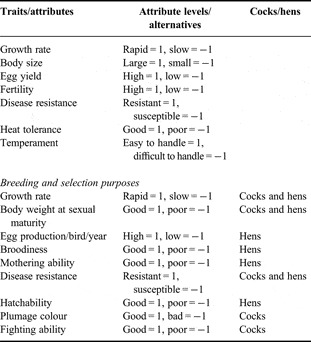
A list of attributes of the IC and their levels were developed based on the discussions with key informants and groups of researchers in the field of animal breeding and economics. The field questionnaires were then developed with the list of attributes and levels, including socio-economic information required from the farmers. It was then applied in a pilot study in Nakuru County as interviews with individuals and groups of farmers. This was followed by a survey in 2007. At this stage, some of the attributes not considered by farmers as useful were identified and subsequently removed. This significantly reduced the number of attributes to be evaluated by the respondents in the main survey. The IC types that were common in most parts of the study areas were the normal feathered, naked neck, feathered shanks, giant, crested head, dwarf sized and frizzle-feathered. Selection of the traits for profile rating choice experiment was achieved through pair-wise ranking from a total of 14 traits given the variation of the ICs. This was done at two levels: (i) traits perceived as most important by farmers and (ii) traits considered important for selection and breeding for both cocks and hens (details are given in the Experimental design section). The attribute and their levels were made as simple as possible and realistic for the final choice experiment survey. Following Louviere, Hensher and Swait (Reference Louviere, Hensher and Swait2000), the attribute's levels for this study were effect-coded. Table 1 shows the attributes and levels of IC traits perceived as most important and those considered by farmers for breeding and selection purposes.
Attributes and levels of IC traits perceived as most important and considered for breeding and selection purposes.

Experimental design
In Table 1, seven traits perceived by farmers as important were selected: five traits for cocks and seven for hens. Using the selected traits in the experiment, a full factorial design resulted in 128 (27 = 128) scenarios or combinations. Since farmers would have difficulty in providing the ratings for all 128 profiles, an orthogonal fractional factorial design was used to reduce the number of scenarios to be rated to 8. A fractional factorial design is a sample of attribute levels selected from a full factorial design without losing information to effectively test the effects of the attributes on producer's preferences (Fields and Gillespie, Reference Fields and Gillespie2008). A total of 450 individual interviews or choice experiments were therefore conducted.
In order to ease the process of data collection and improve communication between enumerators and respondents, well-educated survey enumerators and those who understood the local language and actually came from these specific regions of study were selected and trained on the questionnaire. Based on the pilot and the previous survey experience, in the first section of the main questionnaire's preference ranking or rating, the traits or attributes were divided into four major categories: performance (growth rate, size and yield-egg numbers), reproductive (fertility and prolificacy), functional (disease tolerance, heat tolerance, drought tolerance and temperament) and aesthetic (plumage colours, egg sizes, fighting ability, meat quality and shape). An introduction of about 5–10 minutes was given by the enumerator to each respondent before they were asked to provide preference ratings for the profiles of the IC attributes. The attributes and levels were summarized in the questionnaire in a simple table that could be easily understood and backed up by some illustrations describing the traits. Each enumerator carried a table separately. The farmers were first asked to rank the traits in each of the four categories in ascending order by giving the value 1 to the most preferred trait. Similarly, in the second stage they were asked to rate on the scale 0–10, the profiles they considered containing the traits of primary importance, giving the most highly preferred trait the value of 10.
In the third stage, farmers were asked to rate the profiles for selection and breeding purposes for cocks and hens separately. Overall, the rankings and ratings of the traits by the farmers doing the assessment were based on their perceptions, indigenous knowledge and experiences with the IC. Comparatively the farmers were asked to rank generally the traits that they considered important without taking into consideration the profiles, the categories and the sex of the IC, unlike in the previous stages. This was repeated for the traits intended for selection and breeding. The measure of the agreement for these rankings among the farmers was done using the Kendall's coefficient of concordance (W) and alternatively the weighted indices (in equation 1).
The high and significant correlation values for W would indicate close agreement on the rankings of the traits being chosen by the farmers and vice versa. This was important in comparing the results from the conjoint relative scores and simple ranking or indexing. Only the conjoint relative importance results are presented in this paper. The indices were calculated using the following formula (Bett et al., Reference Bett, Bett, Kahi and Peters2009):
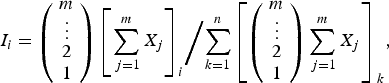
where I i is the index value, X j is the percentage of respondent ranking the attribute or trait i in the jth rank, m is the last rank of the trait or attribute and k is the sum of ranks for n number attributes or purposes. The indices represent weighted averages of all rankings for a particular IC attribute.
Other information hypothesized to influence the farmers' preferences was collected including the major reasons for rearing IC. Under this, six major reasons for keeping IC were identified or suggested, including home consumption, cash income derived from the sale of eggs and live birds, asset building, emergency cases, manure, culture, ceremonies/rituals and lastly for commercial cock fighting. The three existing production systems identified by the farmers were: FR, semi-confined (SC) and confined full-ration systems. The systems of production and the reasons for rearing IC were useful in segmenting the farmers according to their preferences. To solicit more information, farmers were asked to give the reasons for culling and selection of their stock.
Stated preference choice modelling
The Lancastarian conceptual framework was used as a basis of modelling producer preferences in this study. This framework approach suggests that goods are not the direct object of utility; rather, it is the characteristics of the goods from which utility is derived (Lancaster, Reference Lancaster1966) and utility from a good can be decomposed into separate utilities (Louviere, Reference Louviere and Bagozzi1994).
The probit model specifies utility with an observed and an unobserved component. It is also linearly related to the attributes (Louviere, Reference Louviere and Bagozzi1994). When presented with a set of alternatives, individuals will choose an alternative that maximizes their utility. Since the stated preference choice responses are ordered in nature, this study employed the use of an ordered probit. In this case, the observed response can be modelled by considering a latent (not observable) variable yi*, which depends linearly on the explanatory variables X.

where yi* is the dependent variable taking on values 0, 1, 2, 3, … , J, and is viewed as outcomes of continuous process. The dependent variable is observed as the likelihood to prefer or choose certain alternative. β is the vector coefficients, X i is the vector of independent variables and ɛ is the error term. Equation (2) can be estimated through multinomial logit. However, the multinational logit or probit model, which allows for more than two categories, suffers from the well-known “independence of irrelevant alternatives” assumption (Greene, Reference Greene2003), as errors are assumed to be independent from each category. To avoid this problem, the ordered probit model that allows the dependent variable to assume values which are ordinal in nature are used in this study. Therefore, the decision-making process or the preference for a particular alternative for farmer i is as follows:
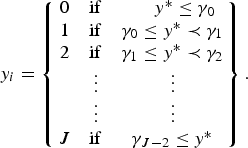
The threshold values γj's are parameters to be estimated, as are the unknown coefficients vector β. The ordered probit model provides the thresholds that would indicate the levels of inclination towards preference of an IC alternative, and so there is no arbitrary assumption about the magnitudes of differences between categories of the dependent variables. Calculating the probabilities of yi being in a particular rank or rating entails the use of the estimated threshold values and can be estimated as
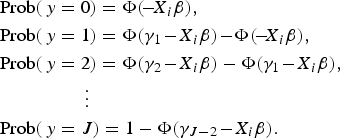
where Φ (− X iβ ) denotes the cumulative standard normal distribution function, X iβ is a set of specific values of X for the estimated coefficients (β) and the threshold values (γ's). The coefficients β are estimated through the maximization of the log-likelihood function.
Empirical procedure
The selection of important non-market economic attributes is estimated using preference ratings by farmers. The choice variable is related to utility as follows:

where U is the unobserved utility level, Y's are the preference rankings and γ's are the threshold variables linking the respondent's actual preferences with the ratings. The stated preference choice ranking or rating model can be generally presented as

where y is a vector of preference ratings (0, 1, 2, … , J) of the attributes, X is a vector of variables representing the IC's attributes (growth rate, body size, disease resistance, fertility, plumage colours, etc.). W captures the interaction of trait levels and characteristics of the household, β 1 is a vector of marginal utilities for the level of traits, μ is a vector of marginal impacts of the interaction between the levels of traits and individuals background and ɛ i is the disturbance term.
The relative importance procedure
The conjoint analysis gives some trade-offs between the traits. Its power and success as a multi-attribute decomposition method rely on its ability to give the relative importance of the individual traits. The relative importance in this study was described as the average values that were ascribed by producers to the traits. The relative importance scores of the attributes were estimated, therefore, as
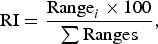
where RI is the relative importance of the attributes. The range is described as the difference between the highest and the lowest attribute utility levels, which is divided by the sum over all utility ranges.
Three models were analysed for main effects and seven interactions were carried out. The three models analysed were for traits generally preferred by farmers and the traits of cocks and hens important for breeding purposes. The seven interactions with the preference ratings done were based on the reasons for keeping and the IC production or rearing systems. To achieve the results, an ordered probit model was used and subsequently analysed using Limdep version 8.0 statistical software (Greene, Reference Greene2002).
Results
Preference profile rating results of IC traits
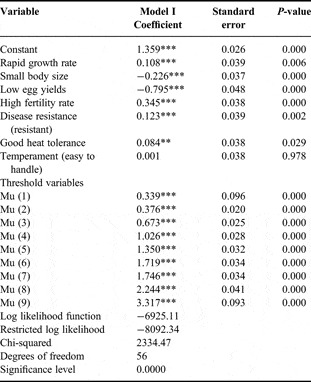
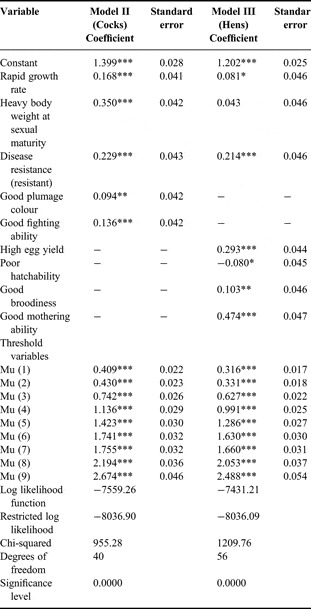
Table 2 shows the main effects of the levels of IC traits on ratings by farmers for traits perceived as most important, whereas Table 3 presents the main effects for the levels of the preferred IC cock and hen performance traits on ratings by farmers for selection and breeding purposes. The independent variable coefficients indicate the part-worths (marginal utilities). Part-worth can be defined as a number that represents the value that an average producer or farmer places on one of the levels of an attribute. More value is indicated by high part-worth, while a low part-worth indicates less value. The threshold values on the other hand represent the link between the ratings and utilities. In all the three models, the values are increasing and positively significant at P < 0.01. This indicates that there is no misspecification error.
Main effects for levels of IC traits on ratings by farmers for traits perceived as most important.

*Significant at 10%; **significant at 5%; ***significant at 1%.
Main effects for the levels of preferred IC cocks and hen performance traits on ratings by farmers for selection and breeding purposes.

*Significant at 10%; **significant at 5%; ***significant at 1%.
In Table 2, the χ 2 is significant with a value of 2334.47 and a log likelihood of −6925.11. All the variables have the expected signs and therefore indicate that they are relevant in explaining the respondent's preference ratings. In model I, all the variables were significant except the trait level if “easy to handle”, implying farmers’ indifference with the trait. The rapid growth rate, high fertility level and high disease resistance level were all positive and highly significant at P < 0.01. Heat tolerance was significant at P < 0.05, whereas small body size and low egg yield are negatively significant at P < 0.01. The negative part-worth values implied that the preferences of the farmer would be lower if there were changes in the attribute levels.
Similarly, Table 3 shows the main effects of performance traits preferred by the farmers on selection and breeding purposes for models II (cocks) and III (hens). The two models were significant with χ 2 values 955.28 and 1209.76, with log likelihoods of −7559.26 and −7431.21, respectively. All variables in model II and most in model III were significant with expected signs.
In model II, all the five trait utility levels are positive and significant. Rapid growth rate, heavy body weight at sexual maturity, resistance to diseases and good fighting ability were significant at P < 0.01 although good plumage colour was significant at P < 0.05.
In model III, most of the traits were significant except for heavy body weight at sexual maturity. Rapid growth rate was significant at P < 0.10. Good broodiness was significant at P < 0.05 while disease resistance, high egg yield and good mothering ability were highly significant at P < 0.01. However, poor hatchability was negatively significant at P < 0.10.
Interaction effects
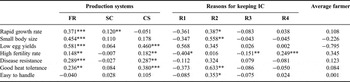
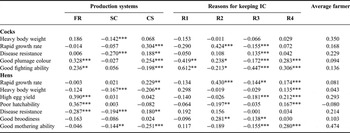
The interactions were carried out to determine if the farmers were heterogeneous in their preferences. This was based on the IC traits perceived as of primary importance and those for selection and breeding within the different kinds of production systems and reasons for keeping IC. The three existing production systems identified by the farmers were used as the first way of segmenting the farmers. These were: the FR, SC and the confined system (CS). The second approach of grouping the farmers was to use the reasons for keeping IC. This was based on the assumption that farmers had varying reasons to keep IC; therefore, the traits they preferred differed significantly. From the seven identified reasons to keep IC, four highly ranked reasons were picked. These were home consumption (R1), cash income (R2), emergency (R3) and asset building (R4). Other reasons from this ranking were cultural, manure and cock fighting. The ranking criterion was based on the index method (equation 1). The marginal values were then calculated for all the interactions. Table 4 shows the different trait levels of primary importance interactions with the production systems and reasons to keep IC on ratings.
Interactions of the levels of traits considered to be of primary importance and the farm and farmer characteristics' influences on the producer preference ratings.

*Significant at 10%; **significant at 5%; ***significant at 1%.
FR, free range; SC: semi-confined; CS, confined system; R1, home consumption; R2, cash income; R3, emergency; R4, asset building.
Most of the incremental part-worth values for FR were significant while only growth rate was significant for SC. In CS, egg yield, fertility, disease resistance and heat tolerance were significant. To understand the meaning of these coefficients for instance, a value that an average farmer in that scenario would ascribe to rapid growth rate was 0.108 (given in Table 2). There was an incremental value of 0.371 and 0.120 under FR and SC, respectively. Adding up the incremental part-worth with 0.108 ascribed by an average farmer gives 0.479 for FR and 0.228 for SC, which basically implies that the farmers placed a higher value on rapid growth rate under FR than in the other systems. The non-significant coefficient value for rapid growth rate under CS means that the preference was not different from 0.108 ascribed by an average farmer, therefore not considered. The same criterion applied to all non-significant coefficients.
Across the production systems, the trait level “easy to handle” was not significant, which implied that segmentation based on this trait was also not possible. However, it was possible to segment using high-fertility trait since farmers preferred this trait for reasons of building the assets (R4) with a utility of 0.594, 0.194 for R3 and a discounting of −0.059 for R1. Similarly, the deductions above applied to the rapid growth rate, small IC body size, good heat tolerance and easy to handle in R2 and the high fertility rate in both R3 and R4. Conversely, utilities for egg yield and disease resistance based on the intended reasons for keeping IC were not different from that of an average farmer since these traits were absolutely important (Table 4).
Table 5 gives the interactions among trait levels for selection and breeding with the farm and farmer characteristics. Only the significant marginal values, which were either negative or positive, were explained. All the negatively significant coefficients indicated that the attribute level represents a reduction to the farmers' utility and the positive significant coefficients were an addition. For cock's traits, good plumage colour and good fighting ability were significant for FR. Heavy body weight and disease resistance were negatively significant for SC. While rapid growth rate, disease resistance and good plumage colour were positive and good fighting ability was negatively significant in CS. Of the seven trait interaction levels for hens, high egg yield and poor hatchability were positive, with a negative significance for disease resistance under FR. At the same time, heavy body weight, disease resistance and good mothering ability were negatively significant for SC. The results also showed that for CS, rapid growth rate and disease resistance were positively significant, but heavy body weight and good mothering ability were negative. It was, however, not possible to do segmentation using good broodiness trait level based on the production systems because of its usefulness.
Influence of the interactions of levels of traits considered for selection and breeding purposes and the farm and farmer characteristics on the producer preference ratings.

*Significant at 10%; **significant at 5%; ***significant at 1%.
FR, free range; SC, semi-confined; CS, confined system; R1, home consumption; R2, cash income; R3, emergency; R4, asset building.
With the reasons for keeping as segments (Table 5), the traits that were significant for cocks based on R1 were good plumage colour being negative but good fighting ability being positive. Rapid growth rate and good plumage colour were positive and good fighting ability was negatively significant for R2. For R3 rapid growth rate, good plumage colour and good fighting ability were negatively significant but disease resistance was positively significant, whereas for R4 good plumage colour and good fighting ability were both positively significant. Using the trait “rapid growth rate”, for instance, an average farmers' part-worth would be 0.168, while the overall utility after adding the marginal utilities were 0.592 and 0.013 for cocks pertaining to R2 and R3, respectively. This meant that the farmers whose reason for keeping was R2 placed a higher value to this attribute when selecting and breeding. The same analogy applied to all significant trait levels in the various classifications. The utility levels for R1 reason to keep IC were not different from that of a representative farmer since none of the trait levels was significant. Rapid growth rate and good broodiness were positive and hatchability had a negative significance for R2 target group. Furthermore, rapid growth rate, high egg yield, good broodiness and good mothering ability were negatively significant for R3. However, for R4 rapid growth rate, heavy body weight, high egg yield, poor hatchability and good mothering ability were all positively significant. Heavy body weight for cocks and disease resistance for hens were not significant in all the reasons indicating their importance in IC rearing.
Relative importance of attributes
The relative importance scores of the attributes were estimated for all the models and are presented in Figures 1, 2a and b.
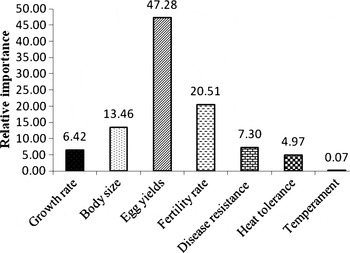
Relative importance for traits perceived to be of primary importance by producers.

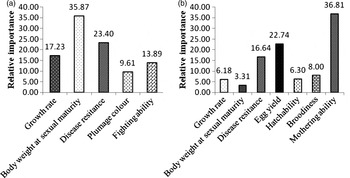
Relative importance for traits of cocks (a) and hens (b) considered important for selection and breeding.

In Figure 1, for the traits perceived as of primary importance by producers, the trait egg yield measured in terms of the number of eggs laid per chicken in a year had the highest relative score of 47.28, while temperament had the lowest value of 0.07. All the relative scores add up to 100.
Figures 2a and b are the relative importance of traits considered by farmers for selection and breeding purposes. In Figure 2a, the traits perceived as important for cocks were body weight at sexual maturity with a high score of 35.87, while disease resistance and growth rate were at 23.40 and 17.23, respectively; the lowest score was 9.61 for plumage colour. Conversely, mothering ability scored high for the hen's traits in Figure 2b with a value of 36.81. Body weight at sexual maturity had the lowest score of 3.31.
Culling and selection for superior qualities
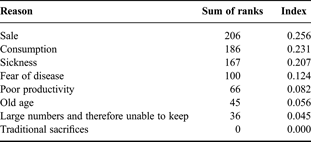
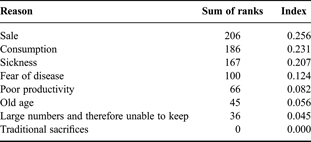
Table 6 presents results on the weighted indices for the reasons for culling and selection. The results indicate that there was a reasonable agreement for sale as a motive for culling, which basically implies that farmers do normally sell most of their stock for cash income while doing the selection to obtain the desired stock. This was followed by those culled because of consumption, sickness, fear of disease, low productivity, old age, to reduce the size of the flock for better management and for traditional sacrifices in that order. Unproductive chickens, excess cocks and cockerels accounted for most of consumption and sale. It was observed that the selected breeding cocks and hens were never sold or slaughtered for home consumption until the unproductive old age. Interestingly none of the farmers culled IC for traditional sacrifices, indicating that some of the traditions have been abandoned in the areas of study.
Reasons for culling and selection.
Discussion
Main effects of IC trait levels perceived by farmers as most important on ratings
The rapid growth rate, high fertility rate, good heat tolerance and disease resistance are considered important by farmers and are therefore positive and significant in model I. Most of these traits may have a direct or indirect influence on the marketability of chickens. Disease resistance has a positive influence on the productivity of chickens. Rearing of IC is a relevant tool in the eradication of poverty in the rural areas (Ondwassy et al., Reference Ondwassy, Nenkare, Ligono and Nelima2000; Yoo, Reference Yoo2005); therefore, the low level of disease resistance would have significant financial losses as a result of mortalities (Kondombo et al., Reference Kondombo, Nianogo, Kwakkel, Udo and Slingerland2003; Biswas et al., Reference Biswas, Uddin, Barua, Roy, Biswas, Ahad and Debnath2006). Heat tolerance is another valuable attribute preferred and should be considered in selection and breeding programmes of ICs, since domestic chicken become easily susceptible to heat or cold environmental stress (Ramnath, Rekha and Sujatha, Reference Ramnath, Rekha and Sujatha2008). Apparently, the naked neck genotype has been identified to be more heat tolerant and disease resistant in the locally existing conditions (Islam and Nishibori, Reference Islam and Nishibori2009). Conversely, ICs have low performance and survival rate than the exotic breeds under confinement (Tadelle, Alemu and Peters, Reference Tadelle, Alemu and Peters2000; Solomon, Reference Solomon2003). This is due to the fact that they are not used to being enclosed and they mainly suffer from paralysis as a result of Marek's disease (Reta et al., Reference Reta, Nigussie and Alemu2006).
Small-sized and low-egg-yielding chickens are undesirable. Generally, a large-sized chicken is better than a small-sized one. The farmers’ preference would be guided by the reasons for keeping, for instance rearing for eggs, meat production, or dual purpose. The egg yield particularly had the highest relative score with a value of 47.28 for the traits perceived as generally important. As expected, farmers would choose high-egg-yielding chicken to satisfy both commercial and subsistence needs, but would be much influenced by the genotype selected, because of the variations that exist in their egg production potentials (Tadelle, Alemu and Peters, Reference Tadelle, Alemu and Peters2000; Grobbelaar, Sutherland and Molalakgotla, Reference Grobbelaar, Sutherland and Molalakgotla2010). Egg production of IC has been identified as the main reason for keeping (Abdelqader, Wollny and Gauly, Reference Abdelqader, Wollny and Gauly2007) and as a function (Dana et al., Reference Dana, van der Waaij, Dessie and van Arendonk2010). However, the low productivity of IC is partly attributed to the prevailing poor management practices, in particular the lack of proper health care which results in high mortalities, poor nutrition and housing (Mwalusanya et al., Reference Mwalusanya, Katule, Mutayoba, Mtambo, Olsen and Minga2002; Biswas et al., Reference Biswas, Uddin, Barua, Roy, Biswas, Ahad and Debnath2006). Improving these factors would result in greater growth rate and egg production (Kingori, Wachira and Tuitoek, Reference Kingori, Wachira and Tuitoek2010). High fertility rate, on the other hand, would increase hatchability of eggs, therefore enhancing the chances that more chicks survive for subsequent consumption and sale.
Implications of farmers’ preference ratings and their relative importance in breeding and selection
While carrying out breeding and selection, farmers evaluate all of the traits that are important to them. These traits are then traded off against one another to obtain more economical and favourable attributes in the long run. This criterion would assist in selecting chicken that meets both the conformity and overall production purpose overtime. For instance, in model II, rapid growth rate, heavy body weight at sexual maturity, resistance to diseases, good fighting ability and good plumage colour are all positive and significant. This shows that farmers are not willing to trade-off high levels of these traits with the lower levels. It further implies that all the selected traits, though having varying utility values, are important for breeding and selection purposes. Moreover, the traits such as growth rate and body weight are economically important when rearing cocks for sale, because heavy cocks would fetch high prices in the market. Even though the local chickens are slow in maturity, selection for faster growth rate is crucial since some of these desirable attributes can be passed on to the other generations. However, maternal effects should be considered if selection to improve the genetic potential of IC is carried out at early ages (Norris and Ngambi, Reference Norris and Ngambi2006). In broiler chicken, selection for body weight and growth has been outstandingly improved, resulting in a negative influence on their reproductive fitness (Rauw et al., Reference Rauw, Noordhuizen-Stassen and Grommers1998; Havenstein, Ferket and Qureshi, Reference Havenstein, Ferket and Qureshi2003). Nevertheless, slight improvements in growth, body weight and greater survivability would have little influence on the ICs' reproductive performance unlike in the highly selected commercial lines.
Using the systems of production to compare the preferred traits, an attribute such as the fighting ability would be more appropriate in the FR system, where there is little control of the flock, and least desirable under confinement. Farmers in most cases keep one breeding cock within a flock, additional cocks and cockerels are kept for either consumption or for sale depending on their goals. Fighting ability as an economically important trait is important especially in cases where farmers keep large flocks with many cocks for different purposes. Uncontrolled breeding is common in the rural areas under the FR system of production. In the process of foraging or scavenging, the free ranging ICs meet other flocks at the village; nevertheless, successful mating would require the presence of a strong desirable breeding cock. The control of the flock of the dominant cock often results from an initial antagonistic interaction with the rest of the cocks. In such a scenario, preference to this trait is then justifiable. Many studies have been able to demonstrate a clear relation of male mating and reproductive success to male dominance (Guhl, Reference Guhl1950; Cheng and Burns, Reference Cheng and Burns1988). It has also been observed that cocks' natural aggressiveness and fighting are linked to the dominance behaviour or territorial control (Queiroz and Cromberg, Reference Queiroz and Cromberg2006). This means that this trait can also be translated as desirable for those whose goal is rearing fighting cocks for entertainment purposes where the physically fitness and training are a prerequisite, although this activity is only practised in some parts of the country, especially the western region of Kenya. In this case, the usefulness of this trait is twofold.
Survivability of the IC depends on its ability to hide or escape from the predators under the predominant FR system of production in the rural areas. The ability to camouflage in the surrounding environment is determined by the plumage colour. White plumage colour was least desirable to the farmers and the ICs with this kind of plumage were evidently few within the households. Farmers alleged that white chickens were easily preyed on by both aerial and terrestrial predators. Biswas et al. (Reference Biswas, Uddin, Barua, Roy, Biswas, Ahad and Debnath2006) recognized that predators among others are the major causes of mortalities in local chickens. Furthermore, the present study observes that the market value of cocks can also be attributed to the good plumage colour. This is important in influencing the preferences of buyers, who in turn would be willing to pay more. This trait was used auspiciously by traders to differentiate the cocks' prices from the primary to the terminal markets in the study areas. Conversely, in studies in other parts of Africa, ICs with white plumage were preferred for use in fulfilling traditional rites (Swatson, Nsahlai and Byebwa, Reference Swatson, Nsahlai and Byebwa2001), and had some beneficial significance for peace (Faustin et al., Reference Faustin, Adégbidi, Garnett, Koudandé, Agbo and Zander2010).
In model III, good mothering ability, high egg yield, good broodiness and rapid growth rate are the traits that had positive path-worth values. This means that the IC farmers would derive a high utility from these traits for their breeding and selection stock. For example, McAinsh and Kristensen (Reference McAinsh and Kristensen2004) found out that some of these traits, including survival of various age groups, full-grown weights, as well as some decision parameters like farmers' need for meat consumption, slaughtering and the age of disposing chickens, if improved, can have the largest impact on output. In this study, producers would prefer high-egg-producing ICs in their flock. This was also recognized as an important selection criterion adopted by farmers in northern Jordan (Abdelqader, Wollny and Gauly, Reference Abdelqader, Wollny and Gauly2007). However, this process can be achieved traditionally by monitoring the number of eggs and the laying rate (Menge, Kosgey and Kahi, Reference Menge, Kosgey and Kahi2005). Consequently, it is essential to develop rapid and accurate selection methods since the existing breeding programmes may take a long time (Yang et al., Reference Yang, Lin, Huang, Liou, Chien, Wu, Huang, Ou, Chen, Lee, Lin, Tang, Lee, Ding, Cheng and Huang2008). This can be partly achieved by training and encouraging IC farmers to keep vital production records in order to provide appropriate information that facilitates the selection of the best performing IC at the farm level, which is not often done.
Disease is a major problem in poultry production under all the systems of production and more seriously under the FR. Low levels of disease resistance in IC mean that in events of an outbreak, colossal losses would be anticipated and only the healthiest birds may remain on the farm; they can then be used as breeding stock. More ICs will be bought from the market or exchanged in order to sustain production. Producers would therefore prefer ICs with some level of disease resistance. This is apparent by the positive utility to disease resistance for both cocks and hens with some reasonable degrees of relative scores. In other studies, disease has also been identified as the greatest constraint on rural poultry development (Aini, Reference Aini1990; Gueye, Reference Gueye2002; Mack, Hoffmann and Otte, Reference Mack, Hoffmann and Otte2005). However, some diseases such as Newcastle, which often results in severe mortalities, can be controlled by early vaccination (Ondwasy, Wesonga & Okitoi, Reference Ondwasy, Wesonga and Okitoi2006); this can be achieved with the assistance of the government extension agents and the non-governmental organizations (MoLD, 2006). However, in most cases, farmers are not aware of this possibility. From the farmers' group discussions in the study area, disease prevention and cure were seen as an important aspect of conservation of ICs. Interestingly, apart from the use of ethno-veterinary drugs, some farmers asserted that they had used cow milk effectively to cure some of the prevalent diseases. This claim, however, has not been documented or scientifically proven.
Good broodiness had a positive utility and a relative score of 8.0 percent for hens. This implies that even though some utility can be derived from this trait, a broody chicken in most cases would be a poor layer and preference to this attribute would be low, but still considerable. Moreover, low production of ICs ready for slaughter or sale is often a result of few clutches per hen per year with long brooding periods (McAinsh et al., Reference McAinsh, Kusina, Madsen and Nyoni2004). But this loss is partially compensated by a higher laying rate during the non-broody period as observed by Jiang, Chen and Geng (Reference Jiang, Chen and Geng2010). Conversely, the survivability of the broody hens' chicks is usually low which was mainly attributed to diseases and loss to predators in the smallholder system (Biswas et al., Reference Biswas, Uddin, Barua, Roy, Biswas, Ahad and Debnath2008). While low number of chicks implies low flock productivity, the situation can be improved by good management practices such as brooding encouragement, improving housing facilities and minimizing predation (Mtileni et al., Reference Mtileni, Muchadeyi, Maiwashe, Phitsane, Halimani, Chimonyo and Dzama2009). In our study, farmers mostly rely on natural brooding to produce chicks. This is usually achieved by choosing a large broody hen to sit on and effectively cover all the eggs comparable to what is described in Sonaiya and Swan (Reference Sonaiya and Swan2004). However, a few of them were able to access the shared artificial brooders from the farmer groups which were either bought or provided by the non-governmental organizations for a period of time on rotational basis. Consequently, these brooders were useful since it reduced the likelihood of hens' over brooding which producers find a problem in egg production. Broody hens were then stimulated to resume laying using traditional methods such as dipping them in cold water and hanging them upside down among many others. Similar methods were reported in Tadelle et al. (Reference Tadelle, Millon, Alemu and Peters2003b). In this case, the preference of a broody chicken is necessary as long as it does not become excessively broody. This trait can be utilized effectively when we have chickens that do not conveniently go broody within the flock. This assertion is clearly supported by Abdelqader, Wollny and Gauly (Reference Abdelqader, Wollny and Gauly2008), who in their study observed that few hens laid eggs continuously throughout the year. It can also be important in serial hatching where chickens are given eggs to sit on continuously for two or more times by removing chicks every time they hatch and replacing them with new eggs as explained by Ondwasy, Wesonga and Okitoi (Reference Ondwasy, Wesonga and Okitoi2006).
Mothering ability had the highest score and a positive utility among all the traits, indicating its importance to the IC farmers. A hen with good mothering ability can increase the survival chance of naturally hatched chicks. Similarly, this trait was considered important in selecting female ICs in Thailand (FAO, 2009), and was secondly preferred after egg production by farmers in Jordan (Abdelqader, Wollny and Gauly, Reference Abdelqader, Wollny and Gauly2007). In addition, the ICs with good mothering ability can also be used as foster mothers (Kitalyi, Reference Kitalyi1998). Conversely, the traits that farmers valued least are heavy weight at sexual maturity and poor hatchability. This means that there was some partial preference to hens with minimum body weight at sexual maturity, since lighter birds lay more eggs. The smaller size is also necessary to reduce feed requirements and increase feed efficiency in the FR system (Olawunmi, Salako and Afuwape, Reference Olawunmi, Salako and Afuwape2008). Farmers were, however, indifferent to poor hatchability; this trait is hence not significant. Subsequently, it had low relative importance as a breeding trait. This implies that farmers would standardize the number of eggs per hen to achieve higher hatchability. Sonaiya and Swan (Reference Sonaiya and Swan2004) acknowledged that hatchability often declines with more than 10 eggs, which basically depends on the size of the hen. This might also be the reason for the low relative value for the egg yield, as compared with the results in Figure 1.
Conclusions
In the present study, traits of economic importance preferred by the indigenous chicken farmers have been identified using conjoint analysis. The relative scores were calculated to determine the traits that would have the greatest influence on the farmers' IC production or rearing decisions. Disease resistance was among the highly preferred traits for both breeding cocks and hens. Mothering ability and egg yield were important for keeping breeding hens. Body weight at sexual maturity, resistance to diseases and growth rate were the most important traits preferred for cocks. Using the traits identified, without making any major changes to the current low-input production systems, the local genotypes can be selected for more productivity and optimal performance while retaining their diversity and adaptability. This would directly improve the livelihoods of the poor rural IC farmers in the long run. The results have also clearly highlighted the need to consider the farmers' preferences in future improvements of ICs. In particular, the outcome is important in the selection and development of breeding schemes.
Acknowledgements
The authors are very grateful for grants offered to H.K. Bett from the Yousef Jameel Scholarship and Humboldt University of Berlin. We also recognized the inputs from the Kenya Agricultural Productivity Project (KAPP) through the Indigenous Chicken Improvement Project (INCIP) in collaboration between Egerton University, Ministry of Livestock Development and Kenya Agricultural Research Institute.