




No CrossRef data available.
Article contents
- Abstract
- Theories of Institutions, Leader Survival, and Policy Choice
- The Impact of Leadership Turnover and Domestic Political Institutions on Relations Between States
- Tainted Love: The Breakdown and Restoration of Cooperation
- Data and Methods
- Results
- Incidences of Sour Relations
- Restoring Sour Relations
- Conclusions
- Appendix
- References
The Impact of Leadership Turnover on Trading Relations Between States
Published online by Cambridge University Press: 01 July 2004
Article contents
- Abstract
- Theories of Institutions, Leader Survival, and Policy Choice
- The Impact of Leadership Turnover and Domestic Political Institutions on Relations Between States
- Tainted Love: The Breakdown and Restoration of Cooperation
- Data and Methods
- Results
- Incidences of Sour Relations
- Restoring Sour Relations
- Conclusions
- Appendix
- References
Abstract
We test how domestic political institutions moderate the effect of leadership turnover on relations between states. Deriving hypotheses from recent theoretical work, Bueno de Mesquita et al. and McGillivray and Smith, we examine how leader change affects trading relations between states using dyadic trade data. Consistent with hypotheses, we find that large winning coalition systems, such as democracies, are relatively immune from the vagaries of leadership change. In such systems, trade remains relatively constant whether leader change occurs or not. In contrast, when winning coalition size is small, as in autocratic states, leadership change profoundly alters relations, causing a decline in trade. Finally, we examine instances of poor relations, measured by a significant decline in trade compared to historical levels. As predicted, instances of poor relations are less common between pairs of democracies than other dyadic pairings. Further, leadership turnover in autocratic systems restores trading relations between states. The effect of leadership change in democracies is much less pronounced.An earlier version of this article was prepared for the 2002 Peace Science Society meeting in Tucson, Arizona. We gratefully acknowledge the financial support of the National Science Foundation, SES-0226926. We thank John Oneal and Bruce Russett for generously making their data available to us. We thank audiences at New York University, the University of Rochester, Yale University, and several anonymous reviewers for their helpful comments.
Information
- Type
- Research Article
- Information
- Copyright
- © 2004 The IO Foundation and Cambridge University Press
Since first drafting this article, the United States has invaded Iraq and deposed its leader Saddam Hussein. For more than a decade Iraq experienced harsh economic sanctions. With Hussein's removal, these sanctions have been lifted and Iraq is in the processes of being reinstated into the international community. Although it was the Iraqi people who bore the costs of the sanctions, the sanctions were aimed at Hussein's regime. With Hussein removed, the prospects for improved relations between Iraq and Western states look strong.
While Iraq offers an extreme example, this article assesses how the turnover of leaders affects relations between states, as measured by trade flows. In particular, drawing on recent theoretical developments, we examine how domestic institutions and leadership turnover affect dyadic trade flows. Consistent with the theoretical arguments, we find that trade flows between states depend on the interaction of institutions and leader turnover.
Scholars, such as Russett and Oneal, have documented that democratic states have higher trade flows than states with less representative institutions.1
We shift the focus of analysis. Rather than examining how institutions affect cross-sectional differences in trade flows, we study the dynamics of dyadic trade flows by looking at how leadership turnover changes trade. Domestic political institutions determine whether leadership change affects trade. Where leaders require the support of a large proportion of the population to remain in power, as in democratic systems, leadership turnover has no impact on trade flows. In contrast, when leader survival requires the support of only a small fraction of the population, as in many autocratic systems, leadership turnover harms trade. Indeed, our estimates suggest that on average the turnover of an autocratic leader reduces dyadic trade with the United States by about 5 percent. Under general circumstances, leadership turnover harms trade in autocratic, but not in democratic systems. However, when relations with an autocratic state are sour, as measured by trade flows substantially below recent historical averages, the replacement of an autocratic leader reinvigorates trade.During the past decade, much attention has been placed on the role of domestic political institutions in shaping relations between states. Perhaps most prominent is the attention given to the democratic peace: the finding that democratic states do not fight each other.2
See Bremer 1992; Bueno de Mesquita et al. 1999; Dixon 1994; Lake 1992; Levy 1988; Maoz and Abdolali 1989; Maoz and Russett 1993; Ray 1995; and Rousseau, Gelpi, Reiter, and Huth 1996.
We proceed as follows. First, we discuss the theoretical connections between leader turnover, institutions, and relations between states. Second, we examine the theoretical implication of these arguments in the context of international trade and derive testable hypotheses. Although the theories predict that domestic institutions influence the level of trade between states, these effects have already been extensively investigated by others.4
Much of this literature stems from investigations into whether trade explains the democratic peace. See Bliss and Russett 1998; Gowa 1994; Mansfield and Pevehouse 2000; Mansfield and Pollins 2001; Milner and Rosendorff 1997; Morrow, Siverson, and Taberes 1998; Oneal 2003; Oneal and Russett 1997, 1999a, 1999b, 2000, and 2001; Polachek 1997; Pollins 1989; Reuveny 2000 and 2001; and Reuveny and Kang 1996 and 1998.
Theories of Institutions, Leader Survival, and Policy Choice
Domestic political institutions shape the incentives and hence the policy choices of political leaders. In particular, leaders want to pick policies that help them survive in office. Although these assumptions form the basis of many theoretical approaches to explaining the effects of institutions on policy formation, we focus our attention on two specific arguments: the Bueno de Mesquita et al. theory of the selectorate and winning coalition, and McGillivray and Smith's theory of leader specific punishments.5
See Bueno de Mesquita et al. 1999, 2002, and 2003; and McGillivray and Smith 2000.
Bueno de Mesquita et al. (hereafter BdM2S2) classify domestic political institutions according to the number of people whose support a leader requires to retain power—the winning coalition, W—and the number of people from whom this coalition of supporters is drawn—the selectorate, S. These continuous dimensions of winning coalition and selectorate are logically distinct from traditional categorical classifications of regime types. However, it is useful for illustration to place traditional categories of regimes within the W and S framework. Modern liberal democracies typically have large selectorates (usually consisting of all adult citizens) and the winning coalition size is also large, being some portion (often around a half) of the selectorate. Monarchies and military juntas are examples of regimes with both small winning coalitions and small selectorates. Autocratic states typically have a small W, although they experience considerable variation in the size of S. The types of policies and the survival of leaders are fundamentally influenced by these institutional variables.
Leaders, assumed to have a fixed set of available resources, produce two types of goods: public goods that benefit all members of society and private goods that benefit only those in the incumbent's winning coalition. When the winning coalition is small, the incumbent is only beholden to a small group to retain power. Under such circumstances, incumbent leaders can effectively enrich members of their coalition through the provision of private goods. Hence, in small coalition systems, BdM2S2 anticipate that leaders will foster patronage, cronyism, and corruption rather than effective implementation of public policy. The former secures the leaders' tenure in office; the latter, while better policy, harms the leaders' prospects for survival.
In contrast, if domestic political institutions require leaders to maintain the support of a large number of individuals in order to keep their job, then leaders will promote effective public policy. In these large coalition systems, such as democracies, leaders cannot effectively reward their supporters through private goods. There are simply too many people to reward and private goods provision stretches the pool of available resources too thinly. Under these circumstances, leaders can reward their voluminous supporters more cost effectively through public goods provision. The size of the winning coalition determines the type of policies that leaders produce.
Of course in reality all policies have both public and private components. However, this does not diminish the finding that coalition size drives the relative public or private focus of policy provision. An illustration is useful. Like many other countries, Kenya uses agricultural boards to regulate its domestic market for agricultural goods. These boards buy agricultural products at fixed prices. When set up properly, agricultural boards help to protect farmers from the vagaries of market prices and provide stable food prices for urban populations, both broad-based benefits. Unfortunately, as in the Kenyan case, these state-run boards can also be used to enrich the few at the expense of the many. In the 1960s, Kenya's first president, Jomo Kenyatta, promoted agricultural interests and sugar was grown as a cash crop in the Western Province and Nyanaz. Through the use of the sugar board and prohibitive import tariffs, Kenyatta's successor, Daniel Arap Moi, enriched his cronies and decimated the sugar industry. The high external tariff kept Kenya's domestic sugar price high. However, farmers did not reap these benefits. Farmers sold their sugar at a set price through the Kenyan Sugar Authority where it was sold on to Kenyan consumers at high prices—about three times the world price. Moi's supporters then imported sugar duty free on the pretext that it was in transit to Tanzania and Uganda. Rather than using the sugar board as a public good to insulate farmers and provide stable food prices, Moi sacrificed a profitable industry to fill the coffers of the ruling KANU party and Moi's cronies.6
See “Kenyan Sugar Growers Taste Corruption's Bitter Fruits,” Times Media Limited, 26 August 1997; and Throup and Hornsby 1998.
The larger a leader's winning coalition, the greater his or her focus on public rather than private goods. In addition to determining the quality of policies a leader provides, winning coalition size, especially in conjunction with selectorate size, determines the quantity of policy produced. BdM2S2 assume that the primary focus of leaders is to survive. They characterize how many of the available resources a leader must expend to match the best possible offer of a challenger. The smaller the coalition size and the larger the selectorate the easier it becomes for leaders to better the offer of any potential challenger. Hence when W is small and S is large, leaders survive easily and can skim off resources for their own discretionary purposes. The derivation of this result is as follows. When the coalition size is small, then leaders predominantly rely on private goods to reward their supporters. This means that the welfare of those outside the coalition is substantially lower than that of persons within the coalition. This creates a loyalty norm toward the incumbent. Although a potential challenger might offer to spend every available penny as efficiently as possible in order to come to power, having attained office this challenger forms a coalition of size W from the available S potential supporters. The fact that the challenger will pick W supporters from the potential pool of S supporters makes defecting to the challenger risky.7
In BdM2S2's formal models, leaders have different affinities for each of the possible supporters. In equilibrium, a leader forms a coalition from the W highest affinity members of S. Because less is known about the affinity structure of the relatively unknown challenger, potential defectors cannot be certain of being among the top W affinity types.
BdM2S2 use their theoretical framework to explain a vast array of political phenomena. While we commend the breadth of their theory's applicability, for our current purpose we exploit only some of these implications. In particular, BdM2S2 provide a metric to measure the ease of leader removal. The smaller W, the harder leader removal becomes and the greater the discretion leaders have in their policy choices. Indeed, as long as leaders in small W systems ensure that their supporters receive some amount of private goods, they are unencumbered with respect to the rest of their policy choices. Once this minimal threshold is reached, leaders that are beholden to only a small number of supporters are unconstrained and can adopt whatever idiosyncratic policies they wish. Their political survival is isolated from these policy choices. Kenya's President Moi managed to survive in office despite abysmal policy performance. Between the time he came to power in 1978 and his departure from office at the end of 2002, per capita income grew less than 5 percent. By way of comparison, U.S. per capita income grew by about 50 percent over the same period.
In contrast, the survival of leaders in large coalition systems is always in jeopardy. Although such leaders focus on policies that promote public welfare, so do their potential challengers. Given the relatively small importance of private goods in such systems, there is little loyalty toward the incumbent. If the challenger offers better public policy ideas then the incumbent's, supporters defect because they have little to fear in terms of either the risk or the cost of future exclusion. Leaders in large W systems must always strive for better public policy to survive. They have little wiggle room for their own discretionary policies, and despite their best efforts, such leaders are frequently removed. Indeed, BdM2S2 show at great length, that despite their superior performance, leaders from large coalition systems are removed more frequently than their small coalition counterparts. Repeating their mantra: in large coalition systems good policy is good politics, but in small coalition systems bad policy is good politics.
Having used BdM2S2 arguments to derive a measure of the ease of leader removal, W, and to show that the larger W, the greater leaders work toward maximizing public welfare, we now turn to a discussion of McGillivray and Smith's model of interstate cooperation. The prisoners' dilemma is commonly conceived as a metaphor for cooperation.8
See, for example, Axelrod 1984; Axelrod and Keohane 1986; Bendor 1987; Downs and Roche 1990; Gourevitch 1996; Guisinger and Smith 2002; Milner 1992; and Pahre 1994.
Although myopically cooperation is impossible, liberal theorists point out the possibility of cooperation by conditioning current behavior on previous outcomes.9
See Axelrod 1984; Baldwin 1993; Gowa 1986; Keohane 1984; Keohane and Nye 1977; Krasner 1983; Milner 1992; Oye 1986; and Ruggie 1993.
Obviously cooperation theory has been developed in a number of ways, for example by letting states choose the depth of cooperation, see Bendor 1987 and 1993; Bendor, Kramer, and Stout 1991; Boyd 1989; Lambertini 1997; Molander 1985; and Signorino 1996.
Scholars such as Leeds have shown that if democratic leaders face audience costs for cheating a trading partner, then cooperation can be deeper and more vibrant between democracies.12
For examples of work showing the impact of regime type, see Gaubatz 1996; Gowa 1994; Leeds 1999; Mansfield, Milner, and Rosendorff 2002; Martin 1993; McGillivray 1997 and 1998; Milner 1997; Milner and Rosendorff 1997; Oneal and Russett 1999a and 2001; Remmer 1998; and Verdier 1998.
See Fearon 1994; Smith 1998; and Schultz 1998, 1999, and 2001b.
See Keohane 1986; and Goldstein 1991.
Under LSP strategies, once a leader has cheated, other states refuse to cooperate for as long as the deviating leader remains in power. However, because the punishment is targeted against the actual leader who cheated rather than the state as a whole, the replacement of this leader reinvigorates relations and enables the restoration of cooperation. Because public welfare is typically enhanced through trade and cooperation, citizens improve their welfare by replacing their leader. Hence when the cost of leader replacement is low (specifically, less than the value of restoring good relations), then citizens replace defecting leaders. In contrast, when the cost of replacing a leader is high, then the leader retains power and cooperation ceases. In terms of the BdM2S2 metric, in large coalition systems, cooperation is restored through the replacement of the defecting leaders. In small W systems, the high loyalty norm means that defecting leaders survive even though the removal of such a leader would restore cooperation and improve public welfare. Public welfare is not the key to political success for leaders of small coalition systems.
Beyond providing mechanisms to restore cooperation, LSP strategies prevent the breakdown of cooperation between large coalition systems in the first place. The principal assumption is that leaders want to keep their jobs. In a large coalition system, cheating a trading partner will cost leaders their jobs; hence they will not cheat. The LSP mechanism allows cooperation under conditions where extant liberal arguments (in particular the use of grim trigger punishments) would suggest cooperation is impossible. In large coalition systems, where leader removal is easy, leaders effectively stake their tenure in office on their cooperation. Because leaders in small coalition systems are not easily removed, and certainly not for harming public welfare, their continued tenure in office is not at stake when they decide whether to deviate. Small coalition leaders cannot commit themselves to cooperate. Neither small nor large coalition leaders' choices are driven directly by concerns for public welfare. Both types of leaders care primarily about political survival. Institutions shape the policies that best fulfill this goal.
Having outlined the theoretical underpinnings for the two arguments, we now derive what these theories predict in the context of trade between states.
The Impact of Leadership Turnover and Domestic Political Institutions on Relations Between States
Regime Type and Cooperation
States with large winning coalitions trade and cooperate at higher levels than other pairings of political systems. Above we showed that, because of the risk to their tenure from cheating, democratic leaders can commit themselves more effectively to cooperate than leaders in smaller winning coalition systems. Hence trade agreements between democratic states are more likely to be honored. Further, democratic leaders divert less trade than autocratic leaders. Although even leaders of large coalitions provide some private benefits for their supporters, their policy objectives are closer to some notion of public welfare maximizing than those of small coalition leaders, for whom survival depends instead on enriching a small group of supporters. Because according to microeconomic theory, free trade is generally welfare maximizing and barriers and distortions to trade enable certain producer groups to earn economic rents, we should expect, even beyond any concept of LSP, that large coalition systems pursue free trade policies while small coalition systems tend to protect producer groups that support the incumbent. We state this as our hypothesis:
H1: Institutional effects: Large coalition states are more open than small coalition states and hence, all else equal, have greater trade flows.
As a corollary, we might add that via LSP states can maintain higher levels of cooperation when both are democratic. All else equal, dyadic trade between large coalition systems will be higher than trade between other pairings of states.
There is already considerable empirical support for these claims, as cited earlier. This is reassuring. Unfortunately, it does little to further our understanding of why institutions influence interactions between states because these results provide no means to distinguish the theoretical ideas advanced here from alternative explanations. We focus on how leadership turnover affects trading relations differently by regime type.
Dynamic Patterns of Trade and Leader Turnover
When a leader is replaced, the new leader may change policy. However, the extent to which we should anticipate policy shifts depends on domestic political institutions. Both the selectorate theory and the LSP theory suggest a decline in trade accompanies leadership turnover in small coalition systems, but not in large coalition systems. This leads to our second hypothesis:
H2: Leadership dynamics: Leadership turnover in a small coalition system reduces trade. The impact of leadership turnover on trade is smaller in large coalition systems.
Although both theories predict this hypothesis, it is worth exploring the logic of each argument in turn. As described above, the selectorate theory suggests that large coalition leaders best maximize their chance of political survival by promoting the provision of public goods and improving social welfare. Because free trade has a high public goods component, democrats tend to promote free trade policies.
Political survival in a small winning coalition depends on paying off a small number of supporters with private goods. Trade and industrial policy is one mechanism that allows leaders to direct resources toward their supporters. Because it is private goods that are the key to surviving in office, the barriers to trade that autocrats erect can be large. Small coalition leaders draw their supporters from those members of the selectorate for whom they have the highest affinity. Hence, one leader's choice of coalition members, and hence policy preferences, can be very different from his predecessor's.
Kenyan President Jomo Kenyatta drew his support from the rich agricultural lands of the Central Highlands and the Kikuyu tribes. His agriculture friendly policies reflected this support base. After Kenyatta's death in August 1978, Moi rose to leadership. Although he initially relied on Kenyatta's traditional support base, Moi set about replacing this coalition with supporters from the Kalenjin tribes of the Central Rift Valley region. These supporters did not benefit from the promotion of the Central Highland's agriculture. So Moi reformed Kenya's political economy leading to large net outflows from the central provinces to other regions.15
As the earlier example of the sugar industry showed, Moi policies radically shifted the focus of Kenya's trade. In the year following Moi's ascension to power, U.S. trade with Kenya dropped nearly 32 percent.As the Kenya example illustrates, leadership change in small coalition systems can lead to a significant shift in trade policy. This policy variance makes trade unattractive because economic actors are wary of setting up trading relations that might be terminated shortly. The risk and uncertainty associated with policy variability discourage trade. In our empirical tests we examine whether leadership change affects the variance in trade flows as well as changes in the level of trade. In large coalition systems protectionist measures are more modest. As such, leadership changes have a greatly diminished impact on trade flows. Of course, leadership change brings about some changes in policy. McGillivray characterizes how the institutions of electoral rule and party discipline affect the changes in trade and industrial policies that accompany political change.16
McGillivray 2004. Her work suggests that policy changes accompany political change in both proportional representation and majoritarian systems, although the size and timing of the policy shift differs across electoral system.
The LSP theory also suggests that declines in trade and other economic interactions accompany leadership turnover in small coalition systems, but not in large coalition systems. Autocrats can and do violate international norms with much greater frequency than democrats. For instance, in 1960 Cuban leader Fidel Castro nationalized the largely U.S.-owned Cuban sugar industry, as well as all other U.S. interests in Cuba. This, combined with his adoption of communist ideals, led to an almost complete cessation of U.S.-Cuban trade. Despite incurring the wrath of the United States and many other Western states, Castro remains in power today. His dependence on a small winning coalition means he can antagonize other states with impunity.
Just because small coalition leaders can abrogate agreements and international norms does not mean that they will. As the liberal paradigm suggests, cooperation is often possible even without the threat of domestic audience costs. However, when the orientation of a leader's chosen coalition, or some other random circumstance, makes defection especially attractive, the lack of domestic constraints means that autocrats defect. The majority of autocrats do not nationalize other states' interests. Unfortunately, the inability of leaders to commit to upholding norms creates risk and uncertainty, which harms trade. In 1959, Castro's first year in power, U.S.-Cuban trade declined 16 percent. Trade with the relatively unknown and unconstrained Castro was risky. In Castro's case the danger was subsequently realized. Yet trade is harmed by uncertainty and risk even when cooperative relations are maintained. Castro's predecessor, Fulgencio Batista, came to power via a coup against Carlos Prio Socarras in March 1952. Although Batista would prove to be a firm U.S. friend, U.S.-Cuban trade dropped by 11 percent in 1952.
The ability of small coalition leaders to form their support base around their idiosyncratically chosen coalition leads to a redirection of trade. The shift in trade policy that often accompanies the ascension of small coalition leaders decreases trade flows. Further, the fact that small coalition leaders can abrogate agreements with impunity creates risk and discourages trade and other economic interactions. In large coalition systems these risks are mitigated. Leaders in large coalitions care about social welfare and so trade distortions are minor relative to those in small coalition systems. Large coalition leaders jeopardize their tenure if they violate international norms, as such, they are constrained. Therefore, newly installed democratic leaders are as trustworthy as their predecessors, while autocrats must demonstrate themselves to be reasonable to deal with.
Both the selectorate theory and LSP theory predict that leadership change has a greater impact on trade in small rather than large coalition systems.
Tainted Love: The Breakdown and Restoration of Cooperation
Leader-specific punishments allow for the restoration of normal relations. If states target punishment for a breach in relations against the responsible leader rather than the state that leader represents, then leadership turnover reinvigorates relations. LSP offers a mechanism to normalize relations. Domestic institutions play a crucial role in shaping the pattern of behavior we expect to see. In large coalition systems leader replacement is easy. If democratic leaders renege on agreements, or in other ways violate the norms of international behavior, then those leaders will be deposed because their citizens wish to avoid the termination of cooperation. The leaders avoid cheating in the first place.
Therefore, we should expect to see few instances of sour relations between democracies. This leads to our third hypothesis:
H3: Sour relations: Relative to small coalition systems, large winning coalition systems are less likely to have poor relations with trading partners (measured as a significant decline in trade relative to recent historical trading patterns).
Unfortunately, in terms of testing the model, trade can deteriorate between states for any number of reasons. In addition to the political breakdown of relations, technological change and harvest failures can also significantly affect trade. While all states experience the latter, the breakdown of relations and trust should disproportionately occur when one of the trading partners is autocratic. Instances of marked decline in trade should be more common when one of the trading partners has a small winning coalition than when both states are democratic.
LSP provides a mechanism through which to restore cooperation. Should a large coalition leader violate international norms in a manner likely to lead to the end of cooperation, then such a leader is likely to be rapidly removed. As stated in Hypothesis 3 above, this makes it extremely unlikely for a democratic leader to defect in the first place. Hence, when a deterioration in trade occurs between democratic states, the theory suggests that it is most likely that the breakdown in trade occurred for some ‘natural’ rather than ‘political’ reason. Under these circumstances, the replacement of a democratic leader is unlikely to restore trade because the leader's actions did not cause the diminished trade. In contrast, instances of poor trading relations between states that are not both democratic could occur for political reasons, because an autocratic leader can violate agreements and norms with relative impunity. Should the leader accountable for the souring of relations be replaced for some exogenous reason, then LSP provides for the rejuvenation of trade. It is important to remember that autocratic leaders are not removed as a result of their reneging on an agreement. If cheating jeopardized their tenure then the autocrat would not have cheated in the first place. This leads to our fourth hypothesis:
H4: Restoration of cooperation: If relations between states are poor then leadership turnover in a small winning coalition system is more likely to restore relations than leadership change in large coalition systems.
U.S.-Iranian relations provide an illustration. The Shah of Iran (1941–79) was a firm U.S. ally. During his reign, the United States and Iran enjoyed high levels of trade and economic cooperation. For instance in 1978, U.S.-Iran trade totaled $7 billion. In 1979, the Shah was deposed during an Islamic revolution that brought the Ayatollah Khomeini to power. During the revolution, Khomeini ordered the detention of U.S. embassy personnel in Tehran. The U.S. hostages were held for fourteen months. U.S.-Iran diplomatic relations were severed and economic relations heavily restricted. Washington prohibited U.S. companies from investing or trading with Iran. In 1981, U.S.-Iran trade was below $400 million. In 1989, the Ayatollah Khomeini died. Although his successor, Hashemi Rafsanjani, largely continued Islamic fundamentalist policies, Khomeni's death led to a significant improvement in U.S.-Iranian relations. In 1991, trade improved to $1.5 billion. Relations subsequently deteriorated, although never to the depth experienced during Khomeni's rule. A similar pattern followed Rafsanjani's replacement with Mohammed Khatami in 1997. This Iranian case suggests that leader change often provides the impetus to normalize, or at least improve, sour relations.
Some care is required in interpreting the hypotheses because trade is a dyadic relationship. Many of these hypotheses are stated in terms of a single state. For instance in the context of Hypothesis 4, although the theory is clear that relations are restored with the removal of the leader responsible for the decline in trade, as part of a systematic test it is hard to designate which leader is responsible. Of course, theory suggests that it is the less democratic leader. However as a practical matter these considerations persist. To alleviate many of these problems, we focus primarily on the trade of all states with the United States rather than trade between all possible dyads. From a practical perspective this has numerous advantages. First, the United States, as the world's largest trader, has significant and persistent trade with most of the world's states. Second, because the institutions of the United States are fairly constant over the entire data, it effectively converts the dyadic predictions of the theory, which are hard to appropriately code without a larger number of variables, into more straightforward monadic predictions. Third, the theoretical predictions are novel. Given that the hypotheses involve relatively complex conditional statements, and to our knowledge there are no prior tests of the hypotheses, we prefer to enhance the clarity of presentation by examining the U.S. dyads only. We reserve tests involving all dyads for the Appendix.
Data and Methods
Although much of the theory above is applicable to all forms of cooperation and trust, we test the theories' predictions in the context of dyadic trade flows. That is, for each pair of countries A and B, we measure the sum of the value of trade from A to B and the value of trade from B to A. Specifically, we use Oneal, Russett, and Berbaum's measures of dyadic trade flows.17
These measures draw on their earlier work as well as work by Gleditsch.18See Gleditsch 2002; and Oneal and Russett 1997, 1999a, 1999b, 2000, and 2001.
Bureau of Economic Analysis 2003. The trade data examine the period between 1885 and 1992. The years 1914–20 and 1939–49 were excluded because of the massive dislocations of the world wars. The implicit price deflator data were only available from 1929 onwards. Analyses using the nominal data, from 1885 onwards, yield substantively similar results.
BdM2S2 measure winning coalition size, W, as a composite index based on the variables regtype, xrcomp, xropen, and parcomp from the Banks data.20
These data are also commonly reported by Polity IV.21 When regtype is not missing data and is not equal to codes 2 or 3 so that the regime type was not a military or military/civilian regime, W receives one point. Military regimes are assumed to have particularly small coalitions and so are not credited with an increment in coalition size through the indicator of W. When xrcomp, the competitiveness of executive recruitment, is larger than or equal to code 2 then another point is assigned to W. An xrcomp code of 1 means that the chief executive was selected by heredity or in rigged, unopposed elections, suggesting dependence on few people. Code values of 2 and 3 refer to greater degrees of responsiveness to supporters, indicating a larger winning coalition. xropen, the openness of executive recruitment, contributes an additional point to W if the executive is recruited in a more open setting than heredity (that is, if the variable's value is greater than 2). Executives who are recruited in an open political process are more likely to depend on a larger coalition than are those recruited through heredity or through the military. Finally, one more point can be contributed to the index of W if parcomp, competitiveness of participation, is coded as a 5, meaning that “there are relatively stable and enduring political groups that regularly compete for political influence at the national level”22Ibid., 18.
BdM2S2 also create a measure of selectorate size based on the polity variable legselec. Although the inclusion of this variable was consistent with expectations, we do not report any of these results.
We measure the turnover of leaders using the BdM2S2 compilation of leaders. These data record the date each leader entered and left office.24
These data are based primarily on Bueno de Mesquita and Siverson's article on the survival of leaders. Bueno de Mesquita and Siverson 1995. These data were cleaned by Goemans. Chiozza and Goemans, 2002 and 2003. The data were then updated by BdM2S2. BdM2S2 2003.
In order to assess the prediction about the restoration of trade hypotheses, we require variables to indicate when trading relations have soured. We report two: bad and sour. Both compare trade in the previous year to recent historical averages. In particular, bad, a dichotomous measure, is coded 1 if the logarithm of last year's trade minus the average logarithm of trade for the preceding five years is less than −0.7. Otherwise bad equals zero. Hence bad is coded 1 when last year's trade was approximately only half of the historical five-year average. sour is a continuous measure of poor relations. It is calculated by comparing the five-year historical average of the logarithm of trade with the logarithm of trade last year. When last year's trade is greater than or equal to the historical average, then sour takes the value zero. If trade was poor last year, then sour is coded as the logarithm of last year's trade minus the historical average:

Table 1 summarizes the definitions of key variables.
Definitions of key variables

Many extant studies of the impact of institutions on trade flows use a gravity model.25
This model uses the analogy of gravity to explain the flow of goods given the masses of states (that is, their wealth and population) and their distance apart.26Wall 1999. See Wall for a background on the gravity model. A standard specification for the gravity model is ln(tradei,t) = β1ln(distancei) + β2ln(gdpai,t) + β3ln(gdpbi,t) + β4ln(popai,t) + β5ln(popbi,t) +…+ ei,t where i refers to the dyad and t refers to the year, ln(trade) is the logarithm of trade, ln(distance) is the distance between states, and ln(gdpa) and ln(popa) refer to the logarithms of the GDP and population of state A.
For a model of dynamic relations between states and a summary of the literature see Crescenzi and Enterline 2001.
Our basic model specification is ln(tradei,t) = β1ln(tradei,t−1) + β2Institutionsi,t + β3LeaderTurnOveri,t + β4GravityVariablesi,t …+ ei,t, where i refers to the dyad, t refers to the year and the error term, ei,t is assumed to be normally distributed with mean zero and variance σ2. In this lagged dependent variable setting, the dependent variable (the magnitude of trade between A and B) depends on the magnitude of prior trade (ln(tradei,t−1)) and political and leadership change. We also include the standard gravity model control variables economic size (ln(gdpa) and ln(gdpb)) and population size (ln(popa) and ln(popb)). The coefficients on the political and leadership variables determine how the expected magnitude of trade varies relative to trade last year. As a rough guide, appropriate for small changes, the coefficient can be thought of as the proportionate change in trade from a unit change in an independent variable.
The data are organized by dyads, and we represent the generic dyad as AB. The dyads are organized by the Correlates of War (COW) project's country code numbers, with the lower numbered state being A. Because the United States is the lowest coded state (2), the data contains dyads with the United States as state A and every other state as B. In the main text we focus on the interactions of every state with the United States, using only those dyads where state A is the United States. In the Appendix we show the results corresponding to all possible dyads. Given the panel nature of the data, we include a fixed effect for each dyad. This allows a unique intercept for each dyadic pair of states28
These fixed-effects control for any idiosyncrasies between A and B that leads to faster or slower growth in trade flows that is not captured by the independent variables.29See Hsiao 1986; Greene 1997; and Beck, Katz, and Tucker 1998. Other techniques for dealing with cross-sectional time series data such as generalized least squares (GLS) and random-effect models produce substantively similar results and so are not reported here.
See King 1989. To be specific, to model the fixed effects we use the following standard notation yi,t − yi = (xi,t − xi)β + (ei,t − ei), where yi is the mean of the dependent variable for dyad i, and so on. We convert all x and y variables to difference from mean format by dyad to implement the fixed effects. Our assumptions are that E(ei,t − ei)=0 and E(ei,t − ei)2 = σi,t2, where σi,t=γ0+γZi,t. Zi,t is a vector of independent variables (not in difference from mean format). The fixed effects apply only to the β and not the γ parameters. As with all other results, the likelihood maximization was carried out in STATA 8.
Results
Leadership Dynamics and the Impact of Institutions
Leadership change reduces trade. This is shown in Model 1 (reported in Table 2). The statistically significant coefficient of −.044 on the leadership change variable (ΔLeaderBt) means that if leadership change occurs in an autocratic state B, then trade between the United States and state B declines by about 4.4 percent relative to what it would have done otherwise. Leadership change clearly impacts trading relations. Yet the theory predicts that the impact is highly dependent on institutions. In particular, we predict that the impact of leadership turnover is much smaller in large coalition democratic systems. The coefficient on the interaction between coalition size and leader turnover is 0.044. Hence, if state B is a large coalition system (wb = 1), the net impact of leader turnover is zero. Leadership change impacts trade flows in small coalition systems, but not in large coalition systems.
Effect of institutions and leadership turnover on dyadic trade (U.S. dyads only)

The institutional context of leadership change determines whether turnover influences trade flows. The pattern is repeated throughout subsequent tests and is an extremely robust finding. The F-tests and chi2 tests reported at the bottom of Table 2 strongly reject the null hypothesis that the leadership change parameter and its interaction with coalition size are both zero; however, the net impact of leadership change in large coalition systems is indistinguishable from zero. This pattern of joint hypotheses tests persist throughout the analyses and is robust to inclusion or exclusion of control variables and method used.
The gravity model specification suggests the inclusion of measures of GDP and population as important control variables. In all models reported, we include controls for the magnitude of the economy and population in both states A and B. As we would expect, these variables are highly significant. Throughout we also include controls for domestic conflict within states A and B. This is important because we want to be certain that the act of changing leaders reduces trade and that the result is not purely a consequence of domestic violence surrounding changeovers. As we would anticipate, violence reduces trade. Although not reported, similar results obtain from controlling for interstate warfare.31
Additional results, the data, and code to implement the maximum likelihood estimations can be obtained from 〈http://www.nyu.edu/gsas/dept/politics/data.shtml〉. Accessed 24 April 2004.
Throughout the results reported in Table 2, the impact of coalition size on the dynamics of trade flows is statistically insignificant. For instance in Model 1 the coefficient on the wb variable is −.024 with a standard error of 0.017. This is a consistent theme throughout, and it stands in stark contrast to the voluminous literature cited earlier that shows democracy increases trade. Yet, the results are not contradictory. In many cases, such as most of Western Europe for instance, the political institutions in state B remain constant (or near constant) throughout the data. In the fixed-effect setting, B's institutions are subsumed into the dyad specific intercept. The wb variable picks up the impact of institutions only in those dyads where wb changes over the temporal domain of the data.32
The standard gravity control variable distance is excluded from the analysis because it is time invariant.
The analyses in Table 2 show a striking and, we believe, a novel result. If leadership change occurs in a small coalition system then that state's trade with the United States will decline by, on average, 5 percent. Leadership change in large coalition systems has little or no impact on trading relations. This result is robust to the inclusion or exclusion of control variables and the methodology used. Yet, given its novelty, we are under obligation to try to rule out alternative explanations that might also account for this new result. It is to this important task that we now turn.
Leadership change in small coalition systems reduces trade. In such small coalition systems, regimes are often synonymous with leaders. As such, regime change often accompanies leadership change. Therefore, it is plausible that the results in Model 1 originate from changes in institutions rather than just changes in leadership. Models 2 and 4 test this hypothesis. The variable Δwb codes changes in the size of state B's winning coalition (wbt − wbt−1). This variable captures the effect of democratization on trade, while the squared version of the variable captures the impact of any form of institutional change, be it toward or away from a large coalition. The positive coefficient on the (Δwb)2 variable suggests that any institutional change increases trades, while the positive coefficient on the Δwb variable suggests that democratizing states increase their trade with the United States more than states becoming more autocratic. Neither of these variables (or joint hypotheses tests) are statistically significant, and their inclusion leaves the effect of leadership turnover unaltered. It would appear that leadership change, rather than institutional change, alters trade flows.
In addition to affecting the level of trade, one might argue that leadership turnover increases trade volatility. This is a perfectly plausible conjecture and it is important to exclude the possibility that this heteroskedascity might account for our findings. To examine the extent to which leadership change and political institutions influence the volatility of trade we explicitly model the variance as a function of explanatory variables. Model 3 shows that σ (the square root of the variance of the error term) is decreasing in the level of prior trade and decreasing in wb. Specifically, if we consider a state whose annual trade with the United States is in the order of about $100 million, then the variance in this trade is about twice as large for small coalition systems (wb = 0) as it is for large coalition systems (wb = 1). The impact of leadership change, and its interaction with wb, are statistically insignificant. Consistent with our theoretical predictions that large coalitions are more trustworthy and their trade policies are more stable; coalition size reduces the variability of trade flows, as evidenced by the statistically significant negative coefficient on the wb term.
Model 4 examines the impact of institutional change both in terms of changes in trade flows via the β coefficient and the variance of trade flows via the σ coefficient. Consistent with the results reported in Model 2, institutional change does not significantly alter the level of trade between states. Similarly, the institutional change has only a modestly significant effect on the volatility of trade. Although the coefficient on Δwb is statistically significant at the 5 percent level, the coefficient on the (Δwb)2 is not and neither is the joint hypothesis test that both these variables are nonzero.
Incidences of Sour Relations
The leader specific punishments described by McGillivray and Smith suggest that leaders of large coalition systems are far more wary of terminating cooperation than leaders of small coalition systems.34
As such, instances of poor trading relations between large coalition states should be less common compared to instances of the breakdown of relations involving small coalition systems. Of course, leaders' policy choices do not account for all instances of large-scale shifts in trading relations. States A and B might stop trading because a technological development means that state A no longer requires state B's exports. States that trade agricultural goods often experience large-scale shifts in trade when crops fail as a result of weather conditions.Obviously the weather is beyond the control of politicians, and so all states can experience a radical decline or rise in trade. While all states are equally subjected to the vagaries of the weather and other natural phenomena, small coalition systems are at greater risk of “politically induced” large-scale trade disruption than large coalition systems. Unlike their large coalition counterparts, small coalition leaders can antagonize other states without jeopardizing their tenure in office. This suggests that while all systems are likely to experience some instances of large-scale disruption of trading relations, such instances are more likely in small coalition systems.
Table 3 provides a test of the prediction that instances of poor trading relations are more common amongst dyads containing small coalition states. Above we defined bad trading relations as trade during the past year being only half of the value of the average in the preceding five years. Table 3 shows the number of instances of bad trade relations (at time t+1) for dyadic trade with the United States as a function of the institutions of state B.35
The variable bad compares trade in period t − 1 with the previous five years. To ensure we are examining the contemporaneous impact of institutions, we use bad at time t+1.
How coalition size affects incidences of bad trading relations (U.S. dyads only)

Small coalition systems are more likely to experience poor trading relations with the United States than large coalition systems. The results in Table 4 confirm these conclusions. Model 5 is a probit model of the occurrence of poor trading relations. This model supports the prediction that small coalition systems are more likely to experience poor trading relations. Model 6, which estimates a tobit model of sour trade relations (at time period t+1), further supports this conclusion. Remember that sour is a continuous measure of poor trading relations, which takes value zero when trade at time t − 1 did not decline relative to the prior five-year period and takes a value equal to the size of the decline relative to the previous five years when trade declined. In 2,622 of the 4,020 observations, trade increases and so sour is left censored. In the remaining 1,398 observations trade declines relative to the previous five years. The negative coefficient of −5.155 on the wb variables indicates that the greater state B's coalition size the less likely it is to experience any decline in trade and, conditional on such a decline occurring, the smaller the decline is likely to be. Large coalition size reduces the risk of negative trade shocks. We now turn to the question of how institutions and leadership change interact to influence how trade patterns respond following instances of poor trading relations.
The impact of institutions and political change on the occurrence and extent of poor relations (U.S. dyads only)

Restoring Sour Relations
If sour relations are the result of a leader's behavior then trading relations should be reinvigorated when the leader is replaced. While this theoretical statement is straightforward, testing it is more complex. First, instances of poor relations need not be related to the behavior of the leader and might instead be the result of a harvest failure. In such a case we should not expect leadership turnover to have any significant effect on the restoration of trade. Unfortunately, we have no good way to identify when a leader's actions, rather than ‘natural’ circumstances, caused a decline in trade. Under LSP, leader replacement of a cheating leader reinvigorates trade. In general we do not know which leader was responsible for the deterioration of trade. This creates a second problem: in examining whether the removal of a leader who has previously cheated normalizes relations, we are averaging over both cheating and innocent leaders, in addition to averaging over instances of cheating and ‘natural’ trade disruptions. The possibility of ‘natural’ decline in trade and our inability to assign responsibility to a particular leader diminishes our ability to observe whether leader change has its predicted effects.
Fortunately, we are guided by theory. According to LSP theory, and supported by the evidence in Tables 3 and 4, democratic leaders are less likely to cheat than autocratic leaders.36
It is extremely difficult to test the impact of LSP directly on the tenure of leaders because of this selection effect. On the equilibrium path large coalition leaders do not take actions that cost them their jobs. Schultz 2001a.
Table 5 reports analyses that test the LSP predictions. The analyses are similar to those reported in Table 2, but with the inclusion of variables to reflect poor relations. Model 7 includes the dichotomous measure of poor relations, bad, as well as its interactions with leadership change in state B, coalition size in state B, and its interaction with both wb and leader turnover. Model 8 includes the same interactions but measures poor relations using the continuous measure, sour. Both models also include institutional change and control variables and the variance structures are explicitly modeled. The results with respect to variables already considered are similar to those in Table 2. For instance, leadership change reduces trade in small, but not large, coalition systems. Therefore, we focus directly on the variables relating to instances of poor trading relations.
Sour trading relations and how institutions and leadership turnover can restore relations (U.S. dyads)

Under LSP, deposition of the leader responsible for a deterioration in relations restores cooperation. The interaction between leader change in state B and bad in Model 7 captures this effect. The positive coefficient supports the prediction. If state B's leader is replaced, wb = 0, and trade last year was bad, then trade increases by about 14 percent (0.172 − 0.035). In contrast, leadership turnover in large coalition systems hampers the restoration of trade: specifically, the net effect of leadership turnover when wb = 1 is (0.172 − 0.035 + 0.074 − 0.328) = −11.7 percent. However, this negative effect is largely counteracted by the greater increase in trade following an incident of bad trade in a large coalition system (the coefficient on the interaction of bad and wb is 0.074). Although the individual coefficients are insignificant, joint hypothesis tests show statistically significant difference between how large and small coalition systems respond to leadership change during periods of poor relations.
Model 7 shows that large coalition systems recover from instances of poor trading relations more quickly than do small coalitions. Further, the mechanisms through which relations are restored differ. When state B is democratic, leadership turnover delays the restoration of trade. When state B is a small coalition system, leader turnover provides the impetus for trade restoration. The estimated effects of leadership change during instances of poor relations are large, yet we suspect that our results underestimate the true effect. The research design prevents us from identifying whether leader A or leader B is responsible for the breakdown in cooperation. Similarly, we cannot ascertain whether the breakdown occurred because of “natural” dips in trade or in response to leaders' policies.
Model 8 also provides limited support for LSP. If trading relations are poor, leadership change in state B improves trade when B's coalition size is small, but not when B's coalition size is large. Unfortunately, many of the individual coefficient estimates for the effect of leadership change and regime type interacted with sour are insignificant. However, in joint hypothesis tests where these coefficients are all simultaneously zero, the null hypothesis is rejected at the 5 percent level. In the Appendix, where we look at trading relations between all possible dyads, the results are highly significant.
Conclusions
Through the examination of dyadic trade this article assesses the impact of leadership turnover and domestic institutions on relations between states. The results suggest that the extent to which leader change influences relations between states strongly depends on the institutional context in which leaders govern. When leaders are easily removed and political survival is closely related to the provision of public goods, then trading relations are robust to leadership change. In contrast, when leaders are beholden only to a small group of supporters, leadership change has a strong impact on trading relations. Generally, the replacement of small coalition leaders harms trade, although when trading relations are poor (substantially below recent historical levels) the replacement of a small coalition leader offers the prospect for normalized relations.
The statistical analyses presented endeavored to test hypotheses derived from two specific theories: Bueno de Mesquita et al.'s BdM2S2 selectorate theory and McGillivray and Smith's Leader Specific Punishment theory.37
While necessarily focused on these specific goals, this article recognizes the growing trend toward examining international politics at the level of the leader. This is not to say that this article examines the individual traits of leaders but rather recognizes that leaders serve within specific institutional contexts. Institutions shape the incentives of leaders and hence the decisions and policies of leaders. In both the theories considered, the primary goal of leaders was to retain power. The institution of winning coalition size affected not only whether leaders can achieve this goal but also the policy routes they choose in their attempts to do so. Domestic incentives profoundly alter the playing out of international relations.Since the path-breaking explorations into international outcomes and the survival of political leaders by Bueno de Mesquita, Siverson, and Woller, scholars are increasingly focusing on individual leaders as the unit of analysis.38
We believe that this movement toward a finer-grained unit of analysis offers the prospect for great leaps forward in our understanding of international relations. While the legacy of theories based on individual decision making is long, too often the focus on international events has led theorists to aggregate up the actions of individuals to examine the behavior of states. Explaining macro-phenomena is a laudable goal and while this direction has allowed consideration of the most salient questions in international relations, it has ignored the opportunity for theory testing. Akin to many other arguments, the theories considered here suggest that democratic states behave differently to autocratic ones. The state level data support such a conclusion, yet this result fails to distinguish the theories under consideration from the myriad of contending explanations at the level of institutional differences between states. However, at the leader level of analysis the theories under consideration make numerous additional predictions that distinguish them from other theories of democratic behavior, such as normative considerations. Through an increased focus on leader level data we believe that international relations scholars will make great advances in sorting through the multitudes of potential causal explanations.Appendix
In the main text we examined only dyadic relations involving the United States. As explained above, this simplified model specification and presentation. Here we briefly present analyses for all dyads. Table 6 is analogous to Table 2, considering the general effect of leadership turnover and regime type. The restoration of relations results, the analogy of Table 5, are presented in Table 7.
Effect of institutions and leadership turnover on dyadic trade (all dyads)

Bad trading relations and how institutions and leadership turnover can restore relations (all dyads)

The principal problem with considering all dyads is that, unlike the tests in the main text, institutions vary in both countries of the generic dyad AB. Dyads are organized by COW country codes with the lowest indexed state being state A. Because there is no theoretical reason why lower indexed states should be systematically different from higher indexed states, we constrain the parameter estimates relating to states A and B to be the same and report a single coefficient that corresponds to the appropriate variable in both states. The results support the same substantive conclusions as those presented in the main text. The principal difference is that when all dyads are considered, the effects of leadership change, although strongly statistically significant, are smaller in magnitude than those reported in the text. This is unsurprising because for many countries dyadic trade flows are inconsequential.
Model A1 in Table 6 is a standard fixed-effect regression model that shows that on average leadership change in a small coalition system reduces dyadic trade by about 0.6 percent. In large coalition systems, leader change has no appreciable impact on leader change. Model A2 reports similar results but explicitly models the determinant of the variance in trade. High levels of prior trade and large coalition systems both increase the variance in trade. Leadership change in small coalition systems also significantly increases the variance in trade, but in large coalition systems the volatility of trade is uninfluenced by leader turnover.
Table 7 assesses the restoration of poor relations using sour, the continuous measure of poor relations. Again the coefficients corresponding to variables relating to states A and B are constrained to be identical. These models support the substantive conclusions articulated in the main text. When relations are poor, leadership turnover in small coalition, but not large coalition, systems reinvigorates trade. Model A3 examines a straightforward fixed-effect model, while models A4 and A5 explicitly model the variance in the error structure.
References
REFERENCES
Axelrod, Robert.
1984.
The Evolution of Cooperation.
New York:
Basic Books.
Axelrod, Robert, and
Robert O. Keohane.
1986.
Achieving Cooperation Under Anarchy: Strategies and Institutions.
In
Cooperation Under Anarchy, edited by
Kenneth A. Oye,
226–54.
Princeton, N.J.:
Princeton University Press.
Baldwin, David A., ed.
1993.
Neorealism and Neoliberalism: The Contemporary Debate.
New York:
Columbia University Press.
Banks, Arthur.
2002.
Cross-National Time Series Data Archive.
Self-Published CD-ROM.
Beck, Nathaniel, and
Jonathan Katz.
2001.
Throwing Out the Baby with the Bath Water: A Comment on Green, Kim,
and Yoon.
International Organization
55 (2):487–95.Google Scholar
Beck, Nathaniel,
Jonathan Katz, and
Richard Tucker.
1998.
Taking Time Seriously in Time-Series-Cross-Section Analysis with a
Binary Dependent Variable.
American Journal of Political Science
42 (4):1260–88.Google Scholar
Bendor, Jonathan.
1987.
In Good Times and Bad: Reciprocity in an Uncertain World.
American Journal of Political Science
31 (3):531–58.Google Scholar
Bendor, Jonathan.
1993.
Uncertainty and the Evolution of Cooperation.
Journal of Conflict Resolution
37 (4):709–34.Google Scholar
Bendor, Jonathan,
Roderick Kramer, and
Suzanne Stout.
1991.
When in Doubt … Cooperation in a Noisy Prisoner's
Dilemma.
Journal of Conflict Resolution
35 (4):691–719.Google Scholar
Bliss, Harry, and
Bruce Russett.
1998.
Democratic Trading Partners: The Liberal Connection,
1962–1989.
Journal of Politics
60 (4):1126–47.Google Scholar
Boyd, Robert.
1989.
Mistakes Allow Evolutionary Stability in the Repeated
Prisoner's Dilemma Game.
Journal of Theoretical Biology
136 (1):47–56.Google Scholar
Bremer, Stuart.
1992.
Dangerous Dyads: Conditions Affecting the Likelihood of Interstate
War, 1816–1965.
Journal of Conflict Resolution
36 (2):309–41.Google Scholar
Bueno de Mesquita, Bruce,
James D. Morrow,
Randolph Siverson, and
Alastair Smith.
1999.
An Institutional Explanation of the Democratic Peace.
American Political Science Review
93 (4):791–807.Google Scholar
Bueno de Mesquita, Bruce,
James D. Morrow,
Randolph Siverson, and
Alastair Smith.
2002.
Political Institutions, Policy Choice, and the Survival of Leaders.
British Journal of Political Science
32 (4):559–90.Google Scholar
Bueno de Mesquita, Bruce, and
Randolph Siverson.
1995.
War and the Survival of Political Leaders: A Comparative Study of
Regime Types and Political Accountability.
American Political Science Review
89 (4):841–55.Google Scholar
Bueno de Mesquita, Bruce,
Randolph Siverson, and
Gary Woller.
1992.
War and the Fate of Regimes: A Comparative Analysis.
American Political Science Review
86 (3):638–46.Google Scholar
Bueno de Mesquita, Bruce,
Alastair Smith,
Randolph Siverson, and
James D. Morrow.
2003.
The Logic of Political Survival.
Cambridge, Mass.:
MIT Press.
Bureau of Economic Analysis.
2003.
National Income and Product Accounts Tables.
Washington, D.C.:
Government Printing Office for the U.S. Department of Commerce.
Available at
〈http://www.bea.gov/bea/dn/nipaweb/index.asp〉.
Accessed 24 April 2004.
Chiozza, Giacomo, and
Hein Goemans.
2002.
Is War Costly? War and the Tenure of Leaders.
Unpublished manuscript,
Duke University,
Durham, North Carolina.
Chiozza, Giacomo, and
Hein Goemans.
2003.
Peace Through Insecurity: Tenure and International Conflict.
Journal of Conflict Resolution
47 (4):443–67.Google Scholar
Crescenzi, Mark J. C., and
Andrew J. Enterline.
2001.
Time Remembered: A Dynamic Model of Interstate Interaction.
International Studies Quarterly
45 (3):409–31.Google Scholar
Deardorff, Alan V.
1995.
Determinants of Bilateral Trade: Does Gravity Work in a Neoclassical
World?
Working Paper 5377.
Cambridge, Mass.:
National Bureau of Economic Research.
Dixon, William.
1994.
Democracy and the Peaceful Settlement of International Conflict.
American Political Science Review
88 (1):14–32.Google Scholar
Downs, George W., and
David M. Roche.
1990.
Tacit Bargaining, Arms Races, and Arms Control.
Ann Arbor:
University of Michigan Press.
Fearon, James D.
1994.
Domestic Political Audiences and the Escalation of International
Disputes.
American Political Science Review
88 (3):577–92.Google Scholar
Frankel, Jeffrey A., and
David Romer.
1999.
Does Trade Cause Growth?
American Economic Review
89 (3):379–99.Google Scholar
Gaubatz, Kurt T.
1996.
Democratic States and Commitment in International Relations.
International Organization
50 (1):109–39.Google Scholar
Gleditsch, Kristian S.
2002.
Expanded Trade and GDP Data.
Journal of Conflict Resolution
46 (5):712–24.Google Scholar
Goldstein, Joshua S.
1991.
Reciprocity in Superpower Relations: An Empirical Analysis.
International Studies Quarterly
35 (2):195–209.Google Scholar
Gourevitch, Peter A.
1996.
Squaring the Circle: The Domestic Sources of International
Cooperation.
International Organization
50 (2):349–73.Google Scholar
Gowa, Joanne.
1986.
Anarchy, Egoism and Third Images: The Evolution of Cooperation and
International Relations (Review).
International Organization
40 (1):167–86.Google Scholar
Gowa, Joanne.
1994.
Allies, Adversaries, and International Trade.
Princeton, N.J.:
Princeton University Press.
Green, Donald P.,
Soo Yeon Kim, and
David H. Yoon.
2001.
Dirty Pool.
International Organization
55 (2):441–68.Google Scholar
Greene, William H.
1997.
Econometric Analysis, 2d ed.
Englewood Cliffs, N.J.:
Prentice Hall.
Guisinger, Alexandra, and
Alastair Smith.
2002.
Honest Threats: The Interaction of Reputation and Political
Institutions in International Crises.
Journal of Conflict Resolution
46:175–200.Google Scholar
Helpman, Elhanan, and
Paul Krugman.
1985.
Market Structure and Foreign Trade: Increasing Returns, Imperfect
Competition, and the International Economy.
Cambridge, Mass.:
MIT Press.
Hsiao, Cheng.
1986.
Analysis of Panel Data.
Cambridge:
Cambridge University Press.
Keohane, Robert O.
1984.
After Hegemony: Cooperation and Discord in the World Political
Economy.
Princeton, N.J.:
Princeton University Press.
Keohane, Robert O.
1986.
Reciprocity in International Relations.
International Organization
40 (1):1–27.Google Scholar
Keohane, Robert O., and
Joseph S. Nye, eds.
1977.
Power and Interdependence: World Politics in Transition.
Boston:
Little Brown.
King, Gary.
1989.
Unifying Political Methodology: The Likelihood Theory of
Statistical Inference.
Cambridge:
Cambridge University Press.
King, Gary.
2001.
Proper Nouns and Methodological Propriety: Pooling Dyads in
International Relations Data.
International Organization
55 (2):497–507.Google Scholar
Krasner, Stephen D., ed.
1983.
International Regimes.
Ithaca, N.Y.:
Cornell University Press.
Lake, David A.
1992.
Powerful Pacificists: Democratic States and War.
American Political Science Review
86 (1):24–37.Google Scholar
Lambertini, Luca.
1997.
Prisoners' Dilemma in Duopoly (Super) Games.
Journal of Economic Theory
77 (1):181–91.Google Scholar
Leeds, Brett Ashley.
1999.
Domestic Political Institutions, Credible Commitments, and
International Cooperation.
American Journal of Political Science
43 (4):979–1002.Google Scholar
Levy, Jack.
1988.
Domestic Politics and War.
Journal of Interdisciplinary History
18:653–73.Google Scholar
Mansfield, Edward D.,
Helen Milner, and
B. Peter Rosendorff.
2002.
Why Democracies Cooperate More: Electoral Control and International
Trade Agreements.
International Organization
56 (3):477–514.Google Scholar
Mansfield, Edward D., and
Jon C. Pevehouse.
2000.
Trade Blocs, Trade Blows, and International Conflict.
International Organization
54 (4):775–808.Google Scholar
Mansfield, Edward D., and
Brian Pollins.
2001.
The Study of Interdependence and Conflict: Recent Advances, Open
Questions, and New Directions for Future Research.
Journal of Conflict Resolution
45 (6):834–59.Google Scholar
Maoz, Zeev, and
Nasrin Abdolali.
1989.
Regime Types and International Conflict, 1816–1976.
Journal of Conflict Resolution
33 (1):3–35.Google Scholar
Maoz, Zeev, and
Bruce Russett.
1993.
Normative and Structural Causes of the Democratic Peace,
1956–1986.
American Political Science Review
87 (3):624–38.Google Scholar
Marshall, Monty G.,
Keith Jaggers, and
Ted Robert Gurr.
2002. Polity IV Project Political Regime
Characteristics and Transitions, 1800–2000.
Available at
〈http://www.cidcm.umd.edu/inscr/polity〉.
Accessed 24 April 2004.
Martin, Lisa L.
1993.
Credibility, Costs, and Institutions: Cooperation on Economic
Sanctions.
World Politics
45 (3):406–32.Google Scholar
McGillivray, Fiona.
1997.
Party Discipline as a Determinant of the Endogenous Formation of
Tariffs.
American Journal of Political Science
41 (2):584–607.CrossRefGoogle Scholar
McGillivray, Fiona.
1998.
How Voters Shape the Institutional Framework of International
Agreements. In
Strategic Politicians, Institutions, and Foreign Policy, edited by
Randolph M. Siverson,
79–96.
Ann Arbor:
University of Michigan Press.
McGillivray, Fiona.
2004.
Privileging Industry: The Comparative Politics of Trade and
Industrial Policy.
Princeton, N.J.:
Princeton University Press.
McGillivray, Fiona, and
Alastair Smith.
2000.
Trust and Cooperation Through Agent-Specific Punishments.
International Organization
54 (4):809–24.CrossRefGoogle Scholar
Milner, Helen V.
1992.
International Theories of Cooperation Among Nations: Strengths and
Weaknesses (Review).
World Politics
44:466–96.CrossRefGoogle Scholar
Milner, Helen V.
1997.
Interests, Institutions, and Information: Domestic Politics and
International Relations.
Princeton, N.J.:
Princeton University Press.
Milner, Helen V., and
Peter Rosendorff.
1997.
Democratic Politics and International Trade Negotiations: Elections
and Divided Government as Constraints on Trade Liberalization.
Journal of Conflict Resolution
41 (1):117–46.CrossRefGoogle Scholar
Molander, Per.
1985.
The Optimal Level of Generosity in a Selfish, Uncertain World.
Journal of Conflict Resolution
29:611–18.CrossRefGoogle Scholar
Morrow, James. D.,
Randolph Siverson, and
Teressa Taberes.
1998.
The Political Determinants of International Trade: The Major
Powers, 1907–90.
American Political Science Review
92 (3):649–61.CrossRefGoogle Scholar
Oneal, John R.
2003.
Empirical Support for the Liberal Peace. In
Economic Interdependence and International Conflict: New
Perspectives on an Enduring Debate, edited by
Edward D. Mansfield and
Brian M. Pollins.
Ann Arbor:
University of Michigan Press.
Oneal, John R., and
Bruce Russett.
1997.
The Classical Liberals Were Right: Democracy, Interdependence, and
Conflict, 1950–1985.
International Studies Quarterly
41 (2):267–93.CrossRefGoogle Scholar
Oneal, John R., and
Bruce Russett.
1999a.
Assessing the Liberal Peace with Alternative Specifications: Trade
Still Reduces Conflict.
Journal of Peace Research
36 (4):423–42.Google Scholar
Oneal, John R., and
Bruce Russett.
1999b.
The Kantian Peace: The Pacific Benefits of Democracy,
Interdependence, and International Organizations, 1885–1992.
World Politics
52 (1):1–37.Google Scholar
Oneal, John R., and
Bruce Russett.
2000.
Why “an Identified Systemic Model of the Democracy-Peace
Nexus” Does Not Persuade.
Defense and Peace Economics
11 (2):197–214.CrossRefGoogle Scholar
Oneal, John R., and
Bruce Russett.
2001.
Clear and Clean: The Fixed Effects of the Liberal Peace.
International Organization
55 (2):469–86.CrossRefGoogle Scholar
Oneal, John R.,
Bruce Russett, and
Michael L. Berbaum.
2003.
Causes of Peace: Democracy, Interdependence, and International
Organizations, 1885–1992.
International Studies Quarterly
47 (3):371–93.CrossRefGoogle Scholar
Oye, Kenneth A., ed.
1986.
Cooperation Under Anarchy.
Princeton, N.J.:
Princeton University Press.
Pahre, Robert.
1994.
Multilateral Cooperation in an Iterated Prisoner's Dilemma.
Journal of Conflict Resolution
38 (2):326–52.CrossRefGoogle Scholar
Polachek, Solomon.
1997.
Why Democracies Cooperate More and Fight Less: The Relationship
Between International Trade and Cooperation.
Review of International Economics
5 (3):295–309.CrossRefGoogle Scholar
Pollins, Brian.
1989.
Conflict, Cooperation, and Commerce: The Effect of International
Political Interactions on Bilateral Trade Flows.
American Journal of Political Science
33 (3):737–61.CrossRefGoogle Scholar
Ray, James Lee.
1995.
Democracies and International Conflict: An Evaluation of the
Democratic Peace Proposition.
Columbia:
University of South Carolina Press.
Remmer, Karen.
1998.
Does Democracy Promote Interstate Cooperation? Lessons from the
Mercosur Region.
International Studies Quarterly
42 (2):25–51.CrossRefGoogle Scholar
Reuveny, Rafael.
2000.
The Trade and Conflict Debate: A Survey of Theory, Evidence, and
Future Research.
Peace Economics, Peace Science, and Public Policy
6:23–49.CrossRefGoogle Scholar
Reuveny, Rafael.
2001.
Bilateral Import, Export, and Conflict/Cooperation Simultaneity.
International Studies Quarterly
45 (1):131–58.CrossRefGoogle Scholar
Reuveny, Rafael, and
Heejoon Kang.
1996.
International Trade, Political Conflict/Cooperation, and
Granger Causality.
American Journal of Political Science
40 (3):943–70.CrossRefGoogle Scholar
Reuveny, Rafael, and
Heejoon Kang.
1998.
Bilateral Trade and Political Conflict/Cooperation: Do Goods
Matter?
Journal of Peace Research
35 (5):581–602.Google Scholar
Rousseau, David L.,
Christopher Gelpi,
Daniel Reiter, and
Paul K. Huth.
1996.
Assessing the Dyadic Nature of the Democratic Peace, 1918–88.
American Political Science Review
90 (3):512–33.CrossRefGoogle Scholar
Ruggie, John G.
1993.
Multilateralism Matters: The Theory and Praxis of an Institutional
Form.
New York:
Columbia University Press.
Russett, Bruce, and
John R. Oneal.
2001.
Triangulating Peace: Democracy, Interdependence, and International
Organizations.
New York:
Norton.
Schultz, Kenneth A.
1998.
Domestic Opposition and Signaling in International Crises.
American Political Science Review
92 (4):829–44.CrossRefGoogle Scholar
Schultz, Kenneth A.
1999.
Do Democratic Institutions Constrain or Inform? Contrasting Two
Institutional Perspectives on Democracy and War.
International Organization
53 (2):233–66.CrossRefGoogle Scholar
Schultz, Kenneth A.
2001a.
Looking for Audience Costs.
Journal of Conflict Resolution
45 (1):32–60.Google Scholar
Schultz, Kenneth A.
2001b.
Democracy and Coercive Diplomacy.
Cambridge:
Cambridge University Press.
Signorino, Curtis S.
1996.
Simulating International Cooperation under Uncertainty: The Effects
of Symmetric and Asymmetric Noise.
Journal of Conflict Resolution
40 (1):152–206.CrossRefGoogle Scholar
Smith, Alastair.
1998.
International Crises and Domestic Politics.
American Political Science Review
92 (3):623–38.CrossRefGoogle Scholar
Throup, David, and
Charles Hornsby.
1998.
Multi-Party Politics in Kenya.
Athens:
Ohio University Press.
Verdier, Daniel.
1998.
Democratic Convergence and Free Trade.
International Studies Quarterly
42 (1):1–24.CrossRefGoogle Scholar
Wall, Howard.
1999.
Using the Gravity Model to Estimate the Costs of Protection.
Federal Reserve Bank of St. Louis Review
(January/February):33–41.Google Scholar
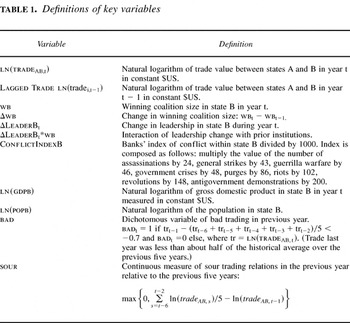
Definitions of key variables
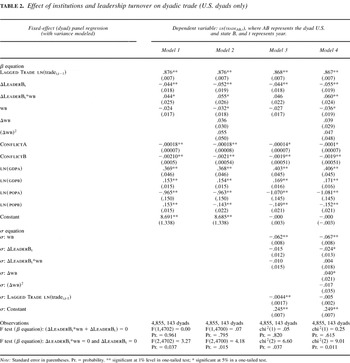
Effect of institutions and leadership turnover on dyadic trade (U.S. dyads only)
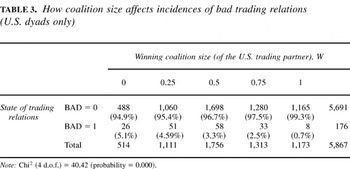
How coalition size affects incidences of bad trading relations (U.S. dyads only)
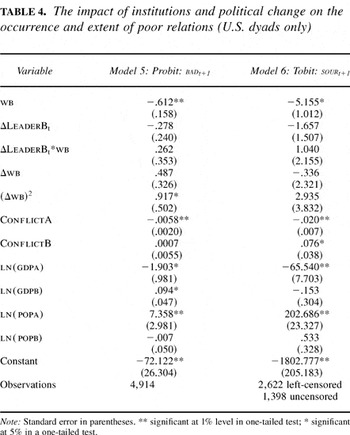
The impact of institutions and political change on the occurrence and extent of poor relations (U.S. dyads only)
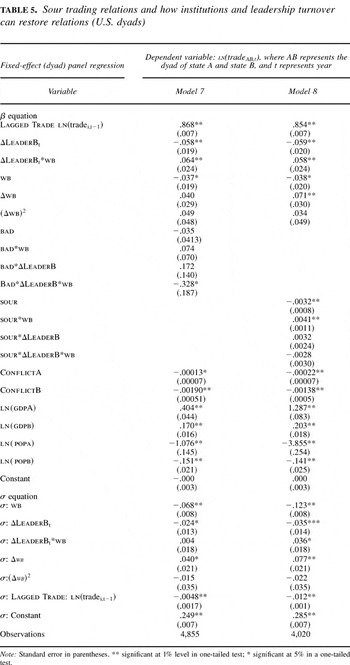
Sour trading relations and how institutions and leadership turnover can restore relations (U.S. dyads)
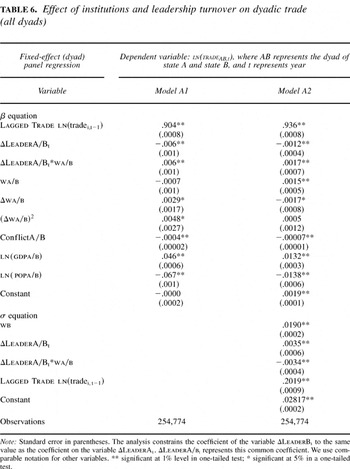
Effect of institutions and leadership turnover on dyadic trade (all dyads)
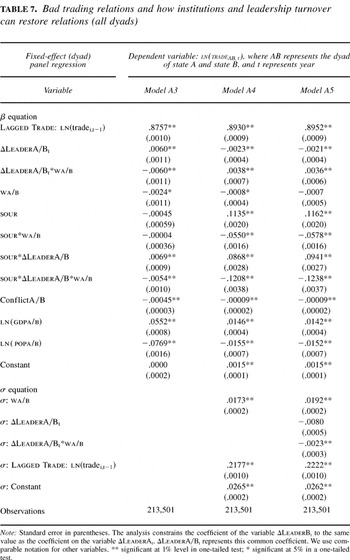
Bad trading relations and how institutions and leadership turnover can restore relations (all dyads)
 You have
Access
- 52
- Cited by