

Pitjantjatjara is a dialect of the Western Desert Language (WDL) of central Australia (Douglas Reference Douglas1958). The Western Desert Language is a member of the south-west Pama-Nyungan group. Together with Warnman, it forms the Wati sub-group. It is spoken by 4000–5000 people, and covers the widest geographical area of any language in Australia, stretching from Woomera in central northern South Australia, as far west as Kalgoorlie and Meekatharra and north to Balgo Hills, in Western Australia. The main dialects, which differ most in regards the lexicon but also to some extent in grammar and phonology, include Pitjantjatjara, Yankunytjatjara, Ngaanyatjarra, Ngaatjatjarra, Southern Luritja, Pintupi-Luritja, Kukatja, Gugarda, Ngalia, Wangkatja, Wangkatha, Manyjilyjarra, Kartutjarra and Yurlparija. It is perhaps more accurately conceived of as a dialect chain, whereby a dialect such as Pitjantjatjara is mutually intelligible with its neighbours Ngaanyatjatjarra and Yankunytjatjara, but not with dialects more distant than these, such as Kukatja and Manyjilyjarra.
Pitjantjatjara is spoken mainly in the north-west of South Australia, but extends north into the Northern Territory, and west into Western Australia. It shares a dictionary and learner's guide with Yankunytjatjara (Goddard Reference Goddard1993, Reference Goddard1996). Yankunytjatjara includes the area known as Ayers Rock (or Uluru in Pitjantjatjara/Yankunytjatjara).
The main speaker in these recordings is Kathleen Windy,Footnote 1 a 35-year-old Pitjantjatjara woman from Areyonga in the Northern Territory. She works with the community's young people as a sports and recreation officer, and comes from a family which is active in language maintenance and education. Areyonga is a small community of about 200 people, located about 230 km south-west of Alice Springs. It is a community in which Pitjantjatjara is the first language of infants, with English learned as a second language for communication with wider Australian society. Although Areyonga is considered a Pitjantjatjara community, it is very close to the border of traditional Arrernte land (see Breen & Dobson Reference Breen and Dobson2005 for an IPA description of Arrernte). Langlois (Reference Langlois2004) provides a vivid overview of teenage Pitjantjatjara speech in Areyonga.
Consonants

All examples show the consonant in word-initial position, except for the retroflex stop, nasal and lateral, the laminal lateral, and the trill/tap /r/, which do not occur in initial position. These consonants are illustrated intervocalically.
Also, the speaker in these recordings did not produce a word-initial la-, ru- or yi-, so these syllables are given in second (and final) position in the word.
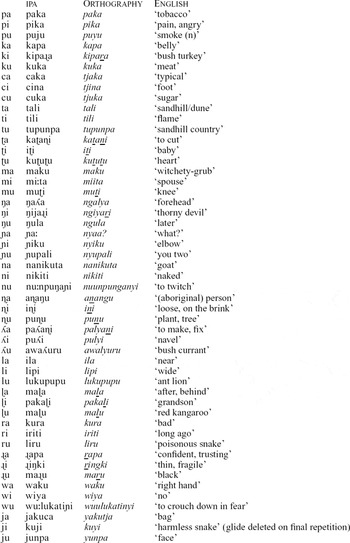
The Pitjantjatjara consonant inventory is typical of Australian languages in having many places of articulation, but comparatively few manners of articulation (Evans Reference Evans and Goldsmith1995, Butcher Reference Butcher, Harrington and Tabain2006). Specifically, it has five consonant places of articulation, including three coronals.Footnote 2 The coronals are divided into apical and laminal articulations – the apical articulations are in turn divided into alveolar and postalveolar (or retroflex) articulations. In contrast to neighbouring Arrernte, WDL is one of the Australian languages that do not make the distinction between different laminal articulations – that is, it does not contrast lamino-dentals and lamino-alveopalatals. The two types of laminal sound exist within Western Desert, but their occurrence is diaphonic rather than phonemic. Certain dialects, such as Ngaatjatjarra and Ngaanyatjarra have a more dental articulation for the laminal,Footnote 3 while others, such as Pitjantjatjara and Yankunytjatjara, have a more alveopalatal articulation. This is clearly audible in the form of a strong palatal off-glide in the speech of Pitjantjatjara speakers we have worked with, including the speaker in the current recordings, and is borne out by the static palatographic data presented in Butcher (Reference Butcher and Lewis1995). It should be noted that we use the palatal IPA symbols for these sounds /c ɲ ʎ/, so it is important to highlight the fact that these sounds are not dorsal palatals, but laminal alveopalatals.
Figure 1 presents averaged FFT (Fast Fourier Transformed) spectra of the three coronal stop consonants, centred at stop burst, and Figure 2 illustrates the strong affrication of the initial stop /c/. However, in intervocalic position, the lamino-alveopalatal may be lenited. These lenitions are more likely to occur between two vowels, both within and across word boundaries and irrespective of syllable position – an example can be heard in the word pikatjara ‘sick’ /ˡpikacara/.
FFT spectra of the three coronal stops of Pitjantjatjara, based on a 10-ms Hamming window centred at stop burst release. Data are from three female speakers, and represent a total of 684 tokens. The data in the top left panel show spectra collapsed across vowel context for the three speakers combined, whereas the remaining three panels show spectra for each stop consonant separately according to vowel context. It can be seen that the vowel /u/ has a profound effect on the spectrum for all three consonants, but that the effect differs for the two apical consonants /t/ and /ʈ/ as compared to the lamino-alveo-palatal consonant /c/.

Spectrogram of the word tjaa ‘mouth’. Note the strong frication following the release of the initial lamino-alveopalatal stop.

There is a nasal series which parallels the plosive series, including all three coronal places of articulation. Moreover, the lateral series also contains contrasts at all three coronal places of articulation, and there is also a rhotic contrast that is phonologically considered to parallel the apical contrast between alveolars and postalveolars (e.g. on the basis of distribution within the word): for the rhotics, the trill/tap /r/ is alveolar, and the continuant /ɻ/ is post-alveolar. Finally, Pitjantjatjara also has the glides /w/ and /j/.
The status of the apical contrast is problematic in many Australian languages, including Pitjantjatjara. Phonologically, the contrast is neutralized in initial position, and word-medially carries a very low functional load. As a result, the contrast is not very robust even in word-medial position: this is evidenced by the fact that even highly literate speakers are unsure of how to spell a word with an apical consonant, and often need to consult the dictionary (in Pitjantjatjara orthography, retroflex consonants are underlined, whereas alveolars are not – e.g. ‘t’ vs. ‘t’ – therefore, in the case of Pitjantjatjara, speakers are often unsure, when they write, as to whether or not a particular apical consonant should be underlined in the word). Nevertheless, speakers are taught the contrast in school, and are aware of minimal pairs, such as ‘wanka’ and ‘wanka’, given in the table of consonant clusters below. Finally, it should be noted that both apical stops are often tapped in connected speech. Such a pronunciation may be heard in speaker KW's recording of the words wuulukatinyi ‘to crouch down in fear’ /wuːlukatiɲi/, nanikuta ‘goat’ /nanikuta/ and nikiti ‘naked’ /nikiti/. In the case of the alveolars, since a single tap is also the most common realisation of the so-called trill, the two phonological categories /t/ ~ /r/ may become indistinguishable from one another. In addition, /r/ may be realised as an approximant in rapid speech, leading to potential confusion for non-native listeners. The word iriti ‘long ago’, for example, is often pronounced as [ˈɪɻɪɾɪ], thereby neutralising the paradigmatic /ɻ/ ~ /r/ contrast (whilst effectively preserving the /t/ ~ /r/ contrast within the word). This realisation of /r/ as [ɹ] or even [ə] is also very common before a following stop, especially in unstressed syllables – e.g. nyurka-nyurka ‘skinny’ may be pronounced as [ˈɲʊɾkɐɲʊ
 ɡɐ]Footnote
4
(compare the disappearance of non-prevocalic /r/ from the non-rhotic accents of English and German).
It is also important to highlight two features of Pitjantjatjara phonology which are typical of Australian languages but unusual outside Australia: there are no fricatives and there is no contrastive voicing. Thus, like most Australian languages, Pitjantjatjara belongs to the 16% of the world's languages which lack a voicing distinction among the stops and to the 6% of UPSID languages that have no fricatives (Maddieson Reference Maddieson1984); of these latter 21 languages, 15 are Australian. Although lacking in obstruents, Pitjantjatjara has a much richer system of sonorant contrasts than most languages outside Australia – 70% sonorants as opposed to 30% obstruents – precisely the opposite proportion to that proposed as the normal tendency amongst the languages of the world (Lindblom & Maddieson Reference Lindblom, Maddieson, Hyman and Li1988). As a result, spoken Pitjantjatjara sounds very sonorous to non-native speakers. In the phoneme chart, we use the voiceless unaspirated symbols for the plosives: this is the default production of these sounds, although voiced variants may be heard intervocalically or following a nasal consonant.
Vowels

Additional example words illustrating long vowels and surface diphthongs are as follows:

Pitjantjatjara has three vowel qualities [ɪ ɐ ʊ] – these are the symbols used on the vowel plot above. However, for phonemic purposes these are more commonly written /i a u/, and these are the symbols used in the phonemic transcriptions of the words. This three-way quality contrast is supplemented by a length contrast, giving /iː aː uː/ as separate phonemes. However, long vowels are low in frequency, and have a low functional load (the minimal pair nyiku ~ nyiiku /ɲiku/ vs. /ɲiːku/ ‘elbow’ vs. ‘here, take this!’ in the wordlist would be one of very few). Figure 3 presents an F1-F2 plot of the short and long vowels of Pitjantjatjara.
Vowel formant data from three female speakers of Pitjantjatjara, including speaker KW. Ellipses represent two standard deviations around the mean, which is plotted for each of the three short (/a i u/) and three long (/aa ii uu/) vowels. Data represent 5280 short vowel tokens and 178 long vowel tokens, collapsed across all consonant contexts in the language.

The vowel sequences /au/ and /ai/ (the latter often pronounced [ɛɪ]), as in pauni and mai, are usually analysed phonologically as bi-syllabic /awu/ and /aji/, respectively. There is no doubt, however, that these are phonetically diphthongs, and they can occur even in Pitjantjatjara words with a glide in the orthography – e.g. nyitayira ‘boy’ is often perceived by linguists as having only three syllables: [ˈɲɪɖɐɪɾɐ]. Goddard (Reference Goddard1993) suggests that /i/ before a postalveolar /ʈ ɳ/ or /ɭ/ is lowered and centralised (thus piti ‘hole’ → [ˡp
 ʈɪ], ini ‘loose’ → [ˡ
ɳɪ]), but we have not observed this to be the case with our speakers (e.g. speaker KW's production of ini and speaker MW's production of piti). Finally, it is worth noting that certain speakers of Pitjantjatjara pronounce the sequence /wa/ as [wɔ] or [wɒ]. Author AB has frequently heard this pronunciation, for example, wangka ‘speech’ as [ˡwɒŋgɐ], wala ‘quickly’ as [ˡwɒlɐ]. Author MT has never heard this pronunciation, which we attribute to the fact that AB's contact has been with speakers from South Australia, whereas MT's contact has been with speakers from the Northern Territory. It is possible that author MT's contacts are more influenced by orthographic conventions, having been taught to read and write Pitjantjatjara in school. It should be noted that the speaker in these recordings produces the sequence as [wɐ].
An acoustic study of vowel formants in the read speech of three Areyonga Pitjantjatjara women, including the current speaker, Kathleen Windy, shows minimal differences in vowel quality between metrically strong and weak syllables (Tabain, Fletcher & Butcher Reference Tabain, Fletcher and Butcher2014). However, formant analysis of the same text read by four speakers from Ernabella community some 20 years earlier suggests a more schwa-like quality for /a/ in weak syllables as compared to strong syllables. These results align with the two authors’ auditory impressions of Pitjantjatjara speech: author MT, who has worked with Areyonga speakers, has not noticed extensive vowel reduction, whereas author AB, who worked with the Ernabella speakers, has noticed vowel reduction. For example, the very frequent word mulapa ‘really’ is often heard as [ˡmʊlə
 ə] in conversational speech – see speaker Mike Williams's reading of the phrase iriti mulapa ‘really long ago’, where it is pronounced [ˡmʊləpɐ]. Moreover, in certain environments, for example between a stop and an approximant – and especially morpheme-finally – the vowel may be deleted altogether, e.g. ngarnkurpa wiya ‘without whiskers’ → [ŋɐɳɡʊɾbˈwɪjə].
Vowels are generally not nasalised before nasal consonants. Pitjantjatjara, like most Australian languages, avoids anticipatory coarticulation of nasality: both auditorily and through the visual inspection of spectrograms and air flow data (Butcher Reference Butcher1999), it is quite apparent that in vowel–nasal sequences speakers avoid lowering the velum until the latest possible instant. The exception to this rule is where metrically weak vowels occur between two nasals. In fact in fast casual speech a weak syllable consisting of a phonological N–V–N (or even N–stop–V–N) sequence may be realised phonetically as a long nasal, e.g. nganampa mai ‘our food’ → [ˈŋɐnɐmˈmɐɪ].
Pitjantjatjara syllable structure is (C)V(C), with the coda consonant restricted to nasals, laterals, and the trill/tap /r/. Moreover, CV syllables are highly preferred, to the extent that Pitjantjatjara (among other dialects of WDL) is renowned for putting /pa/ at the end of a word which in neighbouring Yankunytjatjara ends in a consonant. For example, where Yankunytjatjara speakers would say kuur-kuur ‘owl’ /kuːr kuːr/, Pitjantjatjara speakers would say kuur-kuurpa /kuːr kuːrpa/. It should also be noted that the onset consonant is optional only in word-initial position: Pitjantjatjara has lost the initial /j-/ which is still retained in traditional Yankunytjatjara (for instance Yankunytjatjara yananyi /janaɲi/for the word meaning ‘going’, in comparison to Pitjantjatjara ananyi /anaɲi/) – see speaker MW's production of the phrase yaaltjikutun ananyi? /jaːlcikutun anaɲi/ ‘where are you going?’.
Given the above syllable structure, consonant clusters may occur in word-medial position. However, there are no geminate clusters. Table 1 presents a brief summary of the consonant clusters in Pitjantjatjara – for more detail on the structure of phonological words in Australian languages, including phonotactic constraints, the reader is referred to Hamilton (Reference Hamilton1996).

Examples of consonant clusters. A dash denotes that the sequence is not phonotactically permissible. Note that examples are not exhaustive (e.g. there is no example of the homorganic alveolar lateral–stop sequence in the present recordings).

Notes: (i) C1 cannot be a stop or a glide. (ii) C2 cannot be a lateral or a rhotic. (iii) In homorganic clusters, C1 and C2 must have different manners of articulation. (iv) In heterorganic clusters, the first consonant must be coronal, and the second consonant must be non-apical. However, in sequences of two nasals, the second consonant must be non-coronal; and following /r/, the second consonant must be non-apical.
Perhaps the most noteworthy aspect of consonant clusters in Pitjantjatjara, as in most Australian languages, is that heterorganic nasal–stop sequences do not appear to develop into homorganic sequences. As a result, a minimal set such as /waŋka/ ~ /waɳka/ ~ /wanka/ ‘talk’ ~ ‘spider’ ~ ‘awake/alive’ exists – speaker KW provides a clear example of this set. Electropalatographic data from other Australian languages (e.g. Fletcher, Loakes & Butcher Reference Fletcher, Loakes and Butcher2008) suggests that the apical closure is present in almost all instances of words containing apical–velar sequences. In some of the present recordings there is a weak click at the release of the oral closure for the nasal in a heterorganic nasal–stop sequence. Butcher (Reference Butcher, Harrington and Tabain2006) speaks of the ‘place-of-articulation’ imperative in Australian languages, and such heterorganic sequences form part of the challenge in maintaining cues to place of articulation.
In contrast to the usual absence of anticipatory assimilation of nasality (in vowels), perseverative assimilation of nasality (in consonants) is very common. In connected speech there is often no differentiation in nasality within a consonant cluster, where in the corresponding citation form a nasal is differentiated from a following homorganic oral stop. This is particularly common in unstressed suffixes, such as ergative -ngku /ŋku/, locative -ngka /ŋka/ and possessive -mpa /mpa/, e.g. pulampa ‘those two’s’ → [ˈpʊlɐmːɐ]. This relates to a general tendency for words not to contain two nasal–stop clusters in sequence, the first instead being reduced to a simple nasal. For instance, when the word wati ‘man’ receives the ergative suffix -ŋku, followed by the non-finality particle -mpa, the result is not /wa.tiŋ.kum.pa/ but /wa.ti.ŋum.pa/. It is not clear whether this is a form of dissimilation (usually called elision in the grammar textbooks).
A brief note on prosody
There has been very little work on intonation in Australian languages in general, and this includes WDL and Pitjantjatjara. However, analyses presented in Tabain, Fletcher & Butcher (Reference Tabain, Fletcher and Butcher2014) show that the first syllable of the Pitjantjatjara word is marked by a raising of pitch and by extra duration, but that there is no evidence for secondary stress elsewhere in the word. These results are based on read text recordings of three speakers from Areyonga (including the present speaker, Kathleen Windy) and four speakers from Ernabella in South Australia. This goes against traditional grammatical descriptions of Pitjantjatjara, which often refer to alternating secondary stresses in the word (see Tabain et al. Reference Tabain, Fletcher and Butcher2014 for more detail).
Although far more detailed analyses are needed of Pitjantjatjara prosody and intonation, we refer the reader to Section VII of Douglas (Reference Douglas1955) which, broadly, seems to be a good impressionistic overview of the main intonation patterns in Pitjantjatjara. A very brief description of Pitjantjatjara intonation is also provided in Tabain et al. (Reference Tabain, Fletcher and Butcher2014), with the high pitch accent aligned with the left edge of the word being a characteristic feature.
Finally, the name of the language, which morpho-phonologically is /pi.caɲ.ca+ca.ra/ (i.e. with five syllables), is almost always pronounced [ˈpi.caɲ.ca.ra], with the final syllable of the first (ternary) foot deleted.Footnote 5 Such instances of syllable deletion are quite common in connected speech, especially where there is a succession of two identical (or even similar) unstressed syllables. It could therefore be argued that this is some phonological evidence for a left-headed binary foot structure, though as noted above there is no phonetic evidence for secondary stress, which appears to align with native speaker intuitions. Langlois (Reference Langlois2004: Chapter 2) provides an excellent overview of these syllable deletions, as well as of vowel deletions which result in surface consonant clusters otherwise not permitted in the language.
Transcribed passage
English
South Wind and Sun
South Wind and Sun were arguing.
They saw a traveller approaching. He was wrapped in a warm blanket. They said to one another, ‘Whichever of us can make that traveller take off his warm blanket is stronger than the other.’
So first South Wind started to blow. He blew really hard.
The traveller, however, wrapped his warm blanket more tightly around himself.
South Wind blew as hard as he could, in vain. Then Sun shone. It got really warm. The traveller very quickly took off his warm blanket. South Wind said, ‘Sun, you’re too clever for me.’
Pitjantjatjara
Walpa Ulpariranya Pula Tjintunya
Walpa Ulpariranya pula Tjintunya pikaringanyi.
Paluru pula nyangu yanngatja pitjanyangka, pulangkita unytjunpangka tjutura. Paluru pulanku ngaparku tjapiningi, ‘Nganalu puta yanngatja palumpa pulangkita unytjunpa waniku kunpu ngarala.’
Ka Walpa Ulpariratjalu puunu. Paluru pulkara puunu.
Ka yanngatjalu panya pulangkita unytjunpa palumpa pulkarangku witira tjutunu.
Walpa panya ulparira nguru puunu pulkarangku mulapa. Ka Tjintungku irnyanu. Ka unytjunpa mulaparingu. Ka yanngatjalu mapalku mulapa pulangkita unytjunpa palumpa waningu. Ka Walpa Ulpariratjalu wangkangu, ‘Tjintu nyuntu nintipuka mulapa ngayuku.’
Phonemic transcription
waɭpa uɭpaɻiraɲa pula ciɳʈuɲa
waɭpa uɭpaɻiraɲa pula ciɳʈuɲa pikariŋaɲi.
paluɻu pula ɲaŋu janŋaca picaɲaŋka, pulaŋkita uɲcunpaŋka cutuɻa. paluɻu pulanku ŋaparku capiniŋi, ŋanalu puʈa janŋaca palumpa pulaŋkita uɲcunpa waɳiku kuɳpu ŋaɻala.
ka waɭpa uɭpaɻiracalu puːɳu. paluɻu puɭkaɻa puːɳu.
ka janŋacalu paɲa pulaŋkita uɲcunpa palumpa puɭkaɻaŋku witiɻa cutuɳu.
waɭpa paɲa uɭpaɻira ŋuɻu puːɳu puɭkaɻaŋku mulapa. ka ciɳʈuŋku irɲaɳu. ka uɲcunpa mulapariŋu. ka janŋacalu mapaɭku mulapa pulaŋkita uɲcunpa palumpa waɳiŋu. ka waɭpa uɭpaɻiracalu waŋkaŋu, ciɳʈu ɲuntu niɳʈipuka mulapa ŋajuku.
Acknowledgements
We would like to thank our speakers for their interest in language work, and in particular Kathleen Windy for her support. We would also like to thank Hilda Bert, Charmaine Coulthard and Carolyn Windy for translating the South Wind and the Sun story into Pitjantjatjara, and Marg Purdam for her help with recordings. We are grateful to Adrian Simpson and two anonymous reviewers for their feedback. This research was supported by the Australian Research Council. Palya – thank you.



