Our physical appearance is an important factor in daily social interactions. Indeed, scholars in social psychology have provided compelling evidence that attractiveness stereotypes and the “halo effect” figure prominently in our daily lives, affecting the traits we attribute to others Reference Feeley1,Reference Lemay, Clark and Greenberg2 and they way we are treated by others. However, such an interest in the cognitive effects of physical attractiveness has not yet been applied to questions of mass-level political behavior. In light of the importance of personal experiences and social context as agents of socialization Reference Jennings, Stoker and Bowers3,Reference Sears and Valentino4 and evidence that physical appearance affects life experiences, Reference Berscheid, Lucker, Ribbens and McNamera5 there is good reason to believe that individuals’ physical attractiveness may alter their political values and worldviews.
Despite the social nature of politics, little ink has been spilled considering the effects of physical appearance on political life at the level of mass politics. Rather, the focus has been on examinations of how citizens perceive elites and particularly candidates. Reference Ballew and Todorov6,Reference Dumitrescu7,Reference Lawson, Lenz, Baker and Myers8,Reference Mattes and Milazzo9,Reference Atkinson, Enos and Hill10,Reference Carpinella and Johnson11,Reference Heflick and Goldenberg12,Reference Milazzo and Mattes13 Experimental evidence suggests that physically attractive candidates are perceived as significantly more competent. Reference Samochowiec, Wänke and Fiedler14,Reference Surawski and Ossof15 Additionally, when lacking further information, voters have been shown to prefer more attractive candidates, predicting the outcomes of elections between two political contenders based upon variation in appearance. Reference Olivola and Todorov16,Reference Spezio, Loesch, Gosselin, Mattes and Alvarez17
These effects hold outside of the lab, with more attractive candidates demonstrating significantly greater electoral success, even controlling for traditional explanations of campaign outcomes. Reference Milazzo and Mattes13,Reference Praino, Stockemer and Ratis18,Reference Rosar, Kleinz and Beckers19,Reference Stockemer and Praino20 The “attractiveness premium” is particularly prominent in low-information elections Reference Banducci, Karp, Thrasher and Rallings21 and for uninformed voters. Reference Stockemer and Praino22 Dumitrescu notes that in addition to aspects such as gender, skin tone, and body language, attractiveness is one of a number of important nonverbal cues to which voters react during campaigns. Reference Dumitrescu7
While citizens’ vote choices are seemingly affected by the appearance of the candidates they are choosing between, how might citizens’ own physical appearance affect how they view the world around them? If physical appearance affects how we interact with others and our political beliefs emerge as a by-product of our early life experiences, it stands to reason that appearance would also influence the development of individual political beliefs. Do physically attractive individuals develop in a bubble that creates a differential social experience and, subsequently, different political attitudes? In this article, we take advantage of two distinct datasets — the 1972–74–76 American National Election Studies (ANES) panel and the Wisconsin Longitudinal Study (WLS) — to examine the influence of physical attractiveness on political beliefs.
Our summary findings are twofold: more attractive individuals are (1) more politically efficacious than their peers, and (2) more likely to identify as conservative and Republican than less physically attractive citizens of comparable demographic backgrounds. Though the attractiveness effects are less substantively weighty than traditional drivers of partisanship such as income and education, the results are consistent across datasets and measures of attractiveness, and they persist even when controlling for socioeconomic status and demographics. While thinkers and theorists have often remarked on the health of the body politic, we show that it is also important to understand how the body shapes politics.
Socializing effects of appearance
While recent scholarship has suggested that many political orientations and behaviors are influenced by genetics, Reference Alford, Funk and Hibbing23,Reference Fowler, Baker and Dawes24,Reference Hatemi, Alford, Hibbing, Martin and Eaves25 even this line of research concedes that social environment is an important influence in producing behavior. Reference Hatemi, Funk, Medland, Maes, Silberg, Martin and Eaves26 In his discussion of neuroscience, innate behavior, and brain development, Marcus Reference Marcus27 uses an analogy of a book that parallels our thinking about the interplay between genes and socialization. “Nature provides a first draft, which experience then revises.” The cumulative experiences individuals have over the years prior to reaching adulthood have been shown to affect several choices adults make. Building from the pathbreaking work on socialization by Jennings and Niemi, Reference Jennings and Niemi28,Reference Jennings and Niemi29 subsequent research has shown socialization’s effects in the decision to obtain an education, Reference Kam and Palmer30 the political views that individuals hold as adults Reference Jennings, Stoker and Bowers3,Reference Jennings and Niemi28 and adult political activity. Reference Alwin and Krosnick31,Reference Beck and Jennings32,Reference Jennings and Markus33 While the primary agent of socialization is thought to be the family, Reference Dion, Berscheid and Walster38 children’s schools, their relationships with teachers, their peer networks, and historical context have also been shown to be potent forces in shaping adult beliefs. Reference Hughes, Rodriguez, Smith, Johnson, Stevenson and Spicer35,Reference Spencer36,Reference Thorton, Chatters, Taylor and Allen37
In this article, we posit the existence of another mechanism for socialization: physical appearance. Given that our appearance serves as an important factor in structuring our day-to-day interactions, we believe it also has a potent effect on the political beliefs individuals espouse in life. While race, socioeconomic status, and gender are powerful and traditional components of socialization and social interactions, it is a mistake to understate the lasting effects that variation of physical attractiveness may have on political attitudes and behavior. An individual who is less attractive and less politically efficacious may be substantially less likely to participate in politics, to seek redress for grievances, or to exercise their political rights. Therefore, physical attractiveness biases may produce substantial biases in political activism and the propensity for individuals to be empowered in politics and government.
Attractiveness, stereotypes, and social experiences
Prior work in social psychology has considered the substantial role that appearance and attractiveness play in shaping social interactions and social cognition. These studies typically use the framework of spillover effects or “halo effects” on perceptions of others that occur automatically when interacting with others. Individuals who are perceived as physically attractive are concomitantly attributed other positive traits. These “attractiveness stereotypes,” a term coined by Dion, Reference Dion, Berscheid and Walster38 lead people to evaluate attractive individuals as more intelligent Reference Lemay, Clark and Greenberg2,Reference Lorenzo, Biesanz and Human39,Reference Paunano40,Reference Sheppard, Goffin, Lewis and Olson41 and more successful in life. Reference Feingold42,Reference Jackson, Hunter and Hodge43,Reference Webster and Driskell44
Furthermore, these experiences begin early in life. Attractive children have been shown to experience warmer treatment from their own parents as well as perfect strangers. Reference Berscheid, Walster and Berkowitz45,Reference Bull and Rumsey46,Reference Langlois, Newman, Zanna and Higgins47,Reference Zebrowitz, Hall, Murphy and Rhodes48 Over a lifespan, these patterns of treatment appear to have a pronounced effect on the personality traits more attractive individuals exhibit in social situations, appearing to be more confident, extroverted, happier, and healthier as they reach adulthood. Reference Feingold42,Reference Eagly, Ashmore, Makhijani and Longo49,Reference Langlois, Kalakanis, Rubenstein, Larson, Hallam and Smoot50
The mechanism for this process is a simple one. By virtue of the treatment they receive as a result of their appearance, individuals become more likely to internalize positive or negative behavioral characteristics, Reference Adams51,Reference Lerner and Karabenick52,Reference Lerner, Karabenick and Stuart53,Reference Lerner, Orlos and Knapp54 thereby altering their behavior. This effect is potentially exacerbated by behavioral expectations, as posited by expectancy theory, which asserts that individuals alter their behavior in social situations based upon what they perceive to be expectations regarding their behavior. Reference Rosenthal and Jacobsen55
These social interactions not only influence behavioral characteristics but also have meaningful influences on perceived and actual life successes. As would be expected, better-looking students are perceived as being more capable. Reference Jackson, Hunter and Hodge43,Reference Kenealy, Frude and Shaw56 However, the advantages do not end there. Students who have more attractive personalities or are seen as well-groomed earn higher grade-point averages in high school, Reference French, Robins, Homer and Tapell57 in addition to receiving higher scores on standardized tests. Reference Ritts, Patterson and Tubbs58 More attractive individuals may also have greater levels of educational attainment, with evidence suggesting that those who are viewed as better looking spend significantly more time in school. Reference Judge, Hurst and Simon59,Reference Umberson and Hughes60
Appearance influences not only educational attainment and success in the classroom but also experiences in the workplace. The seminal article examining the relationship between physical appearance and income finds both a “plainness penalty” and “beauty premium” in adult earnings. Reference Hamermesh and Biddle61 Further work exploring this domain has confirmed these findings, Reference Benzeval, Green and Macintyre62,Reference Biddle and Hamermesh63 particularly among female workers. Reference French64 This beauty premium is attributed to increased confidence and communication skills, Reference Mobius and Rosenblat65 which, again, arguably are a product of differential treatment and experiences by virtue of being more or less attractive.
Attractiveness effects on political beliefs
How might these appearance-based experiences translate into political behavior? When evaluating the political sophistication of others, physically attractive individuals are seen as more knowledgeable and persuasive, and they are more likely to be sought out by others as political informants, regardless of their actual levels of political information. Reference Palmer and Peterson66 We posit that interactions that more attractive individuals have with others should have powerful and lasting effects on how those individuals come to understand not only their social world but the political world as well. We see clear parallels between the impact of a lifetime of differential treatment because of one’s appearance and the more specific process of political socialization, through which long-term political orientations are inculcated beginning at a young age.
Disentangling the effects of political socialization is a perpetual challenge, and determining the influence of physical attractiveness on political socialization is difficult because it broaches the interaction between physical attractiveness and household socioeconomics. It is plausible that physical attractiveness is partially determined by the socioeconomics of the household; children from households that can better afford and value cosmetics such as grooming, expensive clothing, and dental braces may engender the potential for attractiveness boosts in socialization. In other words, part of the halo effect may rest in the socioeconomics of upbringing, which would then shape individual political efficacy and ideological leanings.
While socioeconomics shapes individuals’ worldviews and, potentially, evaluations of attractiveness, physical appearance is arguably antecedent because it influences those socializing experiences. For example, Langlois and colleagues Reference Langlois, Ritter, Casey and Sawin67 find that parents treat children differently based on physical attractiveness, which means that our earliest interactions are altered by attractiveness. Analytically, researchers can attempt to control quantitatively for socioeconomic status (which we do in our modeling), but encapsulating socialization in social science models and particularly the influence of attractiveness remains challenging. Given these considerations, there are clear reasons why political attitudes and orientations such as efficacy are influenced by physical attractiveness.
Efficacy, or the sense that one is capable of having a meaningful influence on the political world, Reference Niemi, Craig and Mattei68 is our first political orientation of interest in this analysis. Efficacy has been shown to have a significant influence on an individual’s engagement in politics, with more efficacious individuals reporting increased attention to and knowledge about politics, as well as an increased propensity to participate.
We expect that attractive individuals should feel a stronger sense of efficacy because of their preadult experiences. More attractive individuals are treated differently from less attractive individuals, they are given greater assistance during social interactions, and they have greater propensities toward life success. Being treated as more successful leads individuals to internalize these feelings and behave as if they are more successful. Therefore, they should be more likely to believe they have a greater ability to affect the world around them and that their decisions will be influential. Specifically, we expect that more attractive individuals will report a greater sense of political efficacy; therefore, we predict the following:
- H1:
-
More attractive individuals will express higher levels of political efficacy than less attractive individuals.
We turn next to consider two of the most fundamental orientations for an understanding of how citizens engage with politics: ideology and partisanship. Both are thought to be important lenses through which citizens view the world, as well as powerful influences on the attitudes they hold.
Ideology is an overarching belief system that structures individual attitudes toward the proper ends for society and the means for achieving those ends. While past scholarship has raised questions about the ability of the average citizen to espouse a coherent ideology, Reference Converse and Apter69 citizens are not entirely innocent of ideology. Reference Levendusky70 Those individuals coming of age in politically engaged households and/or environments are more likely to espouse coherent belief systems in adulthood, as ideology is thought to be an orientation that is socially transmissible. Work considering how preadult experiences translate into political orientations suggests that rearing styles have a profound impact on adult ideology; notably, children who come from more authoritarian households tend to endorse more conservative ideologies. Reference Fraley, Griffin and Roisman71 Beyond this, however, ideology may also be an orientation that develops as a product of individual experiences more broadly, as citizens develop their sense of the proper ends for government and how those ends should be attained.
Partisanship, much like ideology, is an orientation that is a lens through which citizens view the political world. Reference Bartels72,Reference Campbell, Converse, Miller and Stokes73 Unlike ideology, partisanship is less a belief system and more a long-standing psychological attachment to or social identification with a political party Reference Green, Palmquist and Schickler74 that reflects shared beliefs with members of the party. Partisanship is one of, if not the most influential orientation individuals hold toward the political system, influencing the candidates that citizens choose to support Reference Lewis-Beck, Jacoby, Norpoth and Weisberg75 and the positions they take on issues. Reference Brewer76,Reference Carsey and Layman77,Reference Highton and Kam78 In addition, partisanship is said to allow voters to estimate issue positions of candidates under conditions of limited information Reference Conover and Feldman79 and influences how citizens attend to politics and the opinions they hold. Reference Bolsen, Druckman and Cook80,Reference Slothuus and de Vreese81 As with ideology, there is compelling evidence that partisanship is informed by experiences that individuals have while coming of age politically, including influence from one’s family and peer group.
While we concede that a good amount of partisanship is rooted in socialization in the family and genetics, Reference Alford, Funk and Hibbing23 physical attractiveness should also influence partisan identity. Because attractive individuals benefit from social interactions and are generally given more attention and granted more expertise, their passage through life may be “easier” (compared with less attractive individuals). Therefore, on average, they may not recognize the challenges others face in life. Such reasoning is consistent with work in psychology on the “just world” hypothesis, in which those who succeed are seen as harder-working or more deserving than those who fail. Reference Meland90 Similar reasoning has been shown to drive attractiveness stereotyping. Reference Dion and Dion83 In a sense, attractive individuals have a blind spot that leads them to not see the need for more government support or aid in society. Given that this is one of the tenets of more liberal citizens, as well as supporters of the Democratic Party, we would expect that more attractive individuals would develop a worldview that is less supportive of government intervention and aid to others.
Having not faced the challenges of other citizens, more attractive individuals should be less supportive of remedying these challenges for the general public. Even though this blind spot may not be universally held and physically attractive individuals do not always have easier lives, on average, physically attractive individuals face fewer hurdles navigating the social world. Consequently, we would expect that more attractive individuals would be more likely to identify as both conservative, and, relatedly, with the Republican Party. Recent elite-level research provides further support for this hypothesis. For example, in a study of the United States, Europe, and Australia, Berggren and colleagues Reference Berggren, Jordahl and Poutvaara84 find that more attractive politicians are more likely to lean right ideologically. Our second hypothesis thus predicts the following:
- H2a:
-
More attractive individuals will be more likely to self-identify as conservative.
- H2b:
-
More attractive individuals will be more likely to identify with the Republican Party.
One refinement of this expectation is that partisanship may yield a cleaner relationship than ideology. As noted earlier, ideology is less firmly held in the mass public, and individuals vary substantially in the meaning and identification of ideology. Reference Converse and Apter69,Reference Kinder85 Ideological effects might be further complicated in our analysis because of the time period of our data. The relationship of ideology may be weaker in the ANES analyses than the WLS because ideology was less clearly sorted between political parties in the 1970s compared with the 2000s, Reference Levendusky70 when the WLS was conducted. In contrast, party and partisanship are a stable and largely fixed point of reference in American politics, with the public able to coherently differentiate between the two parties and their ideological differences, brands, and broad tenets. Reference Claassen and Highton86
Data and methods
The paucity of work examining the political implications of physical appearance at the individual level is partially due to a lack of datasets containing both measures of attractiveness and viable political variables. To test the foregoing hypotheses, we take advantage of two relatively unique datasets: the 1972–74–76 American National Elections Studies panel study and the Wisconsin Longitudinal Study.
The two datasets allow us not only to replicate and provide robustness checks for our findings but also to mitigate concerns regarding potential biases in assessments of individuals’ appearance. The conceptualization of what is attractive could, in theory, vary somewhat across individuals, although evidence suggests that criteria for attractiveness appear to be consistent within cultural groups, Reference Cunningham, Roberts, Barbee, Druen and Wu87 universal and determined by social consensus, Reference Berscheid, Walster and Berkowitz45,Reference Hatfield and Sprecher88 and stable over time. Reference Zebrowitz, Olson and Hoffman89 Additionally, recent research has demonstrated relative consistency across evaluations of appearance, regardless of who is doing the evaluating. Reference Praino, Stockemer and Ratis18,Reference Berggren, Jordahl and Poutvaara84
Variables
As specified in the hypotheses, our key dependent measures are political efficacy, ideology, and partisanship. Political worldview measures consist of ideology, coded from 1 (extremely liberal) to 7 (extremely conservative), and partisanship, coded from 1 (strong Democrat) to 7 (strong Republican). We opt to code the variables this way because it allows us to maximize the variation in strength of attachment to a political worldview as a function of physical appearance and demographic factors. Supplementary analyses in which we collapse these variables to ordinal scales provide patterns of results similar to those reported here. External efficacy is an additive index of two items with binary responses asking whether the respondent feels he or she has any say in government and whether government officials care what he or she thinks, with yes indicating higher efficacy and no lower efficacy. For ideology and partisanship, we rely on the traditional 7-point scales demonstrating not only attachment to a worldview but also the strength of that attachment, with items coded to run from most liberal/Democratic to most conservative/Republican. External efficacy items are whether the respondent feels he or she has any say in government, and whether officials care about what the respondent thinks. All items are recoded to 0 (low efficacy) or 1 (high efficacy), combining into a 3-point scale running from 0 (low external efficacy) to 2 (high external efficacy).
In the ANES, our measure of attractiveness is taken from an interviewer’s single, subjective rating following the completion of the interview. Similar to the traditional ANES interviewer assessments, these were made on a 5-point scale. In this case, interviewers were asked to rate the respondent on a scale from 1 (homely) to 5 (strikingly handsome or beautiful). Specifically, the battery asked respondents to evaluate the respondents’ physical appearance, taking into account the age and sex of the respondent. The attractiveness-rating item was completed at the end of the interviewer’s subjective evaluation battery.
In addition, to serve as a replication and extension, we supplement this measure with a more detailed item collected in the WLS, which consists of normed ratings from 12 evaluators (6 men and 6 women), collected entirely distinctly from the interview process. Rather than a measure taken by a single interviewer, attractiveness ratings were collected separately by a series of coders. Respondents’ high school yearbook photos from 1957 were collected and rated by 12 individuals (6 men and 6 women), with the subsequent scores being normed to remove coder effects. Coding occurred in two waves, in 2004 and 2008. Yearbook photos were cropped and converted to grayscale to ensure comparability, and they were rated by individuals from roughly the same birth cohort as those they were evaluating (see Meland Reference Meland90 for more details on coding in the WLS). This exogenous, more robust measure of appearance safeguards the validity concerns of the ANES measure, and the longer duration of the time series gives us greater leverage on the socializing effects of appearance on political behavior. Together, we believe these distinct assessments of appearance will provide us with a valid picture of how physical attractiveness influences adult political beliefs.
Yet we are cognizant of the possibility that any individual assessment could be conflated with characteristics such as socioeconomic status; our models also take into account measures of respondents’ age, income, education, gender, and race to mitigate these concerns. Age is measured in years, ranging from 18 to 98 in the ANES data and 62 to 73 in the WLS data. Income is measured categorically, ranging from $0 to $35,000 in the ANES and $0 to $710,000 in the WLS data. Education is measured in years of formal schooling obtained in the ANES and WLS data. Gender in the ANES and WLS is coded 1 for female and 0 for male. Race is coded as 1 for nonwhite and 0 for white in the ANES. In the WLS, there is insufficient racial variance to take race into account. We control for demographic and socioeconomic factors in our models because they are standard and powerful explanations for individual political attitudes, allowing for a more conservative test of the independent effects of physical appearance. To facilitate comparisons between coefficients, all variables are rescaled to run from 0 to 1.
Analysis strategy
Our analyses begin with a measure from the preelection wave of the 1972 ANES. Interviewers were, in addition to the other assessments, asked to evaluate respondents’ appearance. This is the only wave in which attractiveness was evaluated. Because the 1972 wave was the start of a panel, we can examine not only whether a relationship exists between interviewers’ perceptions of respondents’ physical attractiveness and political beliefs but also the extent to which the relationships persist over time. As noted earlier, attractiveness ratings tend to remain consistent across the lifespan and appear to be relatively invariant based upon the rater. The 1972 ANES consisted of pre- and postelection waves, with 2,191 completing both waves. Follow-ups were conducted following the election in 1974, and finally, a pre- and postelection survey was fielded in 1976. We focus our analyses initially on those respondents who completed the preelection wave in 1972 (when key interviewer assessments were completed) and subsequent analyses on the 1,624 respondents completing the 1974 reinterview and the 1,320 respondents who completed all three waves of the panel.
To test our hypotheses, we examine the effects of attractiveness on political efficacy and political worldview (ideology and partisanship). Each of the measures are regressed on the interviewer’s assessment of the respondents’ attractiveness and controls for respondents’ age, income, education, gender, and race. Socioeconomic factors such as income that may influence partisanship and ideology, and potentially pollute our measure of attractiveness, are added as controls in each model. Taking advantage of the panel nature of the data, we estimate separate models (where data are available) for each of the three waves.
Results
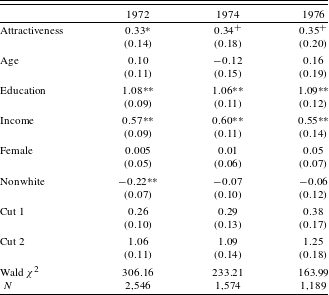
We begin by considering the relationship between physical appearance and political efficacy. The results of these ordered probit models appear in Table 1. Across the waves, more attractive individuals are more likely to hold efficacious beliefs, as posited by H1. In the first wave, physical attractiveness has a clear, positive, and significant effect on efficacy; in the latter waves the effect closely approaches, but does not reach, conventional levels of significance. Physically attractive people would seem to not only have an easier time navigating the social world but feel more efficacious in the political world as well. Our socioeconomic control variables are in the expected direction and significant; higher education and income correspond to higher feelings of efficacy. Though socioeconomic factors are stronger predictors of efficacy, the attractiveness effects are not negligible and appear consistently connected to one’s feelings of efficacy.
Relationships between attractiveness and political efficacy, ANES.
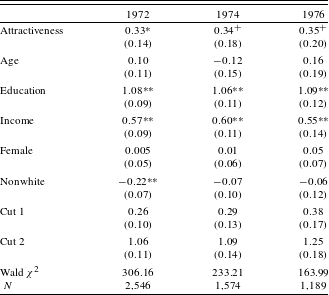
Note: Estimates are ordered probit coefficients with robust standard errors in parentheses. Dependent variable: political efficacy, from 0 (low external efficacy) to 1 (high external efficacy).
 $^{+}p<0.10$
;
 $^{\ast }p<0.05$
;
 $^{\ast \ast }p<0.01$
.
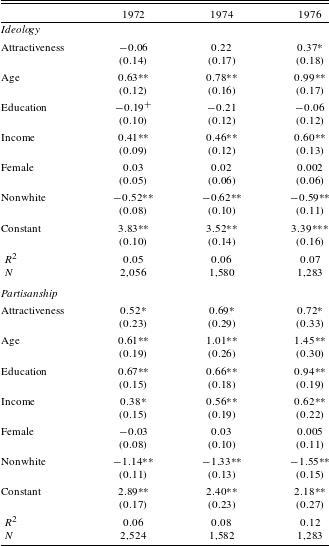
Relationships between attractiveness and political worldview

Note: Estimates are OLS coefficients with robust standard errors in parentheses. Dependent variable: ideology/partisanship, from 1 (strong liberal/Democrat) to 7 (strong conservative/Republican).
 $^{+}p<0.10$
;
 $^{\ast }\,p<0.05$
;
 $^{\ast \ast }\,p<0.01$
.
Our second analysis of the ANES considers the role of physical appearance on the core political beliefs of ideology and partisanship. The results of the initial ordinary least squares (OLS) regressions testing H2a and H2b are presented in Table 2. Our results for ideology are mixed. In 1972 and 1974, attractiveness is not related to ideology. However, the effect of attractiveness on ideology is significant and in the hypothesized direction in the final wave of the panel; more attractive individuals are more likely to identify as conservatives. Our findings for partisanship are more robust with attractiveness consistently influencing partisanship in the expected direction across all waves. More attractive individuals are more likely to identify as Republicans, rather than Democrats, as expected in H2b. Our socioeconomic control variables behave as expected, with higher-income individuals more likely to identify with the Republican Party and to identify as more conservative.
These results lend positive evidence to the socializing experiences expected in our first hypothesis. Respondents with higher physical attractiveness are more likely to identify with the Republican Party. Moreover, we also should note that these effects persist across the panel. While the substantive effects are not as large as the more traditional, socioeconomic explanations for political worldview that we include as controls, they are present and persistent.
Taken together, these results present compelling evidence that individual physical appearance plays a compelling role in how citizens view the political world. More attractive individuals are more politically efficacious, which illustrates the moderating effect that appearance has in the process of political socialization. The impact of appearance persists across waves, suggesting that these effects are representative of an underlying process of socialization into politics, as well as into broader society. More attractive people appear to have different experiences with the world from the less attractive, and these experiences translate into greater degrees of engagement with the political realm.
Yet we have concerns that these effects may be tied to a unique period of time, or they may simply be an artifact of interviewer biases. While the era being examined was far from unrepresentative of the quintessential American political experience, many would claim that politics has changed greatly since the 1970s. As robustness checks, we test for attractiveness effects using an additional, more recent dataset while also examining the effects of varied measures of attractiveness.
Exogenous factors
While we believe that the interviewer’s subjective ratings of respondent characteristics in the ANES are relatively unbiased, and we have attempted to account for factors that could influence the interviewer, such as socioeconomic status, our ratings of appearance are still potentially endogenous. Furthermore, they are the product of a single interviewer’s evaluations and could also be biased by the predilections of that individual, rather than representing a more global evaluation of their appearance. While this could overstate the effects presented in the previous analyses, it could also understate the impact of appearance on political beliefs.
To safeguard against this possibility and as a robustness check, we utilize the Wisconsin Longitudinal Study. The WLS is a longitudinal study of 10,317 respondents who graduated from Wisconsin high schools in 1957. Data were collected across several waves from the respondents, their parents, and, in certain waves, selected siblings. For our purposes, we examine data collected in 2004 and 2011.
We replicate the findings from the ANES using the normed assessment of the respondents’ physical appearance from the WLS (originally measured on an 11-point scale by each rater, which we rescale to run from 0 to 1). As with the ANES, interviewers were asked to assess respondents’ cooperation and engagement with the interview, as well as the respondent’s appearance following its termination. Interviewer characteristics are again unavailable to account for potential biases due to the age, race, or gender of the interviewer. Though the WLS does not have a measure of political efficacy, it does contain ideology and partisanship. The outcomes of interest, therefore, are the individuals’ self-reported partisan identification and ideology. Ideology is measured using the traditional seven-point ideology scale (coded from extremely liberal to extremely conservative). Ideology items are only assessed during the 2004 and 2011 waves of the survey. Partisanship is measured as a 5-item scale, as respondents were asked whether they identified as a Republican, Independent, or Democrat — or were uncertain. Those identifying as uncertain or identifying with third parties were coded as Independents, but results are unchanged if they are omitted from the analyses. Partisanship is only measured in the 2004 and 2011 waves of the survey. We also include controls for age, education, income, and gender in the estimated models. All independent variables are coded from 0 to 1 to ease interpretation of effects and increase comparability between coefficients.
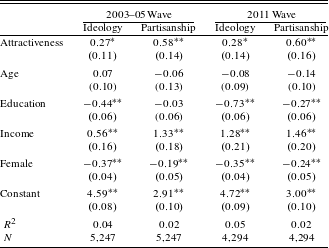
The results in Table 3 serve as a compelling corroboration of the prior results from the ANES. As in the previous models, we see that more attractive individuals are more likely to identify as more conservative. We also see that attractive individuals are more likely to self-identify as Republican. The socioeconomic variables behave as expected with higher incomes corresponding to more Republican and conservative identification. Further, women in the sample are more likely to identify with the Democratic Party and as liberal.
Wisconsin Longitudinal Study

Note: Estimates are OLS coefficients with robust standard errors in parentheses. Dependent variable: 1 (Democrat) to 5 (Republican), and 1 (strong liberal) to 7 (strong conservative).
 $^{+}p<0.10$
;
 $^{\ast }\,p<0.05$
;
 $^{\ast \ast }\,p<0.01.$
These results yield further evidence that attractiveness plays a role in shaping citizens’ views of their political reality, significantly influencing partisan identification and ideological worldview. It does not appear that the ANES results are illusory because of the era of the data or the measurement of attractiveness. We have replicated our previous findings while diminishing the applicability of the critique that the interview process biases our observed measure of attractiveness. These effects are present even when controlling for the important socioeconomic variables of education and income. It is often said that demography is not destiny, and for our purposes, neither is attractiveness. The primary causal drivers of partisanship are still family, genetics, and socioeconomics. In other words, we are cognizant that attractiveness is not the be-all and end-all for political socialization, but across our analyses, physical attractiveness does have a significant and robust influence on political efficacy, ideology, and partisanship. The social nature of politics engenders an environment where our physical bodies can shape our political interactions and beliefs.
Discussion
Politics is at its heart a social endeavor. At their foundation, individuals’ views regarding the proper means to and ends of politics are a combination of inherited characteristics and learned behaviors that are products of their social environment. Over the years, we have learned much about the separate effects of these influences, with genetic explanations for political behavior being privileged in some situations and socialization in others. Reference Alford, Funk and Hibbing23 In this article, we have considered the political implications of a factor that encompasses both processes: physical appearance. Arguably, appearance is a product of genetics, inherited from one’s parents, but also affects how individuals are treated and thus experience the world around them.
Given the substantial influence of attractiveness on social interactions and outcomes, it makes sense that attractiveness would further alter political interactions and beliefs. Yet attractiveness, beyond the elite level of political candidates, is rarely examined in political behavior. Our evidence shows that more physically attractive individuals are more politically efficacious. Further, we find that attractive individuals are more likely to identify with the Republican Party and more likely to be conservative.
While this is an interesting set of findings, there are larger implications given the evidence that attractive individuals are more politically efficacious. With the demonstrated influence of political activists and opinion leaders on mobilizing citizens, Reference Rosenstone and Hansen91 and influencing the views that less engaged citizens hold, Reference Ahn, Huckfeldt and Ryan92,Reference McClurg93,Reference Richey94 and the greater social influence that more attractive individuals are thought to have, we may surmise that more attractive individuals may hold political sway over others in their social networks, regardless of their actual levels of effective political knowledge. Research in a similar vein has demonstrated that more attractive individuals are subjectively perceived as more intelligent and politically knowledgeable, even after accounting for their objective levels of political information. Reference Palmer and Peterson66 If attractive individuals are also more efficacious and more likely to persuade others, we may have further concerns for the quality of opinion leadership and participation. While it may be tempting to conceive of attractiveness research on its surface as shallow or secondary to other components of socialization, it is a mistake to understate the lasting effects that a lifetime of differential treatment may have on political attitudes and behavior. Those who are not blessed with good looks will be less likely to feel empowered, to participate in politics, to seek redress for grievances, or to exercise their political rights. Physical attractiveness research at the elite and mass levels can illuminate biases that produce inequality in political activism and the propensity for individuals to be empowered in politics and government.
If attractive individuals are more efficacious and likely to lean conservative, do these results imply that Republicans have an electoral advantage? A host of variables influence elections, and especially in close races, even a substantively small factor may swing political outcomes. Recent research suggests that conservative-leaning candidates in the United States and Europe are more physically attractive on average than their left-leaning counterparts, which under some conditions leads to an electoral advantage. Reference Berggren, Jordahl and Poutvaara84 At the mass level, if attractive individuals are more likely to be conservative and to be more politically efficacious, the result could be an advantage at the ballot box, particularly if there are differential participation rates. Although it is tempting to weigh these implications, our analysis cannot speak directly to this question. Given the multivariate influences on partisanship and participation, we are hesitant to make firm claims on whether a Republican electoral advantage manifests itself at the ballot box.
As with all research, there are limitations to our results. Finding reliable and valid measures of attractiveness is challenging. Many of our analyses rely on a single, subjective assessment of an individual’s physical appearance taken at a particular moment in time, rather than a measure captured repeatedly. It is possible that the subjective assessment is somehow contaminated by other factors that are a part of the interview process, including respondents’ responses to the survey. We have attempted to mitigate this concern by utilizing the WLS sample to corroborate our ANES results. Using an attractiveness measure that avoids the ANES interviewer evaluation pitfalls, we have corroborated and bolstered our results. Moreover, we are comforted by extant work suggesting that evaluations of attractiveness are unaffected by characteristics of the interviewer and the respondent. Reference Webster and Driskell44 Additionally, we see that significant effects of attractiveness persist across waves of the panel and while controlling for socioeconomic variables, suggesting that the subjective measure is in fact a proxy for our underlying mechanism.
In this analysis, we have attempted to bring forth a novel factor, attractiveness, that affects citizen socialization into adulthood and concomitantly into the political world. While attractiveness is a well-researched topic in social psychology and social life, the findings presented here further our understanding of the motivations underlying political behavior. Future work could build upon these findings by considering and attempting to measure directly the processes through which physical appearance alters how individuals are perceived and treated politically and by directly capturing how these processes are altered with subtle variations in measurement of attractiveness by using experimental methods. Our physical body is frequently overlooked in political science, where the competition is framed around hearts and minds, but this analysis shows that our physical attractiveness can significantly shape our political behavior.
Note
The Stata do-file to replicate the analyses in the article is available as supplementary material on Cambridge Core.
Appendix
ANES Question Wording
Political efficacy:
-
∙ Do people like R have any say in what the government does?
-
∙ Do officials care much what people like R think?
Ideology:
-
∙ We hear a lot of talk these days about liberals and conservatives. I’m going to show you a 7-point scale on which the political views that people might hold are arranged from extremely liberal to extremely conservative. Where would you place yourself on this scale, or haven’t you thought much about this?
Partisanship:
-
∙ Generally speaking, do you think of yourself as a Republican, a Democrat, an Independent, or what?
-
∙ Would you call yourself a strong Democrat/Republican, or a not very strong Democrat/Republican?
Wisconsin Longitudinal Study Question Wording
Ideology:
-
∙ Where would you place yourself on a Liberal and Conservative political scale? (7-point scale; extremely liberal to extremely conservative)
Partisanship:
-
∙ Generally speaking, do you think of yourself as a Republican, Democrat, Independent, or other? (probe for leaners versus pure Independents)