On 10 November 1952, people from across the region of Mount Kilimanjaro, Tanganyika gathered in the district seat of Moshi to celebrate the first annual Chagga Day. This event, organized by the Moshi District Office and the Chagga Native Authority, commemorated the previous year's election of Thomas Marealle as the first popularly chosen paramount chief, or mangi mkuu, to preside over the mountain's numerous chiefdoms. The celebration started with prayer services held at the Catholic and Lutheran churches, followed by a ceremony attended by major local dignitaries District Commissioner J. B. Stubbings and Tanganyika Governor Sir Edward Twining.Footnote 1 At this time, Marealle raised for the first time a Chagga flag, and both he and District Commissioner J. B. Stubbings delivered speeches praising the progress made in the past year and touting the high prospects for the future. The day concluded with a sundowner, more speeches, live music and dancing, and an evening football match. For the next eight years, the event was one of the largest annual parties in the region, with thousands attending from the mountain and nearby areas.Footnote 2
In their speeches, Twining and Marealle declared Chagga Day to be more than just a celebration of an election; they praised it as a sign that the people had finally embraced their common identity as Chagga. Marealle himself proclaimed that it commemorated the day when ‘the Chagga tribe miraculously came together in a unity’.Footnote 3 Since the dawn of European rule in the 1890s, colonial officers had referred to the mountain's disparate residents as a single people – ‘the Chagga’. This designation stemmed from their perception of the mountain as a single, unified landscape, as well as from the similarities of the various mountain communities in terms of agricultural and cultural practices. The people, however, largely eschewed this term. Most referred to themselves by the names of their respective clans and chiefdoms, and though they recognized their commonalities as mountain people, they rarely expressed a common identity. In the interwar years, as the burgeoning coffee industry brought tremendous wealth to the mountain, European administrators became frustrated that economic ‘progress’ was met with neither political centralization nor a greater sense of social cohesion. The events of 10 November, therefore, signaled to many of these individuals a major achievement in the political development of the mountain region and its further integration into the colonial state.
But what did the celebrations of Chagga Day actually mean? Did they signify the emergence of a sense of common identity, and if so was this an inevitability, the end of an evolutionary process? Indeed, many histories of Kilimanjaro – by Bruno Gutmann, Charles Dundas, Kathleen Stahl, Susan Geiger Rogers, and others – describe a relatively linear, straightforward process of political and social cohesion, a coming together of disparate mountain people into a unified community.Footnote 4 In recent years, however, historians of Africa have vehemently challenged such frameworks. Scholars such as John Lonsdale, Terence Ranger, Thomas Spear, and Leroy Vail have shown identities to be actively produced and contested, inspired by certain historical moments and drawing off of real and imagined pasts.Footnote 5 Thus identity formation is definitely not linear and is anything but inevitable. Recent studies have brought some of this analytical depth to our understanding of Kilimanjaro, but they still leave many questions unanswered. Fausto Mkenda, in a piece on Chagga identity before 1886, emphasizes the importance of geography and shared culture in building what he describes as a ‘largely unbounded identity’, but his analysis implies that identity is a natural development rather than something actively constructed and leveraged.Footnote 6 François Devenne and François Bart also look to the importance of shared landscape in building a common sense of being.Footnote 7 While they emphasize that a sense of unity came with political debates related to coffee, this point remains underdeveloped. Emma Hunter's insightful work looks at how the early writing on Kilimanjaro (particularly travel writing and ethnic histories) set out ‘a linear notion of historical progress that blots out contested visions and ideas’.Footnote 8 As a counter, she examines the debates concerning paramount chieftaincy and in particular the role of the Kilimanjaro Chagga Citizens Union (KCCU). While this work provides an illuminating look at how debate shaped the emergence of political identity, it is limited by its focus on one organization that operated for a narrow window of time. Consequently it does not develop the extent to which these debates were part of a longer process, centered on fears over access to the mountain's natural resources. Another unanswered issue is why the people, in forging a sense of mountain-wide identity, chose to embrace the specific term ‘Chagga’. Likely of Swahili origin, it originated outside the mountain, used at first by caravan traders to describe the mountain's populations and later adopted by European explorers and colonial officials. Yet the scholarship has not asked why people chose to adopt this specific term, as opposed to any others, nor has it looked at how people contested the very meaning of the term.
In this article, I extend the recent scholarship on ethnic identity formation in African history with the goal of rethinking our understanding of the term ‘Chagga’. Drawing on a range of sources – published works on Kilimanjaro, colonial government documents and scientific studies, mission journals, and interviews I conducted on Kilimanjaro in 2004 and 2008, I argue that the rise of a Chagga political identity on Kilimanjaro can best be understood in the context of intensive debate over the control of natural resources. Well before the colonial period, notions of identity had been linked not just to the nature of the mountain landscape, but also to specific questions of who has rightful access to land and water. By identifying as members of clans and chiefdoms, people gained access to land for creating homesteads, water furrows for irrigation, and other necessities. These identities also served to protect resources from neighboring mountain peoples and others. In the twentieth century, colonial officials and missionaries promoted Chagga identity as a means of healing old divides and bringing the mountain together for economic benefit and political expediency. The chiefs (mangis), who had become governing agents of the colonial state, leveraged the term as a means of justifying the allegedly traditional roots of new policies, but the general population continued to self-identify as members of their respective chiefdoms and clans. In the 1940s, however, increasing land and water scarcity fueled popular resentment of the mangis and the colonial state. Those leading the charge against the mangis, a grassroots mixture of disgruntled clan headmen and coffee farmers, began to leverage the term Chagga that had been promoted by the very agents they were contesting. In doing so, they disentangled the term from its colonial context and infused it with new meaning and a sense of purpose. The election of the first mangi mkuu (paramount chief) in 1951 can thus be seen as an intervention in a debate over the political future of Kilimanjaro as well as an attempt by grassroots groups to mobilize a sense of common identity to transform the existing political regime.
By looking at the significance of resource control in the development of political identity on Kilimanjaro, it becomes evident that the events of 10 November 1952 did not mark the end of a natural process of ‘coming together’, nor did they indicate feelings of greater incorporation into the colonial state. Rather, they show the extent to which people contested the very meanings of the term Chagga. The sense of political identity that is evident in the 1950s thus resulted from intense debate, and the desire of ordinary people to resist the encroachment of the colonial state in local affairs and the perceived self-serving attitudes of the chiefs. These events thus add to our understanding of how ethnic identities have been constructed, highlighting not only the importance of natural resources, but also the vital role of contestation and debate within communities.
POLITICAL IDENTITY IN THE HISTORY OF KILIMANJARO
The fertile, well-watered slopes of Mount Kilimanjaro have for millennia been home to various societies. Ancestors of the present Bantu-speaking populations began to settle the lower slopes of the mountain in successive waves beginning more than 1500 years ago.Footnote 9 These migrants likely came from nearby highland areas and settled on the mountain's southern and eastern slopes (at altitudes between 4,000 and 8,000 feet). Settlements tended to be located on ridges, separated by deep valleys formed by the fast-moving rivers and streams headed toward the plains. These peoples developed an agrarian economy based upon intensive cultivation of yams, bananas, finger millet, and other crops in small homesteads called kihamba. Over several centuries, each ridge of the mountain developed into an autonomous political space comprised of several different clans, each led by ranking headmen and ritual specialists.Footnote 10 Though politically independent, clans on the same ridge often forged alliances for purposes such as defense, and also had regular contact with those on neighboring ridges through both warfare and markets.Footnote 11 As a result, though politically distinct, people across the mountain came to share common agricultural techniques and cultural practices. In terms of language, Derek Nurse asserts that numerous minor dialects of a single language are spoken on the mountain, the dialects falling into three major groups defined geographically from west to east: West Kilimanjaro, East Kilimanjaro, and Rombo.Footnote 12 These comprise a dialect continuum, meaning that people in neighboring areas could understand one another well while those at the far reaches would have found much of one another's speech unintelligible.
One of the more revealing similarities among the mountain's disparate communities is how they defined themselves and others according to the physical spaces they inhabited. Ludger Wimmelbücker, in his book Kilimanjaro: A Regional History, discusses this through the observations of early European explorers.Footnote 13 For example, Johannes Rebmann, in his diaries and letters to Johann Krapf and the Church Missionary Society, claims that people referred to themselves as Wakirima, meaning ‘mountain people’, and in turn referred to people living beyond the mountain as Wanyika or ‘people of the plains’.Footnote 14 Another term of classification, one noted by Moritz Merker, was wandu wa mndeny or ‘people of the banana groves’.Footnote 15 People used this to contrast themselves from the wasi or hunter-gatherers, and humba and kuavi, meaning pastoralists. These terms indicate the extent to which landscape influenced how people thought of themselves and others. Wakirima and Wanyika imply the importance of the mountain in juxtaposition to the plains. The people living on the mountain believed themselves to be the beneficiaries of divine benevolence, living in a lush, well-watered landscape, in contrast to the peoples living in the semiarid steppe, such as the Maasai. Wandu wa mdneny, wasi, humba, and kuavi, meanwhile, indicate the importance of subsistence. Bananas were not only the staple crop of the mountain, but also were the defining feature of the kihamba and of everyday life. They implied a certain form of political and social order, which was in turn perceived as absent from the peoples of the plains. In spite of the existence of terms such as Wakirima, people tended not to emphasize a shared mountain identity, and a sense of shared political identity was entirely absent. Rather, they identified with more local entities such as families, clans, and age-sets.
In the nineteenth century, chiefdoms became increasingly important as units of social and political organization, and in turn chiefdom names became a common means of identification. Chiefdoms were confederations of the clans on a given ridge, led by a mangi, who was usually the leader of the dominant clan. Over the century, the overall number of independent polities decreased as clans consolidated into chiefdoms, and many smaller chiefdoms joined into larger ones. According to August Widenmann, a German physician stationed at Moshi in the 1890s, there were 37 chiefdoms on the mountain as of 1899.Footnote 16 The increasing importance of chiefdoms, and in turn chiefdom identities, can be linked to two factors, both of which were tied to the control of resources. The first was the need of people to secure access to resources not located within their confines. As the clans grew in size over time, they encompassed the free space between them and their neighbors, in the process blocking free access to vital resources lying uphill, such as wood and honey, or downhill, including salt, iron, and trade goods from the plains.Footnote 17 By the nineteenth century, virtually no settlement had unfettered access to both uphill and downhill goods. This necessitated cooperation, which over time led to tighter political integration and a sense of common identity for people living on the same ridge.
Perhaps the best example of uphill/downhill cooperation was the development of an extensive system of water furrows, the mifongo. Though the mountain was lush in comparison with the neighboring plains, possessing a wealth of streams and rivers, these sources tended to pass by areas of settlement in deep valleys, often 150 feet or more beneath the homesteads. As a means of compensating for the difficulties of the topography, and to make water more readily available for both domestic use and irrigation, mountain farmers developed canals that would channel water away from the valleys and directly into areas of settlement.Footnote 18 These marvels of engineering, often several miles in length, had become a defining feature of life on Kilimanjaro by the nineteenth century, and remain important to the present day. Due to the need to tap rivers and streams at points where they were at close elevation with surrounding land, the furrows frequently originated well above areas of settlement and passed through the lands of multiple clans. The desire for furrows, the need to secure access through neighboring lands, and the benefits of distributing the labor burden of construction and maintenance, gave clans strong incentive to collaborate. The relationships established through water sharing, in turn, set the foundation for their unification into chiefdoms.
Another important factor contributing to the rising power of chiefdoms was the expansion of the long-distance caravan trade between the coast and the Great Lakes in the early decades of the nineteenth century.Footnote 19 Consisting of as many as 500 to 1,000 people and passing through hundreds of miles of arid steppe, these caravans needed provisions that the mountain, with its abundant surface water and intensive cultivation system, was in a unique position to provide.Footnote 20 Clans drew upon their networks with other clans to mobilize resources to provide the food, water, ivory, and slaves desired by the traders. Over time, the dominant members of the dominant clans in these partnerships emerged as mangis. They not only served as trade negotiators on behalf of the clans, but also organized the male age-sets for conducting raids of neighboring ridges in an effort to monopolize trade and procure slaves, as well as in defense against such raids. By the 1890s, mangis had become the central political figures of the mountain, and the chiefdom a crucial political unit.
Why did people come to identify themselves as part of chiefdoms? Aside from evident cultural and linguistic affinities, it is clear that membership conferred privileges. Through chiefdom membership, one could share in its spoils as well as its protection. Chiefdom identity became a way of determining who had rights to certain resources, and who did not. This did not replace other forms of identity, but rather augmented them, with people leveraging different identities at different points toward different ends. Thus we see that before the colonial period, people on Kilimanjaro utilized several means of self-identification related to the landscape and resource control. They considered themselves to be people of the mountain, and people who grew bananas, terms that distinguished them from people outside the mountain. It is accurate to say that people possessed a shared sense of belonging to the mountain, and they acknowledged the common culture and practices and similar language of other mountain dwellers. But they did not acknowledge a common political identity, and the term Chagga had little resonance. Rather, political identities centered on the clan and the chiefdom, reflecting the importance of both familial ties and the mobilizing and protecting of resources.
COLONIALISM AND THE CONCEPT OF THE CHAGGA
The term Chagga, as a reference to the region of Kilimanjaro and the people living on its slopes, does not actually derive from the mountain. Linguists have yet to trace an exact origin for the term, but some speculate that it might be the term used by speakers of the zone G Bantu languages (which includes Swahili) to describe the mountain's inhabitants.Footnote 21 This fits with the emergence of the term in the early nineteenth century, following the increased presence of coastal caravan traders in the region. For the Swahili traders, the term was likely used in a similar fashion to Wakirima, as a means of referring to the physical space of the mountain and its residents, but not as an indication of a political or social unity among them. Among the people of the mountain, however, the term Chagga had no significance.
European explorers, arriving on the mountain in the mid-to-late nineteenth century, adopted the term from their Swahili guides. Johannes Rebmann was among the first to do so. In his letters and journal entries, he referred to both the place and the people as ‘Jagga’.Footnote 22 Though he did make reference to the individual chiefdoms, he clearly considered the mountain to be a singular social and cultural space. Those who followed him, explorers such as Karl Von der Decken (in 1869), Charles New (1871), Harry Johnston (1886–7), Hans Meyer (1887), and William Abbott (1888), came to refer to the mountain itself as Kilimanjaro and the people living there as Chagga.Footnote 23 The most vivid example came from Johnston, who established a homestead on the mountain and lived there for nearly six months. In his writings, he referred to the chiefdom in which he resided, Moshi, as one of numerous ‘Chagga states’ on the mountainside.Footnote 24 In spite of the disunity and hostility present on the mountain, he speaks of the peoples of the mountain as if they are a single group, destined in the natural course of events to become politically unified.
From an outsider's perspective, the use of a single term to describe all the people of Kilimanjaro seemed to make sense. After all, the people lived in the same region on the slopes of the mountain, practiced the same forms of agriculture and animal husbandry, had very similar cultural practices, spiritual beliefs, and social structures, and spoke what were considered to be dialects of the same language. Yet it also reflected a profound misunderstanding of Africa based upon the assumption that people could and should be categorized into tribes, irrespective of their own histories and conceptualizations of difference.
This misunderstanding soon became a cornerstone of colonial rule. In 1892, German expeditionary forces established military control over the chiefdoms of Kilimanjaro, making them a part of German East Africa. In succeeding years, German rule radically altered governance in the region. Mangis became local administrators working under the jurisdiction of a government officer in the newly created town of Moshi, and were charged with maintaining the peace, distributing land, organizing corvée labor, and collecting taxes. Their wealth no longer came from trade and warfare, but rather from extracting money and labor from their subjects. The Germans also began to consolidate many of the smaller chiefdoms into larger ones. This reduced the overall number to 28 by 1916.Footnote 25 Christian missionaries also had a strong impact on the mountain. The Catholic Holy Ghost Fathers and the Leipzig Lutheran Mission followed the Germans into Kilimanjaro in the mid-1890s and quickly spread across the mountain, establishing churches, schools, and dispensaries. By 1915, every chiefdom on the mountain had at least one resident European missionary.
Colonial officials and missionaries approached Kilimanjaro in much the same way the explorers had: as one mountain, one group of people. German colonial officers frequently spoke of people as coming from their respective chiefdoms, but concluded that regardless of their political divisions, they were essentially one people. For example, Widenman concluded in his late nineteenth-century writings about health on the mountain that certain practices were characteristic of the ‘Chagga’ people.Footnote 26 Missionaries likewise considered the people to be all of a single ‘tribe’, one that had merely been fractured by a century of inter-chiefdom warfare. One of the most egregious examples of this perceived ethnic unity comes from Leipzig missionary Bruno Gutmann. A prolific writer, he composed more than thirty books and articles about the people of the mountain between 1907 and 1950.Footnote 27 He not only accepted the idea that they were all members of a common tribe, with a common identity, but he also documented what he saw as their common laws and cultural practices. While he does acknowledge that the majority of his observations come from a single chiefdom and that variation exists, the overall picture he paints is of a homogeneous Kilimanjaro.Footnote 28 Though both the Catholic and Protestant missionaries assumed the mountain to be comprised of one people, they did acknowledge the presence of lingering antagonisms between the various chiefdoms. In response, they promoted messages of cultural and social unity in their religious teachings, school curricula, and even through sporting competitions between various parishes.
The onset of British rule following the First World War introduced another series of political and economic changes to Kilimanjaro. The British, like the Germans, accepted the premise of one mountain, one people, and they took a number of steps to transform this cultural ‘reality’ into a political one as well. In 1919, the district office in Moshi Town grouped the mangis together into a single administrative structure called the Chagga Native Authority, and transformed them into salaried employees.Footnote 29 These steps were intended to consolidate authority and reduce corruption. The office also created a set of three regional Chagga councils, each comprised of the mangis in the respective areas, as well as treasuries for each. In 1928, the district office reorganized again, creating a single Council of Chagga Chiefs, comprised of those deemed most influential, and a single treasury for the whole mountain.Footnote 30 These institutions greatly increased the frequency of communication among the mangis, and led on the whole to greater unity in governance structures. They also imbued the term Chagga with new meaning. It came to denote new political bodies and policies (including the Chagga Council), created along so-called ‘traditional’ lines that were managed by the chiefs as part of indirect rule. Often these usurped authority that had previously rested in the hands of clan heads. For example, in 1931, the Native Authority issued a Chagga Ordinance called ‘Fifty Paces Tangazo’, prohibiting the clearing of trees or planting of crops within fifty paces of a watercourse.Footnote 31 Using this political instrument, the Native Authority usurped power from local clan heads and chiefs, and created a policy that stretched across the mountain.
The most significant economic change to occur in the British period was the rise of coffee. Catholic missionaries had introduced Arabica coffee to the mountain as early as 1900. During the 1920s, however, coffee production proliferated, largely through the actions of Charles Dundas. Assigned as the Moshi district officer in 1920, he believed that coffee was the ‘sine qua non’ for the development of the native economy, and he began to offer mountain farmers direct governmental support in cultivating the crop.Footnote 32 He instructed his agricultural assistants to provide seed, saplings, and technical assistance to interested farmers, and he provided assistance in marketing the product. The results were nothing short of phenomenal. By 1923, an estimated 4,400 men were growing coffee, with just under a million trees among them.Footnote 33 Seven years later, the number of farmers had risen to nearly 10,000, with the total number of trees reaching six million.Footnote 34 The crop became immensely popular due to its high price and relatively low labor input compared to other marketable crops. Revenues from the crop enabled families to pay their taxes and school fees, purchase goods such as tea and rice, and construct larger, more elaborate homes with tin roofs, concrete floors, and block walls. It also facilitated larger-scale projects, such as school and church construction, as well as, according to Sally Falk Moore and Paul Puritt, the completion of a ‘motor road high on the mountain linking the various chiefdoms and facilitating the transportation of the coffee to Moshi Town’.Footnote 35 The embracing of coffee cultivation and the market economy by the people of the mountain, and their use of coffee revenues for everything from paying taxes to building hospitals, pleased the administration. By the 1930s, the government in Dar es Salaam considered the peoples of Kilimanjaro to be economically ‘progressive’.
Yet in spite of these developments, the colonial administration remained frustrated with what it saw as the backwards political and social state of the mountain. This topic was the subject of a report entitled ‘The Political Tendencies of the Wachagga’, submitted by the Moshi district office to the secretariat in 1931.Footnote 36 The report describes a Kilimanjaro that had emerged as a critical part of the colonial economy, but that remained crippled by a lack of unity. As an example, it cited the fact that the people of the mountain still declined to identify themselves as Chagga. It noted, ‘if a Chagga, about to give evidence in Court, is asked his tribe he invariably replies “Mkibosho” or “Mkilema” or whatsoever the name be by which the people in his particular area are called: if he adds “Mchagga” it is as an afterthought’.Footnote 37 It also references frequent bickering and divisiveness among the chiefdoms, necessitating intervention by the district officer. It concludes that if the onset of German colonial rule had not halted inter-chiefdom warfare, a single Chagga polity and common identity would have been inevitable. It was therefore incumbent upon the British administration to use political techniques to encourage the development of political and social unity on the mountain.
COFFEE, LAND, AND WATER
More than thirty years after the establishment of colonial rule, the people of Kilimanjaro had for the most part not embraced a Chagga political or cultural identity. This is striking, considering the extent to which the concept pervaded colonial and missionary thinking, and the manner in which the mangis leveraged the term to bolster their own powers.Footnote 38 In the 1930s and 1940s, however, the term came into increasing use by the populace. This was certainly not inevitable. Nor was it merely the culmination of thirty years of colonial influence, though that power cannot be denied. Rather, the increasing prevalence of Chagga as a term invoking a collective identity can be attributed to the work of grassroots organizations that were striving to preserve and expand access to resources. This becomes clear by looking at three areas of conflict that dominated politics on Kilimanjaro from the 1930s onward.
The first area of conflict concerned coffee. The phenomenal success of African coffee cultivation pleased the government and yielded tremendous wealth for farmers, but it also created anxiety among the region's European settlers, most of whom were also heavily involved in the growing of coffee.Footnote 39 Settlers became fierce opponents of African coffee cultivation in the 1920s. They feared that a thriving African coffee industry would not only depress prices, but would also diminish their access to the cheap agricultural labor necessary for running their estates. In 1923, a group of settlers formed the Kilimanjaro Planters Association (KPA), an organization that actively lobbied the government to place a ban on all African cultivation of coffee on Kilimanjaro, as had been done in Kenya.Footnote 40 The Association provided several reasons justifying its request: African coffee provided a haven for insects and fungal diseases; African cultivation encouraged theft of saplings, seeds, and fertilizer from European farms; and the inferior quality of African coffee would depress the value and tarnish the reputation of settler-grown Kilimanjaro Arabica. Some members even went as far as to start rumors that a rebellion was brewing on the mountain.Footnote 41 Though the government tended to see the claims of settlers for what they were, their accusations and lobbying efforts heightened tensions throughout the whole region. Conflicts between European and African farmers over land, water, and labor issues became increasingly frequent. Moreover, there was fear among Africans that the lucrative coffee industry, which had in many ways transformed life on the mountain, would be stripped from them, leaving them no choice but to become wage laborers.
The second area of conflict concerned the availability of land. From the 1920s, land pressure became a dominant concern of people living on the mountain, stemming largely from the swiftly growing population. In 1900, government officials estimated the African population of Kilimanjaro to be around 80,000. By 1945, it had reached 192,000.Footnote 42 As young men strove to create homesteads of their own, they increasingly found good land hard to come by. The colonial government and the mangis responded by encouraging men to settle in the drier lands near the foot of the mountain. However, this land was generally too dry for the banana, yam, and coffee economy that characterized the mountain, and was therefore undesirable. Families with no recourse ended up dividing existing homesteads among male heirs, which in turn led to a dramatic decrease in the average size of mountain farms, from an average of ten acres at the beginning of the century, to less than two by the 1940s.Footnote 43 Given the value of coffee and the desire of people to increase production, the scarcity of land and the shrinking of kihamba generated resentment. Furthermore, people feared that the government, the mangis, and the settlers were conspiring to take even more land away from them.
For mountain farmers, the most frustrating aspect of land pressure was the fact that European settlers and the missions held several thousand acres of prime land interspersed among the chiefdoms. At the beginning of the century, the German government had encouraged or outright forced many of the mangis to cede land, which the government then in turn sold to settlers or the missions. In some cases, the mangis even sold off land themselves as a way of generating income. In chiefdoms such as Kibosho, nearly one-third of land had been transferred to European control. Furthermore, on settler farms and mission estates, it was common practice for much of the land to be left fallow. By the 1930s, many land-hungry farmers had resorted either to squatting on these lands illegally or to working as tenant farmers.
As tension over the land issue mounted, the government initially responded by placing more authority over land issues in the hands of the mangis. In the 1930s, for example, they gained the ability to supervise the transfer of lands between farmers on the mountain, a measure intended to facilitate the sale of land, especially between people from neighboring clans.Footnote 44 As noted by Sally Falk Moore, however, such changes had the effect of further enhancing the power of the mangis at the expense of the clans.Footnote 45 Clan heads, who had for centuries held power over land matters, accused the chiefs of usurping their powers. Rather than alleviating the land crunch, the mangis actually intensified it, often using their power to increase their own holdings or to pass land on to their supporters. The increasing power of the mangis and the lingering problem of insufficient land alienated two groups in particular, the clan headmen whose powers were being undermined, and an emerging class of educated, Christian coffee farmers who found themselves denied the very resource so crucial to their future prosperity.
The third area of conflict centered on the water supply of the mountain. In the 1920s, the control, use, and management of water resources emerged as a concern of both the colonial administration and the mountain population. Several factors lay behind this, the first being a series of severe droughts that afflicted the region. In the first half of the century, significant shortages of rainfall in highland East Africa occurred in at least six periods: 1888–90, 1898–1900, 1907–8, 1913–15, 1922–4, and 1929–30.Footnote 46 For the colonial administration, however, these droughts sparked fear that East Africa was becoming progressively more arid. Another factor was increasing concern over soil erosion, which emerged at the forefront of environmental preoccupation in the 1930s.Footnote 47 Due to the steeply sloping contours of the mountain, its fast running rivers, the widespread use of flood irrigation on both settler and African farms, and the nature of rainfall – usually much in short spans of time – the region seemed especially susceptible to erosion caused by water.Footnote 48 A third concern was increasing demand for the resource from all sectors of society: the swiftly growing chiefdoms, the settlers at the foot of the mountain, and industrial users throughout the Pangani Valley.
These concerns led the British administration to step up its involvement in the management of water supplies on the mountain. Initially, it took three steps. One, it created a new legal foundation for water control in the 1923 Natural Water Supply Ordinance, which for the first time placed controls on the construction of irrigation canals, such as those on Kilimanjaro.Footnote 49 It also created Water Boards that were responsible for the settling of water disputes and the allocation of water. Lastly, it hired several scientists, including Clement Gillman and Francis Kanthack, to conduct research on the water ‘situation’ on the mountain that would help the government maximize the resource and stop the evils of soil erosion.
These water control initiatives sparked a tremendous amount of concern and anxiety in the chiefdoms. For one, the primary focus of government concern over water was the mifongo. Government officials, especially Kanthack, considered the mountainside system of water furrows to be ‘primitive, wasteful, and inefficient’.Footnote 50 He especially criticized the use of furrows to irrigate finger millet and coffee, a practice he felt contributed to soil erosion. Kanthack concluded that the government should allow existing furrows to remain, but that under no circumstances should it allow the construction of additional ones. This generated much resistance on the mountain, as the furrows had for generations been central to local agriculture.
Conflicts over land, water, and coffee cultivation did not arise in a vacuum, but rather in the context of a rapidly changing society, one marked by an increase in educational opportunity and conversions to Christianity. As people looked to address their grievances, they went first to their mangis. The mangis, however, had come to occupy a precarious position. They ostensibly served the interests of their people, yet they were salaried agents of the colonial state. In addition, they had managed to alienate three important power players on the mountain: clan headmen, coffee farmers, and a new generation of educated elites. Seeing the mangis as ineffective, aloof, corrupt, and the combination of old guard and colonial bureaucrat, these individuals went in a different direction to redress their grievances: creating grassroots organizations whose membership would stretch beyond the boundaries of the chiefdoms and across the mountain.
The first of these organizations was the Kilimanjaro Native Planters Association (KNPA). It was created in 1924 by Joseph Merinyo and Natheniel Mtui (the former an assistant of Charles Dundas, the latter a protégé of Bruno Gutmann).Footnote 51 At first a cooperative society aimed at the purchasing and sharing of spray equipment, it quickly grew into a marketing agency for African coffee and the political arm of the mountain's growers. The KNPA actively lobbied the Moshi district office to preserve their coffee rights, to provide more land for the creation of homesteads, and to preserve water rights, while also refuting the claims made by the settlers.Footnote 52 Within one year, the organization claimed over 7,000 members from all across the mountain. By the next, it had nearly tripled.
Initially, the KNPA had the unconditional support of the government, which was happy to see coffee production and its tax revenues, on the rise. It soon came to fear, however, that the organization was becoming too political, and that it might undermine the authority of the mangis. In 1928, District Commissioner F. C. Hallier proposed what he saw as a compromise between the growers, the mangis, and the settlers. His Coffee Industry Ordinance called for the registration of all African coffee farms for the purpose of controlling disease (an attempt to appease the settlers) as well as the abolition of the KNPA and the consolidation of its powers into the Chagga Council.Footnote 53 This generated a tremendous outcry, partly because of the registration clause, but mainly because most people had no interest in seeing the KNPA dissolved. The organization had become a rallying point of sorts, not just against the settlers but also against the mangis, to the extent that people were willing to defy them to save it. The organization remained standing, signaling that for the first time, people on the mountain were identifying politically with an entity that crossed chiefdom boundaries. The KNPA remained a powerful force on Kilimanjaro for another few years, until an accounting scandal in 1932 led to its demise. By this point, the government had made a firm commitment to supporting African coffee cultivation (which had become extremely lucrative), but desired to rid the organization of its ‘radical’ elements. The scandal allowed the district office to oust the existing leadership, dissolve the organization, and replace it with a successor, the Kilimanjaro Native Cooperative Union (KNCU).Footnote 54 The new co-op served as less of a political space than its predecessor, but it did remain outside the authority of the chiefs.
Both the KNPA and the KNCU succeeded in mobilizing people to protect their coffee growing interests. Doing so gave them access to a wider forum for voicing their concerns and creating relationships extending beyond the chiefdom. In these organizations, people came together to defend themselves not from one another, but rather from outsiders beyond the mountain and their own mangis. In looking for a way in which to identify themselves against these outsiders, people adopted the term that had long been used to describe them, yet in doing so they imbued it with new meaning. In the KNCU, the term Chagga came to be used to refer to members and their families in juxtaposition to non-members on the mountain, Europeans, and newly arriving African migrants from other parts of the colony.Footnote 55 It also emerged as a tool for distinguishing their coffee from that grown by settlers. ‘Chagga’ coffee came to embody a sense of pride, and also a sense of obligation among growers to produce at high quality.Footnote 56
REDEFINING ‘CHAGGA’: THE ELECTION OF 1952 AND PARAMOUNT CHIEFTAINCY
While the KNPA and the KNCU successfully addressed concerns about coffee, they were not as effective in dealing with land and water resources. Land, in particular, proved to be the most problematic issue, since authority to distribute unclaimed or abandoned mountainside acreage rested in the hands of the mangis. In the years following the Second World War, tensions again began to flare between the chiefs and various discontented groups, with two issues in particular generating new concern. One was an announcement of plans by the Arusha-Moshi Lands Commission to redistribute lands and water furrows that had been seized from German settlers. Though less contentious than on nearby Mount Meru (where the dispute over land reallocation would eventually make its way to the United Nations Trusteeship Council), the decision generated controversy on Kilimanjaro because it placed power over redistribution in the hands of the chiefs.Footnote 57 The other issue was a set of reforms made to Chagga Native Authority governance.Footnote 58 The district office chose to consolidate several of the chiefdoms into neighboring ones, leaving only 14. The chiefdoms were then grouped into three divisions: Hai (West Kilimanjaro), Vunjo (South Kilimanjaro), and Rombo (East Kilimanjaro). Each received its own divisional chief (mangi mwitori) and its own council. The existing Chagga Council remained in place, but came to be dominated by the new divisional chiefs. These reforms, though allowing for some popular representation by the masses, centralized power in the hands of the divisional chiefs and further eroded the authority of the clan heads. Most notably, they placed power over land distribution solely in the hands of the divisional chiefs with little check on their powers.
Fearful of these changes, a group of concerned coffee farmers led by former activists Merinyo and Njau banded together in early 1945, calling themselves the Chagga Association. Their group became interested in questions of governance, in particular the preservation of land and water rights for the populace. In a letter written to the district commissioner, the association's leadership indicted what they saw as haphazard and inconsistent laws among the chiefdoms, completely at the whim of the given mangi. They called for government to provide a ‘decent law to govern Wachagga’, one that would both foster unity among rulers and involve young, educated people to a greater extent.Footnote 59 In particular, Merinyo and Njau advocated the election of a paramount chief to preside over the existing mangis. They felt this would reduce the powers of the local chiefs and, through the power of the ballot box, lead to greater say by the local population and greater fairness in land and water issues.
What is perhaps most profound about the Chagga Association is how it challenged the way in which the mangis used the term Chagga. In the political context, the term had come to refer to colonial governance through ‘traditional’ authorities. This new organization, however, used the term to describe the unity of the people as a whole, and their struggle against the oppressive use of power by the mangis. Note the words of Merinyo in a letter to the divisional chiefs.Footnote 60
I would be glad if we could cooperate and look into the deep distress the Wachagga are expressing at this very moment: and we should reflect objectively irrespective of the flattery that the Wachagga have progressed and are in good condition.
You, our leaders – the Waitori [divisional chiefs] and the Wamangi – it is obvious that you are interested only in strengthening your positions, and that you are not interested in the welfare of your people.
In essence, the way in which leaders such as Merinyo and Njau used the word Chagga transformed it from a term of exploitation into one of potential liberation. The key to freedom from the oppressive use of chiefly power lay in the unity of the people. As a means of building this unified front, they leveraged the term long used by the administration – but eschewed by the people – to refer to those living on the mountain.
Initially, their voices went unheard. In 1947, the government handed over several hundred acres of prime ex-German land to the divisional chiefs. As predicted by the Chagga Association, the lands remained in their hands and were never redistributed. In response to the lack of progress being made, Merinyo and Njau organized a new political organization, the Kilimanjaro Chagga Citizens Union (KCCU).Footnote 61 It had two aims: to reform the distribution of land and to make governance across the mountain more unified by having an elected mangi mkuu.Footnote 62 John Iliffe notes that the organization became extremely popular among a wide range of politically alienated people, including ‘dispossessed chiefs, ambitious traders and farmers, old KNPA activists, unprivileged Muslims, [headmen] who resented chiefly authority, and young educated men impatient with the old order’.Footnote 63 It quickly grew, sporting as many as 12,000 members in 1951, and established itself as a major thorn in the side of the Chagga Council.Footnote 64
The colonial administration viewed the KCCU with a great deal of anxiety, as it feared that this popular resistance to government policies could undermine the local implementation of indirect rule. However, it shared the desire to bring central leadership to the mountain as a means of making governance more efficient and reducing costs. In 1951, the administration struck an agreement with the Chagga Council and the KCCU to implement a paramount chieftaincy, and even to allow the mangi mkuu to be chosen by popular vote. By the summer, four candidates had emerged to run in the 8 October election, three of whom were the sitting divisional chiefs: Petro Itosi Marealle of Vunjo, Abdiel Shangali of Hai, and John Maruma of Rombo.Footnote 65
The fourth, Thomas Marealle, was to some extent an outsider. Like the other candidates, he came from a chiefly clan, a requirement for participating in the election. He was, in fact, nephew of fellow candidate Petro Marealle. But unlike his opponents, Thomas Marealle had not spent all of his life involved in local politics. After completing his secondary schooling on the mountain, he studied abroad at both the London School of Economics and Trinity College, Cambridge. He then returned to Tanganyika, working for a time as a government clerk, and later as the manager of the Tanganyika Broadcasting Corporation.Footnote 66 His chiefly heritage, combined with his high level of education and disconnect from local politics, made him attractive in the eyes of the KCCU. As a candidate, Marealle distanced himself from the divisional chiefs by selling himself not as representing a particular chiefdom or division, but rather as representing all the mountain's people. Though few materials survive documenting the actual campaigning, Rogers notes that the KCCU devised powerful propaganda for Marealle.Footnote 67 It claimed that as mangi mkuu, he would ‘abolish the Waitori system, do away with the coffee cess, and lead the Chagga to greatness as an independent sovereign’. Further, ‘he would restore respect to the clans and clan leaders and abolish corruption in the administration, and speak authoritatively to Government, and they would be forced to listen.’ Most importantly, he promised that ‘Chagga vihamba would be safe forever, and more land provided’.Footnote 68 His language emphasized not only his desire to secure land for the people, but also that unity of the people was essential to winning it.
Voters responded favorably to Thomas Marealle's candidacy. In the election, nearly 50 per cent of the electorate (24,002 people in total) turned out to vote.Footnote 69 Marealle claimed 15,661 votes, winning every chiefdom with the exception of one. Marealle's victory represented an important moment in the history of Kilimanjaro. He not only became the first paramount chief for all of Kilimanjaro, but also he did so with popular support from across the chiefdoms. Marealle's appeal lay in a number of factors, including his charisma, his outsider status, and his high level of education. Nonetheless, people's ongoing struggle to secure access to the mountain's resources, and their belief that Marealle would be most successful in championing their interests, contributed first and foremost to his victory. As John Tawney, a writer for the journal Corona noted in a 1952 article summarizing the election, ‘land is life to the Chagga and their feeling for it was a main cause of the election’.Footnote 70
Thomas Marealle took office as paramount chief of Kilimanjaro on 17 January 1952. The installation ceremony, led by Governor Twining, featured a blend of so-called ‘traditional’ rites and rituals alongside modern ones.Footnote 71 Marealle himself dressed in a white Western-style suit with a black tie. After speeches by the governor, members of the Chagga Council came forward, dressed him in a ceremonial robe and hat made with the skins of a leopard and a colobus monkey, and declared him to be Mshumbue, the anointed one. The ceremony ended with speeches by Marealle and the three divisional chiefs, and an evening of dancing and sundowners. In the coming weeks, many of the chiefdoms also held parties in his honor. Among the people, hopes ran high that the new paramount chief would solve many of the region's problems, and help to preserve and expand access to its vital resources. In truth, the newly created office offered Marealle little power with which to make change. As noted by Rogers, ‘he was to be, in fact, a Chief in Council – more than a simple executive officer, but far less than the independent ruler [KCCU] leaders and followers had envisioned and hoped for’.Footnote 72 For the next several years, Marealle worked with local leaders on critical issues including water supplies, road construction, and school and dispensary construction, benefiting from tax revenues from the thriving coffee industry. However, he had little real power as regards the issue of greatest concern.
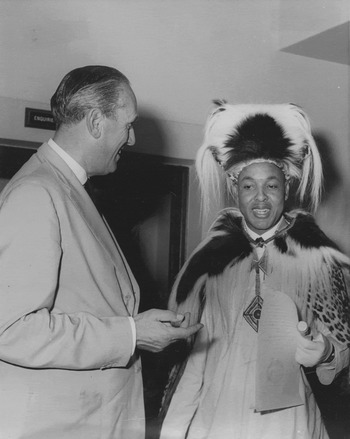
Marealle's tenure as paramount chief is best known for his attempts to promote, even exploit, the burgeoning sense of Chagga cultural identity. In his eyes, the destiny of the people of the mountain lay in a fusion of ‘traditional’ and ‘modern’ practices, and he worked tirelessly to promote cultural symbols reinforcing that vision. For example, he wore his Chagga ceremonial robes atop a white suit for nearly all official functions and visits by dignitaries (see Fig. 1). He also engaged in the creation of new cultural imagery. In 1952, he commissioned the design of a Chagga flag. The flag features Kibo, the great snow-covered peak of the mountain, anchoring the background. Three images emerge in the foreground: a banana tree on the right, a coffee tree on the left, and a masale plant joining the two. The banana tree, as the staple of the mountain, represents tradition and heritage, while the coffee points to the mountain's current and future prosperity. The masale, a common symbol on the mountain for peace, thus bridges the past and present. Lastly, a leopard, representative of power, shrouds the whole scene. The image as a whole symbolized the common heritage of the people, as well as their hopes for the future, and as such served as a symbol for unity throughout the 1950s.
The Rt. Hon Alan Lennox-Boyd, British Secretary of State for the Colonies, speaks with Mangi Mkuu Thomas Marealle II during a visit to the Chagga Council, 1957. Photo courtesy of the National Archives of the UK, The Public Record Office. PRO CO 1069-157-27.

Perhaps most interesting is that Marealle promoted Chagga identity and political unity as something that had been bound to develop in the course of time, an idea drawn from the colonial discourse of one mountain, one people. In the introduction he wrote for the Chagga Day 1955 brochure, he referred to the 1951 election as the ‘historic come-together of the whole tribe’. He then referred at length to the writings of Charles Dundas, who asserted in 1924 that if not for the interruption of colonial rule, a singular Chagga kingdom would have arisen in the course of time.Footnote 73 Marealle, in essence, interpreted Chagga Day as a delayed realization of what Dundas and others had predicted, that it was the destiny of the peoples of Kilimanjaro to become a single entity. This starkly ignored the grassroots political processes that had not only shaped the emergence of this identity, but also had led to his very election.
Marealle's ideas regarding Chagga unity can also be seen in a speech he delivered to the United Nations Trusteeship Council in 17 June 1957, regarding his vision of the future of the Tanganyika Territory. He begins by pointing out the shared alpine landscape, the use of land resources, and the challenges facing the people, before moving to a discussion of the region's stunning economic growth and the political advancements being made. Throughout, he refers to the people of the mountain as the Chagga, only once making reference to the diversity of chiefdoms or clans. He also mentions the importance of preserving ‘Chagga History’, and refers to two initiatives being undertaken: the creation of a cultural heritage society and library called the Chagga Trust, and the commissioning of Oxford scholar Kathleen Stahl to write a history of the Chagga people.Footnote 74 He also tries to situate this identity in the context of the newly emerging discourse of Tanganyikan identity being promoted by nationalist organizations such as the Tanganyika African National Union (TANU).Footnote 75
In spite of his initial popularity, Marealle struggled to maintain broad support. Despite several successes in terms of regional development, he failed to address the core issue leading to his election: the land question. This caused him to lose the support of clan heads and coffee farmers, who felt he had failed to bring needed reforms to fix land distribution policies (such as eliminating the system of divisional chiefs). He also alienated educated youth who questioned not only his dedication to land reform but also his reliance on traditional imagery and autocratic forms of political action to the exclusion of more democratic ones. Most importantly, Marealle's political views placed him into conflict with the nationalists. Kilimanjaro was one of the last regions in the colony to embrace the nationalist movement. TANU leadership – particularly Julius Nyerere, a former friend of Marealle – felt that the overt sense of identity being expressed on the mountain bordered on ethnic nationalism and actually harmed their cause.Footnote 76 Amid increasing pressure, Marealle resigned his post in 1958. Two years later, the people voted again for political reform, this time replacing the paramount chieftaincy with an elected presidency.
The year 1960 marked the end of an era in mountain politics, a definitive shift away from chiefly leadership in the concluding days of colonial rule. The Chagga Day celebrations, and the almost nationalistic symbols of Chagga identity that emerged in Marealle's tenure as mangi mkuu, disappeared almost overnight. As the independent Tanzanian state took form over the next several years, a common identity of being Tanzanian began to emerge. However, the sense of Chagga identity forged by decades of political dispute and contestation over resources has remained, especially as people from Kilimanjaro have migrated to other parts of the country. Today, it implies common cultural and political heritage, and a sense that the mountain landscape is home.
CONCLUSION
Marealle's decline as mangi mkuu thus leads back to the event in question, the Chagga Day celebration of 1952. By looking at how the peoples of Kilimanjaro developed and used identities in the past, as well as the conflicts and debates leading up to 1951, we gain a clearer sense of the significance of this celebration, as well as how the people of Kilimanjaro mobilized political identity in relationship to landscape and the control of resources. In the nineteenth century, the people of the mountain utilized chiefdom identities as a means of securing access to needed resources, and of protecting these resources from those in neighboring chiefdoms. In the twentieth century, however, people began to perceive the biggest threat to their livelihoods coming not from neighboring chiefdoms, but rather from their own chiefs. By joining grassroots organizations whose membership spanned the mountain, such as the KNPA and the KCCU, individuals hoped to protect their resources while at the same time giving themselves voice in government. Thus by forging an identity as Chagga, the people of Kilimanjaro appropriated a term long used by others to describe them and transformed it into a powerful instrument for confronting their oppressors. The vibrant celebration that accompanied Chagga Day in 1952 thus signified a crucial moment in the social and political life of the mountain.
These events not only illuminate issues of identity formation on Kilimanjaro, but they also add much to our understanding of the emergence of ethnic and political identities more generally. They call into question linear narratives of identity development by showing how specific forms of identity, and even the terms used to denote those identities, were subject to contestation. Far from inevitable, notions of identity were actively forged by groups engaged in struggles with the colonial state and among themselves. Furthermore, the case of Kilimanjaro draws specific attention to the relationship between identity formation and resources. On the mountain, notions of identity had long been shaped by the need to secure access to land and water. The emergence of Chagga identity represents a recent example of this, but by no means the only one. This shows us that identities arose not only from increased feelings of belonging but also the need to exercise and protect specific claims. It also indicates that the rise of ethnic identities, often associated with the colonial period, was not exclusively a product of colonialism but rather part of long-term historical patterns of political mobilization and resource control.