

Introduction
IN Western political philosophy, government service provision has been the bedrock for theories about the ties that bind citizens to the state. In addition to the importance of service provision for poverty reduction, human development, and economic growth,Footnote 1 demand for government services is a key driver of political engagement, and the supply of government services is a key determinant of government legitimacy and approval.Footnote 2 However, although the share of basic services that governments provide varies considerably across institutional contexts and historical periods, the field understands comparatively little about how nonstate provision shapes politics.
Due in large part to changes in development aid and private philanthropy, citizens in developing countries—and African countries in particular—are receiving an increasingly large share of critical services from nongovernmental organizations (ngos).Footnote 3 Between 2005 and 2017, the share of bilateral aid bypassing recipient government coffers in sub-Saharan Africa and being channeled directly through ngos increased from about 5 percent to more than 29 percent. Between 2002 and 2012, charitable giving by US foundations to African countries grew more than 400 percent.Footnote 4
Scholars, practitioners, and policymakers have expressed countervailing concerns about the proliferation of ngo services for political economy. Some worry that the explosion of ngo services may reduce citizens’ reliance on government, eroding the material incentives for political participation and undermining perceptions of government performance and legitimacy. For example, Liberia's former minister of public works alleged that branding development projects blocks fragile states from establishing legitimacy.Footnote 5 Similarly, Emily Clough argues that when bureaucracies are weak, “parallel” ngo service provision causes citizens to “exit from the state sector,” resulting in the “disengagement of the most mobilized” and diminishing “pressure on the government to maintain and improve services.”Footnote 6 As Mark Anderson indicates in the Africa Report, “one of the biggest criticisms of ngos is that they break the transmission line that historically has driven progress the world over: popular pressure on national leaders” because “in many African countries, people look to ngos rather than governments to provide services.”Footnote 7
Alternatively, others have asserted that ngo service provision inflates support for political incumbents. This belief is captured by a district-level presidential appointee in Uganda who explained why he supports expanding ngo operations in his district, saying “Okay, well this program will come in, and people will become healthier because of it, and then they will vote for the president.”Footnote 8 Although this is straightforward when ngos and government engage in coproduction or when government officials influence the allocation of ngo projects, ngo projects may also generate credit for government actors for less obvious reasons. Specifically, ngos’ parallel provision of services that are traditionally associated with the state, frequent employment of former government staff, and widespread practices of cobranding ngo projects with the seal of government ministries that have approved their activities can blur the lines between state and nonstate efforts, contributing to an impression of government influence. These blurred lines are especially likely in political contexts where politicians tightly control the distribution of similar government services and the government deploys services on a transactional basis, both of which create an expectation that nonstate services are similarly controlled.
If political incumbents receive credit for ngo provision, support should increase, at least for the specific incumbents who are seen as responsible. Importantly, perceptions of political control over ngos should preclude decreases in engagement or legitimacy, as citizens see government actors as an important intermediary in securing access to these services. Ultimately, both outcomes suggest that ngo service provision entails a trade-off between short-term welfare improvements and long-term weakening of political accountability and state capacity.
Past empirical work has struggled to adjudicate between theories predicting negative and positive effects of nonstate provision on incumbent support for several reasons. First, while data on foreign aid are widely available, data on ngo activities are scarce. This lack of data is especially true at the subnational level, where historical and institutional factors that drive variation in outcomes of interest can be held constant. Second, causal identification from observational data is difficult because the distribution of ngo activities is likely correlated with political factors. Specifically, ngos often target communities that are underserved by government, raising concerns about selection driving correlations between ngo activity and political attitudes. Although several studies have manipulated the information that citizens have about the implementation or funding of ngo projects, actual access to ngo services does not vary in these contexts. Finally, existing work focuses on the effect of short-term access to ngo services. However, sustained access to high-quality ngo services may be required before they effect outcomes like trust, engagement, preferences over the role of government in service provision, and perceptions of incumbent performance.
To overcome these challenges to inference, I conduct original surveys downstream from a large and highly effective ngo community health worker (chw) intervention in Uganda that was implemented in parallel to a similar universal government program. The intervention was randomized at the village-level to accommodate an evaluation of the program's impact on health outcomes, which documented a huge positive effect. Although a nonrandom phase-in of the intervention started prior to my data collection, I present qualitative and quantitative evidence that the phase-in did not systematically target needier villages, did not disrupt balance, and is not driving the findings. I document the effects of sustained access to ngo services by surveying treatment and control villages after eight years of ongoing exposure to the ngo program. This ancillary field experiment design is an underutilized tool to study unintended and long-term effects of interventions on political outcomes.Footnote 9 I registered a full preanalysis plan (pap) with Evidence in Governance and Politics prior to data collection.
Using attitudinal and behavioral measures, I find that citizens with access to ngo services were more likely to prefer ngo over government provision. However, political engagement and perceptions of government legitimacy were not lower in treatment villages. Rather than encouraging apathy or antipathy toward the state, my data show that citizens see ngos as a resource that powerful incumbents control and citizens then evaluate the performance of those incumbents more positively. Across both treatment and control groups, respondents saw the president (but not local politicians or government ministries) as controlling ngo project allocation even more than ngos themselves. Respondents in treatment villages were even more likely to express this belief, suggesting that the intervention reinforced beliefs about the president's political control over the allocation of ngo services.
This article makes several contributions to the study of political accountability, nonstate service provision, and effective aid and philanthropy. First, although numerous previous evaluations have demonstrated that ngo interventions can improve welfare, I demonstrate the importance of political economy factors for understanding the broader impact of specific ngo projects and the rise of ngos more generally. In doing so, I present evidence that the political blind spot of effective altruism leaves major determinants of citizen welfare out of the equation and demonstrate how these factors can be accounted for in future evaluations.Footnote 10 Specifically, I show that ngo service provision can interact with the political environment to contribute to an incumbency advantage, even when projects are implemented independently from government and free of political influence. Furthermore, the perception that powerful politicians influence the allocation of ngo projects lends insight into why previous studies have failed to find a negative effect of ngo provision on political engagement and government legitimacy: even when access to ngo services encourages a preference for ngo over government provision, citizens still see government actors as integral parties in the distribution of these valuable resources.
Second, this article joins a small but growing number of studies that test the unintended effects of ngo service provision on political outcomes using randomized control trials (rcts).Footnote 11 Prior research on the effects of development ngos on political attitudes and behavior has generally relied on qualitative dataFootnote 12 or information experiments.Footnote 13 Furthermore, this ancillary evaluation of an rct provides a rare opportunity to examine the long-term effects of an intervention on political accountability and citizens’ beliefs about governance.
Last, I provide new evidence in the debate about how the substantial increases in ngo service provision over recent decades have affected political economy in developing countries. Specifically, my findings suggest that ngo service provision may entail a trade-off between short-term welfare improvements and a long-term weakening of political accountability and state capacity. In the final section, I discuss the political conditions under which these findings are more likely to generalize and speculate about how these results may vary in other contexts. I call for future research on how ngo provision affects the incentives and behavior of politicians.
NGOs, Service Delivery, and Political Economy
Although ngo service delivery is not typically designed to influence political outcomes, the distribution of valuable services in resource scarce areas is likely to have political consequences. However, existing theories produce countervailing expectations about what these consequences are likely to be. In this section, I trace the potential implications of ngo service provision for political economy. Specifically, I focus on the potential for ngo provision to affect citizens’ preferences for ngo and government services, political engagement and legitimacy, and political credit attribution.Footnote 14 Finally, I synthesize these implications and argue that a decrease in political engagement is unlikely when government actors receive credit for ngo projects, even where citizens’ preferences for ngo services over government services increase.
Citizens’ Preferences for Service Providers
Although a great deal of work has investigated when citizens are likely to make demands on government and when these demands are more or less likely to be effective,Footnote 15 research has paid less attention to the determinants of citizens’ beliefs about what government should provide.Footnote 16 Citizens typically see ngos as organizations that fill gaps in government service delivery and programs, but when ngos provide high-quality services over a long period of time, access to ngo services may increase citizens’ preferences for ngo-provided services and for ngos to have a broad role in providing services to the population at large. A preference for ngo over government services may have unanticipated effects on the type of activities that citizens expect governments to execute and on governments’ political accountability more broadly.
Political Engagement and Government Legitimacy
A great deal of political engagement is instrumental, meaning that citizens participate in politics when they believe that the returns to participation will exceed the costs. In both developed and developing countries, instrumental engagement is often directed at securing access to basic services from government.Footnote 17 ngo provision can affect this calculus in important ways. Most importantly, if access to ngo services causes citizens to prefer ngo services over government services, incentives to demand new or better services from the state may be diminished.Footnote 18 In a developing country context, this disincentive is most likely to affect citizen-initiated contact with government officials, which is a primary means by which citizens communicate their need for new or better services.Footnote 19 To the extent that other modes of participation are a product of a desire for more/better government services, ngo provision may also reduce citizens’ willingness to expend resources on rewarding or punishing incumbents for their performance through voting or contentious activities like protesting. This decrease in engagement is especially likely in the African context, where political parties are less programmatic and political engagement is often motivated by incumbents’ “proffering of material goods.”Footnote 20 Disengagement can thereby diminish political pressure on governments to invest in providing services, contributing to a negative equilibrium of government underprovision.
More dramatically, government support and legitimacy are also rooted in citizens’ perceptions of government's ability to provide services. Theoretical and empirical research suggests that when states provide services, citizens are more likely to trust government, approve of performance, and comply with government directives by paying taxes.Footnote 21 Increased access to ngo services may convince citizens that politicians or government agencies are failing to do their jobs,Footnote 22 thereby reducing trust, perceptions of performance, or compliance.Footnote 23 More extreme instances of disappointment in government performance may actually increase some forms of engagement, especially contentious ones like voting against incumbents or protesting. Despite these predictions, empirical work using both in-depth interview data and evidence from survey experiments manipulating information about funding and delivery of services has generally found null or even positive effects of ngo activities on perceptions of government performance and legitimacyFootnote 24 and citizens’ monitoring behavior.Footnote 25
Political Credit Attribution
While many have predicted ngo provision will erode public confidence in government, several potential mechanisms link nonstate provision to increased, rather than decreased, support for government. For example, empirical work has found that ngo projects can have positive effects on perceptions of government legitimacy and capacity through coproduction with government agencies.Footnote 26 However, many ngo projects are implemented largely independently from government, rather than being coproduced with the government. Alternatively, government actors may receive credit if they are able to influence which communities receive ngo projects.Footnote 27 In many countries, politicians can direct the distribution of state resources or foreign aid to politically valuable constituencies in exchange for increased support in targeted communities.Footnote 28 According to basic models of political accountability, government actors that possess and exercise the power to target resources to specific constituents should receive credit for those resources in the form of increased political support. However, while local or national politicians may influence the location of ngo projects in some instances, these decisions are often beyond their control. In fact, bilateral donors often channel aid through ngos (referred to as bypass aid), with the expressed purpose of circumventing political interference in its allocation.Footnote 29 When ngos work as intended, political incumbents should not be able to target benefits toward only politically valuable communities.Footnote 30
When ngo projects are implemented independently from government and are aloof from political influence over allocation, political incumbents may still benefit from an impression of influence. For local politicians, this benefit may be the result of active (often undeserved) credit claiming.Footnote 31 Alternatively, for national politicians, this benefit may be a result of perceived control over ngos. Rational voters attempting to assign credit for the presence of an ngo project in their community may draw on knowledge of how similar government resources are allocated in their country. Where incumbents foster perceptions of distributive politics as transactional (services are provided in exchange for political support), citizens with limited information may assume that ngo projects are similarly targeted transfers.Footnote 32 Direct contact with ngos may actually encourage beliefs that incumbents are involved in ngo service provision by blurring the lines between ngos and the state. When ngos provide services that are traditionally seen as the jurisdiction of government, observing ngo operations may cause citizens to associate ngo services with the government actors who control similar state resources. Even without explicit coproduction, ngos often provide complements to existing government health programs by filling gaps in the geographic reach or programmatic coverage of government programs.Footnote 33 Furthermore, ngos often hire government employees, including front-line service providers such as chws, contributing to a brain drain that has sparked widespread concern in the development community.Footnote 34
Contact with an ngo project may also expose citizens to government- ngo cobranding, which is standard even when the government plays little or no role.Footnote 35 Witnessing ngos producing services traditionally associated with the state, the presence of former government employees on ngos’ staff, and exposure to cobranding may make citizens who gain access to ngo services more likely to believe that powerful government actors direct the allocation of ngo projects. Government actors benefitting from an impression of influence over ngo services has two important implications. First, access to ngo services is unlikely to undermine political engagement or government legitimacy. In this scenario, citizens see government officials as an essential intermediary that can respond to citizens’ demands for service provision through the deployment of ngo projects. Second, the government actors who are perceived as controlling these resources are likely to benefit from higher approval ratings or improved perceptions of their job performance. If ngo provision encourages this perception of influence due to factors like jurisdictional overlap and cobranding with government, we should see increased perceptions of these actors’ power over ngo project allocation as well.
When government actors receive credit, and which government actors get this credit, is likely to depend on the political environment. ngo projects are most likely to generate political credit in contexts where government actors exercise considerable political control over the distribution of public goods and when citizens believe that changes in access to government services are typically a result of political machinations. Such a scenario is most likely in countries where political power is more concentrated and government actors are relatively unconstrained in their ability to provide services to or revoke services from communities that reciprocate with political support. Alternatively, in contexts where government actors have very limited influence over the allocation of state resources—as may be the case in conflict zones or in failed states where government provision is rare and service delivery is typically part of international relief efforts—or where resources are distributed according to fixed rules or bureaucratic procedures, we should expect the impression of influence over ngos to be greatly limited.
In many African countries, national political executives exert the greatest control over the distribution of public goods.Footnote 36 In such countries, presidents are most likely to receive credit for ngo projects. In competitive authoritarian regimes, such as Uganda, executives reward government supporters and attempt to win over opposition supporters with access to public resources. In contexts where mobilization strategies exclude specific groups, the impression of influence may extend only to communities that are plausible members of the electoral coalition. Party leaders or members of the legislature who control distributive politics may be more likely to enjoy increased support.
Research Setting
To test this argument, I use a large and highly effective ngo chw intervention in Uganda: the Living Goods (lg) Community Health Promoter (chp) program. The lg chp intervention operates parallel to a similar government-run system known as Village Health Teams (vhts). Uganda's Ministry of Health adopted the government vht program in 2001 to act as the “bridge … between community and health facilities.”Footnote 37 Each village has a government vht comprising volunteers who are selected by their community (often through a popular vote) and is overseen by a member of the district health team or a nearby health facility. Government vht members are expected to serve twenty-five to thirty households, although they often serve many more in practice. Despite high levels of satisfaction with government vhts, many government vht members are undertrained and mortality from easily preventable or treatable diseases remains high. While government vhts and lg chps are designed with similar objectives, lg chps are equipped with superior training, receive financial remuneration, and offer a wider array of health products and services. lg recruits and trains chps to diagnose and treat childhood illnesses, refer individuals to nearby health facilities, and earn an income by selling preventive and curative health products at subsidized rates. lg chps are selected competitively from female applicants (ages eighteen to forty-five) with basic writing and math skills. Eligible candidates receive two weeks of training before taking a skills test to determine who is selected, after which elected candidates receive one-day training sessions every month.
According to a survey of 196 chps conducted by lg, the average lg chp spent 2 days per week working as a health promoter, conducting 10 household visits per day and working 8 hours per week. lg chps reported revisiting 13 percent of households in their village each month and 48 percent of lg chps reported visiting a new household in the month before data collection. lg chps also reported arranging, on average, 1.5 health education meetings per month, and 23 percent of households reported being visited by an lg chp in the 30 days before the survey. A randomized evaluation found that the lg chp program was highly effective at improving health outcomes, causing a 27 percent reduction in child mortality in treatment villages over a 3-year period.Footnote 38
A chw program, and the lg chp program in particular, is well-suited to study the political economy of ngo service provision. Although ngos conduct programming in many sectors including governance and education, health is the sector with the most ngo activity by a wide margin.Footnote 39 chws provide primary health care and are the first point of contact with the health system for the majority of people living in rural Africa.Footnote 40 chws also provide services that are politically salient. According to Afrobarometer, health care was the most frequently cited priority for increased government spending among Ugandan respondents (mentioned by 61.6 percent) and the second most cited in the full sample of thirty-one African countries (54.1 percent).
The lg chp intervention provides residents of treatment villages with an opportunity to directly compare chw programs operated by the Ugandan government (vht) and an ngo (the lg chp). The lg intervention is heavily branded, with lg chps wearing lg-branded clothing and distributing health products bearing the lg logo. This common practice increases the information available to citizens and reduces chances that citizens believe these services are provided by government health workers. But lg also engages in extensive cobranding with government. Like many ngos, lg has both “direct operations” that provide health services directly to citizens and “indirect operations” designed to strengthen the government health system (for example, by equipping government vhts with mobile devices and software). For this reason, lg engages in extensive cobranding with the government, and their promotional materials and public outreach frequently features the Ministry of Health logo.Footnote 41 Furthermore, lg often recruits former or current government health workers to be chps, another common practice among health ngos working in developing countries.Footnote 42 The lg chp intervention is operated independently of government, providing an opportunity to investigate whether contact with an ngo blurs the line between ngos and government actors even when government is not directly involved in coproduction.Footnote 43
Uganda also provides a well-suited case to study these dynamics. Uganda is a low-income country in East Africa ruled by an electoral authoritarian regime and characterized by a powerful chief executive. President Yoweri Museveni came to power in 1986 following a civil war, and his National Resistance Movement (nrm) Party firmly controls the national legislature, with 69 percent of mps currently nrm affiliates. Museveni has been able to continue winning elections in part by exerting tight control over resource allocation,Footnote 44 and the president and other politicians frequently make public statements characterizing service provision as a reward for or an inducement to political support. In African countries, presidents often “wield disproportionate formal powers vis-à-vis other political institutions,” including “the ability to channel state resources.”Footnote 45 According to the Presidential Power Index,Footnote 46 which ranks countries according to levels of formal presidential power, Uganda (0.436) scores near the average for African countries (mean = 0.44, min = 0.04, max = 0.79).
The allocation of public goods in Uganda is explicitly transactional and the president frequently makes public statements linking provision to votes. Not only does the president acknowledge in campaign speeches that receiving government resources is a reward for supporting him and his party, but he also describes provision to opposition communities as an inducement to increase support.Footnote 47 The president's control over state resourcesFootnote 48 and the importance of “voting wisely” are well-known to voters in Uganda.Footnote 49 Regardless of political alignment, executives can use resources to reward supporters of or increase support for the president. As one Ugandan political scientist expressed, “The president automatically receives credit [for service delivery] as an individual, but local governments have to claim it.”
Although Ugandan citizens correctly perceive the president as controlling the allocation of state resources, qualitative and quantitative evidence shows that the geographic distribution of aid-funded ngo projects is not predicted by political characteristics, which suggests that political influence over ngo project allocation is limited.Footnote 50 However, the widespread (and deliberately fostered) perception that the president exerts tight control over resource allocation, that these decisions are tied to the supply of political support, and that existing resources will be revoked or future resources withheld if support is insufficient, likely encourages citizens to begin from the assumption that even nonstate resources are given at the behest of the executive.
Research Design
Between 2011 and 2014, lg conducted a cluster randomized trial (crt) in 214 villages (115 treatment and 99 control) encompassing more than 50,000 households in 10 districts across all 4 regions of Uganda. Important for this analysis, the program has operated continuously in treatment villages since 2011. lg's randomization of their intervention provides the opportunity for an ancillary analysis of the unintended long-term effects of ngo activities on political outcomes.Footnote 51 This approach provides several advantages for the internal validity of the study. First, I am able to measure the long-term effects of the intervention. Although changes in health outcomes can manifest rapidly, changes in political attitudes and behavior often require prolonged exposure to environmental changes.Footnote 52 Many rcts across a range of subjects have documented short-term effects that do not persist in the long run;Footnote 53 this study surveys treatment villages after 8 years of continuous exposure to ngo services.
Second, the original evaluation documents that the intervention improved health outcomes dramatically, satisfying a theoretical assumption that ngo services successfully improve welfare. According to Martina Björkman Nyqvist and colleagues, the lg chp intervention “reduced the under-five mortality rate by 27 percent, infant mortality rate by 33 percent, and neonatal mortality rate by 27 percent after three years” and increased health knowledge, utilization of preventive and treatment approaches, and health service coverage. Finally, the original evaluation documents that treatment spillovers into control villages were minimal, migration into treatment and control villages was similar, and households in treatment and control clusters were balanced on a wide range of social and economic characteristics before treatment.
Ancillary evaluations often entail drawbacks as well, including a lack of researcher control over the intervention. In this case, a nonrandom phase-in of the intervention into control villages started in 2014. Due to limited resources, the evaluation collected household-level data only for the subset of control villages that had not received the phased-in intervention by October 2018. Although bias from this phase-in cannot be ruled out definitively, I present qualitative and quantitative evidence that the phase-in was not driven by village characteristics that are likely to bias estimation. The evaluation collected village-level data for all villages originally assigned control status; analyses show that control villages that did and did not receive the phased-in intervention after 2014 are balanced on a wide range of characteristics both before and after phase-in. Most importantly, the main findings are robust to the exclusion of villages in districts where the phase-in was most intense.
Data for this study come from two sources. First, the study uses a household survey in treatment and control villages to test the main hypotheses. Second, I use village-level data on service delivery and infrastructure collected using a mix of phone and in-person interviews with local council and government vht members. Phone interviews were conducted using contact information obtained from lg; in cases where no government vht member could be reached by phone, field officers were sent to conduct the interview in-person. All village-level data were meticulously verified by enumerating both the Local Councilor 1 (lc1) and one government vht member in each village and by performing call-backs to rectify discordant information.
Although data collected in 2013 demonstrated the large, positive effects of the intervention on health outcomes, it is important to note that program activities continued through ancillary data collection in 2018. Section A of the supplementary material shows that respondents in treatment village were aware of the lg chp program (almost 25 percent of respondents in treatment villages listed lg in response to an open-ended question asking for a list of ngos operating in their village), knew that it was implemented by an ngo rather than the government, saw it as nonprofit rather than for-profit, expressed high levels of satisfaction, and were more likely to report that their household had contact with and benefited from health ngos (but not non–health ngos) than respondents in control villages. Reassuringly, the median household in control villages reports zero instances of contact with the lg chp program in the past year, whereas the median treatment household reports one instance of contact. Section B in the supplementary material shows that respondents in treatment communities were no more likely to believe that the survey team was sent by an ngo or government, mitigating concerns about researcher-demand bias.
Randomization and Sampling
The original study was a crt embedded in the roll-out of the lg chp program. Clusters correspond to villages, and branches correspond to headquarters that oversee operations within that district. Randomization was stratified by branch. To ensure that the lg chp(s) in each village could access all households in their community, only villages with fewer than 400 households were eligible to receive the treatment. In 9 branches, randomization was balanced while in 1, zone randomization was unbalanced for operational purposes (2:1). This randomization resulted in a sample of 115 treatment villages and 99 control villages. In 2014, a nonrandom phase-in of the intervention into control villages started. Of the 99 villages assigned to control status, 47 remained unexposed to the intervention in October 2018. Of the 115 original treatment villages, 4 villages ceased to have an active chp after their chps died or moved away. I sample all 47 control villages that remained untreated and all 115 treated villages. See section C of the supplementary material for the number of villages in each treatment condition by district. In sample villages, team leaders met with local councilors to create a list of households. Seven households were randomly selected for enumeration in treatment villages; 14 households were selected for enumeration in control villages. This imbalance accounts for the smaller number of control villages relative to treatment villages. Within each household, the trial selected either the male or female head of household for enumeration.
Treatment Definition and Estimation
Following the original evaluation, I define the treatment as giving households the opportunity to benefit from ngo services and use a binary indicator and intent-to-treat as the causal estimand of interest. I estimate the following model:
 $${\rm Y}_{ij} = \beta _1T_{ij} + \beta _2b_j + \beta _3b_j\ast T_{ij} + \beta _4X_{ij} + \beta _5X_{ij}\ast T_{ij} + {\epsilon}_{ij}. $$
Yij is the outcome of interest in village i located in branch j. Tij is a binary treatment indicator taking a value of one for households in treatment villages, and β 1 is the average treatment effect. bj is branch fixed effects to account for stratification, and Xij is a vector of covariates. I include individual (age, sex, and level of education measured on a six-point scale) and (pretreatment) village-level covariates (the president's vote share in the parish in which the village is located and distance to the nearest health facility, hospital, upgraded road, and transmission line). I demean all covariates and fully interact them with the treatment.Footnote 54 Standard errors are clustered at the village level. Results without covariates are substantively similar and available in section D of the supplementary material.
To address concerns about multiple hypothesis testing, I combine into an index measures of related outcomes testing the same hypothesis. For each variable, I compute z-scores by subtracting the mean of the control group and dividing the variable by the standard deviation of the control group. By averaging across z-scores, I construct an index. Prior to standardization, I impute missing values on dependent variables by setting them equal to the mean of each outcome variable for the relevant treatment arm.Footnote 55 Most outcomes exhibit very little missingness, and the main results are unaffected to estimation without imputation. I preregistered outcomes and index construction. I describe and justify all departures from the pap in section E of the supplementary material.
Violations of Random Assignment
Nonrandom phase-in of the intervention into control villages started in 2014. Due to limited resources, household-level data were only collected for the subset of control villages that had not received the phased-in intervention by October 2018. This phase-in introduces the potential for unobserved baseline differences between treatment and remaining control villages to bias the analysis. I take two approaches to minimize concerns about these violations of random assignment. First, I draw on multiple sources of data and more than forty variables collected at multiple points in time to demonstrate balance (1) between remaining control and phased-in control villages and (2) between treatment and control villages with and without excluding control villages that received the phased-in intervention. For all balance tests, I report both the results of a block-adjusted omnibus balance test and the one-by-one comparisons.Footnote 56 Section F in the supplementary material provides a detailed discussion of these data, methods, and results.
I begin by showing pretreatment balance using household and village-level data from Björkman Nyqvist and colleagues measuring village size, infrastructure, accessibility, and health characteristics. I then use endline survey data from seven thousand households collected by Björkman Nyqvist and co-authors and variables from my original household survey to show balance on respondent and household characteristics, measuring size, education, health, and consumption.Footnote 57 Last, I use data from my village-level survey, measuring the number of ngos providing services in the village, the number of health facilities and schools to which residents have access; road quality; water source; lc1 satisfaction with the village's government vht services; and the number of years residents have had access to piped water, the electricity grid, and piped sewage.
I find no evidence that the nonrandom phase-in generated imbalances (1) between control villages that did and did not receive the phased-in intervention or (2) between treatment and control villages (with and without excluding control villages that received the phased-in intervention). These results comport with anecdotal evidence suggesting that the phase-in, which was determined by branch offices (which oversaw between three and thirty original control villages each), was not conducted in a systematic way. According to an interview with one lg branch manager, all control villages were prioritized for treatment, but plans were often thwarted by unanticipated events. For instance, in one branch, a woman had successfully completed the full training sequence but got married and moved away from the district before beginning her post, while another trainee passed away shortly after beginning work. Due to the significant costs associated with this training, such events frequently caused substantial delays in roll-out. An lg chp working in a neighboring district told a similar story: one chp recruited and trained to serve a nearby village relocated to care for a sick relative after only a few days of work.
While these analyses rule-out many of the systematic differences that we would expect to bias findings, others exist that we do not observe at baseline. Importantly, the inclusion of block fixed effects means that the analysis considers variation between treatment and control villages within districts. Districts are the most relevant administrative unit for politics and governance and service delivery is administered by district governments, and lower-level officials have little formal role. However, we cannot rule out village-level differences. For example, if the roll-out went to villages with more politically connected or responsive local officials, citizens in the remaining control villages may have been less likely to contact local officials at baseline. These baseline differences could bias against finding a negative relationship between the lg chp and my primary measures of political engagement. These potential unobserved differences should encourage caution when interpreting my results. However, the uniformity of null results across types of political participation that are more (contacting an lc1) and less (voting, contacting district officials) likely to be affected by village-level differences is encouraging.
My second approach to dealing with violations of random assignment is intended to minimize concerns about the potential for nonrandom phase-in to bias estimation. If village characteristics that drove the phase-in of the intervention are also associated with my outcome variables, treatment effects should attenuate when looking at within-district variation in districts where the phase-in was least intense. I repeat all analyses on subsets of the sample, excluding villages in districts where more than 60 percent, 50 percent, and then 40 percent of control villages received the phase-in. The most restrictive sample includes 336 respondents across 22 control and 211 respondents across 30 treatment villages from 4 of the 10 districts (see section C of the supplementary material). The main findings are robust—and actually stronger—in all of these restricted samples. In the main text, I report results using both the full sample and the most restrictive sample (excluding villages in districts where more than 40 percent of control villages received the phased-in intervention).
The inclusion of block fixed effects implies that the larger effect sizes in the restricted samples should reflect a greater difference between treatment and control villages within those districts rather than baseline differences between districts that are included and excluded from the restricted sample. However, if included districts have worse health outcomes or lower levels of support for the president at baseline, larger effect sizes in these districts may occur relative to those that I excluded. According to the Ministry of Health's 2014 Annual Health Sector Performance Report (the most recent report prior to the beginning of the phase-in), which rates district health performance across fourteen indicators, districts excluded from the restricted analysis have an average score of seventy on the aggregate index, compared to included districts, which have an average score of sixty (this variable has a mean of sixty-three and a range of thirty-one to eighty-three).Footnote 58 Although these differences are not large, they may allow for greater improvements in health and account for somewhat larger effects on political outcomes. Alternatively, in the 2011 election (the most recent election prior to the beginning of the phase-in), the average vote share for the president in districts excluded from the restricted analysis was 68 percent compared to 72 percent for those included (mean of 68 percent), suggesting that lower baseline support for the president does not account for larger increases in these districts.
Results
I present the results of ordinary least squares regressions taking each outcome as the dependent variable. All outcome variables are converted to z-scores and coefficients can be interpreted as standard deviations. The exact wording of each question and the components of each index are presented in section G of the supplementary material. I begin by presenting results about citizens’ preferences for the role of ngos and government in health service provision. Respondents in control (and treatment) villages express very positive views of ngos. When compared with government actors across a variety of measures, ngos and the president are always viewed more positively than other government actors and agencies. Despite these positive views, most respondents in both treatment and control villages preferred that government be primarily responsible for health service provision. If access to ngo services makes citizens less willing to demand services from or otherwise engage with government, access to ngo services must first weaken this preference for government to deliver most health services. Consistent with this expectation, respondents in treatment villages were significantly more likely to prefer ngo provision of health services.
Next, I look to measures of political credit, finding evidence that the president received political credit for the intervention. Consistent with expectations, respondents in treatment villages were more likely to see the president as controlling the allocation of ngo projects. These findings are especially striking given that they are measured a full eight years after the introduction of the lg chp intervention into treatment villages. Notably, I find no evidence that the intervention affects perceptions of lower-level political actors. In the final sections, I unpack the mechanisms driving political credit for the president and provide evidence against alternative explanations. I then look at the effect of the intervention on political engagement and government legitimacy. Using more than a dozen measures, results provide no support for the expectation that access to ngo services decreased engagement or legitimacy. These findings are consistent with the argument that when government actors receive credit for services, access to ngo services is unlikely to have a detrimental effect on this outcome.
Service Delivery Preferences
I measure respondents’ preferences for the role of government and ngos in service provision, using two attitudinal and one behavioral measure. The two attitudinal measures ask about preferences for ngos and government generally in health service provision. This measure captures respondents’ broad feelings about whether ngos are a viable and desirable alternative to government. The behavioral measure focuses specifically on preferences for the lg chp versus the government vht program.
When asked whether government or ngos should “provide most of the health care in the country” while the other plays a “minimal role,” citizens in both groups report wanting government to provide most care. However, respondents in treatment villages are much more likely to report a preference for ngos. When asked about whether government or ngos “should both pay for and provide health services” or whether government should pay while ngos provide, a plurality of respondents in both treatment and control villages report that government should both finance and deliver the majority of health services. However, in treatment villages in the full sample, almost as many respondents believe that although government should finance provision, ngos should take the lead in health service delivery.
The behavioral measure gives respondents the opportunity to vote on the division of a real donation made by the research team between the lg chp program and the government vht program. This exercise is designed to capture respondents’ beliefs over which program would use the money in a more beneficial manner for the citizens of Uganda. Since the donation was small (approximately US$140) and respondents were made aware that both programs operated across the entire country, respondents were unlikely to expect to benefit directly from the donation to either service provider. For the full sample, respondents in control villages voted to give an average of 31 percent of the money to the ngo, while those in treated villages voted to give 37 percent to the ngo.
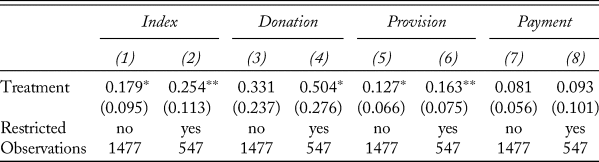
Across all three measures, the preference for government as the primary health service provider is visibly weaker in communities that were randomly assigned to receive the lg chp intervention. To test this relationship statistically, I create an index in which higher values indicate a greater preference for ngo service provision. Table 1 reports the results. The index is significant and substantively large, ranging from 0.18 to 0.25 standard deviations. Inspecting the individual components of this index, we see that respondents in treatment villages vote to give a much larger share of the donation to the ngo program, ranging from one-third to one-half of a standard deviation (although only significant for the restricted sample).
Effect of LG CHP on Preferences for NGO Service Provision

∗ p < 0.1, ∗∗ p < 0.05, ∗∗∗ p < 0.01; standard errors are clustered at the village level
Turning to questions that ask about respondents’ preferences for ngos in health service provision relative to government, we see clear evidence that treated respondents are more likely to believe that ngos should provide most of the health care in Uganda (ranging from 0.13 to 0.16 standard deviations), and some evidence that they believe government should either finance ngos to deliver such services or allow ngos to take over both financing and delivery (ranging from 0.8 to 0.9 standard deviations, although neither is significant). See section H of the supplementary material for plots of the raw data for each of these questions. Respondents in treatment villages also report seeing health service provision as a significantly lower priority for the national government to address (see section I in the supplementary material), reinforcing these findings. Overall, these results suggest that ngo provision changed how citizens view the role of government by weakening perceptions of government as the ultimate provider of health services.
Credit Attribution
The lg chp intervention provides a hard test of whether ngos generate political credit, as several important factors militate against credit generation. Operations are carried out largely independently of the government health system, and the intervention was randomly assigned across villages, ruling-out real political interference in project allocation. Interviews with more than a dozen lg staff confirmed that the program operates independently and revealed no instances of government interference or political credit claiming at the local or national level. However, the provision of health care relies on many inputs and multiple levels of oversight,Footnote 59 and consumers of ngo services typically lack information on whether government contributed to or influenced their production or allocation. When ngos provide services that are traditionally associated with the state, I argue that citizens are likely to draw on their knowledge of how those resources are typically distributed to assign credit.
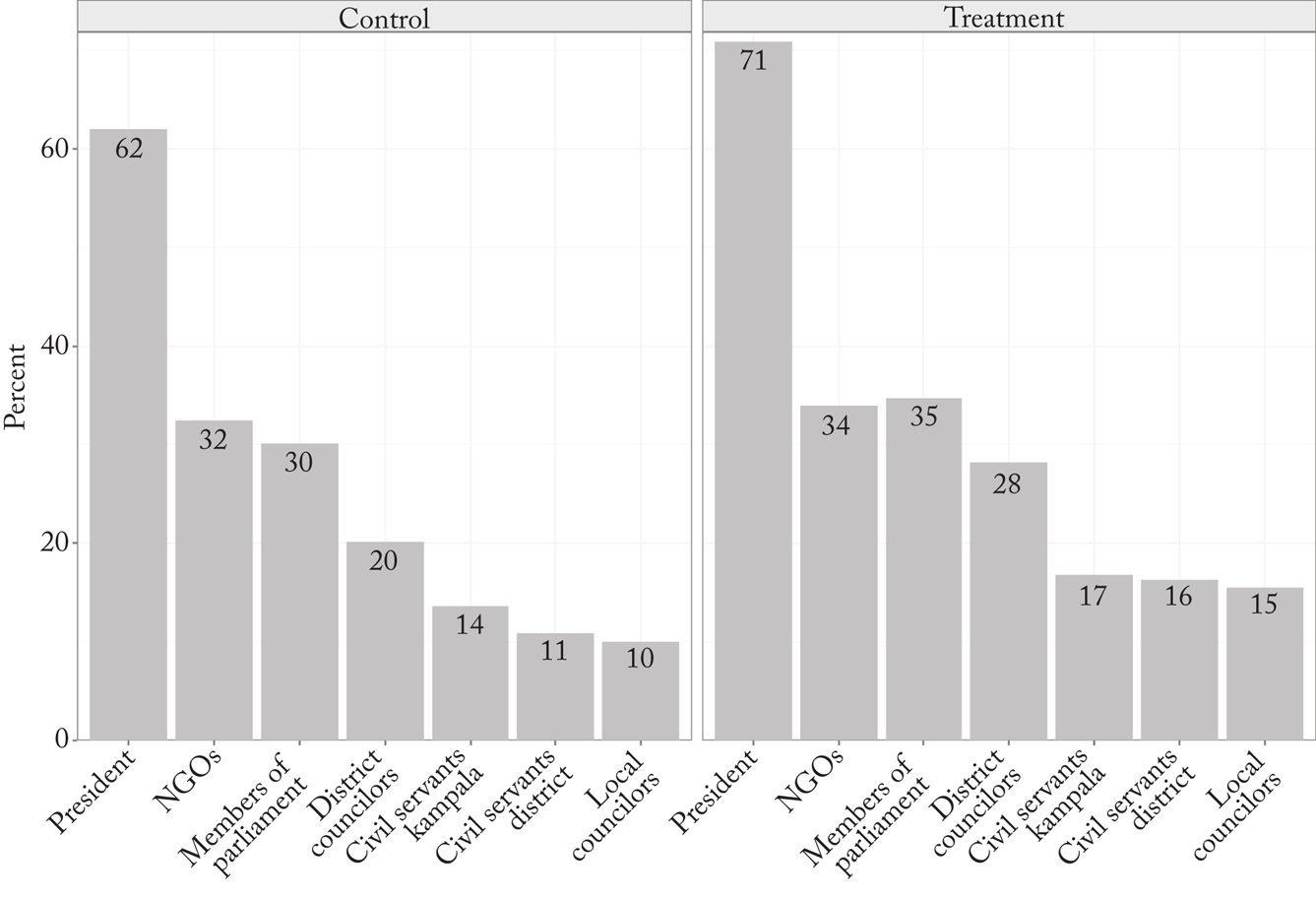
If this is the case, we should expect that respondents either (1) have strong prior beliefs that government actors have substantial power over ngo projects or (2) update their beliefs that government actors have substantial power after contact with an ngo project. Figure 1 shows the share of respondents that reported ngos and government actors have “A lot” of power over where ngos locate their projects on a four-point scale ranging from “None” to “A lot.” Looking specifically at measures of perceived influence over ngo projects in control villages (to get a sense of pretreatment beliefs), citizens report only the president as having significant influence over the location of ngo projects. When asked how much power ngos and various government actors have over where ngos locate their projects, 62 percent of respondents in control villages reported that the president has “A lot” of power. The second most powerful actor was ngos themselves at 32 percent, followed by Members of Parliament (mps) with 30 percent (see section J of the supplementary material). Looking at questions that ask specifically about the role of local politicians and government agencies in attracting or overseeing ngo projects at the local level (described below), respondents see mps as having the most influence with only 8 percent of respondents reporting that they have helped “A lot” to bring ngos to or oversee ngos in their community. Furthermore, perceptions of the president's power are very similar across partisanship (61 percent for respondents in parishes in which the president received less than 60 percent of the vote in the 2011 election compared with 64 percent in parishes in which he received at least 60 percent), regions (ranging from 64 percent in central and western Uganda to 57 percent in eastern Uganda), and levels of education (58 percent among low-education respondents compared to 67 percent for high-education respondents). See section J.4 in supplementary material online for additional details.
Share of Respondents Reporting Actor Has “A Lot” of Power over NGO Project Locationsa
a This question asks respondents how much power each actor has over where NGOs decide to put their projects and services.

Consistent with the argument that contact with ngos creates an impression of government influence, perceptions of power were higher in the treatment group for all government actors. However, the difference in perceived influence between treatment and control is the largest for, and only statistically significant for, the president. Furthermore, none of the differences are significant for measures of lower-level actors’ influence at the local level. In treatment villages, 71 percent of respondents reported that the president has “A lot” of power. Also consistent with learning about government influence rather than baseline differences in beliefs about ngos, the treatment and control groups have very similar beliefs about the influence of ngos over their own projects. In summary, respondents see only the president as having significant influence over the location of ngo projects, even after accounting for changes in beliefs after exposure to an ngo project. Therefore, we should expect only the president to receive credit for ngo projects.
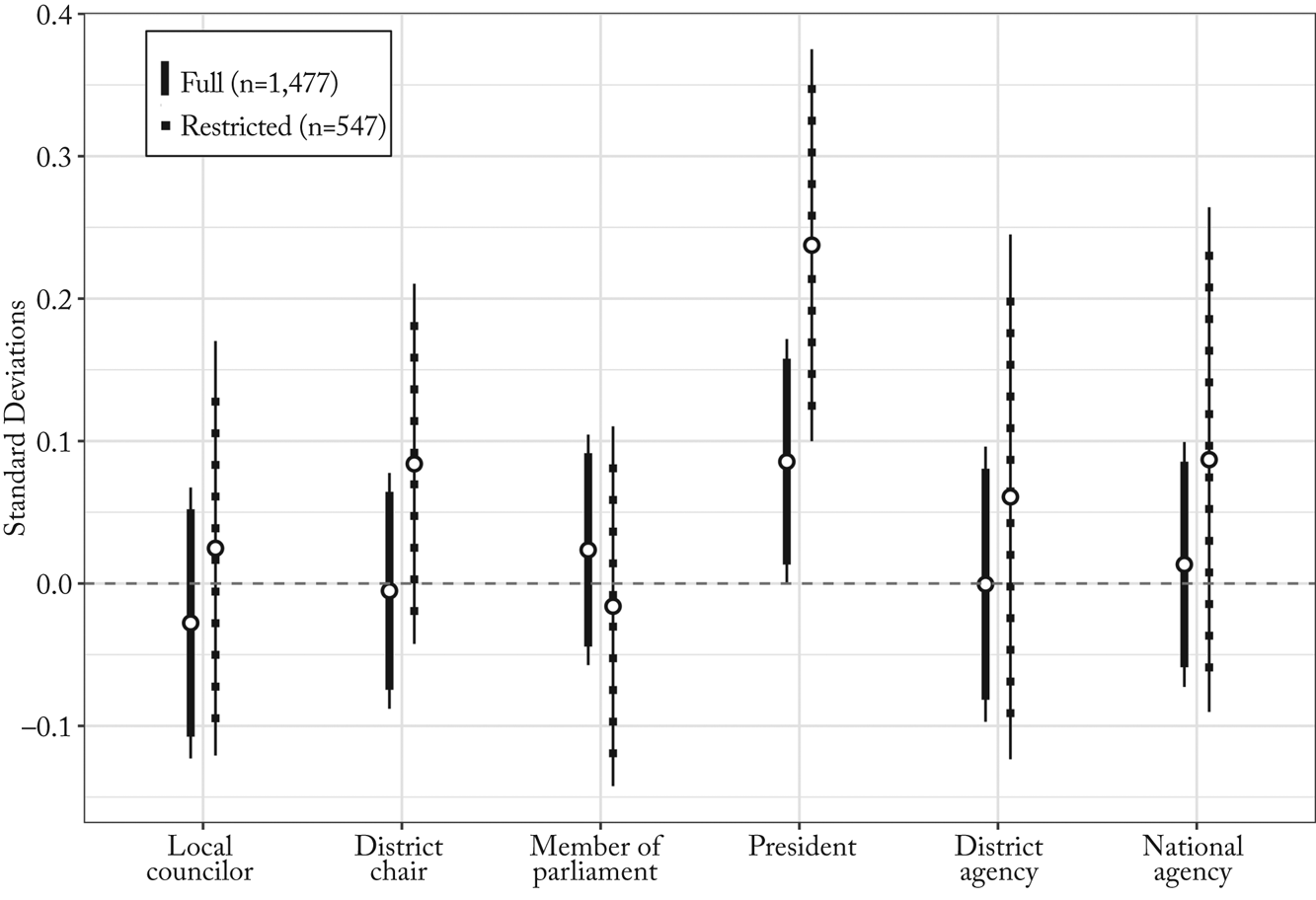
I estimate the effect of the lg chp on credit attribution using five questions about six government actors. I ask three questions for all six actors. The first asks about each actors’ power over where ngos locate projects. Two more questions ask specifically about the role of local politicians and agencies in attracting or overseeing ngo projects at the local level, and are asked only for local councilors, district chairs, mps, and district agencies who could plausibly oversee the implementation of ngo projects on the ground. The remaining two questions ask about satisfaction with the job performance of politicians and government agencies generally and in providing health services specifically.Footnote 60 I combine these questions into a single index variable for each distinct government actor, which includes all questions asked for that actor.Footnote 61 Across specifications, results provide no evidence that local councilors, district chairs, mps, or district or national health agencies receive credit for the intervention. However, Figure 2 suggests that the president did benefit from the intervention, with the effect on the credit index ranging from 0.09 to 0.24 standard deviations.
Effect of CHP Intervention on Political Credita
a Index variable including measures of satisfaction with job performance generally and in providing health services specifically, and perceptions of power over where NGOs locate projects. Index for local actors (local councilors, district chairs, Members of Parliament, and district agencies) also includes two questions asking about their role in attracting or overseeing NGO projects.

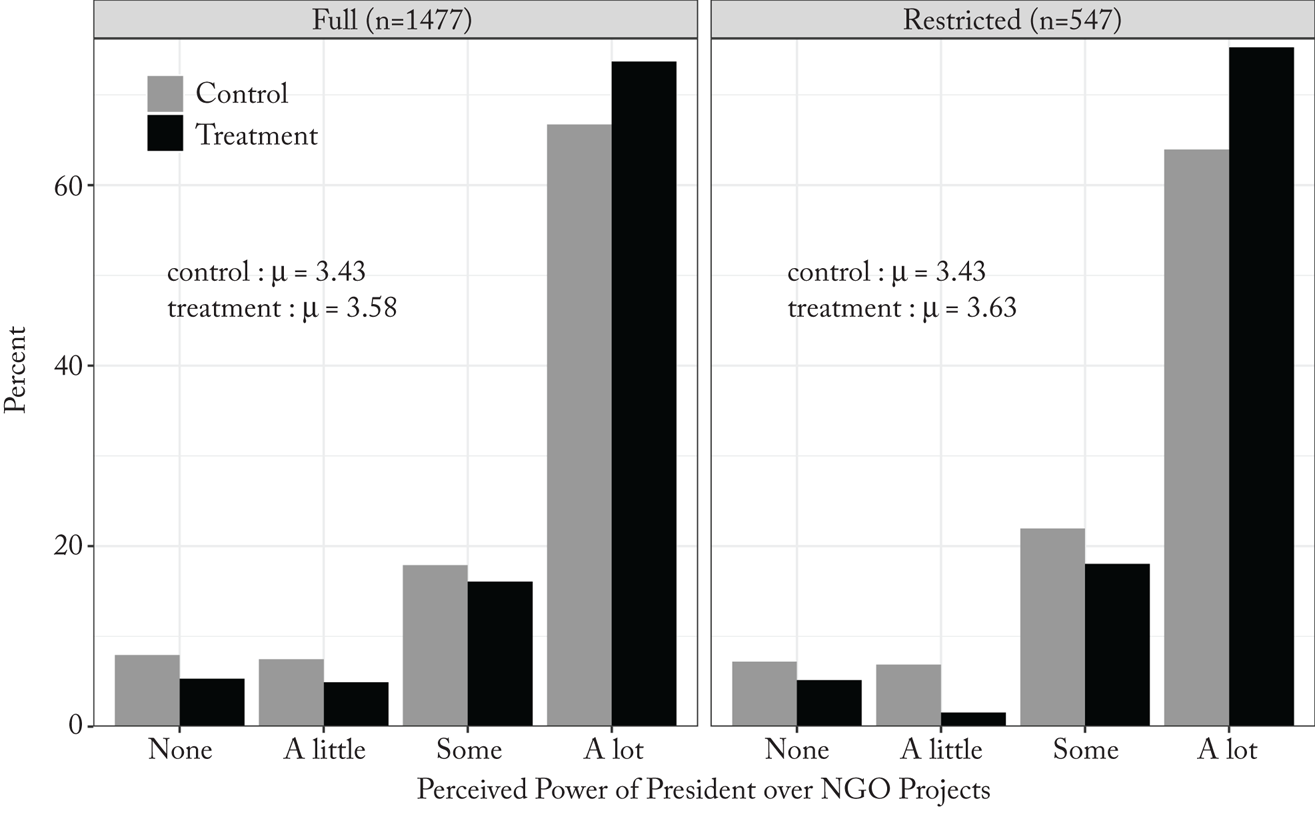
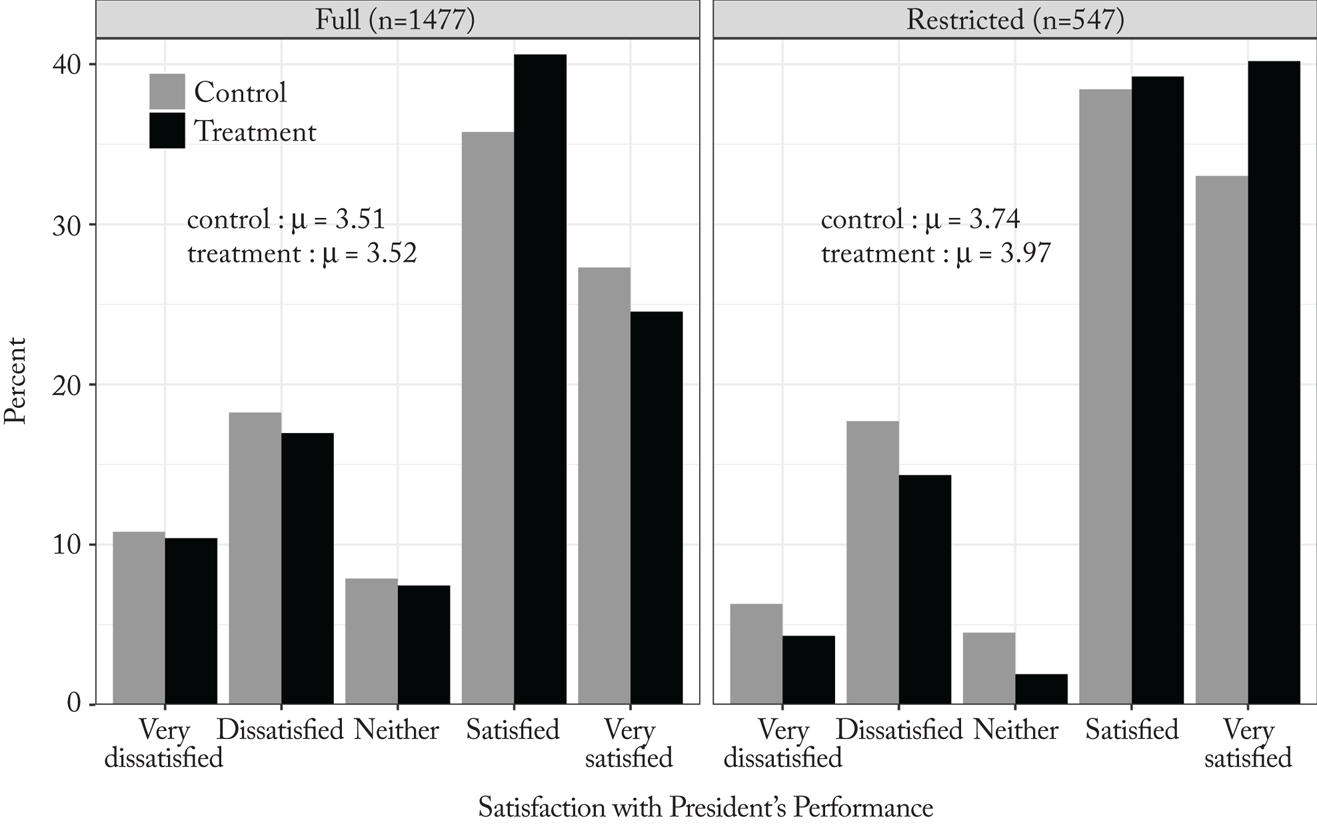
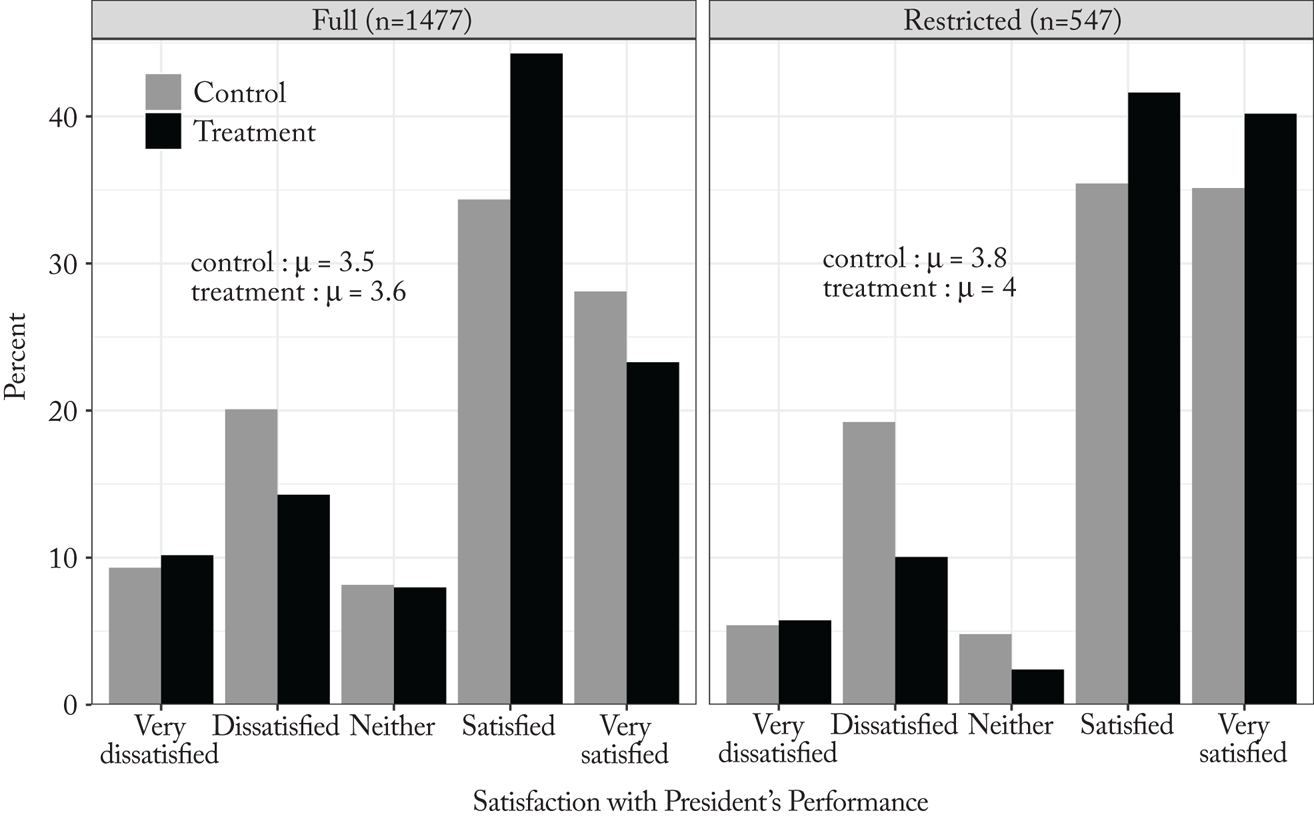
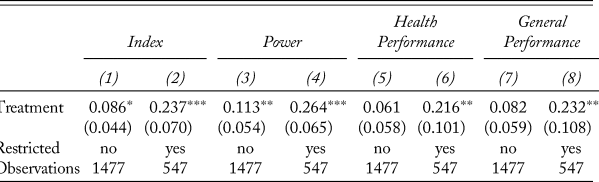
Table 2 presents results for each component of the president's political credit index. While all measures of credit are positive and substantively meaningful, the largest effect is on perceptions of power, ranging from 0.11 to 0.26 standard deviations (also shown in Figure 3). Interestingly, I find no evidence that the effect is moderated by pretreatment partisanship (measured by the president's vote from the 2006 election for the parish in which each village is located), suggesting that these results are not driven by motivated reasoning. Figures 4 and 5 plot the distribution of responses for perceptions of the president's health-specific and general job performance. Both measures also show some evidence that the intervention increased perceptions of the president's job performance in treatment villages. As expected, we see no such evidence for other government actors.Footnote 62
Perception of President's Power over Where NGOs Locate Projectsa
a Question: How much power do you think the president has over where NGOs decide to put their projects and services?

Perception of President's Performance in Health Service Provisiona
a Question: Are you satisfied or dissatisfied with the way the president is currently doing their job in providing health services?

Perception of President's Performance in Generala
a Question: Are you satisfied or dissatisfied with the way the president is currently doing their job in general?

Effect of LG CHP on Credit to the President

∗ p < 0.1, ∗∗ p < 0.05, ∗∗∗ p < 0.01; standard errors are clustered at the village level
Rather than receiving credit for choosing the communities that receive ngo services, citizens may believe that ngos first select the location of project activities, and the president merely permits this service. However, many other government actors also exercise the same gate-keeping power, and citizens likely perceive them to do so. ngos must obtain approvals at the district level, and district officials often publicly block the operation of human rights ngos.Footnote 63 Similarly, if credit was instead the result of respondents updating their beliefs about the volume of ngo activity that the president allows, respondents would positively update their beliefs about total ngo health spending in the country. Section K in the supplementary material provides disconfirmatory evidence.
Engagement and Legitimacy
Theories of instrumental political engagement and the social contract expect that when non–state actors provide viable substitutes for critical government services, engagement with and legitimacy of government will suffer. The lg chp program provides a likely case to uncover these effects, given its parallel provision of a widely used service over a long period of time and that it shifted citizens’ preferences away from government and toward ngo provision. However, the intervention's positive effect on political credit for the president gives reason to doubt these predictions.
To measure engagement, I ask respondents about their household's contact with government actors and ngos, attendance and participation at community meetings and ngo events, political knowledge, media consumption, and voting and other participation in three recent elections. To measure engagement behaviorally, I give respondents an opportunity at the end of the survey to send a message to either government health agencies (described as “the Ministry of Health and your District Health Office”) or to an unspecified ngo in their district (described to respondents as “a large health ngo with offices in Kampala and in your district”). The prompt makes clear that sending a message is optional, meaning that responding imposes a direct cost on survey participants in time and cognitive effort. Responses were translated into English and word counts were used as a measure of engagement intensity.Footnote 64 These measures are combined into eleven index variables measuring engagement with six distinct government actors, information consumption, political knowledge, organizational membership, contentious participation, and participation in election-related activities.
These index variables, as well as an investigation of their component variables, yield no evidence that the lg chp intervention affected levels of engagement with government actors or with ngos. If anything, treatment villages reported slightly higher levels of engagement with government. However, coefficients for most index variables are unstable across the full and restricted samples and rarely reach statistical significance. See section L in the supplementary material for a full description and presentation of results and section G.1 for a list of questions.
To measure legitimacy, I ask respondents about their trust in government actors and ngos; the share of designated service delivery funds that each actor spends, wastes, or steals; and tax compliance. Evidence that trust in government is lower in treatment villages is very weak, and respondents see ngos slightly more negatively. Levels of trust in the president are somewhat higher in treatment villages while trust in local councilors and mps is somewhat lower, though the differences are not significant. I also ask about contentious forms of participation, including contacting the media with a complaint, attending protests, or refusing to pay a tax or fee. When asked whether they have withheld any taxes or fees owed to government (never, once or twice, more than twice, more than five, or more than ten times), the average response is slightly lower in treatment (0.38) relative to control (0.43) villages, indicating higher levels of tax compliance.
See section K in the supplementary material for a full description and results and section G.8 for a list of questions. Overall, these findings offer compelling evidence from a variety of measures that despite providing a high-quality service parallel to a similar government program over a long period of time, ngo provision did not have a negative effect on political engagement or perceptions of government legitimacy. In fact, results are more consistent with slightly higher engagement, which may result from perceptions of an increased return to political participation due to a stronger belief that government influences the allocation of ngo projects.
Mechanisms and Alternative Explanations
I argue that direct contact with ngo services will blur lines between state and nonstate efforts and that powerful government actors will receive credit for ngo provision. The Results section provides strong support for these claims. In this section, I present evidence in favor of the specific mechanisms that my argument posits and consider several alternative explanations that could explain these results.
Substitution and Capacity Spillovers
In addition to perceptions of political control, incumbents may also receive credit for ngo interventions as a result of positive spillovers from ngo activities on related government programs, especially when governments and ngos engage in coproduction of the same services. However, this scenario is also possible where ngos engage in parallel provision, which allows knowledge and skills to diffuse between ngo and government workers.Footnote 65 This transfer of often intangible resources may increase citizens’ satisfaction with government service provision and political incumbents but is less likely to contribute to an impression of political influence.
Despite their not receiving credit for the ngo program, we did not see evidence for reduced engagement with the local politicians and district officials who oversee the parallel government program. The prediction that access to parallel ngo services would undermine political engagement assumes that ngo services are a substitute for government services or reflect negatively on the performance of government. Interviews with lg and government health workers revealed that in some cases, government vht members were recruited as chps and maintained close social ties with their former associates, which created opportunities for learning between the ngo and government health workers.
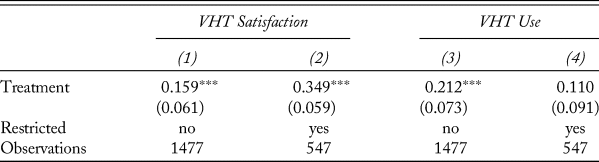
To investigate this possibility, I ask respondents about levels of contact and satisfaction with government vhts. Results in Table 3 suggest that the intervention increased respondents’ satisfaction with the parallel government vht program and contact with government vht members. This evidence—that the programs served as complements—makes findings that access to the ngo program increased preferences for ngo service provision even more striking. Although these positive spillover effects could also explain credit given to the president, evidence that citizens update their beliefs about the president's power over ngo allocation as strongly as they update their beliefs about his performance suggests that political credit is not a result of positive spillovers on the quality of the parallel government vht program.
Effect of LG CHP on Perceptions and Use of VHTs

∗ p < 0.1, ∗∗ p < 0.05, ∗∗∗ p < 0.01; standard errors are clustered at the village level
Reallocation of Government Spending
If ngo spending on health services in treatment villages allowed the government to divert spending to new activities in those villages, a second alternative may explain increased political support for the president or a null effect on engagement. Using village-level data, I compare remaining control villages to phased-in control villages and remaining control villages with all villages that have received the lg chp intervention (treatment villages plus phased-in control villages). I provide evidence that these groups are similar on both pre- and posttreatment access to a variety of local infrastructure and public goods (see sections M and F of the supplementary material). These results comport with Brigitte Seim, Ryan Jablonski, and Johan Ahlbäck, who find that ngo projects have a minimal effect on how local governments allocate spending between recipient and nonrecipient communities.Footnote 66
Health and Political Outcomes
A third alternative explanation is that improved health will affect political engagement or credit attribution. If the intervention made respondents healthier, and this improvement in health made respondents more mobile, more able to attain education, or resulted in higher earnings, these differences may have increased political participation in a way that countered decreases in engagement that access to ngo services caused, resulting in null findings. Similarly, higher wages could increase approval or perceptions of the president's job performance (although higher wages are unlikely to impact perceived influence over ngos), although higher education would bias against this result, as education is negatively correlated with the president's approval. Although ruling out this possibility directly is difficult, I investigate this possibility by looking at differences in levels of education and self-reported living conditions. Using living conditions as a proxy for wealth, we see little difference between respondents in control and treatment villages (2.94 versus 2.99 on a 10-point scale, p = 0.43). Although we do see significantly higher levels of education in treatment villages (2.86 versus 3.06 on a 6-point scale, p = 0.01), the consistently null results across diverse modes of political engagement that have different correlations with education provide some assurance that higher education is not masking a negative effect of the intervention on engagement.Footnote 67
Responsiveness and Capacity
Receiving health services from an ngo may allow citizens to compare the responsiveness or capacity of ngos and government. This ability to compare the responsiveness of providers may explain why respondents in treatment villages are more likely to prefer ngo over government service provision. To measure perceptions of responsiveness, I ask about respondents’ beliefs that they could influence the actions of local or national government actors or ngos and how effective various lobbying activities aimed at these actors would be. Results provide no evidence that respondents see ngos or government as more or less responsive in treatment villages.Footnote 68 See section N in supplementary material for a full description and presentation of results and section G.6 for a list of questions.
To measure perceptions of government capacity, I ask respondents whether they agree or disagree with statements asserting the ability of local and national government agencies to carry out health-related tasks. To measure capacity on a relative scale, I ask respondents to estimate the share of services in the country provided by government versus non–state actors. I find no evidence that respondents in treatment villages see the capacity of ngos or local or national government more negatively (or positively). See section G.7 for a list of questions and section K for a presentation of results.
Respondents’ Awareness of the Treatment
To further test whether the increased preference for ngo services and increased political credit for the president were generated by respondents’ awareness of access to ngo services (rather than misattribution of ngo services to government, misattribution of improvements in household or community welfare to government policy, or positive spillovers on government capacity), I look at the strength of these effects among the subset of respondents in treatment villages who (1) reported being aware of the lg chp intervention or (2) reported that they believed the lg chp program was operated not-for-profit (rather than for-profit) or (3) received care from an lg chp. In treatment villages, 49 percent of respondents were aware of the lg chp program and 49 percent believed that the intervention was nonprofit. The median treatment household reported one instance of receiving care in the past year.
If the effects of the intervention were not a product of citizens’ awareness of the ngo program or were the result of pretreatment differences, the main effects should be similarly sized for respondents in treatment villages who were not aware of the lg intervention or believed that it was for-profit. For all three alternative definitions of the treatment variable, the effect of the treatment on the index measuring preferences for ngo services remains significant and becomes substantially larger.Footnote 69 For credit to the president, coefficients for the full sample also remain significant and become substantially larger, although coefficients for the restricted sample remain similar in size (see section J in supplementary material). These results reinforce my interpretation of the main findings, reflecting a genuine increase in preferences for ngo service delivery over government service delivery, and an effect on political credit for the president driven by changing beliefs about his influence over ngo provision.
Conclusion
Political economy research has produced opposing expectations about the likely effects of nonstate service provision on important political outcomes. On one hand, theories of instrumental engagement and the social contract suggest that decreasing the role of the state in service provision may reduce citizens’ engagement with government and perceptions of government legitimacy. Alternatively, work on credit attribution in complex political environments gives reason to expect that nonstate provision may inflate support for incumbents who receive credit for the production, allocation, or welfare effects of ngo services. I synthesize these theoretical disagreements and argue that perceptions of political control over allocation will preclude the erosion of feelings of reliance on government, even as citizens positively update their beliefs about the viability and desirability of ngos as an alternative service provider to government. Instead, ngos’ provision of services that are traditionally associated with the state, as well as practices like ngo-government cobranding and hiring, will foster among citizens an impression of political influence that benefits powerful incumbents.
To test these expectations, I field original surveys downstream from a highly effective randomized health intervention implemented in parallel to a similar universal government program in Uganda. The lg chp program resembled a most-likely case in which to find evidence for political disengagement. The program provided an effective and popular alternative delivered in parallel to a salient, front-line universal government program. Consistent with concerns among scholars and policymakers about a weakened social contract, access to ngo services changed citizens’ preferences for the role of government in service provision, causing stronger preferences for ngo, over government, delivery.
However, these preferences did not result in lower levels of political engagement or damage perceptions of government performance or legitimacy, even after eight full years of continuous access to the program. Instead, citizens saw ngos as a valuable resource that powerful government actors controlled and updated their beliefs about the quality of actors who they saw as responsible for these allocations. Looking at a broad range of government actors, evidence suggests that only the president received credit for the intervention. Not only did citizens express strong ex-ante beliefs that the president influences the allocation of ngo services, but contact with the ngo program strengthened this belief. Although access to ngo services did cause citizens to “look to ngos rather than governments to provide services,” their view did not imply a weakening of the social contract. Rather than feeling less reliant on government, citizens with access to the intervention were more likely to believe that the president actively controls which communities receive ngo services and which do not.
Alternatively, the lg chp program is a hard test of whether ngos generate political credit. The ngo carried out the program largely independently of the government health system and randomly assigned the program across villages. However, respondents believed that the president was controlling ngo project allocation, and the intervention strengthened the belief in political control over allocation of ngo services. This hard test may partly account for the null effects of the program on political credit for local government actors, who are more likely to take part in interventions that involve explicit coproduction. Furthermore, President Museveni's long tenure and top-down control over the distribution of government resources may crowd-out the ability of local politicians to effectively claim credit for themselves. Investigating the effect of similar interventions that involve more inputs or oversight from local government, especially in contexts with weaker chief executives or less restrictions on political competition from opposition groups, could enrich our understanding of credit attribution and nonstate service delivery.
The argument advanced in this article assumes that ngo services are higher quality than those that the government provides. The effect of ngo provision is likely to be different in contexts in which ngo programs are ineffective or where government services rival ngos in their quality. In such circumstances, access to ngo services may decrease preferences for nonstate providers. Interestingly, this decrease could improve perceptions of incumbent performance because government services compare favorably with those that ngos provide, or it could decrease approval if citizens believe that incumbents are directing less desirable nonstate services to their community rather than high-quality government services.
These findings have ambiguous normative implications. On one hand, ngo activities may let underperforming governments off the hook by inflating public support, which may be especially problematic in contexts where credit flows to a powerful chief executive with autocratic tendencies. If governments respond to increased political support or changing preferences among citizens by retrenching from service delivery and diverting spending to less publicly oriented tasks, they could contribute to the long-term deterioration of state capacity. However, although respondents with access to the lg chp intervention were more likely to believe ngos should provide most of the country's health services, a clear majority still believe that government should at least finance health services. This finding suggests that citizens are unlikely to reduce their demand for government involvement in service provision. Furthermore, the ability of at least some political actors to receive credit may also provide an incentive for governments to create a facilitating environment for nonprofits.
These findings advance our understanding of how the provision of services conditions individual preferences for the role of government in that provision and how citizens attribute political credit in complex governance environments. The findings also carry important implications for practical questions about the role of non–state actors in securing citizens’ welfare and the potential costs that donors and policymakers face when invoking these actors. Going forward, donors should think carefully about whether channeling resources to ngos undermines political incentives to invest in state capacity. However, the results do suggest complementarities between ngo programs and government programs are possible even without explicit coproduction. While I provide some evidence that the intervention studied here did not cause differential government investments in local public goods, further research should explore the impact of citizens’ expectations for government to understand the consequences of ngo service delivery for political accountability.
Supplementary Material
Supplementary material for this article can be found at https://doi.org/10.1017/S0043887122000107.
Data
Replication files for this article can be found at https://doi.org/10.7910/DVN/KW5KG1.
Acknowledgements
I thank Guy Grossman, Erik Wibbels, Jennifer Brass, Dorothy Kronick, Emmerich Davies, Pablo Beramendi, Pia Raffler, Julie Weaver, Alyssa Huberts, Taylor Boas, Edmund Malesky, and participants and organizers at NEWEPS-12, WGAPE 2019, and the Duke Political Economy Working Group for comments. I am deeply indebted to Samuel Olweny and the staff at Matrice360 Uganda for their tireless work and steadfast commitment to this project. This project would not have been possible without Martina Björkman Nyqvist. This project was approved by the Mildmay Uganda Research and Ethics Committee (REF 0410-2017), the Uganda National Council for Science and Technology (SS170ES), the University of Pennsylvania Institutional Review Board (REF 828451), and the Office of the President of Uganda. A full preanalysis plan was registered with Evidence in Governance and Politics (20181017AA) prior to data collection.
Funding
Support came from the National Science Foundation (SES-1747642), an anonymous foundation, the University of Pennsylvania, the Browne Center for International Politics, and an American Political Science Association Centennial Grant.