Schizophrenia is a biologically based disorder that resides in a social context. The vulnerability-stress model is a useful conceptual framework to explain how different sources of stress can affect the development of the disorder or its course (Nuechterlein, Dawson et al., Reference Nuechterlein, Dawson, Gitlin, Ventura, Goldstein, Snyder and Mintz1992; Nuechterlein, Snyder, & Mintz, Reference Nuechterlein, Dawson, Gitlin, Ventura, Goldstein, Snyder and Mintz1992; Zubin & Spring, Reference Zubin and Spring1977). The level of familial tension is one potential area of stress for patients living with their families (Hooley, Reference Hooley2007). Expressed emotion (EE), as traditionally assessed after applying the Camberwell Family Interview (CFI; Vaughn & Leff, Reference Vaughn and Leff1976) to the patient’s key relative, has repeatedly shown to predict an increased relapse rate in schizophrenia (Brown, Birley, & Wing, Reference Brown, Birley and Wing1972; Bebbington & Kuipers, Reference Bebbington and Kuipers1994; Butzlaff & Hooley, Reference Butzlaff and Hooley1998).
EE is based on criticism, hostility, and emotional over-involvement (EOI), although it includes also two positive indices, warmth and positive remarks (PR) (Leff & Vaughn, Reference Leff and Vaughn1985). Studies show that the prevalence of criticism and EOI varies between Northern and Southern European/American countries, although criticism has been viewed as the main predictor of many characteristics of high-EE families in most Western societies (Kavanagh, Reference Kavanagh1992). Despite empirical evidence shows patients as the target of caregivers’ criticism and that patients’ views can be informative and advance our understanding of family dynamics, few studies have sought to obtain data directly from patients (see Renshaw, Reference Renshaw2008 for an overall review); and none of them have been carried out in a Mediterranean culture.
If we consider theories about personal appraisals mediating the relationship between environment and stress (Lazarus & Folkman, Reference Lazarus and Folkman1984; Lazarus, Reference Lazarus1993), the traditional assessment of EE with the CFI which considers information during an interview with the key relative would not have why to correspond to patient’s perceptions of that EE. Particularly concerning schizophrenia, six of the seven studies that have included both perspectives of criticism (Bachmann, Bottmer, Jacob, & Schröder, Reference Bachmann, Bottmer, Jacob and Schröder2006; Cutting, Aakre, & Docherty, Reference Cutting, Aakre and Docherty2006; Kazarian, Malla, Cole, & Baker, Reference Kazarian, Malla, Cole and Baker1990; Scazufca, Kuipers, & Menezes, Reference Scazufca, Kuipers and Menezes2001; Tompson et al., Reference Tompson, Goldstein, Lebell, Mintz, Marder and Mintz1995; Weisman, Rosales, Kymalainen, & Armesto, Reference Weisman, Rosales, Kymalainen and Armesto2006) have not found correspondence between them, except under particular circumstances. For example, in moments of clinical instability (Scazufca et al., Reference Scazufca, Kuipers and Menezes2001), only when highly critical caregivers were included (Tompson et al., Reference Tompson, Goldstein, Lebell, Mintz, Marder and Mintz1995; Scazufca et al., Reference Scazufca, Kuipers and Menezes2001; Cutting et al., Reference Cutting, Aakre and Docherty2006; Bachmann et al., Reference Bachmann, Bottmer, Jacob and Schröder2006), or among ethnic majority group members compared to minorities (Tompson et al., Reference Tompson, Goldstein, Lebell, Mintz, Marder and Mintz1995; Weisman et al., Reference Weisman, Rosales, Kymalainen and Armesto2006). In contrast, the seventh study (Lebell et al., Reference Lebell, Marder, Mintz, Mintz, Tompson, Wirshing and McKenzie1993) found a total coincidence between both views, although using a self-rated instrument in the part of the relatives instead of the CFI or another similar interview applied to relatives but assessed objectively by professionals. Therefore, the criticism perceived by the patients does not seem to be able to substitute the traditionally considered vision of the CFI based on relatives’ expression of emotions. However, it might offer us helpful and complementary information of the family emotional environment from an insider view and with fewer sources.
As regards the predictive validity of perceived criticism for patients with schizophrenia, it has demonstrated to predict relapse over a period of 9-months to 1-year follow-up in three studies (Baker, Kazarin, Helmes, Ruckman, & Tower, Reference Baker, Kazarin, Helmes, Ruckman and Tower1987; Lebell et al., Reference Lebell, Marder, Mintz, Mintz, Tompson, Wirshing and McKenzie1993; Tompson et al., Reference Tompson, Goldstein, Lebell, Mintz, Marder and Mintz1995), while no association with deterioration in one (Taylor & Meeks, Reference Taylor and Meeks1996), although the patients showed a pattern of symptoms very stable over time in this last study. In Lebell et al. (Reference Lebell, Marder, Mintz, Mintz, Tompson, Wirshing and McKenzie1993) and Tompson et al. (Reference Tompson, Goldstein, Lebell, Mintz, Marder and Mintz1995), patients’ view of criticism even proved to be a better predictor of relapse than that from the caregivers’ perspective. This means that we will have more probabilities of predicting and controlling relapses if we have information about the patients’ perceptions of criticism. Besides, thanks to the easy and quickly way to obtain it, we could even use this resource with certain frequency as a thermometer of the family environment temperature.
In contrast to the link of both perspectives of criticism with the subsequent relapse shown by most studies, the literature has pointed out that relatives’ negative affect expressed towards the patients in form of criticism and/or EOI is independent of the current levels of psychotic psychopathology of the patients (Bentsen, Notland et al., Reference Bentsen, Munkvold, Notland, Boye, Oskarsson, Uren and Malt1998; Brown et al., Reference Brown, Birley and Wing1972; Cutting et al., Reference Cutting, Aakre and Docherty2006; Heikkilä et al., Reference Heikkilä, Karlsson, Taiminen, Lauerma, Ilonen, Leinonen and Salakangas2002; Kuipers et al., Reference Kuipers, Bebbington, Dunn, Fowler, Freeman, Watson and Garety2006; Miklowitz, Goldstein, & Falloon, Reference Miklowitz, Goldstein and Falloon1983; Nuechterlein, Snyder et al., Reference Nuechterlein, Dawson, Gitlin, Ventura, Goldstein, Snyder and Mintz1992; Vaughn, Snyder, Jones, Freeman, & Falloon, Reference Vaughn, Snyder, Jones, Freeman and Falloon1984). From the patients’ side, symptom severity seems to be unrelated to their perceptions of criticism (Cutting et al., Reference Cutting, Aakre and Docherty2006; Scazufca et al., Reference Scazufca, Kuipers and Menezes2001; Tompson et al., Reference Tompson, Goldstein, Lebell, Mintz, Marder and Mintz1995), which argue against the notion that higher scores on perceived criticism might simply be reflections of greater symptomatology. Therefore, although it could be intuitively expected that relatives would be more critical of patients with a more severe illness or who would have more symptoms of psychopathology, at the same time that patients cohabiting with more critical caregivers would present worse psychopathology, this is not the case. Hooley (Reference Hooley2007) suggested that instead of the severity of particular symptoms, what may be important is the patients’ decline in social functioning and in particular the fact that families try to cope with patients’ more difficult and challenging behaviours. Thus, relatives’ willingness and ability to make such accommodations is what may underlie the development of higher EE attitudes such as criticism, also in line with the model of Lazarus and Folkman about subjective appraisals of the events (Lazarus & Folkman, Reference Lazarus and Folkman1984; Lazarus, Reference Lazarus1993).
Positive affect, i.e. the relatives’ warmth and the PR towards the patients, was also considered in this study. The literature shows that patients’ perceptions of their relatives’ attitudes of care towards them influence positively on the course of the illness in a period from nine months to one year (Warner & Atkinson, Reference Warner and Atkinson1988; Baker et al., Reference Baker, Kazarin, Helmes, Ruckman and Tower1987; Lebell et al., Reference Lebell, Marder, Mintz, Mintz, Tompson, Wirshing and McKenzie1993), while there is no data regarding how they are associated to the current level of symptomatology. Considering the typical view of EE from the CFI, López et al. (2004) found that family expressed warmth was a significant protective factor for Mexican Americans but not for Anglo Americans. Bertrando et al. (Reference Bertrando, Beltz, Bressi, Clerici, Farma, Invernizzi and Cazzullo1992) indicated that high warmth was associated with a lower admission rate in both low- and high-EE families. Both studies suggested that family positive affect can contribute to preventing relapse depending on the sociocultural context. In addition, Bentsen, Munkvold et al. (Reference Bentsen, Munkvold, Notland, Boye, Oskarsson, Uren and Malt1998) showed that relatives’ warmth was not related to patients’ symptom severity. Therefore, it seems that family positive affect has a very beneficial effect on the prognosis of schizophrenia (despite only six studies have considered it in schizophrenia), although it is not so clear its relationship to the current severity of the psychotic symptoms.
At last, apart from how the presence of positive affect could associate to the illness and according to theories based on the power of positive emotions such as the broaden-and-build theory of positive emotions (Fredrickson, Reference Fredickson2001), we hypothesized that the presence of positive affect could also act as a buffer of perceived criticism, making it decrease. Scazufca et al. (Reference Scazufca, Kuipers and Menezes2001) carried out the only previous study on this issue, showing no relationship between the presence of relatives’ warmth and/or PR and the patients’ perception of criticism.
Thus, the present study aimed to explore if the cross-sectional findings previously commented would be replicated in a Mediterranean country such as Spain. For that, our specific objectives were: (a) To assess the congruence of the criticism expressed by the key relatives towards the patients and the criticism perceived by the patients, (b) To examine if the presence of key relatives’ positive attitudes towards the patients varied the association between the expressed and the perceived criticism, and (c) To explore the relationship between the relatives’ expressed emotions (including the positive ones) and the perceived criticism with the severity of the psychotic symptoms of the patients.
Method
Participants
A total of 21 dyads of outpatients with diagnoses of schizophrenia according to DSM-IV-TR (American Psychiatric Association, 2002) and their key relatives were consecutively recruited. Patients’ inclusion criteria were the indicated diagnosis (confirmed after reviewing the charts) as well as the accessibility and willingness of the key relative to participate. Key relatives were those living with the patient, who had most contact and the most significant relationship with the patient. Patients’ exclusion criteria were neurological or any somatic illness that could interfere with the psychiatric diagnosis, moderate to severe mental retardation, evidence of current substance dependence, psychiatric exacerbation and/or changes in medication during the last month. All patients were receiving antipsychotic medication at the time of the study, and reported an adherence rate greater than 90% to the medical prescription over the last month. The mean time of illness duration was 10.5 years (SD = 8). A total of 81% were men with a mean age of 32.4 years (SD = 6.6, range = 21-50), and most of them were single (85.7%) and had not children (90.5%). Altogether 14% had completed primary school, 47.6% junior school-until 14 years-, 14.3% secondary school, 9.5% had concluded in a professional school, and 14.3% in College. Most of them (66.7%) were unemployed (61.9% received a government compensation for permanent disability) and, from the rest, 9.5% had a sick leave and 23.8% were employed. The sample of relatives was comprised of 81% mothers, 9.5% spouses, and 9.5% siblings. Ninety-five percent were women with a mean age of 55.6 years (SD = 12.1, range = 32-72). Of the relatives, 76% had completed primary school. The study was carried out at the Mental Health Centre of Parc Taulí Hospital in Sabadell (Barcelona) and it was approved by the local ethic committee. Informed consent was obtained from all participants.
Instruments and Procedure
Patients underwent the interview for the Positive and Negative Syndrome Scale (PANSS; Kay, Fiszbein, & Opler, Reference Kay, Fiszbein and Opler1987; Peralta & Cuesta, Reference Peralta and Cuesta1994). The patients’ perceptions of their relatives’ criticism towards them were examined applying the Perceived Criticism Scale (PCS; Hooley & Teasdale, Reference Hooley and Teasdale1989). It consists of a single question, namely: “How critical do you consider your relative to be of you?” It is administered as a 10-point Likert scale and anchored with the values not at all critical and very critical indeed. Predictive and concurrent validity of the PCS is high for different samples (Hooley & Teasdale, Reference Hooley and Teasdale1989; Renshaw, Reference Renshaw2008; White, Strong, & Chambless, Reference White, Strong and Chambless1998). To explore our first aim we also applied the ‘perceived criticism’ score of the Family Emotional Involvement and Criticism Scale (FEICS; Restrepo et al., Reference Restrepo, Hernández, Cardona, Arango, González, Puerta and Molina2004; Shields, Franks, Harp, McDaniel, & Campbell, Reference Shields, Franks, Harp, McDaniel and Campbell1992), which is also a well-established measure of patients’ perceptions of their key relatives’ critical stance towards them. This subscale of the FEICS comprises 7 items that are rated from almost always to almost never on a 5-point Likert scale. An example of the items includes “my relative is always trying to get me to change”. The internal consistency –Cronbach’s alpha – was 0.82 for this scale in the original study (Shields, Franks, Harp, Campbell, & McDaniel, Reference Shields, Franks, Harp, Campbell and McDaniel1994). All these instruments were applied to the patients by students graduated in psychology and especially trained for reliability and consensus in the PANSS.
To assess key relatives’ EE, the abbreviated version of the Camberwell Family Interview (CFI; Montero & Ruiz, Reference Montero and Ruiz1992; Vaughn & Leff, Reference Vaughn and Leff1976) was used. It is a semi-structured interview of approximately one and a half hour of duration with the key relative that assesses their attitudes before different aspects of the patient’s situation (psychiatric history, family time budget, irritability/quarrelling, current clinical symptoms, household tasks, money matters, family relationships, medication, future). This interview is audio-recorded and subsequently coded for EE by a trained professional. Five indices are rated: criticism (frequency count of critical comments towards the patient); hostility (score of 0: no hostility; 1: present as generalisation of criticism only; 2: present as rejection only; or 3: present as generalisation and rejection); EOI (0: none; 1: very little; 2: some; 3: moderately high; 4: high; or 5: marked); warmth (0: none; 1: very little; 2: some; 3: moderate; 4: moderately high; or 5: high); and PR (frequency count of positive comments about patient). First author carried out and rated all the CFI interviews with the relatives, while M.I.M. coded 20% of the interviews randomly selected. Both coders were previously trained by Dr. Christine Vaughn in London to give reliable ratings of EE. Inter-coders reliability was obtained satisfactorily in the present study (coefficients superior to 0.80). The CFI interviewer had no knowledge of the information gathered during the patients’ interviews, and vice versa. The time gap between patient and relative interviews varied from 1 to 16 days.
Statistical analyses
All the study variables were quantitative. For the first aim, we proceeded to compare expressed and perceived criticism by means of correlations. To examine the validity of the patients’ perceptions of criticism with the PCS, congruence to the FEICS score was also examined by calculating correlations. For the second aim, a linear regression of perceived criticism on criticism expressed by relatives moderated by warmth was carried out. The regression coefficient was adjusted by EOI since literature (e.g. Keefe, López, Tiznado, Medina-Pradas, & Mendoza, 2011) describes EOI strongly correlated with warmth as measured with the CFI in key relatives and EOI strongly correlated to criticism from the patients’ perception. Thirdly, correlations of the relatives’ EE indices and the patients’ perceived criticism with the severity of the psychotic symptoms were performed. For all the correlations, Pearson or Spearman statistics were calculated depending on whether the variables were normally distributed according to the Shapiro-Wilk Test. All significance test results are quoted as two-tailed probabilities. An alpha level of .05 was used for all tests and the false discovery rate (FDR; Benjamini & Yekutieli, Reference Benjamini and Yekutieli2001) was calculated considering the multiple comparisons.
Results
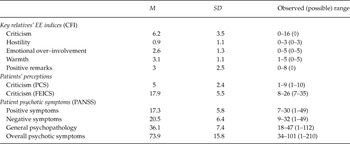
Descriptive data regarding relatives’ EE indices, perceived criticism, and psychotic symptoms are shown in Table 1. As observed, patients’ symptomatology is consistent with their outpatient status.
Description of the key relatives’ EE indices, perceived criticism, and psychotic symptoms (N = 21)

Note:
CFI: Camberwell Family Interview, PCS: Perceived Criticism Scale, FEICS: Family Emotional Involvement and Criticism Scale, PANSS: Positive and Negative Syndrome Scale, ◊: Frequency count.
Correspondence between expressed and perceived criticism
Key relatives’ expression and patients’ perception of criticism did not correlate (ρ = −.04, p = .86); no correspondence between the amount of criticism expressed by the key relatives towards the patients and the criticism perceived by the patients was found. There was no relationship either between perceived criticism and another critical stance expressed by the relatives, that is hostility (ρ = −.01, p = .96).
Despite patients’ perceptions of critical attitudes were not related to the key relatives’ expression of criticism, they were significantly related to the FEICS score of perceived criticism (ρ = .47, p =.03). Thus, the two scores on patients’ perceptions of criticism, that from the PCS and that from the FEICS, correlated positively and significantly with each other. On the other hand, key relatives’ EE indices were also congruent to each other. For instance, criticism correlated positively and significantly to hostility (ρ = .86, p < .001), whereas negatively to warmth (ρ = −.45, p =.04); and warmth was positively and significantly related to PR (ρ = .49, p =.03).
Does the key relatives’ warmth work as a buffer of perceived criticism?
Warmth demonstrated not to interact significantly with relatives’ levels of criticism. On their side, EOI was necessary as an adjusting variable since the relationship between expressed criticism and warmth varied from positive (raw coefficient) to negative (adjusted by EOI coefficient). Then, findings showed that the influence of relatives’ expressed criticism on patients’ perceived criticism decreased when the levels of warmth increased, but this moderation effect was statistically very weak (p = .84). Once the interaction was eliminated of the model, it was observed that the effect of relatives’ expressed criticism on perceived criticism was also very low (p = .62). Thus, according to these findings and from a strictly statistical point of view, the fact that relatives showed positive affect in form of warmth towards the patient did not make patients to perceive less criticism.
Relationship of emotions expressed by the key relatives and patients’ perceived criticism with symptoms severity
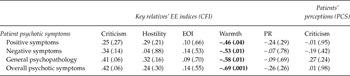
As can be observed in Table 2, none of the key relatives’ negative expressed emotions (criticism, hostility, or EOI) as assessed with the CFI were significantly related to the symptom severity. As regards the amount of criticism perceived by the patients, there was neither any significant relationship with their current level of psychotic symptomatology. Thus, findings revealed that criticism is not associated with the current level of symptoms to a statistically significant extend. However, an evaluation of the correlation coefficients demonstrated that the relationship was there regarding the expressed criticism, but the sample size was so small that it did not reach significance (although it was marginally significant at .06 in two variables). The correlations were positive and above .40 (medium/strong in behavioural sciences) between criticisms expressed by the key relatives and patients’ symptoms (in concrete, the general psychopathology and the overall psychotic symptoms scales).
Correlation coefficients (p values) of key relatives’ EE indices and perceived criticism with the severity of the psychotic symptoms (N= 21)

Note:
CFI: Camberwell Family Interview, PCS: Perceived Criticism Scale, EOI: Emotional overinvolvement, PR: Positive remarks. Significant at p < .05 (two-tailed).
In contrast, the warmth expressed by the key relatives was negatively and significantly correlated to all the symptoms studied (positive and negative symptoms, general psychopathology, and total psychotic symptoms) -See Table 2-. Therefore, patients presented less symptomatology when their key relatives were warmer with them, possibly at the same time (if we consider a circular relationship) that the key relatives expressed more positive affect in form of warmth towards the patients that presented fewer symptoms.
It was found a FDR value of 0.0257, a very acceptable rate under the 5%, which indicates a low rate of expected false positives in our observations.
Discussion
Firstly, the present study assessed the correspondence between the criticism expressed by caregivers towards schizophrenia patients and the criticism perceived by the patients in a Mediterranean sample. At this respect, we found that both perspectives did not correspond, that is, as more critical comments were rated by professionals from the relatives’ perspective during the CFI, patients did not perceive more criticism. This is in line with the findings of Scazufca et al. (Reference Scazufca, Kuipers and Menezes2001) and Tompson et al. (Reference Tompson, Goldstein, Lebell, Mintz, Marder and Mintz1995), and is contrary to the Bachmann et al.’s (Reference Bachmann, Bottmer, Jacob and Schröder2006) and Weissman et al.’s (2006). Our findings also showed the validity of the patients’ view of criticism, by comparing it to another well-established measure. Therefore, the idea that in Mediterranean countries as in other Western countries schizophrenia patients do not perceive criticism in a similar way than that rated with the CFI is suggested. Some plausible explanation could be the difficulty to perceive negative emotions in this kind of patients, as defended by some authors (Bellack, Mueser, Wade, Sayers, & Morrison, Reference Bellack, Mueser, Wade, Sayers and Morrison1992; Trémeau, Reference Trémeau2006), although it seems that this difficulty disappears when the critical attitude shown by the caregiver is very intense (Cutting et al., Reference Cutting, Aakre and Docherty2006; Tompson et al., Reference Tompson, Goldstein, Lebell, Mintz, Marder and Mintz1995). Another possibility might be that patients have an impaired theory of mind in its affective component (Brüne, Reference Brüne2005), a deficit inferring complex emotions in others from observable cues. This would make difficult for them to respond to the question “How critical do you consider your relative is towards you” which requires to take the point of view of their relative. Just asking patients “How much do you feel criticized by your relative”, that only implies their own experience and opinion to reply, could help (Cutting et al., Reference Cutting, Aakre and Docherty2006). However, to reply the FEICS it was not necessary to make such inferences and the results were consistent. Future research could further study if these differences between expressed and perceived criticism could represent a patients’ facet of emotional recognition or theory of mind.
Second, the fact that relatives showed positive affect in form of warmth towards the patient did not make patients to perceive less criticism. This would be in agreement with Scazufca et al. (Reference Scazufca, Kuipers and Menezes2001) that found that the presence of a warm attitude in the key relatives or the emission of positive remarks towards them did not relate at all to the criticism perceived by patients. If we admit Bellack et al.’s findings (1992) stating that schizophrenia patients consistently underestimate the intensity or negativeness of negative emotions, but they are not deficient in perception of positive emotional displays, it may be inferred that patients recognised their relatives’ warmth but that did not change their way of perceiving their relatives’ criticism. It would be also interesting to carry out more research comparing expressed and perceived positive affect, in particular of warmth within the EE context. In this direction, a recent study conducted in Los Ángeles by Keefe et al. (2011) has concluded that schizophrenia patients’ and their key relatives’ perspectives only corresponded in the case of positive emotions (warmth), but not in negative emotions (criticism or EOI), which reinforce our inference.
The present study also showed that neither the negative emotions expressed by the relatives towards the patients during the CFI (criticism, hostility, or EOI) nor the criticism perceived by the patients were associated with the patients’ symptom severity. Consistent with the literature (Bentsen, Notland et al., Reference Bentsen, Munkvold, Notland, Boye, Oskarsson, Uren and Malt1998; Brown et al., Reference Brown, Birley and Wing1972; Cutting et al., Reference Cutting, Aakre and Docherty2006; Heikkilä et al., Reference Heikkilä, Karlsson, Taiminen, Lauerma, Ilonen, Leinonen and Salakangas2002; Kuipers et al., Reference Kuipers, Bebbington, Dunn, Fowler, Freeman, Watson and Garety2006; Miklowitz et al., Reference Miklowitz, Goldstein and Falloon1983; Nuechterlein, Snyder et al.Reference Nuechterlein, Dawson, Gitlin, Ventura, Goldstein, Snyder and Mintz1992; Vaughn et al., Reference Vaughn, Snyder, Jones, Freeman and Falloon1984), it seems that it is not the severity of the psychotic symptoms what makes relatives be more or less critical, hostile or overinvolved neither the fact of cohabiting with critical relatives what makes patients show better or worse psychopathology. The alternative suggested by Hooley (Reference Hooley2007) was not contrasted in our sample, but a mean of almost eleven years of illness duration does not seem to be the most demanding period for the relatives to do adaptive changes. It would be interesting to explore this in future research by comparing with more challenging first episodes or even at-risk mental states. Similarly, from the patients’ side, symptom severity seems to be neither related to their perceptions of criticism, which is also in line with the previous scarce research on this issue in schizophrenia (Tompson et al., Reference Tompson, Goldstein, Lebell, Mintz, Marder and Mintz1995; Scazufca et al., Reference Scazufca, Kuipers and Menezes2001; Cutting et al., Reference Cutting, Aakre and Docherty2006). Higher scores on perceived criticism is not simply a reflection of greater symptomatology. Probably perceived criticism is a complex phenomenon in which insight, personality traits and family cultural issues play a role.
In contrast to what happened with negative affect, positive affect that caregivers expressed towards patients, in particular warmth, was associated with patients’ psychotic symptoms severity. This finding reveals as quite relevant fundamentally for being a positive result even with a small sample size and also because the literature at this respect is almost inexistent -the only previous study that considered this question was Bentsen, Munkvold et al. (Reference Bentsen, Munkvold, Notland, Boye, Oskarsson, Uren and Malt1998)-. Then, putting together what we have presented so far, it seems that negative affect relates to schizophrenia differently than positive affect. A possible reason for this result, based on the literature, includes that patients perceive both kind of emotions differently, possibly due to a neurologically based perceptual deficit or to a self-protective mechanism to reduce or avoid stress (Bellack et al., Reference Bellack, Mueser, Wade, Sayers and Morrison1992). Furthermore, this study suggests a more relevant role for positive affect in symptoms severity in schizophrenia than for negative affect, which has important implications for family interventions. Thus, not only it is essential to reduce the family negative affect in the patient’s family environment, but also to promote the presence of positive affect. Prevailing models of the EE-relapse association conceptualize EE as a form of stress for patients (Hooley & Gotlib, Reference Hooley and Gotlib2000), basically based on the Zubin & Spring’s vulnerability-stress model (1977). Maybe our recommendation for the future is to focus also on positive aspects and integrate the prevalent view with more up to date models based on positive psychology (f.i. the Fredrickson’s model, 2001).
A shortcoming of the study is the small sample size, which probably limits the statistical power of the analyses. For example, it would have been probable to find with a greater sample the statistical signification for the ‘buffering’ effect of warmth in the influence of the expressed criticism on the perceived criticism, or the enough statistical power of the relationship between expressed criticism and symptoms severity. For that reason, the results should be examined cautiously and should encourage future research in this line with greater samples. Although the ratio between number of cases and statistical test done is low, we did not modify the significance level below 5% to not hide relations that could be unnoticed otherwise. Furthermore, the FDR for this study indicated a very low rate of expected false positives which is like a guarantee.
Patients’ perceptions of the family EE may be an important insider’s view that might help us to explain the impact and meaning of the revealed differences in the perception and interpretation of affect within families with a member with schizophrenia and its influence on the future symptoms. It would be very interesting to examine patients’ internalized global experiences of the family environment. For example, it might be useful to try an alternative and more ecological method of assessing the patients’ appraisals about the relationship with their key relatives with an in-depth interview similar to the CFI. Efforts to improve the way to assess patients’ perceptions of their relatives’ emotional stance, both negative and positive, are being done (Keefe et al., 2011; Medina-Pradas, Navarro, López, Grau, & Obiols, Reference Medina-Pradas, Navarro, López, Grau and Obiols2011). Other recommendation for future research is to study all these relationships longitudinally. For example, since the value of EE has historically been in the ability to predict relapse and exacerbation, a much stronger argument would be made for the use of the measure of perceived criticism if it was linked to future patient relapse.
This study offers for the first time Mediterranean context information about family positive affect and perceived criticism in schizophrenia. Regarding criticism, the present findings replicate what previous Western studies found in other sociocultural contexts. We fundamentally have learned that expressed and perceived criticism cannot be equated, since some families may be identified by professional as having a critical home environment whereas the patient might not perceive the same. Besides, it puts light on the mechanisms by which EE is related to schizophrenia symptoms, suggesting a different pattern for positive and negative affect. All in all, this is a relevant paper refining theories to underpin the use of family interventions in people with schizophrenia, specially emphasising the promotion of positive affect and the inclusion of patients’ viewpoint in psychological treatments.