Introduction
Sweet corn is popular both as a fresh and processed vegetable. It is a major crop grown throughout the USA. However, it is especially subject to yield loss from weeds. In a survey by Williams et al. (Reference Williams, Rabaey and Boerboom2008c), nearly all sweet corn fields surveyed had weeds that escaped management, and a majority of those fields suffered yield loss due to weed competition. Besides reducing yield, weed interference can affect several ear traits associated with quality (Williams and Masiunas, Reference Williams and Masiunas2006). Fewer herbicides are labeled for sweet corn than field corn, and there is a growing market for organic certified sweet corn, which does not allow synthetic herbicide use. Employing cultural practices and alternative methods to manage weeds could benefit growers; e.g., growing sweet corn hybrids that tolerate and/or suppress weeds and using intense physical control methods.
Mechanical weeding methods are often more effective when they are part of a weed management strategy that involves cultural methods, such as competitive crop varieties (Melander et al., Reference Melander, Rasmussen and Barberi2005). Grevsen (Reference Grevsen2003) reported that pea cultivars with high biomass accumulation were more competitive with weeds than small-sized cultivars and, therefore, more suitable for use in organic production. Yenish and Young (Reference Yenish and Young2004) showed that a tall wheat variety reduced goatgrass (Aegilops cylindrica Host) biomass by 46 and 16% compared with a short wheat variety. Among wheat cultivars, competitive ability was associated with greater overall leaf area, resistance to loss of tillers, greater height, and canopy structure and development (Seavers and Wright, Reference Seavers and Wright1999).
Sweet corn hybrids differ greatly in height, canopy development and ability to intercept light, which may affect their ability to tolerate and suppress weeds (Williams et al., Reference Williams, Boydston and Davis2006; Zystro et al., Reference Zystro, de Leon and Tracy2012). Pataky (Reference Pataky1992) reported total leaf area ranged from 2540 to 4660 cm2 per plant among 11 sweet corn hybrids. Makus (Reference Makus2000) reported that a taller, later maturing hybrid suppressed weeds more than a shorter, early maturing hybrid. Among 16 traits evaluated by Zystro et al. (Reference Zystro, de Leon and Tracy2012), plant height showed the greatest correlation to sweet corn tolerance to weeds and weed suppressive ability. Williams et al. (Reference Williams, Boydston and Davis2007, Reference Williams, Boydston and Davis2008b) demonstrated that a taller sweet corn hybrid with a dense crop canopy suppressed weeds and maintained yields better in the presence of weeds than a shorter hybrid with less leaf area. Shoot biomass and seed rain of wild-proso millet, a common grass weed in sweet corn, were correlated negatively with crop leaf area index (LAI) after V6 stage (six visible leaf collars) (Williams et al., Reference Williams, Boydston and Davis2007). Among 23 commercial sweet corn hybrids evaluated, phenomorphological traits of rapid canopy closure and a large, late-maturing canopy were positively associated with competitive ability (So et al., Reference So, Williams, Pataky and Davis2009).
Organic producers have limited weed management options and rely heavily on cultivation and sometimes flaming to manage weeds in sweet corn. In production systems that use cultivation as the primary method of managing weeds, utilizing sweet corn hybrids that tolerate weeds better or possess weed suppressive traits may decrease crop losses due to weeds while helping suppress weeds. Integrating weed suppressive hybrids in conventional production systems that rely heavily on herbicides could help suppress difficult to control weed species and herbicide resistant weeds and also reduce yield losses due to weeds (Williams et al., Reference Williams, Boydston and Davis2008a).
These studies were conducted to evaluate the tolerance of four sweet corn hybrids differing in height and canopy density to weeds and weed response to the same hybrids when grown under three weed management levels; (a) rigorous with herbicides and hand weeding, (b) intensive cultivation, and (c) lower intensity cultivation.
Materials and Methods
Site conditions and management
Field trials were conducted in 2009 and 2010 near Prosser, Washington and in 2010 and 2011 near Urbana, Illinois. Fields were prepared using standard tillage practices consisting of chisel plowing, disking and followed by a cultipacker. Fertilization, other pest control and irrigation followed standard sweet corn production practices for each region. The soil at Washington was a Warden loam (2009) and a Warden sandy loam (2010) (Coarse-silty, mixed, superactive, mesic Xeric Haplocambid) with 1% organic matter and pH of 7.2–7.5. The soil at Illinois was a Flanagan silt loam (fine, smectitic, mesic Aquic Argiudoll) with 4.0% organic matter and pH of 6.0. Experiments were located in different fields in each year. In Washington, sweet corn was grown under sprinkler irrigation and watered as needed.
Sweet corn hybrids and weed management
Two sweet corn hybrids with short stature and lower leaf area: ‘Spring Treat’ (Mesa Maize) and ‘Sugar Buns’ (Crookham Company), and two hybrids with tall stature and denser canopy: ‘Code 128’ (General Mills) and ‘Legacy’ (Harris Moran Seed Company) were planted on 76 cm row spacing on May 7, 2009 and May 6, 2010 in Washington and May 5, 2010 and May 11, 2011 in Urbana, IL.
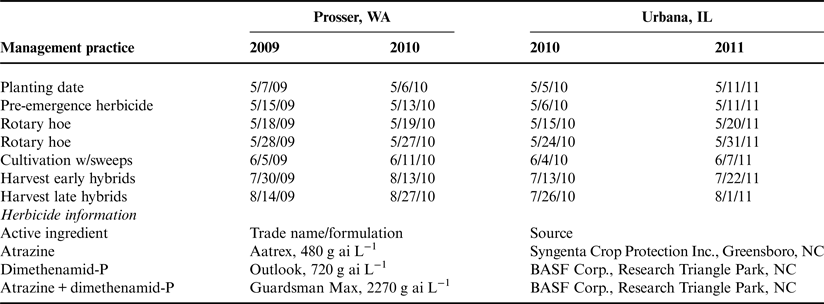
Both sites were infested naturally with common lambsquarters (Chenopodium album L.), redroot pigweed (Amaranthus retroflexus L.), barnyardgrass [Echinochloa crus-galli (L.) Beauv.] and green foxtail [Setaria viridis (L.) Beauv.]. Hairy nightshade (Solanum physalifolium Rusby) was also present at Washington in both years and giant foxtail (Setaria faberi Herrm.) present in Illinois. In addition to the natural weed population, velvetleaf (Abutilon theophrasti Medik.) and wild-proso millet (Panicum miliaceum L.) each were seeded at a rate of 11 seeds per meter of row immediately after sweet corn seeding at Illinois. Three weed management levels were implemented and timing of agronomic practices is listed in Table 1. In the weed free (WF) weed management treatment, herbicides were applied pre-emergence and plots were cultivated with sweeps and hilling shovels approximately 4–5 weeks after planting (WAP), followed by periodic hand-weeding as needed to keep the plots WF season long. Pre-emergence herbicides applied were atrazine and dimethenamid-P and applied at the labeled rate for each soil type. Herbicides were applied with a bicycle sprayer equipped with flat fan nozzles operated at a pressure of 186 kPa in a total spray volume of 187 L ha−1.
Summary of agronomic and weed management practices in sweet corn at Prosser, WA and Urbana, IL in field trials conducted in 2009–2011.

The high intensity cultivation (HC) treatment consisted of rotary hoeing at the spike (emergence) stage of sweet corn, a second rotary hoeing approximately 10 days later, and cultivation with sweeps and hilling shovels at 4–5 WAP. The low intensity cultivation (LC) treatment was rotary hoed at the spike stage of sweet corn and cultivated once with sweeps at 4–5 WAP.
The experimental design was a split plot randomized complete block with four replications. Levels of the main plot factor were weed management (WF, HC and LC), the plot sizes of which were 4.6 × 37 m2, and split plots (hybrids) sizes were 4.6 × 9 m2.
Sweet corn and weed parameters
Sweet corn stand densities were recorded just prior to the first cultivation by counting plants within 6 m lengths of the two center rows in each plot. Early season weed density, corn height and number of visible leaf collars on corn were recorded in early June (4 WAP). Early season weed density was determined in a 1 m2 quadrat randomly placed between the center four rows of each plot. Corn height and LAI were determined in early June at the V5/6 stage and post silking (Illinois) and late June at the V6/7 stage and post silking (Washington) from two plants per plot from WF treatments only. Two crop plants were harvested, leaves were separated and green leaf area was measured using an area meter (LI-3100C area meter, LI-COR, Lincoln, NE). LAI at each sampling date was estimated as the product of mean leaf area per plant and number of plants per m2.
Intercepted photosynthetically available radiation (IPAR) by the crop canopy was recorded at the same growth stages as mentioned previously in Illinois and in mid-July (Sugar Buns and Spring Treat in R1 stage) and post silking in Washington from the WF treatments only. IPAR was measured under full-sun conditions at three locations within each plot using a linear ceptometer (AccuPAR PAR-80 linear ceptometer, Decagon Devices, Pullman, WA). Two measurements of photosynthetically available radiation (PAR) were taken; one measurement above the crop canopy and one at the soil surface, with the sensor perpendicular to, and centered over, rows 2 and 3. All measurements were taken between 10 a.m. and 2 p.m., and percent IPAR was estimated as the difference between the above canopy measurement and the soil-surface measurement divided by the above-canopy measurement multiplied by 100. Four readings were taken per plot.
Sweet corn yield (total ear mass) was determined by harvesting all the ears greater than 4.4 cm diameter when kernel moisture was at or near 78% for each hybrid. Relative yield was determined by dividing the total ear mass in each plot by the ear mass of the WF plot for each hybrid and multiplying by 100. Weed fresh weight was determined by weighing weeds clipped from a 0.76 × 3 m2 area from one of the two center rows at the time of sweet corn harvest.
Data analysis
Analysis of variance (ANOVA) was performed using SAS (Version 9.4 SAS Institute Inc., Cary, NC) Proc Mixed procedure. Sweet corn hybrid, weed management treatments and site-year were considered fixed variables. Data were pooled across site-years when no significant site-year or site-year by treatment interactions occurred. Early season LAI and weed density and final weed biomass data were log transformed to meet normality assumptions of ANOVA. Mean separations were performed using Fisher's protected least significant difference test at P = 0.05.
Results and Discussion
Sweet corn hybrid growth characteristics
Both site-year and sweet corn hybrid significantly affected early season sweet corn height, LAI and IPAR and there was a significant site-year by sweet corn hybrid interaction (Table 2). At Washington in 2009 and 2010, corn height at V7 stage was greatest for Code 128 hybrid, followed by Sugar Buns, Legacy and least for Spring Treat (Fig. 1). Early season LAI and IPAR also averaged the least for Spring Treat in 2009 and 2010 at Washington, whereas Code 128 and Legacy averaged the greatest IPAR (Figs 2 and 3).
Early season height of four sweet corn hybrids under weed-free conditions in Washington and Illinois 2009–2011. Measurements recorded at V7 stage in Washington and V5/V6 stage in Illinois. Means within a site-year with the same letter are not significantly different according to Least Significant Difference (P = 0.05).

Early season leaf area index (LAI) of four sweet corn hybrids under weed-free conditions in Washington and Illinois 2009–2011. Measurements recorded at V7 stage in Washington and V5/V6 stage in Illinois. Means within a site-year with the same letter are not significantly different according to Least Significant Difference (P = 0.05).

Early season percent intercepted photosynthetically active radiation (IPAR) by four sweet corn hybrids under weed-free conditions in Washington and Illinois 2009–2011. Measurements recorded at V8/R1 stage in Washington and V5/V6 stage in Illinois. Means within a site-year with the same letter are not significantly different according to Least Significant Difference (P = 0.05).

Analysis of variance (ANOVA) P values for sweet corn growth parameters from weed-free treatments in Washington and Illinois in 2009–2011.

LAI, leaf area index; IPAR, intercepted photosynthetically active radiation.
Early season LAI data were ln (x + 1) transformed prior to ANOVA.
In 2010 and 2011 at Illinois, corn height at V5/6 stage was greatest for Code 128 followed by Legacy, Spring Treat and Sugar Buns was shortest (Fig. 1). Sugar Buns also averaged the lowest early season LAI and IPAR at Illinois in 2010 and 2011, although there were no significant differences in early season LAI in 2011 (Figs 2 and 3). We cannot fully account for the differences in rank among the four hybrids for early season height, LAI and IPAR other than the data were collected at an earlier growth stage at Illinois compared with Washington. Relative to the other three hybrids, Sugar Buns was taller and had a greater LAI in Washington than in Illinois.
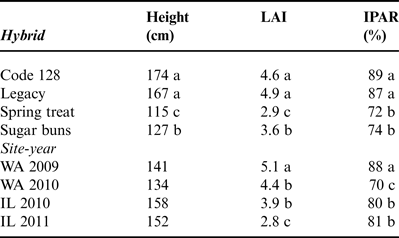
Site-year did not impact final sweet corn height, but final sweet corn height differed among hybrids and there was a significant hybrid by site-year interaction (Table 2). Final height was greater for Code 128 and Legacy, averaging 174 and 167 cm, respectively and least for Sugar Buns and Spring Treat averaging 127 and 115, respectively (Table 3). Final LAI and IPAR were significantly affected by both hybrid and site-year and there was a significant hybrid by site-year interaction (Table 2). Final LAI was least for Spring Treat (2.9) and greatest for Legacy and Code 128 (4.9 and 4.6, respectively) (Table 3). Final LAI was greatest in Washington in 2009 and least in Illinois in 2011. In 2010, LAI was similar at Washington and Illinois (Table 3).
Final height, leaf area index (LAI) and percent intercepted photosynthetically active radiation (IPAR) of four sweet corn hybrids in Washington and Illinois in 2009–2011 under weed-free conditions. Data for hybrids is averaged across site-years.

Means within a column and within hybrid or site-year followed by the same letter do not differ significantly according to Fisher's Protected Least Significant Difference test (P = 0.05).
Late season IPAR was similar for Code 128 and Legacy hybrids, averaging 89 and 87%, respectively, whereas Spring Treat and Sugar Buns averaged only 72 and 74%, respectively (Table 3). Late season IPAR was greatest in Washington in 2009 (88%) and least in Washington 2010 (70%), while IPAR in Illinois averaged 80–81% in 2010 and 2011.
Sweet corn stand and yield response to weed management level
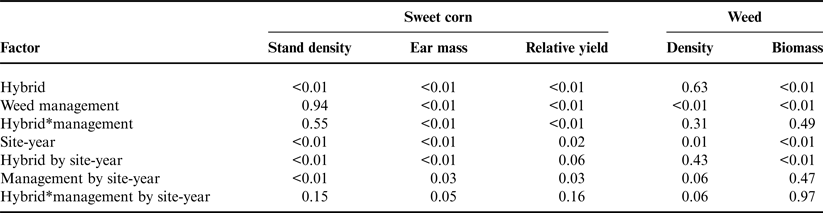
Sweet corn stand averaged 7.0 plants m−2 over all site-years, hybrids and weed management levels. Weed management level did not significantly impact sweet corn stand density. Site-year and hybrid significantly affected sweet corn stand density (both P < 0.001) and there was a significant site-year by hybrid-interaction (P < 0.001) (Table 4). In 2009 at WA, Spring Treat averaged only 5.8 plants m−2, whereas average plant stand for the other three hybrids ranged from 7.4 to 7.9 plants m−2 (data not shown). In 2010 at WA, Code 128 and Spring Treat averaged 4.9 and 5.6 plants m−2, respectively, while the other two hybrids ranged from 6.9 and 7.8 plants m−2. Differences in corn stands between hybrids in WA were likely due to a combination of the type of planter used and seed quality differences among hybrids. At Illinois, corn stands were less variable among hybrids and ranged from 6.9 to 7.7 plants m−2 in 2010 and 6.7 to 7.8 plants m−2 in 2011.
Analysis of variance (ANOVA) P values for sweet corn stand density, ear mass and relative yield and early season weed density and late season weed biomass in Washington and Illinois in 2009–2011.

Weed counts and weed biomass data were ln (x + 1) transformed prior to ANOVA.
Over all site-years, total ear mass of WF plots ranged from 17.7 to 22.6 MT ha−1 for Code 128, 12.8 to 18.7 MT ha−1 for Legacy, 12.4 to 17.9 MT ha−1 for Spring Treat, and 8.1 to 20.5 MT ha−1for Sugar Buns (data not shown). Under WF management, Code 128 yielded the greatest ear mass in all site-years.
Relative yield was significantly impacted by hybrid and weed management level, and there was a significant hybrid-by-weed management interaction on relative yield (P < 0.0001) (Table 4). There was also a significant site-year (P = 0.02) and site-year by weed management effect for relative yield, so data are presented separately for each site-year (Figs 4 and 5).
Relative yield of four sweet corn hybrids grown under two levels of weed management in Washington in 2009 and 2010. Means within a site-year and weed management level with the same letter are not significantly different according to Least Significant Difference (P = 0.05).

Relative yield of four sweet corn hybrids grown under two levels of weed management in Illinois in 2010 and 2011. Means within a site-year and weed management level with the same letter are not significantly different according to Least Significant Difference (P = 0.05).

Relative yields of the two taller hybrids, Code 128 and Legacy, tended to be significantly greater than those of the two shorter hybrids, Spring Treat and Sugar Buns when comparing hybrids within weed management levels and site-years. At all site-years, the two tall hybrids with greater leaf area (Code 128 and Legacy) were able to maintain greater portions of their WF yields in the presence of weeds (Figs 4 and 5). In WA, relative yields of Code 128 and Legacy hybrids ranged from 54 to 94% in HC and LC treatments in 2009, whereas relative yields of Spring Treat and Sugar Buns ranged from 21 to 46%. Under greater weed pressure in 2010, relative yields of Code 128 and Legacy were 41–49% of WF yields in HC and 24% in LC treatments (Fig. 4). Relative yields of Spring Treat and Sugar Buns were only 13–28% in HC and 2–9% in LC in 2010.
In IL, relative yields of Code 128 and Legacy hybrids ranged from 81 to 93% in HC and LC in 2010, whereas relative yields of Spring Treat and Sugar Buns ranged from 19 to 60% (Fig. 5). In 2011, relative yields of Code 128 and Legacy ranged from 67 to 94% in HC and LC treatments. Relative yield of Spring Treat and Sugar Buns were 50–51% in HC and dropped to 11–18% in LC in 2011.
Relative yield measured in these studies reflects the ability of each hybrid to overcome weed interference. In 3 of 4 site-years, relative yields of the two shorter hybrids, Spring Treat and Sugar Buns, were significantly greater under HC than LC indicating these two hybrids are sensitive to weed management levels. Relative yields of Code 128 and Legacy were similar among HC and LC in 3 of 4 site-years suggesting these hybrids have the ability to maintain a greater portion of their WF yield when grown under less intense weed management.
Weed response to sweet corn hybrids and weed management level
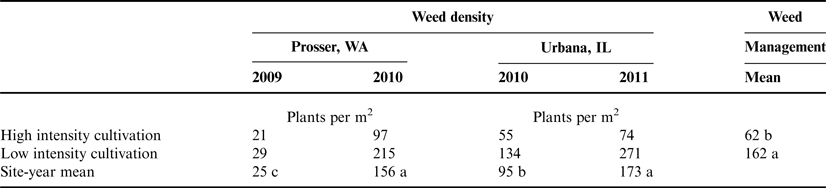
Sweet corn hybrid did not significantly affect weed densities in early June (Table 4). Early season differences between sweet corn growth and canopy development among hybrids were relatively small and prior to canopy closure had little impact on weed emergence and establishment. Weed densities in early June were significantly affected by site-year (P = 0.01) and weed management level (P < 0.01). In 2009 at Washington, weed densities were relatively low and were similar between HC and LC treatments, averaging 21 and 29 plants m−2, respectively. In the other 3 site-years, early season weed densities in LC plots were more than double that of HC plots (Table 5).
Early season weed density in sweet corn grown under two weed management levels in Prosser, WA and Urbana, IL 2009–2011.

Means within a row or column followed by the same letter do not differ significantly according to Fisher's Protected Least Significant Difference test (P = 0.05).
Final weed fresh biomass was significantly affected by weed management level, sweet corn hybrid and site-year and there was a significant site-year by hybrid interaction (Table 4). Final weed biomass averaged over hybrids was least in Washington in 2009 averaging 113 g m−2 in HC treatments and 183 g m−2 in LC treatments and was greatest in Illinois in 2010 averaging 926 g m−2 in LC treatments and 458 g m−2 in HC (data not shown). Averaged over all hybrids, final weed biomass was greater in LC (526 g m−2) compared with HC treatments (377 g m−2).
In 3 of 4 site-years, the higher LAI/taller hybrids suppressed weeds better than the lower LAI/shorter hybrids (Fig. 6). Differences in the magnitude of impact of sweet corn hybrids on final weed biomass at Washington in both years were less pronounced and a lower overall weed biomass was produced than in Illinois (Fig. 6). A similar trend was evident in Washington in 2009. The differences in weed suppressive ability of three sweet corn hybrids differing in canopy and height were more pronounced in Illinois than in Washington in a previous report (Williams et al., Reference Williams, Boydston and Davis2007). Late season LAI tended to be greater in Washington than in Illinois (Table 3) possibly contributing to greater overall weed suppression in Washington. Differences in weed species composition at each site-year and sowing of weeds at Illinois could also account for differences in final weed biomass and the degree of final biomass suppression by the crop. At Illinois, the two taller hybrids, Code 128 and Legacy, reduced final weed biomass in both years more than the two shorter hybrids, Spring Treat and Sugar Buns (Fig. 4), indicating that utilizing weed suppressive hybrids may have greater utility in Midwest sweet corn production areas than in Western regions. However, the benefits of maintaining yield by growing weed tolerant hybrids were realized in all site-years.
Final weed biomass in four sweet corn hybrids grown in Washington and Illinois 2009–2011. Means within a site-year with the same letter are not significantly different according to Least Significant Difference (P = 0.05).

Conclusions
These results illustrate the influence of sweet corn hybrid selection on both yield loss from weed competition and on weed biomass production. Combining competitive hybrids with higher intensity weed management allowed for consistently higher relative yields. Many factors such as taste, recovery, yield potential and kernel texture influence producer and processor decisions on sweet corn hybrid selection. These results suggest that producers could also benefit by choosing more competitive hybrids when planting in fields with a known history of heavy weed pressure or difficult to control weeds. In addition, producers of organic certified sweet corn, which have fewer tools to control weeds, could likely benefit from growing hybrids that tolerate greater weed pressure and provide more weed suppression.
Acknowledgements
The authors gratefully acknowledge the valuable technical assistance of Encarnation Rivera, Treva Anderson and Jim Moody and the statistical assistance of Bruce Mackey.