Implications
The chemical esterification of acid oils with glycerol (both economically interesting by-products from oil refining and biodiesel industries, respectively), generates a new type of fats with a different acylglycerol structure, that can provide valuable characteristics in animal nutrition, apart from the environmental benefits associated with their use. The results of this study indicate that re-esterified palm oils with a high mono- and diacylglycerol content, can be used in weaning-piglet diets as good, alternative fat sources, showing a similar total fatty acid apparent absorption to that of native soybean oil.
Introduction
Nursing piglets digest fat from sow’s milk very efficiently (Cho and Kim, Reference Cho and Kim2012). However, fat digestibility decreases during the 1st weeks’ post-weaning (Cera et al., Reference Cera, Mahan and Reinhart1988). The particular fatty acid (FA) positional distribution of sow’s milk fat seems to aid fat utilization. About 60% of palmitic acid in sow’s milk fat is esterified at the acylglycerol sn-2 position (Innis et al., Reference Innis, Quinlan and Diersen-Schade1993). In contrast, palmitic acid in vegetable oils is predominately esterified at the sn-1,3 positions (Mattson and Volpenhein, Reference Mattson and Volpenhein1963). Thus, whereas the intraluminal hydrolysis of fat from sow’s milk mainly results in the formation of 2-monopalmitin, the hydrolysis of vegetable oils produces free palmitic acid (Innis et al., Reference Innis, Dyer and Lien1997), which is poorly absorbed due to its tendency to form insoluble soaps with divalent cations in the gut (Small, Reference Small1991).
Re-esterified oils are obtained by reacting acid oils with glycerin. On one hand, these technical fats have an increased proportion of saturated fatty acids (SFA) located at the acylglycerol sn-2 position, with respect to their corresponding native oil (Vilarrasa et al., Reference Vilarrasa, Tres, Bayés-García, Parella, Esteve-Garcia and Barroeta2014), thus having a FA positional distribution more similar to that of fat from sow’s milk. On the other hand, these re-esterified oils may also have different proportions of mono- (MAG) and diacylglycerols (DAG) (Vilarrasa et al., Reference Vilarrasa, Tres, Bayés-García, Parella, Esteve-Garcia and Barroeta2014). These amphiphilic molecules can act as emulsifying agents, able to enhance lipase activity and FA incorporation into mixed micelles (Martin et al., Reference Martin, Moran-Valero, Vázquez, Reglero and Torres2014). It was hypothesized that the different acylglycerol structure of re-esterified oils may enhance the SFA apparent absorption and, thus, their overall nutritive value, especially in young animals. The aim of the present study was to investigate the potential use of re-esterified palm oils, differing in their acylglycerol structure, in comparison with their corresponding acid and native oils, and also with an unsaturated fat source in weaning-piglet diets. The parameters assessed were: FA apparent absorption, acylglycerol and free fatty acid (FFA) composition of feces, and growth performance.
Material and methods
Experimental fats
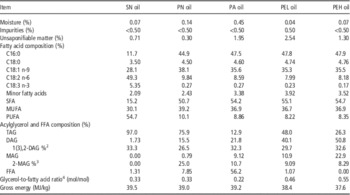
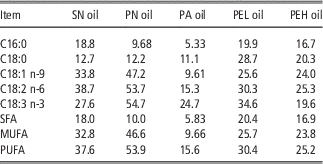
Experimental fats were supplied by SILO S.p.a. (Florence, Italy). Re-esterified palm oils were produced taking, as raw materials, acid palm oil (a by-product obtained from the refining process of crude palm oil, with a high FFA content) and glycerin (a by-product obtained from the methylation process applied for biodiesel production), which were processed in a reactor for 4 to 6 h, under high vacuum conditions (1 to 3 mmHg), at temperatures between 190°C and 250°C, and without chemical catalysts. According to the stoichiometric proportion of FFA and glycerol, fats with the same FA profile (Table 1), but with a different FA positional distribution (Table 2), and triacylglycerol (TAG), DAG and MAG proportions (Table 1) were obtained.
Chemical analyses of the experimental fatsFootnote 1

SFA=saturated fatty acids; MUFA=monounsaturated fatty acids; PUFA=polyunsaturated fatty acids; TAG=triacylglycerols; DAG=diacylglycerols; MAG=monoacylglycerols; FFA=free fatty acids.
1 Native soybean oil (SN oil), native palm oil (PN oil), acid palm oil (PA oil), re-esterified palm oil low in mono- and diacylglycerols (PEL oil), and re-esterified palm oil high in mono- and diacylglycerols (PEH oil).
2 The proportion of 1(3),2-DAG v.1,3-DAG.
3 The proportion of 2-MAG v.1(3)-MAG.
4 Estimated calculation based on the values of the acylglycerol and FFA composition.
Fatty acid positional distributionFootnote 1 within acylglycerol molecules of the experimental fatsFootnote 2 (%)

SFA=saturated fatty acids; MUFA=monounsaturated fatty acids; PUFA=polyunsaturated fatty acids.
1 Expressed as the proportion of each fatty acid located at the sn-2 position of the acylglycerol molecules, calculated as follows: sn-2%=(sn-2/Total)×a×100, where sn-2 is the FA composition at the sn-2 position, Total is the total FA composition in the original fat and a is the ratio between the moles of FA located at the sn-2 position and the moles of total FA. a was 0.30, 0.28, 0.08, 0.23 and 0.20 for SN, PN, PA, PEL and PEH oils, respectively.
2 Native soybean oil (SN oil), native palm oil (PN oil), acid palm oil (PA oil), re-esterified palm oil low in mono- and diacylglycerols (PEL oil) and re-esterified palm oil high in mono- and diacylglycerols (PEH oil).
Oil samples were analyzed in triplicate for moisture (Method 926.12 of the Association of Official Analytical Chemists (AOAC), 2005), impurities (ISO 663:2007), unsaponifiable matter (Method 933.08 of the AOAC, 2005), acylglycerol and FFA composition (ISO 18395:2005), MAG and DAG positional isomers (Sacchi et al., Reference Sacchi, Addeo and Paolillo1997), total FA composition (Guardiola et al., Reference Guardiola, Codony, Rafecas, Boatella and López1994), sn-2 FA composition (Commission Regulation (EEC) No. 2568/91 – Annex VII), and gross energy content (IKA-Kalorimeter system C2000 basic; Staufen, Germany), as described in more detail in our previous report (Vilarrasa et al., Reference Vilarrasa, Tres, Bayés-García, Parella, Esteve-Garcia and Barroeta2014).
Animals and diets
The study was performed at the experimental farm of IRTA Mas de Bover (Constantí, Tarragona, Spain). The experimental procedure received the prior approval from the Ethical Committee of the same institution. All animal housing and husbandry conformed to the European Union Guidelines (2010/63/EU).
A total of 120 male and female crossbred weaning piglets ([Landrace×Duroc]×Pietrain) were obtained from the swine herd of the same experimental station. Piglets were weaned at 26 days of age and received a commercial medicated feed for 5 days, to prevent the occurrence of diarrhea and to ensure that all animals start consuming feed before the experimental period. Then, at 31 days of age, piglets (average weight of 8.50±1.778 kg) were blocked by initial BW (six blocks), and randomly assigned to one of the five dietary treatments. Animals were housed in pens of four animals, avoiding that two piglets of the same maternal origin were allocated at the same pen. The gender of the animals was not taken into account for the allocation of the animals. Throughout the study, feed and water were supplied ad libitum, and animals were raised under controlled conditions of light and temperature.
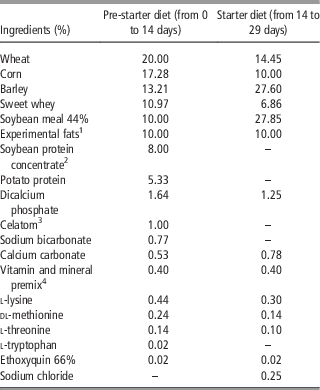
The feeding program consisted of two diets (in mash form): a pre-starter diet (from day 0 to 14) and a starter diet (from day 14 to 29), that were formulated to meet or exceed National Research Council (NRC,1998) requirements and to minimize basal fat levels. Pre-starter diets were supplemented with 1% of Celatom (Jesús Riesgo; Madrid, Spain) to increase the amount of HCl-insoluble ash as an inert digestibility marker. The five dietary treatments were the results of including 10% (as-fed basis) of one of the following experimental fats to the basal diet: native soybean oil (SN), native palm oil (PN), acid palm oil (PA), re-esterified palm oil low in MAG and DAG (PEL), or re-esterified palm oil high in MAG and DAG (PEH). The composition of the experimental diets is presented in Table 3.
Ingredient composition of the experimental diets (as-fed basis)Footnote 1

1 Native soybean oil (SN oil), native palm oil (PN oil), acid palm oil (PA oil), re-esterified palm oil low in mono- and diacylglycerols (PEL oil) or re-esterified palm oil high in mono- and diacylglycerols (PEH oil).
2 Hamlet Protein; Horsens, Denmark.
3 Jesús Riesgo; Madrid, Spain.
4 Provides per kg of feed: vitamin A (from retinol), 10000 IU; vitamin D3 (from cholecalciferol), 2000 IU; vitamin E (from alfa-tocopherol), 25 mg; thiamine, 1.5 mg; riboflavin, 3.5 mg; pyridoxine, 2.4 mg; cobalamine, 20 µg; calcium pantothenate, 14 mg; nicotinic acid, 20 mg; biotin, 50 µg; folic acid, 0.5 mg; menadione, 1.5 mg; Ca, 0.21 g; Mg, 57 mg; Fe (from FeSO4·7H2O), 120 mg; Cu (from CuSO4·5H2O), 150 mg; Co (from 2CoCO3·3Co(OH)2·H2O), 0.6 mg; Zn (from ZnO), 110 mg; Mn (from MnO), 60 mg; I (from Ca(I2O3)2), 0.75 mg; Se (from Na2SeO3), 0.37 mg; ethoxyquin, 3.33 mg.
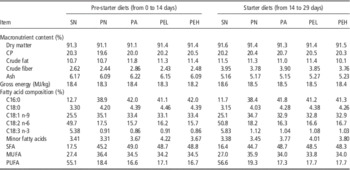
Analytical determinations of feeds were performed according to the methods of the AOAC (2005): dry matter (Method 934.01), ash (Method 942.05), CP (Method 968.06), crude fat (Method 2003.05) and crude fiber (Method 962.09). Gross energy was determined as described previously for experimental fats, and HCl insoluble ash of pre-starter feeds was determined following the method of McCarthy et al. (Reference McCarthy, Aherne and Okai1974). Lipids from feeds were extracted with chloroform/methanol (2 : 1, by vol) according to the Folch et al. (Reference Folch, Lees and Sloane-Stanley1974) procedure. Nonadecanoic acid (C19:0, Sigma-Aldrich Chemical Co.; St. Louis, MO, USA) was added as an internal standard before processing. The FA content was analyzed following the method of Morrison and Smith (Reference Morrison and Smith1964). The macronutrient and the FA composition of the experimental diets are presented in Table 4.
AnalyzedFootnote 1 macronutrient content and fatty acid composition of the experimental diets (as-fed basis)Footnote 2

SFA=saturated fatty acids; MUFA=monounsaturated fatty acids; PUFA=polyunsaturated fatty acids.
1 All samples were analyzed at least in duplicate.
2 Diets with 10% (as-fed basis) of native soybean oil (SN), native palm oil (PN), acid palm oil (PA), re-esterified palm oil low in mono- and diacylglycerols (PEL) or re-esterified palm oil high in mono- and diacylglycerols (PEH).
Controls and sampling
The amount of feed and BW of the animals were recorded at the beginning, on day 14 and at the end of the trial, to calculate average daily feed intake, average daily gain, and gain-to-feed ratio (G : F) for each period and for the overall study.
From day 6 to 10, a balance study was undertaken, following the method of grab sampling, described by Kavanagh et al. (Reference Kavanagh, Lynch, O’mara and Caffrey2001). Feces from each animal were collected once a day by rectal stimulation and were immediately frozen at −20°C. Feces were pooled within a pen, freeze-dried, ground and kept at 5°C until further analyses. Fecal samples were analyzed by the same methods as those described for feeds (HCl-insoluble ash, gross energy and FA content) to determine the digestible energy of the diets and the apparent absorption of FA. The apparent absorption coefficient of a particular nutrient (X) was calculated as follows:
 $$\,\%\,\,{\rm apparent}\,{\rm absorption}\,{\rm of}\,X=\,\left\{ {{\rm 1}-\left[ {{{\left( {{{F_{X} } \over {F_{M} }}} \right)} \over {\left( {{{D_{X} } \over {D_{M} }}} \right)}}{\rm }} \right]} \right\}{\times}{\rm 1}00$$
where F X is the concentration of a particular nutrient in feces, F M the concentration of the inert marker in feces, D X the concentration of a particular nutrient in the diet and D M the concentration of the inert marker in the diet. The digestible energy was calculated from the product of energy apparent absorption and its corresponding feed gross energy.
The acylglycerol and FFA composition of feces was analyzed according to ISO 18395:2005, in which TAG, DAG, MAG and FFA are separated according to their molecular size by size-exclusion HPLC. Before analysis, fat was extracted from feces with diethyl ether after acidification with HCl 1N. The acylglycerol molecules were quantified by internal normalization. Finally, these values were expressed as gram per 100 g of fat intake, based on values of fat apparent absorption, as the value obtained represents the fraction of non-absorbed FA.
Statistical analysis
Normality of the data and homogeneity of the variance were verified. The experiment was designed as a randomized complete block design with six blocks of initial BW and five dietary treatments. All data were subjected to ANOVA using the GLM procedure of SAS (version 9.2, SAS Institute Inc.; Cary, NC, USA). Differences between treatment means were tested using Tukey’s correction for multiple comparisons. The experimental unit was the pen, so there were six replicates per dietary treatment. Results in tables are reported as least square means and differences were considered significant at P<0.05.
Results and discussion
Characterization of experimental fats
The chemical analyses of the experimental fats are presented in Table 1. Whereas SN oil was mainly composed of linoleic (49.3%) and oleic (28.1%) acids, palm oils were high in palmitic (47.0±1.43%) and oleic (36.1±1.32%) acids.
The specific distribution of FA within acylglycerol molecules (Table 2) found in native oils was in agreement with that reported by Mattson and Volpenhein (Reference Mattson and Volpenhein1963). Whereas SFA were preferentially esterified at the sn-1,3 positions, unsaturated FA were preferentially esterified at the sn-2 position. The chemical esterification process involved a certain redistribution of FA within acylglycerol molecules. Re-esterified palm oils showed a greater percentage of SFA located at the sn-2 position and, therefore, a lower percentage of monounsaturated fatty acids and polyunsaturated fatty acids located at the sn-2 position, when compared with their corresponding PN oil.
Regarding fat acylglycerol and FFA composition (Table 1), native oils, considered as positive controls, were mainly composed of TAG, although PN oil showed a lower TAG and a greater DAG and FFA contents than did SN oil. Acid palm oil, as a negative control, showed a high FFA content, so its glycerol-to-FA ratio decreased. Re-esterified oils showed variable amounts of TAG, DAG and MAG, and low levels of FFA. Re-esterified palm oil high in MAG and DAG showed a greater amount of MAG and DAG, and a lower amount of TAG than did PEL oil. The different acylglycerol composition observed in experimental fats was closely related to their glycerol-to-FA ratio and, in turn, to their subsequent gross energy content. Given that the average heat of combustion of palm FA (39.6 MJ/kg) is more than twice that of glycerol (18.2 MJ/kg), the increased glycerol-to-FA ratio of PEH oil resulted in a lower gross-energy content.
Finally, indices of lipid quality (Table 1) showed low levels of moisture, impurities and unsaponifiable matter for native oils. However, PA, PEH and especially PEL oils showed a greater unsaponifiable matter content.
Digestibility balance
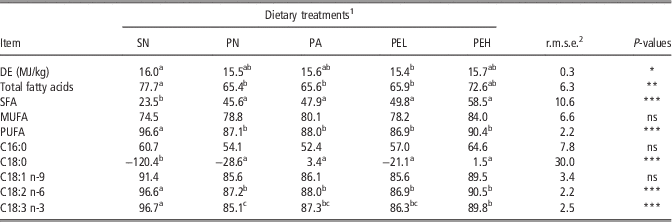
The effects of dietary fat sources on the digestible energy of the diets and the apparent absorption of individual FA are presented in Table 5. As expected, unsaturated FA were better absorbed than were SFA, and stearic acid was less well absorbed than was palmitic acid, because as unsaturation increases, digestibility is increased, and as the FA chain length increases, digestibility is reduced (Doreau and Chilliard, Reference Doreau and Chilliard1997). In this sense, SN, due to its high unsaturated FA content, showed the greatest total FA apparent absorption and, therefore, the greatest digestible energy. The more unsaturated the fat, the greatest the digestible energy, as has been observed by several authors with young pigs (Cera et al., Reference Cera, Mahan and Reinhart1988; Powles et al., Reference Powles, Wiseman, Cole and Hardy1994) and also with growing/finishing pigs (Wiseman et al., Reference Wiseman, Cole and Hardy1990; Powles et al., Reference Powles, Wiseman, Cole and Hardy1993). However, SN treatment also showed the lowest SFA apparent absorption, in particular, of stearic acid. The negative values of stearic acid apparent absorption may be caused by endogenous losses (fat secretion during the passage of digesta and fat synthesis in the hind gut), but, above all, by the biohydrogenation of unsaturated FA of the C18-family into stearic acid by the microflora in the hind gut (Carlson and Bayley, Reference Carlson and Bayley1968). Therefore, hind-gut fermentation might contribute to changes in FA composition of feces and, consequently, influence digestibility coefficients of individual FA. Compared with apparent ileal digestibility, apparent fecal digestibility underestimates the apparent absorption of stearic acid and overestimates the apparent absorption of unsaturated FA of the C18-family, but the total FA apparent absorption is not affected (Jørgensen et al., Reference Jørgensen, Jakobsen and Eggum1992).
Digestible energy of the diets (MJ/kg) and apparent total tract digestibility coefficients (%) of weaning piglets according to different fat sources in diet

DE=digestible energy; SFA=saturated fatty acids; MUFA=monounsaturated fatty acids; PUFA=polyunsaturated fatty acids; ns=not significant.
1 Diets with 10% (as-fed basis) of native soybean oil (SN), native palm oil (PN), acid palm oil (PA), re-esterified palm oil low in mono- and diacylglycerols (PEL) or re-esterified palm oil high in mono- and diacylglycerols (PEH).
2 n=6.
*P<0.05; **P<0.01; ***P<0.001.
a,bValues within a row with different superscripts differ significantly at P<0.05.
No differences were found between PN and PA treatments (P>0.05), unlike what was expected. In contrast with our results, Powles et al. (Reference Powles, Wiseman, Cole and Hardy1994) reported a progressive linear decline in the apparent absorption of both saturated and unsaturated fat sources with increasing FFA content in young pigs. However, in agreement with our results, DeRouchey et al. (Reference DeRouchey, Hancock, Hines, Maloney, Lee, Cao, Dean and Park2004) examined the effects of different levels of FFA in choice white grease (up to 53%) and found that the concentration of FFA had no effect on fat apparent absorption in weaning piglets. Both our PA oil and the maximum level of FFA used by DeRouchey et al. (Reference DeRouchey, Hancock, Hines, Maloney, Lee, Cao, Dean and Park2004) did not exceed 60% of FFA and, therefore, the rest of acylglycerol molecules present in the oil could have provided enough MAG for the formation of mixed micelles. Thus, acid oils are an economically interesting alternative to their corresponding native oils, provided they have a moderate amount of FFA and a low percentage of moisture, impurities and unsaponifiable matter, as we have also observed in fattening pigs (Vilarrasa et al., submitted).
Regarding re-esterified oils, although no statistically significant differences were found among palm oil treatments, PEH showed the greatest total FA apparent absorption. This could be due to the emulsifying effect of MAG and DAG molecules (Martin et al., Reference Martin, Moran-Valero, Vázquez, Reglero and Torres2014). However, PEH oil was mainly composed of 1(3)-MAG and 1,3-DAG species, which, in terms of fat absorption, are not expected to be as well absorbed as 2-MAG and 1(3),2-DAG, because pancreatic lipase specifically hydrolyzes the external sn-1,3 positions (Mattson and Beck, Reference Mattson and Beck1956). In this sense, Jones et al. (Reference Jones, Hancock, Harmon and Walker1992) observed that the addition of distilled MAG to tallow increased the digestibility of total FA and long-chain SFA in weanling pigs, due to their emulsifying effect. Nevertheless, the greater sn-2 palmitic acid content of PEL oil did not enhance the apparent absorption of this long-chain SFA, when compared with that of PN (P=0.97) and PA (P=0.85) treatments. In contrast with our results, greater fat absorption has been found in infants (Filer et al., Reference Filer, Mattson and Fomon1969; Carnielli et al., Reference Carnielli, Luijendijk, van Beek, Boerma, Degenhart and Sauer1995) and rats (Renaud et al., Reference Renaud, Ruf and Petithory1995; Lien et al., Reference Lien, Boyle, Yuhas, Tomarelli and Quinlan1997) fed TAG with palmitic acid esterified at the sn-2 rather than at the sn-1,3 positions. It is possible that the lack of improvement observed for the total FA apparent absorption in PEL may be due to the lower palmitic acid content at the sn-2 position of this oil (19.9%) when compared with that of fats used in the studies cited above (from 33% to 84%).
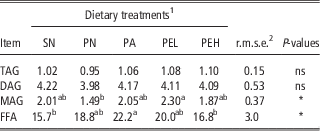
Acylglycerol and FFA composition of feces
The products of fat digestion in feces were analyzed to better understand how the fat acylglycerol structure affects the digestion and absorption processes. The acylglycerol and FFA composition of feces (in gram per 100 g of fat intake) is shown in Table 6. Feces contained low levels of TAG, DAG and MAG. This means that TAG and DAG were almost completely hydrolyzed along the gastrointestinal tract, and MAG were absorbed due to their hydrophilic character (2-MAG and some 1(3)-MAG) or completely hydrolyzed to glycerol and FFA (mainly 1(3)-MAG). However, FFA constituted the major lipid fraction in feces for all treatments, suggesting that the absorption of FFA is the main limiting factor of fat absorption in weaning piglets. Several authors have attributed the decreased fat apparent absorption in the post-weaning period to insufficient secretion of bile (Jones et al., Reference Jones, Hancock, Harmon and Walker1992), although others have also suggested a decreased secretion of lipases due to the adaptation of the pancreas to the new diet (Lindemann et al., Reference Lindemann, Cornelius, el Kandelgy, Moser and Pettigrew1986; Jensen et al., Reference Jensen, Jensen and Jakobsen1997).
Acylglycerol and FFA composition of feces (g/100 g of fat intake) according to different fat sources in diet

TAG=triacylglycerols; DAG=diacylglycerols; MAG=monoacylglycerols; FFA=free fatty acids; ns=not significant.
1 Diets with 10% (as-fed basis) of native soybean oil (SN), native palm oil (PN), acid palm oil (PA), re-esterified palm oil low in mono- and diacylglycerols (PEL) or re-esterified palm oil high in mono- and diacylglycerols (PEH).
2 n=6.
a,bValues within a row with different superscripts differ significantly at P<0.05.
*P<0.05; **P<0.01; ***P<0.001.
Regarding differences among dietary treatments, animals fed PA excreted a greater amount of FFA than did those fed SN and PEH diets (P<0.05). Small differences were also found for MAG content. Animals fed PEL excreted a greater MAG content than those fed PN (P=0.008). In contrast with the findings of Simoes et al. (Reference Simoes, Brachet, Picou and Cointepas1985), who reported a greater response of lipase to unsaturated fats than to saturated fats in growing pigs, our data did not show a lower excretion of TAG, DAG and MAG by animals fed SN treatment in comparison with those fed palm oil sources (P>0.05), ruling out the possibility of an increased hydrolytic activity when unsaturated fat sources are added.
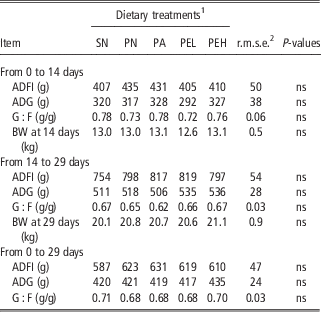
Growth performance
The effects of dietary fat sources on growth performance are presented in Table 7. Growth performance of the piglets was not significantly affected by the different dietary fat sources (P>0.05). In agreement with our results, several authors have also consistently reported limited, if any, growth response during the first 2- to 3-week post-weaning when various supplemental fat sources were added to diets (Lawrence and Maxwell, Reference Lawrence and Maxwell1983; Cera et al., Reference Cera, Mahan and Reinhart1988; Jung et al., Reference Jung, Kim and Han2003).
Growth performance of weaning piglets according to different fat sources in diet

ADFI=average daily feed intake; ADG=average daily gain; G : F=gain-to-feed ratio; ns=not significant.
1 Diets with 10% (as-fed basis) of native soybean oil (SN), native palm oil (PN), acid palm oil (PA), re-esterified palm oil low in mono- and diacylglycerols (PEL) or re-esterified palm oil high in mono- and diacylglycerols (PEH).
2 n=6.
In conclusion, despite the different acylglycerol structure of re-esterified oils, there were no significant differences in digestibility or performance with respect to their corresponding PN and PA oils in weaning-piglet diets.
Acknowledgments
This work was carried out thanks to the financial support provided by the Ministerio de Economía y Competitividad of the Spanish Government (Projects AGL2010-22008-C02 and CTQ2012-32436), a pre-doctoral research grant from the Generalitat de Catalunya (Ref. 2012FI_B 00406), and a post-doctoral research grant from the Generalitat de Catalunya and the EU through the Beatriu de Pinós Post-doctoral Program (Ref. 2011BP_B 00113). The authors are also grateful to SILO S.p.a. (Florence, Italy) for providing the experimental fats. This manuscript has been proofread by Mr Chuck Simmons, a native English-speaking University Instructor of English.