INTRODUCTION
Rio de Janeiro State lies in a biogeographical transition zone between tropical and subtropical fauna, with a large, albeit little studied, number of species of sponges. The taxonomic study of these sponges was initiated in the 19th Century by foreign scientific expeditions such as ‘Challenger’ and later by Brazilian researchers Mello Leitão (Reference Mello-Leitão1950), Mello Leitão et al. (Reference Mello-Leitão, Pego and Lopes1961), Borojevic (Reference Borojevic1971), Borojevic & Peixinho (Reference Borojevic and Peixinho1976) and Mothes-de-Moraes (Reference Mothes-de-Moraes1981, Reference Mothes-de-Moraes1985). Most of these studies were on the north coast of the State of Rio de Janeiro (in the region of Cabo Frio) (Muricy & Silva, Reference Muricy, Silva, Silva and Lavrado1999), whereas in the region of Ilha Grande Bay, located further south-west, a few taxonomic studies have been reported until now (Hajdu et al., Reference Hajdu, Zea, Kielman and Peixinho1995; Muricy & Ribeiro, Reference Muricy and Ribeiro1999; Muricy & Hajdu, Reference Muricy and Hajdu2006; Azevedo & Klautau, Reference Azevedo and Klautau2007).
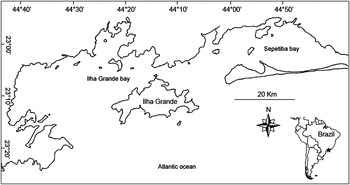
The Ilha Grande Bay, in the municipality of Angra dos Reis, is located between the 44°00′W and 44°40′W meridians and 23°00′S and 23°40′S parallels and composes an estuarine system with the bay of Sepetiba (Belo et al., Reference Belo, Dias and Dias2003). These bays, and in particular the Central Channel of the bay of Ilha Grande, are areas with intense ship traffic due to the presence of important ports and of a shipyard that receives oil from the petroleum platforms, in addition to having intense touristic activity (Paula & Creed, Reference Paula and Creed2004). The bay of Ilha Grande has an irregular landscape with seven harbours and 106 beaches (Figure 1). It has open access to the Atlantic Ocean, except for the central area where the island of Ilha Grande is situated, and extends 13.4 km north–south and 29.5 km east–west (Guerra & Soares, Reference Guerra and Soares2009). The aim of this paper is to describe two new records for Ilha Grande Bay, one of which is a new record for Brazil.
Map of Ilha Grande bay region (Paula & Creed, Reference Paula and Creed2004 modified).

MATERIALS AND METHODS
The specimens were obtained during three campaigns using distinct collecting methods in each of the years 2003, 2007 and 2009. A quantitative method was performed in the first campaign during the ‘RAP Ilha Grande’ (where RAP = Rapid Assessment Protocol) project; the second consisted of a survey of coral-associated fauna; and the third was qualitative, with collections accomplished via SCUBA diving in depths of 1 to 12 m. All samples were stored in 80% ethanol and deposited in the Porifera Collection at the Museu de Zoologia of Universidade Federal da Bahia (Collection UFBA-POR).
The examination of external morphological characters (growth form, surface type, consistency, arrangement or distribution of the pores and oscules, etc.) was accomplished using stereomicroscopes. Identification was obtained upon the description and micrometries of spicules (N = 30) and thick sections of the skeleton, according to methods described by Hajdu et al. (Reference Hajdu, Peixinho and Fernandez2011).
Abbreviations used in the text are as follows: LABPOR/MN, Laboratório de Porifera, Museu Nacional, Universidade Federal do Rio de Janeiro; MNRJ/UFRJ, Museu Nacional do Rio de Janeiro/Universidade Federal do Rio de Janeiro; UFBA-POR, Porifera Collection, Museu de Zoologia of the Universidade Federal da Bahia; UFRJ, Universidade Federal do Rio de Janeiro; YPM, The Peabody Museum of Natural History, Yale University.
RESULTS
SYSTEMATICS
Order POECILOSCLERIDA Topsent, Reference Topsent1928
Suborder MYXILLINA Hajdu, Van Soest & Hooper, Reference Hajdu, Van Soest, Hooper, Van Soest, van Kempen and Braekman1994
Family IOTROCHOTIDAE Dendy, Reference Dendy1922
Genus Iotrochota Ridley, Reference Ridley1884
DIAGNOSIS
Iotrochotidae with principal skeleton of smooth megascleres (styles and strongyles) typically separable into two shape and size categories (Rützler et al., Reference Rützler, Maldonado, Piantoni and Riesgo2007).
Iotrochota arenosa Rützler, Maldonado, Piantoni & Riesgo, Reference Rützler, Maldonado, Piantoni and Riesgo2007
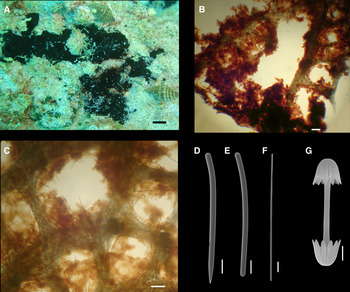
(Figure 2; Table 1)
Iotrochota arenosa Rützler et al., Reference Rützler, Maldonado, Piantoni and Riesgo2007: (A) specimen (scale bar: 1 cm); (B) skeleton transverse section (scale bar: 200 µm); (C) detail of skeleton transverse section; (D–G) spicules; (D) style (scale bar: 20 µm); (E) strongyle I (scale bar: 20 µm); (F) strongyle II (scale bar: 20 µm); (G) birotula (scale bar: 2 µm).

MATERIAL EXAMINED
Brazil: UFBA 771: Rio de Janeiro, Mangaratiba, APA de Tamoios, Ilha dos Arrependidos, No. 29, 23°2.601′S/44°8.398′W, 2 December 2003, coll. A.E.S. Oliveira, 6 m depth. UFBA 773: Rio de Janeiro, Angra dos Reis, Ilha Grande, Ponta da Enseada, No. 31, 23°6.122′S/44°11.443′W, 1 December 2003, coll. J. Creed & A.E.S. Oliveira, 4 m depth. UFBA 2000: Rio de Janeiro, Angra dos Reis, Ilha Itacuatiba, No. 42, 23°4.200′S/44°15.200′W, 7 December 2003, coll. J. Creed, 9 m depth. UFBA 2012: Rio de Janeiro, Angra dos Reis, Enseada do Itapinhoacanga, No. 28, 23°2.812′S/44°12.827′W, 2 December 2003, coll. J. Creed & A.E.S. Oliveira, 5 m depth. UFBA 2752: Rio de Janeiro, Angra dos Reis, Ilha Grande, Aroeira, No. BR1, 23°04.668′S/44°14.495′W, July 2006, coll. B. Lages, 10 m depth.
ADDITIONAL MATERIAL EXAMINED
Brazil: UFBA 4215: Bahia, Salvador, Naufrágio Cavo Artemidi, 13°03′17.9″S/38°31′32.6″W, 22 November 2011, coll. C. Menegola & C. Castello Branco, 20 m depth. UFBA 4216: Bahia, Maraú, Baía de Camumu, Ponte do Campinho, 13°54.675′S/38°59.378′W, 22 October 2012, coll. C. Castello Branco & M. Filgueiras, 8 m depth.
EXTERNAL MORPHOLOGY
Massive and a soft-to-hard consistency. An irregular, smooth-to-conulose surface (up to seven millimetres) with small oscula flush with the sponge surface up to three millimetres in diameter and scattered irregularly, specimen fragments with 42.2 to 97.5 millimetres and up to 24 millimetres thickness. Purplish brown, nearly black in situ and purplish brown when preserved (Figure 2A).
SKELETON
A reticulate skeleton with multispicular tracts forming a quadrangular network of fibres. Tracts are up to 230 µm wide. A dense layer of organic material in addition to the fibre reticulation, brownish pigmentation and scattered megascleres. Microscleres are scattered throughout the skeleton (Figure 2B, C).
SPICULES
Smooth styles, straight or curved in the basal portion, with hastate, acerate, conical or mucronated points (Figure 2D). Strongyles in two categories: strongyles I, smooth and slightly curved spicules (Figure 2E); strongyles II are accessory spicules, smooth, slight and straight (Figure 2F). Birotules with a straight, slender shaft and umbrella-shaped ends. (Figure 2G) (see Table 1 for spicule measurements).
Comparative data for micrometry spicules Iotrochota arenos a Rützler et al., Reference Rützler, Maldonado, Piantoni and Riesgo2007: the styles and strongyles were measured for total length and width. The birotula were measured for total length. The means are underlined. All measurements were in µm (N = 30).

BATHYMETRIC DISTRIBUTION
Between zero and 45 m deep (Rützler et al., Reference Rützler, Maldonado, Piantoni and Riesgo2007) occurring between 1 and 20 m deep in Brazil (present paper).
GEOGRAPHICAL DISTRIBUTION
Caribbean: Belize, Puerto Rico and Jamaica (Rützler et al., 2007). Brazil: Bahia and Rio de Janeiro States (present paper).
REMARKS
The specimens registered for the Bahia State (Todos-os-Santos Bay and Camumu Bay), UFBA 4215 and UFBA 4216, as I. birotulata are conspecific with our samples from Rio de Janeiro State. Iotrochota arenosa differs from I. birotulata by the presence of a second category of strongyles accessories and colour in life purplish brown, while I. birotulata present a second category of styles, sometimes rarely and colour in life very dark purple, with a thin sheen of emerald green over much of surface.
Although Boury-Esnault (Reference Boury-Esnault1973) described I. bistylata (later synonymized with I. birotulata) with two categories of styles, the other records of I. birotulata from Brazil which present description of the species (Hechtel, Reference Hechtel, Harrison and Cowden1976; Santos et al., Reference Santos, Coutinho and Hajdu2002; Moraes et al., Reference Moraes, Oliveira, Klautau, Hajdu, Muricy, Alves and Castro2006; Cedro et al., Reference Cedro, Hajdu, Sovierzosky, Correia, Custódio, Lôbo-Hajdu, Hajdu and Muricy2007; Hajdu et al., Reference Hajdu, Peixinho and Fernandez2011), did not comment about the second category of strongyles. Furthermore, these authors described the colour in life of I. birotulata as black, black with dark green or yellow; this makes us suggest that the species previously described for Brazil as I. birotulata may be I. arenosa, being a necessary revision of the specimens of the Brazilian coast. This report is the first record of I. arenosa for Brazil.
Order POECILOSCLERIDA Topsent, Reference Topsent1928
Suborder MYXILLINA Hajdu, Van Soest & Hooper, Reference Hajdu, Van Soest, Hooper, Van Soest, van Kempen and Braekman1994
Family RASPAILIIDAE Nardo, Reference Nardo1833
Subfamily ECHINODICTYINAE Hooper, Reference Hooper, Hooper and Van Soest2002
Genus Echinodictyum Ridley, Reference Ridley and Duncan1881
DIAGNOSIS
Erect, vasiform, flabellate, ramose or massive growth forms with surface typically rugose, with ridges, conules and other processes. Texture characteristically harsh, brittle and flexible, reflecting high ratio of silica to spongin in skeleton. Axial and extra-axial skeletons virtually undifferentiated. Choanosomal skeleton not compressed, irregularly reticulate. Spongin fibres usually massive, fully cored by oxeas and echinated by acanthostyles. Extra-axial skeleton vestigial, consisting of individual subectosomal styles embedded in peripheral fibres, and projecting through ectosome or merely dispersed between fibres. Ectosomal skeleton usually membraneous, sometimes skin-like, typically without specialized spiculation (except in one species). Ectosomal region contains heavy deposits of type B spongin, frequently with dense deposits of pigment granules. Structural megascleres are oxeas of 1–2 sizes, together with acanthostyles, long or short subectosomal styles, and short slender ectosomal styles in one species. Microscleres may be sparse and rare raphides (modified after Hooper, Reference Hooper, Hooper and Van Soest2002).
Echinodictyum dendroides Hechtel, Reference Hechtel1983
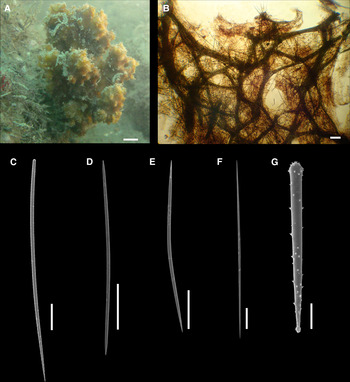
(Figure 3)
Echinodictyum dendroides Hechtel, Reference Hechtel1983: (A) species in situ (scale bar: 1 cm); (B) skeleton transverse section (scale bar: 20 µm); (C–H) spicules; (C) style I (scale bar: 100 µm); (D) oxea I (scale bar: 100 µm); (E) oxea II (scale bar: 50 µm); (F) raphidiform oxea (scale bar: 50 µm); (G) acanthostyle (scale bar: 20 µm).

Pandaros sp. Muricy et al., 2008: 68.
MATERIAL EXAMINED
Brazil: UFBA-POR 2844: Rio de Janeiro, Angra dos Reis, Ilha Grande, Saco do Céu, No. IG1, 23°06.315′S/44°12.077′W, 16 August 2009, coll. C. Menegola & C. Castello Branco, 2 m depth.
COMPARATIVE MATERIAL EXAMINED
Brazil: Holotype YPM 8946: Pernambuco, Maria Farinha, 7°52′S/34°49′W, 1 May 1964, coll. J. Laborel, intertidal. MNRJ 13214: Rio de Janeiro, Angra dos Reis, coll. G. Muricy, 2 m depth.
ADDITIONAL MATERIAL EXAMINED
Brazil: UFBA-POR 1860: Bahia, Salvador, Porto da Barra, 13°03′S/38°32′W, coll. R. Berlink & E. Hajdu, 5–8 m depth.
EXTERNAL MORPHOLOGY
Arborescent, flexible sponge with a soft but tough consistency, 91 mm in height, 58 mm wide and branches 15–32 mm high; a basal stalk and spiked surface on which spicules can be observed on the ends of the projections using stereomicroscopes. The specimens are brownish orange in situ and brownish purple when preserved in 80% ethanol. The oscula are spread throughout the body and are 1 mm in diameter (Figure 3A).
SKELETON
A plumoreticulate skeleton with multispicular tracts ranging from 35 to 140 µm thick, forming an irregular reticulation with some ascending tracts. Raphidiform oxeas form clusters in the ectosome. Oxeas I and several styles form tracts with protruding acanthostyles, giving an equinated aspect to such bundles. Dispersed pigmentation with organic matter and diatoms in the present material (Figure 3B).
SPICULES
Three style categories are present; the first two differ in length, and the third differs in thickness. The first category is of large styles, smooth, slender and slightly curved with a rounded base and hastate or acerate points, measuring 640–995–1500 (means are underlined) µm long and 8–12.8–18.6 µm wide (Figure 3C). The second category is more rare and similar to the first one, differing only in length, measuring 220–335.7–460 µm long and 8–11.4–13.3 µm wide (N = 14). The third category is a smooth, very slender, raphidiform style with a round base and hastate points 320–421–500 µm long and 2.7–3.9–5.3 µm wide. Oxeas fit into three size categories (Figure 3D, F): oxeas I are slender, straight and smooth with hastate, acerate or mucronated points 370–523.3–650 µm long and 10.6–12–13.3 µm wide; oxeas II are smooth, slender and may be slightly curved in the middle portion with hastate, acerate or mucronated point 200–261.3–320 µm long and 8–8.2–10.6 µm wide. Oxeas III or raphidiform oxeas are slender and smooth and sometimes present a slight curve in the middle portion, with hastate points, that are 160–300.1–425 µm long and 1.3–2.3–2.5 µm wide. Acanthostyles are short and stout with spines irregularly distributed 95.8–116.4–167.6 µm long and 5.3–6.3–8 µm wide (Figure 3G). Raphides are smooth and scattered, 82.5–117.6–142.5 µm long.
BATHYMETRIC DISTRIBUTION
The species has been found in the intertidal zone by Hechtel (Reference Hechtel1983) and down to two metres deep in the present paper.
GEOGRAPHICAL DISTRIBUTION
Brazil: Rio Grande do Norte (Muricy et al., 2008), Pernambuco (Hechtel, Reference Hechtel1983), Alagoas (Cedro et al., 2007), Bahia and Rio de Janeiro (present paper).
REMARKS
The specimens registered by Muricy et al. (Reference Muricy, Esteves, Moraes, Santos, Silva, Klautau and Lanna2008) as Pandaros sp. for the Potiguar basin (RN), UFPE-POR 272, UFPE-POR 363, UFPE-POR 374, UFPE-POR 399, and the specimen from Salvador (BA) UFBA-POR 1860, are conspecific with our sample. The identification of the present material at the species level was confirmed by a comparative study with the holotype of Echinodictyum dendroides deposited at the Peabody Museum of Natural History, Yale University. In the original description (Hechtel, Reference Hechtel1983), only three spicule categories are mentioned for the species: oxeas, styles and acanthostyles. However, the specimen collected in the bay of Ilha Grande (and the holotype) presents more categories. We are distinguishing the spicular groups of E. dendroides into eight categories: three categories of styles, separated by long styles (I), short and thick styles (II) and short and thin styles (III); three oxeas categories, separated by size and thickness into large oxeas (I), small oxeas (II), and raphidiform oxeas (III); and acanthostyles; and raphides (not registered in the original description).
DISCUSSION
The present study adds a new record to Brazil and a new occurrence for the State of Rio de Janeiro. Iotrochota arenosa, previously reported only in the Caribbean, is registered for the coast of Bahia and the south coast of Rio de Janeiro, which expands its occurrence area to the south-west Atlantic and further connects the Brazilian and Caribbean fauna. Echinodictyum dendroides, a species endemic to Brazil up to now, which was known only for the north-eastern region, is registered for the first time in the State of Rio de Janeiro (south-east region) and the diagnosis of the genus is redefined. Moreover, the location stands out for having species provisionally endemic for Brazil (Polymastia janeirensis and Echinodictyum dendroides), for the State of Rio de Janeiro and for the area of Ilha Grande Bay (Clathrina aspina, Clathrina angraensis and Paraleucilla perlucida (Azevedo & Klautau, Reference Azevedo and Klautau2007)).
ACKNOWLEDGEMENTS
We thank Dr Joel Creed for donating the material, financing the surveys and donating some pictures published in this paper. We thank Dr Rob Van Soest for the loans of Caribbean samples for comparison, and Dr Guilherme Muricy for his willingness to help and for searching the holotype of Echinodictyum dendroides in the collection at Yale Peabody Museum of Natural History (Yale University). We thank Elivaldo de Lima (Museu Nacional, UFRJ) for scanning electron microscopy and Júlio César Fernandez for laboratory assistance. This work was supported by PETROBRAS (Projects FAPEX 07.0213 and MNRJ/SAPE 460022548-3), MMA/PRONABIO/GEF (0034/00/02) and MCT/CNPq 15/2007 (479000/2007-7).