Microorganisms belonging to the genus Propionibacterium are Gram-positive, usually pleomorphic, non-spore-forming, non-motile, range from anaerobic to aerotolerant, generally catalase-positive and are able to ferment lactate to short-chain fatty acids, mainly propionate and acetate (Carvalho et al. Reference Carvalho, Guezenec, Gautier and Grimont1995; Jan et al. Reference Jan, Belzacq, Haouzi, Rouault, Metivier, Kroemer and Brenner2002; Turgay et al. Reference Turgay, Irmler, Isolini, Amrein, Froehlich-Wyder, Berthoud, Wagner and Wechsler2011). Propionibacterium spp. have been isolated from the skin or dairy products, and examples of their species are Prop. acidipropionici, Prop. freudenreichii, Prop. jensenii and Prop. thoenii (Tilsala-Timisjarvi & Alatossava, Reference Tilsala-Timisjarvi and Alatossava2001; Jenkins et al. Reference Jenkins, Harper and Courtney2002).
Propionibacteria originating from milk play an important role in the production of Swiss and Emmental-type cheeses: during maturation, lactic acid bacteria produce lactate, which is converted to propionic acid, acetic acid and carbon dioxide, and contribute to the flavour and the emergence of eyes in these cheeses (Piveteau, Reference Piveteau1999; Thierry et al. Reference Thierry, Maillard, Herve, Richoux and Lortal2004). Additionally, propionibacteria are able to synthesise biopreservative compounds, such as bacteriocins, as well as folic acid, proline and vitamin B12, as shown by several studies that have assessed the probiotic potential of this genus (Mantere-Alhonen, Reference Mantere-Alhonen1995; Meile et al. Reference Meile, Le Blay and Thierry2008; Cousin et al. Reference Cousin, Mater, Foligne and Jan2011).
Propionibacterium spp. growth in dairy products must be controlled because it is necessary to ensure minimal concentrations in end products to allow for the development of typical characteristics and probiotic activity (Cousin et al. Reference Cousin, Mater, Foligne and Jan2011). For monitoring in the dairy products industry, Yeast Extract Lactate (YEL) culture medium is usually employed to enumerate propionibacteria, after incubation at 30 °C for 5 d; however, this protocol does not provide adequate selectivity because enterococci and lactobacilli can also form visible colonies (Thierry et al. Reference Thierry, Madec and Richoux1994). Madec et al. (Reference Madec, Rouault, Maubois and Thierry1994) developed a selective medium named Lithium Glycerol (LG) based on the resistance of propionibacteria to lithium and their ability to ferment glycerol under anaerobiosis. LG agar has shown higher selectivity for propionibacteria when compared with YEL; this selectivity is considered adequate for the enumeration of this group in mixed cultures or foods containing different lactic cultures (Thierry et al. Reference Thierry, Madec and Richoux1994; Thierry & Madec, Reference Thierry and Madec1995).
The conventional procedures for the enumeration of microbial groups in foods, including starter and probiotic cultures, are very time-consuming and require a variety of apparatus to ensure ideal conditions of microbial growth (as example, anaerobiosis generators and chambers). Thus, reliable alternative methods for enumerating microorganisms are needed for food industries, enhancing laboratory work and shortening the time required to obtain final results (Brichta-Harhay et al. Reference Brichta-Harhay, Guerini, Arthur, Bosilevac, Kalchayanand, Shackelford, Wheeler and Koohmaraie2008; Bremser et al. Reference Bremser, Luecke, Urmetzer, Fuchs and Leist2011). The Petrifilm™ system (3M Microbiology, St. Paul, MN, USA) is an example of such an alternative method that increases the speed of enumeration (McGregor et al. Reference McGregor, Traylor, Gough, Hazlett and Bird1995; Bulte et al. Reference Bulte, Heckotter, Schott, Kirschfeld and Jockel1998; Beloti et al. Reference Beloti, Barros, Nero, Pachemshy, Santana and Franco2002). As a ready-to-use system, Petrifilm™ represents an improvement in speed and efficiency in conducting analyses, as well as a reduction in the laboratory work required to obtain results (Senyk et al. Reference Senyk, Kozlowski, Noar, Shipe and Bandler1987). Petrifilm™ Aerobic Count (AC) plates have been used in combination with selective culture media for the enumeration of lactic acid bacteria (LAB), with reliable results that justify their use in the monitoring of these microorganisms in fermented foods (Champagne et al. Reference Champagne, Gardner, Piette and St-Gelais1994; Pattison et al. Reference Pattison, Geornaras and von Holy1998; Nero et al. Reference Nero, Beloti, Barros, Ortolani, Tamanini and Franco2006, Reference Nero, Rodrigues, Viçosa and Ortolani2008; Ortolani et al. Reference Ortolani, Viçosa, Beloti and Nero2007; Gonçalves et al. Reference Gonçalves, Freitas, Nero and Carvalho2009; Miranda et al. Reference Miranda, Neto, Freitas, Carvalho and Nero2011). However, the performance of this system for the enumeration of propionic acid bacteria has not been evaluated until now.
The aim of this study was to evaluate the performance of Petrifilm™ AC associated with LG broth as an alternative method for enumerating Propionibacterium spp. strains and commercial starter cultures, and also propionibacteria from Emmental-type cheeses.
Materials and methods
Microbial cultures and cheese samples
Five reference strains of Propionibacterium spp. (Prop. freudenreichii subsp. shermanii CIRM 01, Prop. acidipropionici CIRM 38, Prop. jensenii CIRM 39, Prop. thoenii CIRM 40, and Prop. freudenreichii subsp. freudenreichii CIRM 116) were obtained from the Centre International de Ressources Microbiennes – Bactéries d'Intérêt Alimentaire (CIRM-BIA, INRA, Rennes, France) and stored at −20 °C in YEL agar. A loop of each stock culture was added to LG broth and incubated at 30 °C for 24–48 h; the obtained cultures were then streaked on LG agar plates and incubated under the same conditions. Isolated colonies were then transferred to LG broth and incubated at 30 °C to obtain cultures with turbidity similar to McFarland tube 1, which approximately corresponds to 3×10⁸ colony forming units per ml (CFU/ml).
Three commercial lyophilised cultures used in Emmental cheese production were included in this study: PS-1 (Chr. Hansen A/S, Horsholm, Denmark), PB-I (Sacco, Cadorago, Italy), and CHOO (Zit™ Eyes, Danisco, Niebüll, Germany). All stock cultures were kept at −20 °C, and upon use, approximately 1 g each culture was transferred to LG broth and incubated at 30 °C for 24 h. Then, colonies isolation and culture preparation steps were performed as described previously for reference strains.
Emmental-type cheeses produced by three different dairy companies (one French and two Brazilian) were purchased from various retail stores and kept under refrigeration until microbiological analysis.
Culture media
LG broth was previously prepared as described by Madec et al. (Reference Madec, Rouault, Maubois and Thierry1994) with the following composition (in one litre): 10 g lithium lactate, 10 g peptone, 10 g yeast extract, 6 g glycerol, 1 g powdered milk, 50 mg bromocresol purple, 328 mg K2HPO4 and 56 mg MnSO4 (all chemicals from Sigma Aldrich, St. Louis, MO, USA). LG agar was prepared by adding bacteriological agar at 1·5% (w/v) (Merck KGaA, Darmstadt, Germany) in LG broth. After autoclaving, a cocktail of commercial antibiotics (obtained from the kit Pal Probiobac™, Laboratoires Standa, Caen, France) was added to the LG broth and agar to confer selectivity for propionibacteria.
YEL broth was prepared according Malik et al. (Reference Malik, Reinbold and Vedamuthu1968) with the following composition (in one litre): 10 g peptone, 20 ml sodium lactate, 10 g yeast extract, 328 mg K2HPO4 and 56 mg MnSO4 (all chemicals from Sigma-Aldrich). YEL agar was prepared by adding bacteriological agar at 1·5% (w/v) (Merck) in YEL broth. YEL broth and agar were used as non-selective culture media for propionibacteria.
2,3,5-Triphenyltetrazolium chloride (TTC) reduction by propionibacteria
All reference strains were diluted ten-fold in 0·85% NaCl (w/v) and plated (in duplicate) by pouring using YEL agar added to TTC (Sigma-Aldrich), in order to achieve end concentrations of 0·0025 and 0·0050% (w/v) (Beloti et al. Reference Beloti, Barros, Freitas, Nero, Souza, Santana and Franco1999). As controls, the same dilutions were plated on YEL agar without TTC. All plates were incubated at 30 °C for 7 d under anaerobiosis (Anaerocult, Merck); afterwards, the resulting colonies were enumerated and the counts expressed in CFU/ml. During enumeration, the ability of the Propionibacterium spp. strains to reduce TTC, thus forming red colonies, was recorded. This experiment was conducted in triplicate.
Propionibacteria enumeration
Immediately after recovering of Propionibacterium spp. strains and propionibacteria commercial starter cultures, the obtained cultures were subjected to ten-fold dilution using LG broth. For cheese samples, 25 g of each cheese was obtained with a sterile knife and transferred to individual sterile bags containing 225 ml of a 0·85% NaCl (w/v) solution, homogenised, and subjected to ten-fold dilution using LG broth. Four dilutions of each culture and cheese sample were selected and pour plated on LG agar (duplicate) and in Petrifilm™ AC plates. The plates were incubated at 30 °C for 7 d at anaerobic conditions (Anaerocult, Merck). After incubation, the colonies formed on the plates were counted and the results expressed in CFU/ml (cultures) or CFU/g (cheeses). Reference strains and commercial cultures were tested in triplicate, and twelve cheese samples were evaluated (four from each dairy company).
Molecular identification of Propionibacterium spp
To verify the adequate selectivity of the tested culture media, a total of 70 colonies recorded from cheese samples plated on LG agar and Petrifilm™ AC added to LG broth were subjected to morphological characterisation by Gram staining and genus-specific PCR (Dasen et al. Reference Dasen, Smutny, Teuber and Meile1998). The selected colonies were streaked on YEL agar (incubation at anaerobic conditions, Anaerocult, Merck, at 30 °C for 48 h), and isolated colonies were transferred to YEL broth (incubated at 30 °C for 48 h). The purified cultures were subjected to DNA extraction using the Wizard Genomic DNA Purification Kit (Promega Corporation, Madison, WI, USA). The multiplex PCR reactions contained 12,5 μl of 2× Go Taq Green Master Mix (Promega), 1 μl of the primer bak4 (AGGAGGTGATCCARCCGCA, reverse, at 100 μm), 1 μl of the primer bak11w (AGTTTGATCMTGGCTCAG, forward, at 100 μm), 0,5 μl of the primer gd1 (TGCTTTCGATACGGGTTGAC, forward, at 100 μm), 2 μl of extracted DNA (in a minimal concentration of 15 ng/μl), and ultra-pure PCR water (Promega) to a final volume of 50 μl. The PCR conditions were initial denaturation at 95 °C for 3 min; 35 cycles at 95 °C for 30 s, 58 °C for 30 s and 72 °C for 30 s; and a final extension step at 72 °C for 10 min. Amplification products were mixed with 20x GelRed stain (Biotium Inc., Hayward, CA, USA) at a ratio of 5 : 1, and the products were submitted to electrophoresis in a 1% agarose gel made with 0·5×TBE. PCR products of 889 bp (primers bak4 and gd1) were recorded as typical for Propionibacterium spp., and PCR products of 1508 bp (primers bak11w and bak4) were recorded as positive controls for the reactions.
Statistical analysis of results
The counts of reference strains plated on YEL agar with and without added TTC were compared to verify the inhibition of this substance over the propionibacteria. In addition, the TTC reduction capacity of the cultures was observed.
The counts of reference strains, commercial cultures and cheese samples obtained on LG agar and Petrifilm™ AC added to LG broth were converted to log10, and the mean counts were compared by ANOVA and Tukey tests (P<0·05). In addition, the log10 counts were compared by linear regression (P<0·05). All analyses were performed using software Statistica 7.0 (StatSoft Inc., Tulsa, OK, USA).
Results and discussion
All tested strains were capable of reducing TTC, forming red colonies in YEL agar, and inhibitory activity of TTC was observed only in specific situations (Table 1): CIRM 39, CIRM 40, and CIRM 116 presented very small colonies when plated on YEL agar added to TTC at 0·0050% (w/v), making proper and reliable enumeration difficult and indicating an inhibitory activity of TTC. However, 0·0025% (w/v) TTC did not inhibit the growth of all reference strains, except CIRM 116 TTC (Table 1). TTC at 0·0050% (w/v) determined an inhibitory activity that resulted in small sized colonies of some Propionibacterium spp. strains; however, when the colonies enumeration was possible, the final counts did not differ from the controls in YEL agar without TTC (P>0·05, Table 1). This dye is used as a colour indicator in a number of culture media for the enumeration of bacteria (Senyk et al. Reference Senyk, Kozlowski, Noar, Shipe and Bandler1987), as in some Petrifilm™ plate systems (e.g., AC), because it facilitates the visualisation of the resulting colonies by its reduction and the appearance of red pigment (Kenner et al. Reference Kenner, Clark and Kabler1961). Based on these results, CIRM 116 was not considered in the following methods conducted to evaluate the performance of Petrifilm™ AC plates added to LG broth to enumerate propionibacteria.
Mean counts (±sd) of Propionibacterium spp. reference cultures plated on Yeast Extract Lactate (YEL) agar with 2,3,5-Triphenyltetrazolium chloride (TTC) at 0·0025 and 0·0050% (w/v)

† Control: Propionibacterium spp. cultures were plated in YEAL agar without TTC, to show their real counts without inhibitory agent (TTC); ‡Analysis of Variance (ANOVA), F: ANOVA value, P: level of significance. Mean values in a same row followed by distinct superscript letters are significantly different (P<0·05). nr: not recorded
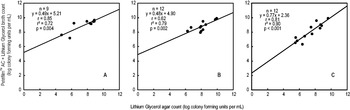
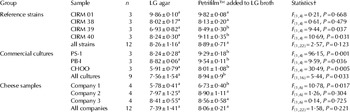
Figure 1 shows the linear regression parameters and dispersion of propionibacteria counts of reference and commercial cultures and cheese samples obtained by LG agar and Petrifilm™ AC plates associated with LG broth. The correlation coefficients obtained for each data group were significant (P<0·05), demonstrating the levels of equivalence of both methods. Despite presenting significant correlations (Fig. 1), Petrifilm™ AC added to LG broth trended to present higher colony counts when compared to the conventional plating system, although the differences were not significant difference according to ANOVA (P>0·05, Table 2). Although the observed differences between the tested methodologies, the results indicate the feasibility of the Petrifilm™ AC for enumerating propionibacteria when compared with the conventional plating system, as observed in previous studies focusing other starter cultures and lactic bacteria, microorganisms that present similar biochemical and technological properties (Champagne et al. Reference Champagne, Gardner, Piette and St-Gelais1994; McGregor et al. Reference McGregor, Traylor, Gough, Hazlett and Bird1995; Pattison et al. Reference Pattison, Geornaras and von Holy1998; Nero et al. Reference Nero, Beloti, Barros, Ortolani, Tamanini and Franco2006, Reference Nero, Rodrigues, Viçosa and Ortolani2008; Ortolani et al. Reference Ortolani, Viçosa, Beloti and Nero2007; Gonçalves et al. Reference Gonçalves, Freitas, Nero and Carvalho2009; Miranda et al. Reference Miranda, Neto, Freitas, Carvalho and Nero2011).
Linear regression parameters and dispersion of propionibacteria counts (in log of colony forming units per ml) of reference strains (a), and commercial cultures (b), and Emmental-type cheese samples (c) obtained by Lithium Glycerol (LG) agar and Petrifilm™ AC added to LG broth. In each graph: n: number of samples; r: correlation index; r 2: coefficient of determination; P: level of significance.

Mean counts (±sd) of Propionibacterium spp. reference strains, commercial cultures, and from Emmenthal cheese type samples subjected to enumeration by Lithium Glycerol (LG) agar and Petrifilm™ AC plates added to LG broth

† Analysis of Variance (ANOVA), F: ANOVA value, P: level of significance. Mean values in a same row followed by distinct superscript letters are significantly different (P<0·05)
The morphological analysis of the 70 colonies selected from both LG agar and Petrifilm™ AC plates added to LG broth indicate the adequate selectivity of this culture medium for this genus: all of the colonies presented typical Propionibacterium spp. characteristics (Gram positive, pleomorphic). Furthermore, PCR of the 70 isolates resulted in 889 bp products, confirming the identification of Propionibacterium spp. (Dasen et al. Reference Dasen, Smutny, Teuber and Meile1998). Based on the obtained data, the presence of lithium, glycerol, and a cocktail of antimicrobials, associated with incubation under anaerobiosis were sufficient to provide adequate selectivity of the culture medium to enumerate only Propionibacterium spp., either by conventional plating procedure or by association with Petrifilm™ AC plates. Although typically employed for propionibacteria enumeration in cheese, LG selective agents can inhibit the growth of some specific strains of this genus (Rossi et al. Reference Rossi, Dellaglio, Peluso and Torriani2000), which can explain some of the differences observed in the present study (Table 2). Because commercial cultures usually are composed of several strains of starter cultures (Dworkin et al. Reference Dworkin, Falkow, Rosenberg, Scheifer and Stacjebrandt2006), some of them may have been inhibited by the selective agents in LG agar and were not able to form visible colonies (Table 2). In contrast, the Petrifilm™ AC plates added to LG broth may have provided better conditions for strains to form visible colonies, considering the presence of additional nutritive substances of the system, and also the presence of a dye, TTC, that improves the visualisation of colonies.
Propionibacterium spp. were able to reduce TTC properly, and the dye did not show inhibitory activity against the strains, when present at 0·0025% (w/v), except for the CIRM 116 reference strain. When associated with LG broth, the Petrifilm™ AC plates presented adequate selectivity and the proper recovery of Propionibacterium spp. reference strains and propionibacteria commercial starter cultures, as well as from the Emmental-type cheese samples. The obtained results indicate the adequacy of Petrifilm™ AC plates added to LG broth for the enumeration of propionibacteria as a monitoring tool in the dairy industry.
AF Carvalho and LA Nero are supported by CNPq and FAPEMIG.