INTRODUCTION
Parasites are often assumed to affect the host's life-history traits in a way that depresses the host's fitness (Møller, Reference Møller, Clayton and Moore1997). Any depression of the host's fitness occurs through a reduction of the number of reproductive attempts (estimated by the life span and time to first reproduction) and/or a reduction of the fecundity (i.e. the number of produced offspring per reproductive attempt) (Stearns, Reference Stearns1992). Thus parasitism can ultimately result in strong effects on host population dynamics, as suggested by empirical and theoretical studies (Anderson and May, Reference Anderson and May1978; Dobson and Hudson, Reference Dobson and Hudson1992; Hudson et al. Reference Hudson, Newborn and Dobson1992, Reference Hudson, Dobson and Newborn1998). Reduction of fecundity due to ectoparasitism has been documented several times (e.g. Deter et al. Reference Deter, Cosson, Chaval, Charbonnel and Morand2007; Møller, Reference Møller, Clayton and Moore1997; Neuhaus, Reference Neuhaus2003; Saino et al. Reference Saino, Calza and Møller1998), whereas evidence of the negative effect of ectoparasites on life span and thus on the reproductive life-time is scarce (but see Brown et al. Reference Brown, Brown and Rannala1995).
Among host-parasite interactions, small mammals and their ectoparasites have been understudied despite their ecological importance in terrestrial ecosystems and their role in epidemiology of several zoonoses (e.g. Chagas' disease: Garcia et al. Reference Garcia, Ratcliffe, Whitten, Gonzalez and Azambuja2007, Lyme disease: Brisson et al. Reference Brisson, Dykhuizen and Ostfeld2008). Fleas are widespread parasites of small mammals, vectors of numerous diseases (Medvedev and Krasnov, Reference Medvedev, Krasnov, Morand, Krasnov and Poulin2006) and their effects on host's fitness are largely unknown. Some recent studies in gerbils demonstrated that fleas induce body mass loss in adult desert gerbils Gerbillus dasyurus (Khokhlova et al. Reference Khokhlova, Krasnov, Kam, Burdelova and Degen2002), whereas this was not the case in adult Anderson's gerbils Gerbillus andersoni (Hawlena et al. Reference Hawlena, Krasnov, Abramsky, Khokhlova, Saltz, Kam, Tamir and Degen2006a). Flea infestation may also reduce immune defences (Goüy de Bellocq et al. Reference Pipano2006; Devevey et al. Reference Devevey, Niculita-Hirzel, Biollaz, Yvon, Chapuisat and Christe2008), which in turn may affect survival. However, evidence of reduced recapture rate has only been provided in parasitized juvenile Anderson's gerbils (Hawlena et al. Reference Hawlena, Abramsky and Krasnov2006b). In the common vole Microtus arvalis, flea infestation affects growth and body mass, depresses host immune defences and induces anaemia (Devevey et al. Reference Devevey, Niculita-Hirzel, Biollaz, Yvon, Chapuisat and Christe2008), which could severely reduce survival probability, but definitive tests of the effect of flea infestation on life span are still lacking.
In this study, we experimentally tested whether parasitism by fleas reduces the life span of their hosts, the common vole. We monitored the life span of captive males parasitized by fleas or kept non-infested until natural death. We also measured haematocrit and body condition throughout life, and at death we weighed spleen, heart, and testes in order to examine whether life span variations could be due to physiological disorders.
MATERIALS AND METHODS
The stock population consisted of wild adult common voles from meadows surrounding the University of Lausanne (Switzerland). Voles were deparasitized with 4 μl of 120 mg/ml veterinary selamectin (Stronghold®, Pfizer, New-York) deposited beneath the ear at their arrival in the animal room. Topical application of selamectin provides effective protection against external and internal parasites during 4 weeks without negative side-effects on host health (Pipano, Reference Pipano2003). Experimental animals were male common voles born from the stock population. They were aged between 45 and 60 days at the start of the experiment (day 0). Common voles reach their adult size at 3 months (Jacob, Reference Jacob2003). All animals were individually housed in a polypropylene cage (36 cm×20 cm×18 cm) in an animal room with a 14 L:10 D cycle and constant temperature of 21±1°C. Cages contained 1 litre of sterilized soil and a flowerpot (diameter 14 cm) as a vole roost. Hay and tap water were available ad libitum and animals received apples and seeds regularly throughout the experiment.
At day 0, 52 adult males originating from 25 litters were weighed, measured, and blood sampled. At day 1, individuals were randomly assigned to the flea-treatment group or non-parasitized control group. Twenty eight individuals were parasitized by fleas (treatment group) and 24 individuals were kept as control. Parasitized voles were exposed to adult and larval rat flea Nosopsyllus fasciatus by receiving 15 g of a mix of bedding coming from cages of wild voles which were not deparasitized and where fleas had developed naturally. In 4 samples of 15 g of bedding, flea loads comprised between 25 and 64 individuals (average=44 fleas). The control group received 15 g of a mix of bedding without fleas. Voles were housed in the same animal facility and the cages were randomly placed on shelves. See Devevey et al. (Reference Devevey, Niculita-Hirzel, Biollaz, Yvon, Chapuisat and Christe2008) for more details.
Body mass and haematocrit were measured at the start of the experiment and at days 98, 119, 139, 237, 335, 430, 640, and 742. Sample sizes decrease over time due to this design running until the natural death of every individual.
On each blood sampling day, blood was drawn by tail-cutting into a pre-heparinized capillary for haematocrit. Haematocrit capillaries were centrifuged for 10 min with a standard centrifuge (Haematokrit 24, Bioréac SA, Lausanne, Switzerland). The amount of red blood cells relative to the total amount of blood volume was measured with a calliper to the nearest 0·1 mm. Body mass was measured to the nearest 0·1 g. After death, corpse length from the tip of the nose to the base of the tail was measured on a graduated board. Individual body condition at day 98 and the following days was assessed by extracting residuals from the regression of body mass on body length (r2=0·11, n=174, P<0·001). Then the heart, spleen and testes were removed, cleaned from connective tissue and weighed (0·1 mg).
Effect of parasitism on life span of voles was first tested by a Kaplan-Meier survival analysis. The Kaplan-Meier estimator is a product-limit survival estimate from life-time data (Kaplan and Meier, Reference Kaplan and Meier1958). We analysed change in haematocrit and body condition throughout adulthood (age equal or older than 98 days) with repeated-measure ANOVA over continuous time in backward procedure. Because changes in haematocrit or body condition over time can be due to within-individual changes (improvement, senescence) or to between-individual change (selective disappearance), we added the factor ‘age of last measurement’ in the ANOVA (van de Pol and Verhulst, Reference van de Pol and Verhulst2006). To control for allometric relationships between corpse mass and organs (heart: R2=0·45, F1,26=20·9, P<0·001; spleen: R2=0·06, F1,25=1·6, P=0·2; testes: R2=0·49, F1,29=28·1, P<0·001), we entered corpse mass as a covariate in the analyses of the mass of spleen, heart and testes. Variables were log-transformed if necessary in order to normalise the distribution. Reported values are means±standard error. All tests were two-tailed and were performed with JMP 7.0.0.
RESULTS
The life span of parasitized voles (mean: 293·7 days, median: 194 days, max: 804 days) was reduced compared to control voles (mean: 460 days, median: 538 days, max: 1076 days; χ2=6·04, d.f.=1, P=0·014; Fig. 1), even after excluding voles which did not reach 100 days of age (respective medians, 224 and 550 days; χ2=6·07, d.f.=1, P=0·014).
Life span curves of voles infested by fleas (full line) or non-infested by fleas (dashed line).

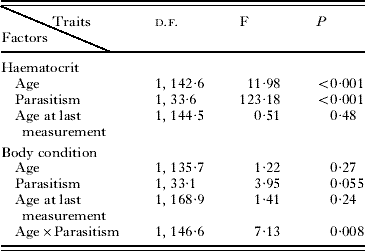
The two groups did not differ for body mass and haematocrit at the start of the experiment (t-tests, respectively t 49=0·32, P=0·8 and t 49=0·61, P=0·5). The mean haematocrit level of parasitized voles (0·43±0·00) was lower than in control voles (0·52±0·00) throughout life, and in both groups the level decreased as voles aged (Table 1). Body condition tended to be lower in parasitized voles than controls and diminished with age in non-parasitized individuals (F1,98=9·75, P=0·002; Table 1), whereas that was not the case in parasitized voles (F1,72=0·53, P=0·47). The non-significant term ‘age of last measurement’ means that the changes are due to individual variation of trait values and not to selective disappearance (van der Pol and Verhulst, Reference van de Pol and Verhulst2006).
Results of the repeated measures analyses of variance on haematocrit and body condition throughout the life-time of voles
(The mean haematocrit level of parasitized voles was lower than in control voles, and in both groups the level decreased as voles aged. Body condition tended to be lower in parasitized voles than controls and diminished with age in non-parasitized individuals, whereas that was not the case in parasitized voles.)

At the time of death, parasitized voles were smaller than those of non-parasitized voles (respectively 101·7±2·2 mm and 111·9±2·2 mm, t 34=3·24, P=0·003). After controlling for body mass, parasitized voles had larger spleens (non-parasitized: 31·8 mg±1·3; parasitized: 87·4 mg±1·4; F1,27=5·74, P=0·024) and larger hearts (non-parasitized: 130·8 mg±1·1; parasitized: 164·7 mg±1·1; F1,26=6·58, P=0·016) than controls, but testes were of similar mass (non-parasitized: 121·0 mg±14·8; parasitized: 78·2 mg±12·3; F1,26=0·30, P=0·59).
DISCUSSION
Our study demonstrates that flea infestation by Nosopsyllus fasciatus can reduce life span of one of its natural hosts, the common vole. Brown et al. (Reference Brown, Brown and Rannala1995) also showed that survival was approximately 12% lower for cliff swallows Petrochelidon pyrrhonota reproducing in parasitized nests compared to those from fumigated nests, demonstrating that parasitism experienced during the short period of reproductive effort can result in loss of up to 1 year of life-time reproductive success. We found that the mean life span of parasitized voles decreased by 36%, or 166 days. Theoretically, the life-time reproductive success is correlated with life span in iteroparous species because a long life span may be associated with a higher number of possible breeding attempts and more breeding experience (Clutton-Brock, Reference Clutton-Brock1988; Stearns, Reference Stearns1992; Weladji et al. Reference Weladji, Gaillard, Yoccoz, Holand, Mysterud, Loison, Nieminen and Stenseth2006). This statement is confirmed by several empirical studies in rodents (Ribble, Reference Ribble1992; Wauters and Dhondt, Reference Wauters and Dhondt1995) as well as in small birds (Schmoll et al. Reference Schmoll, Schurr, Winkel, Epplen and Lubjuhn2009) and in large mammals (Pettorelli and Durant, Reference Petorelli and Durant2007; Weladji et al. Reference Weladji, Gaillard, Yoccoz, Holand, Mysterud, Loison, Nieminen and Stenseth2006). In the present study, voles had no access to mates and we have thus no data on life-time reproductive success. However, we can hypothesize that in natural conditions, the decrease of life span induced by parasites or other extrinsic mortality factors leads to a lower number of breeding opportunities and to a lower life-time reproductive success, especially for short-lived species exposed to high extrinsic mortality factors (Christe et al. Reference Christe, Keller and Roulin2006). Moreover, experimental evidence suggests that endoparasitism reduces the reproductive success of breeding common voles (Deter et al. Reference Deter, Cosson, Chaval, Charbonnel and Morand2007).
The exact mechanisms by which flea infestation accelerates death are not yet clear. Nevertheless, this experiment may provide us with some non-mutually exclusive hypotheses, suggesting that flea infestation can trigger complex trade-offs between different functions like the immune system, erythropoiesis and blood circulation. The immune system is chronically in demand and the observed huge spleen relative to the body mass of parasitized voles (on average 274% of the mass of the spleen of the control voles) can be due to intense immune activity (Møller et al. Reference Møller, Christe, Erritzoe and Mavarez1998) which might favour immune disorder and auto-immune diseases (Sorci and Faivre, Reference Sorci and Faivre2009). Nevertheless, the immune effort by itself does not shorten the life span of common voles (Devevey et al. Reference Devevey, Chapuisat and Christe2009). Moreover, rodents parasitized by fleas are immuno-depressed (Devevey et al. Reference Devevey, Niculita-Hirzel, Biollaz, Yvon, Chapuisat and Christe2008; Goüy de Bellocq et al. Reference Goüy de Bellocq, Krasnov, Khokhlova, Ghazaryan and Pinshow2006), and this makes them more sensitive to diseases. Alternatively, the spleen may also act as an erythropoietic organ in microtines (Watkins et al. Reference Watkins, Moshier, O'dell and Pinter1991), and thus splenomegaly observed in this study could be due to a combined effect of immune activation and the necessity to produce new red blood cells. This could be one of the morphological changes induced by anaemia. Besides, the hypothesis that parasitized voles have a higher resting metabolic rate due to an increased breath and/or heart output in response to anaemia (Devevey et al. Reference Devevey, Niculita-Hirzel, Biollaz, Yvon, Chapuisat and Christe2008) is now corroborated by the finding that parasitized voles have a heavier heart than control voles. The precocious anaemia associated with low body condition early in life and other physiological disorders may explain the early death of parasitized voles. In addition, fleas are known to be vectors of several micro-organisms (Ricketssiae typhus, trypanosomes …) (Medvedev and Krasnov, Reference Medvedev, Krasnov, Morand, Krasnov and Poulin2006) with potentially pathogenic effects on the host. The measured cost of flea infestation is thus the sum of the direct effects of the flea and the indirect consequences of potentially inoculated pathogens.
Overall, these results demonstrate that the presence of fleas affects one important host life-history trait in a way that could depress fitness. It emphasizes the necessity to integrate parasitism, even by seemingly inconspicuous fleas, in studies involving the life-history traits of small mammals. Macroparasites as well as microparasites can affect survival and life span (Burthe et al. Reference Burthe, Telfer, Begon, Bennett, Smith and Lambin2008) and this may in turn affect population dynamics (Deter et al. Reference Deter, Charbonnel, Cosson and Morand2008; Townsend et al. Reference Townsend, Newey, Thirgood, Matthews and Haydon2009).
All manipulations were done under control of the Vaud Veterinary Authorities, authorization 1848.
We are very grateful to J. Notari for his help with the experiment, and to K. S. Osmont, K. Harle, N. Kaldonski and N. Charbonnel for their insightful suggestions. We thank P. Bize and two anonymous referees who greatly helped to improve the manuscript. This research was supported by grants 3100A0-104118 and 3100A0-120479 from the Swiss National Science Foundation.