An extremely severe cyclonic storm, Fani made land fall in Odisha, an Eastern State in India on May 3, 2019. It was the strongest tropical cyclone to strike since the 1999 Odisha super-cyclone. Fani was categorized as a high-end Category 4 major hurricane. It had a maximum wind speed of 250 km/h. It also affected other states especially Western Bengal in India and Bangladesh. Around 89 people lost their lives in the storm (64 in Odisha) and it caused 8.1 billion USD of damage in India and Bangladesh, mostly in Odisha.1 There was a massive evacuation before the storm, which improved pre-disaster management,2,Reference Kumar, Gettleman and Yasir3 and decreased the death toll. In contrast, around 10000 people (figures up to 30000 suggested) died in 1999 Odisha super-cyclone, with a colossal destruction of property and livelihood when the sea water came inland up to 35 kilometers at various places.4
Odisha frequently experiences floods, cyclones, droughts, and heat waves,Reference Chittibabu, Dube and Macnabb5 probably because of geographical factors, such as having many rivers and a long coastline adjoining the Bay of Bengal which is known to have frequent tropical cyclones.Reference Ray-Bennett6 As it is known, disasters have a more devastating effect in developing regions compared to developed areas.Reference Kar, Krishnaraaj and Rameshraj7 The devastating effect of the 1999 super-cyclone in Odisha was associated with considerable degree of psychiatric morbidity.Reference Kar, Jagadisha, Sharma, Murali and Mehrotra8 A range of mental health issues were reported including post-traumatic stress symptoms (PTSS), depression, anxiety, dissociation, suicidality, substance abuse, and even antisocial behavior such as quarrels, aggressive behavior, etc.Reference Kar9
Within 3 months after the 1999 Odisha super-cyclone, 82% of survivors who lived within the centre of devastation had either post-traumatic stress disorder (PTSD), severe depression or anxiety compared to the 11% who lived further away.Reference Suar, Mandal and Khuntia10 Around a year after the super-cyclone, reported proportion of PTSD was 44.3%; anxiety disorder 57.5% and depression 52.7%.Reference Kar, Jagadisha, Sharma, Murali and Mehrotra8 The suicidal cognitions (death wish 66.4%; suicidal ideas 38.0%, plans 18.3%), and behaviors (suicidal attempt) (12.6%) were also increased.Reference Kar11 Considerable portions of adolescent victims of 1999 super-cyclone had anxiety (12.0%), depression (17.6%), post-traumatic stress disorders (26.9%-30.6%) around a year after the disaster.Reference Kar and Bastia12,Reference Kar, Mohapatra, Nayak, Pattanaik, Swain and Kar13 In 1 study, 37.9% of adolescents had at least 1 diagnosis and comorbidity was found in 39.0% of them.Reference Kar and Bastia12
Other post-disaster studies in the Eastern Indian region reported similarly high prevalence of psychiatric morbidity. Within 3 months after 2004 Asian tsunami, prevalent figures of depression and adjustment disorder (both 13.5%), PTSD and panic disorder (both 10.8%) and other disorders (43.2%) in children and adolescents were considerably high.Reference Math, Tandon and Girimaji14 A study on adults 4.5 years after 2004 Asian Tsunami reported overall morbidity in 77.6% with an estimated prevalence of anxiety symptoms in 23.1% victims, depression in 33.6%, PTSD in 70.9% and comorbidity in 44.7%.Reference Kar, Krishnaraaj and Rameshraj7
There are various studies following cyclones in other parts of the world reporting psychiatric morbidities. A study 6 months after Hurricane Mitch, in Nicaragua reported PTSD in 4.5% in less damaged areas to 9% in the worst affected regions; and at 1 year, 50% of them still had PTSD.Reference Caldera, Palma, Penayo and Kullgren15 In a study on adolescents following Hurricane Mitch, at 6 months, PTSD prevalence ranged from 14-90%, depressive disorder from 29-81% and comorbidity of PTSD and depression from 8-79% in regions with different degrees of impact.Reference Goenjian, Molina and Steinberg16 Following Hurricane Andrew, prevalence of PTSD was 36%, major depression was 30%, and anxiety 20% at 6-12 months; with 51% of cases having first onset of psychiatric disorders after the hurricane while 56% continued to have symptoms after 6 months.Reference David, Mellman, Mendoza, Kulick-Bell, Ironson and Schneiderman17 In children, 3 months after Hurricane Hugo, more than 5% had enough symptoms to be considered as PTSD.Reference Shannon, Lonigan, Jnr and Taylor18 In the evacuees of Hurricane Katrina, within 12-19 days, 62% had acute stress disorder.Reference Mills, Edmondson and Park19 In a study comparing pre- and post-Hurricane Katrina, the prevalence of mental illness increased with severe mental illness almost doubling from 6.9% to 14.3%, and post-disaster (18 months) PTSD was 47.7% in parents with low income.Reference Rhodes, Chan, Paxson, Rouse, Waters and Fussell20 A longitudinal study 14 months after Hurricane Sandy and a follow up 1 year later reported a decrease of prevalence of anxiety from 50% to 41.5%, depression from 35.4% to 30.8% and PTSD from 28.7% to 24.8%.Reference Schwartz, Gillezeau, Liu, Lieberman-Cribbin and Taioli21 A meta-analysis on prevalence of PTSD related to typhoons or hurricanes suggested an overall figure of 17.8%,Reference Wang, Wu and Dai22 which decreased, matching with the decreased severity of the disaster.
Over the years disaster preparation, evaluation, and rescue have been improved in Odisha and the damage due to cyclones have been contained.Reference Dora and Padhee23,24 For example, before the cyclone Fani, the Odisha State Disaster Management Authority evacuated over 1.2 million people in the coastal areas to cyclone shelters, arranged thousands of emergency workers and volunteers to support disaster management, and warned people through text messages, TV, sirens, and public address systems.1 While these efforts have been effective in reducing the loss of life, in contrast to the outcome following 1999 super-cyclone, concerns still remain about the rescue and relief operations around the event and post disaster support in these areas. In this context, we intended to study the mental health issues following the cyclone Fani, especially to review whether the extensive pre-disaster preparation and rescue made any difference compared with the 1999 super-cyclone. The specific objectives of the study were to explore the anxiety, depression, and PTSS within 1 month of the cyclone Fani in Odisha, and to reflect on the impact of disaster management activities.
Method
The study was done in 3 villages (Sanabandhakera, Brahmagiri, Alarpur) selected randomly out of 11 villages affected by cyclone Fani in Brahmagiri Panchayat. These villages are around 90 km from Bhubaneswar, the capital city of Odisha, and 25 km from Puri, the nearest city. The 3 villages have 1213 households with a total population of 6702. The households in the villages were selected randomly and available adults were approached to participate in the study. At this stage, it was a convenient sampling based on availability and willingness of the individual. This approach was continued, and 80 individuals were recruited out of the 103 approached (response rate 77.7%).
The data was collected 1 month after the storm, by research assistants with graduate level education; who were trained in the research methodology and data collection procedure. The data collection continued for around 2 weeks. A questionnaire sheet was prepared for socio-demographic information, disaster experience and 3 self-rated scales for PTSD, anxiety, and depression.
Scales
PTSD was assessed by Primary care PTSD screen for DSM 5 (PC-PTSD-5). It is a 5-item screening questionnaire with yes or no answers, which have been designed for use in primary care settings. A cut off score of 3 is optimally sensitive to suggest probable PTSD.Reference Prins, Bovin and Smolenski25 It assesses PTSS in the last 1 month. This scale has been found acceptable in different populations.Reference Li, Zhang and Chen26,Reference Jung, Kim, Kim, Roh, Chae and Park27 Each of the 5 items asks for 2 specific types of PTSS; in this study these were asked separately to make it more comprehensive for the local people. The responses were combined to get the score for the specific item, for example a positive answer to any 1 or both questions would qualify for a ‘yes’ response. We used a translated version in the local language Odia, along with the English scale.
Anxiety symptoms were measured using Generalised Anxiety Disorder (GAD)-7 questionnaire, which is a commonly used self-rated, validated instrument for screening for GAD and assessing its severity.Reference Spitzer, Kroenke, Williams and Löwe28 It measures anxiety symptoms in the last 2 weeks, with 7 items which are evaluated thus: 0 meaning not at all, to 3 being nearly every day. From a possible total score of 21, the total individual score is categorized as none (0-4), mild (5-9), moderate (10-14), and severe (15-21) reflecting the degree of anxiety. It was available in Odia language.
Depressive symptoms and their severity were assessed using Patient Health Questionnaire (PHQ)-9 scale. PHQ-9 is a validated, self-rated scale, which has been used as a screening instrument for depression and its severity.Reference Kroenke, Spitzer and Williams29 The duration of depressive symptoms covered in the scale is 2 weeks. PHQ has 9 items which are analyzed as 0 meaning not at all to 3 being nearly every day. PHQ-9 was available in Odia language. Of the 9 items, 1 of the questions is about having thoughts being better off dead or of hurting yourself in some way. This was considered for suicidal cognitions. Based on the total score, the depression can be categorized as none (0-4), mild (5-9), moderate (10-14), moderately severe (15-19), and severe (20-27).
Socio-demographic variables such as age, gender, education (no formal education, school, college, university or professional), occupation, marital status (single, married, widowed, separated), economic status (poor, lower middle, upper middle, and upper) were collected by self-report. Occupation was determined through open ended questions for the respondents to describe which was later categorized to cultivation, business, housewives, and students. The cyclone Fani related experience e.g., evacuation before the cyclone; fear of death, injury, injury or death in family, damage to home (partial but habitable, partial but not habitable, complete), difficulty in finding food and water during the cyclone period, displacement after the cyclone, difficulty in finding job or continuing work, and livelihood were also collected using a questionnaire method. The open ended questions explored the most severe difficulty respondents faced and the help that the victims needed.
The project was approved as a non-interventional survey by the institutional ethics committee of the Quality of Life Research and Development Foundation (QoLReF/2019/Fani). Written informed consent was obtained, and voluntariness, anonymity, options to withdraw at any time was highlighted. As part of the project a mental health team visited the affected people in the villages for psychological support. A consultant clinical psychologist was available for referral of any person with mental health concern for psychological assessment and intervention. There was further scope to refer affected individuals to local health services for support and to psychiatric services at Mental Health Institute when appropriate. All these mental health services were freely available.
Analysis
Sample Size Calculation
We calculated sample size based on the formula: n = Z2 PQ/d2; where, n = required sample size, Z = the value of standard normal variant at 95% level of confidence, P = prevalence of PTSD, Q = 1 − P, d = 10% (allowable error). Considering prevalence of psychiatric morbidity of 80% based on a previous study following 1999 super-cyclone,Reference Kar, Jagadisha, Sharma, Murali and Mehrotra8 it was calculated that the sample size required will be approximately 61. Allowing 25% of incomplete data related issues; total sample size for the study was estimated to be 76.
Outcome variables included the proportions of affected population that had specific diagnostic probabilities of anxiety, depression, and PTSD following the screening. Disaster experience and the socio-demographic variables were predictor variables. We used 95% confidence interval (95% CI) for proportions of prevalence, and Fisher’s Exact test to evaluate the degree of association between different categorical variables; means were compared using t-test, and degree of correlation was measured between anxiety, depression, and PTSS score using Pearson’s correlation coefficient, r. The data was analyzed with SPSS version 25. Missing values were not included in the analysis; there was no scoring for 1 female for all scales, and another 2 participants (1 female and 1 male) had no scoring for the PC-PTSD-5. The level of significance was considered at the standard 0.05 level.
Results
There were 80 participants, with 44 (55%) males and 36 (45%) females with mean age (SD) of 50.5 (10.3) and 44.3 (8.96) years respectively (P < 0.01). Most (66.3%) were school educated; 92.5% were married, 35% had agriculture as their occupation, followed by 11.3% in business, and 40% were housewives; 77.5% had lower middle socio-economic status (SES) and the rest were in the lower SES. There was no difference in reported monthly family income between participants from the 2 genders. However, significantly (P <0.01) more males (36.4%) reported being in the lowest SES compared to females (5.6%). Significantly more females (30.6%), reported no formal education compared with (4.5%) males (P < 0.01).
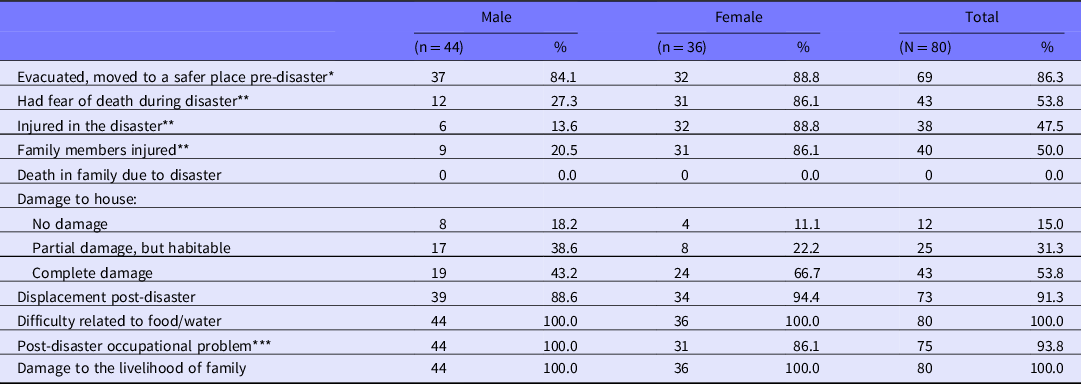
Disaster experience of the victims is given in Table 1. The figures indicate the intensity of the impact of the cyclone. When asked about the most severe difficulty they faced following the cyclone, damage of house (35.0%) was most commonly reported, followed by lack of food (20.0%), and no work (8.8%). Only 3.8% people (all females) reported receiving any help related to the damage by cyclone, by the time of study around 1 month post-disaster.
Disaster experience

*P = 0.065; **P < 0.01, ***P < 0.05, Fisher’s exact test.
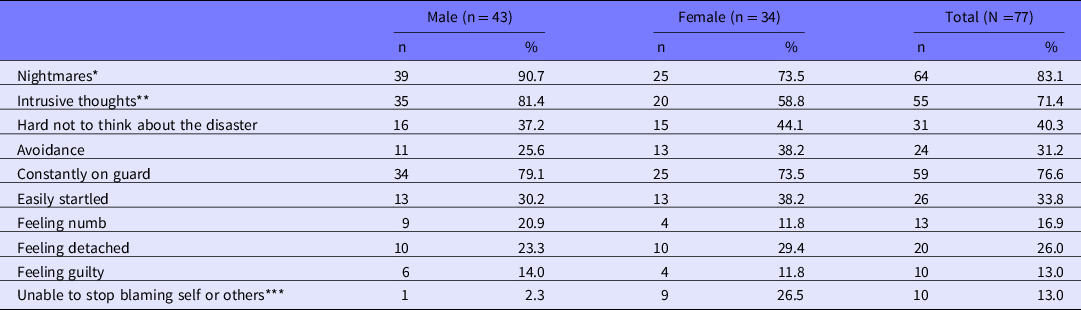
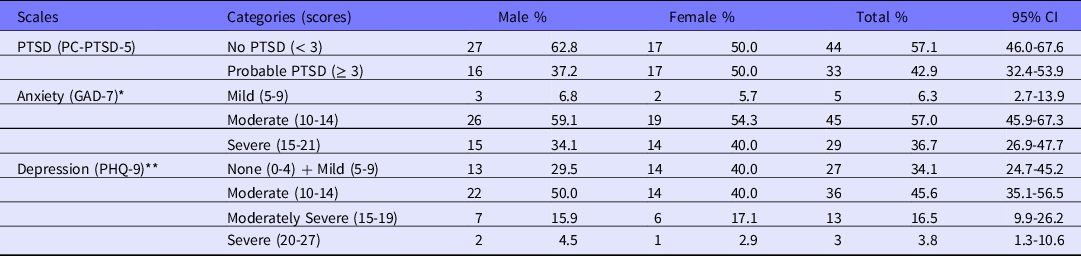
The frequencies of PTSS are provided in Table 2. It ranged from 83.1% for nightmares to 13.0% for being unable to stop blaming self or others for the outcome. Table 3 depicts the probable PTSD diagnosis, severity range for depression (PHQ-9 categories), and anxiety (GAD-7 categories). Cut off score of 3 in PC-PTSD-5 is optimally sensitive to probable PTSD, which suggested that probable PTSD in the studied sample was 42.9% (95% CI: 32.4-53.9). A cut-point of 4 is considered optimally efficient; and based on that there were 25.6% males and 26.5% females (total 26.0%, 95% CI: 17.5-36.7).
Post-traumatic stress symptoms

The 10 symptoms represented here consist of 2 specific post-traumatic stress symptoms from each of 5 items of PC-PTSD- 5.
*P = 0.066; **P = 0.069, ***P < 0.01, Fisher’s exact test. Information for 1 male and 2 females was not available.
Categories of anxiety, depression, and post-traumatic stress

*There was none with 0-4 score on GAD-7, indicating everyone had mild or more degrees of anxiety. All comparisons were statistically non-significant. **There were only 5.7% females with no depression, so ‘none’ and ‘mild’ groups were combined. For PTSD, total N is 77, and for anxiety and depression, it is 79.
Considerable proportions of victims had anxiety and depression. There was no significant difference in the mean PHQ-9 score (11.6 ± 3.7 v 11.0 ± 3.9, t: 0.66, df:77, P: 0.51), GAD-7 score (13.8 ± 2.9 v 13.5 ± 2.6, t: 0.51, df: 77, P: 0.61) or PC-PTSD-5 score (2.5 ± 1.4 v 2.8 ± 1.4, t: −0.86, df: 75, P: 0.39) between the male and female participants. Suicidal cognitions in the form of death wish or suicidal ideas were reported by 14% of the people (some days 12.7% and more than half the days 1.3%); there were no gender differences.
Comorbidity
Majority of participants had comorbidity; when proportions with mild depression and mild anxiety were included, 54.5% had 2 diagnoses and 42.9% had all 3. Although 50% of female and 37.2% of male victims had all 3 diagnoses, it was not statistically significant. When persons with at least moderate degree of anxiety or depression were considered, 26.0% had 1, 31.2% had 2 and 37.7% had all 3 diagnoses.
Factors Associated with Probable PTSD
We compared the socio-demographic and disaster experiences of participants having probable PTSD with those who did not. There was no difference in mean age of those with and without probable PTSD (48.0 ± 11.8, v 47.8 ± 8.7 years, t: −0.11, df: 75, P: 0.91 respectively); or in the distribution of sociodemographic categories (gender, education, occupation, marital status, socioeconomic status). The only disaster experience related factors that were significantly associated with PTSD were damage to home and displacement after the disaster. In relation to damage of houses, 53.7% with complete damage to their houses, and 41.7% with partial damage but not habitable had PTSD compared with 8.3% with partial damage but habitable (P = 0.017). Displacement following the cyclone suggested that 47.1% with such history had PTSD compared to 0% of those who were not displaced (P = 0.018).
Categories where association approached significance were evacuation, fear of death during disaster and injury of family. Although majority were evacuated, 50% of the evacuated victims had probable PTSD compared with 0% of those who were not evacuated (P = 0.056). More than half (57.5%) of victims who felt they might die during the disaster had PTSD compared with 32.3% who did not have such feelings (P = 0.054). Majority of victims (57.9%) who reported injury of family members in the cyclone had PTSD compared with 33.3% who did not have such history (P = 0.056).
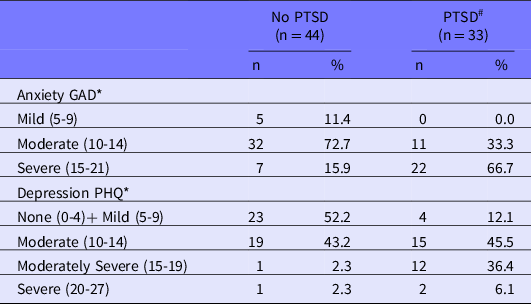
Depression (PHQ-9 score: 13.6 ± 3.4 v 9.6 ± 3.3, t: −5.183, df: 75, P < 0.001) and anxiety (GAD-7 score: 15.5 ± 2.3 v 12.3 ± 2.4, t: 5.81, df: 75, P < 0.001) scores were significantly more in those with PTSD compared to those without. Similarly, PTSD diagnosis was associated significantly with categories of depression and anxiety with greater severity (Table 4). There was also significant correlation with PC-PTSD-5 score with GAD (Pearson’s r: 0.69, P < 0.01) and PHQ score (Pearson’s r: 0.596, P <0.01). Depression and anxiety scores had significant correlation with each other (Pearson’s r: 0.631, P <0.01) as well.
Depression and anxiety in PTSD

# Based on PC-PTSD-5 score of 3 or more, *P < 0.001; Fisher Exact Test. There were only 2 (4.5%) persons with depression (0-4) and no PTSD, so ‘None’ and ‘Mild’ depression categories were combined.
Factors Associated with Anxiety and Depression
As there were only 6.3% (n = 5) with mild anxiety, we grouped mild and moderate anxiety (n = 50) in contrast to severe (n = 29) degree of anxiety for the calculation of association with demographic and disaster related factors. There was no significant difference between genders, education, marital status, occupation, economic status. Among the disaster experiences, 40.3% of displaced people had severe anxiety compared with 0% who were not displaced (P = 0.043). Association of injury of family (67.9% of people with severe anxiety reported injury of family members compared with 44.4% with moderate anxiety, P = 0.059) and damage to house (65% people with severe anxiety had complete damage of house compared with 46% with moderate anxiety, P = 0.061) with severe anxiety approached significance. Majority (75.9%) of participants with severe anxiety had probable PTSD, in contrast to 22.9% with moderate anxiety (P < 0.001).
We compared persons with none or mild depression (n = 27) with those having moderate or more severe depression (n = 52). There was no significant difference in these 2 groups of depression in demographic categories. Among the disaster experience, only the evacuation and displacement were significantly associated with moderate to severe depression. For example, 70.6% of evacuated people had moderate to severe depression in contrast to 29.4% who had mild depression (P = 0.037). Similarly, 70.8% of displaced people had moderate to severe depression and 29.2% of them had mild depression (P = 0.006). More than half (58.0%) of participants with moderate and severe depression had probable PTSD, in contrast to 14.8% who had mild depression (P < 0.001).
Discussion
This study was conducted a month after the 2019 cyclone Fani in Odisha. Disaster experience of the sample suggested that most of the participants were evacuated, had problems related to food and water, were displaced and had problems related to occupation and livelihood. More than half were afraid of death during the disaster, with significantly more females reporting that compared to males. This suggested the severity of the trauma impact.
It was observed that a considerable number of people who resided in the exposed area in rural settings suffered from anxiety, depression and PTSS. There were 42.9% who had PC-PTSD-5 score 3 or more, suggestive of probable PTSD. These results and similar studies in the region,Reference Kar, Jagadisha, Sharma, Murali and Mehrotra8,Reference Suar, Mandal and Khuntia10,Reference Kar and Bastia12,Reference Kar, Mohapatra, Nayak, Pattanaik, Swain and Kar13 consolidate that PTSS are valid concepts following disasters and are ubiquitous in different cultures. However there are great variations over the prevalence figures, which could be due to various factors such as severity of disasters,Reference Wang, Wu and Dai22 duration between the event and the study,Reference Schwartz, Gillezeau, Liu, Lieberman-Cribbin and Taioli21 and may be post-disaster support. Our study findings also suggest that PTSS are common within the first month, similar to a study done within the first month of hurricane Katrina.Reference Mills, Edmondson and Park19 Predictive potential of early stress symptoms for later PTSD has been suggested.Reference Mills, Edmondson and Park19 This opens up possibilities of early intervention and the opportunity to study the outcome both in the short and long-term. As extreme weather events are common in the developing world and affect large populations, it is essential that post-disaster support strategies include the screening of affected populations for mental health consequences and arrange their intervention.
PTSD prevalence of this study conducted after around a month of Fani is comparable to the studies done in the region at 3,Reference Suar, Mandal and Khuntia10 and 12 monthsReference Kar, Jagadisha, Sharma, Murali and Mehrotra8 following 1999 Odisha super-cyclone; although they were done at different time periods following the disaster and did not use PC-PTSD-5. However, a similarity in prevalence figures even at 1 month is noticeable in the findings. The reported range of psychiatric morbidity varies even following similar disasters, and it is probably dependent on various factors including trauma intensity for the individual, duration since the disaster, methodology etc.Reference Caldera, Palma, Penayo and Kullgren15 For example, within the first month of Katrina, 62% of affected people had acute stress disorder,Reference Mills, Edmondson and Park19 and around 5-8 months after, PTSD was reported to be 14.9%Reference Kessler, Galea, Gruber, Sampson, Ursano and Wessely30; at 2 weeks post-2004 Tsunami PTSD prevalence was 22%, and it was 30% at 6 months.Reference Tang31 Considering these figures, observations in this study is higher, possibly due to the impact of the cyclone as perceived by the affected population e.g. a considerable proportion of participants had a fear of death during the cyclone, struggled for food, had damaged homes, and had problems of livelihood. Impact of the trauma in developing economies is probably more pronounced by the secondary stresses of inadequate resources to support for necessities such as shelter, food and difficulties in livelihood. Although the disaster management activities have been better, effective post-disaster support systems through robust long-term strategies for the affected people may help.
Anxiety and Depression
In this study, anxiety was most prevalent, with severe anxiety in 36.7% and moderate anxiety in 57.0%. Degrees of depression suggestive of clinical concern were severe depression (3.8%), moderately severe depression (16.5%) and moderate depression (45.6%). The observed prevalence of anxiety and depression is comparatively more than those observed 1 year after the 1999 super-cyclone in Odisha,Reference Kar, Jagadisha, Sharma, Murali and Mehrotra8 which may be due to various factors including the difference in the time of study following the disaster. Studies considering overall psychiatric morbidity also report varied prevalence figures: 1 year after 1978 cyclone in Sri Lanka, 50% of the population had psychiatric morbidity;Reference Patrick and Patrick32 prevalence of psychological dysfunction in the evacuees after Cyclone Tracy was 58% initially and 41% at 10 weeks.Reference Parker33 Estimated 30-day prevalence of any anxiety-mood disorder was reported to be 49.1% and 30.3% for PTSD following Hurricane Katrina.Reference Galea, Brewin and Gruber34
Although there are variations,Reference Goenjian, Molina and Steinberg16,Reference David, Mellman, Mendoza, Kulick-Bell, Ironson and Schneiderman17 the post-disaster prevalence figurers are much more than that of psychiatric morbidity in the general population. The proportions of affected people with anxiety, depression and PTSS in this study are above the mental morbidity prevalence figures in the general population in India (current: 10.6%, lifetime: 13.7%).Reference Murthy35 The increase of prevalence of mental illness from pre-disaster figures in the population is well reported.Reference Kessler, Galea, Gruber, Sampson, Ursano and Wessely30 It can be appreciated that major disasters evoke significant anxiety during disaster and the mental health symptoms continue in the post disaster period.
Factors Associated with Morbidities
Although higher proportions of females had probable PTSD, severe depression and anxiety, the difference from males was not significant. It is in contrast to many studies which report greater vulnerability of females.Reference Ditlevsen36 Pre-disaster evacuation, fear of death during the disaster, injury of family members, complete damage of house, and displacement following the cyclone were associated with PTSD. It is possible that those who were not evacuated had cyclone worthy buildings and they stayed on without being evacuated. The fear that one might die in a disaster, as observed in this study, has been known and reported to be a stressor for psychiatric morbidity, especially PTSD.Reference Parker33,Reference Sharma and Kar37 This cognition of fear of death during the disaster is a key factor that appears to be associated with the possibility of PTSD later.
Influence of Pre-disaster Support
The results highlighted that even if there were commendable pre-disaster evacuations and preparations,2 the psychological impact of the cyclone was still considerable and comparable to the observations following a similar type of disaster in 1999 in Odisha.Reference Kar, Jagadisha, Sharma, Murali and Mehrotra8 However, the previous studies were done in a comparatively longer period after the disasters and the prevalence may fluctuate over time. While evacuations are helpful and save lives, these could be stressful because of the urgent need to move quickly, sometimes without adequate preparations. Besides, in Odisha most rural people have livestock at home and it is a concern to leave them behind. It is observed that most people are not able to assess the risk appropriately or take timely decisions,Reference Vorst38 and they may find the evacuations unnecessary and stressful. Providing more information about evacuation, actions people need to take themselves to prepare, and providing clarity to the evacuation process may help. In the planning and implementation of evacuation process, attention to the human factors and the mental health concerns of the evacuees are essential.
Post-disaster displacements are stressful too.Reference Munro, Kovats and Rubin39 Displacements or relocations are known factors impacting mental health and have been reported following cyclone Tracy,Reference Parker33 and floods in the UK.Reference Munro, Kovats and Rubin39 Particularly, living farther away from one’s own house, which has been damaged in the disaster, without any immediate resource to repair or rebuild are factors that probably increases the stress burden. During this time, unavailability of work and its effect on livelihood complicate the situations. Besides disruptions to day to day life, displacements affect quality of life and wellbeing of the relocated people.Reference Cofini, Carbonelli, Cecilia and di Orio40 Actions to rebuild houses may be supported adequately and quickly so that victims can return to their homes sooner. The long-term solutions however are cyclone resistant safe houses especially in the coastal regions, improved connectivity, and underground electric connections,24 which have been suggested. All these require financial support to the affected people as majority had occupational and livelihood problems, and economic difficulties after the disasters have been reported to be a contributing factor for PTSD.Reference Gigantesco, Mirante and Granchelli41
Injury to family members in the disaster, during a period when the regular medical services are either not available or too stretched; or situations where people do not have adequate resources to go for treatment elsewhere is stressful. This contributes further to the impact of the disaster. Measures to provide adequate medical support should be prioritized in post disaster situations.
Comorbidity
Comorbidity was high at 74% of victims having more than 1 diagnosis, while considering moderate level of severity. The figure is slightly higher than 63.4% reported following the 1999 super-cyclone.Reference Kar, Jagadisha, Sharma, Murali and Mehrotra8 Similar observations have been reported from previous studies involving cyclones,Reference Kar and Bastia12,Reference Adams, Danielson, Sumner, McCauley, Cohen and Ruggiero42 and floods.Reference Dai, Kaminga and Tan43 Reported comorbidity figures in adolescents after disasters were lower (39% after super-cyclone and 30% following an earthquake).Reference Kar and Bastia12,Reference Sharma and Kar37 Comorbidities are common after disasters as trauma may manifest in various ways. As observed in this study PTSD, anxiety and depression were highly comorbid conditions in the disaster victims and greater severity of anxiety and depression was associated with PTSD significantly. This suggests that although categorically different, these are common outcomes to the exposure to catastrophic traumas. The clinical implication of the finding is that in the post-disaster scenario, it is logical to assess for all these 3 conditions, or a presence of 1 should suggest exploring for comorbidities.
Self-harm and Suicidality
In this study, suicidal cognitions were observed in 14% of people within a month of the cyclone. Reported figures after 6 months of Hurricane Mirch in Nicaragua was 8.5%.Reference Caldera, Palma, Penayo and Kullgren15 Proportions of victims having suicidal cognitions and behaviors within 1 year of 1999 super-cyclone was much higher.Reference Kar11 This suggests if the stresses linked to the cyclone and emerging difficulties are not ameliorated adequately, there may be a potential risk of increase of suicidality. The variations of figures for suicidal cognitions could be due to different time periods studied and it may have a cumulative effect for additional secondary stresses linked to the disaster. In addition, suicidality could be different in different cultures as a reaction to stress.
Measures that may help
From the associated risk factors observed in this study, it may be reflected that a few measures may help in improving the management of disasters such as cyclones which are frequently occurring in Odisha. As damage of houses was an identified issue, support for rebuilding the damaged houses enabling a quicker return to personal accommodations in the short-term, and replacing houses constructed with mud and thatched roof by disaster worthy buildings in the long-term may help. Pre-disaster evacuations save lives, comparing the death toll in 1999 super-cyclone to the recent Fani cyclone.1,2,4 However, as half of the evacuated individuals had probable PTSD, it may be better to explore in future studies if the evacuation process itself may also contribute in some way. Preparedness and provision of adequate medical support to deal with cyclone related injuries are important considering the association of PTSD with the injury of family members. Another factor of fear of death during the disaster being associated with PTSD may need to be elicited specifically and supported.
Limitations
The study has a small sample size, secondary to feasibility and resource issues; however, considering it is a pilot study, the findings are expected to be relevant. The sample was from rural areas, there was no comparative group from urban or non-affected areas which would have given comparative figures of the impact elsewhere. There was gross variation of the reporting rates of injury of self and family members by the male and female participants. It is not clear why females in comparatively much higher proportions than males reported injury to self and family. Although physical discomfort during evacuation and stay in cyclone shelter homes and injuries while managing debris were some of the possible reasons, it was difficult to ascertain. The PC-PTSD-5 has not been validated in the studied population, however the local population understood English and a translated version of PC-PTSD-5 in Odia was also provided during the evaluation. It was not feasible to conduct detailed clinical or structured interviews in the field, which could have been ideal to confirm the clinical diagnoses. Various other mental health indicators, like self-harm, suicidal behavior, or substance use, were not specifically studied.
Conclusion
A considerable proportion of disaster victims had anxiety, depression and stress symptoms within a month of the cyclone. In spite of better pre-disaster management actions such as evacuations and support in the disaster shelters, the psychological impact of the cyclone was still significant. The study identified some primarily disaster related factors including damage of house, evacuation and displacement as being associated with the psychiatric disorders; this suggests the need for greater attention to the emergency disaster management process and its delivery. Future studies should look into the progression of the symptoms over time, influence of any secondary stressors due to the consequences of the disaster, and the effect of any socioeconomic and psychological interventions on the disaster-trauma related psychiatric morbidities. In addition, disaster management strategies and processes should assess and address the factors associated with the mental health concerns of the affected population in a systematic manner.
Acknowledgement
We acknowledge the Quality of Life Research and Development Foundation (QoLReF), Mental Health Institute (MHI) and the Institute of Insight for all their help and contributions in the course of this study.