INTRODUCTION
The very success of the Shari'a in producing a distinctly ‘Islamic’ way of life was accompanied by a failure in the area of public, constitutional and criminal law, not to mention human rights in general and an aspect of them which lay close to the heart of the Prophet, the emancipation of women (Ruthven Reference Ruthven1984, 153).
Women's participation in economic, social, and political life is an integral part of social progress (Coleman Reference Coleman2004; Drèze and Sen Reference Drèze and Sen2002, Chap. 1). Yet women remain vulnerable in most developing countries, not least in many Muslim societies known for subordination and ill-treatment of women (Arab Development Challenges Report 2011; Fish Reference Fish2002). Dire examples include the destruction of girls’ schools and the killing of working women in the Swat Valley of Pakistan (Orakzai Reference Orakzai2011) and fatal assaults on women and girls by the notorious Saudi clerical police, mutaween (Coleman Reference Coleman2004, 90). The conflict between women's empowerment and Islamic discourses has been discussed in the scholarly literature (Afary Reference Afary2004; Afshari Reference Afshari1994; see also Chaturvedi and Montoya Reference Chaturvedi and Montoya2013), and some research even suggests that Islamic culture is one of the main barriers to gender equality around the world (Inglehart and Norris Reference Inglehart and Norris2003).
According to Ross (Reference Ross2008; Reference Ross2009; Reference Ross2012), however, Muslim women's lack of empowerment is a consequence of oil abundance in the Middle East rather than Islamic culture. He argues that high levels of oil rents tend to retard women's progress in developing countries because it confines women to the household. Modernization typically creates jobs for women in low-wage export-oriented industries, which give them an identity outside the household and, in turn, promote their education and political participation. But these jobs are less common when economic development is based on oil wealth (Ross Reference Ross2008; Reference Ross2012).
Islam as a religion is by no means incompatible with women's empowerment. This makes Ross’ explanation appealing. However, a Middle Eastern “resource curse” notwithstanding, there are good reasons to suspect that resistance to social change, and gender equality in particular, dominated the Muslim world long before the discovery of oil. Islam's early encounter with Hellenic thought led to a rational and intellectual revolution, but this was reversed in a theological struggle won by the religiously orthodox in the ninth century, just around the time Islam became consolidated in everyday Muslim life (Allawi Reference Allawi2009; Reilly Reference Reilly2010; Ruthven Reference Ruthven1984). As a consequence, orthodoxy was embedded in Islamic culture, and when modernization gradually empowered women elsewhere, the same process was stalled in the Muslim world. The outcome of the theological struggle, the so-called “closing of the Muslim mind” (Ali Reference Ali2007), has been seen as an impediment to economic development and scientific progress (see also Hoodbhoy Reference Hoodbhoy1991; Kuran Reference Kuran2011), and, as argued here, it has also been a critical juncture for the continuing resistance to gender equality. If this indeed is the case, we should expect that modern Muslim countries, even those with no or limited oil, are worse off than otherwise similar countries when it comes to women's rights.
To test this expectation, the study compares women's economic, social, and political rights in 166 countries for the period 1999–2008. The primary women's rights indicators included in the analysis are based on the Cingranelli-Richards (CIRI) Human Rights Data Project (Cingranelli and Richards Reference Cingranelli and Richards2014) and have thus far not been assessed in relation to Islamic culture or oil rents in a global sample. Because the CIRI indicators measure women's de facto rights rather than their proportional participation in economic and political life, the results can be expected to present a more accurate picture of women's status than previous findings (Ross Reference Ross2008; Reference Ross2012). But to test the robustness of the results, the analysis also includes alternative indicators such as female labor force participation, female political participation, girls’ school attendance, and income gap between men and women.
The analysis shows that the existence of a “resource curse” in the Middle East cannot explain the relatively low level of women's rights in the Muslim world. On the contrary, the association between oil and women's rights seems to be driven by a few oil-rich Muslim countries, and when the 11 members of the Organization of Arab Petroleum Exporting Countries (OAPEC) are excluded from the sample,Footnote 1 oil and gas rents no longer have a significant effect on women's economic, social, or political rights. However, the Muslim proportion of a country's population is significantly associated with less respect for all three types of rights, even when oil and other relevant factors are controlled for. The analysis also looks at potential variation between Muslim majority countries that might stem from the historical period during which a country came under Islamic influence, but there is little evidence of a general pattern. In conclusion, while oil wealth may bolster repressive regimes against social change, Muslim women's relatively poor rights record is most likely a consequence of persisting orthodox tendencies in Islamic culture.
ISLAMIC CULTURE AND WOMEN'S RIGHTS: A PATH DEPENDENCE ARGUMENT
Islam as a religion is committed to tolerance and social justice and is not incompatible with gender equality. The Quran does present a clear gender hierarchy but provides relatively favorable conditions for women, its time of writing considered (Mayer Reference Mayer1999, Chap. 6; see also Keddie Reference Keddie1990). For example, the Quran sees Adam and Eve as being “of equal nature” and, contrary to the Bible, it does not hold Eve solely responsible for the original sin (Ishay Reference Ishay2008, 7, 35, 55). Instead, what became crucial for Muslim women's status was the dominant religious interpretation during the formative years of the Islamic civilization and, specifically, the formalization of Islamic law (sharia) two centuries after the death of the Prophet, which led to a progressive loss of women's social and sexual rights (Ruthven Reference Ruthven1984, 87; Syed Reference Syed2010).
After the early Islamic conquests in the seventh and eighth century, Muslims ruled the Middle East, except for Turkey, as well as North Africa and parts of Central Asia (Hodgson Reference Hodgson1974; Ruthven and Nanji Reference Ruthven and Nanji2004). The territorial expansion brought along exposure to foreign culture, and Hellenic influences of philosophy and science inspired a ninth century enlightenment movement in the Muslim world. The movement was led by a group of rationalist theologians, the Mu'tazilites, who emphasized free will and believed that the Quran should be subjected to reason (Ali Reference Ali2007; Hourani Reference Hourani1985; Reilly Reference Reilly2010, Chap. 1). The Mu'tazilites initially gained momentum and were even supported by the Abbasid caliphs, al-Ma'Mum (813–833) and al-Mu'tasim (833–842), but their free thinking challenged the standard orthodox belief that the Quran is uncreated, the work of God, and thus unquestionable. The theological struggle that followed was won by the religiously orthodox who controlled the Islamic education system and eventually won over the political elite when caliph al-Mutawakkil (847–861) withdrew support for the Mu'tazalite doctrine (Ruthven Reference Ruthven1984, 198–200; see also Tibi Reference Tibi2009, Chap. 8).
Over the following 100-year period, the rationalist movement came to a rather abrupt end, and by the 11th century the few remaining Mu'tazalites were subject to repression and their works were destroyed on charges of heresy (Ali Reference Ali2007; Hourani Reference Hourani1985; Reilly Reference Reilly2010). The victorious orthodox doctrine left little room for free will and insisted on the uncreated nature of the Quran and the immutability of the divine laws.
Importantly, the theoretical struggle of the ninth century coincided with the formalization of Islamic law and the consolidation of Islam in everyday life (Ruthven Reference Ruthven1984, 87). It thus marked the end of the formative period of the Islamic civilization, symbolized by the death of one of the most authentic hadith collectors, al-Bukhari (810–870; see Figure 1), whose records of the sayings and acts of the Prophet, which previously had been passed along orally, became a fundamental part of Islamic law (Hourani Reference Hourani1985, Chap. 1; Ruthven Reference Ruthven1984, Chap. 4). As a consequence, the orthodox and not the Mu'tazilite doctrine laid the foundation for the classical period of the Islamic civilization and came to influence Islamic culture for more than a millennium. In Ali's (Reference Ali2007, 446) words, after the defeat of the rationalist movement “it was the anti-philosophic orthodoxy that reigned supreme in the Muslim world.” The cost of altering established arrangements and institutions increases as they become embedded in society (Pierson Reference Pierson2000, 259).Footnote 2 This means that even modest historical events can have major long-term consequences if they happen at the right time. The rationalist defeat became the key historical juncture that initiated a path of resistance to social change in the Muslim world, and the durability of this path was strengthened by the orthodox notion of Islamic law as being immutable. The formalization of Islamic law was designed to reject new religious interpretations, as indicated, for example, by the juxtaposition of innovation and heresy in the religious vocabulary (Ruthven Reference Ruthven1984, 152–153; Tibi Reference Tibi2009, 63).
Regarding family law, women were placed in a distinctively subordinate relationship with their male relatives (Keddie Reference Keddie1990; Mayer Reference Mayer1999, Chap. 6). Polygamy was accepted, divorce rights were reserved for men, women's inheritance was half of men's, and male guardianship was required. The masculine domination was to a large extent justified in the religious texts. For example, in one of al-Bukhari's hadiths, the Prophet is said to have denigrated both women's intelligence and religiosity: “Is not the witness of a woman equal to half the witness of a man? This is the defect in her intelligence. And when she is ceremonially impure [i.e., menstruating] she neither prays nor fasts. This is the defect in her religion” (Ruthven Reference Ruthven1984, 166). Islamic family law thus relegated women to a life in domesticity, which meant that they came to play an insignificant role in economic, social, and political life (Mayer Reference Mayer1999, 98–99; see also Syed Reference Syed2010).
As already mentioned, historically strong patriarchal traditions are by no means unique to Islamic culture. However, the embeddedness of orthodoxy in religious institutions and in society at large affected the Muslim world's reaction to modernization. Modernization was frequently seen as “Westernization” and social change was resisted, particularly regarding gender equality (Lewis Reference Lewis2002). Hence, when institutions such as banking and cooperation inevitably had to change as a consequence of economic globalization, opposition was maintained to changes involving family life, which were seen as vital to Muslim identities (Kuran Reference Kuran2011, 300). As Huntington (Reference Huntington1996, Chap. 5) argues, modernization and the influence of Western culture brought along an Islamic resurgence where Muslims turned to Islam as a source of identity (cf. Figure 1). Islamist movements became a dominant force because religious organizations held legitimacy and because political authorities legitimated their political power on the basis of conservative Islamist discourses (Huntington Reference Huntington1996, 115; Moghadam Reference Moghadam2003). Resistance to women's empowerment thus still dominates much of the Muslim world (Allawi Reference Allawi2009, 204; Mayer Reference Mayer1999, 99–100), and as Inglehart and Norris (Reference Inglehart and Norris2003, 71) bluntly put it, “an Islamic religious heritage is one of the most powerful barriers to the rising tide of gender equality.”
Timeline of the Islamic Civilization. Sources: Hodgson Reference Hodgson1974, vol. 1–3; Hourani Reference Hourani1985; Ruthven Reference Ruthven1984; Ruthven and Nanji Reference Ruthven and Nanji2004.

Many Muslim societies have witnessed both significant debate and progress concerning women's rights (e.g., Mir-Hosseini Reference Mir-Hosseini2000; Moghadam Reference Moghadam2003), and a potential caveat to the historical explanation presented here is its inability to account for variation within the Muslim world. A common assumption, which also exists in Ross' (Reference Ross2008; Reference Ross2012) work, is that the lack of development is a particularly Middle Eastern or Arab problem (Arab Development Challenges Report 2011; see also Stepan and Robertson Reference Stepan and Robertson2003).Footnote 3 Such notions would lead us to expect that geography or ethnicity influences Muslim women's status.
An alternative historical proposition would be that Muslim countries differ according to the historical period during which they became a part of the Muslim world. As argued above, the orthodox interpretation of Islam became dominant from the ninth century onward, and one possibility is that it only did so in the countries that were part of the Muslim world at that time. Afterward, during the classical period of the Islamic civilization, Islam spread to parts of Sub-Saharan Africa, Central, South, and Southeast Asia, as well as the Balkan Peninsula via Muslim conquests, merchants, and missionaries (Hodgson Reference Hodgson1974; Ruthven and Nanji Reference Ruthven and Nanji2004; see Figure 1). Conversion was typically a gradual process where Islamic culture and practices had to coexist with non-Islamic traditions. This meant that the Islamic model had to be rather flexible, and Islamic law was often only partly realized in public, commercial, and criminal matters (Ruthven Reference Ruthven1984, 152–162).
Historical processes thus provide a potential source of variation between Muslim countries. But Islamic law was rather consistently applied across the Muslim world in matters of family and personal conduct (Ruthven Reference Ruthven1984, 161). And when European legislation and state law later replaced many sharia principles during the colonial period, family law was left intact (An-Na'im Reference An-Na'im, Witte and Christian Green2012, 62–63; see also Lewis Reference Lewis2002). Accordingly, although social life was far from uniform across the Muslim world, common cultural practices regarding gender relations were created and maintained. If Islamic culture in fact plays a role concerning the empowerment of modern women, we should thus expect it to do so across the Muslim world. However, because important differences may exist, I test for potential variation between Muslim majority countries in the statistical analysis below.
To sum up the theoretical section, the study does not argue that Islam as a religion is extraordinarily repressive or that Muslim women are destined to live in servitude. Rather, opposition to women's empowerment is among the expected consequences of a historical path characterized by orthodoxy and anti-rationalism. It might be soothing to shy away from cultural explanations and see natural resources as the primary cause of the repression of women, but the probable “resource curse” comes on top of a 1000 years of frozen social hierarchy and resistance to gender equality (Allawi Reference Allawi2009; Hourani Reference Hourani1985; Keddie Reference Keddie1990). In the counterfactual situation where Muslim countries were not overrepresented among oil-based economies, orthodox traditions and institutions would still be expected to impede women's empowerment. In the next section, I discuss the empirical strategy of the study including the operationalization of women's rights. Are women's economic, social, and political status in the 21st century influenced by Islamic culture, despite Ross’ (Reference Ross2008; Reference Ross2012) alternative explanation?
DATA AND METHODS
In answering, “How can we be sure that women in the Middle East are impeded by oil, not by Islam, or the region's distinctive culture and history?”, Ross (Reference Ross2012, 124) shows that women's participation clearly covaries with oil income in the Middle East, that is, between countries with an approximately equal Islamic culture. Yet the association between oil and women's empowerment within the Middle East does not say much about Muslim women's relative rights level. Even in Tunisia, which Ross highlights as an example of the prospects of women's empowerment in the absence of extensive oil wealth, women's labor participation lags behind the average developing country (Arab Development Challenges Report 2011, 6).
Ross (Reference Ross2008; Reference Ross2012) further examines the effect of oil rents and Muslim population (as a proportion of a country's total population) on female labor force participation and the proportion of female seats in parliament in a global sample of countries. The two outcome variables are used as indicators of women's economic rights and political influence. However, by purely focusing on proportions, these indicators might not capture de facto discrimination and repression of women. To exemplify, female labor force participation was 47.9% in Nigeria in 2013, roughly the same as in Belgium (47.7%), and substantially higher than in Italy (37.9%) (Human Development Report 2013). Yet few would disagree that Nigerian women, particularly in the Muslim north, experience more systematic repression and labor discrimination than women in Western Europe (Gender in Nigeria Report 2012; World Economic Forum 2014). In the same way, female seats in parliament do not equal female access to political power. In non-democracies, legislatures often have no real power, and if there is a general resistance to women's empowerment in society, a powerless legislature might even make it easier to place women in parliament (Paxton Reference Paxton1997, 445). Iran, for instance, does have female members of parliament, but their lack of political influence is rather obvious as they are prohibited from running for president (Moghadam Reference Moghadam2003, 74). Islamic culture might thus be of consequence despite Ross’ non-findings.
To assess women's de facto rights, we thus need broader measures that take into account how countries’ laws and practices actually protect women. CIRI's women's rights indicators do just this by measuring the extensiveness of laws and government practices that protect women against discrimination (Cingranelli and Richards Reference Cingranelli and Richards2014). The indicators take a large number of internationally recognized rights into account and are coded annually based on US State Department Reports. The first indicator, women's economic rights, covers factors such as equality in pay, promotion, job security and hiring, including the right to work in the military and the police force. It also covers free choice of profession without a husband's or male relative's consent (Cingranelli and Richards Reference Cingranelli and Richards2014, 77). The second indicator, women's social rights, includes education, travel, and participation in social and cultural life as well as equality in inheritance, marriage, and divorce. It does not, however, account for domestic violence, rape, and honor killings.Footnote 4 The last indicator, women's political rights, includes the right to vote, join political parties, run for office, and hold government positions. It also takes women's proportion of the national legislature into account, and it does not assume that women lack political rights because a given country has no formal democratic institutions. Each measure is quantified on a four-point ordinal scale (0–3) where higher scores indicate greater respect for women's rights (see also Chaturvedi and Montoya Reference Chaturvedi and Montoya2013).
Obviously, rights such as the freedom to take a job without male consent and equality in marriage and divorce challenge the interpretation of Islamic family law presented above. If this interpretation was embedded and has survived in Muslim institutions and practices, countries with large Muslim populations must be expected to underperform on these women's rights indicators. To accommodate potential biases or measurement error in the CIRI indicators,Footnote 5 I also include several alternative outcome variables in the analysis: from the World Bank Database, the proportion of women in the total labor force, the proportion of women in parliament, and the proportion of girls enrolled in primary and secondary school;Footnote 6 from the Organisation for Economic Co-operation and Development Gender, Institutions and Development Database, the female proportion of professional and technical workers, the ratio of female to male earned income, and the proportion of women in top positions such as legislators, senior officials, and managers.Footnote 7
Following Ross (Reference Ross2008; Reference Ross2012), I use cross-national regression to assess the relationship because religious heritage, as described above, is considered to be constant (time-invariant) within countries given the rather limited time span for which human rights data are available. This type of analysis can show whether variables are statistically significantly correlated while potential confounding factors are controlled for. I use the mean value of each time-varying variable over a 10-year period, 1999–2008, to reduce measurement error by diminishing the influence of singular country-year scores. Although the CIRI indicators are ordinal, their 10-year means demonstrate approximate linearity, and I use ordinary least squares regression. The CIRI indicators are clearly interrelated but they are far from identical. The correlation between economic and political rights is 0.50 in the sample, between economic and social rights it is 0.81, and between political and social rights it is 0.57. This means that the indicators do touch upon different aspects of women's rights and thus might have different associations with the independent variables (cf. Drury and Peksen Reference Drury and Peksen2012, 9).
As for the first independent variables, I also follow Ross and proxy Islamic culture with the Muslim proportion of each country's population.Footnote 8 I use 1990 Muslim population data from the Pew Research Center.Footnote 9 As it seems plausible that a potential effect would stem from Muslim majority culture, I retest the models with a binary measure of Muslim majority (see Fish Reference Fish2002). Of the 166 countries in the sample, 42 have a Muslim majority population. Next, oil rents are measured as the 10-year mean of the total value of oil and gas production in thousand US dollars per capita (from Ross Reference Ross2012).Footnote 10 Concerning control variables, I include the 10-year mean of variables that are correlated with oil rents and the Muslim proportion of population and at the same time are likely to be associated with women's rights:
-
1. Income, per capita gross domestic product (logged, in constant prices, from the Penn World Tables). Aside from oil economies, Muslim countries are relatively poor, and as a proxy for modernization, income is seen as an important driver of women's empowerment.
-
2. MENA, a binary indicator of whether a country is situated in the Middle East and North Africa (including Turkey and Israel). Both oil economies and Muslim countries are heavily over-represented in the region. It might be a specific regional factor rather than oil or Islamic culture that impedes women's empowerment.
-
3. Democracy, an indicator of whether governmental offices are filled through contested elections (Cheibub et al. Reference Cheibub, Gandhi and Vreeland2010). There are few democracies among oil economies and Muslim countries, and democratic institutions are expected to safeguard women's rights.
-
4. Socialist law, an indicator of whether a country is or used be a communist state (La Porta et al. Reference La Porta, Lopez-de-Silanes, Schleifer and Vishny1999). Socialist law is underrepresented in the Middle East and gender equality was one of the legitimating principles of socialist states (Marcus Reference Marcus2014).Footnote 11
The statistical results are presented in the next section. I report several model specifications for each of the main dependent variables. First, I report the baseline model where oil rents are not included and, next, the full model with oil. Then, the full model is reported, but the main predictor, Muslim proportion, is substituted for a dummy variable indicating whether a country has a Muslim majority population. In a fourth set of models, I drop all Western countries from the sample to make sure that the positive women's rights record of the West, in which the proportion of Muslims is relatively small, does not distort the findings.
As mentioned above, I also want to test whether a small number of oil-rich countries with particularly negative women's rights records could be what drives the effect of oil wealth. In a fifth set of models, I thus drop the 11 OAPEC members (see Appendix A), which are characterized by their oil wealth and Islamic culture and are among the usual suspects when it comes to repression of women. If Ross is correct in stating that oil abundance in the Middle East is the main culprit of women's lack of empowerment then Islamic culture should have no effect when these countries are dropped from the model. Finally, I present models that test the potential variation between Muslim majority countries. As discussed above, countries that were part of the Muslim world at the end of the formative period of the Islamic civilization, when Islamic law was formalized, might be particularly prone to orthodox tendencies. Of the 42 Muslim majority countries in the sample, 25 were influenced by “Early Islam” (–900 CE). The last 17 became part of the Muslim world during the classical period of the Islamic civilization (authors coding, based on Hodgson Reference Hodgson1974; Ruthven and Nanji Reference Ruthven and Nanji2004).
RESULTS
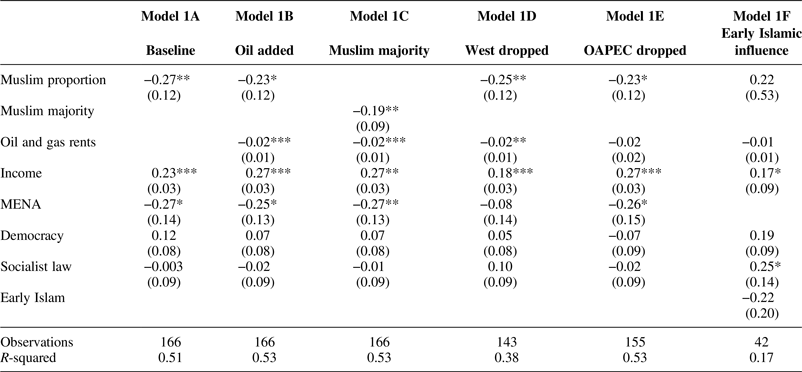
Table 1 presents the results for women's economic rights. As shown, the Muslim proportion of a country's population is statistically significantly associated with gender inequality. The inclusion of oil rents in Model 1B slightly diminishes the association, but both indicators of Islamic culture, “Muslim proportion” and “Muslim majority” (Model 1C), are statistically significant. Holding the rest of the independent variables constant, the indicators account for approximately a 0.2 change on the 0–3 scale, equaling some 7% of the variation in women's economic rights. As shown in Model 1D, this effect practically does not change when all Western countries are removed from the sample. That is, when we only look at developing and newly industrialized countries, having a large Muslim population is still negatively associated with gender issues such as equality in pay, promotion, and job security.
Islamic culture, oil, and women's economic rights

Note: Unstandardized OLS coefficients with robust standard errors in parentheses. Time-variant variables are averaged over the 1999–2008 period. Constant terms included (not shown).
***p < 0.01, **p < 0.05, *p < 0.10 (all two-sided tests).
In support of Ross’ argument, oil wealth also seems to decrease women's economic empowerment. Each thousand dollar increase in oil and gas income per capita is associated with a 0.02 drop in women's economic rights (Model 1B). However, when the OAPEC countries are dropped in Model 1E, the negative correlation is no longer statistically significant. This indicates that the purported association between oil and women's rights is driven by a limited number of influential observations. On the other hand, the effect of “Muslim proportion” remains unchanged. Hence, whereas there is no statistically significant effect of oil rents when the OAPEC countries are dropped, the effect of having a large Muslim population is the same in samples with and without the 11 oil rich Arab countries.
Model 1F compares the 42 Muslim majority countries in the sample according to the period during which they came under Islamic influence (cf. Figure 1). As shown, whether a country joined the Muslim world early (–900 CE) or late cannot explain its current women's rights record. There is also no effect if we instead compare Muslim majority countries in the MENA region with those outside the region (not reported to save space), and, in general, the effect of Islamic culture seems to be quite stable across countries. Another test does indicate that Arab countries are worse off than non-Arab Muslim majority countries concerning women's economic rights. But the same is not the case concerning women's social and political rights. There thus does not appear to be a generally valid “Arab gap” regarding gender equality when other relevant factors are taken into account (cf. Stepan and Robertson Reference Stepan and Robertson2003; see also Fish Reference Fish2002).
Looking at the control variables in Table 1, it comes as no surprise that the level of income affects women's economic rights. Modernization makes room for women in the labor market, and these women subsequently contribute to economic growth. The regional control for MENA is associated with economic discrimination against women but only in the models that include the Western countries, which again indicates that Muslim women's lack of empowerment is not a particular Middle Eastern issue. Neither democracy nor socialist law seems to matter much concerning women's economic rights.
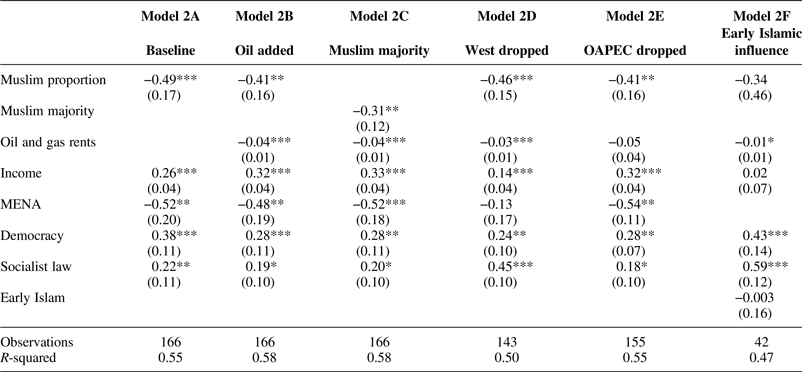
Islamic culture plays an even bigger role when we turn to women's social rights in Table 2. When oil rents are accounted for (Model 2B), the Muslim proportion of a country's population explains some 14% of the variation in women's social rights. “Muslim proportion” is also statistically significant when the Western countries are dropped in Model 2D and when the OAPEC countries are dropped in Model 2E. And again, oil rents are insignificant in the sample without the oil-rich Arab countries. Unlike in Table 1, democracy and socialist law now seem to positively affect women's rights. This indicates that gender equality on issues such as marriage, inheritance, and the freedom to travel is strengthened by democratic institutions and socialist heritage. Democracy and socialist law is also what primarily explain the variation in women's social rights between Muslim majority countries, and it cannot be explained by early Islamic influence (Model 2F) or by whether a country is Arab or is situated in the MENA region (not reported).
Islamic culture, oil, and women's social rights

Note: Unstandardized OLS coefficients with robust standard errors in parentheses. Time-variant variables are averaged over the 1999–2008 period. Constant terms included (not shown).
***p < 0.01, **p < 0.05, *p < 0.10 (all two-sided tests).
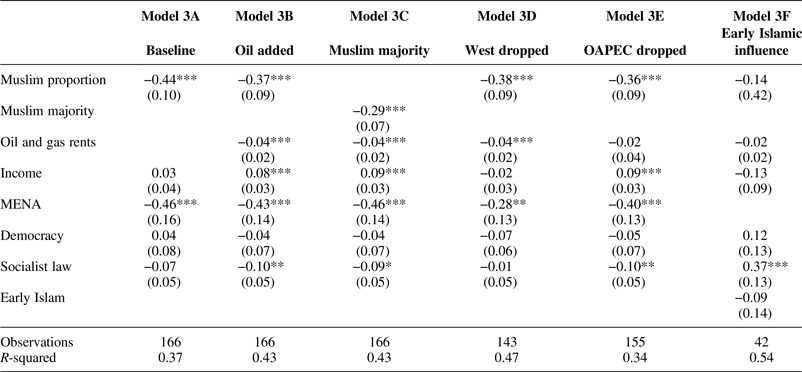
The general picture does not change much when we look at women's political rights in Table 3. Whereas Islamic culture is consistently statistically significant, oil rents turn insignificant when the OAPEC countries are dropped (Model 3E), and early Islamic influence cannot explain the variation between Muslim majority countries (Model 3F). The association with income is less consistent concerning women's political rights, and socialist law has a negative influence in some of the models, which indicates that countries with a socialist heritage are worse off concerning gender equality in voting and running for office.
Islamic culture, oil, and women's political rights

Note: Unstandardized OLS coefficients with robust standard errors in parentheses. Time-variant variables are averaged over the 1999–2008 period. Constant terms included (not shown).
***p < 0.01, **p < 0.05, *p < 0.10 (all two-sided tests).
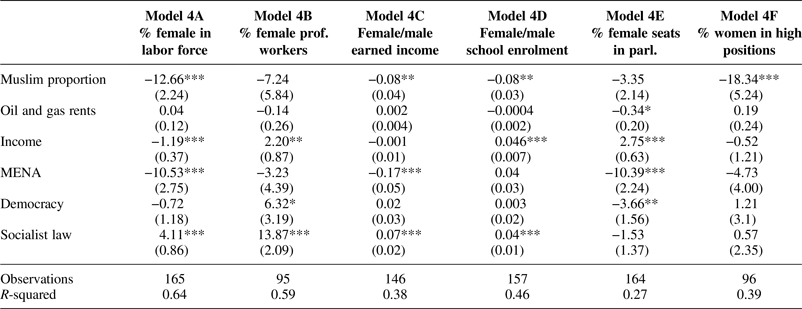
Finally, Table 4 presents the results for the models using alterative measures of women's participation in economic, social, and political aspects of life. In support of Ross’ (Reference Ross2008) findings, the proportion of women in parliament is statistically significantly associated with oil and gas rents, and the Muslim proportion of a country's population is not (Model 4E). However, as discussed above, seats in parliament do not necessarily equal political power, and the notion that women often are more likely to get their fair share of seats in powerless parliaments may also explain why democracy has a negative effect in the model (see Paxton Reference Paxton1997).
Alternative measures of women's participation

Note: Unstandardized OLS coefficients with robust standard errors in parentheses. Time-variant variables are averaged over the 1999–2008 period. Constant terms included (not shown).
***p < 0.01, **p < 0.05, *p < 0.10 (all two-sided tests).
Perhaps more surprisingly, oil rents are not significantly associated with women's participation in the remaining five models. The Muslim proportion of a population, on the other hand, has a statistically significant and negative effect on the proportion of women in the labor force (Model 4A), income equality between men and women (4C), the proportion of girls enrolled in primary and secondary school (4D), and the proportion of women in high positions such as legislators, senior officials, and managers (4F). There is, however, no statistically significant effect when it comes to the female proportion of professional and technical workers (Model 4B). Although the general picture is less straightforward concerning these alternative measures, as should be expected regarding measures of participation rather than de facto rights, it is quite indicative that “Muslim proportion” is statistically significant in four out of six models and oil rents only in one out of six.
All in all, and in contrast to previous findings (Ross Reference Ross2008; Reference Ross2012), the results strongly indicate that Muslim countries lag significantly behind in terms of women's economic, social, and political rights. This is the case even when oil wealth is accounted for, and the relationship seems to be fairly constant across the Muslim world.
CONCLUSION
Moving into the 21st century, Muslim women experience more gender inequality than women in the rest of the world. This does not mean that their rights have not improved in recent years (Moghadam Reference Moghadam2003; World Economic Forum 2014) or that Islam as a religion is particularly repressive (Keddie Reference Keddie1990; Mayer Reference Mayer1999). It rather means that some contextual factors impede Muslim women's empowerment with the consequence that social change has moved faster elsewhere. One possible explanation for this inertia is oil and gas wealth, which has been argued to keep women in developing countries in the household in the absence of low-wage, export-oriented jobs (Ross Reference Ross2008).
The argument of this study is that oil cannot be the principal explanation for Muslim women's poor human rights record. Some of the Muslim countries that are most notorious for repressing women, such as Afghanistan and Pakistan, are poor on natural resources, and this suggests that we need to look for a deeper explanation than the relatively recent extraction of oil. The consolidation of Islam in everyday Muslim life coincided with a theological struggle in the ninth century, which embedded religious orthodoxy and resistance to social change in the Muslim world (see Ali Reference Ali2007; Reilly Reference Reilly2010; Ruthven Reference Ruthven1984). As argued here, this critical juncture strengthened the view of women as inferior and bound to the household and meant that the positive influence of modernization experienced by women elsewhere generally has been stalled in the Muslim world.
Based on this proposition, the study assesses women's economic, social, and political rights in 166 countries for the period 1999–2008. The analysis does find evidence of a negative relationship between oil rents and women's rights, but this seems to be driven by a small number of particularly oil-rich and repressive countries, that is, the 11 OAPEC members. However, even when factors such as oil, income, and democracy are accounted for, Muslim countries still fall markedly short of the rights levels obtained by women in other countries. This is also true if we only look at countries outside the “West,” and the effect of Islamic culture is quite constant across the Muslim world.
The study contributes to recent advancements in understanding why contemporary challenges in Muslim societies exist, both in the Middle East and elsewhere. Obviously, more in-depth and country-specific studies are needed, and the rather modest claim of this study is that we cannot understand Muslim women's status, their progress and limitations, without acknowledging the historical path of the Muslim world. Islamic culture has convincingly been argued to confine scientific and economic development in the Muslim world (Hoodbhoy Reference Hoodbhoy1991; Kuran Reference Kuran2011), and, for now, the same seems to be the case concerning women's rights.
APPENDIX A: THE LARGEST OIL ECONOMIES IN THE SAMPLE AND THE OAPEC MEMBERS

APPENDIX B: SUMMARY STATISTICS